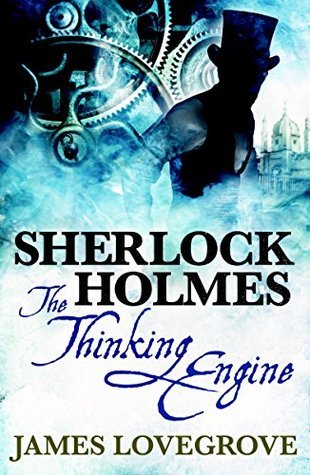
Man vs Machineit is 1895, and Sherlock Holmes is settling back into life as a consulting detective at 221B Baker Street, when he and Watson learn of strange goings-on amidst the dreaming spires of Oxford.A Professor Quantock has built a wondrous computational device, which he claims is capable of analytical thought to rival the cleverest men alive. Naturally Sherlock Holmes cannot ignore this challenge. He and Watson travel to Oxford, where a battle of wits ensues between the great detective and his mechanical counterpart as they compete to see which of them can be first to solve a series of crimes, from a bloody murder to a missing athlete. But as man and machine vie for supremacy, it becomes clear that the Thinking Engine has its own agenda...
James Lovegrove is the author of several acclaimed novels and books for children.
James was born on Christmas Eve 1965 and, having dabbled in writing at school, first took to it seriously while at university. A short story of his won a college competition. The prize was £15, and it had cost £18 to get the story professionally typed. This taught him a hard but necessary lesson in the harsh economic realities of a literary career.
Straight after graduating from Oxford with a degree in English Literature, James set himself the goal of getting a novel written and sold within two years. In the event, it took two months. The Hope was completed in six weeks and accepted by Macmillan a fortnight later. The seed for the idea for the novel — a world in microcosm on an ocean liner — was planted during a cross-Channel ferry journey.
James blew his modest advance for The Hope on a round-the-world trip which took him to, among other places, Thailand. His experiences there, particularly what he witnessed of the sex industry in Bangkok, provided much of the inspiration for The Foreigners.
Escardy Gap was co-written with Pete Crowther over a period of a year and a half, the two authors playing a game of creative tag, each completing a section in turn and leaving the other to carry the story on. The result has proved a cult favourite, and was voted by readers of SFX one of the top fifty SF/Fantasy novels of all time.
Days, a satire on consumerism, was shortlisted for the 1998 Arthur C. Clarke Award (losing to Mary Doria Russell’s The Sparrow). The book’s genesis most probably lies in the many visits James used to make as a child to the Oxford Street department store owned by his grandfather. It was written over a period of nine months while James was living in the north-west suburbs of Chicago.
Subsequent works have all been published to great acclaim. These include Untied Kingdom, Worldstorm, Provender Gleed, The Age Of Ra and the back-to-back double-novella Gig. James has also written for children. Wings, a short novel for reluctant readers, was short-listed for several awards, while his fantasy series for teens, The Clouded World, written under the pseudonym Jay Amory, has been translated into 7 other languages so far. A five-book series for reluctant readers, The 5 Lords Of Pain, is appearing at two-monthly intervals throughout 2010.
He also reviews fiction for the Financial Times, specialising in the Young Adult, children’s, science fiction, fantasy, horror and graphic novel genres.
Currently James resides in Eastbourne on the Sussex Coast, having moved there in August 2007 with his wife Lou, sons Monty and Theo, and cat Ozzy. He has a terrific view of the sea from his study window, which he doesn’t sit staring out at all day when he should be working. Honest.
One of the better Sherlock Holmes pastiches I’ve read. The man vs. machine theme lends an air of steampunk, though otherwise it is a classic and dark Victorian mystery. Holmes is pitted against a device that can answer any question and apparently solve any crime, leading many to believe that Holmes has at last met his match.
The suspense of wondering what Holmes is up to, the captivating pace, the shocking twist at the end, all made for a thrilling page-turner.
The adventures of Sherlock Holmes in the dark academia!! 😜 I feel delighted to finally read a murder mystery set in Oxford that is fun and not dumb. This author keeps surprising me most pleasantly: he gives a lot of clues and foreshadowing, but in a very entertaining way, when the reader can start uncovering the story, but is not given enough to guess the ending before the grand reveal when all puzzles fall into place. The author also keeps getting me to wonder “wait, but why haven’t they done X and asked Y?” and a few pages later the characters do exactly that, filling in most, if not all, plot holes and inconsistencies, and this feels so gratifying! Although Lovegrove clearly has a thing for automation and sci fi stuff, in this one these elements were used fittingly. And I am still very grateful for a more interesting, deeper developed Watson who has an actual life and opinions, and even his own sense of humor. And Holmes is still hilarious and brilliant, yet fallible in his own ways. The audiobook narrator is also doing wonders with his voice play, especially in this one; he makes these books even more immersive and humorous.
It is spring in 1895 and Sherlock Holmes is adjusting to life once more at 221B Baker Street. When news from the towering spires of Oxford University reach his ears however, the game once more is afoot.
Professor Quantock has created an incredible machine that he claims can rival the most astute minds – including Sherlock Holmes. When the newspapers place a wager between man and machine, Holmes cannot resist a challenge. He and Watson travel to Oxford’s hallowed halls to take on the clever thinking engine where the two compete to be the first to solve a series of crimes. At first the crimes seem unconnected but as Holmes and Watson dig deeper they begin to uncover more clues that point to the Thinking Machine perhaps having its own agenda.
As much as I love the influx of new Sherlock Holmes stories, unfortunately The Thinking Engine is not one of the best. Lovegrove’s previous Holmes novel The Gods of War was excellent and I was hoping this second book would be as good as the previous, but alas it is not.
That is not to say this wasn’t a good book; far from it in fact. While the mysteries were well thought out and executed and the story itself was overall quite good, it just did not feel like a Sherlock Holmes novel. At some points the characterizations were so off; especially that of Holmes. At times it felt like Holmes was almost a caricature of himself.
As for the thrilling climax, I found it almost laughable. It was not the kind of ending I was looking for and it felt quite trite. The ending felt rushed and wasn’t very satisfying. Yes, the good guys won and the bad guys got their comeuppance; it just didn’t feel right though. It could have been handled so much better.
As much as I enjoy reading and rereading Sherlock Holmes short stories and novels, The Thinking Engine is one I will likely not read again. The characters whom I normally find so fascinating were not at all engaging and the end left me feeling let down.
Only the most die-hard Holmes fans should consider this one even if it’s to complete their collection. Casual Holmes fans can give this one a pass.
Opět jsem se pustila do vod jiných autorů píšících o Holmesovi a Watsonovi. Jsem moc ráda, že v tomhle ohledu autoři dodržují jistá pravidla a drží se určité šablony. O to lépe se mi pak čtou takto rozdílné příběhy. Tentokrát se však vyskytne hned několik případů, které mají společný činitel. A jak se brzy ukáže, dost nečekaný.
Samozřejmě jsem už od začátku myslícímu stroji nevěřila. Ale až do posledních stránek jsem netušila, kdo za tím stojí a jak to udělal. Až jsem se blížila, bylo to očividnější a do očí bijící. Nemůžu říct, že by mě to zklamalo, závěr byl vymyšlený dobře, i když takového padoucha snad nebylo třeba.
Během čtení autor odkazuje na spoustu skutečných osobností, například mě překvapila fakta o Lewisi Carrollovi. Vzhledem k tomu, jakou knihu napsal, jsem nečekala jeho povolání, ani že nejde o pravé jméno. Vždycky jsem myslela, že to byl podivín, který snad ujížděl na drogách, když něco takového sepsal. Ale vyskytl se tu třeba i Houdini, a spousta dalších. Takové spojitosti mě vždycky potěší.
K obsahu knihy nemám žádné velké kritiky. Mě se to prostě líbilo a užila jsem si to po svém. Občas bylo čtení zdlouhavé, přece jen těch případů bylo více, takže dojít na konec chvíli trvalo. Co bylo horší, tak překlad. Občas pokulhával, sem tam se objevily trošku krkolomnější věty. U Quantocka se zapomínalo koktat, u závěrečného záporáka zase mluva jednou byla komplikovaná, jindy najednou mluvčí fungoval normálně...
V celkovém ohlédnutí jsem spokojená. Watson byl výborný vypravěč, často zmiňoval i skutečné příběhy sepsané Doylem, Holmes byl tajnůstkář a intrikán, mátl soupeře i mě jako čtenáře. Za mě prostě spokojenost.
3.75 stars rounded up. I enjoyed this one a lot, but the ending felt a teeny bit far-fetched so not quite 4 stars. Lovegrove's other Holmes imaginings that I have read have also been a hit with me and The Thinking Engine, where Holmes' antagonist is a thinking machine, an AI prototype, was very enjoyable.
I enjoyed The Thinking Engine quite a bit. Many red herrings, both subtle and gross, are scattered throughout this Sherlock Holmes adventure. You may think you have author James Lovegrove's game figured out-all I will say is that I promise you're wrong. No spoilers! Remember: time spent with Mr. Holmes is never wasted. Now go buy this book.
Really loved how faithful this was to what I feel I know about Sherlock Holmes in the Conan Doyle stories. This one had great intrigue and a few mysteries that at first I didn't see how they were tied together.The steampunk type theme and the wrapping up with a not so nice little bow was a satisfying ending. Well worth the time if you enjoy Sherlock Holmes stories, which I do.
James Lovegrove has rapidly (we're talking since this summer) become one of my favorite Holmesian pastiche writers. This is my third Lovegrove-penned Sherlock Holmes story, and it really lined up to check all of my boxes: a "road trip" case (I always enjoy when Holmes's adventures take him out of his home turf), super-high stakes, epic stumbling blocks ("Watson's" intro promises a case where not only is Holmes himself pushed to the breaking point, but his friendship with Watson is strained and tested, too, and the story makes good on those promises), a touch of science fiction (I loved the idea of Holmes having to face something so many of us do: the fear that technology was about to make his skill set obsolete) … and a book jacket that promises, if you know your Guy Ritchie Sherlock Holmes at all, the reappearance of several notable foes.
Lovegrove, like any other pastiche writer, places touches of his own interpretations of the characters into his writing. His Holmes here was a little more arrogant than I tend to prefer, but it didn't slide too far in the wrong direction, and had enough politeness and polish in Holmes to counterbalance it, so I could let it go. Besides, I liked what Lovegrove seemed to be setting up with his choice of 1895 as the setting: it's the year after Holmes's return from his three-year Reichenbach hiatus, and despite it being a year in which Holmes is at the top of his game, it's also a year of recovery for the both Holmes and Watson, in different ways. (This doesn't pan out quite as much as I would've liked, but I appreciated the fact that it was touched on -- the first time I've seen a pastiche writer suggest ANY kind of emotional fall-out from the events of Reichenbach for either character. More of this, pastiche-writers, please!)
I even liked But still; everything was on track.
The plot twist at the end was one I found super-neat, and the surprise burst of action at the finale was properly exciting. All was coming along nicely for a four-star review, no question.
And then those bloody last few pages.
I've always been pretty upfront about how important the ending of a story is for me -- a great one can save a story for me, and a bad one can ruin the whole experience. It was a nice change of pace to be able to acknowledge my enjoyment of the book even as I disagreed with the ending -- but between that ending, and a Holmes just a touch more arrogant than in Lovegrove's previous offerings, it does leave me, I think, at three stars.
Well, that’s not quite accurate. But it is Sherlock Holmes pitted against an incredible crime solving machine which its inventor hopes one day will link up to other machines in police stations and newspaper rooms all around the country. So yeah, it’s Sherlock Holmes taking on the internet.
It's a book which manages the interesting trick of feeling both Victorian and incredibly modern at the same time. I don’t have any way of knowing if it might be the case, but it wouldn’t surprise me if it turned out that Lovegrove was a big fan of the Basil Rathbone version of Sherlock. With its derring-do version of the character, a big grand adventure with melodramatic moments, THE THINKING ENGINE has the same kind of feel as those 1940's movies. (Although our Watson here is far more competent than the Nigel Bruce version.) As such it may not be quite in sync with Conan-Doyle, but it’s still a damned entertaining read.
Fancy reading my forthcoming novella, Death at the Seaside, ahead of everyone else? Advance review copies are available. Just follow this link
If you are a fan of Sherlock Holmes and John Watson, I have a book for you to add to your reading list. The Thinking Engine by James Lovegrove is a compelling, well-written read from start to finish, and Lovegrove has joined my list of writers to watch for new installments in the Sherlock Holmes mysteries currently being published by Titan Books (the other writer on that list is Mark A. Latham). Like Latham, Lovegrove has a strong understanding of Holmes and Watson as characters as well as the original Holmes canon by A. Conan Doyle. Lovegrove masterfully delivers an intricate mystery complete with enough foreshadowing to help readers unravel parts of the puzzle but not enough clues to let them guess the whole puzzle before Sherlock makes his grand reveal. Lovegrove situates the story within a larger thematic context that makes the events of The Thinking Engine relevant to modern 21st century readers, all while offering a fascinating portrait of Holmes, Watson, and their friendship that has an incredible depth of insight. For those readers with a book budget, here’s what you need to know: the book is not available through the Kindle Unlimited library and it also wasn’t available through my local library, either in print or ebook format. If you want to read The Thinking Engine, you’ll have to buy it. This is one of my recommended reads (so far the list this year is short!) and in my opinion, it’s absolutely worth your book dollars, especially if you’re a fan of Sherlock and Watson.
First, a short summary that will hopefully give you a better idea of the story you can expect to read (for me, the back cover copy on this book is less than helpful in that regard). The opening chapter of the novel (you could in fact call it a prelude to the rest of the story and not be off the mark) finds Sherlock and Watson visiting the British Museum after hours, where an exhibit of artifacts from Egypt—including the sarcophagus and mummy of a pharaoh—is on exhibit. The duo has been asked to debunk stories that the pharaoh is not truly dead, and that his living mummy walks the halls of the museum during the night. Holmes successfully solves the case, and in the next chapter, the primary mystery that will occupy the great sleuth is introduced. While reading the newspaper, Holmes comes across a story announcing a demonstration of a thinking engine—designed by an Oxford don and reportedly capable of solving crimes using the same level of intellect of the greatest geniuses to have lived. The story goes on to say that the thinking engine will prove its abilities by solving the case of three gruesome murders that recently occurred in Oxford. In addition, Lord Knaresfield wagers five hundred pounds that the thinking engine will equally match wits with Sherlock and correctly identify the murderer. Feeling insulted and unable to walk away from such a challenge, Holmes and Watson make their way to Oxford. What follows is an intricate battle of wits between Sherlock and the thinking engine that sees more murders take place in the university town before the true mastermind behind the crimes is revealed.
You can, of course, read The Thinking Engine on a surface level. But why would you want to, when the thematic level of the novel is so rich and thought-provoking? Lovegrove invites readers to consider the implications of the rapid proliferation and accessibility of computers and what appears to be the next step in technological evolution—artificial intelligence—all while couching the central thematic questions within the historical context of Victorian London. Not only does the success of the thinking engine in battling wits with Sherlock Holmes lead to the characters wondering if the engine will make Sherlock obsolete, but it also pushes readers to question how the existence and rush toward technological evolution is changing what it means to be human. Lovegrove puts in opposition the zeal of the academic (and in this particular case, the interest of governments and law enforcement in being able to acquire and save large amounts of data and access it quickly), the skepticism of a rationalist, and the spiritualism of a man of faith, with each man viewing the problem and existence of the thinking engine from different perspectives. Professor Quantock sees the possibilities of such a technology and strives to turn those possibilities into realities; Sherlock questions the superiority of the technology and whether it is truly capable of supplanting human reason and logic; Inspector Tomlinson questions whether such technology should exist and how it might change our understanding of the human soul. Then Lovegrove takes these questions a step further by giving us an antagonist whose motivation is to create truth and thereby see all and rule all. It’s been a while since the summer I taught a literature class focused on 20th century detective fiction, but if I were ever to teach another, this book would make the reading list. There is so much to explore and think about in The Thinking Engine, and if you’re a reader who likes smart books, you will enjoy this one immensely.
If, however, you have no interest in the novel’s thematic context, then the other compelling aspect of the story is the way it delves into the friendship between Sherlock and Watson and perhaps most importantly, Watson’s own observations of Sherlock and portrayal of him. For those of you who have read other reviews of Holmes and Watson stories on my blog, you’ll know it is my opinion that observant readers understand that it is John Watson (not Sherlock) who is the main character of the story and that it’s through his portrayal of Sherlock that we come to truly know Watson. In the Foreword, Watson tells us he’s writing this story in the year 1927, more than thirty years after the events took place. We, of course, know one of the reasons he’s just now writing and publishing the story—before now, he has not wanted to portray Holmes in a negative light. He has waited so long to tell this story because the distance of time allows him to tell the story honestly (which should make readers question if he’s been a dishonest or unreliable narrator in other stories). Watson writes in the Foreword that during this particular case “Holmes was driven to his breaking point and very nearly broken” and that the same is true of their friendship, “which was tested to its limits”. With this in mind, Watson’s observations of Holmes—his actions and behaviors—throughout the novel, as well as his own responses, are pivotal to understanding what he’s trying to convey in the Foreword. There’s a moment in the story when Watson questions what it would mean if the thinking engine is able to demonstrate an intellect that is equal to, or perhaps greater than, the greatest of intellects humans have ever known (i.e., the intellect of Sherlock Holmes). This isn’t merely a philosophical question, but it’s also a meditation on what it would mean for Watson if a machine’s intellect is greater than Sherlock’s. Would the years he has spent depicting their adventures and revering Sherlock’s reason and skills of deduction be for nothing? While Watson spends a lot of time in the novel giving readers insight into what he sees as Sherlock unravelling, we must also consider how Watson reacts to his friend unravelling and why this case put such stress on their friendship. For Watson to lose his faith in Sherlock would be disastrous for him. He needs the belief and faith he has had in Sherlock for so many years to be maintained—vindicated even. And so while he writes about Holmes’ crisis of self-confidence and emotional torpor, he is in a very real way writing about the same in himself. Lovegrove’s deft handling of Watson in this novel is commendable, and it makes what on the surface seems to be too much navel-gazing and not enough action an elegant, extended contemplation of how our own identities can be shaped and dependent upon those closest to us.
The Thinking Engine easily earns a place on my list of recommended reads. Writing this review has made me realize just how much I loved this book and how it engaged my mind on several different levels. Also, I can’t help drawing a parallel between this novel and the BBC series Sherlock. If you’ve completed series four of the show, you’ll have watched the episode titled “The Lying Detective”. The Thinking Engine reminds me a lot of that episode, but because I don’t want to spoil either one I’ll say nothing else about it other than I loved that episode as much as I loved this book.
Looking for more book reviews? Visit my book blog at endnotesbookblog.com
A quick, fun read by Lovegrove, largely catching the tone and mood of the original Conan Doyle stories - and bringing a slightly more speculative fiction element sometimes found in ACDs non-Holmes stories, which just brushes the edge of steampunk. Oddly, one failing of the tone is that I found it difficult to differentiate between the voices of Holmes and Watson. Perhaps Lovegrove couldn't hep thinking of them as a single entity.
There are a number of these latter-day Holmes adventures, and i own several of them by both Lovegrove and George Mann (an author deeply conversant with steampunk and Victoriana), and am looking forward to reading more.
I love Sherlock Holmes, and so I am desperate enough to read any author's attempt to recreate Sir Arthur Conan Doyle's master detective. I would say that this book is above average for this segment of the market. He creates much of the feel of a Sherlock Holmes story, and the style of writing was very similar to the author's. However, the plot and its development were both too predictable, and at times too obvious to be a true Sherlock Holmes story. Good effort though, and thoroughly interesting.
I'm not convinced by Lovegrove's Holmes. There. I've said it. Having said that, it's a fun character/ world to play with, and this is not badly written at all. I did think the Police character (Tomlinson) was an interesting alternative to the Lestrade-type, and the first murder worked well. However. There were a number of smaller incidents, part of a larger arc, and whilst each of them on their own was good, and the arc wasn't a terrible one, somewhere it didn't quite work for me.
Except for the very end, I did thoroughly enjoy this book, and excepting that, I would consider reading another in the series.
I realize that The Thinking Engine had a much greater scope than machinery, not to mention computers, had in that era. It's especially so as that the larger in freedom, the less confined that a computer is allowed to compute, the more unlike human thought and the more ridiculous they become. That's akin to the current craze of having artificial intelligence write this or that ad or story or like Inspirobot writing inspiration. It goes so far off the mark that it's funny. One of the kids showed us an artificial intelligence's created romantic comedy just this week, and of course, it's nothing like romantic comedy. If that's the state of artificial intelligence now, then it was much worse then.
It made me think of Zork and early world-building games that supposedly allowed one to enter whatever directions one wanted into that fictional world. But there was so much that Zork didn't know how to handle. Of course, there have been chess computers that can wade through an impressive array of move choices by rating and ranking them as to their value in achieving the goal, and thinking more moves deep than a human can. But their worth is not in their ability to reason, but in their ability to process and calculate, and that's in them being given a very narrowly-defined set of parameters.
So, originally, I wondered if this book would be one in which we had to suspend belief to accept an unreasonable amount of artificial intelligence in the world of Sherlock Holmes, and I would be disappointed in that ... but because I was already thinking along those lines, I was able to figure out The Thinking Engine much faster than Holmes, and it seemed to take him a long while to accomplish it. Of course, Holmes wouldn't have as much familiarity with artificial intelligence as we have. So you've got a chance at solving it.
I have, also, heard of the Turk before, in the realm of chess. I'm not entirely sure where. My dad facilitated several regional chess tournaments and also dappled in artificial intelligence in chess computers, having one play another in his research for a book on a particular chess opening. So I could well have heard it from him. But somehow I also associate it with the automaton of the cartoon movie Hugo, although I can't remember if Hugo explored the idea in full or not. Hugo, I thought, had a great deal more substance to it than most cartoons.
"The Thinking Engine" story was well done and I would consider another in the series.
"So that's how you can find it in yourself to be so forgiving towards Holmes - your faith inclines you towards charity." "It goes hard sometimes, but yes." "I wish I could follow your example."
I liked everything about that exchange: someone trying to live out their faith, and the other person not meeting that with resentful animosity, suspecting him of trying to show up others, but realizing it for what it is - an individual trying to live well.
It makes me think of those who resent the people going to the gym, thinking they do it to show others up, when really they aren't doing it "at" the others at all, but merely because they want to do well taking care of their own bodies. I liked this humble response much better: "I wish I could follow your example." And surely there are different places where each of us (or most of us) have an example worth following. Even if we cannot humanly do it all, there are things to admire in others without feeling put down by their endeavors.
This book had the same issue as Benedict Cumberbatch's TV series modern version of "Sherlock," when I quit watching it with ("His Last Vow" 3rd episode, 3rd season) which, I suppose, makes me a more of a "purest" of wanting to stick closer to Sir Arthur Conan Doyle's intentions. It seemed less a part of the plot in this book than in that episode, however. Perhaps that made it more cold-blooded and more matter-of-fact and I wouldn't continue with the book series, either, if that became more of an issue. Sir Arthur Conan Doyle's Holmes was more moral than that.
Favorite quotes: "It has always been true that those who routinely and energetically do good are considered suspect, their motivations questioned. Such is human nature, to regard altruistic behaviour as though it were a disease or a mental disorder. It is also true that possession of an acute intellect is an attribute many find intimidating... The average person does not care to be reminded of his averageness and hence looks askance on the above-average person and views with deep mistrust and even hostility the exceptionally above-average."
"I am not wholly averse to publicity but neither am I wholly comfortable with it, certainly not to the extent that you are. I have a high enough profile as it is without my face appearing in the papers." This made me think of today's social media.
"He seemed the type to hold a grudge, and to enjoy doing so." There are some people who enjoy holding grudges. I think they feel validated by someone's offense, as if that made them more worthy somehow - either because they were important enough for someone to attack or because they were worthy because of all the injustice they've bourn, a sort of martyr's complex.
"My loyalty to Holmes, however, prevented me going. We had been bosom companions for fifteen years ... There would come a moment, I was sure, when sense would return to him and he would reach out to me. He would find me waiting patiently, good Watson, faithful Watson, steadfast as a Shire horse." There is a balance between being loyal and being a doormat, and Watson does give up quite a lot in his friendship with Holmes. Still, all in all, he does so because he enjoys the friendship and is able to do so without resentment, most of the time, so I think he's still on the loyalty side of that loyalty/doormat coin. And I hope that I would be as "steadfast as a Shire horse" also.
A huge twist at the end with an old enemy of Holmes showing up. As a lead up to that encounter Holmes seems to be the worse when trying to out sleuth the Thinking Machine. But he soon rises to the occassion and there is an epic battle at the end.
Holmes and Watson were so out of character as to be unbelievable. So was every other Canon character who appears. The author couldn't even be bothered to replicate their speech patterns correctly.
The good: Lovegrove can write - good plotting and use of language, even some clever themes and historical context peppered in alongside the requisite canon references. I like the genres he mixes. Cases/mysteries are fair. He can also write in an approximate facsimile of Doyle's style. The voice of Watson rings true in many ways.
The bad: his Holmes is a real ass to Watson. It makes one wonder why he hangs around. I'm not talking the typical Holmes shenanigans like faking death or illness or even being a bit terse or impatient with Watson's slowness to catch on, but constantly belittling and denigrating his friend. There a little of the famed friendship on offer here unless it is on Watson's side. Lest you think this refers to a ruse of Holmes in this particular book, it is a problem I have with most of Lovegrove's Holmes work, which is a real shame because otherwise it's very serviceable. Canon Holmes isn't this much of a jerk, in fact, he can be quite thoughtful and kind, and cares for Watson outside of insults directed at him. It seems there is a bit of adaptation creep in pastiche these days, and jerk geniuses are in vogue. But if I wanted that, those characters are a dime a dozen. Where's Holmes?
Also just so people know there's a lot of embarrassment and humiliation involved in this one if that's not something you like experiencing secondhand.
One of the better Holmes pastiches I have read as generally I find them hit or miss. This started well with a ‘pre credits scene’ where SH & DW meet a young Houdini , all of which felt very late Victorian setting. Then the story moves to Oxford and a series of crimes happening in the university town. The characters introduced I found all interesting to meet and the various investigations all felt very Holmsian. Then the story takes a slight steampunk direction by introducing the thinking engine of the title, a continuation of the machine created by Babbage & Lovelace when starting the computer revolution. It all worked really well I found, an interesting set of mini investigations, an overarching story that centred on the thinking engine and for me at least, a very good ending. Overall a very solid read and a definite recommendation if you’re looking for a Holmes pastiche, not sure if the author’s other SH novels match up to this but will give them a read if I come across any of them in the library.
. . . . . . . Only final thought - in the final problem canon shirt story I remember that a certain professor does not have a Christian name but his colonel brother does which is James - do the brothers share that name and when was that introduced?
This entire review has been hidden because of spoilers.
Published ten years ago, this story about a machine that can supposedly think for itself, develop theories and offer solutions, it is almost uncomfortably fitting for the current world of AI.
I enjoyed the mini mysteries within this book a lot more than the over arching one. The mystery of the Thinking Engine itself isn't really much of one, because there is only one answer. I did like the way it was set up however and the little twist at the end, even if it was a somewhat over used twist. The smaller crimes however is where this book shines. It allows Holmes to really flex his mental muscles and show off why he is the greatest detective.
As always he treats Watson somewhat shamefully at times, and showing remorse after the fact does not make up for the fact that he doesn't trust him.
Overall however, this was an entertaining entry into the non-Doyle Sherlock stories. I found it engaging, easy to read and I will be looking out for the others books by this author.
Ich hatte meine Probleme mit diesem Buch. Zum einen war für mich relativ schnell ersichtlich, dass der Colonel seine Finger mit im Spiel hat, denn mal ganz ehrlich, so offentsichtlich wie er am Anfang der Geschichte erwähnt wurde, konnt es ja nur so kommen. Zum anderen... Moriarty... schon wieder... ich weiß nicht wie viele Geschichten ich jetzt schon gelesen habe, in denen er plötzlich wieder auftaucht! Irgendwie erscheint es mir, dass die Autoren zu faul sind sich selbst einen eigenen Megabösewicht auszudenken! Nicht desto trotz war dieser Moriarty wenigstens von seinem Sturz angeschlagen, deswegen gibt es nicht ganz so viel abzug und die Geschichte mit dem Computer-Ähnlichen Gebilde war nun auch nicht so daneben. Schade bleibt es trotzdem. Ich hätte mich tatsächlich mehr über Colonel Moriarty gefreut als über den Professor selbst!
Well, the ending was rather satisfying, but parts were a bit of a slog.
Starts well, too. Holmes and Watson are in a museum and a mummy starts walking towards them. Holmes immediately understands it's a fake, and inside is ... none other than Harry Houdini.
A couple of murders, we know are linked but not sure how, except they are solved by The Thinking Machine, which is like an enormous 19th century computer.
Holmes purposely gets addicted to laudanum to bait the killer, and to make Watson believe he's self-destructed (like he made Watson suffer when he "died" on the Reichenbach Falls), because Watson does not have a poker face.
And speaking of the R. Falls ... the Thinking Machine is just a box with a human inside. A human we thought was dead! Reminded me a bit of Doctor Loveless in Wild Wild West.
Entertaining enough, and stellar narration again.
This entire review has been hidden because of spoilers.
Professor Quantock has built a computational device that he claims will be equal to Sherlock Holmes himself. With Watson by his side, Holmes journeys to Oxford to take on the machine. However, things are not all they seem and this case may destroy the consulting detective.
This was a well-written pastiche. Pulling influence from the original stories, it does an admirable time of mimicking Doyle's writing style. Holmes sounds like Holmes and Watson sounds like Watson, which I always find to be important in stories like this.
The pace is good and kept me interested from start to finish. I guessed the twist at the end, but it was still interesting.
I would recommend this to readers of Sherlock Holmes who enjoy a slight steampunk edge.
Sherlock is trying to find out what this Thinking Engine is all about.
As he goes about solving the mystery,he is working on the engine seems to be a step ahead of him and Dr. Watson.
People get killed and Sherlock has to figure out who is the murderer. He gets to the point of being severe disappointment. Sherlock is at the point of nearly giving up. Watson has to come to get him out of the mindset. He lets Sherlock know about a new clue that brings Sherlock out of his disperse. With this new information, Sherlock has figured out who the masterminds are.
This is a different series by different authors on Sherlock and Watson.
The book with the hidden subtitle "Sherlock Holmes and the robot" has a very good idea behind. Each chapter is written in thrilling style, especially the more you are coming to the last pages of it. Unfortunately, the real end was disappointing for myself - the author wanted to reconnect the previous books and bring in something (or somebody) already known to readers. Personally I felt a bit more disappointed; if you are reading very carefully from certain page you start to have the suspicious and finally you realize that your very first though who is the bad guy here - is correct. I spent some nice moments with the book, but would not go through all 350 pages again.
Ever since Sherlock Holmes came out of copyright (about 1980, if memory serves?) there have been several novels & short stories continuing the canon: some good, some- less so. James Lovegrove is definitely one of the better authors- in fact, I cannot think of a Holmes tale he's penned that I don't like.
For me, he has captured both Holmes & Watson very well (a lot of writers do go wrong with Watson, but Lovegrove definitely gets him)- this tale of a rudimentary computer features some familiar faces, & also transfers Holmes from Baker Street to Oxford for the duration.
This is another good-read offering from Titan Books which has taken Holmes, Watson et al to its bosom. Set in Oxford before the turn of the 20th Century, Holmes competes with technology to solve a bunch of seemingly unrelated crimes raging for petty to down-right ghastly. James Lovegrove does a good job adopting Watson's late-Victorian prose, and appropriates several of Conan-Doyle's characters to fill in his plot. Whether this pleases Sherlock tragics is a matter of opinion. I'd have preferred a complete new bunch of villains and helpers, but you can judge for yourselves. It's a wee bit padded-out in places, but a ripping yarn nevertheless. I finished it in a couple of days.
One thing is missing. Holmes never explains what he knew or suspected in the middle of the case, so his uncharacteristic behaviour is still a mystery. We will never know how much of his sulk was real and how much was dissimilation.
I can believe that Holmes would react very badly to the idea of an intelligence greater than his own, but on the other hand, he is usually stimulated by "a foeman worthy of our steel." He always said that Mycroft was smarter than he was, but that a detective must be a man of action as well as logic. This was his big chance to prove exactly that, by finding clues that the Engine could not see. If he couldn't beat the Engine that way, it must be cheating!
Man vs Machine. Professor Quantock has built a wondrous computational device, which he claims is capable of analytical thought to rival the cleverest men alive. He challenges Sherlock Holmes to a competition. Naturally, Holmes cannot ignore this challenge. He and Watson travel to Oxford, where a battle of wits ensues between the great detective and his mechanical counterpart as they compete to see which of them can be first to solve a series of crimes, from a bloody murder to a missing athlete. I wanted to see if he was going to be able to beat the machine or if he was going to take it well if he couldn't. The ending was a bit much but the series of twists made for an interesting listen.