Twelve compressed masterworks from this great American writer of catastrophe fiction, in which lives are upended as much by broken hearts as by collapsing dams, hideously mismanaged wars, gargantuan wildfires, and apocalyptic storms
“Jim Shepard is a fantastic writer—compassionate, funny, and fearless—[whose work] does what great writing always inspires us to look more closely at life, and be more caring.” —George Saunders
"A deft, audacious artist." —Norman Rush, National Book Award-winning author of Mating
In Richard Ford’s view, Jim Shepard’s “talent is so various and canny he can write about seemingly anything and make it thrilling to us,” and in these stories spanning six centuries we find viscerally evoked worlds as wildly diverse as a mercenary’s corner of 16th century Madrid, a young apprentice’s pre-Revolutionary Boston, and Edward Hyde’s London. With civil engineers and destitute veterans we encounter the devastating 1935 Labor Day hurricane in Florida, and we read the 1864 letters between Lucy in Boon, North Carolina (“Three privates are currently sleeping soundly on our porch in their muddy blankets”) and her great love, William, on the march in Tennessee (“I can’t write much for it seems we are looking for a fight every minute”), while the title story introduces us to the stubborn Constance, who had “no gift for flirtation” with men, preferring Minna, her best friend and “queen of bad influences,” as their vexed devotion unfolds in part on the liner Lusitania.
With irony, compassion, and withering humor, these stories evoke the terrible ease with which cataclysm, human-engineered or otherwise, can sweep away all we find most precious, and expose those limitations we’ve refused to address. At the same time, Shepard celebrates what is best in the love and friendships we sustain, and the passions and grace we grant one another.
Jim Shepard is the author of seven novels, including most recently The Book of Aron, which won the Sophie Brody Medal for Achievement in Jewish Literature from the American Library Association and the PEN/New England Award for fiction, and five story collections, including his new collection, The World To Come. Five of his short stories have been chosen for the Best American Short Stories, two for the PEN/O. Henry Prize Stories, and one for a Pushcart Prize. He teaches at Williams College.
Who are we when the circumstances that normally define us suddenly disappears?
That is the provocative question behind Jim Sheperd’s fascinating new collection that showcases mainly ordinary people living ordinary lives until they are forced to face a catastrophe. The catastrophes vary from hurricane and shipwrecks to fires and social upheaval The reader is immersed into the 1935 Labor Day hurricane in the Florida Keys, the 1910 Great Fire of Idaho, the Civil War, even the mind of Mr. Hyde in the Dr. Jekyll and Mr. Hyde saga.
In the title story, Constance, an inhibited Englishwoman, forms an intense friendship with Minna, an intelligent, independent legal secretary. Their relationship develops against the constraints of Edwardian society and ultimately intersects with the 1915 sinking of the Lusitania. Ironically, “bad influence” Minna ultimately enhances Constance’s sense of self.
These disasters confirm to us that life is unstable. Nature turns violent. Wars begin and drag on. Ships sink. People die unexpectedly. And we puny humans have no control over circumstances. (It brings to mind--and I paraphrase -- George Bernard Shaw's line that man makes plans and God in his heaven laughs). But we do control how we respond to these catastrophes and how we treat others. Although the author calls his collection “catastrophe fiction”, it is just as much about our inner strength and the grace we extend to one another.
There are no heroes and villains in life, Shepherd suggest. We can be foolish and selfish and at the same time loving and brave. We can advance and even transform our lives without waiting around to decide we are “brave enough.” We can face the bad decisions, hubris, and selfish wars that we create – the human-made catastrophes’ in our life as well as the ones that are totally behind our control. All are a test of character and we have it within ourselves to show the stuff we are made of.
This is a thought-provoking collection that deserves to be read and considered carefully. Many thanks to Knopf for enabling me to be an early reader in exchange for a review that reflects my honest assessment.
What Jim Shepard achieves in these stories is portraying the human spirit against seemingly insurmountable odds. Whether from outside forces, such as flood, fire, sinking, among others, or from inside forces as those that plague Mr. Hyde, he pits the individual against them and gives a human face to disaster.
A Meal Shared, a Story Withheld, and the Things We Cannot Make Right In "The Queen of Bad Influences," Jim Shepard finds his deepest subject not in history's catastrophes alone, but in the imperfect obligations of those who survive to remember, explain, and sometimes remain silent. By Demetris Papadimitropoulos | October 29th, 2026
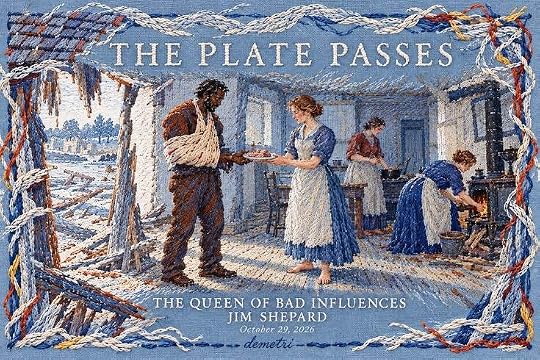
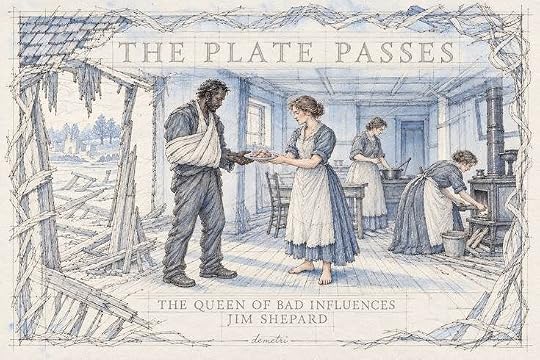
The Plate Passes – In a flood-damaged kitchen, a single plate of ham moves between James Singleton and the woman who wrapped his arm in her shawl; the pale room makes space for her kindness and for the story of Lucinda’s last act that she leaves untold.
Downstream of the failed South Fork dam, James Singleton follows the smell of frying ham into a ruined house, where three white women cook. One binds his injured arm with her shawl. They share a plate. One withholds a story: a Black stranger had pushed her onto a roof before being swept away. That woman was Lucinda, his missing wife. The meal is a kindness. The silence is harder to classify.
Even in the last paragraph of “Privilege,” knowledge moves unevenly. We follow James into the kitchen, then enter the barefoot woman’s private recollection, then return to the stove. Neither knows how their stories touch. The narrator alone knows that the rescuer and the missing woman are Lucinda. Shepard writes that she “chose not to relate” the rescue, not that she meant to hurt James. Before falling silent, the woman has recounted resisting her husband’s wish to move uphill. She can tell that part of her survival story, but not the stranger’s part in it. The shawl holds; the plate passes. Only the reader receives the missing news.
More difficult than condemning the woman is accounting for her ordinary generosity. She sees an injury and helps without hesitation. Yet another woman’s sacrifice, the act that saved her, has not entered the story she tells her companions. The omission belongs to a world in which a Black stranger may save a white woman without acquiring a claim upon her memory. Shepard gives us no warrant to invent the survivor’s private reasons. James eats beside someone who knows the end of his search, and the conversation never reaches it. The ham is shared; Lucinda’s final act stays private. That is the wound the scene leaves open.
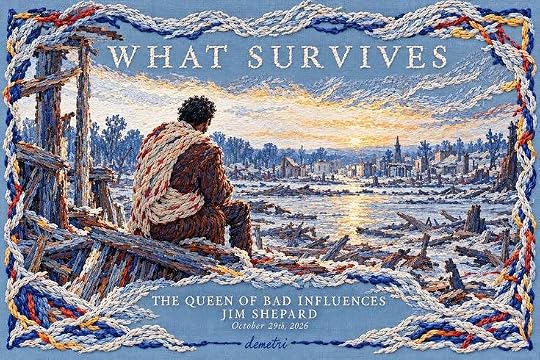
What Survives – Wrapped in the shawl that offered him care, James Singleton looks across the wreckage of the Johnstown Flood. The ruined landscape holds the evidence of what has happened, but not the news he needs most: that Lucinda, the wife he is searching for, saved another woman’s life.
Elsewhere, knowledge confers very different obligations. An evacuation comes too late. A soldier writes home from a battle he cannot stop. A participant in genocide insists he was simply good at his job. They are not versions of one failure. Shepard is strongest when he distinguishes people denied the means to act from people who possess those means and prefer an explanation. Shepard sustains the distinction more often than not.
The collection crosses the Johnstown Flood, the Florida Keys hurricane, the Northwest fires, Gallipoli, and the sinking of the Lusitania, among other calamities. It also enters Hyde’s grievance, Eichmann’s postwar self-defense, and a boy’s recollections of a brother’s psychiatric illness. The periods and narrators change; the question of who gets to tell a story, and what goes untold, does not.
Rosalie Brady, in “Village of Islands,” has a marriage, a half-abandoned gift for drawing, and a postcard from a honeymoon in Havana. The hurricane makes relics of these ordinary things. Homer Dean, a veteran working in the Keys, knows how little a government program’s promises may count for an unemployed man. The rescue train comes too late. Weeks later, he is found with an arm still around a boy he tried to protect. Nobody has been looking for Homer. The final fact feels almost like something a clerk might write in the margin, and is more terrible for it.
In “The Devil’s Broom,” Domenico and Aldo have names and a friendship before the wildfire kills them. Domenico’s charred fist holds a Saint Christopher medal from a girl he once helped at a train station. A log calls them “Two Unidentified Italians” but counts twenty-one consecutive days and nights of work. Their families never receive the wages. The ledger remembers the labor and loses the laborers. Shepard can supply the names and the story of the medal. He cannot send the money home.
Particulars fill Shepard’s sentences until a system starts to feel like weather. Barometers, railroad turns, forest roads, military orders: a clause supplies one more difficulty, and another makes it harder to escape. A person then reaches for a rail or a child, and the prose abruptly has a body again. The method works when the detail alters the action; at other times the archive speaks longer than the character. We have learned exactly why a journey became impossible while waiting for somebody to take the next step. There are passages in which one almost hears the library cart passing through the smoke.
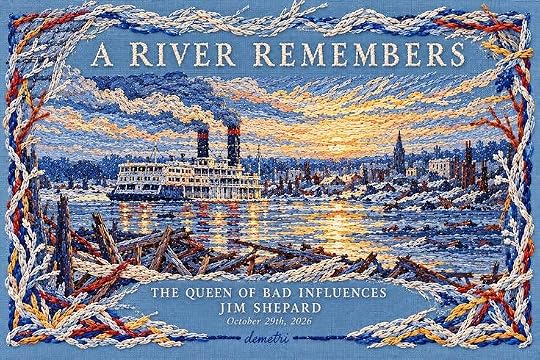
A River Remembers – An imagined steamboat passes a broken waterfront beneath a sky crowded with embroidered light. The river carries the visible wreckage of disaster, while the lives it has altered remain harder to account for. History preserves the catastrophe more readily than the people caught inside it.
Against the catastrophe, people retain the bad manners of being alive. Soldiers complain about clothing and superiors. Couples quarrel over things too small to survive a summary of the period. An official may be impressively titled and useless in practice. Shepard lets the jokes coexist with the coming loss. Their point is that the people involved had not yet turned into history. They had things to be annoyed about, some of them splendidly inconsequential.
Perhaps it is no accident that Hyde is so eager to speak. Reworking Robert Louis Stevenson’s “Strange Case of Dr Jekyll and Mr Hyde,” Shepard gives the murderer the injured dignity of a man certain he has been misunderstood. In his acknowledgments, Shepard explains that he has transferred some of Jekyll’s language to Hyde. The theft is wickedly funny. The language of conscience survives in a murderer’s mouth. Hyde would like us to mistake his command of the language for evidence of moral seriousness.
An even colder performance takes place in “The Others Spoke, Now I Want to Speak.” Eichmann meets Willem Sassen and former Nazis in Argentina, where the group hopes to make the past more defensible. He discusses deportations and departmental rivalries as if presenting evidence of professional competence. Loading trains becomes a matter of cattle and flour sacks. He makes the comparison without pausing over its horror. His listeners seem to want some regret, or at least a story with fewer admissions. Eichmann wants recognition for the work.
Documentary history makes the title more sinister. The German Federal Archives catalogue a 1956 Eichmann manuscript titled “Die anderen sprachen, jetzt will ich sprechen” – the German equivalent of Shepard’s story title. The perpetrator had already requested the floor. The archive verifies the title, not Shepard’s dialogue. In Shepard’s fiction, speech destroys his defense. He has told on himself.
It is Sassen who finally switches off the recorder after Eichmann speaks proudly of the genocidal enterprise. At home Eichmann consoles himself: everyone makes choices that hurt others. A household truism becomes monstrous. Shepard does not allow the ordinary vocabulary of disappointment to diminish willing participation in mass murder. Other characters may be helpless or compromised. Eichmann belongs to another moral category.
Much of “The Mentally Ill Are Not Alone” belongs to a younger brother trying to anticipate John’s distress. At a hospital John catches his sleeve and begs not to be left. The boy is frightened by the possibility that he might be able to intervene. Later he hears his father speak of “collateral damage” and takes the expression to a dictionary in the den. It gives family suffering the impersonal sound of a military operation. The boy also recognizes that such close observation might make him better at hurting others. The dictionary has supplied a definition, not a defense.
It takes a backyard party, complete with a makeshift display of his books and reviews, for the younger brother to see the role he has made for himself. He has turned John’s experience into fiction, disguising him as a younger sister. Passing John in the house, he hears: “The author.” The narrator hears mockery and a measure of admiration: John can see that his brother has built a life out of their troubled household. Then comes his admission that he chose and exploited the part of the family observer, becoming “excellent at observing but not so great at intervention.” It sounds almost like a professional shortcoming. The cost belongs to his brother.
The boy could not have cured John. That matters. His later admission matters too: by treating other people as the subjects of his attention, he made an art and a refuge out of their problems while leaving his own insufficiently examined. His admission does not purify him; it also gives him material for another story. Shepard’s work depends on much the same power to observe, and the story lets a suspicion fall across that power. The witness may love the person he writes about and still profit from occupying the better position.
Rather than let confession become the collection’s answer, Shepard turns to letters. In “Our Day of Grace,” William describes the defenses outside Franklin while imagining the husband he might become to Lucy. His fate is unstated. His tenderness does not make his Confederate allegiance disappear. At Gallipoli, William Malone writes to Ida about camp life, the campaign, and home, before history fixes his date of death. We know the danger that his words have yet to meet. That gap makes the letters hurt.
Other stories lean on that gap so often that it begins to feel appointed. In “Children of the Sun,” Spanish veterans face artillery while a murdered Indigenous elder’s rebuke returns to a soldier’s memory. “The Sons of Liberty” leaves Josiah running short of ammunition at Bunker Hill, thinking of Sally. The silence preserves an imagined future. Repeated, the gesture becomes familiar. The reader recognizes Shepard’s preferred curtain.
Particularly exposed is “Engineer of Safe Havens.” We learn that Judith has died in the blizzard before following her sister Frieda home. Frieda remembers Judith waiting to accompany her inside and believes that loving sacrifices will be repaid. The thought is piercing precisely because we know the sister is gone. It is also arranged so neatly against our knowledge that Frieda seems to be approaching a sentence rather than a house. I felt the story arranging my grief for me. Its tenderness deserved a little more room to be unpredictable.
One can admire that care while questioning its distribution. In “Children of the Sun,” Spanish soldiers receive love affairs, vanity, grievances, and memories. The Indigenous elder they killed appears mainly as an accusation in a soldier’s memory. Colonial violence is condemned; his independent life remains thin. Fiction also distributes interiority unevenly. The story has not escaped that difficulty.
Underneath the failed warnings and evasions, people do act. Homer holds a child against the hurricane. Ed Pulaski leads firefighters into a mine tunnel; Emma lives with the injury that follows. During a temporary burial armistice at Gallipoli, a Turkish officer offers an enemy soldier an unexpected courtesy. Constance tries to keep children alive aboard the sinking Lusitania. These gestures cannot abolish disaster, and their actors cannot know the ending. Such actions matter even when they cannot rescue everyone.
Love presents Constance with a problem that cannot be solved by feeling harder. She works in her father’s business, with more security than she sometimes notices. Minna is a legal secretary with professional ambitions that cannot be postponed for someone else’s comfort. Their closeness carries romantic desire Constance cannot name. Minna refuses to inhabit Constance’s hesitation. Constance hopes to answer with a look. Admiration cannot get Minna a job.
Once Minna asks for help finding work in a business consortium connected to Constance’s father, the failure acquires duration. Minna comes to an arranged meeting. Constance is inside, and for twenty minutes she does not answer the door. Twenty chances to change her mind. Minna calls attention to class as well as friendship. Secure in her father’s business, Constance treats Minna’s independence as a threat. Her fear is real. So is the woman left waiting.
Shepard lets us discover this earlier betrayal after we know Minna has disappeared when the Lusitania sinks. Constance also tries to save children. Her courage at sea exists beside her refusal on land; neither incident settles the other. The broken chronology changes the suspense. It moves backward to an appointment Constance could have kept. The shipwreck neither punishes nor excuses her.
During the final pages, four years later, Constance sits in her childhood bedroom on the morning of her wedding. The steeple clock strikes the wrong hours, a familiar local embarrassment. She remembers walking with Minna among gorse, dragonflies, and starlings. Minna took both her hands before offering a formula she had learned in business: say what you want, explain why, propose how to obtain it. Each clause pushes a private feeling toward a statement another person might answer. Earlier, when Constance invoked her peace of mind, Minna greeted the phrase with open disbelief. Constance had hoped that looking at Minna would be reply enough. Then Shepard leaves an unusually short sentence standing by itself: “And Constance had refused that invitation.” For a woman so gifted at prolonging uncertainty, the past arrives in a grammatical form that permits none. The sentence does not establish what would have happened if she had answered. It establishes only that she did not.
Explaining the story in a June 2025 interview with Cressida Leyshon for The New Yorker, Shepard said he abandoned the predictable approach to the Lusitania’s sinking and rearranged the relationship around the event. The suspense belongs to an earlier choice, not the sinking. Yet a discomfort remains. Minna insists on an independent life; the narrative nonetheless gives us that life through Constance’s remorse. Her absence becomes Constance’s education. That danger persists.
Memory has a different trade in each pair of hands. Eichmann recruits it to excuse murder; the family novelist makes his brother’s suffering into art; the woman in “Privilege” keeps a rescue to herself. Their situations demand different judgments. The connection is not an equivalence of guilt but a question about who controls the account. Shepard can restore to the page the name a ledger neglected, or give Constance a chance to recognize what she withheld. His sentences can also make a lost life fit the shape of an argument with disconcerting ease. It is when some detail refuses to fit that his fiction feels freest.
Even in a book this attentive to ordinary lives, grief can seem expertly scheduled. Shepard sometimes lets research overrun a scene and his endings show their machinery. Yet his best stories are less tidy: James receives a meal without the news he needs, the family writer finds his confession useful, Constance saves children without having been generous to Minna. I rate “The Queen of Bad Influences” 87/100, equivalent to 4.50/5 on Goodreads. The unease extends to his own methods.
The last image Constance remembers from the ship is of people who cannot bring themselves to jump toward a lifeboat, even after watching others reach it. She also remembers a mother and child sliding down the deck. Fear of drowning is not fear of answering Minna. Constance makes the analogy. On the morning of her wedding the church clock tells the wrong time. There is still a wedding to attend.
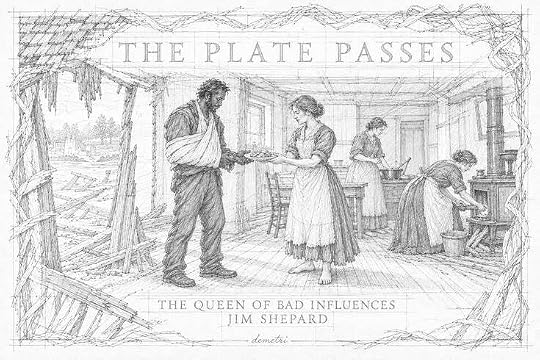
The Kitchen, Before the Wash – Graphite composition and architectural underdrawing study for “The Plate Passes.”
The Kitchen, First Light – Initial blue watercolor-wash study over the graphite composition for “The Plate Passes.”
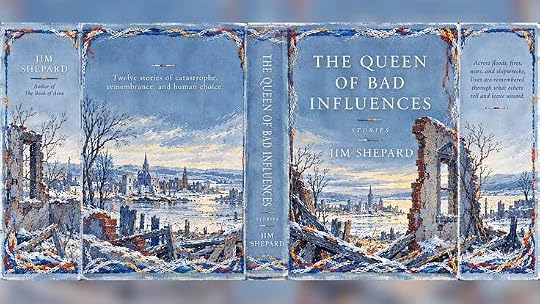
What the Record Leaves Out – Alternate full dust jacket with flaps.
All watercolor illustrations by Demetris Papadimitropoulos. Watercolors are done on 140lb vellum and then scanned into the computer using an Epson scanner. From there, they are finalized in Procreate. No AI was used in writing this review — all art and opinions are my own.
Preread: Excited for this collection about struggling Americans trying to make a life in an extremely unbalanced era. Historical fiction is excellent in novel or story form.
Total Rating: ⭐⭐⭐⭐
"The reverberation had jolted Alma and Jenny’s entire railroad car, knocking Alma’s novel to the floor, and after a horrified silence she asked the conductor if he thought the reservoir had given way, and the conductor, white -faced, cried that he thought it had, and everyone in a great confusion looked to gather grips and valises to hand before the oncoming thunder petrified all and Jenny glanced back to see what looked like the entire forest coming down upon them, with so much uprooted at the forefront that it looked like an avalanche of trees." p119 "Privilege"
In Short: I haven't read any historical fiction shorts, but I really like them! This is an eclectic blend of stories that tend to tackle the moral struggle we all deal with in life. Not just ethics in theory, but also ethics in emotional living, in how we feel and respond to what we experience.
I did not finish this collection, because the 9th story hit a very personal place for me, and in a way I consider myopic and without compassion. People who actually crush the agency of someone else become sort of obsessed with justifying it. I feel like this story is the narrator (author?) obsessing and justifying a terrible choice his family made about his brother.
With the earlier stories, I was compelled by the romantic prose and compelling characters. I think it's probably likely very few readers will see what I saw in "The Mentally Ill Are Not Alone". I do wish I could tell the author he is wrong. Mentally ill people are often alone. Statistics uphold the fact. And also, "the mentally ill" is horribly dehumanizing. We are people. Mentally ill people.
I don't think any of these implicit biases will diminish the popularity of this collection, though. It is quite beautifully written and most people agree with him, not me, about mentally ill people's place in the world.
In fact, he'll probably win a big award for this book. You heard it here first.
The Stories: 1. ⭐⭐⭐⭐ "Village of Islands" - The writing is gorgeous, but I'm finding this piece boring. Slice of life is not my favorite genre. It actually grew on me. Nothing more tense than living amongst racism. Especially when there's a storm coming. 2. ⭐⭐⭐⭐⭐ "The a testament of Edgar hyde" - The prose is gorgeous. "Utterson was the sort whose milk-and-water aspect was never complicated by a smile: cold, scanty, and embarrassed in discourse, and backward, parched, and dreary in sentiment. From chin to nave as thin and unappetizing as Job’s turkey. The ideal companion for the good doctor, he of the scented soap and feathery footfall." p35 Also, the narrative voice in this one is addictive. I had no idea what this brilliant thing was until my third read of the story! It's a character sketch of Mr. Freaking Hyde! 3. ⭐⭐ "Our Day of Grace" - Told in a two-sided letter correspondence. Not always a fan of this form. I think though it was a good choice for this piece, which is about a couple torn apart when the husband goes to fight in a war. But still, the pace is just dull. 4. ⭐⭐⭐"The Devil's Broom" - Fascinating character! "Though he was a fast learner and a hard worker and seemed to be valued at any worksite, in the privacy of his solitude he castigated himself as feckless, slow on the uptake, and generally of no use to anyone, and in the face of any idleness whatsoever became disgusted with himself in general. The cure for such funks turned out to be getting farther out into the wilderness, and by the time he was hired by the fledgling Forest Service as an assistant ranger, he had tramped more miles in the surrounding counties than any man alive, and was so dedicated to his own version of a backwoods education that he had once tied himself to a lodgepole pine on a ridgeline to better understand the vagaries of the wind." p69 5. ⭐⭐⭐⭐⭐ "The Others Spoke, Now I Want to Speak" - A brilliant piece of fiction, like historical fiction and alternate fiction had a little weird genre baby! 6. ⭐⭐⭐⭐ "Privilege" - Long sentences creates a breathless panic in this great disaster story. 7. "Children of the Sun" - This story contains a wonderful story about walnuts. And many wonderful stories about life's struggle. "[W]e don't get anything we cry for...." p135 ⭐⭐⭐⭐ 8. "Where Are the Lads of New Zealand Tonight?" - "Busy inspecting the men’s quarters and straightening things out. The Govt parsimonious with deck scrapers and sand soap. I remind my superiors of the specter of sickness if we don’t work to keep clean. Hygiene, hygiene, hygiene. Cultivate the habits of a cat, I tell the men. You tease me about my neatness, but I have always found such labor honorable. All such labor is." p146 A powerful statement on gendered labor, and in a setting in which feminism could not be said to be the impetus of the mindset. ⭐⭐⭐⭐⭐ 9. "The Mentally Ill Are Not Alone" - I have severe mental illness and had a childhood a lot like John's. I don't really know how I feel about what the author concludes here. I'm not going to rate this one. This collection honestly lost me here. 10. "Engineer of Safe Havens" - 11. "The Sons of Liberty" - 12. "The Queen of Bad Influences" -
Thank you NetGalley and publisher for the arc!📚
Content Warnings: . . . . . . . . Fist fighting, DV, violence against children, discriminatory language, cannabalism (mention), ableism, ableist language, forceful institutionalization, emotional abandonment, verbal and emotional abuse by a child, toxic family dynamics, unmoderated anger, passive aggression, immaturity, unhealthy coping
This is a collection of 12 short stories, some I liked and connected with the characters more than others, but overall, the stories explore catastrophes and human reactions and responses to them, both human-made and natural.
I wasn’t in love with the writing, and while I appreciated what the stories were trying to convey, not all of them resonated with me. I think readers who enjoy historical fiction will appreciate this collection more than I did.
⭐️ 3 stars
Thank you Knopf and NetGalley for the review copy, all opinions are my own
It would take a unique reader for me to go out of my way to recommend this book to. While I had my doubts at times, this book overall, pulled me in. The authors story telling is amazing as he brings you to historical moments in time and makes you feel as though you’re living them within a short storied format. My personal favorite short stories in the book were “Where Are the Lads of New Zealand Tonight?” and “The Mentally Ill Are Not Alone.” I cannot say enough good things about this authors ability to write; I was simultaneously looking up the definitions for a multitude of new words as well as historical facts. Reading this book made me yearn for high school English class and an opportunity to dissect the deeper meaning as a group, collaboratively.
Some meaningful quotes I took away: - “Perhaps for us it’s been like that old story of Diogenes being asked how one lives with the truth, and answering that the truth should be treated like fire: not approached so close that it sears you, and not given such a wide berth that you freeze.” - “At this spectacle, even the most gentle must become savage. And even the most savage must weep.”
This was a really interesting concept, and the author showed tremendous skill in crafting each story within the time frame required, with the appropriate backgrounds and dialect of the times. While impressed by the author's expertise, there were only a few stories that I connected with on the most minimum of levels: the American Revolution story, the Civil War story, and the Johnstown Flood story.
I just could not emotionally connect with the writing. That's not the author's fault.
Would I read more from the author? Maybe.
I received a complimentary e-copy of the book from the publisher and NetGalley, and my review is being left freely.
Whether they are of the natural or human-caused variety, Jim Shepard is a connoisseur of disaster. From hurricanes to shipwrecks to wars, there are catastrophes aplenty in his sixth short story collection, THE QUEEN OF BAD INFLUENCES. What makes these 12 tales that seamlessly blend real and fictional characters more than voyeuristic glimpses of tragedy is Shepard's expert craftsmanship and his ability to shift his lens from wide-angle to close-up, bringing an intensely human dimension to the most dire circumstances.
In previous collections, such as LIKE YOU'D UNDERSTAND, ANYWAY and YOU THINK THAT'S BAD, Shepard has carved out a niche as a master of deeply researched, imaginatively recreated historical short fiction. Ranging around the globe and across more than three centuries, most of the stories in this collection --- three of which were chosen for Best American Short Stories and two for Pushcart Prizes --- are situated firmly in that genre.
Shepard wastes no time ratcheting the drama up to Category Five with the opener, “Village of Islands.” In it, he brings to life the Labor Day 1935 Key West hurricane, one of the most intense Atlantic storms on record, with top winds believed to have approached 250 miles per hour and a death toll of more than 400. Shepard depicts the savage storm through the eyes of a handful of characters desperate to escape its fury. Most notable among them are newlyweds Rosalie and George Brady and Homer Dean, one of 50 World War I veterans brought to steamy South Florida to construct a camp to house 650 of their fellow soldiers assigned to a highway construction project and who become the subject of a dramatic rescue effort by rail. Shepard's depiction of the fates of the Bradys and Homer brings the story to a moving conclusion.
Among the most dramatic stories is “The Devil's Broom,” an account of the devastating wildfires in the Northern Rockies in August 1910. That conflagration is seen through the eyes of Edward Pulaski, an assistant ranger with the US Forest Service, whose real-life heroism was instrumental in saving the lives of 43 of the “punks, stew bums, and pool hall boys” who made up much of his hastily recruited firefighting crew. “Privilege” vividly evokes the 1889 Johnstown Flood. A poorly maintained earthen dam built to create a massive lake for the enjoyment of plutocrats like Andrew Carnegie and Henry Frick collapsed, inundating the valley below. The most compelling of its shifting perspectives is that of John Parke, Jr., the dam's resident engineer, who is all too aware of its fatal but preventable weaknesses and who can only watch in horror as nature exacts its awful price.
The last of this trilogy of natural disasters is “Engineer of Safe Havens,” which imagines the nor'easter in November 1898 that capsized the paddle wheel steamer Portland on its way from Boston to Portland, Maine. It revolves around a trio of characters --- Alice Elinor Hays, whose father is a passenger on the vessel; Thomas Merrill, its first engineer; and Alonzo Ansel Crozier, a Black deckhand seeking to improve his lot through a life at sea. For all their many skillfully portrayed moments of high drama, in all three of these stories, Shepard persistently returns to the plight of these characters as they confront forces that overwhelm their ability to respond.
Two of the collection's stories --- both accounts of war --- rely on the epistolary format. In “Our Day of Grace,” two women exchange correspondence with their Confederate soldier husbands in Tennessee in November 1864 on the eve of the Battle of Franklin. The war is a “graveyard for virtues,” writes William, a former schoolteacher from North Carolina and a reluctant volunteer. He observes ruefully in the letter that concludes the story on the eve of battle, “Hope calculates its schemes for a long & durable life, & presses us forward to imaginary points of bliss, & grasps at impossibilities, & so ensnares us all.”
In “Where Are the Lads of New Zealand Tonight?” the second of the stories rooted in eloquent, revealing letter writing, Shepard tells the true story of William G. Malone, commander of a regiment of New Zealand soldiers embroiled in the disastrous 1915 Gallipoli Campaign. Consistently critical of their British commanders in his letter to his wife Ida, as his comrades' casualties mount, he laments how the “High Command sends us packing with a bagful of hallucinations. Were it not all so serious, it would be laughable.” In both of these stories, he effectively deprives war of its sheen of glamour.
Shepard is a versatile writer, and he occasionally departs from his affinity for tragic tales rooted in history. In the chilling “The Testament of Edward Hyde,” he revisits Robert Louis Stevenson's classic story from the viewpoint of the monstrous titular character. “The Mentally Ill Are Not Alone” reads like a slice of memoir, recounting the story of teenager John Shepard's battle with mental illness in the late 1960s from the point of view of his younger brother, Jim, a writer.
Each of the stories in THE QUEEN OF BAD INFLUENCES unfolds in a well-structured narrative over approximately 20 pages. Yet there's no sense of monotony, despite the absence of any flashy fictional devices or epiphanies. That's because of Shepard's impressive range and his ability to seize the reader's attention on the first page and hold it to the last with accounts of resilience in the face of forces beyond human control. Engrossing in the moment and memorable in hindsight, they're durable examples of the storyteller's art.
In this collection, Jim Shepard writes about catastrophes. Each of the twelve short stories focuses on a catastrophe, and Shepard creates characters, many of whom are based on real people of the time. He doesn't necessarily craft each story chronologically, with a beginning, middle, and end; rather, he uses different techniques in each. In the "Village of Islands" about the 1935 Florida hurricane, we meet characters who give us background on how people ended up in the Florida Keys and what the horrible living conditions were like. Then, we learn the reality of the hurricane and the chaos that ensued.
In "Our Day of Grace," the text consists of a correspondence between William, a Confederate soldier in the American Civil War, and his wife, Lucy. Both report on trying to cope with their unique circumstances and report on elements of war, William experiencing its actual horrors, and his wife attempting to maintain the household without her loved one. In this same story, we read a one-sided letter from Hattie, whose husband, CW, is fighting alongside William. CW doesn't seem to write, yet Hattie is persistent in communicating. Shepard effectively conveys the realities of the war from a Southern perspective, and the letters underscore how people documented their lives during that era.
One story that will stay with me long after reading the collection is "The Mentally Ill Are Not Alone." The narrator describes the overwhelming challenges posed by his brother's mental illness. It is a sobering reminder of the stigma that has long surrounded mental health issues. Particularly disturbing is the story's depiction of schools that were incapable of meeting the needs of children with disabilities. Although the events take place in the 1960s, and some progress has certainly been made, it is still unsettling to see how much trust the parents placed in a Catholic school ill-equipped to help their son. Shepard is equally critical of the ineffective treatments provided at Yale. The story invites readers to consider how society treats people whose minds work in atypical ways.
In the title story, "Queen of Bad Influences," Shepard writes about the sinking of the Lusitania. The story features a friendship between two girls on the cusp of adulthood as they try to forge a possibly romantic bond while traveling aboard the Lusitania. At least one survives, and we learn of the catastrophic sinking as we also learn about the catastrophe of the relationship that never completely developed.
Shepard is an engaging writer, and this collection encouraged me to reconsider both well-known historical disasters and the quieter calamities that occur within families, friendships, and communities. His stories prompt reflection not only on the people affected by large-scale tragedies but also on the ways ordinary relationships are tested as individuals struggle to survive the challenges of everyday life.
**Review of *The Queen of Bad Influences: Stories* by Jim Shepard**
Jim Shepard’s *The Queen of Bad Influences* is a remarkable collection of historical short fiction that explores how fragile human lives become when confronted by forces beyond their control. Across eleven stories spanning different centuries and American landscapes, Shepard brings together heartbreak, friendship, war, natural disasters, and the quiet moments of connection that give life its meaning. The result is a collection that feels both historically expansive and deeply intimate.
One of the collection’s greatest strengths is its ability to make history feel immediate and personal. The account of the 1935 Labor Day hurricane in Florida, told through multiple perspectives, and the Civil War-era correspondence between Lucy and William offer different ways of experiencing uncertainty, separation, and danger. Meanwhile, “The Devil’s Broom,” with its depiction of the men confronting the devastating Northwest wildfires of 1910, adds another compelling dimension to the collection. These stories do more than revisit historical events; they bring readers close to the people whose lives were shaped by them.
The title story offers a particularly intriguing emotional center through Constance and her complicated friendship with Minna. Their relationship, unfolding partly aboard the Lusitania, captures the unpredictable nature of affection, loyalty, and personal reckoning. Throughout the collection, Shepard demonstrates a gift for portraying relationships under pressure, revealing how love and friendship can become especially meaningful when the world around them feels unstable.
What makes these stories especially affecting is their recognition of human vulnerability. Disasters, whether natural or created by human ambition, expose the limits of certainty and control. Yet Shepard does not leave readers with destruction alone. He also celebrates correspondence, companionship, curiosity, and the small acts of tenderness that help people endure difficult circumstances.
*The Queen of Bad Influences* is a thoughtful, ambitious collection for readers who appreciate literary short fiction, historical settings, emotionally complex relationships, and stories that find humanity amid catastrophe. It is a powerful reminder that even when circumstances are beyond our control, the connections we form with one another remain profoundly important.
“The Queen of Bad Influences” is a short story collection by Jim Shepard purportedly consisting of twelve “masterworks” from a “great American writer of catastrophe fiction.” I received an advanced reader’s copy from NetGalley, and I wholeheartedly disagree with the sentiment. I found the stories so boring or so offensive that I barely made it half the way through them, skimming over the last one I read before abandoning the book entirely.
A couple of the stories I read relate to horrific natural disasters resulting in catastrophic losses of life, and they were somewhat interesting. Another consists of some very boring correspondence during the civil war, and one inexplicably appears to be a retelling in olde English of Robert Louis Stevenson’s tale of Dr. Jekyll and Mr. Hyde with the addition of a female character. The story that made me decide I no longer wanted to read more involves a first-person narrative by Adolf Eichmann in exile supporting his involvement in Hitler’s regime. I failed to see the irony or humor in this or any of the stories.
These stories are amazing. Disturbing. Brilliant. Devestating.
I mean, Shepard takes us into the mind of Mr. Hyde and a Nazi escaped to Argentina justifying his actions in the destruction of the Jews. An early Forest Service worker contends with a lack of tools and men. A Confederate soldier’s letters home. Terrifying places to go.
The stories considers the catastrophic, natural and human made. Each is a crystalline depiction of worlds I hope never to experience.
Thanks to Knopf for a free book through NetGalley.
I have seen more depravity in the last month than in my my days previous. This war is a graveyard for virtues. from Our Day of Grace by Jim Shepard
Thank you Knopf and NetGalley for the eARC under the KDPG Program.
Like most short story books, it's a bit hit-or-miss depending on what clicks with you. I mean, yeah. I liked some stories more than others. I liked some dynamics more than others. It's just one of those where you go in learning a little snippet of history and seeing how various groups lived in those times.
I'm a sucker for historical fiction and this short story is a heavy hitter. Each story takes place in a different time during a major event, be it a major historical event or in some cases a major personal event. Tackling topics such as war, natural disaster, mental health struggles, and more, Shepard has put together a collection that will find a way to hit you right in the gut.
I'm not a huge fan of short stories but I really liked this collection. There were a couple of stories I didn't care for at all but I found most of them enjoyable. See my full review at Girl Who Reads.
I give this book 4 stars for great research and writing of what the goodreads blurb calls "catastrophe fiction" - who knew there was such a category? That is precisely what this story collection is- well crafted tales of human folly and natural disaster. No uplift here.