“In When America Roared, Jonathan Kaufman draws together a bushel of figures who thrived in one fateful decade…[providing] useful insights along the way.” —New York Times Book Review
The panoramic story of the 1980s, exploring the triumphs and failures of the decade that shaped the 21st century more than any other, from a Pulitzer Prize winning reporter who witnessed the transformations firsthand
In January 1980, America seemed broken. Inflation raged. Interest rates topped 20 percent. Americans were held hostage in Iran. The Soviet Union invaded Afghanistan with impunity. Japan was eating American manufacturing alive. Three networks controlled what Americans watched. China had been closed for 30 years.
Ten years later, everything had changed. The economy was booming. The Soviet Empire was collapsing. American businesses were competitive again.
In this immersive, character-driven narrative, Jonathan Kaufman lays bare the contending ideologies—and people—who battled for control of business, media and politics in the 1980s, shaping the way we live today. As Ronald Reagan and conservatives pummeled the Democratic party, as Jack Welch redefined leadership at Fortune 500 companies, and as deregulation spearheaded by Mark Fowler allowed television to become the hundreds of specialized and partisan channels we watch now, the groundwork was laid for our current economic and political conflicts. The decade also launched transformative social and political movements. Karen Nussbaum and Jane Fonda galvanized a struggling women’s movement, Evan Wolfson spearheaded the gay community’s legal fight against a hostile government, and Barack Obama cut his teeth as a community organizer in Chicago—all building long-lasting movements whose success progressives can learn from today.
From pivotal moments in board rooms and court rooms, to cultural touchstones like the birth of hip hop and of conservative talk radio, as well as the author’s eyewitness experiences in Tiananmen Square and Prague, When America Roared is the riveting story of how the 1980s built the world we live in, for better and for worse. It is the decade that made us—and the key to understanding where we go from here.
The Iron Is Buried. The Television Multiplied. The Rules Stayed. “When America Roared” turns Jonathan Kaufman’s five lives into a history of the 1980s as an age when temporary solutions became durable institutions – sometimes faster than anyone noticed. By Demetris Papadimitropoulos | August 27th, 2026
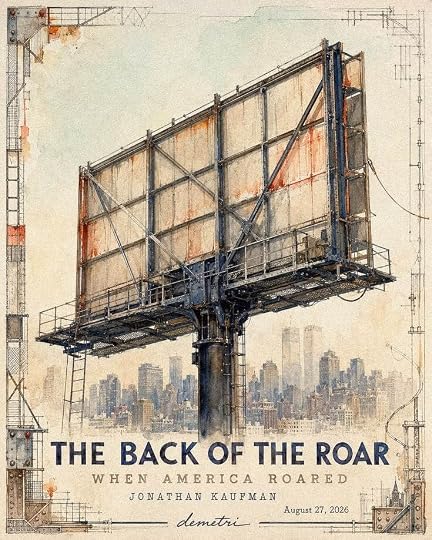
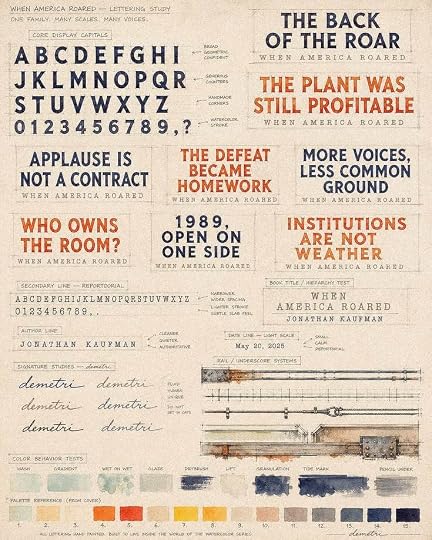
“The Back of the Roar” turns the decade’s monumental public assertion around, revealing the braces, bolts, rails, revisions, and institutional machinery that allowed it to stand – and kept working after the sound faded.
Defeat is often more instructive than victory in Jonathan Kaufman’s “When America Roared.” Robert Bork loses his Supreme Court confirmation fight, and the young conservative legal movement studies the result like game film: who organized better, what had not yet been built, what would need to exist next time. Evan Wolfson, pursuing a cause many of those conservatives opposed, eventually reaches a related conclusion about marriage equality. Outrage can start a movement. A lawsuit can win a headline. Neither makes a victory last. Kaufman is less interested in the decade’s costumes than in the work happening behind them, when an insurgent idea acquires staff, money, procedures and successors – and begins to pass for ordinary life.
Even the subtitle, “How the 1980s Saved, Then Broke, the Country – and Led Us to Today,” is neater than the history Kaufman finally tells. His decade does not rescue America and later betray it in two tidy acts. The saving and the breaking are often the same operation viewed at different distances. Corporate restructuring restores competitiveness while loosening the bond between employer and employee. Deregulation expands consumer choice but thins older ideas about public obligation. Financial liberalization produces wealth, then helps turn inequality into somebody else’s line item. Kaufman’s recurring “both-and” can sound diagrammatic when he names it; his evidence is better than the phrase. Some of the decade’s reforms became dangerous not because they failed, but because they worked well enough to become difficult to question.
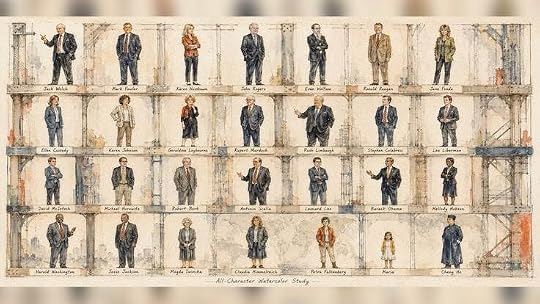
Most of the narrative moves through a recurrent cast of five: Jack Welch, Mark Fowler, Karen Nussbaum, John Rogers and Evan Wolfson. Welch remakes General Electric around competition and shareholder returns; Fowler pushes broadcasting toward consumer choice; Nussbaum tries to turn working women’s visibility into bargaining leverage. Rogers builds a Black-owned investment firm while confronting the distance between individual ascent and accumulated wealth across a community. Wolfson pursues marriage equality when much of his own movement regards it as strategic fantasy. They are not five profiles stapled to a decade. Their lives show what changing rules reward, what they discard and who suddenly gets admitted to the room.
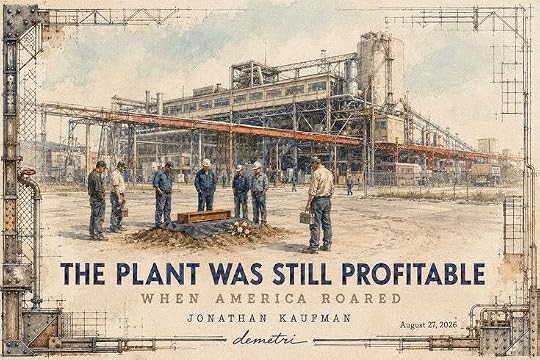
Early in Welch’s tenure, Kaufman’s method becomes brutally concrete. Welch closes a profitable GE iron plant in Ontario, California, because current profitability is no longer the decisive test. The business is vulnerable to cheaper global competition and fails his standard for future dominance. More than eight hundred workers lose jobs that had anchored stable lives; on the plant’s last day, employees bury a metal iron in a mock funeral. The scene needs little theoretical embroidery. The old question – can this operation sustain itself? – has become a harsher one: is this the best possible use of capital? Welch helped make the second question sound like managerial common sense.
“The Plant Was Still Profitable” sets a small mock burial beneath an intact factory, making the cruelty of the scene depend on precisely what has not collapsed: the building still looks capable of work.
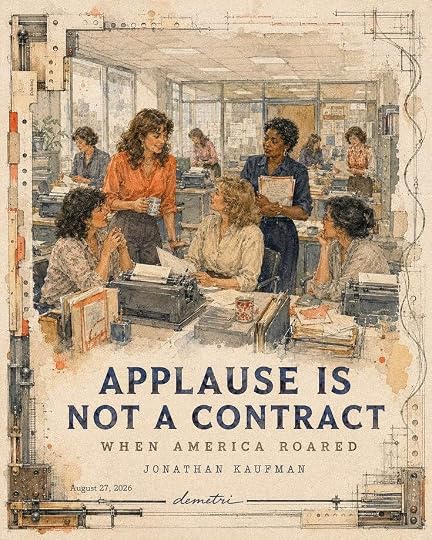
The answering story belongs to Nussbaum. Her organization 9to5 turns secretaries’ grievances into a movement armed with wit, data and an instinct for public attention. The film “9 to 5,” starring Jane Fonda, Lily Tomlin and Dolly Parton, makes those grievances popular culture. Women laugh because the humiliations are familiar. Yet visibility proves less durable than contract. Nussbaum turns toward unionization just as Ronald Reagan’s firing of striking air traffic controllers announces a new willingness to break organized labor. Employers discover that delay can be strategy. Workers discover that popularity is not leverage. A movement can be famous and still lack the power to make its gains stick.
“Applause Is Not a Contract” places recognition inside the ordinary machinery of work – typewriters, papers, desks, files, and women discovering that visibility can travel much farther than leverage.
Rather than assign the era one moral temperature, Kaufman first asks why intelligent people found these reforms persuasive, then totals the damage. Welch faced real industrial weakness. Fowler confronted three-network dominance and a regulatory culture he regarded as paternalistic. Rogers understood that political rights without economic ownership could remain thin. Wolfson saw that airtight legal arguments meant little if much of the country barely recognized gay lives as lives organized around love, care and family. Kaufman refuses to make his subjects fools. That choice is not generosity for its own sake. Reforms that answer a genuine problem are precisely the reforms most likely to travel.
In Bork’s loss, the Federalist Society receives a lesson rather than a verdict. Its young conservative lawyers do not decide that history has spoken; they improve the pipeline, expand the network, think in decades. Wolfson later studies some of the same long-range tactics and imagines a marriage-equality campaign capable of surviving years of rejection. The political purposes are plainly different. What crosses the ideological divide is method, and Kaufman is careful not to confuse a borrowed strategy with a shared cause. A movement that cannot absorb defeat is unlikely to outlast it.
“The Defeat Became Homework” imagines loss not as rubble but as paperwork being sorted into shelves, networks, procedures, and the patient institutional capacity required for another attempt.
Put the five beside one another and they begin to answer questions their individual chapters cannot. Welch and Nussbaum offer rival accounts of what work owes a worker. Fowler and the later talk-radio universe test whether consumer sovereignty can replace public-service obligations in broadcasting. The Federalist Society and Wolfson make patience a form of political leverage. Rogers poses a different question: if a market opens its doors, who gets to own what is on the other side? A factory closure, a broadcast rule and a marriage campaign are not equivalent events. Kaufman’s design lets them press on the same stubborn problem without pretending otherwise: what makes a gain stick?
At the sentence level, Kaufman is less showy than sure-footed: medium-length declaratives, clean verbs, brisk exposition, then the well-timed turn. A small object often carries what another writer might hand to a page of theory: the buried iron, Fowler’s “toaster with pictures,” Nussbaum’s dragon tattoo, keys jangling in Prague, an East German child guarding an unopened Coca-Cola. The images are documentary rather than lyrical. They put policy in the hand. It suddenly has weight, texture and somebody’s fingerprints on it.
Part of the pleasure of this prose is how quickly consequence falls into line. Kaufman can make one decision seem to release the next, like a row of well-spaced dominoes. The cleaner the sequence becomes, the easier it is for inheritance to resemble paternity. Fowler belongs in any account of partisan broadcasting, but a regulator who loosened one set of constraints cannot by himself explain a media economy subsequently transformed by consolidation, cable, digital platforms and political entrepreneurs. Welch is a powerful exemplar of changing corporate governance; he need not father every later layoff, leveraged maneuver or spectacular executive payday. Kaufman usually respects the distinction. Sometimes the straight line is simply more seductive than the crowded intersection.
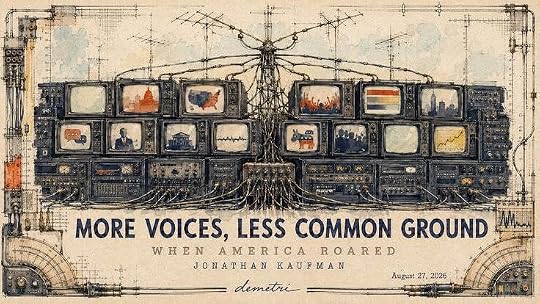
Against that concern, Fowler’s campaign against the fairness doctrine is one place where Kaufman earns the line he draws. It begins as principled deregulation, not a concealed project to manufacture conservative media; some conservatives even oppose repeal because the rule helps secure their access to broadcasters. Once it disappears, Rush Limbaugh discovers that one-sided political talk can be cheap, entertaining and immensely profitable. Rupert Murdoch and Roger Ailes later operate inside a media economy where segmentation is no longer a defect but a business model. The middle links stay in view. The sting is simpler than the genealogy: more voices can coexist with less common ground.
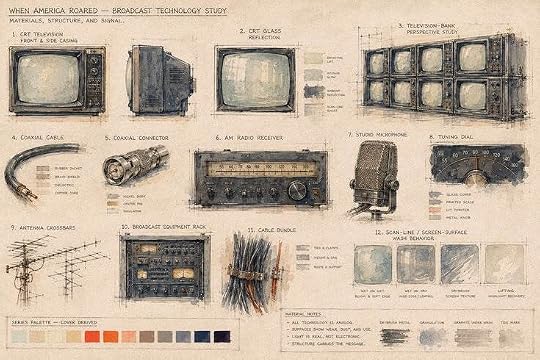
“More Voices, Less Common Ground” lets screens, cables, antennas, and signal paths proliferate until abundance itself begins to divide – many channels, many audiences, and less shared ground beneath them.
Donald Trump arrives late, where he is more useful. Businessman as celebrity, wealth as credential, grievance as entertainment, segmented media as political opportunity – he sits at a junction of several histories Kaufman has already traced. Making Trump the destination would reduce the decade to another origin story about the present. Kaufman instead leaves him where he belongs in this book: not the answer, but evidence that several currents can meet without agreeing on who deserves credit for the river.
In the nearest literary neighborhood are Gary Gerstle’s “The Rise and Fall of the Neoliberal Order” and George Packer’s “The Unwinding.” Gerstle offers a more theoretically exact account of political order; Packer takes greater formal liberties with braided social history. Kaufman is more insistently reportorial. He wants the room where a decision is made, the person making it, then the jobs, contracts, audiences, courtrooms and communities altered outside the door. That instinct gives “When America Roared” much of its speed, and occasionally its false confidence: a room can show where a decision occurred more easily than it can prove where history began.
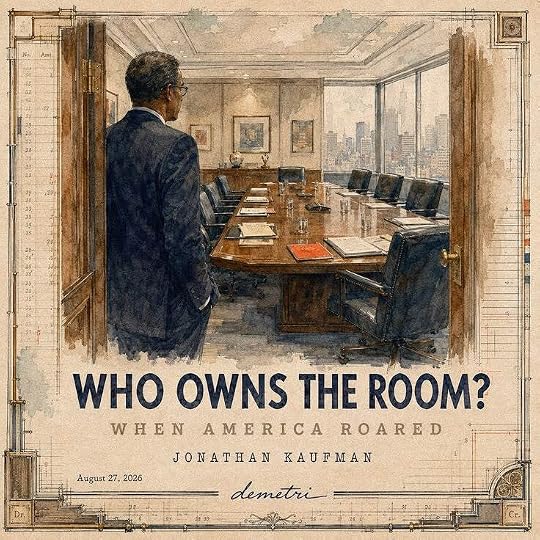
More difficult to fit into Kaufman’s cleanest pattern is John Rogers. His rise at Ariel Investments shows that access, political influence and professional networks can open doors once closed to Black financiers. Yet representation in a boardroom does not necessarily redirect the contracts, ownership stakes and advisory relationships through which wealth compounds. Rogers keeps running into that fact. His story unsettles accounts that mistake representation for redistribution. It also exposes an asymmetry Kaufman need not apologize for: Rogers does not have to explain a later political order as directly as Fowler or Welch to reveal a contradiction inside the economic order being built around him.
“Who Owns the Room?” looks through the threshold of financial access toward the contracts, chairs, and decisions further inside, where admission and ownership cease to mean the same thing.
If any phrase is made to carry too much freight, it is “the market.” Kaufman uses it to encompass competition, shareholder primacy, deregulation, consumer choice, financialization, free trade and the retreat of public obligation, though those mechanisms have different actors and effects. The wide lens creates a similar problem abroad. His treatment of China, Tiananmen Square, Eastern Europe and communism’s collapse vividly recovers why 1989 looked like vindication for American capitalism. The mistake was to confuse expanding markets with expanding political liberty. China’s state-directed capitalism and Russia’s oligarchic aftermath show how badly that inference aged. The wide view is persuasive; the category holding it together is sometimes less so.
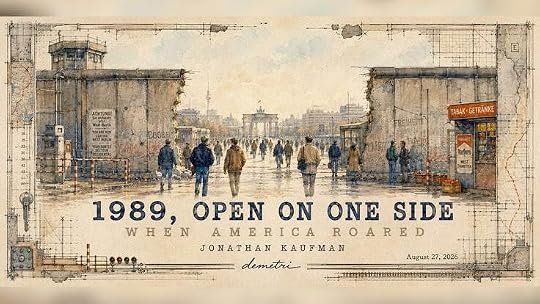
The first three parts of “When America Roared” carry closed dates. The fourth is “The Triumph of the Market (1988–).” That dangling dash changes the assignment. December 1989 no longer closes anything. Careers continue, institutions harden, victories accumulate costs, strategies migrate into new hands. Kaufman has quietly shifted from a history of the decade to a history of its afterlife. The question is no longer simply what happened in the 1980s, but what kept happening because of them.
“1989, Open on One Side” places human movement through a breached boundary at the center while commercial color stays at the margins – political opening and market triumph sharing a moment without becoming synonyms.
Reckoning begins at Jack Welch’s funeral. GE, once the corporate monument to Welch’s genius, has already suffered from strategies celebrated when the measurements looked good. GE Capital’s financial ingenuity, once a machine for dependable earnings, helped make the company vulnerable; the conglomerate ultimately broke apart. Kaufman avoids the easy trick of announcing that Welch was wrong all along. He was right often enough to become enormously influential. That is the harder problem. Success measured on one timetable can hide liabilities maturing on another. History rarely sends the bill in the same quarter as the profit.
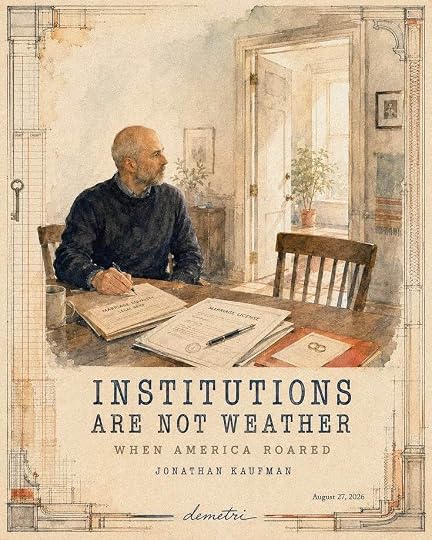
Opposite Welch’s reckoning, Wolfson offers the book’s cleanest case against inevitability. Marriage equality moves from a cause so marginal that major gay organizations resist prioritizing it to a national legal reality. The route is stubbornly uncinematic: losses, argument, persuasion, coalition-building, more losses, more work. Here persistence alters what once looked fixed. Institutions are not weather. People build them, defend them, revise them and, sometimes, replace them.
“Institutions Are Not Weather” brings legal papers and ordinary domestic space into the same quiet threshold, where something once treated as fixed becomes visibly human, built, and therefore changeable.
Present-day corporate language makes Welch easy to hear again: technological disruption, smaller teams, reorganization before an existing model actually fails. No fluorescent arrow from Welch to artificial intelligence is required. Fowler’s faith in consumer choice is similarly legible in a media world with almost limitless supply and remarkably little agreement about what deserves common attention. The point needs little topical garnish. A successful arrangement gathers rules, routines and beneficiaries around itself until remembering that it was once disputed begins to require historical excavation.
On my scale, “When America Roared” lands at 87/100, or 4/5 stars. Kaufman makes difficult institutional history unusually easy to follow without pretending its actors knew what posterity would make of them. What keeps the book below the highest range is equally clear: some causal lines grow cleaner than the evidence warrants, the five protagonists bear unequal explanatory weight, and the prose more often carries the argument beautifully than startles on its own. Those are meaningful limits in a book whose intelligence depends so heavily on making disparate things connect.
Underneath Kaufman’s promised roar is a quieter account of what remains after the sound fades. A nation frightened by stagnation chooses speed, competition, shareholder discipline and deregulation; other movements, facing other barriers, learn their own lessons about durability. By 1989 the United States looks less like a country that has made choices than one that has discovered how modern life is supposed to work. That confidence is the final trick. The decade does not simply save America and then break it. It leaves behind successful answers, humming long after many people have forgotten the questions. The iron is buried, the Wall is rubble, the television has a thousand descendants – and behind all that noise, the machinery keeps running.
All-Character Watercolor Study
Important-Objects Watercolor Study
Cover-Palette and Pigment Study
Series Lettering Study
Border Architecture Study
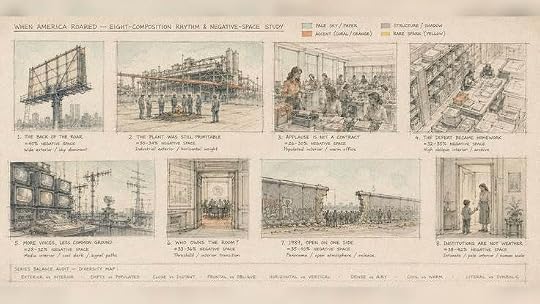
Composition and Negative-Space Study
Broadcast Technology Study
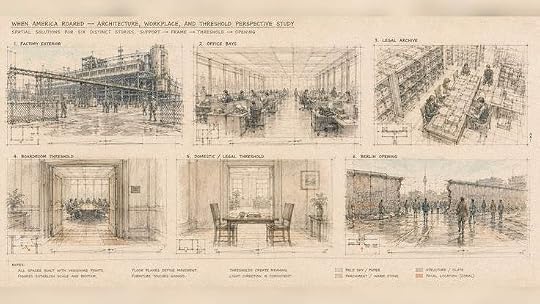
Institutional Spaces Study
Alternate Full Dust-Jacket Study
Emblematic Underdrawing Study
Emblematic First-Wash Visualization
All watercolor illustrations by Demetris Papadimitropoulos. Watercolors are done on 140lb vellum and then scanned into the computer using an Epson scanner. From there, they are finalized in Procreate. No AI was used in writing this review — all art and opinions are my own.
The 1980s are a fascinating decade in America. Some of the highest highs (economic boom, yuppies, hairstyles, technological innovation) and lowest lows (AIDS, the crack epidemic, hairstyles, inequality) were experienced in the decade. Its a decade that could be mined for countless books, and as we continue to put distance from the 80s, more will be written.
Its such a fascinating decade that I was excited to pick up this book. Unfortunately, I found "When America Roared" to be lacking.
Of course, this is not a general history of the decade, but in its goal I found it to be disorganized. The book mostly focuses on three realms: corporate revitalization and the economic boom; media deregulation; and the Rise and fall of various social movements. The book then tells this story through five characters: Jack Welch, CEO of GE; Mark Fowler, head of the FCC; Karen Naussbaum, a women's rights activist; Evan Wolfson, a gay lawyer; and John Rogers a wealthy Black Chicagoan.
I did enjoy some aspects of the book, the writing style is not bad. And some parts were engaging.
My biggest issue was the organization. To me, this book reads as if the author really wanted to do a book on Jack Welch and corportism of the 1980s, and had to include the other stuff. Welch gets several chapters devoted to him, including an entire chapter on his upbringing, and one about his battles in New York. This is where the author is at his best.
The other 4 really get shafted: Mike Fowler is mentioned early on, then is completely unmentioned until the last chapter. Same with Karen Nassbaum. Meanwhile, John Rogers and Evan Wolfson do not appear until the back half of the book, again only for a chapter or two at most. While their stories were interesting, I felt like the author only scratched the surface of all of this.
Getting outside of the core, the asides in the book too felt a bit random. There are sections put in various chapters that discuss some asides from the 80s like a deeper exploration into Nickeloedon, the birth of hip-hop, Jesse Jacksons 1988 presidental bid, discussions about Obama & Trump, and more. Again, these are good for additional context, but it leaves me questioning why these specific things and not more? Why wasnt there asides on the crack epidemic, the tech boom, the cola wars, and much more? The book is only 262 pages, and it already felt uneven, so these took away for me.
Then there is the final chapters, which is mostly the authors recollections and reporting from 1989 in China during Tiananmen Square and the fall of the Berlin Wall. While interesting, in a book supposed to focus on the five characters of the book along those themes, it does not fit in my opinion.
Again, this is not a bad book, but I feel like it lacks from some organizational and narrative issues. If the author had maybe focused solely on Jack Welch, or perhaps made the book longer so he could go into more detail, it would've made up for some of these deficiencies.
Thanks to NetGalley and Viking Books for the digital copy of this book; I am leaving this review voluntarily.
If I’ve said it once, I’ve said it a million times: the current state of the country is because of everything that went down when Ronald Reagan was president. His “reign” was from 1981 – 1989, and his contribution to the shit show we’re in now should not be overlooked. When America Roared shows how the political and economic shifts back then are directly reflected in the policies and politics we have today.
The decade of the 1980s is shown by following five people:
Jack Welch from General Electric John Rogers, owner of a Black-owned investment firm Karen Nussbaum, a fierce advocate for the visibility of working women and equality Evan Wolfson, fighter for marriage equality Mark Fowler, who moves broadcasting to the next level The timeline basically looks like this: Reagan elected -> Trickle Down Economics (never worked) -> Repeal of broadcasting’s Fairness Doctrine -> Rush Limbaugh on radio and Fox News on TV -> Newt Gingrich and on and on. The 1980s can be summed up as corporate deregulation happening at a time when marginalized groups (women and LGBTQIA) were fighting for equal rights.
For those of us who lived through the Reagan era, When America Roared takes this Gen X kid back to a time when I didn’t understand everything going on around me, but in hindsight, we’re living with the catastrophic policies that affect us to this day. For younger people, it’s an eye-opening look at corporate greed and the marginalizing of everyone except those in power.Download Interactive Maps
I saw this book in the Wall Street Journal. It details the rise of the Reagan revolution. The book also tells of how bad things were under Jimmy Carter and how the Country needed to change. But it spends too much time on Jack Welch, the former CEO of General Electric. I already knew most of what the book states about Welch. The book doesn’t really tie up how the 1980’s led to where we are today. There are better history books about the 1980’s and where the country is today.
This entire review has been hidden because of spoilers.
Using a series of vignettes of carefully curated individuals, Kaufman attempts to draw a straight line from economic and social gains of the 1980's to the polarization and excesses of today. It is not clear that the relationship is a clear as he suggests (and even moderates somewhat in the final chapter).
Huh. For those of us of a certain age, this was quite a trip down memory lane of the really awful things that happened when we were too young and stupid to fully understand what was really going on. Everything was a cringey "oh, ya..."
Doesn't make me feel any better about what's going on now, though: the country surviving Watergate doesn't guarantee surviving today's dumpster fires...
Good overview of America in the 1980s. I was familiar with a lot of the content but I did find the stories of the some of the people he choose to profile new and interesting.