Since its discovery in 2014, the Keeladi excavation has become one of India's most contested digs - hailed by some as proof of an urban civilization in South India and dismissed by others as political mythmaking.
Journalist Sowmiya Ashok traces the serendipitous discovery of this ancient settlement and the political storm it set off.
Her journey takes her from the earliest Iron Age sites in Tamil Nadu to the Harappan site of Rakhigarhi in Haryana and the lost port of Muziris in Kerala. Along the way, she chats with archaeologists while sweating under the scorching sun, clings to rickety platforms at a roaring jallikattu arena, and even tastes ancient pottery at an excavation site.
Blending sharp insight with humour, The Dig reveals how political battles over science and history continue to shape our understanding of India's past.
A compelling account of the Keeladi excavations from a journalist’s perspective. It chronicles the discovery of Keeladi, the key individuals involved and the political dynamics surrounding the archaeological findings. The narrative unfolds like a travelogue as Sowmiya recounts her journey across the state, meeting various people, acquiring scientific knowledge, discovering Tamil Sangam poetry, learning about scripts and other relevant texts to delve deeply into the discoveries. It is evident that Sowmiya is a proud Tamil, but there is no regional/political bias in her writing. She takes no sides.
I don’t know if it was intentional on the author’s part to highlight this, but it gave me great joy to read about the significant role women have played at every stage, from excavation teams to DNA research, legal representation and Tamil script studies. So refreshing. I visited the Keeladi excavation site and the museum and to be honest, my first impression had been that there wasn’t much to showcase. Reading this book was like a breath of fresh air as it gave me a fresh perspective. Super informative.
A lovely journey that’s a mix of personal and collective history, the author peppers the pages with easy humour much like the potsherds scattered across sites. With a writing style that’s easy to read, this book travels physical, temporal, and political landscapes in a way that focuses on the history itself, the discovering of our shared pasts.
The primary site in the book, Keeladi, is prominent in news media and citizen circles, in parliaments and the Tamil diaspora. It has been regularly politicised, with various manipulative narratives in the last few years by regional and central political parties. The hallmark of this book is how deftly and objectively the author presents this politicisation, leaving you wondering about what the actual truth is, what narratives are being fed when and by whom. For instance, we might miss connections or fail to detect patterns because we may be quick to associate Tamil pride with anything we discover. The author reminds us with the book that these discoveries are also about a history that is more than Tamil, beyond the Tamil pride narrative.. the history of human beings, of Indians and our origins.
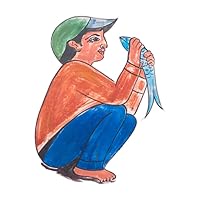
I like the use of sketches instead of pictures, but I would have liked a map somewhere in the copy, to help locate the reader along the journey.
At the archaeology conference in Chennai and Library, Tripathy had showed the audience a picture of the Kondagai skulls. Some had missing jaws and cheekbones. ‘As you can see, many breakages have happened. Post excavation also,’ she told them. It was her analysis of the 13 skeletons that Kaviya had delivered to her lab. All the adult individuals, all over 30 years of each, suffered from joint related diseases. Thirty was considered ‘old’ in antiquity.
A very good read about Keezhadi, Sangam literature, understanding Archeology 101 and the politics surrounding South Indian pre-history and history.
Although the author’s writing style can be dry at times, it does improve in the second half, where the point is proven.
It is a pretty decent if you want to understand the excavations at Keeladi and the subsequent politics surrounding the same. Also covers the history of Muziris in Kerala.
“You can't really know where you are going until you know where you have been.” - Maya Angelou
I first heard about this book in an Asianet News YouTube program called Science Talks. It was a talk show, and Amarnath Ramakrishna, the archaeologist and one of the key figures behind the Keeladi excavations, was the interviewee. During the interview, he mentioned a book called The Dig, which talks about the Keeladi excavations, and I immediately added it to my Goodreads reading list.
I have always been fascinated by the questions: Who are we? Where did we come from? Especially since my roots are in South India, it is no surprise that I loved this book even more. In my childhood, I even had the absurd thought that my white-skinned cousins were Aryans while me and my brown skinned cousins Dravidians. I was always engrossed in the idea of why India is so diverse, not just in culture and language, but also among its people. I think this book answered many of the questions I had been seeking for years.
Before starting The Dig, I had the preconceived notion that it was only about the Keeladi excavations. But it isn't. Along with Keeladi, the book contains small yet valuable information and fascinating stories about many other excavation sites across India, as well as the remarkable archaeologists, the real heroes who help unearth our roots and have dedicated their lives to uncovering our past. The author, Sowmya Ashok, has a wonderful sense of humour. She tries to present even the most complex archaeological discoveries in a light-hearted and engaging way. Just when I found myself completely immersed in the world of excavations, one of her witty lines would suddenly appear and change the mood entirely. One moment I felt like an archaeologist standing inside an excavation trench, and the next moment I felt like a member of the audience at a stand-up comedy show.
Tamil Nadu Government played a very important role in unearthing and preserving one of the most significant chapters of India's ancient history through the Keeladi excavations. It is unfortunate and sad that people often mix politics, race, religion, or other unnecessary bullshit agendas with archaeology. Because of that, we sometimes fail to appreciate what archaeology truly represents: an honest attempt to understand our shared past through evidence rather than ideology.
The Sangam world is incredible. Just by looking at the structures in Tamil Nadu built by the Pandya kings, we can see that they were no ordinary people. Without the help of modern technology, they created remarkable works that continue to stand even today. So yes, their civilization might have been truly magnificent. I can proudly say that my ancestors were part of the Sangam world.
We are all unique. DNA analysis may reveal who our ancestors were, yet our identities might be different. We may carry Ancient South Indian (ASI) ancestry, but if, for example, we are born and brought up in Britain to South Indian parents, our identity is British. We may be born in South India and later live anywhere in the world, but somewhere deep within us, our roots remain. They quietly whisper the story of where we came from and remind us that understanding our past is also a way of understanding ourselves.
“You have to know the past to understand the present.” - Carl Sagan.
such a fun trip from keeladi to rakhigarhi to indus valley civilisation (via zoom!) to muziris. learnt about so many impressive archeological methods and the process of reconstructing historical narratives from scarce artefacts. overall, a very fun read.
An immersive journey into the world of Indian archaeology, where the ancient, the recent past, and the present collide. It is excavated, contested, and reimagined in the service of belief and identity. The narration is crisp, perfectly laced with subtle humour, and, like the finest Far Eastern cinema, allows food to drift in as a sensorial aside. A rare, rational pleasure. Five stars.
If you are someone who follows the news, you couldn't have missed the debate around Keeladi - an archeological site near Madurai in Tamil Nadu for its claims of being an independent urban settlement in the south dating back to 6th century BC and the govt at the centre not fully endorsing certain aspects of it. Also, we already had the poems written during the Sangam Era (roughly 300 BC to 300 AD) in Tamil which spoke of a urban civilization with names of places unlike the Rig veda et al which is seen as the text for the IVC (Indus Valley Civilization /Harappan civilization) in the north. But to go along with the Sangam texts, we (Tamils) did not have archeological evidence in the form of an excavation site with pottery and other artifacts that help in dating. That was filled up by Keeladi which bore evidence to a fully developed and literate urban settlement and the carbon dating done by advanced methods like AMS were solid. So, it became a matter of Tamil pride and as I said earlier certain aspects of it were contested by the Centre, I mean people at ASI, and it became a matter of political debate.
Also, there is this Aryan-Dravidian conflict In terms of languages and its origins. Also, there is this theory that people in India are a mix of migrant population from central Asia (Iranian Hunter-gatherers), Eurasian ( present day Russia) steppes and people known as Ancestral South Indians (ASI) and Sanskrit as a language belongs to the Indo-European language spectrum or in other words, brought in by the migrant population. The present ruling govt wants to debunk this and with some evidence proposes that Indians are an indigenous race and sanskrit has local origins.
The author discusses all these aspects and more based on available scientific evidence. She is a journalist and not an archeologist or connected to any related discipline. So she has travelled to various place - sites and museums etc, spoke to experts in various fields, collated information from disparate sources and put together this book. The good thing is it has been written with a lot of humour, without any political bias and she hasn't made it read like a text book while not skimping on details. She has given a list of all the references i.e articles and books at the end of the book and it was an interesting exercise for me referring to the internet for many articles bcoz I hadn't read any of this stuff after my tenth grade. So, I had a good time reading it. Not so sure how other readers would find the same thing. So, if the subject matter interests you, then I recommend reading it.
Keeladi - A small village near Madurai becomes a point of controversy when structural remains, artefacts, pottery etc. are unearthed by the ASI in 2014.
The findings of the excavation (and the things that were not found during it - something to relate them with religion or Vedic culture) put a big question mark on the "Aryan Roots" theory Indians have. I mean why is it so important a belief, that any discussion related to us being an indigenous civilization is discarded instantly?
The author made this book seem like a journey which the reader is compelled to take along with her. She tried to show us how a country where the narratives are set so hard, struggles to accept something that doesn't align with those narratives however important the new discoveries may be.
It really hurt me to see history being manipulated and archaeological findings being caught up in political and cultural debates.
We should be able to know "where did we come from" without having to succumb to these "North vs South", "Aryan vs Dravidian origins" narratives!
What I really liked about this book is that when trying to highlight the Sangam literature or the importance of Jallikattu to Tamils, she gave parallel attention to the north as well as the ancient port of Muziris in Kerala. A whole chapter is dedicated to Rakhigarhi (a crucial Harappan site in Haryana).
Despite being a Non - Fiction book, it didn't feel cumbersome. I was hooked through the entire length of the book. The author's ironic remarks and sarcasm are not to be missed!
It was a highly informative read for me and that could not be summed up in a review. So if you loved reading about Indus Valley Civilization in school, then this book is something you'd definitely find fascinating.
“We call it the dark age of the period of the BJP for the last 11 years. It is the dark age of the Archaeological Survey of India.” -- K K Mohammad
When the famed archaeologist KKM said this, it was bound to erupt into controversy, and the largest sitting troll army in the world left no ballistic unfired with the fusillade of misdirected, illinformed and politically bigoted hate. That politics and archaeology share a concomitant relation in complicitous ideological behaviour cannot be skipped over, and Sowmiya Ashok's 'The Dig - Keeladi and the Politics of India's Past' is an apt empirical evidence that rhymes with how the battle to secure past has grown rhetorically in the political circles that have swallowed up the cultures of diversity into an unifying model of monotonic crucible. As Sowmiya puts it in her epilogue, which I personally regards as the tour de force of her thoroughly investigated book,
"... It was hard to pin people's words down as efficiently as a potsherd unearthed from a trench could nail down a culture."
The Dig is a story of Keezhadi (Keeladi), a village near Madurai (Tamil Nadu) that sprang up the nation's consciousness over the last one decade after excavations pointed to South India's first urban settlement. This fact was unsettling for a significant majority who were then forced to compare the Indus-Saraswati-Gangetic civilization with the one lying down South, this questioning the very basis of the Vedic beginnings that the North was so enamored with. What was not intended to be a North - South debate, unfortunately took the turn and in the process sucked in some of the brightest hotshots in the field, whose ideological shifts hurt the discipline more than anything else. It's a little far-fetched to say that the fabric of archaeology in India has been torn asunder, but the direction of its movement is compelling enough to think that way.
While archaeological findings can be slow turners to motivated conscience, the case of Keeladi was (and has been) steroidic, in so far it collectively accelerated the ante against the generally accepted narrative (whether nominal or real is for others to judge) of the Gangetic plains as housing the second phase of urbanization in the subcontinent, especially after the collapse of the Indus and Saraswati Valley Civilizations. But, even more important is the fact that the excavations in Keeladi, Sivagalai and Pattanam (the last being in Kerala near the Periyar River) are dated contemporaneously with the peaking of the Sangam Literature, this lending credibility to the physicality of geographies that were hitherto liminal on mythological premises. Deep down in the South, it had always been known that the Romans, Greeks, Chinese and the Arabs had well established trade lines. But the precise locations of many of the port towns was elusive. Not just the international connections, the digs in Keeladi found punch-marked solver and copper coins, the earliest form of Indian coinage, dating back to the 6th century BCE, proving conclusively that trade did exist between the North and the South. Amarnath Ramakrishna, with an ancestry in Gujarat's Saurashtra region and now a homegrown Tamilian! (Pun Intended) was the chief excavator in Keeladi. He has been unceremoniously transferred over the years beginning 2015 to put a stop to any further excavations. As he maintains that Delhi was deliberately trying to suppress a unique Tamilian civilization because it challenged the idea of a homogeneous Indian identity. While, this might not be openly spoken about, the Tamilian consciousness is anything but far from accepting it. The politicians have conveniently played the spin doctors to give an aggressive edge to the North-South narrative of the Great Indian Epics, depending on which side of the spectrum they belonged to. This last point is corroborated with the findings at Sivagalai, where 13 Accelerator Mass Spectrometry C14 dates and 7 Optically Stimulated Luminescent dates proved that forged metal in the form of iron was a compelling evidence to declare that Sivagalai was the oldest iron age site in the world, including those in Anatolia Turkey, China, and even closer to home in Telangana and Uttar Pradesh. This statement by the Chief Minister of Tamil Nadu, Stalin with immense pride and satisfaction that iron age began on Tamil soil was an attack on those who mocked that literature could never become history.
The dubiousness of archaeological practitioners that were sticklers of the interpretation that Vedic literature could not have come from Central Asia, has harmed the discipline of archaeology by not considering outliers. Those who advocated outliers were shuffled around across various archaeological circles, Amarnath included. This has been intellectually frustrating, and the case in point is Vasant Shinde from Pune's games Deccan College. This top-notch excavator has shown enough strands of Right-Wing affinity to dub the field more bureaucratic than is healthy. While still hazy, there is a growing consensus that the Harappans must have spoken some flavour of Dravidian language, the theory that the Indo-European languages must have encountered a Out of India migration father's stream as a result of this conjectures, and filled the Aryan Invasion Theory somewhat. Whether the people who built Keeladi are descendants of the people who may have migrated South when their civilization went into terminal decline in the second millennium BCE or whether they had been here already remains unclear. Either ways, it deepens the divide between the discursive North and South.
Sowmiya Ashok's book is a daring dig in the field getting controversial by the day, and is only the prologue for spate of literature likely to invade is in the near future. There is humor spiced throughout the text, but on the whole, it is a severely serious work pointing to a sense of things to come. As a journalist, Sowmiya humbly accepts her lack of training in archaeology, but her travels nevertheless paint a vivid picture and the travails she must have undertaken to research her treatise, which are adventurous underline the sincerity of the work. I did expect some gastropolitics along the way, thanks to her teasing delicacies on her sojourns, but, they seldom converted the decent start. Anyhow, the book is accessible in prose and a real page turner.
Definitely a must read for a history buff. The author not only covers about Keezhadi but covers briefly how archeology works across India. She definitely has a good sense of humour and as I read the book, it makes me want to go to Madurai and Keezhadi. Looking forward for her next work!
Such a lovely book - makes me want to go to Keeladi and check it all out. And at the end of the day it's such a down to earth book filled with real people.
Why do origin stories matter so much to humankind? Was there a temple under a mosque? Did Vedic culture come from outside of the Indian geography? Which is older, the Classical Age of North India or the Sangam Age of the South? Were there connections between the Harappans and the Iron-Age settlements in the South? The politics of identity cloud the history we write. When the news of the Keeladi excavation began to gain traction in 2015, it unearthed a tsunami of interest in archeology in the Tamil heartland. For the first time, there was real proof that the urbanisation of the Magadha period in North India had an unconnected counterpart in the South. The origins of Tamil civilization was pushed back 2600 years. And then came the Iron Age site of Sivagalai - soil samples and rice husks in urns there dated back to a period almost contemporaneous to the Harappan civilization, pushing back Tamil antiquity nearly 5300 years. It is an amazing story that journalist Sowmya Ashok writes. Meeting archeologists, DNA specialists, people working on the field, common folk, ministers and bureaucrats and traveling from Keeladi to Mayiladumparai to Pattanam in Kerala (Muziris), she crafts a history lesson that is being updated to the current day. She quotes beautiful Sangam poetry that helps interpret archeological findings and even attempts to learn Tamili, the Tamil-Brahmi script that is distinct from its contemporaneous Prakrit-Brahmi. As Ashok recounts the fascinating findings enriched by DNA research and radioactive dating, she also writes of the incredible pressure faced by these specialists both from resurgent Tamil pride and a Hindutva-driven agenda at the center. As she says, "..with the State acting as the custodian of how our past is studied and remembered, over time, these stories have become political games to capture who is indigenous to this land." The book is hugely informative. The non-chronological narrative can be a bit confusing, but what you are finally left with is a sense of awe for an ancient culture that reverberates across time and space, and deep respect for the "quiet heroes" who are working to discover how we came to be the people we are today. A big, big recommend.
We approach history the way we approach a courtroom verdict — as settled fact, delivered by evidence, immune to opinion. The Dig dismantles that comfortable assumption quietly but thoroughly.
Consider something as seemingly objective as carbon dating. A dated artefact doesn't return a year — it returns a range. 300 BCE to 600 BCE. Three centuries of ambiguity, gift-wrapped in scientific authority. Which end of that range you choose to anchor your narrative to isn't a scholarly decision. It's a political one. And the consequences — for national identity, for whose civilisation gets to claim antiquity, for who writes the textbook — are anything but academic.
What makes Soumiya Ashok's work particularly sharp is that she doesn't stop at archaeology. Genetics, literary history, and material archaeology frequently disagree with each other on the same questions. And where three sciences produce three answers, what fills the gap isn't more science. It's power.
This is the book's central argument: ambiguity is not a vacuum. It is a territory. And political narratives don't wait for scholarly consensus before moving in.
Ashok is honest enough to admit her own positionality upfront — she cannot be a neutral narrator any more than anyone else can. That admission, rather than undermining the book, is precisely what gives it credibility. History, she implies, has never had a neutral narrator. We just forgot to ask who was speaking.
Sowmiya Ashok's The Dig-Keeladi and the Politics of India's Past is a non-fiction book that chronicles the controversial Keeladi archaeological excavation in Tamil Nadu. She traces her investigative journey from Tamil Nadu's earliest Iron Age sites to the Harappan site of Rakhigarhi in Haryana and Kerala's lost port of Muziris, blending on-site archaeology scenes with conversations with archaeologists.
Humanity is obsessed with the past, our legacy, our history and an obsessive need to have a linear and stratified narrative about our religious, linguistic and geographical identities but as Soumya Ashoka in her research found out that " History was noisy" and filtering through this noise she has written a compelling book about our complicated past. Written with sharp insight and humor, the book also examines how archaeology has been practiced and politicised throughout independent India, demonstrating how scientific inquiry has been corrupted into a tool for political legitimation rather than genuine discovery, making it essential reading for anyone interested in history, current affairs, and the dangerous intersection of science and politics.
Especially in a time when we have collectively abandoned peer-reviewed journals for podcasts, Instagram reels, and online platforms promising to reveal "SHOCKING TRUTHS" to mass audiences, making viral content more effective at manipulating public opinion than rigorous scholarship.
“A land where the very breath, song and sacrifice of its people have bound to the Tamil Language”.
Everywhere, it’s about Keeladi. The identity of ancient roots just found in the southern region of India. A decade back, this happened. A team was sent to trace the origin of our history from the Stone Age, under the leadership of Amarnath. He was the sole reason for the excavation. And suddenly, they transferred him to somewhere in the northern part of India. You lay the foundation for it, and the Centre can’t digest it anymore. That’s the result for Amarnath. Definitely, it’s political in many ways.
Every detail the author has researched, and the travel over the years, has been beautifully put into the book. More than the political aspect, it’s about ancient history in the soil being covered, and it should be known to everyone. What I loved was her sarcasm along with the story flow. That’s where the book stood out for me. I never felt bored throughout the whole journey along with her travel. She has split the journey into two parts. The first part is about how it started, and the second part is more about archaeological work. It has a beginning, and there is no end — it’s even more about what’s to come.
I even happened to know more than what school books preached to me. One chapter I was completely obsessed with was about DNA; it was purely new to me. Lastly, I watched her interview — it was so good, and I wish it had extended some more. To simply say: a rare book that delivers the important history behind the ancient world underneath. I have shortened myself so that you can read and know Keeladi. Definitely a must -must read from my side.
3.5 stars. This book is very interesting in parts, and dragging in others. But let the title not mislead you, it's hardly about Keeladi but very much about the politics of piecing together India's past. Sowmiya Ashok is a journalist and this book is traveling to different archaeological sites, speaking to archaeologists and students and people from different places and putting together the story of India's past against the backdrop of a narrative the central government is trying to forcibly push. As a complete outsider to the field, I am left with a deep sense of appreciation for the discipline of archaeology and the drudgery of everyday digging versus the grand stories that emerge. She zooms out from Keeladis to other sites in Tamil Nadu like Arikamedu (a site I visited on a Pondicherry trip), Sivagalai, Adichanallur and Mayiladumparai to Rakhigarhi in Haryana and Pattanam in Kerala (presumably inhabited by the Muziris). It certainly sparked an interest to learn more about these disparate histories. She does not give us a linear storyline but snippets of conversations, interviews and her own findings. This book is a documentary style peek into the messy world of deducing the past amidst black and white narratives, about the process of finding facts but not the facts themselves...
Sowmiya Ashok's The Dig: Keeladi And The Politics Of India's Past is an interesting book. As the title suggests, it focuses on Keeladi, a historical settlement found in Tamil Nadu, that may even predate the far more famous Harrapan Civilization sites.
While archeologists thronged the site, so did politicians; and its discovery in 2014 led to a further deepening of the discord between India's North and South.
Language, culture, ancestry and questions of Dravidian vs Aryan were all thrown in the melee and instead of celebrating something that could rewrite history we seem to have gotten lost in the politics of it all.
In this book, information about the site shares equal space with the controversies around it and it makes for a good, if not, necessarily deeply engaging read.
An exceptional 'dig' into India's past and how our present and our polictics shapes it.
For an archaeology newbie, this book presents the finds and the facts in such an interesting way that I was not once bored or tired of reading. I felt a sense of wonder while reading, really imagining, like the author sometimes wrote about, the process of the 'digs' and how fascinating it would be to actually work and then discover a lost city, a lost 'wharf', and so many artefacts that our ancestors left behind to tell their stories. How amazing would it be to unearth a pot and it leads to the unearthing of a new 'civilisation' lost to the world and only spoken about in Sangam literature.
This book really is exceptional, and I thoroughly enjoyed reading it.
I picked up this book hoping to read more about Keeladi—but it turned out to be much more expansive. Keeladi final report is not yet published by ASI (as mentioned in the book). In that sense unfinished book. May be scope for a sequel:) Or I wonder the rush to publish the book was to put a voice that may counter with what is coming or a sponsored propaganda.
The book explores a range of archaeological digs across India, weaving them into a broader narrative. The author also takes a few subtle “digs” at the current state of the ASI, which added a layer of quiet critique to the storytelling.
I enjoyed the book and especially Madurai section mutton scene.
This was an interesting and engaging read, I learnt a lot about archaeology and also the different political forces and individual biases that come into play when we try to learn more about our past. In that sense it's not a "classical" popular history book and the author is no historian (nor is the book advertised that way), but her writing style is quite evocative and personal, reminded me of another one of my favorite Indian non fiction authors Samanth Subramanian. It's left me inspired to dive back into Indian history and read some books especially about the prehistory and early history of southern India.
Extremely detailed and thorough book on just not Keeladi, but about archeology in general. This was the first time I was reading something very detailed and technical about this field, and how the various institutions in India function. However, the book takes its time to go through key details and points, and I saw myself skipping loads of pages to get to the meat of the book. A very insightful read indeed for someone open to know about new things in general
What an extraordinary narrative style Sowmya has... It feels like you are traveling with a friend, sharing stories. And as light as it feels, this book is laden with politics, history, and so much data. It makes you question your ancestry, wonder about a world from a different time and fills you with pride and some times, gently breaks your bubble. Cannot recommend this book enough. Especially if you are South Indian
I really like the premise of the book - how a thousands of years old civilization can impact the politics of today. And the author writes well - she weaves in the personal deftly, writes with simplicity and lucidity, and shows some restrained humour too.
But, unless archaeology/ history are your thing, there is only so much you can read of this book. It was a DNF for me, but I can see how it would be appreciated by a niche audience.
The Dig by Sowmiya Ashok is a fascinating exploration of the Keeladi excavation, shedding light on one of India's most significant archaeological discoveries. Blending history, archaeology, and meticulous research, the book challenges long-held narratives and uncovers the untold story of an ancient Tamil civilization. It presents complex historical findings in an engaging and accessible way, making readers appreciate the richness of India's past.
The book provided an interesting behind the scenes perspective to any archeological discoveries in India. Since Keeladi was one of the recent discoveries, it was fun to remember some of the new articles as I was progressing through the book. The book also left me with a bit of disappointment as it shed light on how the historical information is manipulated for the general public to meet the political agenda of the party in power.
I really enjoyed this book! It was exactly what I needed to dive into the Keeladi excavations and other recent Southern Indian finds. The book does a great job balancing facts with different perspectives, handling the politics of it all without getting preachy. Plus, the humor sprinkled throughout makes it an easy, satisfying read!
I felt so connected, curious, and learned so much about my culture in the most real way possible. I loved how every place she travelled to was intertwined with its food I could almost taste everything alongside the archaeology and the unearthing that unfolded in this book.
I hold this one very close to my heart, @sowmiyashok.writes. The Dig was so beautifully written.
C'est un livre remarquable sur l'archéologie et la politique en Inde. L'auteure a beaucoup voyagé, s'est entretenue avec des experts et des habitants et recherches, que reflechir elle ecrit. Toutefois, ses descriptions de certaines personnes sont un peu étranges ou bizzares. Je ne sais pas ce que ces gens pensent en lisent cela à leur sujet.
Good narrative structure kept me interested. Broadly sets the stage about archeology and its political implications in India. The author takes you along on her real human journey while keeping the nitty gritty details interesting for a casual reader.