"This revolutionary book is one that modern leaders and change makers must read." —Readers' Favorite
Managers direct reports. Leaders inspire followers. Role models engineer identity and magnify the future.
The secret to exceptional impact isn’t talent. It’s the power of role modelship. Your competitive edge depends on learning from the best. As we integrate AI into our lives, it’s more vital than ever to model the best of who we are. AI learns from us. It mirrors our data, habits, and humanity. Role Modelship offers the human grounding and guardrails AI lacks.
Silicon Valley tech executive Eli Potter reveals how the same core values that the world’s most impactful innovators use to achieve lasting influence can be harnessed to grow, adapt, and scale any organization or product. Sixty-eight percent of adults under forty say they’re more satisfied with their careers and finances when they have a role model.
Featuring over two hundred real-life stories, Role Modelship presents insider strategies that create transformative growth and success. Learn to unlock the next level of excellence and turn your leaders into role models.
AI Can’t Be What It Can’t See: A Review of “Role Modelship” and the Quiet Crisis of Values in the Age of Agentic Work By Demetris Papadimitropoulos | February 1st, 2026
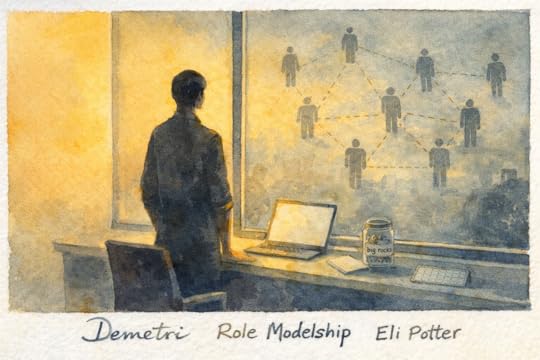
Watercolor Piece by Demetris Papadimitropoulos
Eli Potter’s “Role Modelship” arrives with the wind-in-the-hair confidence of a keynote that refuses to stay on the stage. It wants to follow you home, climb into your calendar, pin itself to your Slack, and tap your shoulder before your next meeting: Example-set until you’re proud. In Potter’s universe, leadership is not merely a set of competencies but a kind of moral physics, a chain reaction of visible habits and values that travels through teams, products, and, increasingly, machines. We are always teaching something, she argues, even when we believe we’re only shipping code, closing a quarter, or surviving a Tuesday.
The book’s central premise is both old as proverb and newly urgent: we see farther by standing on the shoulders of giants, but we still have to learn to walk on two legs. Potter is less interested in the mythic lone genius than in the lineage that makes genius legible and contagious. Her “giants” are not marble heroes; they are multipliers, the kind of people who instinctively trade private triumph for public lift. The goal is not to become a monument. It is to become a relay.
Potter organizes this relay into five recurring human values, her house pentagon: stewardship, fellowship, mentorship, leadership, sponsorship. A reader can feel the architecture behind the prose: categories, ladders, nested loops, routines made visible, reframings that turn the emotional weather of work into a navigable forecast. The book is full of those bright, almost sticky conversions: failure becomes learning; drained becomes recharging; quitting becomes pivoting; disappointed becomes delayed. It is an optimistic lexicon, but not a naïve one. Potter has enough corporate miles to know that language is the first battleground where culture either degrades into cynicism or lifts into shared intention.
What differentiates “Role Modelship” from the crowded shelf of leadership literature is the insistence that values are no longer merely interpersonal. They are infrastructural. Potter’s most compelling argument is that in the age of AI, your habits are training data. AI, as she repeats, can’t be what AI can’t see. That line has the satisfying bluntness of a safety label, and it performs double duty: it’s a warning about bias and a rallying cry for visibility. If organizations allow their “normal” to remain exclusionary, extractive, or fear-based, then automation will not cleanse the system; it will scale the system. If they insist on deliberate role modeling, then AI becomes less a haunting mirror and more a magnifying glass held with care.
The book’s late-stage crescendo, the rallying cry Potter calls “Wire 2 Model,” leans into this idea with pop-culture buoyancy. She imagines agentic coworkers with brand skins, digital Barbie and Ken running GTM challenges, coaching middle managers, managing budgets, even nudging humans not to interrupt one another in Zoom calls. It’s playful and a little unnerving, which may be exactly the point: our future colleagues may be avatars, but our future values cannot be outsourced. Potter’s best moments are the ones where she refuses the lazy technological fatalism of our era, the shrug that says: the model will decide. The book keeps returning to agency, to the human decision to show up differently, to the notion that “goals aren’t just targets to hit; they’re demands to become different humans.”
That phrase also reveals Potter’s style. She writes in mottos and incantations, the way a coach might speak during the crucial minutes when a team’s body language starts to betray it. “Role Modelship” is not shy about being a book with a pulse. It is crowded with quotations, parables, brand slogans, and cultural touchstones that move from “Seinfeld” to “Dune” to “The Wizard of Oz” with a kind of caffeinated sincerity. Potter’s mind is a collage board: Metcalfe’s Law sits next to apple pie, “Cosmos” next to a reframing table, a Notre-Dame restoration reverie next to a prompt to express gratitude on LinkedIn. Some readers will find this maximalism invigorating, a reminder that leadership is not a sterile discipline but a lived, mixed-media practice. Others may feel the book’s attention skipping like a stone, the metaphors multiplying until they begin to compete with the argument.
Still, the scaffolding is sturdier than the glitter suggests. Potter’s practical frameworks are designed to be used, not admired. Her “Stop → Anchor → Start” method for one-day habits is classic behavioral design dressed in her signature language. You stop the time-wasting reward loops, anchor new behaviors to nonnegotiable routines, then start in small, sequential increments. She extends the idea into weekly habits via the Pickle Jar Theory, emptying the calendar of sand to make room for big rocks. The twenty-one-day section pushes into organizational design: boards of directors for middle managers, sprint calendars, feedback loops, and a recurring insistence that accountability must be social to stick. Potter is an evangelist for visibility. Invisible, random routines stay slippery; visible, anchored routines become culture.
If these tools feel familiar, that’s because Potter is candid about her intellectual lineage. “Role Modelship” stands in conversation with “The Power of Habit,” “Atomic Habits,” and the broader behavioral canon that treats identity as a byproduct of repeated action. It also echoes the leadership bookshelf staples – “Multipliers,” “Dare to Lead,” “Good to Great,” “The Culture Code,” “Leaders Eat Last,” “Drive,” “The Speed of Trust” – while filtering them through an AI-era moral lens: what happens when your culture is not only a hiring magnet, as Potter notes through examples like HubSpot’s culture-as-product framing, but also a dataset?
Where Potter is most original is not in inventing a new psychology of habit, but in making the ethical implications of workaday behavior feel newly concrete. A toxic boss isn’t just a human problem; it is a pattern that gets encoded. A lack of psychological safety isn’t merely an engagement risk; it becomes an algorithmic shadow that can follow a company into its tools. Her emphasis on diversity of voices and data is not presented as HR virtue signaling but as a technical necessity: if the mirror is fed a narrow life, it will reflect a narrow life. That is a persuasive reframing for an era in which so many organizations claim to care about equity while building systems that quietly optimize around convenience.
The book’s parade of role model examples – corporate executives, cultural figures, educators, choir directors, public leaders – is meant to demonstrate the five values in action. Scott Herren’s financial transformations, Reese Witherspoon’s platform-building, Michelle Obama’s high-grace public stewardship, a teacher’s generational influence, a CIO’s innovations in sports technology: Potter wants the reader to feel the network effect, to understand that role modeling is not a personal brand but an ecosystem. She even does the math for you, turning mentorship into multiplication, lineage into exponential growth. The numerical certainty can feel a bit too clean; networks are not always so obedient, and human influence is rarely a simple square. But as metaphor, it works. It does what Potter’s best metaphors do: it persuades the reader that small, consistent actions are not small at all.
There is, however, a tension at the center of “Role Modelship” that the book sometimes smooths over with slogan. Potter’s insistence that we can “reframe” our way into healthier meaning is valuable – and also limited. Reframing is powerful when you have agency; it can become a gentle cruelty when you don’t. A worker facing exploitation or discrimination does not need better vocabulary alone; they need structural change, accountability, and protection. Potter gestures toward systems often enough to show she understands this, especially when she discusses organizational routines, boards, and predictable processes that elevate diverse talent. But her tone sometimes risks sounding like a motivational poster hung over a cracked foundation. When she is specific about governance, compliance, and the design of feedback loops, the book gains weight. When she leans too hard on uplift without interrogating power, it can float.
Similarly, Potter’s futurecasting – digital coworkers, agent marketplaces, synthetic avatars, AI-to-AI protocols – is lively, but it carries an expiration date. Today’s AI discourse ages fast. Some of her examples already feel like snapshots from a rapidly moving parade, and a reader may wonder which of these visions will remain relevant once the next platform shift arrives. Yet the underlying question Potter keeps asking is durable: in a world where machines can mimic style, simulate empathy, and optimize at scale, what do humans owe one another? Her answer is not abstraction. It is practice. It is showing up, over and over, with values that can survive replication.
“Role Modelship” is ambitious in a way that is increasingly rare in business writing: it is not content to help you win at work. It wants to help you win as a team, win as a culture, win as a species with its hands still on the steering wheel. At its best, the book feels like a blueprint for moral stamina, a reminder that the future will not be shaped only by engineers and capital but by the quiet decisions people make in meetings, in feedback, in whose voice gets amplified and whose gets overlooked.
At its messiest, it can feel like an overflowing tote bag of metaphors, frameworks, citations, and cheerleading – a book that sometimes confuses accumulation for persuasion. Potter’s stylistic DNA is everywhere: the rallying cries, the lists, the earnest pop culture, the repeated insistence that every day is demo day. If you like your leadership books to read like a spirited sermon with diagrams, you’ll be fed. If you prefer austere argument and fewer exclamation points in spirit, you may wish for an editor to empty the jar more aggressively.
And yet: there is something bracing about Potter’s refusal to be cool. “Role Modelship” is a warm-blooded book in a cold, automated time. It argues, sometimes with a grin, sometimes with a hand on your shoulder, that influence is inevitable – so you might as well set the example intentionally. That message, even when delivered with maximalist gusto, lands because it meets the moment. We are living through an era in which institutions are asking humans to adapt faster than humans can metabolize change, and where AI promises to solve everything except the question of what should matter. Potter’s contribution is to insist that what should matter is not mysterious. It is visible. It is repeatable. It is, in her language, wireable.
Role Modelship: Multiply Your Impact to Influence AI by Eli Potter is a leadership and organizational development book focused on how role modeling can shape culture, performance, and human AI alignment in modern workplaces.
The book argues that true influence goes beyond management or leadership into “role modelship,” where individuals actively shape identity, behavior, and organizational direction. It combines real-world stories with strategic insights on leadership behavior, culture building, and adapting to AI influenced environments.
This is best suited for leaders, managers, and organizational strategists interested in culture transformation, influence, and leadership development in the context of emerging AI systems.
AI has created a world of uncertainty leaving me question what the impact will be. This wonderful work helped me understand that I do have control and a responsibility to help shape AI. I will continue to look upon those that know more, but will rise to be a mentor given the opportunity. I had the pleasure of reading this book through a GoodReads giveaway.
Role Modelship: Multiply Your Impact to Influence AI is a forward thinking and practical exploration of leadership in an increasingly AI-driven world.
In this work, Eli Potter introduces a compelling shift in perspective from traditional leadership toward what he defines as “role modelship,” a concept centered on influence through example rather than authority.
One of the book’s strongest contributions is its relevance. By connecting leadership principles to the rise of artificial intelligence, it highlights an often-overlooked reality: AI systems reflect the behaviors, values, and patterns of the people who design and train them.
The idea that influence extends beyond teams to technology itself is both timely and thought-provoking. It reframes leadership as something that not only shapes organizations but also the digital systems that increasingly shape society.
The book is rich with real-world examples, drawing from a wide range of industries and experiences. These stories help ground the concepts and make them accessible to readers at different stages of their careers.
Another key strength is the focus on identity and values. Rather than emphasizing tactics alone, the book encourages readers to consider who they are modeling and why. This adds a deeper, more reflective dimension to the leadership conversation.
The writing balances inspiration with practicality, offering strategies that can be applied in real world settings while still maintaining a broader vision of impact.
Thematically, the book explores influence, responsibility, and the evolving role of leadership in a technology-driven age. It suggests that the most meaningful impact comes not just from decisions, but from the behaviors and standards we consistently demonstrate.
Overall, Role Modelship is an insightful and timely guide that challenges readers to rethink leadership through the lens of influence, identity, and the future of AI.