The story of the novel in Britain is a good story. It begins in the eighteenth century, when people from outside the regular circles of power and authority began to read in ever greater numbers, seeking words that helped explain their multifarious hopes and desires. A new kind of literature was needed for this growing market of readers, one that reflected as many different lives in its pages as there were people to buy them, that could change with the times and do something something novel.
In this illuminating new history of both an art and an industry, Philip Hensher describes how the evolutionary scramble by writers and publishers to get attention drove constant innovation in writing techniques, and produced new ways of printing, distributing, and selling books. Over the course of three hundred years, these forces shaped the novel’s form and its future, from Daniel Defoe to Zadie Smith. Reading widely across the famous, the once famous and the utterly (if unfairly) forgotten, Hensher’s account is a book of investigative verve that makes a serious case for widening the canon.
A History of the Novel in Britain is not only a study of this endlessly entertaining and inspiring it is a hoard of treasure waiting to be discovered and enjoyed.
Hensher was born in South London, although he spent the majority of his childhood and adolescence in Sheffield, attending Tapton School.[2] He did his undergraduate degree at Lady Margaret Hall, Oxford before attending Cambridge, where he was awarded a PhD for work on 18th century painting and satire. Early in his career he worked as a clerk in the House of Commons, from which he was fired over the content of an interview he gave to a gay magazine.[1] He has published a number of novels, is a regular contributor, columnist and book reviewer for newspapers and weeklies such as The Guardian, The Spectator , The Mail on Sunday and The Independent. The Bedroom of the Mister’s Wife (1999) brings together 14 of his stories, including ‘Dead Languages’, which A. S. Byatt selected for her Oxford Book of English Short Stories (1998), making Hensher the youngest author included in the anthology.http://literature.britishcouncil.org/... Since 2005 he has taught creative writing at the University of Exeter. He has edited new editions of numerous classic works of English Literature, such as those by Charles Dickens and Nancy Mitford, and Hensher served as a judge for the Booker Prize. From 2013 he will hold the post of Professor of Creative Writing at Bath Spa University.[3] Since 2000, Philip Hensher has been listed as one of the 100 most influential LGBT people in Britain,[4] and in 2003 as one of Granta's twenty Best of Young British Novelists.[1] In 2008, Hensher's semi-autobiographical novel The Northern Clemency was shortlisted for the Man Booker Prize. In 2012, Hensher won first prize -German Travel Writers Award, and is shortlisted for the Green Carnation Prize. He also won the Stonewall Prize for the Journalist of the Year in 2007 and The Somerset Maugham Award for his novel Kitchen Venom in 1996. He wrote the libretto for Thomas Adès' 1995 opera Powder Her Face. This has been his only musical collaboration to date. His early writings have been characterized as having an "ironic, knowing distance from their characters" and "icily precise skewerings of pretension and hypocrisy"[1] His historical novel The Mulberry Empire "echos with the rhythm and language of folk tales" while "play[ing] games" with narrative forms.[1] He is married to Zaved Mahmood, a human rights lawyer at the United Nations.
Novels consist of a number of things, and one of them, often, is a story. A good story can be told in a few sentences. Or it can be sustained over tens of thousands of words. And the story of the novel in Britain is a good story. It has heroes and heroines, and villains, too. It has quests and adventures, marvellous inventions and hidden treasures. It discovers secret pathways and gardens, and conceals traps for the unwary. It has magicians, and it has careful, responsible scribes, too. It is a good story.
Coming to this as an avid but inexpert reader, A History of the Novel in Britain turned out a surprisingly enthralling read, its intimidating size, scope and density– about 600 pages of text followed by another 50 pages of notes and bibliography– not for a moment curbing my initial excitement and enthusiasm.
Arising out of fifty-five years of his reading, Hensher is telling not “the” but “a” history – namely his unapologetically personal and subjective story of the novel in Britain, and he does so in a superbly compelling way, apparently determined to stay true to his own standards and vocation as a novelist. As a matter of principle, he decided to only write about the novels he effectively read– with a few exceptions that he couldn’t track down. Imagining this must have implied ploughing through thousands of books among quite a few not so thrilling ones, for this alone he deserves admiration for this labour of love.
Odd as it may sound about a non-fiction book, Hensher undeniably manages to present the life and evolution of the novel in Britain as a good adventure story, with a keen eye for detail (ineptly unappealing book titles) and felicitous anecdotes which makes it feel awkward if not wrong to share excerpts from it, lest revealing too much of the plot or irksomely meddling in his storytelling (remembering a friend who once urged me not to ask her questions during her exposé in order not to interrupt the chronology of her story). Exactly that pulsating narrative flow is one of the great merits and delights of this book, since Hensher connects the dots between authors, periods and genres, draws parallels, points at the indebtedness of authors to their predecessors (Jane Austen to Fanny Burney, Virginia Woolf and Ivy Compton-Burnett to Charlotte Yonge)- in short puts the authors and the novel into a wider context. Discussing storytelling techniques or perspectives he highlights that what seems brilliantly new might rather be nil novi sub sole after all:
"It is noticeable that by the beginning of the twenty- first century, fiction categorized and rewarded as ‘experimental fiction’ was often required to fullfil a few firm genre requirements, hardly any of which could be regarded as new: to have passages in stream-of-consciousness, a style of writing established since the First World War; to be in the present tense, like passages of Dickens; to express modernity in fragmentary collage like Evelyn Waugh; to have central characters with no assigned name, like Fanny Burney’s last novel; to be written in the second person, like Lewis Grassic Gibbon; to have passages of self-aware commentary on the novelistic approach and the novelist him or herself, rather like Fielding; to write whole chapters or even a whole novel in a single sentence, much like the last chapter of Ulysses. In the weakest of novelists of declared experimental bent nothing can be found that was not done better in novels written over a century ago."
A strong opinion? Yes, occasionally, Hensher’s voice as a critic is rather waspish and brutal (using denominations as ‘idiotic’ or ‘witless’, or writing on Georgette Heyer: “Historical specialists continued to arise, and sometimes to make long, profitable careers out of their terrible novels”). Probably at least one of your favourite authors will be given a dressing-down (Virginia Woolf) or not even deemed worthy of mentioning (Anita Brookner). As a reader, you might not share his literary sympathies or political proclivities, but when you are the kind of reader who likes to engage with what you are reading and are fond of reading books on books without bothering about a casual spoiler, you will likely delight in the wide range of critical views, riveting analyses on phenomena like the silver fork novel, the popularity of the historical novel and retellings, the rise of the short novel. Also readers not averse to the business aspects of the publishing and printing business (patronage, Mudie’s three-volume novel format, the role of libraries, marketing, prizes, gatekeeping and legal issues like copyright) will be served generously.
Although I have only read a small fraction of the authors and novels that Hensher discusses, after ten years of hanging out in this virtual reading Walhalla, many of those unread novels and authors waved to me like old friends. It was a singular joy to encounter those novels and authors that are devotedly reviewed on Goodreads in a broader context, from Samuel Richardson’s Pamela and Henry Fielding’s Shamela to Angela Carter and Le Carré. Evidently, I was anxious to read Hensher’s opinion on some of the British authors close to my heart; it was a relief to find at least Penelope Fitzgerald and particularly Elizabeth Taylor handled with care.
Hensher is not above giving certain authors their due, despite his lack of enthusiasm for them (grouching for instance on Virginia Woolf “Perhaps she was always writing about herself and nobody else”.) and to include them perhaps not in his personal pantheon but nonetheless granting them their place in the canon. That personal pantheon – Dickens, Thackeray, Trollope, Arnold Bennett (“The Old Wives’ Tale (1908) stands out. It ought to be acknowledged among the twenty greatest novels in English), Anthony Powell, Forster, Nancy Mitford, Wodehouse, V.S. Naipaul, Barbara Pym, Robbert Liddell, Elizabeth Taylor - to name a few - is as wide-ranging and various as it seems telling when taking a closer look at Hensher’s own background and proclivities (looking at the length of his own novels, a preference for the bulky type and reading reviews about his the The Northern Clemency, a rather obvious dislike of the political left).
Hensher concludes his overview with an extensive list of the editions of the novels he read and lists the names of circa 250 authors by whom at least one - if not all – novel should be permanently and easily available, as an equivalent of the French Bibliothèque de la Pléiade – the canonic novels. That canon, as meticulously appraised throughout this book, undoubtedly would offer reading inspiration and contemplation for multiple reading lives, even if one would stay in Albion forever bookwise. Because I enjoy making lists and subsequently not sticking to them, the treasure Hensher is offering here is in any case persuasive enough to have promised myself a copy of A History of the Novel in Britain as soon as it will be published, to be able to consult it whenever the need arises, which likely will be often.
Many thanks to the author and to Penguin for an ARC via NetGalley.
An awesome book. He makes a terrible lot of fierce generalisations and judgements about this or that period and you kind of have to take what he dishes out because you haven’t read the 300 novels of the 1830s and 40s that he has, but I didn’t mind that.
He’s quite prepared to throw some shade, I liked that part particularly, as you may imagine. On Henry James’ late novels :
They are sometimes rather strangely short of anything resembling incident… In my view The Sacred Fount is the most difficult novel in the English language, Finnegans Wake and The Making of Americans not excluded.
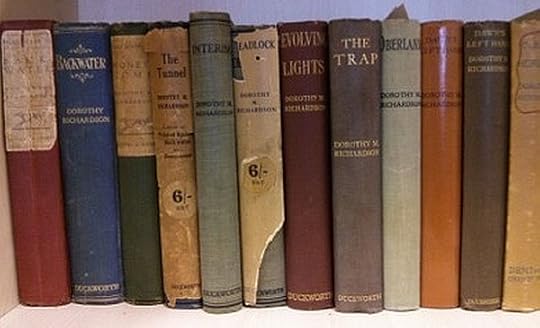
And you have to laugh immoderately when he crashes into Dorothy Richardson’s gigantic Pilgrimage epic (13 novels published 1915-1938) :
Many readers have found the cycle dismayingly boring and put it down to the excruciating triviality of most of Miriam’s experiences… Pilgrimage is indeed extremely boring.. The reason it is boring is the same reason that monologuing egotists in real life are boring… egotists never pause to find out what distinguishes an individual, after a banal first scoping…it makes for a terribly wearying reading experience
According to Philip Hensher this is how her fans will leap to her defence:
Of course we don’t know anything about the people round Miriam! Of course she’s extremely boring to, listen to! That’s because this is a very good book!
He loves dear Virginia’s To the Lighthouse and Mrs Dalloway but not The Waves
I frankly admit to detesting it.
And here’s a little literary question. Who is he writing about here? Can you guess?
Everybody has read it. It is an enormous popular favourite. It is, moreover, clearly a work which achieves a great originality, even though this may be at the cost of stubbornly ignoring almost all other practitioners of the art. Nobody considering the history of fiction seems to write about it; it has hardly ever been taught in institutions or promoted by authorities. Its life is undeniable, and 70 years after it was published we may as well admit that it is part of our literature.
A MORE DETAILED REVIEW OF THE LAST 100 PAGES – CHAPTER ENTITLED “NEW NOISES”
This covers the period 1960-2000.
The gobsmacking depth of Professor Hensher’s knowledge shows up in many casual mentions of novelists I never or only faintly heard of such as R F Delderfield, Edgar Mittelholzer, George Lamming, Margaret Oliphant and on and on.
And he seems to remember actual details about all the hundreds of novels he’s read whereas I have to check on Goodreads if I actually did read this or that book or I just have a false memory of reading it. Here he is praising Elizabeth Taylor :
Letters in general are a source of danger and even violence – the discovered note confirming adultery in Angel, the anonymous letter of denunciation that wreaks havoc at the end of The Soul of Kindness, as well as the self-penned love letters that a paid companion uses to make her employers’ life hell
He has read so much that he can confidently say that in the late 60s/early 70s
A large number of novels were produced about groups of characters in extreme old age, limiting characters under the age of sixty or even excluding them altogether
But wait – he has a superpower :
Some of the best novels of the time could be comfortably read in an afternoon
I confess that even a short one (150-200 pages) would take me all day with no breaks, so I think the professor simply reads at three times the speed of a normal person. It’s probably an entry requirement if you are going to write a history of novels.
LIKES AND DISLIKES
He beats up “experimental” novelists and leaves them scrabbling for their phones to call the cops
In the weakest of novelists of declared experimental bent nothing can be found that was not done better in n ovels written over a century ago. What, frequently, is demonstrated is that “experimental fiction” has become a genre with as strict requirements as a cheap romance or whodunnit, far from the ludic inventiveness of that first generation of experimental novelists.
(Ludic is one of his very favourite words.)
There are sideswipes
Novelists as patently untalented as D M Thomas
And unexpected fountains of praise
V S Naipaul was the single best writer to emerge in the English language after the War
Didn’t see that coming.
And there are some headscratchers too Kazuo Ishiguro’s novel The Unconsoled gets a rare page long discussion – he liked Ishiguro and calls this “his best novel” but then on the same page says that it’s “indubitably rather boring” (p567). Hmmm.
Ah yes, he gives a shout out to Abebooks.com! I would like to second that emotion.
A COUPLE OF THINGS I MIGHT QUIBBLE WITH
He scoffs at the idea that novels should be morally uplifting
For many years, the gatekeepers of the novel had insisted that the value of the novel lay in its moral arguments. The idea of a great novel that was quite unconcerned with morality…or even one that might be admired even if one considered its argument to be completely deplorable, was quite disregarded
And he gives examples of some novels he considers “irresponsible” but still great – The Satanic Verses for instance. But later, as he is decrying the decline of novel reading in Britain, he mentions the sad case of a teenage boy murdered by another teenage boy which happened as he was writing this chapter.
I doubt that anyone in this story was a habitual reader of novels. If you had read more than one novel, with attention, it would be impossible to bring a machete down upon the face of another human being without guessing what it would be like to be behind that face as the blade fell upon it. You would not do it.
He seems to be quite genuine in this idea – the idea being that reading novels inspires empathy and inhibits the urge to inflict violent vengeance. Surely this contradicts his earlier comment because couldn’t we think of many “irresponsible” novels written, say, The Turner Diaries, which were explicitly written to inculcate these vicious emotions. It sounds like a naïve argument to me.
And he hands out vast praise to Zadie Smith’s White Teeth for capturing
Voices that had hardly existed until a year or two before in just that syntactic form …for the reader in the future, a certainty that a quickly receding style of speech was precisely recorded
It seems he’s read a ton of novels but not seen many indie movies that have done exactly that since 1990 at least.
Quibbles aside, this is just what I wanted to read. Already made a note of eleven novels I now must read.
This is a gloriously eclectic - in some places nicely iconoclastic - history of the British novel, from its beginnings in the seventeenth century (Hensher discounts the prose romance etc. which, he claims, has different 'rules' from the nascent novel) to around 2000. What makes it both more penetrating and more valuable than the standard academic tomes that plod through the same-old history, is precisely Hensher's subjectivity combined with a life-long love of reading and a scholarly perspective (he did his PhD on eighteenth century satire), all leavened by his own status as a novelist. I didn't always agree with Hensher's theories or choices but he says upfront, as good readers always do, that he wants people to disagree, discuss and argue back - that's all part of the process of learning and engagement with literature.
One of the guiding principles that makes this book stand out from its predecessors is that Hensher is more attentive to the recent academic work on the history of literary marketplaces, the mechanisms of the publishing trades, and the legal frameworks within which literature is created and read: the gate-keepers of the Stationers' Company, the impact of the first copyright law not appearing until Queen Anne, the role of the major lending libraries like Mudie's which used public morality as a criterium for what they were prepared to put into circulation are all shown to influence not just who could write and who had access to literature but what was written. (There's an interesting follow-through as Hensher muses on how major book prizes like Booker don't just reward already-written books but can impact on what form books might take based on previous winners and the effort needed by the judges to get through the lists). Laws like the Net Book Agreement which was abolished in 1997 affect the market, and even the deaccessioning of 'classics' from many public libraries and the consequent drop-off of users is lamented as closing down our ability to read widely and historically for free.
A prime argument - and here I'm really not convinced - that Hensher makes is that the British novel has always been about social mobility. There are certainly places where he has made me rethink a particular book but this over-reaching argument definitely made me argue back - exactly the kind of provocative stance I want from a book that might have simply tread old ground.
The other thing I love about this book is the genuine pleasure that Hensher shows in reading, moving easily from genre fiction like Agatha Christie to the 'literary' in a way that self-consciously makes those boundaries porous. He is also not afraid of breaking some long-established consensus: for example, he states clearly something that I have long thought, that Evelyn Waugh is a political reactionary in his books, and that Jilly Cooper's 'bonkbusters' are firmly located in a long English tradition that encompasses books like Middlemarch and Anthony Trollope.
A quick warning: Hensher spoils plots so do be aware if this is an issue for you. Otherwise, I found this a breath of fresh air that is both erudite and playful.
This is an excellent biography of the British novel, taking the reader from the 1720s to 2000. Obviously, it covers many, many authors, and it also investigates how books were published, where they were purchased or borrowed and suggests that, at its core, the British novel is based on social mobility. I am not totally convinced by this argument, but in a society which is still very class-based, it is a valid viewpoint.
The joy for me in this book, though, is the way that Philip Hensher careers through history. From sensational novels and early works, such as Daniel Defoe's 'Robinson Crusoe,' and Jonathan Swift's 'Gulliver's Travels,' through sequels, sales, booksellers, libraries, advances, the three-volume novel making way for a single volume, continuing to paperbacks. Throughout the novel's history, it was constantly changing - finding new genres, topics and subjects, allowing readers to enter unfamiliar worlds. So much of what you read is still relevant - Dickens taking to the stage to perform his work has resonance with the success of Audible, the desire for books to be cheaper and more available, links to the emergence of e-books. Mostly, the novel has always allowed the reader to escape, and Henser links the types of novels written to the times. For example, Evelyn Waugh's sumptuous 'Brideshead Revisited' being written during the austerity of WWII.
Overall, this is a fascinating account of the history of the novel, with the lens firmly on Britain. I received a copy of this book from the publisher, via NetGalley, for review and I recommend it highly.
This history of the novel is refreshingly practical, more interested in the commercial context of novel production than the more 'theoretical' models of the development of the form. And it's such a treat to read, if you enjoy novels - it's really fun to discover new writers who have faded away from literary culture, writers like Hannah More or Jane Porter or Tobias Smollett who Hensher advocates for with great enthusiasm. He says throughout that novels ought to be more widely read because it's a pleasure to read them, not a chore, and should only ever be done for pleasure; sometimes it's a more delayed pleasure, when the novel is tougher, for instance - but it's pleasurable nonetheless. But he also has the classic old person thing of insisting that if more people were to read novels, the world would be a better place, in some vague sense. These aren't completely contradictory views; but they don't sit well together in this book, because of Hensher's politics. He can't reconcile them.
It's true that if more people read novels there would be less violent crime; but not because reading a novel guarantees that you won't become 'the kind of person who carries a machete in London' - it's because if you're the kind of person able to motivate yourself through novels, with access to a good library, or money to buy books, or a stable home environment, a quiet space in which to read, or a school with a good library, or a good public library, society's already invested in you, you're already lucky, the material conditions of your life have determined that you're not the sort of person who runs around London with a blade.
There's an awkward moment where Hensher invents and believes in a reality where all published novelists are without fail invariably irately opposed to the UK Conservative Party and enthusiastically pro-Labour. There was no respect or even interest in this political perspective for decades, Hensher says. "Britain had a Conservative government for most of the period 1979-2024 without fiction acknowledging that anyone of any intelligence or personal morality supported such a thing", apparently; and "a modern-day prize committee would never reward a novel that chose to inhabit the point of view of a Brexit supporter, or even a Conservative voter, with any sympathy". John Major's had a favourite novelist, he says, Trollope; Starmer, on the other hand, couldn't name a single novel he'd ever read, when asked. Hensher judges from that that the "fervent loathing of most contemporary novelists for the Tories of the 1980s and 1990s and their much-heralded dedication to the Labour politicians of the 2020s may be misplaced." This is absolutely farcical - and, indeed, if I were Hensher's darling friend Alan Hollinghurst I'd be feeling slightly forgotten about.
There's a huge decline in reading, yes, but also a decline in educational standards, reduced funding for libraries, very little funding for the arts, English courses getting slashed, minimised, undervalued, underfunded, libraries getting turned into pastrami shops throughout the country - if people aren't reading novels as much as Hensher (and I, in fact) would like, he'd be wise to stop littering his book and Twitter feed with these stupid, sassy jabs and stop squinting at the political-economic choices made by those politicians he accuses the literary establishment of prejudicing themselves against - Thatcher and Major included. And the fact that those Tories read and loved novels isn't a sign that they're good people, it's a sign of being middle-class, and liking Trollope won't get you off the hook.
There is a really good book trying to escape from Philip Hensher’s A History of the Novel in Britain. The potential escapee is by Philip Hensher, successful novelist, but it is imprisoned by Philip Hensher, much less successful literary historian. These two aspects of the same author are so conflicted they even have different voices. Hensher-as-novelist writes with clarity, insight, and passion in the first person. Hensher-as-literary-historian sounds like a parody of a crabby 1950s professor, passing down unargued opinions as definitive judgements: a novel is ‘worth our attention’ or ‘blundering’; the prose wanders; this voice, too, repeatedly attacks shadowy ‘gatekeepers of the novel’.
First, the good. It is an excellent idea to get a novelist to write about novels. Novelists, quite rightly, read novels the way carpenters look at joinery: how has this effect been achieved? How is the character made memorable? How does the plot actually work? These practical questions almost always disclose aspects of great significance. Professors of literature (like me) call this ‘literary form’; Hensher, a novelist, calls this technique. Whenever his history discusses technique, or developments in technique, it is interesting. With great writers – Austen, Dickens, Eliot – it is illuminating, but where Hensher-as-novelist is revelatory is with authors who are today, sadly, less read. His discussion of Thackeray’s Vanity Fair (1847-48), for example, is superb: insightful about the weaving of style, history, social commentary, character, plot, and ways of writing that Thackeray invents. The book makes a powerful case for out-of-favour novelists such as George Moore: ‘inventive, absorbing and truthful’. Arnold Bennett’s The Old Wives’ Tale (1908) ‘is a miracle of human sympathy … but a miracle too, of technical command’. I bought copies of Moore’s Esther Waters (1894) and the Bennett as soon as I finished Hensher’s account.
I enjoy reading professionals’ book reviews in various magazines and the one reviewer that I actually seek out is Philip Hensher. His reviews are thoughtful and thorough. I was delighted, therefore, to see that he has written A History of the Novel in Britain. Seven chapters take us through the development of the novel from the early 1700s to the year 2000. As the title states, Hensher only looks at novels published in Britain or by writers who lived in Britain, thus including Henry James.
This book differs from previous histories, such as Ian Watt’s The Rise of the Novel, by pushing the content of the novels cited into the background. This is not a book to read if you want to know the plot of, say, Pride and Prejudice. Rather, Hensher has read a huge number of novels and looked at trends and inflection points, where technology; business practices; or stylistic innovations, have changed the production or consumption of novels. I thought that Mudie’s circulating library was responsible for nearly all nineteenth century novels being published in three volumes, but I was wrong. Hensher shows us that most fiction was published in one volume editions rather than three, citing the number of novels published in 1861 using details from the Victorian Research Web’s database. When Mudie announced that they would cease to buy three-volume novels from January 1895, publishers ceased to publish them and authors ceased to write them. That meant that authors could write shorter, sharper novels with more freedom to address new subjects in a new way.
His focus upon authors’ techniques is also illuminating. He doesn’t praise the old stalwarts that have appeared in every study of the novel to date. I almost wept with joy when I read his pithy comment upon Ann Radcliffe’s The Mysteries of Udolpho: “Udolpho is awful rubbish by any standards existing then, now, or in between.” Yes! At last, someone prepared to tell the world that the Emperor has no clothes! Thank you, Hensher! Although praising some aspects of Dickens, he also shows that even Dickens got it wrong at times.
It was refreshing to see authors such as Elizabeth Bowen and Ivy Compton-Burnett recognised for their innovation and skill. Although female authors’ books of the 1920s – 1950s are being republished (and eagerly purchased by modern readers), I think there has been a whiff of patronising patriarchal tolerance from most critics. Hensher compares Elizabeth Bowen’s mannered intricate style with Henry James and cites her “spectacular psychological feat” in The House in Paris.
Hensher is scathing about modern prizes for authors, such as the Booker Prize, highlighting their tendency to nominate worthy novels that address issues of current social interest. Rightly, he states that “[…] novelists of social issues are largely forgotten, because the subject of a novel is its last and most superficial claim on our interest.” As he says, “What do not last are novels commended […] because they are probably good for you.”
If you are interested in the development of the novel then this book is essential reading. It is not always an easy read, as some sentences can be dense. However, Hensher’s refusal to follow the orthodox path (i.e. the one that looks at Defoe, Richardson, Fielding, Smollett, Burney, Austen, Scott, Dickens, Thackeray, Trollope, Hardy, James, Lawrence; and which always mentions the same set of less well-known authors such as Sterne, Radcliffe, Lewis, Reade); and his recognition of mid-century female authors’ brilliance makes this a very important book indeed.
I should probably have known that a study of this nature would irritate me in its early chapters - reading anything that takes a general view of your academic speciality is likely to do so. Hensher writes with fluent clarity, for the most part, but his generalisations about the state of the field and his evident disdain for much literary-historical scholarship (he often indicates that a critic exists who has a certain opinion, but does not state their name or link to their work, for example) is frustrating. I may keep reading in short doses, but the cavalier quality of his writing about 18th-century novels, and the arbitrariness of his scope, makes me less willing to trust his pronouncements on those of later eras.
This is a very interesting and informative account of the development of the British novel from its origin in the early 18th century to the turn of the 21st century. As well as discussing a huge number of individual authors and novels, starting with Daniel Defoe and Jonathan Swift and ending with the likes of Jilly Cooper, Kazuo Ishiguro, and Zadie Smith, Philip Hensher goes into some detail about book production and marketing, showing how publishers, library owners, and booksellers had a major influence on the type and size of books that were published and how little control the early authors had over their novels.
According to Prof Hensher, the basis of the novel, and what distinguishes it from earlier literature, is the increasing freedom of society starting around the turn of the 18th century, allowing greater social mobility which provides a lot of material to the novelist. As society becomes more complex and fluid, different types of novels emerge, including wartime stories, spy novels, science fiction, and novels by foreign-born authors based on their home countries.
As well as discussing the most popular authors over the years - Austen, Eliot, the Brontes, Trollope, Dickens, Hardy, Kipling, etc. - the author discusses a huge number of less well known authors and novels, some of which were very popular in their day but are hard to find nowadays and some of which are still with us (and being turned into TV miniseries). He says at the beginning of the book that he only mentions novels that he has read personally. I have no idea how so many novels can be read in one lifetime, but it's an impressive selection and really enriches the book.
Given all the material he covers, this isn't a short book, but it was a real pleasure to read.
With thanks to NetGalley and the publisher for a prepublication ebook.
A History of the Novel in Britain by Philip Hensher offers an ambitious and illuminating examination of how the British novel developed over three centuries and how changing readers, writers, publishers, and markets continually reshaped the form. Rather than treating literary history as a fixed progression of famous works and canonical authors, Hensher presents the novel as a constantly evolving art shaped by the relationship between creativity, readership, technology, and commerce.
One of the book's most compelling aspects is its attention to both the celebrated and the overlooked. Moving from Daniel Defoe to Zadie Smith while also recovering writers who were once famous or have been unfairly forgotten, Hensher makes a persuasive case for looking beyond the traditional literary canon. His discussion of publishing, printing, distribution, and the struggle for readers also demonstrates that the history of the novel is inseparable from the history of the book industry itself.
Readers interested in British literature, literary history, publishing, books about books, cultural history, and the evolution of storytelling should find A History of the Novel in Britain especially rewarding. At more than seven hundred pages, it is an expansive work, but its larger achievement is its invitation to reconsider how novels become influential, how literary reputations are formed, and how many fascinating stories remain waiting to be rediscovered.
A very uneven book. It is at its best on the history of the business side of novel publishing - how authors were paid, the form in which their works were published, the influence of Mudie's Library service in the 19th century, and so on. On the novels and novelists themselves, the author is outspokenly opinionated, with an irritating tendency to throw around words like "superb", "excellent", "terrible" and "appalling". There are surprising omissions - no mention, for instance, of Anne Bronte - and indulgent over-attention to some authors - Evelyn Waugh is an example. For the post-World- War-2 period, there are some questionable statements about political fashions in fiction. An afterword shows a rather naive faith in the ability of novel-reading to make the world a better place. There is a degree of repetitiveness, and the book had the feel to me of being over-hastily written and in need of revision and a bit of tidying up.
Much of it is taken up with Philip Hensher asserting his own personal opinions. The reader who wants a balanced account of novels and novelists from the early 18th century onwards will not find it here.
I have to confess that although I love both history and reading, I’m not especially knowledgeable about the history of the novel and this book appealed to me as the chance to rectify that a bit. I was not prepared, though, for its sheer size and scope.
Philip Hensher has done an astonishing job of recounting the history of the novel in Britain from its beginnings in the 18th century to the millennium, choosing a variety of books that is never limited to obvious choices but includes some I was personally much less familiar with.
It wasn’t a book I could read quickly, there was far too much information to absorb to do that, but there is so much research and so much knowledge from the author that I never wanted to rush it anyway but treat it with the respect it deserved.
It was a genuinely fascinating read, a real achievement and highly recommended.
Thanks to Netgalley, the author and publisher for an advance copy in return for an honest review.
This book was a joy to read. The author shows in great detail how the novel as we know it today evolved over the last 300 years. How styles and genres appear, change and influence the next generation of authors. In addition to that Philip Hensher also analyses the industry that developed around it, forms of distribution, printing costs, legal matters etc. We get the usual writers that are to be expected, but also some almost forgotten treasures to rediscover. One little caveat though: the author voices his opinion on some of the writers he mentioned very clearly (which I found mostly amusing), but of course we are all entitled to our own opinion.
A very opinionated book. Definitely a personal history. Inevitably some choices have to be made but odd to see several pages about Ronald Firbank and not a mention of, to pick one egregious omission, Anne Brontë.
Perceptive in lots of ways, quite enjoyable to read (I skimmed parts) but odd little insertions like comparing publishers’ censorship in the 19th century to the fact that apparently authors aren’t allowed to write novels in support of Brexit.
Anyway. Be aware that this is an extremely personal view from a man with some very decided opinions. However I do agree with him that Bleak House is the finest novel in the English language so…
It is a highly contextualised study of the evolution of novels in Britain. It puts the evolution of novels in the wider context of industry, legal and social development. It is an intriguing book for both historians and reading enthusiasts.
I love reading and a love books about books. I enjoyed this but not as much as others I have read. It was lacking a humour and therefore came across to me as a little dense. Still great for picking up some social history and some book tips. Thanks to NetGalley and Penguin Classics.
I bought this book in the hope of learning something new about English novels. What I found was a history of the marketing of English novels. Total disappointment.
This was an interesting read. I had listened to a couple of Podcasts with Hensher (one from a couple of years ago lamented the inability of undergraduate students of English Literature to cope with reading a whole novel) and I was keen to see how he tackled this topic.
There was a lot of detail around copyright, publishing and patronage which I found very interesting. Hensher was forthright in his opinions, not all of which I shared. The scope of the book is necessarily broad and he is to be congratulated on reading so extensively in order to comment "first hand" so to speak. There were parts that I skimmed, but the periods of time where I had also read fairly widely and was thus able to compare my opinion with his were very enjoyable to read and often illuminating.
One of the take-aways for me, was the new (to me) information that Jane Austen found inspiration for her titles in Fanny Burney's novels.