A paradigm-shattering exploration of how we fight and how we build healthy conflict, from the author of The Art of Gathering
We say we want community. Successful teams. High-performing colleagues and workplaces. Dynamic friend groups. Yet many of us don’t understand the crucial element we need to forge long-lasting communities in our lives: healthy conflict.
In The Art of Fighting, Priya Parker explains that we can’t form and grow effective relationships without a fight. She rejects the idea that conflict is abnormal or that good groups don’t fight. All groups change and evolve; indeed, it’s because people disagree that good groups flourish.
As she did in the now-classic The Art of Gathering, Parker draws on her far-reaching experience as a conflict facilitator, her own detailed research, and real-world examples to lay out the ways that people can identify disputes, determine how to address them, and what to do if they are insurmountable. Whether people disagree in the boardroom or the locker room, on a playground or in church, online or in person, conflict is a part of life, and understanding healthy conflict and how to harness its power is more important than ever. The Art of Fighting is a vital primer to help all of us understand how to do that.
Priya Parker is a facilitator and strategic advisor.
She is the founder of Thrive Labs, at which she helps activists, elected officials, corporate executives, educators, and philanthropists create transformative gatherings. She works with teams and leaders across technology, business, the arts, fashion, and politics to clarify their vision for the future and build meaningful, purpose-driven communities. Her clients have included the Museum of Modern Art, LVMH, the World Economic Forum, meetup.com, Stone Barns Center for Food and Agriculture, the Union for Concerned Scientists, and Civitas Public Affairs.
Trained in the field of conflict resolution, Parker has worked on race relations on American college campuses and on peace processes in the Arab world, southern Africa, and India. She is a founding member of the Sustained Dialogue Campus Network. She has been appointed a member of the World Economic Forum Global Agenda Council on Values Council and the New Models of Leadership Council. She is also a senior expert at Mobius Executive Leadership.
Priya is the author of The Art of Gathering: How We Meet and Why It Matters (Riverhead Books, 2018). She is passionate about helping people create gatherings in their work and life that are transformative and meaningful for the people in them. She is also the co-creator of the 15 Toasts dinner series format and I Am Here Days. Her TEDx talk on purpose has been viewed more than 1 million times.
Priya studied organizational design at M.I.T., public policy at the Harvard Kennedy School, and political and social thought at the University of Virginia. She lives in Brooklyn, New York.
The Art of Fighting shifted how I think about disagreement. Rather than treating conflict as something to avoid, Parker makes a compelling case that healthy conflict is essential to strong relationships and thriving groups. Her central insight, that avoidance and false harmony are actually far more damaging than honest disagreement, is freeing.
Parker argues that when we hide conflict, we rob ourselves and our relationships of the opportunity to grow closer, understand each other more deeply, and become stronger as a group. This permission to fight, paired with the tools to do it well, is exactly what's needed. I highly recommend.
This is more of a guide for consultants to help organizations and groups than it is a book to help individuals improve their skills for difficult conversations. Lots of stories as examples but hard to get to the essence of the practical tips.
I genuinely think Priya Parker’s The Art of Fighting should be required training for humans.
We are all part of groups—our families, workplaces, friendships, communities—and conflict is inevitable. What Parker does so brilliantly is teach us how to “hold the heat”: to stay present in the discomfort of conflict rather than immediately trying to avoid it, smooth it over, or make it disappear.
One of the ideas that stayed with me most is that the story we tell ourselves about a conflict—and about how that conflict was resolved—shapes our future relationship with that group. Conflict doesn’t necessarily mean something has gone wrong. Handled well, it can actually deepen relationships, strengthen groups, and help us understand one another better.
Parker manages to make these ideas practical, thoughtful, and deeply human. I finished this book thinking differently about conflict not just as a supervisor and colleague, but as a friend, parent, and person.
I was so impressed that I bought copies for the other supervisors I work with. And I already know I’m going to read it again. This is one of those rare books that doesn’t just give you interesting ideas—it gives you tools that can genuinely change the way you move through the world.
I read Priya Parker's book, The Art of Gathering: How We Meet and Why It Matters and LOVED it! I rated it 5 stars and recommended it to many friends. I highlighted many parts of the book and immediately implemented many of her suggestions.
I listened to The Art of Fighting: The Transformative Power of Conflict on audiobook and regretted listening to it because I couldn't take a lot of notes. I am going to get a hard copy of this book, devour it, and then give it a rating.
The author starts by establishing her credentials, then gives some examples of how she helped resolve a few conflicts at different companies. I didn’t find much that I wanted to note down.
It was more focused on organizational culture than I was expecting (given the many podcasts I’ve listed to with her!) but still really useful. Will repurpose some of the ideas and questions for the classroom.
I pre ordered this book earlier this year and I was so excited for it! There are some really great frameworks for how to deal with serious conflict amongst a group. I gave it three because sometimes the thread was a bit hard to follow. And that I was hoping for a book to help with everyday group conflict, not necessarily big chasms that happen in a group.
I'm such a fan of Priya's work, and I was curious to explore the connection between the art of gathering and the art of fighting. Just as you can intentionally design an experience, you can design the settings for high-stakes conversations with care and purpose.
Healthy conflict begins with a desire to remain in relationship, and to deepen that relationship through the clarifying and fortifying power of holding heat together. Priya revisits several examples she has shared either in the AoG or in her course, but they still feel interesting to examine through a new lens. They make great companion novels. First, how to gather people, and second, how to help them stay together when we inevitably face friction.
We have an abundance of tools in this modern age for self-help, but far fewer for group-help. While I didn't find this book massively actionable (but I didn't super anticipate it to be as it is a book, not a workbook), it certainly is full of wisdom. I did find it inspiring to see the creative and compassionate examples of groups bravely engaging in dialogue. In such a divisive world, where people are quick to cancel and go no-contact, this book models how grappling with differences can be a unifying endeavor. I especially appreciated the concept of reconciling people more than reconciling ideas.
Top quality guide for those of us who lead groups of people and encounter the conflict that comes with the territory.
Conflict is not something we should avoid; it’s something that strengthens us when we approach it right. Parker argues that groups become stronger through “storming,” working through disagreements, clarifying values, and defining shared purpose.
Paramount to addressing conflict is knowing the underlying need of the parties involved. Rather than diving into a process, it takes time to surface and articulate the NEED to address. A lot of groups jump right to the Zoom call or mediation.
Most valuable to me are her frameworks for understanding and addressing group conflict. Concepts such as “forcing mechanisms,” threats to a group’s sense of “us-ness,” and the distinction between surface disputes and deeper identity-based tensions offer powerful insights for leaders and facilitators. Parker shares concrete tools, including reflection workbooks, conflict timelines, and conversation exercises that help groups surface issues before they become fractures.
I recommend The Art of Fighting for anyone who leads teams, facilitates groups, coaches organizations, or helps people navigate conflict. It’s an insightful guide to turning disagreement into a source of clarity, connection, and collective strength. Thank you to NetGalley and Riverhead Books for the advance copy in exchange for a review.
"When we think conflict is wrong, we limit our ability to face it". Priya Parker has provided a road map in her latest book, The Art of Fighting, for groups of any size to identify and move through their conflicts, arguments, and disagreements. Most of us have been raised to believe that conflict is indeed wrong, but Priya helps her readers understand that conflict is there to tell us something. The book is laid out in three helpful sections, each loaded with helpful guidance and examples. I highlighted many quotes that resonated with me. Here are my favorites:
"The most meaningful human connection is forged not because you have avoided conflict but because you have confronted it." "Feelings, no matter how painful, are not bad." "Where there are strong feelings, there is energy, and energy is easier to work with than empathy."
I feel this book is best suited for groups, but you can also adapt all of her guidance for couples or families.
Based on the interviews of the author that came out before the book was released, I thought this was going to be about all kinds of fights, mostly of adults. Turns out it's about only one kind of fight (or conflict, really) that happens within groups that are struggling around issues of the group's identity.
I was also disappointed because:
1. The author creates her own vocabulary for various aspects of conflict, such as the stages of preparing to help groups in conflict. I wish she would use the terms that are already commonplace for these concepts.
2. The author cited examples of conflicts to illustrate the concepts she is describing, but these examples are often inadequate. They leave us wondering, what happened next? Did the strategy she is recommending help? And I sometimes wondered why she was using an example of a conflict between just two people, when according to her own introduction, the book is about conflict within groups of people.
3. Although the author claims, in the beginning of the book, that any of these strategies can be used by anyone, she often admits that some of these strategies require practice and experience. In that sense, it seemed like the book was more of a giant sales pitch for her services.
I didn't finish reading -- I stopped at page 156 (just over half way through).
I absolutely loved The Art of Gathering, but this was nowhere near as good, and I had to force myself to finish rather than giving up. Parker ostensibly looks at the most effective ways for groups to resolve conflict, but it felt like she was really primarily only solving organizational conflict around identity. Furthermore, the whole book is really scattered and rather hard to follow. Parker uses a dozen or so different real life examples, but they are sprinkled in bits and pieces across the different stages of the conflict so that for each one, I could barely remember the details of the situation by the time it came up again. It felt like it was more her trying to prove that she had worked with a lot of different groups, rather than truly sharing illustrative examples of what she was talking about. Although the concepts were interesting, the execution was so dry and scattered that I didn’t actually learn nearly as much as I hoped.
As an experienced consultant (and human) but a like-minded ostrich, leaning into conflict has always been a challenge for me.
In "The Art of Fighting," Priya Parker offers practical, step-by-step advice for how to think about, prepare for and engage in conflict. I found plenty I’ll use in my work and life. But the part that moved me most was the final section on cleaving.
Whether we leave or recommit, conflicts and groups eventually come to an end. And Parker crafts the ending of the book in a way that invites us to see those endings through a paradoxical lens: they can be heartbreaking and worthy of embracing. They alter us, and perhaps we should allow ourselves to be altered by them. They can be brutal and beautiful at the same time.
I think a lot about the anxiety I feel around conflict and how to get better at moving toward it rather than away from it. I’d never really considered the beauty in conflict, or the beauty that can come from moving through it.
This book gave me practical tools for getting better at something I find difficult. More unexpectedly, it gave me a different way to see it.
I really like Priya Parker. I know it’s odd that she would follow up a book called The Art of Gathering with one called The Art of Fighting, but she’s spent her career as a consultant hosting mediation meetings, so it kind of fits.
She writes clearly and this book is filled with practical advice about how to enter conflict better. It’s relevant for businesses, teams, churches, relationships. At times she veers a bit into “consultant-speak” but on the whole the insights and advice are poignant and cogent.
“Human connection is as threatened by unhealthy peace as it is by unhealthy conflict”
I had very high hopes this would magically turn me into an extraordinary communicator/conflict partner but not yet. It took some adjustment to the writing and prolific examples to find connection to my life but the author returns to the examples as throughlines for different concepts. I’m glad I read it and did find a lot to highlight but will need to keep learning.
This quote sums up the thesis: Fights, I will say one last time, aren’t a calamity or a moral failure. Fights make and remake us.
I learned so much from reading this book and I hope to be able to put it into practice. The ideas are accessible and easy to understand less easy to practice I assume.
At some point I got tired of trying to relate this from the heavy consultant/corporate focus to literally any other situation. This had some good points and tips, but after the first couple of chapters they felt far and few between all of the stories.
I have selected this book as Stevo's Business Book of the Week for the week of 9/13, as it stands heads above other recently published books on this topic.
Mixed review. It brings up some good insights about the importance of conflict. It's important to keep in mind that the absence of conflict isn't always a great thing, but when managed in a constructive way, conflict can help people improve and grow personally. Like some other reviews have mentioned, this book seems to be aimed at groups and organizations, not so much for individuals. Also, sometimes the author jumps from different topics and if you're not up to date on pop culture, you might not understand some of the references.
I have been recommending this book to A LOT of people as I have been reading it. Each time I picked The Art of Fighting up, it left me thinking of ways that I could apply its concepts to my personal and work life.
This book is not a “how to” manual of how to fight. It is a thoughtfully curated series of anecdotes which illustrate the concepts and skills that Parker believes are essential to the art of fighting. Highly recommended.
Silence With Excellent Manners Is Still Silence Priya Parker’s “The Art of Fighting” makes a lively case against mistaking conflict avoidance for health – then wisely complicates its own advice by admitting that some groups need repair, some need renovation, and some need the administrative decency to end. By Demetris Papadimitropoulos | August 21st, 2026
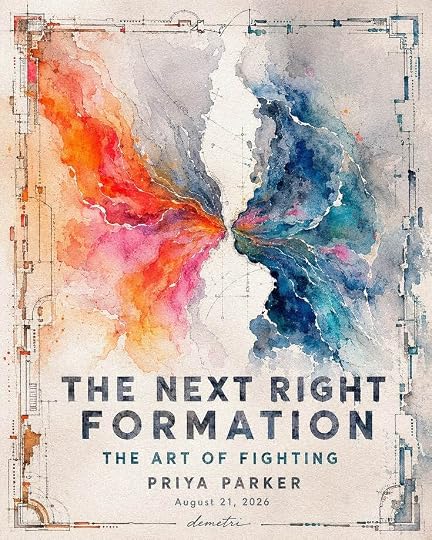
A shared form reaches the point where staying together can no longer mean staying the same – pigment mingles, resists, separates, and leaves enough paper open for another arrangement to become possible.
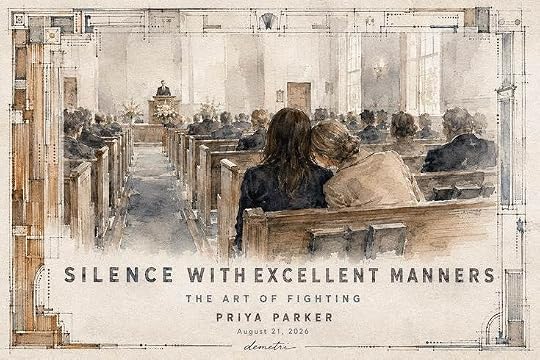
During her grandfather’s funeral in Waterloo, Iowa, Priya Parker heard a minister offer what he meant as the crowning evidence of a good man’s good life: in fifty years of marriage, Ruth and Lyle Parker had never fought. Parker’s stepmother leaned over and whispered, “Oh dear.” The aside is tiny, almost indecorously funny, and it contains the splinter “The Art of Fighting: The Transformative Power of Conflict” spends the next three hundred pages worrying loose. Parker’s own parents also seemed not to fight, until their marriage ended. The family lesson was tidy: good people do not make heat. Parker begins by asking whether such peace may sometimes be silence with excellent manners.
At a funeral where fifty years without a fight are offered as evidence of marital grace, one whispered “Oh dear” opens the question Parker will spend the book pursuing: whether apparent peace can conceal everything a relationship never learned to say.
Even the title promises a simpler book than Parker finally writes. “The Art of Fighting” sounds like a manual for surviving confrontation with sharper questions and fewer slammed doors. Parker, a conflict facilitator and the author of “The Art of Gathering,” certainly provides the equipment: ways to distinguish destructive conflict from “unhealthy peace,” to diagnose before intervening, to decide what sort of fight is actually underway. Then the destination shifts. By Part III, a good fight is no longer one that saves the group. It is one that discovers whether the group should be saved, and what “saved” would now have to mean.
More revealing than any single technique is Parker’s suspicion of the problem people first bring her. Rebekah thinks she is deciding what to do about her family’s exhausting Passover seder, a decades-old ritual freighted with Holocaust memory, cooking labor, political tension, grief, and obligation. She explains the logistics almost clinically, then begins to cry. Parker hears in those tears what the facilitator Sethu Nair calls “relational longing” – the ache produced when a relationship still matters even though its current form no longer works. Emotion becomes evidence. Dinner is only where the argument has landed; underneath are memory, labor, identity, and the fear that changing a family ritual might amount to betraying the family itself.
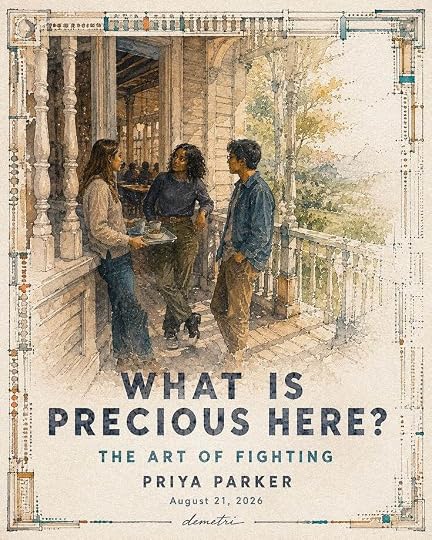
Rebekah’s family ritual strains against the shape that has carried it for years, the withdrawing chair revealing the paradox Parker calls relational longing: sometimes we want the form to change precisely because what it holds still matters.
Everywhere in the book, ordinary objects develop suspicious depths. A guest list becomes a referendum on kinship. A renovation exposes competing ideas about what a museum is for. A flag drags an institution’s contradictions onto a desk. A garden becomes an argument about ownership and intimacy. Parker lets the reader first see the kerfuffle at ordinary size, then turns it until the submerged structure catches the light. By midway through the book, you begin making the turn before she does.
The gift and the irritation of Parker’s method are close relatives. She is a gifted namer: “hairline fractures,” “Worthy Grapples,” “emotional hangovers,” “connected goodbyes,” gardens that need watering. Some terms lodge exactly where they should; others arrive after the observation has already done perfectly well without stationery. The accumulation is a recognizable practitioner reflex: if an insight can be capitalized, it may soon be asked to wear a blazer. Parker is too perceptive for the habit to become fatal, though not always too delighted by frameworks to resist it.
Rhythm keeps all this instruction from congealing into instruction-speak. Parker favors medium-length conversational sentences, then breaks them with questions, fragments, lists, or a joke that arrives half a beat early. She can move from institutional authority to “strawberry jam” without dropping the argument. The shifting register makes conflict speakable. A book conducted entirely at the pitch of emergency would reproduce the panic it wants readers to outgrow. Parker lowers the temperature of the language while leaving the heat of the situation intact.
Images quietly chart the same movement. Heat and fire dominate early; tears become both rupture and bodily response; conflict is excavated, grappled with, stitched, watered, rebuilt. By the final section, houses and renovation have largely displaced storms. Tear. Dig. Grapple. Mend. Rebuild. Parker is not chiefly a maker of sentences one pauses to admire in isolation. Her better trick is preparatory: she gives an idea a scene, lets the scene become less stable than it first appeared, then names what the reader has already started to feel.
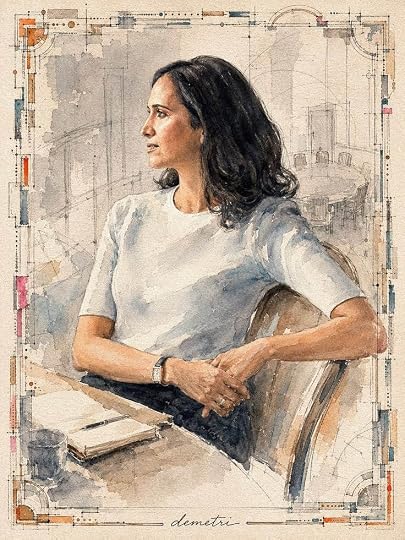
A portrait of the facilitator as both observer and participant – the conflict-averse practitioner whose professional attention to groups remains inseparable from the family history that first taught her what silence can cost.
Parker makes the structure argue alongside her. Tear, Grapple, Cleave: the sequence does more than stop the case studies from wandering off with the silverware. “Tear” refuses to equate rupture with dysfunction. “Grapple” slows the reader’s eagerness to convene the cathartic meeting. “Cleave,” a contronym meaning either to cut apart or bind together, removes reconciliation from its usual position as the respectable ending. The nine interludes loosen the larger sections with banter, gossip, ritual, proxy wars, bodily preparation. By the time Parker reaches “Cleave,” the book has changed the question from How do we fix this? to What should this become?
A large portion of Part II is devoted to resisting premature earnestness. Excavate before intervening. Find the actual Need before scheduling the meeting meant to satisfy it. Think about scale, hierarchy, setting, and consent before inviting everyone into the room. Parker’s distinction between consensus and consent matters because agreement is easy to manufacture when disagreement has a price. Participants need not leave thinking the same thing. They do need to understand what they have entered and retain enough agency that “openness” does not become another instruction from above.
Power is where the book becomes least susceptible to its own warmth. Parker knows that vulnerability is not magically egalitarian. A leader may be confused, ashamed, angry, wounded; subordinates are still not automatically the proper audience for those feelings. The boss who can fire you is not merely another hurt person in the circle. Parker’s formulation is better: leaders can confuse what needs to be felt with what needs to be said. Suddenly the soft furnishings of contemporary workplace candor look a little less innocent.
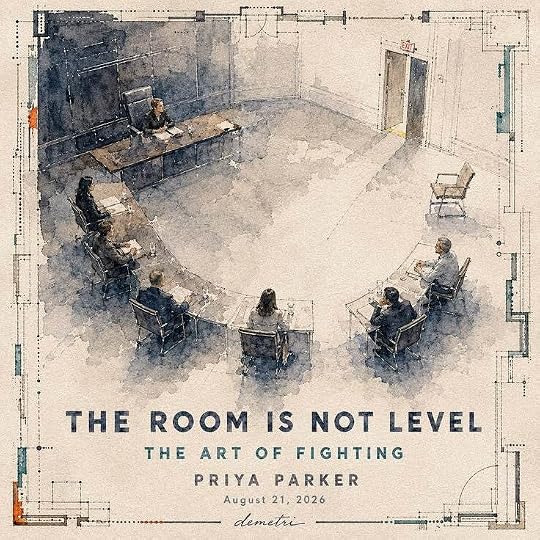
The chairs may share a floor, but not everyone occupies the same room: exits, sightlines, distance, and institutional authority turn Parker’s warning about power into a geometry no invitation to “speak freely” can quite erase.
And once that distinction is visible, Parker’s extraordinary portability becomes harder to accept without qualification. “The Art of Fighting” moves easily among families, companies, churches, friendships, government agencies, sports teams, movements, arts organizations. Genuine patterns recur across them. But a friendship cannot dock your pay, a voluntary collective cannot usually determine your public benefits, and an employer does not distribute belonging in the same way a family does. Parker often registers these differences inside individual stories. Her larger vocabulary of “the group” can blur them. The case may know more about power than the category imposed on it.
Darker complications also haunt Parker’s account of older inherited communities. She suggests that people with fewer ways to exit families, religions, professions, and local worlds developed stronger internal practices for handling conflict, while modern people can more readily bounce. There is something persuasive here: when leaving is difficult, people have stronger incentives to devise ways of staying in the same room. Yet the locked door has never been an uncomplicated school for relationship skills. High exit costs also preserve silence, dependence, hierarchy, and abuse. Parker is strongest when she asks whether leaving has become reflexive; she is less convincing when earlier communities begin to look like keepers of a lost communal wisdom.
Instead of ignoring that danger, Parker keeps placing escape hatches inside her own argument. Chapter Three asks whether the fight should happen at all. Some tensions should remain tensions. Some problems belong somewhere else. Sometimes the useful result of disagreement is information rather than intimacy. And some groups are dead and have not yet had the administrative decency to notice. Her artful fighter is therefore not a person who has conquered avoidance and now confronts everything in sight. The harder skill is discrimination: knowing when staying is courage, when leaving is clarity, and when “repair” is only nostalgia with better facilitation.
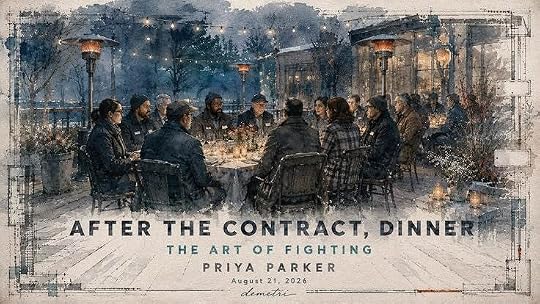
Flowers, votives, name tags, and borrowed heat hold a freezing patio together after a bruising organizational fight, suggesting that the aftermath of conflict may begin less grandly with agreement than with the awkward return of ordinary company.
Much later, when Parker reaches endings, “The Art of Fighting” becomes a stranger and better book. The theatrical collective 13P was created by thirteen playwrights to produce thirteen plays and then dissolve. Once the work was finished, the group kept its promise and threw an “Implosion Party.” The name is comic; the principle is severe. Permanence does not certify value. A group may disappear because it failed, because circumstances changed, or because it did exactly what it came to do. Parker’s willingness to let success end in extinction gives “Cleave” its necessary second edge.
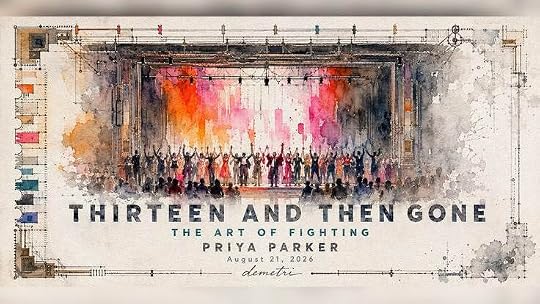
13P reaches its promised ending in celebration rather than defeat, the stage already dissolving toward paper as Parker makes one of the book’s most liberating distinctions: permanence is not the only evidence that something succeeded.
In Chapter Ten, staying acquires conditions of its own. Parker separates repair from renovation. Repair concerns what people owe after harm: acknowledgment, restitution, changed behavior, restored dignity. Renovation asks what must happen to the arrangement that held them. At the Bread Loaf Writers’ Conference, the useful question becomes not how to preserve the wait-scholar tradition, but what within it was actually worth preserving. Access for emerging writers mattered. The inherited mechanism no longer necessarily did. A value and the structure once built to express it are not the same thing. Reconciliation without redesign can simply return everyone, more politely, to the scene of the problem.
That distinction reaches backward through the entire book. Parker separates belonging from continuity. Staying together is not proof of health; leaving does not nullify whatever was real before the departure; an apology is not a time machine. A fight earns its keep only if what it uncovers is allowed to alter conduct, structure, expectation, or form. Otherwise the group has staged an expensive emotional pageant and returned everyone to their assigned seats.
At the threshold between inherited practice and possible redesign, Parker’s question becomes architectural: preserve what the old structure made possible, perhaps, but do not confuse the value with the mechanism that once carried it.
Repetition is the fee Parker charges for making these distinctions difficult to forget. She often establishes a concept, dramatizes it, names it, and then continues proving it after the jury has started looking for its coat. The middle grows crowded with relational longing, Need, identity, power, ritual, consent, repair. The examples remain lively enough that the drag is mild, but not every illustration develops the argument; some merely salute it as it passes. The interludes change the weather, but the book still dislikes leaving a useful observation homeless.
One illuminating neighbor is Amanda Ripley’s “High Conflict,” which studies the traps that turn disagreement into a self-reinforcing system. Parker is more interested in what happens once a group has recognized the trap: what the fight reveals about the arrangement itself, whether its members should stay, and what must change if they do. Her cases persuade because she has spent years inside rooms where these questions were live. Confidence thins when those cases are recruited to speak for “the group” in the abstract.
Part of the book’s attraction to the contemporary loneliness conversation follows naturally from this emphasis. Parker argues that modern life offers abundant help for the self and comparatively little “group help.” Her answer is not simply more contact. More contact also means more chances for disappointment, unequal labor, political disagreement, badly organized dinners, and discovering that the people you love have astonishing opinions about masks. Community without a capacity for friction is hospitality on probation. The harder question begins after everybody has found one another.
One can admire that reach and still feel where it strains. I land at 86/100, or 4/5 stars. “The Art of Fighting” is intellectually stronger than its headline proposition that conflict can be healthy, and its three-part design earns rather than merely displays its cleverness. The deductions come from the same ambition that makes it useful: Parker sometimes lets concepts cross unequal settings too easily, some historical claims reach beyond the evidence shown, and a few examples linger after their work is done. The book travels well. Occasionally it travels without enough luggage.
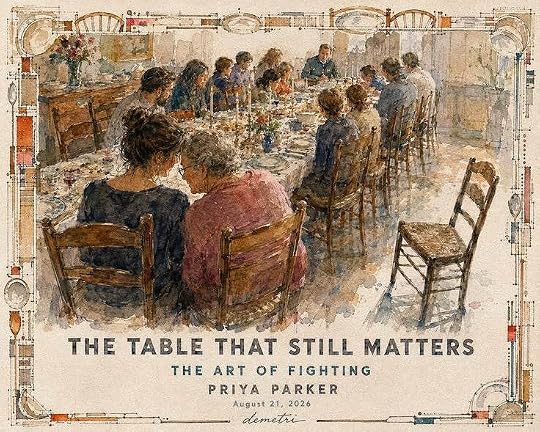
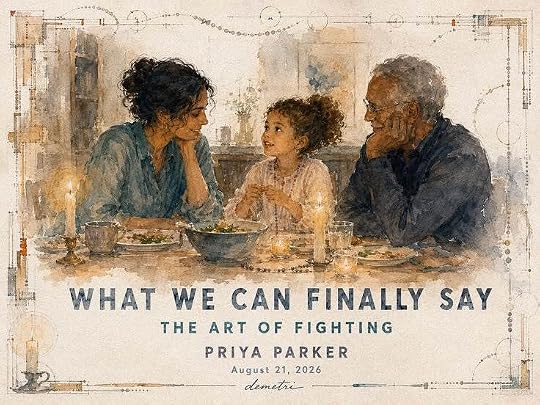
Up to the epilogue, Parker has mostly shown what her method can do for other people’s groups. Then her young daughter asks Parker’s father why he and Parker’s mother divorced. His first explanation is evasive. Parker intervenes, not to reopen the marriage or prosecute either parent, but to give the child a truer account: two people could love each other and still lack the habits, support, and surrounding community needed to fight through what separated them. The marriage remains over. Parker repairs the story, not the marriage. What changes is what the family can finally say.
Three generations gather around a question that cannot repair a finished marriage but can repair the story told about it, leaving Parker’s final form of conflict not as victory or reunion but as a past made truthful enough to speak aloud.
Looked at from that table, the title loses some of its pugilistic swagger. Fighting is not the opposite of belonging, Parker argues, and neither is leaving. The real opposite may be refusing to let a relationship tell us what it has become. “Cleave” earns its place because one word can hold both futures: bind, or cut. Neither outcome is moral in advance.
Only then does the opening funeral return with its full irony. A marriage praised for never fighting becomes part of the history that sends Parker toward conflict work; a child’s blunt question gives that history another chance to speak; a father listens while his grown daughter revises the family legend.
Still, Parker does not end with a rescued institution, a reconciled faction, or a facilitator collecting her wisdom on the way out. She ends at a table, with a hand reaching across it, after nothing in the past has been undone. The marriage is still over. The question has simply become survivable enough to answer.
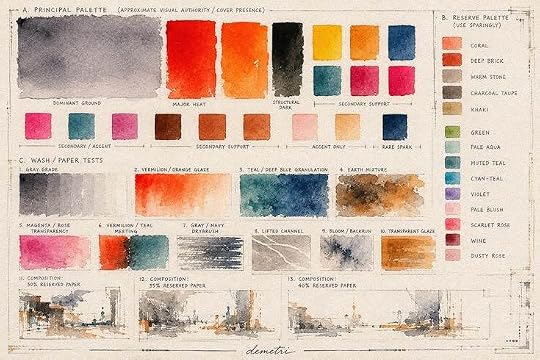
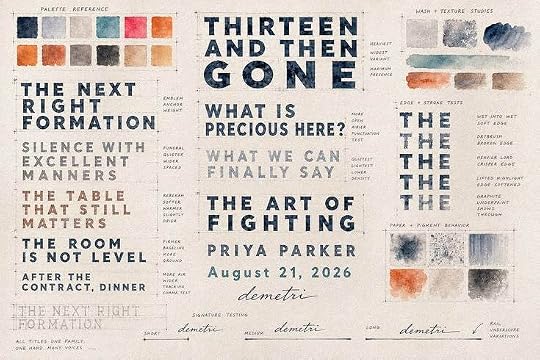
Cover-Palette and Wash Study
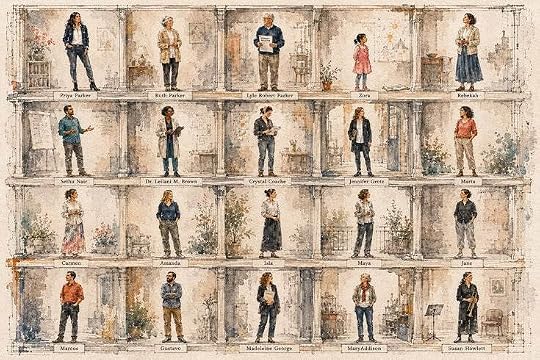
Full-Body All-Character Watercolor Study
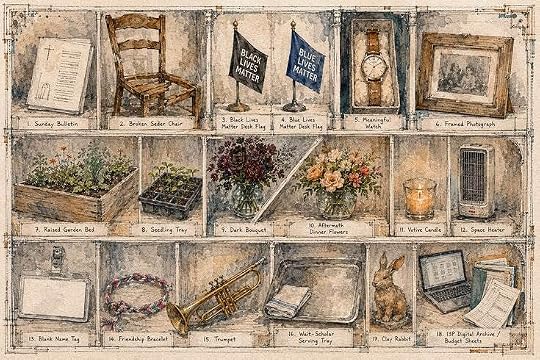
Important-Objects Watercolor Study
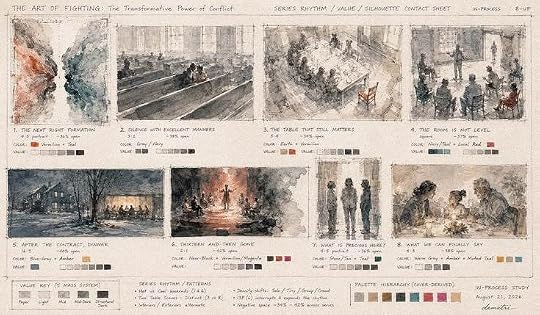
Series Rhythm and Silhouette Study
Series Typography Study
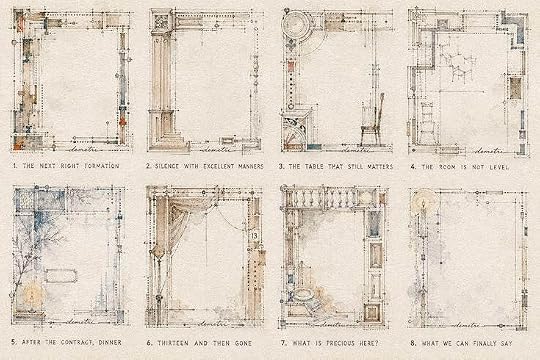
Border Architecture Study
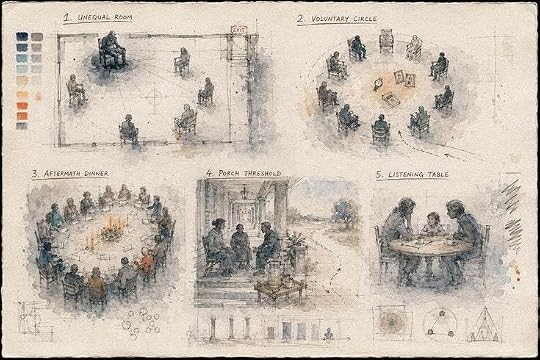
Group-Spacing and Power-Geometry Study
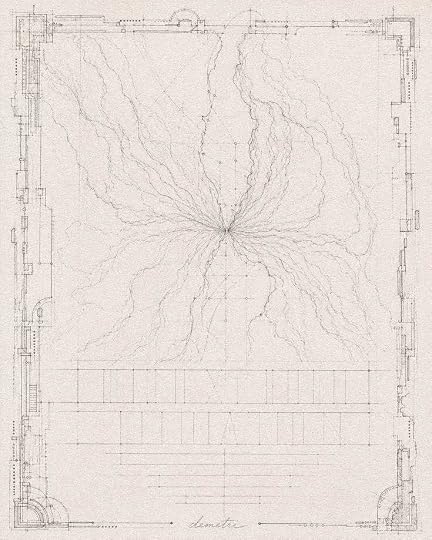
First Underdrawing Pencil Study
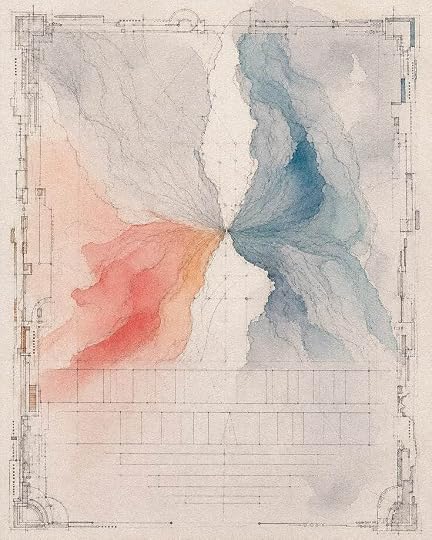
First-Wash Watercolor Visualization
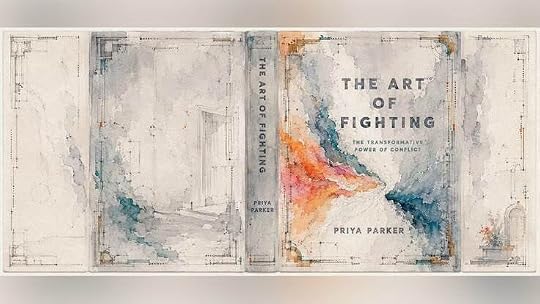
Alternate Full Dust-Jacket Watercolor Study
All watercolor illustrations by Demetris Papadimitropoulos. Watercolors are done on 140lb vellum and then scanned into the computer using an Epson scanner. From there, they are finalized in Procreate. No AI was used in writing this review — all art and opinions are my own.
Meh. It was OK. As the great Michael Jackson did *not* say, "I am a fighter, not a lover", so I don't think I was the target audience for this one. I like to think that I could write my own book on verbal skirmishes. ** I was provided this book free for review, but all opinions are my own.
So little meat on these bones. Endless anecdotes and stories. So few actionable steps. Seems like a 40min TedTalk where an editor asked, add 9h of anecdotes. Instead read: Stone & Heen's Difficult Conversations or Rosenberg's Nonviolent Communication
The Art of Fighting by Priya Parker is an upcoming exploration of how conflict, when approached intentionally, can lead to deeper understanding and stronger relationships. Known for her work on meaningful gatherings, Parker is expected to bring a thoughtful and structured perspective to navigating disagreements in both personal and professional settings. While details are still limited, the book promises to reframe conflict as a tool for connection rather than division, offering practical insights on how to engage in more productive and purposeful conversations. Even ahead of its release, The Art of Fighting stands out as a highly anticipated guide for anyone looking to handle conflict with clarity, intention, and impact.
I gave five stars to Priya Parker’s The Art of Fighting: The Transformative Power of Conflict because it made me appreciate that conflict is an essential part of growth in any relationship or group. That said, the book is different from what I was hoping for.
I was hoping for more structure, or at least frameworks a reader could readily apply. The book does have an architecture. It moves from Tear (naming the rupture and deciding whether it is worth facing), through Grapple (the work of the fight itself), to Cleave (the aftermath, a word Parker uses for both parting and binding more closely). It also sorts conflicts by intensity and by how deeply they challenge a group’s identity. Even so, I learned, to a large extent, that there is no single set of rules. She often begins a chapter with a theme and then moves into anecdotal stories about how a particular situation was handled. I would have preferred some theory or framework at the outset, examples in which that framework was put to use, and a summary at the end tying the stories back to the framework.
In some cases, it seemed as if she had come across how others had chosen to address their challenges and then let the example carry the lesson. At the Canlis restaurant, “the brothers built two secret places within the restaurant exclusively for staff to have intimate, sometimes tough one-on-ones: a bar in the cellar with a keg, couch, and record player (called ‘the hooch’ as we’ve seen), and a spot on the roof, The Caché, with a rosé tap and a fireplace. ‘You can always go there and have a chat,’ Mark told me. The Canlis family continuously encourages their staff to clear the air with each other directly.” That is a thoughtful solution. It also demonstrates the book’s real counsel: if you are creative and deliberate, you can—and maybe should—design your own.
The book progresses from our natural aversion to conflict, through conflict itself, and then along one of two paths: parting after conflict or rebuilding after it. Through the various phases of engagement, whether in a relationship or in a group, we have choices. We can decide whether to have the discussion, whether to stay or go, and whether to reshape the environment. Whatever path we follow, Parker argues, the work calls for discernment, courage, discomfort, love, creativity, intention, openness, humility, and a willingness and ability to hold heat. These, she says, are learnable skills.
Conflict and disagreement are natural parts of life. We should learn how to engage them and resolve our differences in a mature manner, even if resolution means walking away because the relationship or group no longer serves our needs. Too often people become overwhelmed and are unable either to express themselves or to change their situation in a helpful way. Parker’s book will not hand you a checklist. It will, if you let it, change how you think about conflict, and that was enough for five stars.
[Out 9/8/26] 4.25// This was one of my most anticipated reads for the Fall, so I was so excited when I received an e-galley. After coming off of her mega-popular book THE ART OF GATHERING, Priya Parker brings her expertise as a conflict-resolution facilitator in her newest book. She starts off by saying, "I became a conflict facilitator not because I am fearless, but because I hate conflict" - what an opening line! From here, Parker makes a case that our society's inability to hold conflict and engage in it in a healthy way is a driver for the loneliness and isolation we face. In 3 parts - "TEAR," "GRAPPLE," and "CLEAVE" - she walks the reader through best practices in managing group conflicts and disputes. In order for a successful and productive group conflict, what we do before the fight matters. While engaged in the conflict, we need to have a high level of emotional intelligence (or as she says, "group intelligence") and the willingness to explore what is the capital N "Need" of the group. Parker teaches us how to hold space and hold heat; ask the questions and provide the most helpful formats. Finally, she guides us in how to navigate the emotions after a fight, whether that means breaking up or building back better.
It is clear how smart and experienced Parker is. She draws from experience working with a variety of groups, from companies to nonprofits to friend groups to restaurants. That being said, there is a lot of information to process. This book is really a workbook, and really requires the reader to work. It took me two weeks of reading this book slowly so that I could process the amount of information. I think it's probably more information than the average reader needs, especially the "interludes" which cap off each chapter, yet they're really more of a continuation of the chapter. What I was really missing was a summary at the end of each chapter and/or appendices in the back. That could help make the book easier to reference when conflict arises.
I could see this being a great resource for someone who manages conflict on a daily basis, such as HR. For the everyday reader, it's probably more than what I needed, but I'll still be considering many frameworks she presented, such as the Magnitude of Conflict grid.
Thanks to Riverhead Books and NetGalley for the ARC.
I really liked this and honestly think it is so universally useful. The book is evidence based, but also emotional enough to move you to action. I found some of the anecdontes genuinely beautiful. The word "art" in the title absolutely nails what makes this book about conflict different from other resources.
I'm terrible at conflict because I either fight hard or cower quickly (or an awkward little dance of both), but this book provides a slower, more thoughtful approach with actual examples that helps your brain hold onto the ideas. I'm still thinking about how impactful the stories we tell ourselves in our brain about the conflict are shaping the ongoing relationships after the conflicts. The book brings courage to those scared of conflict, softness to those a little too eager for conflict, and reflectiveness that helps us all see the humanity in one another amidst conflicts.
Favorite bookmarks: Chapter 1 -I connected right off the bat in the author's discussion on conflating disagreement with mistreatment, discomfort for threat, and internal anxiety for exterior danger. Man, I've seen that a lot in higher ed in the last decade and I loved having someone write about this and the implication of these mix-ups on our ability to resolve conflict well.
Chapter 6 -"May the Holy Spirit speak through us." The author shares an anecdote from a faith community in conflict. There were listening sessions before decisions were made and in those time, they communally spoke aloud the phrase, "may the Holy Spirit speak through us" and before anyone responded to another, they were asked to pray silently for a moment. This kept everything conversational and less argumentative. I find this so beautiful as it centers the image of Christ in each person above the opinion they're choosing to voice.
Chapter 10 -"Repair is more than annulling what was done. It means using the same power differently."
Epilogue -"Our marriage is also in a community...continuous friends witnessing them or who could even know anything was wrong. People fight and it's really normal and okay and having a loving community and friend group to help you through the bumps is so helpful." - again, beautiful
Disclosure: I received a copy of THE ART OF FIGHTING: THE TRANSFORMATIVE POWER OF CONFLICT by Priya Parker in exchange for an honest review. Thank you to Riverhead Books—an imprint of Penguin Random House LLC, author Priya Parker, Goodreads giveaways, and everyone involved in the opportunity to review this book. Shout out to Helen Yentus of Riverhead Books for her gorgeous book cover design.
Excerpts from my personal journal: “When management decided to place colleagues on 6-month static high conflict work teams, chaos followed. They called us to a retreat with a facilitator who gave us an easel-sized flip chart pad and markers and tasked us to use unrestrained honesty to draw a ship representing our office…apparently it was a rhetorical question not to be answered.” “Our work team vessel was deeply ridiculed—a pirate ship depicting colleagues collapsing from exhaustion swabbing the decks, people stepping over bodies, refusing to work and getting promoted, others voluntarily jumping ship. Our ship became the talk of the session, and was apparently super problematic as it noted colleagues were forced to walk the plank while some were pushed overboard.” “Our radical honesty was met with management hostility and accusations of dishonesty. How dare we make a mockery of the conflict resolution exercise? (Read: How dare we deign to tell the truth?)” “The result? We learned there was no safe space, telling the truth came with consequences, and management’s apparent motivation was to label truth-tellers as ‘troublemakers’ and to push them out the organization. Solving disputes was not their end goal. Getting rid of and/or silencing perceived troublemakers was…and when all was said and done fewer people offered any hot takes when asked…at meetings colleagues universally refused to speak up out of fear of retribution.”
The Art of Fighting is an essential tool across life’s spectrum of messiness— from professionals navigating toxic workplaces to parents investigating why their kiddos had a bad day at soccer camp.