An archaeologist travels to a distant planet to spend time among a mysterious a people who live in temperature-controlled domes, worship a deity called Dog, and repeat an elliptical phrase from which they draw their mulai, the tree comes. The descendants of a long-forgotten space mission, the Mulai have abandoned the social norms that once bound them to Earth. Over centuries of isolation, their language has become more about change than stability, and the ways they eat, write, reproduce, bury their dead and understand gender have all transformed into something almost unrecognizable. As the archaeologist records his attempts to understand their world – a strange negative of our own – questions of translation, meaning-making and the ultimate precarity of civilization come to the fore. Drawing on Borges, Le Guin and Calvino, The Mulai is a mind-bending work of metafiction whose interlocking puzzles resound with Munir Hachemi's singularly playful and eclectic style.
Munir Hachemi (born 1989) is a Spanish writer. He was born in Madrid to an Algerian father and studied Spanish at university.
He also obtained a master's degree in Latin American studies. His fiction appeared initially in fanzines under the aegis of the Escritores Bárbaros collective. His first novel Cosas vivas appeared in 2018.
In 2021, he was named by Granta magazine as one of the most promising young Spanish-language writers in the world.
Una de las cosas de las que más me lamento, en lo que a literatura española actual se refiere, es que tengo la impresión de que se toman pocos riesgos. Especialmente los nombres más reconocidos en los últimos años parecen haber renunciado en gran medida a la experimentación formal, a la osadía temática, a la diferenciación con respecto al resto del mercado editorial. Los hay (y las hay) que escriben más que bien, y que son capaces de hacer novelas correctas y muy dignas, pero triste futuro le espera a una literatura que no tiene nada más que una banal corrección que ofrecer. En este sentido, envidio enormemente la valentía que demuestran en Latinoamérica, donde, a mi juicio, es donde hoy se está cociendo la verdadera innovación literaria en nuestra lengua.
Munir Hachemi ha llegado a mi vida discreto, por recomendación de Alina, mi librera de referencia (Librería La Fabulosa), en plena Feria del Libro de Madrid. Esos “llévatelo”, amables pero rayano en imperativo, que a veces nos lanzan nuestros libreros cuando detectan, con esa mirada mágica que tienen, una conexión entre un libro y tú, lector. Me lo llevé renqueante, sin especial interés, y sólo prioricé su lectura porque se dio la coincidencia de que Hachemi estaría firmando a los pocos días en esa misma caseta. Y, guau.
Ahora puedo entender perfectamente por qué Granta le escogió como uno de los mejores escritores jóvenes en español. “El árbol viene” es una obra literaria monumental, que no sólo demuestra la enorme inteligencia y cultura del autor, en especial su conocimiento del lenguaje y la antropología, sino su valentía a la hora de enfrentarse a los temas que toca en la novela y de arriesgarse técnica y estilísticamente. Tan breve como inabarcable, “El árbol viene” encierra dentro tanto que dudo que una sola lectura pueda enfrentarse a todos sus tesoros. Casi me parece sobrenatural que esto se escondiese en un autor español.
La referencia obligada para este libro debe ser “La mano izquierda de la oscuridad”, de Ursula K. Le Guin, obra a la que ciertamente se parece, hasta cierto punto. Pero, personalmente, desde una perspectiva literaria, tengo la impresión de que la novela de Hachemi es mucho más placentera y equilibrada, sin dejarse llevar tanto por el trasfondo filosófico-antropológico como Le Guin, que a veces parecía olvidarse de que estaba escribiendo ficción. Hachemi, en ese sentido, siempre nos está ofreciendo una obra artística, sin por ello renunciar a un enorme sostén de pensamiento académico y filosófico, y logrando, en mi opinión, cerrar sus temas de manera mucho más efectiva, con mayor solidez intelectual, sin esa sensación de evanescencia que en muchas ocasiones me provocaba la obra de la autora estadounidense.
Y es que si algo me ha quedado claro con la lectura de “El árbol viene” es que Munir Hachemi no necesita referencias, aunque las tenga. Tiene su propia voz y capacidad y talento más que sobrados para producir y defender su obra literaria. En el caso de esta novela, personas que disfruten de ficción especulativa como la citada de Le Guin, o como “Oryx y Crake”, de Margaret Atwood, o “Exhalación”, de Ted Chiang, seguro que disfrutarán de ella. Pero también lo harán cuales quiera que disfruten de la gran literatura, de los autores que toman riesgos y aciertan, y de novelas que te desafían y te llevan más allá de tu zona de confort y hacen que tengas que plantearte dilemas.
En “El árbol viene”, además de una notable obra de ciencia ficción, nos enfrentamos a un acertijo inmenso, en el que se nos propone el problema de nuestra propia inteligencia y evolución como especie y sociedad. Lingüística, antropología, religión, poética, historiografía, sociología, etnología… Cada pequeño detalle de esta novela esconde enormes connotaciones y preguntas, y nadie debería perdérsela. Por mi parte, desde luego, ya voy a por el resto de la obra de este autor que ya se queda en mi nómina lectora.
The Mulai fled Earth many generations ago, settling on a distant planet and quickly forgotten about by their Earth-dwelling counterparts. Relying on an automated shipment of food and supplies, the group quickly sheds the norms and customs of their home planet, instead adopting an entirely new way of life, language included.
I loved the dizzying feeling of being dropped into this text and having to do the work to orient myself. The reader is introduced to the culture of this group in a variety of ways, first person accounts from the Mulai themselves inform the reader of the routines of daily life, diary entries from The Archaeologist provide an outsider perspective, and the formal report put together on Earth using The Archaeologist's findings attempt to make sense of the evolution the Mulai took from an anthropological lens. Much of the focus surrounds the Mulai's ever-changing language--spend a few days away and the language becomes incomprehensible, their rules around writing--only to be done in public at the scriptorium, writing in isolation is frowned upon, and one particular Mulai's efforts at translation.
It's an intoxicating, dense work, the reader working to map out the timeline of the Mulai's existence while also pondering the existential questions Hachemi presents about the mind-expanding possibilities that can be contained within the human experience. It had me thinking a bit about something Jo mentioned recently after reading The Dawn of Everything, of how the development of civilization is not simply a linear process, that humans have instead experimented with many ways of being and existing within a society. And Hachemi is exploring that truth in this novel, through this group of humans that have shed the rigidity of their former lives in favor of something more dynamic. Through the generations, entire concepts have been lost, but new ones have emerged and though, to an outsider, it appears this population has regressed, the reality is simply the life-affirming revelation that there is no single right way in which a community should operate.
Sanches' capable hand is given more visibility in this meta novel as footnotes appear to provide context to some of the wordplay that perhaps worked better in the Spanish language original. It's a commendable feat of translation to take an experimental work such as this that is so focused on language and be able to render it in a completely new language while maintaining the complexity of the ideas explored while also becoming so seamlessly incorporated within the fictional work herself.
It's the kind of book that I'm never going to be able to properly analyze in the space of an Instagram caption, it begs to be read alongside the works it references and it's made me realize I really, really need to be prioritizing Le Guin.
La buena ciencia ficción es un espejo donde vernos reflejados y este libro es una muestra de ello. Imagina un contexto muy estimulante para replantearnos nuestras certezas como sociedad y como especie. Nos propone un ejercicio de antropología futura y nos anima a preguntarnos sobre lo rápido que pueden mutar unas normas que entendemos como naturales
Cuando ocurre una vez, puede ser casualidad. Dos veces ya es a propósito. Así que no se me caen los anillos a la hora de afirmar lo siguiente: Munir Hachemi es un autor que trabaja con maestría los dobles sentidos literarios. Al fin y al cabo, su debut “Cosas Vivas” ya fue una espeluznante disección de las cloacas alimentarias en la que anidaba una teoría sobre los límites del relato autobiográfico sobre el que tanto se debate últimamente bajo el nombre de “autoficción”.
Y su segunda novela, “El Árbol Viene“, vuelve a ser un espacio en el que dos posibles novelas conviven de forma totalmente harmónica e incluso en beneficio mutuo. Por un lado, lo evidente: una apasionante distopía en la que una misión espacial fallida acaba dejando a una comunidad humana totalmente varada en un planeta hasta que se convierten en una civilización fascinante de extrañas costumbres. Por otro lado, lo menos evidente: una nueva exploración literaria, esta vez sobre el poder (y las trampas) del lenguaje a la hora de articularnos en forma de sociedad y comunidad.
La parte de la distopía podría parecer la más trillada. Pero no. Al fin y al cabo, vivimos un momento literario en el que esta práctica es moneda de cambio común y ha rebasado los límites de la ciencia ficción para ser abrazada por el entretenimiento de masas. Lejos quedan los referentes como “1984“, “Un Mundo Feliz” o “Fahrenheit 451” y cerca queda un modelo de ficción cada vez más extendido pero también cada vez más erosionado. Las nuevas distopías se revelan cada vez más incapaces de arrojar una verdadera advertencia sobre el futuro, ya sea porque se pierden en la parte de la ciencia, olvidándose de la ficción, o porque viven demasiado apegadas al éxito populista presente.
Pero ahí está el primer logro del libro: Munir Hachemi no busca un éxito populista presente y, de hecho, se atreve a ser aventurero y desafiante con una narración fragmentada a partir de diferentes voces que el lector debe reconstruir a modo de piezas de un puzzle lanzadas al viento y diseminadas en diferentes tiempos. El principal narrador de “El Árbol Viene” es o podría ser El Arqueólogo, nombre nada casual que denomina a una persona que cae entre los mulai como parte de una expedición y acaba quedándose entre ellos para intentar explicar qué ocurrió en el pasado para que estos humanos hayan acabado por alejarse de lo que entendemos por humanidad.
Pero también existen otros narradores en “El Árbol Viene“: con los capítulos de El Arqueólogo se alternan otras voces mulai que explican el mundo bajo su propio punto de vista. Y esto resulta apasionante por diferentes razones. La primera de ellas es por el estimulante desafío que propone Hachemi: cuando la voz es mulai, las palabras y el lenguaje que estos usan para referirse al mundo es un laberinto en el que el lector debe ir guiándose por puro instinto.
Por poner un ejemplo divertido: el lector tardará en entender que los lobos de los que hablan los mulai no son precisamente lobos. Por poner otro ejemplo especialmente magistral: hasta que El Arqueólogo especifica que para los mulai follar es absolutamente todo menos la penetración, es probable que el lector haya pensado (llevado por el hábito de poner la penetración en el centro del acto sexual con el que nos han adoctrinado) que los mulai estaban penetrándose continuamente los unos a los otros. “El Árbol Viene” atenta continuamente contra las expectativas del lector, obligándole a despegarse del lenguaje como herramienta fiable para entender el mundo y quebrando sus convicciones para forzarle a una empatía que nazca en la voluntad de entender a los otros (los mulai) en vez de explicarlos a partir de los patrones y códigos propios (del lector).
Y la propia estructura de “El Árbol Viene” hace lo mismo: la multiplicidad de voces es, de hecho, un reflejo directo de cómo estructuran los mulai una sociedad en la que el individuo se pierde y solo tiene sentido como parte de una comunidad. Una sociedad en la que los relatos tienen una importancia crucial e incluso guardan un espacio elevado, el scriptorium, para que las historias sean registradas. Aunque ese registro no se entienda como la acción de usar las palabras para fijar y anclar el relato en el tiempo, para convertirlo en algo unívoco y eterno, sino precisamente para todo lo contrario: para liberarlo como una acción viva que presupone que el relato irá mutando en el tiempo cuando otros accedan al scriptorium.
La narrativa como democracia. Y así lo escribe el autor: “En nuestras lenguas la escritura rectifica de alguna manera las curvas del lenguaje y fija el propio lenguaje; en la lengua mulai, la palabra escrita es tan líquida como… no, más líquida que la oral“. Un concepto realmente estimulante que apuesta por empoderar un lenguaje que siempre debería aspirar a ser más y más libre y a alejarse de cualquier tipo de corsé que lo enquiste en el espacio y en el tiempo.
Aquí llega entonces el segundo gran logro y el otro lado del doble sentido de “El Árbol Viene“: dentro de esta sofisticada y vibrante distopía, Munir Hachemi nunca se pierde en la parte de la ciencia (aunque la tiene en cuenta) y acaba apostando por la lengua-ficción más que por la ciencia-ficción. Puede que lengua-ficción sea un término estúpido, pero ya me entiendes: me estoy refiriendo a una ficción distópica construida a partir del lenguaje y no a partir de la ciencia.
En manos de Hachemi, la reflexión sobre el lenguaje se eleva hasta alturas realmente sublimes. Empezando por la advertencia de la trampa que suele ser precisamente este lenguaje: una vez perdieron el contacto con la Tierra, los mulai originales se olvidaron en tiempo récord de todo lo que creían intrínseco a la humanidad. “El Árbol Viene” lo tiene claro: el lenguaje es el cemento que hace posible que se sostenga la estructura de nuestra sociedad pero, como todo cemento, implica una rigidez que también puede ser entendida como prisión. Si las paredes de la prisión cae, los presos corren en libertad.
Leyendo “El Árbol Viene“, no puede evitar pensar en libros recientes que me han apasionado… Pienso en “Peregrino Transparente” de Juan Cárdenas por el uso del lenguaje para apresar lo desconocido; en “La Parte Blanda de la Montaña” de Álex Prada por el mundo “primitivo” que funciona con terminologías por las que el lector ha de moverse por intuición; en “El Libro de Todos los Amores” de Agustín Fernández Mallo por esa relación entre el lenguaje y el fin del mundo; y en “La Naranja Mecánica” de Anthony Burgess, claro, no por ser lectura reciente, sino por la creación de todo un lenguaje y una sociedad que funciona con sus propias reglas.
Pero, sobre todo, lo que pienso cuando leo “El Árbol Viene” es que la advertencia de Munir Hachemi no podría ser más gozosa. Él mismo escribe: “No estoy seguro de que los mulai conozcan la literatura. Desde luego, si entendemos por literatura el complejo dispositivo cultural que existe en nuestras sociedades, no la conocen; si la entendemos como el uso lúdico o hedónico del lenguaje, sí“. Y es que, por mucho que el lenguaje pueda ser una prisión, también puede ser un campo de puro hedonismo. Lo único que necesitamos es reventar el cemento y olvidar cualquier regla que nos impida movernos con libertad.
A demanding SF-novella for lovers of Borges and Calvino.
The Mulai are the descendants of human settlers once sent to colonize a new planet. Having been left to their own devices for almost two centuries, Earth sends the Archaeologist to re-establish contact with them. The Archaeologist finds a society that has evolved in a completely different direction than ours on Earth.
I loved Hachemi's Living Things very much and still think about it regularly.
But I had a hard time with this, for the same reason I tend to struggle with Borges or Calvino. Clearly the fault of my limited imagination and inability to go along.
While an important point of this is to hold up a mirror to our own society and question concepts such as ownership and identity, I need it to be packed in a believable narrative in order to go along with it. There is no tension either, just a description of this society and I couldn't get over the key assumption, which is that humans can develop a sort of utopian society in which there is no hierarchy, no jealousy, no property, no real curiosity - especially not in just 180 years. I know: this is all intentional. It's not meant to be believable, just as Marco Polo's cities aren't.
And I am sure I have missed many points and many references.
Enormous emphasis is put on language and how it shapes society. By naming things in certain ways, we condition them. This is very true, but the impacts seemed highly overstated, in a way that probably only writers really hope or believe.
It is thought-provoking, intellectually demanding and remarkably short. If Invisible Cities is your favorite book, I would definitely give this one a go...
** a copy of this book was provided by the publisher **
This is an exquisitely strange little book about language and translation. It's a little bit about colonialism and the intersection of cultures, and a lot about how reading Invisible Cities will drive you to madness.
Esto es ciencia ficción, de esa que te lleva a un mundo completamente nuevo, donde TODO es diferente y el lector es tan aventurero como el narrador/arqueólogo que va a conocer a esta civilización, los mulai, y cómo su lengua moldea a la forma que tienen de relacionarse con el mundo (y viceversa).
Está escrito difícil, cuesta sus buenas páginas entrarle a la lectura, pero una vez que entrás estás hasta el cuello.
Es cierto que le falta un nudo, un conflicto, un argumento. Pareciera más que es una intro a un universo cuyas aventuras van a contarse en el tomo 2. Pero me gustó, y que me haya enganchado algo tan no-fácil en este período donde la concentración me abandona por completo, es todo un mérito.
Un portentoso ejercicio de imaginación y documentación por parte del autor, no recuerdo haber leído nada parecido. Cada vez me fascina más como algunos autores pueden sorprenderte tanto en 200 páginas.
Siempre me han gustado las historias de ciencia ficción que tienen el lenguaje como elemento central en la trama. Es imposible comprender una lengua sin comprender la cultura que lo origina (y viceversa), son aspectos inseparables, así que las historias que se centran en el lenguaje suelen meterse en el charco de describir con detalles una cultura presumiblemente alienígena, y eso me encanta.
Para describir la lengua y la cultura mulai el autor combina a la perfección tres tipos de voces. En primer lugar, los relatos en primera persona de los mulai te sumergen en su cultura. En segundo lugar, los informes oficiales de los investigadores humanos enviados con el objetivo de establecer contacto presentan la lengua y la cultura mulai desde una perspectiva humana. Estos fragmentos están escritos de forma ensayística y con secciones censuradas, cosa que me acanta. Por último, tenemos el diario personal de uno de los investigadores. Esto es lo que me ha parecido más interesantes, porque en ellos se destacan las diferencias entre las culturas mulai y humanas en un plano mucho más emocional y personal, incluyendo desde sus hábitos alimenticios hasta sus costumbres sexuales.
No puedo decir casi nada de la trama porque cualquier cosa desvelaría desenlaces importantes, pero puedo decir que, partiendo de una premisa de lo más verosímil, Hachemi llega a lugares y desenlaces que yo jamás antes había leído.
Si no le doy las 5 estrellas es porque a veces el lenguaje me ha resultado recargado y me sacaba un poco de la historia, pero eso puedo ser yo que soy un ansias y leo sin diccionario. Por lo demás, lectura recomendada 100%.
Excerpt from the journal of one of the first Mulai Circa the year 220, before tbe end of the supply containers Translated into Mulai or invented in Mulai, or both, by Faida Re-translated from Mulai into Spanish by the Archaeologist And translated into English by Julia Sanches
At the time I didn't have a clue where I got the strength to hide the book and the radio, but I know now - now I know I want to preserve some part of what we were.
'The Mulai' (2026) is Julia Sanches's translation of the 2023 novel by 'El árbol viene, el árbol viene, el árbol viene' by Munir Hachemi.
Although translation doesn't do Sanches's work full justice, since language and translation is so integral to the text that she has had, rather like the 2026 International Booker winning Taiwan Travelogue, to insert herself into the text via footnotes. And I suspect this will be a strong contender for the 2027 longlist and beyond.
The premise of the novel is that a colony was set up on a distant planet, and then, due to climate-induced crises on Earth, largely forgotten. Although supply containers still arrive on an automatic schedule.
But after 250 years, the containers stop arriving, an event of such significance that the settlers - the Mulai mark their calenders b.C. and a.C. around this date.
Isolated from Earth, which is equally, indeed quite deliberately, forgetten to them, the Mulai develop a distinctive culture, a belief-system and a linguistic of their own, mainly living in the main bio-dome. They believe in a god who supplies all things, which they call Dog; fail to distinguish between robots and living creatures; believe that one day that 'The Tree Comes'; and have only one sexual taboo, which is against vaginal sex, reproduction achieved via artificial insemination from a piece of legacy technology in 'the Temple'.
159 a.C. an archeologist arrives from Earth to make contact with them, and large parts of the novel consist of his field notes, as he first deciphers and then increasingly becomes embedded in their culture.
We also have accounts from some key Mulai, including Emma, who 30 years post their arrival tries to preserve some connection with their earthly origins, hiding a radio and a Spanish translation of Calvino's Le città invisibili; Flukeh, the leader at the time the containers stopped coming; and Faida, who around 154 a.C. discovers and starts to translate Calvino's novel, although believing it to describe real events, and writes/translates the stories of the Mulai which we have (and who may have made contact with Earth).
The Mulai's language has both evolved from our own languages (plural) in unusual ways:
Nearly all etymological discussions have ended in the same way, which is to say: they haven't. Of course, in some cases there is a clear relation, but only when an archaic script has stabilized the mutant nature of the Mulai tongue. The clearest example of this is lobo,(10) which comes from the Korean term lobos | 로봇, meaning robot, and is printed on the sides of the machines that live around the Dome. Nonetheless, and despite something of a consensus, discussions are ongoing, even in cases like this one.(11)
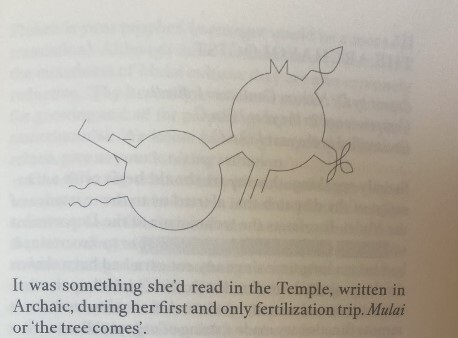
Don't be misled by my previous statement; if the act of writing has fixed this word in time, it is only because it is printed on the wolves themselves - and in Korean, not Mulai. In our tongues, writing in a way rectifies the curves of language while also stabilizing it; in the Mulai tongue, the written word is as liquid as... no, it is more liquid than the spoken word. At the same time, the former can extend invisible bridges between elements of the latter, which is often incomprehensible without its counterpart.
Footnotes: (10) Note from the English translator: Translated in these pages as wolf. (11) It's been suggested that lobo may come from the Spanish term for wolf. Though unlikely, perhaps this word magnetized the Korean term due to the behavioural similarities between wolf-lobos and robot-lobos.
[as an aside, the Korean 로봇 is a direct phonetic rendition of robot - the ㄹ as close to a 'r' as one can get and the ㅅ a 't' sound rather than a 's' at the end of a syllable block although can become an 's' sound if one adds e.g. 이]
But as per the above, this correspondence largely applies to the sound of loan words - the Mulai's own script (one that Hachemi devised as a university student) is graphically and conceptually very different from our own:
And therein lies the novel's power - the way it demonstrates both how a society could evolve very differently to our own, but that also how language, culture, believes and economic systems each evolve in tandem.
This really needed more plot, and even maybe a little horror. I understand why it doesn’t - the novel is reminiscent of Borges in its investigation of language and information, and the structure which builds in time but leaves out enough to keep us wondering. But the book really suffers from this influence as there is nothing else to drive it forward. The novelty of the science fiction element only takes you so far, and without a sense of eeriness or cosmic horror that I know Hachemi would be so good at, it falls quite flat.
Hachemi has masterfully built a world of the Mulai which is endlessly fascinating to the archeologist and main scientists of the novel, but wanes early on for the reader. I adored the etymology and felt as though if this was spliced with a storyline that was building tension it would have been absolutely incredible. Leaving this book feeling slightly disappointed but appreciating Hachemi’s literary influences and enjoying the book still for what it is.
Leí un poco y después hice un parón porque no terminaba de entrar (hacía que pensara mucho en Los desposeídos) y ya después todo casi del tirón. Ha dado la casualidad de que al mismo tiempo también he leído y terminado Novela natural de Gospodinov y, aunque son novelas muy distintas, creo que se entenderían muy bien la una a la otra. Ha sido bonito.
As an anthropology major, I found this a fascinating look into a fictional culture set in the future. The archaeologist sent to study the Mulai fully immerses himself in their world, though ethically, he definitely crossed some boundaries. He gave me some Malinowski vibes here, that’s for sure. The Mulai’s language is one of the most intriguing parts of their culture because it’s constantly evolving, which makes translation nearly impossible.
We also get the POV of several Mulai characters and we see how they understand their world and “Dog,” their version of god. One character’s slow epiphany about her own existence stood out to me as one of the most compelling threads in the book. Ultimately, the novel argues there’s no single “correct” way to live, and that imposing one culture’s values onto another is a mistake.
My only complaint is that the prose got wordy in places and some of the language discussion went over my head. Still, this was a genuinely interesting exploration of a fictional culture.
The Mulai is a morally gray translated novel about alternative modes of living, heavy on linguistics and transgression. The story is told through multiple modes, frequently using ethnographic field notes which help produce a vast amount of worldbuilding in under 200 pages. It feels a little bit like the product of someone grappling with The Left Hand of Darkness and Invisible Cities (and maybe even Vanishing World) while on a butt ton of acid.
Από τα πιο περίεργα βιβλία που έχω διαβάσει. Λυπάμαι πραγματικά τους μεταφραστές, μου φαίνεται άθλος να μεταφραστεί αυτό το βιβλίο χωρίς να χαθούν πράγματα στην μετάφραση. Μου φάνηκε πολύ ευκολοδιάβαστο και δεν μπορούσα να το αφήσω παρά το γεγονός ότι γενικά ήταν δυσνόητο, πολλά πράγματα ξεκαθάρισαν προς το τέλος κι άλλα τόσα δεν ξεκαθάρισαν. Θα το ξαναδιάβαζα σύντομα εύκολα. Πολύ ιδιαίτερο βιβλίο επιστημονικής φαντασίας με μπόλικα στοιχεία γλωσσολογίας εξαιτίας του θέματος της μελέτης ενός πολιτισμού. 7.5 / 10
A long-forgotten human colony on a distant planet is rediscovered by a Spanish archaeologist. Through his field notes, personal diaries, and oral histories spanning 150 years after Earth's supply ships mysteriously stopped arriving, we watch a civilisation reinvent itself. Language splinters, myths harden into religion, communities evolve, and history becomes something negotiated rather than remembered.
Equal parts witty, coarse and quietly profound, the novel explores translation, storytelling, faith (including prayers to Dog), sex, and the wonderfully messy ways cultures transform over time. It's an inventive meditation on what survives when the past is lost.
Fans of Atwood’s Oryx and Crake, Calvino (whose work features in the text!) Borges or Ursula K. Le Guin will find plenty to admire in this ambitious, deeply thoughtful novel.
Ha pasado un año y sigo pensando en este libro. En cómo habla de lingüística, y de costumbres, de desfragmentar a conciencia una civilización y encontrarse con que ha aparecido una nueva sociedad con reglas y tabúes nuevos, no necesariamente aquellos que inicialmente se esperaba, pero nuevos.
Qué pasada. Construye un universo fácil de seguir pero tan preciso (y creíble) que algunas veces olvidas que estás leyendo ciencia ficción. Totalmente recomendable.
Con una ambientación un poco "Dune" (al menos yo me lo he imaginado así) y un estilo descriptivo un poco "Las montañas de la locura" (especialmente los primeros apuntes del Arqueólogo), Munir construye un pequeño universo plenamente autónomo preñado de detalles imaginativos. El lector al principio avanza a tientas, pero pronto se siente como en casa, como en un mar conocido (aunque a ratos no haga pie ni palpe el fondo). Es una obra que arriesga, tanto en continente como en contenido, y acaba resultando sorprendente para lectores poco familiarizados con la ciencia ficción (o la ficción especulativa). En apenas 170 páginas consigue trazar una especie de alegoría sobre cómo se cimenta una cultura, con sus códigos y sus creencias. Las partes que tratan sobre la sexualidad de los mulai y la complejidad de su lengua me han resultado especialmente sugestivas. Seguiremos leyendo.
It is a good thing this book is not any longer than it is (171 pages in my English language translation from the original Spanish), else I would surely have had to quit on it.
It is a fascinating thought experiment about the ways in which language mutates across time and in response to circumstance and perhaps most importantly based on the needs and desires and beliefs of the community that uses it. And it certainly calls into question how much faith we should have in the accuracy of our translations of long dead or yet to be invented languages; much less in our confidence about whether the information contained in the original was meant to be factual or fictional.
For me, though, the “story“ surrounding all of that did not really work to add anything to it. Nor did the back-and-forth, future-past-present, structure of the novel.
I may just not be smart enough to appreciate this one.
Le doy un 3 no por el libro en si, sino porque creo que no he llegado a comprender del todo ciertas cosas. Es un libro más denso de lo que parece, y me ha dado ganas de aprender más acerca de la antropología de otras culturas, más específicamente de diarios de campo; así como cuestionarme nuestra propia cultura.
Guau. Es arriesgada en su planteamiento y también en lo que transmite. Es evidente la influencia de Ursula K. Le Guin y creo ver un poco de China Miéville en su reflexión sobre el lenguaje, pero respira mucha originalidad en un ámbito literario como el español. Y aún siendo compleja en su reflexión se lee rápido, es ágil y engancha, es voluble como el idioma de los mulai, crea pensamientos en nuestra cabeza que dan vueltas y vueltas y que a cada uno le llevará a una conclusión distinta pero que no están desconectadas entre sí. Es un libro para tomar notas, muchas.
Una novela de ciencia ficción compleja pero muy original sobre el papel del lenguaje en la definición de nuestras realidades.
El comienzo del libro resulta un poco críptico, pero a medida que pasan las páginas, se desgrana, vaciles del autor mediante, lo mulai. Esto no siempre me ha parecido que funcione, pero sorprende y divierte cuando sí lo hace.
Es muy interesante cómo Munir Hachemi se sirve de una narración fragmentada para contraponer la forma en la que mulais y humanos perciben la realidad propia y la del contrario, siempre a través del lenguaje y sus derivadas.
También se destila, al igual que pasaba en Cosas vivas, una crítica directa a los modelos relacionales y de consumo de nuestras sociedades.
No he entrado de lleno en la historia y me sabe mal, porque creo que plantea cuestiones muy interesantes a nivel de antropología del lenguaje. Es difícil generar simpatía e identificación hacia los personajes, quizás el propio formato en el que está redactado no ayuda.