

What do you think?

Resilient Optimism: The Science of Sustaining a Positive Mindset in Tough Times
Positive psychology researcher and bestselling author Michelle Gielan reveals how science-backed habits can help you sustain optimism and thrive through stress, uncertainty, and change.
Optimism—it's crucial for making progress in life and work. And it's easy to feel optimistic at the start of a new project or when you're on a successful roll, full of hope and energy. But when setbacks strike, optimism can quickly evaporate, dragging down performance, morale, and even health. With workplace engagement at an all-time low and burnout at historic highs, the key question becomes How do we sustain optimism—even through challenging times?
Bestselling author and researcher Michelle Gielan offers a science-backed answer in Resilient Optimism. Drawing on decades of research in positive psychology and neuroscience, Gielan reveals that making optimism endure isn't about forcing positive emotions or ignoring reality—it's about building simple, repeatable behaviors that create a positive mindset and make it stick. These mindful practices transform challenges into fuel for resilience, performance, and well-being.
With compelling stories and actionable strategies, Gielan guides readers through five key recalibrating mindset to focus on what's working, reframing stress as a tool for growth, triaging commitments to protect energy, recharging smarter to sustain performance, and connecting the dots of our busy lives through small acts that spark meaning. To support her advice, she shares breakthrough findings—from studies showing how optimism predicts success and health to real-world examples of leaders and teams who turned adversity into advantage.
Practical, inspiring, and deeply researched, this book shows that optimism isn't a predetermined trait—it's a trainable skill, accessible to anyone. Whether you're navigating organizational upheaval, economic uncertainty, or personal setbacks, Resilient Optimism is your roadmap for thriving in tough times.
Optimism—it's crucial for making progress in life and work. And it's easy to feel optimistic at the start of a new project or when you're on a successful roll, full of hope and energy. But when setbacks strike, optimism can quickly evaporate, dragging down performance, morale, and even health. With workplace engagement at an all-time low and burnout at historic highs, the key question becomes How do we sustain optimism—even through challenging times?
Bestselling author and researcher Michelle Gielan offers a science-backed answer in Resilient Optimism. Drawing on decades of research in positive psychology and neuroscience, Gielan reveals that making optimism endure isn't about forcing positive emotions or ignoring reality—it's about building simple, repeatable behaviors that create a positive mindset and make it stick. These mindful practices transform challenges into fuel for resilience, performance, and well-being.
With compelling stories and actionable strategies, Gielan guides readers through five key recalibrating mindset to focus on what's working, reframing stress as a tool for growth, triaging commitments to protect energy, recharging smarter to sustain performance, and connecting the dots of our busy lives through small acts that spark meaning. To support her advice, she shares breakthrough findings—from studies showing how optimism predicts success and health to real-world examples of leaders and teams who turned adversity into advantage.
Practical, inspiring, and deeply researched, this book shows that optimism isn't a predetermined trait—it's a trainable skill, accessible to anyone. Whether you're navigating organizational upheaval, economic uncertainty, or personal setbacks, Resilient Optimism is your roadmap for thriving in tough times.
208 pages, Hardcover
Published September 22, 2026
Ratings & Reviews
Friends & Following
Create a free account to discover what your friends think of this book!
Community Reviews
Displaying 1 - 22 of 22 reviews

Review of advance copy received from NetGalley
I really enjoyed Resilient Optimism and especially appreciated how practical it felt. Rather than simply telling us to “think positively,” Michelle Gielan gives concrete examples of how we can actually change the way we respond to stress and challenges.
One example that really stuck with me was Sully landing the plane on the Hudson. He still felt the stress of the situation, but the way he processed that stress allowed it to work for him instead of against him. I loved the idea that stress itself isn’t always the enemy - we can listen to what it is telling us about our fears and what matters most to us, and use it as a tool to build resilience.
I also loved the reminder that optimism can have a ripple effect. The idea that even one person practicing resilient optimism can influence others and potentially create a movement really stayed with me.
This was an encouraging and meaningful listen with plenty of ideas I can see myself coming back to, especially during stressful seasons of life and work.
It felt like a long informative podcast rather than a book, and it was a very enjoyable listen.
Thank you to NetGalley and the publisher for the ALC in exchange for my honest review.
One example that really stuck with me was Sully landing the plane on the Hudson. He still felt the stress of the situation, but the way he processed that stress allowed it to work for him instead of against him. I loved the idea that stress itself isn’t always the enemy - we can listen to what it is telling us about our fears and what matters most to us, and use it as a tool to build resilience.
I also loved the reminder that optimism can have a ripple effect. The idea that even one person practicing resilient optimism can influence others and potentially create a movement really stayed with me.
This was an encouraging and meaningful listen with plenty of ideas I can see myself coming back to, especially during stressful seasons of life and work.
It felt like a long informative podcast rather than a book, and it was a very enjoyable listen.
Thank you to NetGalley and the publisher for the ALC in exchange for my honest review.

September 26, 2026
A great book about optimism and practical ways to maintain a positive mindset. Enjoyed audio being narrated by the author and was surprised to learn she's the wife of the happiness guy, Shawn Achor. I'll be utilizing what I learned and likely revisiting this one when reminders are needed.

August 14, 2026
I received an ARC after seeing the author speak at the 2026 ICAN Conference, and this book delivers exactly what she promised on stage — resilient optimism you can actually use. It’s packed with real‑world examples that feel like they were pulled straight from my own day‑to‑day grind.
What I loved most is her core message: optimism isn’t a mood, it’s a behavior. Small, repeatable actions that steady your mind, rebuild worn‑down neural pathways, and shift you from survival mode into growth. Her reframes on stress, celebrating tiny wins, triaging commitments, and intentionally focusing on what’s working were simple but genuinely transformative.
This is practical, encouraging, and immediately applicable. A standout read for anyone running a full life on a low battery — and wanting tools that actually help.
What I loved most is her core message: optimism isn’t a mood, it’s a behavior. Small, repeatable actions that steady your mind, rebuild worn‑down neural pathways, and shift you from survival mode into growth. Her reframes on stress, celebrating tiny wins, triaging commitments, and intentionally focusing on what’s working were simple but genuinely transformative.
This is practical, encouraging, and immediately applicable. A standout read for anyone running a full life on a low battery — and wanting tools that actually help.

Review of advance copy received from NetGalley
I have become a very optimistic person as I've aged, and because I value this quality so much, I turned to this intriguing resource filled with helpful strategies to achieve and maintain optimism. Highly recommended for anyone who wants to become more positive in dealing with life's challenges.

Review of advance copy received from NetGalley
The Distance Between Circumstance and Surrender
In “Resilient Optimism,” Michelle Gielan asks how we keep acting when experience has begun to teach us that what we do no longer matters
By Demetris Papadimitropoulos | August 28th, 2026
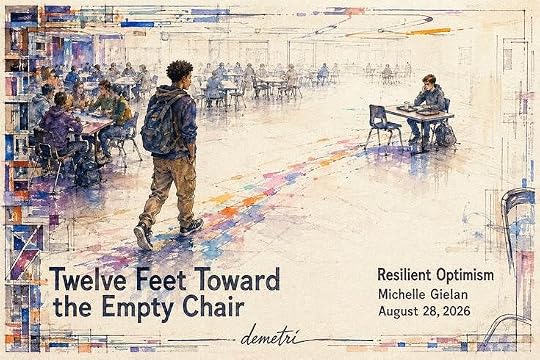
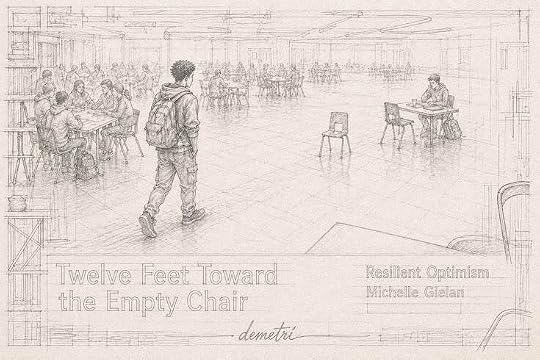
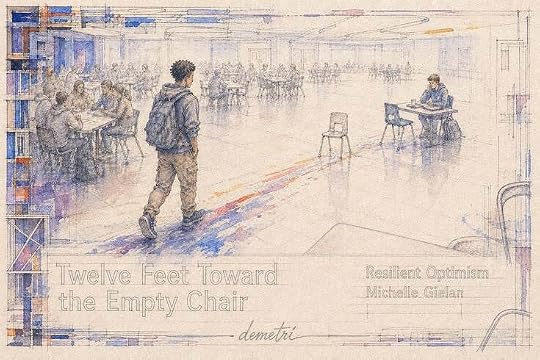
“Twelve Feet Toward the Empty Chair.” Denis Estimon crosses the cafeteria toward a student sitting alone; the open ground between them, rather than Denis or the chair, becomes the measure of remaining agency.
During the worst night of Vidya Krishnan’s career, optimism would have sounded almost indecent. A routine procedure at Ericsson had knocked out wireless service across part of Northern California for three hours; ordinary monitoring could not locate the failure, executives wanted answers she did not have, and Krishnan, then a director of network engineering, lay beside her sleeping six-year-old son while the rule she had mistaken for security – work hard, be perfect, never let anyone down – came apart. Michelle Gielan begins one of the episodes on which “Resilient Optimism” can actually be tested not with hope but with shame. Her argument earns its confidence only after the damage has been counted.
Eventually Krishnan stops treating the failure chiefly as evidence against herself and begins asking what permitted one mistake to travel so far. The culprit is almost comically small – one accidental extra character in code – but the response is architectural. She studies high-risk fields and helps rebuild quality assurance around redundancies, visible process and safeguards instead of individual heroics. The important change is not that she learns to feel differently about failure. The system becomes harder to break. In a genre often tempted to renovate the worker while leaving the workplace untouched, that is Gielan’s better instinct: alter the conditions as well as the story told about them.
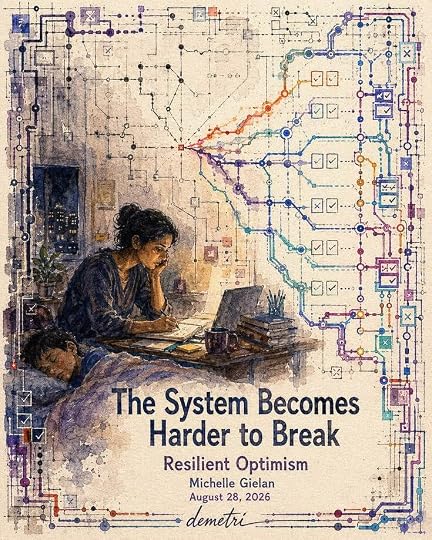
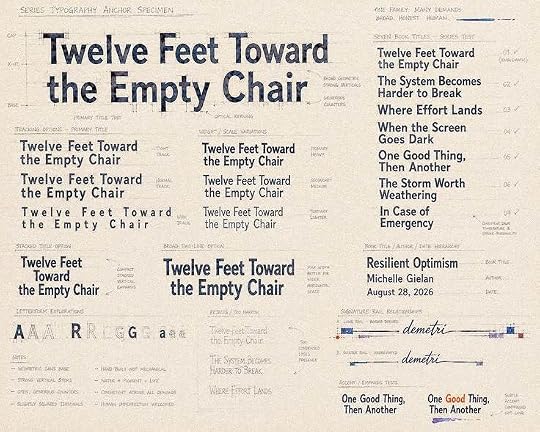
“The System Becomes Harder to Break.” Vidya Krishnan’s failure becomes architectural: a tiny point of breakdown gives way to redundancy, checking, shared process and a system less dependent on individual heroics.
Much of “Resilient Optimism” turns that instinct into five practices. Gielan, a former television-news anchor turned positive-psychology researcher, asks readers to recalibrate what they notice, reinterpret stress, triage where effort goes, recover deliberately and “connect the dots” between constructive acts and a larger sense of possibility. A final chapter widens the frame to the moods and habits of teams, classrooms, families and workplaces. The arrangement looks almost suspiciously neat. What holds it together, though, is not optimism in the ordinary sense.
Even here, the real antagonist is helplessness. Gielan is interested in what happens when setbacks accumulate until effort and outcome begin to feel unrelated. At that point the future does not merely look dark; action starts to look pointless. Her five practices amount to ways of building a counter-record: this mattered, that changed, someone noticed, something moved. The deeper question is not whether a person can feel hopeful on command. It is whether experience still offers enough proof that choice leaves a trace.
The chapter on commitments makes that question easiest to see. It begins with the usual offenders – overloaded calendars, reactive email, Slack, the fairy tale of “just one more thing” – then makes a harsher claim: low-value busyness can train people to work constantly while losing faith in the force of their own work. One fundraiser creates a “Progress Wall” covered with donations secured, meetings won and photographs of students helped by scholarships. The board answers a question no inbox can: where did all that effort go? Morale, Gielan understands, depends partly on legibility.
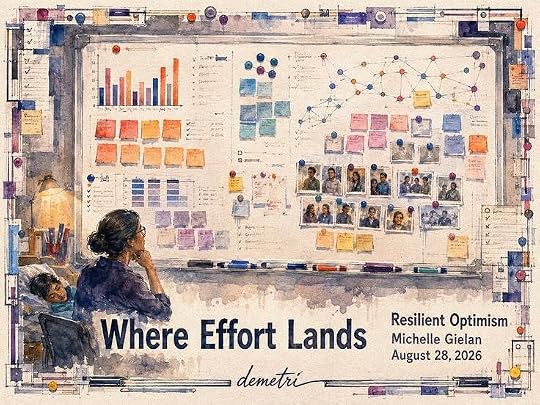
“Where Effort Lands.” A Progress Wall turns invisible labor into visible consequence: a counter-record of what moved, whom the work reached and why effort remains legible enough to matter.
Rest gets moved into the same field of cause and effect. Gielan has little patience for the executive fantasy of being a shark who will die if movement stops. We are mammals, she reminds the reader, and mammals have to come up for air. Her chapter on recovery puts time off inside resilience rather than after it. The useful advice is blessedly ordinary: stop checking the inbox from the beach, protect the return from vacation, let a weekend contain some actual absence from work. The advice itself is familiar. What matters is where she places it. Recovery is not the medal for having endured enough; it is one of the conditions that make judgment possible.
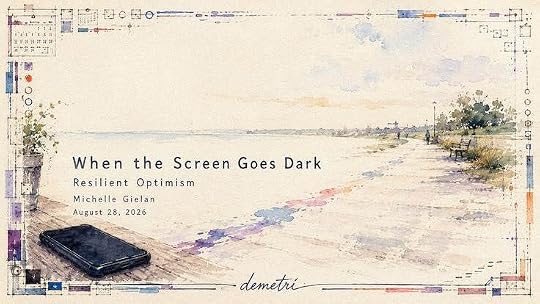
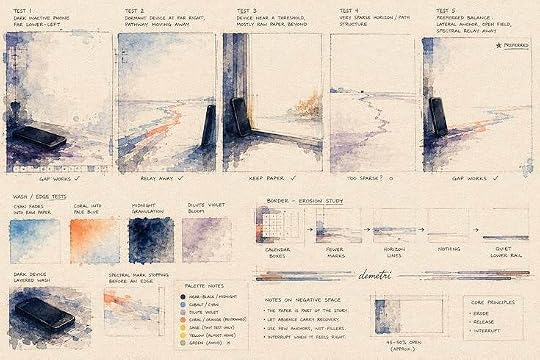
“When the Screen Goes Dark.” A dark inactive device yields to open paper, path and distance, making recovery visible not as another task completed but as the space attention is finally permitted to leave unfilled.
In prose, Gielan prefers usefulness to verbal display. She likes short declarative sentences, direct address and objects that can carry an argument beyond the page: folders, walls, dots, ripples, pivots, “yes, and.” A scene opens, research enters, the lesson contracts into something portable. She has the useful vice of wanting every abstraction to leave the room with a job. Her humor helps. Modern office life supplies enough absurdity that she seldom has to manufacture much more. What the prose rarely permits, by design, is an experience that refuses immediate interpretation.
Predictability comes with that efficiency. Once several chapters have passed, the architecture can be heard: someone is overwhelmed, research supplies a counterintuitive explanation, a practice changes, improvement follows, and the anecdote resolves into a tool or list. Gielan teaches well, but she seldom lets a scene resist the lesson waiting for it. Even pain is often converted into instruction with suspicious speed. Several examples could disappear without depriving the book of substance; their absence might give the remaining ones more pressure.
And yet the order of the chapters does more than keep the material tidy. Attention comes first because people cannot act on possibilities they no longer notice. Stress follows because difficulty must be interpreted before it can be used, endured or refused. Commitment triage asks where effort should go. Recovery preserves the capacity to choose. “Connect the Dots” finally explains why the earlier practices belong together: human beings turn recurring experiences into stories about whether their actions have effects. Five techniques become one account of how futility takes hold.
Perhaps that is why “Connect the Dots” feels like the book’s hinge rather than merely its sixth chapter. Gielan describes the mind as an eager pattern-maker, capable of turning failed proposals, ignored ideas, layoffs and private disappointments into one increasingly plausible sentence: why bother? Her answer is deliberately modest. Praise someone. Solve one problem. Call a friend. Help a colleague. Put one contrary fact into the record. These acts do not solve grief, precarity or institutional dysfunction. They make absolute futility harder to claim because something, however narrow, has just changed.

“One Good Thing, Then Another.” Small acts of care accumulate across separate lives and settings, becoming a distributed pattern of consequence rather than a heroic story about any single person.
Against Martin E. P. Seligman’s “Learned Optimism,” Gielan’s particular move becomes clearer. Seligman helped establish the trainability of optimistic explanatory patterns; Gielan relocates more of the work into routines, environments and observable acts. Her resilient optimist changes what information she stores, which demands she accepts, whether she rests and what she models for others. Gabriele Oettingen’s “Rethinking Positive Thinking” supplies the objection Gielan has to survive: hope has to remain answerable to obstacles. Her strongest chapters do. Elsewhere possibility occasionally outruns its jurisdiction.
Doubts sharpen when the book moves from personal choice to institutional reach. In the final chapter, Gielan celebrates “positive deviants,” people who model a better norm without waiting for permission. A bus driver buckles her seatbelt. A nurse sanitizes her hands where colleagues can see. Co-workers praise one another publicly. Denis Estimon, remembering what it felt like to eat alone after moving from Haiti, begins sitting beside classmates who have no one at their table. A buckled belt, sanitized hands, one changed lunch table: the examples persuade because none initially pretends to be a revolution.
Influence plainly travels through groups, but influence is not authority. Formal power, staffing, money, incentives and policy do not vanish because norms can spread sideways. Gielan sometimes knows this beautifully: Krishnan changes a system; leaders delegate; workers set boundaries; rest requires cultural permission as well as personal discipline. Elsewhere, confidence in the next available gesture expands until agency starts to resemble power. A person can change the temperature of a room without controlling the building.
More troubling than the repetition is the flattening produced by Gielan’s preferred move: make the problem small enough to act on. That move is often humane and useful. It can also make a bad morning, chronic overload, professional disgrace, premature childbirth, loneliness and workplace dysfunction look unusually susceptible to the same family of interventions. They are not equivalent because each admits some next step. The framework travels remarkably well. Occasionally it travels so well that the terrain starts disappearing beneath it.
If the book compresses experience, it also compresses evidence. Gielan draws from experiments, surveys, organizational outcomes, neuroscience, consulting experience and personal story, then sends them through the same fluent narrative machinery. Evidence of unequal strength can emerge wearing the same cut. She does offer caveats. In discussing financial well-being, for instance, she notes that one study captured a single moment rather than following participants over time. Elsewhere, associations and retrospective cases acquire something closer to causal force. The issue is not the presence of research but the prose’s tendency to make unlike findings look equally settled.
The book works best when the size of the claim matches the size of the act. Gielan’s “yes, and” formulation succeeds because the first half cannot be skipped. The failed quarter remains failed. The exhausted worker remains exhausted. Bad news is not required to reveal a secret blessing before the sentence can continue. Possibility arrives after acknowledgment, not instead of it. That promise is smaller than the suggestion that mindset transforms outcomes. It is also more credible.
Resilience is a risky word because it can become an elegant way of relocating responsibility. Workplaces are fond of resilience rhetoric when staffing, authority or compensation would be more useful. Gielan knows enough to resist the worst version of that bargain. Her rational optimist wears the seatbelt. Some stress is a reason to leave. Rest is not laziness. A broken process should be rebuilt. These qualifications keep “Resilient Optimism” from becoming a handbook for smiling more efficiently at bad conditions, though they cannot entirely quiet the suspicion that resilient employees are sometimes asked to solve problems resilient institutions should have prevented.

“The Storm Worth Weathering.” Resilience is not endurance without judgment: some pressure must be crossed, some boundaries must be kept, and some routes must be refused.
Our current workplace gives that suspicion plenty to feed on. “Resilient Optimism” arrives amid technological disruption, economic unease, frayed attention and chronic overload, all of which sharpen Gielan’s question: what allows a person to keep acting meaningfully when outcomes feel less controllable? The question is older than Slack and will survive it. What feels specifically contemporary is the argument over who should be required to absorb uncertainty – the worker, the manager, the organization or, inconveniently, all three.
Part of what Gielan sees clearly is that work can conceal its own effects. Grace, an ICU nurse, keeps letters and photographs from former patients and families in an “In Case of Emergency” folder. On terrible days, the collection does not cancel the patient who died; it stops that death from becoming the complete account of her nursing. Elsewhere managers record small wins and teams name contributions aloud. The practice may sound minor until one notices the recurring problem beneath it: effort without a visible trace is difficult to distinguish, psychologically, from effort that accomplished nothing.
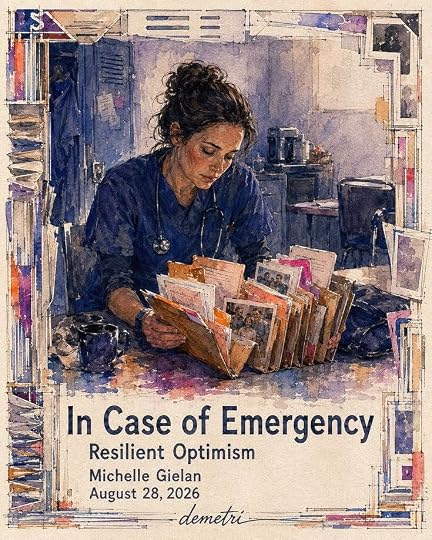
“In Case of Emergency.” Grace’s worn folder does not erase the patient who died; it keeps one terrible outcome from becoming the whole record of her nursing.
Optimism here becomes something closer to a counter-record than a belief. A boundary changes tomorrow’s calendar. Delegation changes who carries the burden. A real break changes available attention. A note of praise changes what another person hears about her work. None guarantees a favorable outcome, and Gielan sometimes lets success finish the story too neatly. Still, her behavioral emphasis imposes a useful condition on hope: it has to touch something.
Ultimately the “pivot” is the book’s best late simplification. The five habits become repeated redirections rather than grand transformations. You do not have to leap; you have to shift. A pivot assumes constraint. It begins from the position one actually occupies and asks what movement remains available from there. Gielan occasionally decorates the idea with more uplift than it needs, but the modest geometry is persuasive.
Leaving aside the brighter slogans, I would place “Resilient Optimism” at 81/100, or 4/5 stars: a strong, unusually usable synthesis whose argument about futility is more interesting than its optimistic vocabulary initially suggests, but whose repetitions, causal overstatement and faith in personal intervention keep it below the exceptional range. Gielan is very good at giving diffuse psychological problems handles. Sometimes the handles look cleaner than the machinery underneath. Most of them hold.
One image kept returning to me: Denis Estimon in a school cafeteria, choosing a different table. Years after learning what it felt like to sit alone, he notices another student without company and walks toward him. Gielan’s conclusion measures the move at twelve feet. Twelve feet is better than a grand metaphor because it has a limit. It will not repair every culture, rescue every worker or redistribute every form of power. But it can still be crossed.
Small as the distance is, the claim becomes stronger when kept to scale. The most durable optimism in “Resilient Optimism” is not confidence that the room will change because we enter it, nor the fantasy that circumstance will yield if we think correctly. It is the narrower conviction that between circumstance and surrender there may still be some ground left to cover. Hope does not have to own the room. Sometimes it only has to know where the empty chair is.

Full-Body Shelf-Style All-Character Watercolor One-Sheet
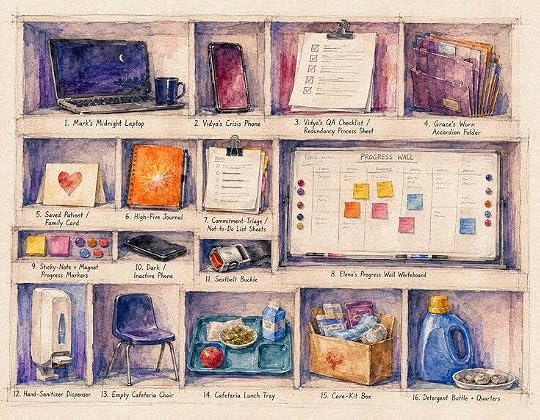
Shelf-Style All-Most-Important-Items Watercolor One-Sheet
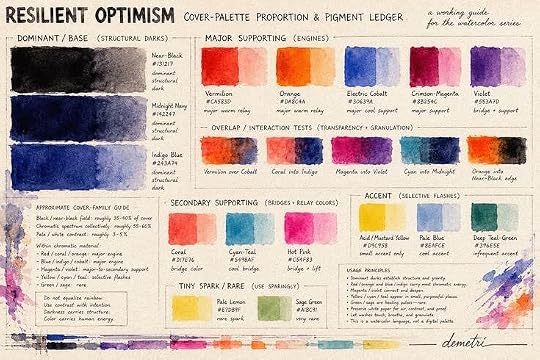
Cover-Palette Proportion & Pigment Ledger
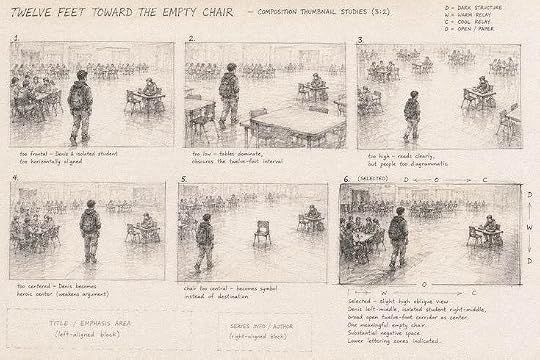
Emblematic Composition Thumbnail Sheet
First Underdrawing Pencil Drawing
First Underdrawing Pencil Drawing with First Wash of Watercolor
Series Typography Anchor Specimen

Seven-Border Architecture & Signature-Rail Study

Vidya Network Geometry & Redundancy Study

Grace Archive-Material / Folder-and-Paper Study
Recovery Negative-Space / Dark-Screen Wash Study
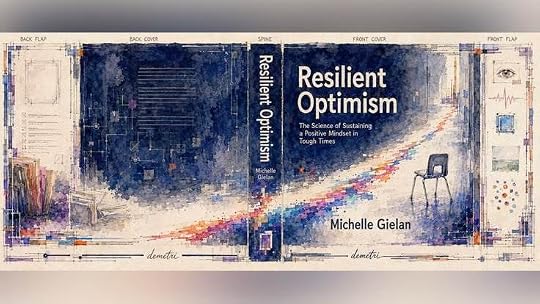
Alternate Book-Cover Full Dust Jacket with Flaps Watercolor
All watercolor illustrations by Demetris Papadimitropoulos.
Watercolors are done on 140lb vellum and then scanned into the computer using an Epson scanner. From there, they are finalized in Procreate. No AI was used in writing this review — all art and opinions are my own.
In “Resilient Optimism,” Michelle Gielan asks how we keep acting when experience has begun to teach us that what we do no longer matters
By Demetris Papadimitropoulos | August 28th, 2026
“Twelve Feet Toward the Empty Chair.” Denis Estimon crosses the cafeteria toward a student sitting alone; the open ground between them, rather than Denis or the chair, becomes the measure of remaining agency.
During the worst night of Vidya Krishnan’s career, optimism would have sounded almost indecent. A routine procedure at Ericsson had knocked out wireless service across part of Northern California for three hours; ordinary monitoring could not locate the failure, executives wanted answers she did not have, and Krishnan, then a director of network engineering, lay beside her sleeping six-year-old son while the rule she had mistaken for security – work hard, be perfect, never let anyone down – came apart. Michelle Gielan begins one of the episodes on which “Resilient Optimism” can actually be tested not with hope but with shame. Her argument earns its confidence only after the damage has been counted.
Eventually Krishnan stops treating the failure chiefly as evidence against herself and begins asking what permitted one mistake to travel so far. The culprit is almost comically small – one accidental extra character in code – but the response is architectural. She studies high-risk fields and helps rebuild quality assurance around redundancies, visible process and safeguards instead of individual heroics. The important change is not that she learns to feel differently about failure. The system becomes harder to break. In a genre often tempted to renovate the worker while leaving the workplace untouched, that is Gielan’s better instinct: alter the conditions as well as the story told about them.
“The System Becomes Harder to Break.” Vidya Krishnan’s failure becomes architectural: a tiny point of breakdown gives way to redundancy, checking, shared process and a system less dependent on individual heroics.
Much of “Resilient Optimism” turns that instinct into five practices. Gielan, a former television-news anchor turned positive-psychology researcher, asks readers to recalibrate what they notice, reinterpret stress, triage where effort goes, recover deliberately and “connect the dots” between constructive acts and a larger sense of possibility. A final chapter widens the frame to the moods and habits of teams, classrooms, families and workplaces. The arrangement looks almost suspiciously neat. What holds it together, though, is not optimism in the ordinary sense.
Even here, the real antagonist is helplessness. Gielan is interested in what happens when setbacks accumulate until effort and outcome begin to feel unrelated. At that point the future does not merely look dark; action starts to look pointless. Her five practices amount to ways of building a counter-record: this mattered, that changed, someone noticed, something moved. The deeper question is not whether a person can feel hopeful on command. It is whether experience still offers enough proof that choice leaves a trace.
The chapter on commitments makes that question easiest to see. It begins with the usual offenders – overloaded calendars, reactive email, Slack, the fairy tale of “just one more thing” – then makes a harsher claim: low-value busyness can train people to work constantly while losing faith in the force of their own work. One fundraiser creates a “Progress Wall” covered with donations secured, meetings won and photographs of students helped by scholarships. The board answers a question no inbox can: where did all that effort go? Morale, Gielan understands, depends partly on legibility.
“Where Effort Lands.” A Progress Wall turns invisible labor into visible consequence: a counter-record of what moved, whom the work reached and why effort remains legible enough to matter.
Rest gets moved into the same field of cause and effect. Gielan has little patience for the executive fantasy of being a shark who will die if movement stops. We are mammals, she reminds the reader, and mammals have to come up for air. Her chapter on recovery puts time off inside resilience rather than after it. The useful advice is blessedly ordinary: stop checking the inbox from the beach, protect the return from vacation, let a weekend contain some actual absence from work. The advice itself is familiar. What matters is where she places it. Recovery is not the medal for having endured enough; it is one of the conditions that make judgment possible.
“When the Screen Goes Dark.” A dark inactive device yields to open paper, path and distance, making recovery visible not as another task completed but as the space attention is finally permitted to leave unfilled.
In prose, Gielan prefers usefulness to verbal display. She likes short declarative sentences, direct address and objects that can carry an argument beyond the page: folders, walls, dots, ripples, pivots, “yes, and.” A scene opens, research enters, the lesson contracts into something portable. She has the useful vice of wanting every abstraction to leave the room with a job. Her humor helps. Modern office life supplies enough absurdity that she seldom has to manufacture much more. What the prose rarely permits, by design, is an experience that refuses immediate interpretation.
Predictability comes with that efficiency. Once several chapters have passed, the architecture can be heard: someone is overwhelmed, research supplies a counterintuitive explanation, a practice changes, improvement follows, and the anecdote resolves into a tool or list. Gielan teaches well, but she seldom lets a scene resist the lesson waiting for it. Even pain is often converted into instruction with suspicious speed. Several examples could disappear without depriving the book of substance; their absence might give the remaining ones more pressure.
And yet the order of the chapters does more than keep the material tidy. Attention comes first because people cannot act on possibilities they no longer notice. Stress follows because difficulty must be interpreted before it can be used, endured or refused. Commitment triage asks where effort should go. Recovery preserves the capacity to choose. “Connect the Dots” finally explains why the earlier practices belong together: human beings turn recurring experiences into stories about whether their actions have effects. Five techniques become one account of how futility takes hold.
Perhaps that is why “Connect the Dots” feels like the book’s hinge rather than merely its sixth chapter. Gielan describes the mind as an eager pattern-maker, capable of turning failed proposals, ignored ideas, layoffs and private disappointments into one increasingly plausible sentence: why bother? Her answer is deliberately modest. Praise someone. Solve one problem. Call a friend. Help a colleague. Put one contrary fact into the record. These acts do not solve grief, precarity or institutional dysfunction. They make absolute futility harder to claim because something, however narrow, has just changed.
“One Good Thing, Then Another.” Small acts of care accumulate across separate lives and settings, becoming a distributed pattern of consequence rather than a heroic story about any single person.
Against Martin E. P. Seligman’s “Learned Optimism,” Gielan’s particular move becomes clearer. Seligman helped establish the trainability of optimistic explanatory patterns; Gielan relocates more of the work into routines, environments and observable acts. Her resilient optimist changes what information she stores, which demands she accepts, whether she rests and what she models for others. Gabriele Oettingen’s “Rethinking Positive Thinking” supplies the objection Gielan has to survive: hope has to remain answerable to obstacles. Her strongest chapters do. Elsewhere possibility occasionally outruns its jurisdiction.
Doubts sharpen when the book moves from personal choice to institutional reach. In the final chapter, Gielan celebrates “positive deviants,” people who model a better norm without waiting for permission. A bus driver buckles her seatbelt. A nurse sanitizes her hands where colleagues can see. Co-workers praise one another publicly. Denis Estimon, remembering what it felt like to eat alone after moving from Haiti, begins sitting beside classmates who have no one at their table. A buckled belt, sanitized hands, one changed lunch table: the examples persuade because none initially pretends to be a revolution.
Influence plainly travels through groups, but influence is not authority. Formal power, staffing, money, incentives and policy do not vanish because norms can spread sideways. Gielan sometimes knows this beautifully: Krishnan changes a system; leaders delegate; workers set boundaries; rest requires cultural permission as well as personal discipline. Elsewhere, confidence in the next available gesture expands until agency starts to resemble power. A person can change the temperature of a room without controlling the building.
More troubling than the repetition is the flattening produced by Gielan’s preferred move: make the problem small enough to act on. That move is often humane and useful. It can also make a bad morning, chronic overload, professional disgrace, premature childbirth, loneliness and workplace dysfunction look unusually susceptible to the same family of interventions. They are not equivalent because each admits some next step. The framework travels remarkably well. Occasionally it travels so well that the terrain starts disappearing beneath it.
If the book compresses experience, it also compresses evidence. Gielan draws from experiments, surveys, organizational outcomes, neuroscience, consulting experience and personal story, then sends them through the same fluent narrative machinery. Evidence of unequal strength can emerge wearing the same cut. She does offer caveats. In discussing financial well-being, for instance, she notes that one study captured a single moment rather than following participants over time. Elsewhere, associations and retrospective cases acquire something closer to causal force. The issue is not the presence of research but the prose’s tendency to make unlike findings look equally settled.
The book works best when the size of the claim matches the size of the act. Gielan’s “yes, and” formulation succeeds because the first half cannot be skipped. The failed quarter remains failed. The exhausted worker remains exhausted. Bad news is not required to reveal a secret blessing before the sentence can continue. Possibility arrives after acknowledgment, not instead of it. That promise is smaller than the suggestion that mindset transforms outcomes. It is also more credible.
Resilience is a risky word because it can become an elegant way of relocating responsibility. Workplaces are fond of resilience rhetoric when staffing, authority or compensation would be more useful. Gielan knows enough to resist the worst version of that bargain. Her rational optimist wears the seatbelt. Some stress is a reason to leave. Rest is not laziness. A broken process should be rebuilt. These qualifications keep “Resilient Optimism” from becoming a handbook for smiling more efficiently at bad conditions, though they cannot entirely quiet the suspicion that resilient employees are sometimes asked to solve problems resilient institutions should have prevented.
“The Storm Worth Weathering.” Resilience is not endurance without judgment: some pressure must be crossed, some boundaries must be kept, and some routes must be refused.
Our current workplace gives that suspicion plenty to feed on. “Resilient Optimism” arrives amid technological disruption, economic unease, frayed attention and chronic overload, all of which sharpen Gielan’s question: what allows a person to keep acting meaningfully when outcomes feel less controllable? The question is older than Slack and will survive it. What feels specifically contemporary is the argument over who should be required to absorb uncertainty – the worker, the manager, the organization or, inconveniently, all three.
Part of what Gielan sees clearly is that work can conceal its own effects. Grace, an ICU nurse, keeps letters and photographs from former patients and families in an “In Case of Emergency” folder. On terrible days, the collection does not cancel the patient who died; it stops that death from becoming the complete account of her nursing. Elsewhere managers record small wins and teams name contributions aloud. The practice may sound minor until one notices the recurring problem beneath it: effort without a visible trace is difficult to distinguish, psychologically, from effort that accomplished nothing.
“In Case of Emergency.” Grace’s worn folder does not erase the patient who died; it keeps one terrible outcome from becoming the whole record of her nursing.
Optimism here becomes something closer to a counter-record than a belief. A boundary changes tomorrow’s calendar. Delegation changes who carries the burden. A real break changes available attention. A note of praise changes what another person hears about her work. None guarantees a favorable outcome, and Gielan sometimes lets success finish the story too neatly. Still, her behavioral emphasis imposes a useful condition on hope: it has to touch something.
Ultimately the “pivot” is the book’s best late simplification. The five habits become repeated redirections rather than grand transformations. You do not have to leap; you have to shift. A pivot assumes constraint. It begins from the position one actually occupies and asks what movement remains available from there. Gielan occasionally decorates the idea with more uplift than it needs, but the modest geometry is persuasive.
Leaving aside the brighter slogans, I would place “Resilient Optimism” at 81/100, or 4/5 stars: a strong, unusually usable synthesis whose argument about futility is more interesting than its optimistic vocabulary initially suggests, but whose repetitions, causal overstatement and faith in personal intervention keep it below the exceptional range. Gielan is very good at giving diffuse psychological problems handles. Sometimes the handles look cleaner than the machinery underneath. Most of them hold.
One image kept returning to me: Denis Estimon in a school cafeteria, choosing a different table. Years after learning what it felt like to sit alone, he notices another student without company and walks toward him. Gielan’s conclusion measures the move at twelve feet. Twelve feet is better than a grand metaphor because it has a limit. It will not repair every culture, rescue every worker or redistribute every form of power. But it can still be crossed.
Small as the distance is, the claim becomes stronger when kept to scale. The most durable optimism in “Resilient Optimism” is not confidence that the room will change because we enter it, nor the fantasy that circumstance will yield if we think correctly. It is the narrower conviction that between circumstance and surrender there may still be some ground left to cover. Hope does not have to own the room. Sometimes it only has to know where the empty chair is.
Full-Body Shelf-Style All-Character Watercolor One-Sheet
Shelf-Style All-Most-Important-Items Watercolor One-Sheet
Cover-Palette Proportion & Pigment Ledger
Emblematic Composition Thumbnail Sheet
First Underdrawing Pencil Drawing
First Underdrawing Pencil Drawing with First Wash of Watercolor
Series Typography Anchor Specimen
Seven-Border Architecture & Signature-Rail Study
Vidya Network Geometry & Redundancy Study
Grace Archive-Material / Folder-and-Paper Study
Recovery Negative-Space / Dark-Screen Wash Study
Alternate Book-Cover Full Dust Jacket with Flaps Watercolor
All watercolor illustrations by Demetris Papadimitropoulos.
Watercolors are done on 140lb vellum and then scanned into the computer using an Epson scanner. From there, they are finalized in Procreate. No AI was used in writing this review — all art and opinions are my own.

September 26, 2026
“You’re not expected to leap, you’re just invited to shift.” I truly enjoyed this book. The incredible intersection of psychological research and practical tips to adopt…a book after my own heart.

Review of advance copy received from NetGalley
Thank you to NetGalley and RB Media for the advance listening copy in exchange for an honest review.
4 stars
Not my usual fare, but I picked this one up for a reason, as I'm going through a particularly rough time in relation to my career, and it delivered on that front. What really works here is the structure — every chapter opens with a real vignette showing the method in action before the science backs it up, so you're primed to see how it applies to your own life rather than just reading theory. The gratitude practice stuck with me most: something as small as writing down two or three good moments a day. Simple enough that I actually want to start doing it — I've got a friend I'm planning to set up a daily "good moments" Discord channel with, directly inspired by this.
The tips and case studies are the real strength of the book — practical, grounded, easy to actually picture yourself using.
One caveat, and it's more about stress-resilience research in general than this book specifically: it's not clear these studies include people with chronic illnesses like ME/CFS, and a chronically activated nervous system runs on different baseline mechanics than what these studies are usually measuring. So I genuinely don't know if the findings apply to a body like mine. Even so, I still wanted to try the techniques on their own merits — evidence gap aside.
There's also a moment of unintentional ableism that's worth naming: an exercise that asks you to reflect on how a stressful experience "shaped you" lands very differently when what it shaped was a chronic illness. A later version of the same exercise handles it more carefully — it acknowledges the pain before reframing it — but underneath, it's still doing a "gain through pain" thing. Hit or miss.
Also, heads up if you have pregnancy/birth/medical triggers — there's content there I wasn't expecting going in.
Gielan narrates it herself, and it's genuinely one of the better examples of author-as-narrator I've heard — she's clearly at home speaking to an audience, and that comfort comes through in a reading with real personality.
Recommended if you want a practical, well-delivered entry point into resilience science — just know the research is skewed toward a healthy, nondisabled population, so your mileage may vary depending on what body you're bringing to it.
4 stars
Not my usual fare, but I picked this one up for a reason, as I'm going through a particularly rough time in relation to my career, and it delivered on that front. What really works here is the structure — every chapter opens with a real vignette showing the method in action before the science backs it up, so you're primed to see how it applies to your own life rather than just reading theory. The gratitude practice stuck with me most: something as small as writing down two or three good moments a day. Simple enough that I actually want to start doing it — I've got a friend I'm planning to set up a daily "good moments" Discord channel with, directly inspired by this.
The tips and case studies are the real strength of the book — practical, grounded, easy to actually picture yourself using.
One caveat, and it's more about stress-resilience research in general than this book specifically: it's not clear these studies include people with chronic illnesses like ME/CFS, and a chronically activated nervous system runs on different baseline mechanics than what these studies are usually measuring. So I genuinely don't know if the findings apply to a body like mine. Even so, I still wanted to try the techniques on their own merits — evidence gap aside.
There's also a moment of unintentional ableism that's worth naming: an exercise that asks you to reflect on how a stressful experience "shaped you" lands very differently when what it shaped was a chronic illness. A later version of the same exercise handles it more carefully — it acknowledges the pain before reframing it — but underneath, it's still doing a "gain through pain" thing. Hit or miss.
Also, heads up if you have pregnancy/birth/medical triggers — there's content there I wasn't expecting going in.
Gielan narrates it herself, and it's genuinely one of the better examples of author-as-narrator I've heard — she's clearly at home speaking to an audience, and that comfort comes through in a reading with real personality.
Recommended if you want a practical, well-delivered entry point into resilience science — just know the research is skewed toward a healthy, nondisabled population, so your mileage may vary depending on what body you're bringing to it.

Review of advance copy received from NetGalley
“Resilient Optimism” arrived at exactly the right moment. I'd just come back from holiday and was thinking about what I could realistically do to improve team morale and culture, rather than simply accepting that every conversation starts with a list of problems.
So Michelle Gielan’s book which gathers her thoughts and research on positive psychology into one coherent package was perfect for a re-set. There wasn't much that was completely new conceptually, but that's hardly a criticism. The strength of the book lies in how clearly she explains the evidence and, more importantly, how Gielan turns it into practical actions rather than inspirational slogans.
The book is well structured, easy to follow and packed with case studies that keep it grounded in reality. I particularly appreciated the concrete suggestions. And while the underlying principles were often familiar, some of Gielan's ways of making them stick were new to me.
In fact, I've already started experimenting. After returning to work and receiving the usual barrage of everything that had gone wrong while I was away, I've begun asking people to tell me one positive thing as well. We are currently at the "slightly puzzled look" stage of culture change, but it's early days…
Having Gielan narrate the audiobook herself was a real bonus. She's an excellent speaker, clearly passionate about the topic and completely at ease with the material. The narration feels natural and engaging and this made the content memorable.
This is a practical, evidence-based and highly listenable book. I've come away with a handful of useful ideas for work and a number of new habits - foremost tips on how to hold on to my post-holiday positivity and a renewed appreciation of the benefits of optimism.
Thank you to RB Media & Ascent Audio, NetGalley and Michelle Gielan for an advance listening copy of this book.
So Michelle Gielan’s book which gathers her thoughts and research on positive psychology into one coherent package was perfect for a re-set. There wasn't much that was completely new conceptually, but that's hardly a criticism. The strength of the book lies in how clearly she explains the evidence and, more importantly, how Gielan turns it into practical actions rather than inspirational slogans.
The book is well structured, easy to follow and packed with case studies that keep it grounded in reality. I particularly appreciated the concrete suggestions. And while the underlying principles were often familiar, some of Gielan's ways of making them stick were new to me.
In fact, I've already started experimenting. After returning to work and receiving the usual barrage of everything that had gone wrong while I was away, I've begun asking people to tell me one positive thing as well. We are currently at the "slightly puzzled look" stage of culture change, but it's early days…
Having Gielan narrate the audiobook herself was a real bonus. She's an excellent speaker, clearly passionate about the topic and completely at ease with the material. The narration feels natural and engaging and this made the content memorable.
This is a practical, evidence-based and highly listenable book. I've come away with a handful of useful ideas for work and a number of new habits - foremost tips on how to hold on to my post-holiday positivity and a renewed appreciation of the benefits of optimism.
Thank you to RB Media & Ascent Audio, NetGalley and Michelle Gielan for an advance listening copy of this book.

August 16, 2026
Resilient Optimism by renowned psychology researcher Michell Gielan is a book that sets out to teach the reader that optimism is not just something that you are born with, it is a perspective that can be worked on, built upon and encouraged so that it becomes the default position, not just when things are easy but also when there are challenges to be faced. Building this resilient optimism will not only improve happiness it can also increase productivity and improve performance at work a and at home.
The book is clearly and concisely written, with ample anecdotes and real life examples used to illustrate the author's points and a very useful "key takeaways" section at the end of each chapter that encourages the reader to incorporate what they have learned into their day to day life in small ways, but ones that are easily incorporated into the day to day routine. The book aims to teach the reader how to recalibrate their mindset and transform the stress response into something more productive by triaging tasks and commitments. The importance of rest and time to recharge is also highlighted , as well as how to make the most of that recharging time.
To encapsulate the message of the book in one sentence I would quote the author, " optimism is not a mood , it is a behaviour" and this book is an excellent tool that allows the reader to immediately put their learning into use.
I read an ARC courtesy of NetGalley and the publisher, all opinions are my own.
The book is clearly and concisely written, with ample anecdotes and real life examples used to illustrate the author's points and a very useful "key takeaways" section at the end of each chapter that encourages the reader to incorporate what they have learned into their day to day life in small ways, but ones that are easily incorporated into the day to day routine. The book aims to teach the reader how to recalibrate their mindset and transform the stress response into something more productive by triaging tasks and commitments. The importance of rest and time to recharge is also highlighted , as well as how to make the most of that recharging time.
To encapsulate the message of the book in one sentence I would quote the author, " optimism is not a mood , it is a behaviour" and this book is an excellent tool that allows the reader to immediately put their learning into use.
I read an ARC courtesy of NetGalley and the publisher, all opinions are my own.

September 19, 2026
Michelle Gielan's Resilient Optimism makes a solid case that optimism is a behavior rather than a feeling, and that it can be trained through small, repeatable habits. If you have read much in this space, though, there is not a lot here you haven't heard before. It landed for me as a brief, workplace-flavored version of Oliver Burkeman's Four Thousand Weeks, with familiar ideas about attention, stress, rest, and letting go of what doesn't matter.
I also found the title a little deceptive. There are plenty of sections on why resilient optimism is worth having, but far less hands-on guidance on how to actually build it, especially for different kinds of people. I tend to be an optimist who struggles to stay resilient, and I wanted more than gratitude journaling and "focus on the good." I suspect pessimists would feel this gap even more sharply, since being told to concentrate only on positive thinking can create a painful cognitive dissonance rather than real change. Gielan's five behaviors (recalibrate your mindset, transform your stress response, triage your commitments, recharge smarter, and connect the dots) are a clean framework, but they stay closer to the what than the how.
The part that stuck with me was the reminder to filter my to-do list through my priorities. Asking how each task aligns with my personal and professional goals, and deleting the rest, is a simple practice I can act on immediately. For that alone the book was worth reading, and readers new to positive psychology will likely get more out of the fuller framework than I did.
I also found the title a little deceptive. There are plenty of sections on why resilient optimism is worth having, but far less hands-on guidance on how to actually build it, especially for different kinds of people. I tend to be an optimist who struggles to stay resilient, and I wanted more than gratitude journaling and "focus on the good." I suspect pessimists would feel this gap even more sharply, since being told to concentrate only on positive thinking can create a painful cognitive dissonance rather than real change. Gielan's five behaviors (recalibrate your mindset, transform your stress response, triage your commitments, recharge smarter, and connect the dots) are a clean framework, but they stay closer to the what than the how.
The part that stuck with me was the reminder to filter my to-do list through my priorities. Asking how each task aligns with my personal and professional goals, and deleting the rest, is a simple practice I can act on immediately. For that alone the book was worth reading, and readers new to positive psychology will likely get more out of the fuller framework than I did.

September 22, 2026
I have a love-hate relationship with self-help books. I find so many of the psychological concepts fascinating (of course I want to be happier and more productive), but unless a book's conclusions are grounded in science and research, I have a hard time staying invested or taking it seriously.
Resilient Optimism was exactly my kind of book. Michelle Gielan is a former CBS News anchor turned positive psychology researcher, and she's great here as the audiobook narrator. She does a terrific job of pairing research findings and theory with real-life anecdotes that make her points more relatable and easier to understand.
My biggest takeaway is that resilient optimism isn't just a mindset. It's a set of behaviors that have to be developed and practiced until they become habits. She devotes a chapter each to five behaviors and offers practical tools and strategies: recalibrate your mindset away from negativity, harnessing your response to stress, prioritizing tasks to manage chronic overload, building in rest to combat mental fatigue and connecting small acts to reclaim the narrative.
I listened to this as a NetGalley ARC but will likely seek out a print copy at some point soon. I think this book could be a valuable resource and there are several points here that deserve a reread and reminder.
Resilient Optimism was exactly my kind of book. Michelle Gielan is a former CBS News anchor turned positive psychology researcher, and she's great here as the audiobook narrator. She does a terrific job of pairing research findings and theory with real-life anecdotes that make her points more relatable and easier to understand.
My biggest takeaway is that resilient optimism isn't just a mindset. It's a set of behaviors that have to be developed and practiced until they become habits. She devotes a chapter each to five behaviors and offers practical tools and strategies: recalibrate your mindset away from negativity, harnessing your response to stress, prioritizing tasks to manage chronic overload, building in rest to combat mental fatigue and connecting small acts to reclaim the narrative.
I listened to this as a NetGalley ARC but will likely seek out a print copy at some point soon. I think this book could be a valuable resource and there are several points here that deserve a reread and reminder.

September 25, 2026
Resilient Optimism is a powerful reminder that optimism is not about having a perfect life or always thinking positively. It is about learning how to navigate the difficult moments without allowing them to define you.
I really enjoyed Michelle Gielan’s approach because it feels realistic. Life happens. Plans change, disappointments come, and some seasons are simply harder than others. This book encourages you to acknowledge those moments while also recognizing that you still have the ability to choose your next step.
One of my biggest takeaways was the importance of paying attention to the story we tell ourselves when things go wrong. Our circumstances may not immediately change, but shifting our perspective can change how we carry them.
This was a timely read for me and one that left me feeling encouraged, reflective, and reminded that hope and resilience are choices we can continue making—even on the hard days.
Definitely a 5-star read!
#ResilientOptimism #MichelleGielan #BookReview #FiveStarRead #KeepGoing
I really enjoyed Michelle Gielan’s approach because it feels realistic. Life happens. Plans change, disappointments come, and some seasons are simply harder than others. This book encourages you to acknowledge those moments while also recognizing that you still have the ability to choose your next step.
One of my biggest takeaways was the importance of paying attention to the story we tell ourselves when things go wrong. Our circumstances may not immediately change, but shifting our perspective can change how we carry them.
This was a timely read for me and one that left me feeling encouraged, reflective, and reminded that hope and resilience are choices we can continue making—even on the hard days.
Definitely a 5-star read!
#ResilientOptimism #MichelleGielan #BookReview #FiveStarRead #KeepGoing

September 19, 2026
Michelle Gielan’s Resilient Optimism aims to show that optimism isn't an inherent personality trait, but something you can learn. She draws on psychology and neuroscience to reframe resilience not as passive endurance, but a set of micro actions. This is not toxic positivity. It's more of a guide practical tips that you can use immediately. I did not like the formulaic structure of each chapter (first anecdote, then case study, then a tool to implement yourself), as this became really repetitive after a while. Also, if you're in a toxic workplace, there is no way that shifting your mindset can give your resilient optimism, instead of just burnout. But these limitations were never acknowledged.
Gielan narrates the audiobook herself and that works well: her delivery is warm and engaging. Overall, this is a handy set of tools for anyone who finds themselves too busy and their batteries too low.
Thank you to NetGalley and Ascent Audio / RB Media for providing an advance listener copy
Gielan narrates the audiobook herself and that works well: her delivery is warm and engaging. Overall, this is a handy set of tools for anyone who finds themselves too busy and their batteries too low.
Thank you to NetGalley and Ascent Audio / RB Media for providing an advance listener copy
Review of advance copy received from NetGalley
Thank you to Netgalley for the free ARC! Totally worth it to listen to it as an audiobook. It is read aloud by the author who used to be a CBS broadcaster. Gielan has an amazing way of blending stories, practical strategies, and science backed research to write a very accessible book. Her stories are inspiring and make the reader feel like they too can apply the strategies described in their own lives! Integrating years of research in the areas of neuroscience and psychology, Gielan describes how resilient optimism is all about creating positive mindsets with simple, repeatedable behaviors. Listening to the book, I was already thinking about changes that I can make in my own life to become more of a resilient optimist! Highly engaging, practical, and inspiring, this book is a must read!

Review of advance copy received from NetGalley
I’m not sure what pushed me to request this, but it’s probably that I’ve been in a mental funk for over a year now and choosing optimism hasn’t been on the table. That being said, I appreciated the ease that came with reading this book, it was down to earth and practical and didn’t come off as preachy at any point.
It definitely felt as though the book intended to be concise, which was appreciated. It had a bunch of personal stories and plans of action that can be digested in small doses. Overall, this was a good pickup.
Publish Date: September 22, 2026
I received an advanced copy of Resilient Optimism from Netgalley and the publishers in exchange for my review.
Publish Date: September 22, 2026
I received an advanced audio copy from Netgalley and the publishers in exchange for my review.
It definitely felt as though the book intended to be concise, which was appreciated. It had a bunch of personal stories and plans of action that can be digested in small doses. Overall, this was a good pickup.
Publish Date: September 22, 2026
I received an advanced copy of Resilient Optimism from Netgalley and the publishers in exchange for my review.
Publish Date: September 22, 2026
I received an advanced audio copy from Netgalley and the publishers in exchange for my review.

September 14, 2026
Resilient Optimism was such a great read!! It’s packed with a lot of inspiring stories and plans of action that can be implemented immediately. Some key takeaways for me are… Turn my stress into energy and focus. Spend my energy what matters most. Rest intentionally. Always be kind and don’t be afraid to share emotional stories. This is the first book I’ve read by Michelle Gielan and it definitely won’t be my last. I listened to the audiobook and the author/narrator did a great job. 🩷🖤
I would like to thank RBmedia and NetGalley for giving me an ALC (which did not sway my opinions or review).
I would like to thank RBmedia and NetGalley for giving me an ALC (which did not sway my opinions or review).

Review of advance copy received from NetGalley
A lot of this book resonated with me because I think it aligns a lot with the way that I live my life. There were some nice suggestions in here about how to change your mindset and some really interesting studies that were mentioned. It's good to hear that. These are some skills that you can build instead of just being born as a resilient optimist. I have a tendency to listen to audiobooks at 1.5 speed, but this was a little too much for me. The information was a little too dense for me to process it that quickly and really pay attention, so that might be helpful if you are a person who normally listens to audiobooks.

Review of advance copy received from NetGalley
Resilient Optimism
Summary: resilient optimism is a brilliantly written book that applies real techniques to home and work. It not only helps with mindset shifts to be optimistic but gives you the tools help productivity. If you can’t afford therapy start here.
First impressions: Small positive actions one at a time to help build positive routines. I can get behind this.
Overall:
*I got this as a free ARC through NetGalley for an honest review. All thoughts and opinions are my own. Thank you to everyone who made this happen❤️
Summary: resilient optimism is a brilliantly written book that applies real techniques to home and work. It not only helps with mindset shifts to be optimistic but gives you the tools help productivity. If you can’t afford therapy start here.
First impressions: Small positive actions one at a time to help build positive routines. I can get behind this.
Overall:
*I got this as a free ARC through NetGalley for an honest review. All thoughts and opinions are my own. Thank you to everyone who made this happen❤️

Review of advance copy received from NetGalley
This is a great book. It is well researched, full of tips that can improve your professional (and your personal life) and is funny as well. Although I have heard a lot of these ideas and science before it is very well written with a fresh take on the topic. I came away with things to take forward, things to spend less time doing and things to continue. In today’s climate i think everyone could do with some resilient optimism. Thanks to NetGalley and Mantle for the ARC.

Review of advance copy received from NetGalley
Interesting book. I learnt new things and validation of some aspects I k ew of. Enjoyed it. Thank you to the author. Thank you to #netgalley and the publisher for an ARC.
Review of advance copy received from Author
Lots of tangible things you can try to be more positive.
Displaying 1 - 22 of 22 reviews