1 • Poor Little Warrior • (1958) • short story by Brian W. Aldiss (variant of Poor Little Warrior!) 8 • The Moon Moth • (1961) • novelette by Jack Vance 48 • Testament of Andros • (1953) • short story by James Blish 73 • A Triptych • (1969) • short story by Barry N. Malzberg [as by Barry Malzberg] 80 • For a Breath I Tarry • (1966) • novelette by Roger Zelazny 120 • Game for Motel Room • (1963) • short story by Fritz Leiber 131 • Thus We Frustrate Charlemagne • [Institute for Impure Science] • (1967) • short story by R. A. Lafferty 144 • The Man Who Came Early • (1956) • novelette by Poul Anderson 172 • The Time of His Life • (1968) • short story by Larry Eisenberg 182 • The Doctor • (1967) • short story by Theodore L. Thomas [as by Ted Thomas] 191 • Time Trap • (1948) • novelette by Charles L. Harness 225 • The Pi Man • (1959) • short story by Alfred Bester 243 • The Last Man Left in the Bar • (1957) • short story by C. M. Kornbluth 256 • The Terminal Beach • (1964) • novelette by J. G. Ballard
There are many authors in the database with this name.
Robert Silverberg is a highly celebrated American science fiction author and editor known for his prolific output and literary range. Over a career spanning decades, he has won multiple Hugo and Nebula Awards and was named a Grand Master by the Science Fiction and Fantasy Writers of America in 2004. Inducted into the Science Fiction and Fantasy Hall of Fame in 1999, Silverberg is recognized for both his immense productivity and his contributions to the genre's evolution. Born in Brooklyn, he began writing in his teens and won his first Hugo Award in 1956 as the best new writer. Throughout the 1950s, he produced vast amounts of fiction, often under pseudonyms, and was known for writing up to a million words a year. When the market declined, he diversified into other genres, including historical nonfiction and erotica. Silverberg’s return to science fiction in the 1960s marked a shift toward deeper psychological and literary themes, contributing significantly to the New Wave movement. Acclaimed works from this period include Downward to the Earth, Dying Inside, Nightwings, and The World Inside. In the 1980s, he launched the Majipoor series with Lord Valentine’s Castle, creating one of the most imaginative planetary settings in science fiction. Though he announced his retirement from writing in the mid-1970s, Silverberg returned with renewed vigor and continued to publish acclaimed fiction into the 1990s. He received further recognition with the Nebula-winning Sailing to Byzantium and the Hugo-winning Gilgamesh in the Outback. Silverberg has also played a significant role as an editor and anthologist, shaping science fiction literature through both his own work and his influence on others. He lives in the San Francisco Bay Area with his wife, author Karen Haber.
Alpha was a long running series of anthologies edited by Robert Silverberg that reprinted stories from the genre magazines of the previous two or three decades that he felt had been overlooked and that were deserving of being saved for posterity. The only criteria he had was literary merit, and he selected a wide variety of themes and styles. This first volume has stories from two of the best known English New Wave writers, J.G. Ballard and Brian W. Aldiss, quirky and unconventional pieces from R.A. Lafferty, Larry Eisenberg, and Barry Malzberg, as well as good traditional stories from Alfred Bester, C.M. Kornbluth, Fritz Leiber, and others. Of particular note is Jack Vance's The Moon Moth, now regarded as a classic but forgotten until this Silverberg resurrection. My favorite in this volume is a wonderful Roger Zelazny story, For a Breath I Tarry.
8,5 Starting out I was ready to award this book five stars, and a 9,5 star rating. But the final stories were not to my taste. They are by classic authors, thought, so you may think them masterpieces. I know Robert Silverberg did! This is the first in a series of collections, dating from 1970 on, featuring stories selected from the previous three decades. It's a retrospective aiming to showcase stories that deserve an audience based on literary merit and importance to the genre, bringing them to the attention of a then new generation of readers. Almost all authors included here were already known by me, and some stories I had read before, others I knew by reputation (The Moon Moth by Jack Vance - now a classic story of the author, but this collection was the first time it was published since its first appearance!). As all authors are of classic status and important stories are chosen the quality in this collection is indisputable. And there were a lot of stories I really enjoyed. Brian Aldiss has a story that looks at the trope of the dinosaur hunter through a psychological lens. What would bring a man to leave his world behind for the past and hunt a brontosaurus. A different kind of dinosaur tale. Vances story is rightfully considered a classic, featuring a hunt for a criminal on a planet where people hide behind masks and play musical instruments to communicate. The other culture is well portrayed and the solution is well thought out. And Vance obviously has a way with words: it's all vibrant! James Blish's story was one I had a hard time understanding. It was about several people reacting to an kind of destructive solar flare? A bit too experimental to my taste. Roger Zelazny's 'For a breath I tarry' I must have read as a teenager. It's a great far future tale, describing a supercomputer trying to recreate humanity. Even more than fifty years later it still works perfectly, with some great idea's (The robot that travels the earth telling its tale and cannot be stopped as it will only obey humans). A high point of this collection in my opinion. Fritz Leibers story 'Game for hotel room' is fun. Not deep but entertaining, and a little wry. R.A. Lafferty's 'Thus we frustrate charlemagne' is an interesting take on the futility of trying to change the past. It took some surprising twists and turns to a devastating conclusion. I like Lafferty's style. Poul Anderson in 'The man who came early' takes on another aspect of time travel. A man from our time straned in the past. We think we are further developed compared to our forebears - but each person is fitted the best for the time he lives in. Anderson writes convincingly in the tone of voice of a Norseman from the middle-ages. 'The time of his life' by Larry Eisenberg has a man and his son researching the biological clock with unexpected effects. Ted Thomas in 'The Doctor' has another man stranded in the past. A harsh story, very interesting, though the trope of the unintelligent caveman as employed here is no longer supported by science. Charles L. Harness spins a very entertaining tale in 'The Time Trap' taking the reader on a roller coaster with revelations and twists at every corner. It takes theology and science and brews of them a heady mix. I liked how the descriptions of how blood and hemoglobin works are scientifically mostly sound. To me as a biomedical scientist that made me appreciate the story even more. Alfred Bester likes to play with language in 'The PI man' - at the start he almost lost me, but then it began to make sense. Kurnbluths' 'The last man left in the bar' was a little too experimental to my taste. Cornbluth is described as 'A writer's writers', or even 'a writer's writer's writer' - and it shows. I wasn't able to appreciate this one. 'The terminal beach' by J.G. Ballard was on the surface easier to understand but I was quite bored reading it, due to the languid tone (intended no doubt), and the story that was hardly a story. Yes, it was about a man losing his identity in the midst of the remains of a nuclear test site, losing the boundary between himself and time and space. I know Ballard wanted to explore inner space as opposed to outer space, but this kind of desolution is not to my taste. One for the connoisseurs of more literary forms of SF, I guess. Still, my conclusion is that this is a very powerful collection that is really recommended for the range of stories it contains!
⭐⭐⭐ The Pi Man ALFRED BESTER ⭐⭐ A Triptych BARRY N. MALZBERG ⭐⭐⭐ Poor Little Warrior BRIAN W. ALDISS ⭐⭐ The Last Man Left in the Bar C. M. KORNBLUTH ⭐⭐ Time Trap CHARLES L. HARNESS ⭐⭐⭐ Game for Motel Room FRITZ LEIBER ⭐⭐⭐ The Terminal Beach J. G. BALLARD ⭐⭐⭐⭐⭐ The Moon Moth JACK VANCE ⭐⭐⭐ Testament of Andros JAMES BLISH ⭐⭐⭐ The Time of His Life LARRY EISENBERG ⭐⭐⭐⭐⭐ The Man Who Came Early POUL ANDERSON ⭐⭐⭐ Thus We Frustrate Charlemagne R. A. LAFFERTY (read before) ⭐⭐⭐⭐⭐ For a Breath I Tarry ROGER ZELAZNY ⭐⭐⭐⭐⭐ The Doctor THEODORE L. THOMAS
Alpha One is the first of a series of anthologies edited by Robert Silverberg. Silverberg says "The Alpha series of anthologies will center on no particular theme except that of literary quality," and he certainly succeeded. The first volume contains a number of great stories, including:
"The Man Who Came Early" by Poul Anderson. A 20th century man finds himself in 10th century Iceland, and what initially looks to be something similar to Twain's A Connecticut Yankee turns out very differently.
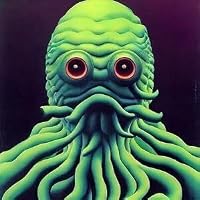
"The Moon Moth" is one of Jack Vance's best works. As is often the case, one of the great joys is the cultures he creates: in this case a planet where everyone wears masks and communicates by singing. The plot involves a murder mystery, and about how one figures out who is who when everyone is masked.
"The Doctor" by Ted Thomas, like the Anderson story above, involves a modern man suddenly finding himself in the past -- in this case, in the far past, where he lives with a tribe of early hunans and tries to act as a doctor to them.
"Thus We Frustrate Charlemagne" by R.A. Lafferty takes a familiar SF trope -- trying to change the past to make for a better future -- but told in typical Lafferty style, with wonderfully bizarre and often funny outcomes.
The anthology also includes works by Alfred Bester, Fritz Leiber, J.G. Ballard, Barry Malzberg, Roger Zelazny, C.M Kornbluth, and others. About the only story a felt was a bit subpar was "Time Trap" by Charles Harness, which was clever but rather clunky.
**** Poor Little Warrior (1958) • Brian W. Aldiss ***** The Moon Moth (1961) • Jack Vance **** Testament of Andros (1953) • James Blish *** A Triptych (1969) • Barry N. Malzberg ***** For a Breath I Tarry (1966) • Roger Zelazny **** Game for Motel Room (1963) • Fritz Leiber **** Thus We Frustrate Charlemagne (1967) • R. A. Lafferty *** The Man Who Came Early (1956) • Poul Anderson *** The Time of His Life (1968) • Larry Eisenberg ** The Doctor (1967) • Theodore L. Thomas *** Time Trap (1948) • Charles L. Harness ***** The Pi Man (1959) • Alfred Bester **** The Last Man Left in the Bar (1957) • C. M. Kornbluth * The Terminal Beach (1964) • J. G. Ballard
Includes stories from all over the place. Silverberg has chosen a wide variety of topics from authors well known and and not so well known. I did enjoy most of them. Some were way too out there, but everyone should like something here.