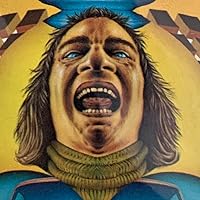
Second Ace printing (first as a single volume). All signs pointed to the fact that no human could come back alive from Barnard's Star. Something elusive, beyond comprehension, existed out there; something that was a perpetual bait, a perpetual trap. But Arch Comyn knew he had to join tht second fated mission. For somehwere beyond the veil of the Transuranae lay the answer to the question that was more important than life to him.
Leigh Brackett was born on December 7, 1915 in Los Angeles, and raised near Santa Monica. Having spent her youth as an athletic tom-boy - playing volleyball and reading stories by Edgar Rice Burroughs and H Rider Haggard - she began writing fantastic adventures of her own. Several of these early efforts were read by Henry Kuttner, who critiqued her stories and introduced her to the SF personalities then living in California, including Robert Heinlein, Julius Schwartz, Jack Williamson, Edmond Hamilton - and another aspiring writer, Ray Bradbury.
In 1944, based on the hard-boiled dialogue in her first novel, No Good From a Corpse, producer/director Howard Hawks hired Brackett to collaborate with William Faulkner on the screenplay of Raymond Chandler's The Big Sleep.
Brackett maintained an on-again/off-again relationship with Hollywood for the remainder of her life. Between writing screenplays for such films as Rio Bravo, El Dorado, Hatari!, and The Long Goodbye, she produced novels such as the classic The Long Tomorrow (1955) and the Spur Award-winning Western, Follow the Free Wind (1963).
Brackett married Edmond Hamilton on New Year's Eve in 1946, and the couple maintained homes in the high-desert of California and the rural farmland of Kinsman, Ohio.
Just weeks before her death on March 17, 1978, she turned in the first draft screenplay for The Empire Strikes Back and the film was posthumously dedicated to her.
Toward the end of 2015, to commemorate the 100th anniversary of the birth of the so-called "Queen of Space Opera," Leigh Brackett, I decided to read (and, in several cases, reread) 10 of this great author's works, both novels and short-story collections. One of Brackett's books that I did not read at the time, for the simple reason that a reader's copy was not then in my possession, was her fourth novel out of an eventual 10, an oversight that I was happy to rectify just this week. And I am so glad that I did, as the book in question, "The Big Jump," has just revealed itself to me to be still another wonderful creation from this beloved writer.
"The Big Jump" initially appeared in the February 1953 issue of "Space Stories," a short-lived, 25-cent pulp magazine that only came out with five issues (from October 1952 to June 1953) before folding; Brackett was 37 years old at the time. This initial publication of "The Big Jump" featured interior artwork by the great Virgil Finlay that I would love to see someday. Two years later, the novel would appear as one-half of one of those cute little "Ace doubles" (D-103, for all you collectors), backed with the novel "Solar Lottery," written by some first-time novelist fella named Philip K. Dick. (Full disclosure: I do happen to own that 35-cent Ace rarity, and it is one of my most prized books; a museum-piece treasure that I don't even like taking out of its plastic bag, let alone subject to a thorough read.) Another 12 years would elapse before Ace rereleased "The Big Jump," now in its own stand-alone paperback, and it is that 50-cent edition from 1967 that I was thrilled to acquire and experience recently. The book saw still another Ace incarnation in 1976 that sold for $1.50--it's always interesting to me to note how any book's cover price steadily climbs over the years--followed by three more iterations from other publishers. I believe the most recent release was in 2011, from an outfit called Phoenix Pick. Bottom line: "The Big Jump" should pose no problem whatsoever for the potential buyer to locate today. And that is a very fortunate thing indeed, as this short novel will surely please anyone who sits down with it.
As Brackett's book opens, the world is agog that Earth's first mission to another star has been successfully completed. Employing his brand-new faster-than-light (FTL) drive, a man named Ballantyne, as well as four others, had traveled to one of the worlds orbiting Barnard's Star, a mere six light-years away, and then returned! But soon, rumors begin to circulate to the effect that only Ballantyne has come back, his fellow crewmen unaccounted for. In a bravura opening set piece, we see a man named Arch Comyn, a worker employed by Inter-World Engineering, break into the high-security space field on Mars run by the Cochrane Company, the ruthless family concern that holds a virtual monopoly on all solar-system space travel and that had financed Ballantyne's mission. Comyn, as it turns out, is a close personal friend of Paul Rogers, one of those four missing crewmen, and he is desperate to interview the hospitalized Ballantyne. Sadly, after a violent forced breakin, Comyn finds Ballantyne in no condition to talk, and the quivering and haunted space explorer can only whisper some words involving desolation, loneliness, and something called "the Transuranae" before he screams out and dies. Following this wonderful introduction, Brackett's book can be roughly divided into four sections.
In the first, Comyn is brutally interrogated by the Cochrane family before being released. Back in NYC, our engineer hero realizes that he is being tailed by two different groups, and meets the loveliest of the Cochrane clan, the willful and hard-drinking Sydna. In the next section, Sydna brings Cochrane to the family's palatial estate on the Moon, perched atop the Mare Imbrium and encased in its protective and transparent hemispherical dome. Here, Comyn meets the aged patriarch of the family, Jonas, as well as Sydna's cutthroat relatives, and gets to see the remains of Ballantyne, which are being studied by the Cochrane doctors and scientists. For Ballantyne, though dead, is yet full of jittery motion, his body energized by the unknown transuranic elements that have suffused it. (Hence, the blurb on the 1955 and 1967 Ace covers: "One man had come back--but he was neither dead nor alive.") The Cochrane family wastes little time in outfitting another spaceship with the Ballantyne drive, and Comyn manages to finagle his way into this return expedition to Barnard-2 that will both search for survivors and (much more important to the Cochrane weasels) locate the source of those superrare--and supervaluable--unknown transuranic elements.
Thus, after a claustrophobic and nerve-racking transit that comprises the book's third section, Comyn and the small crew do indeed land on Barnard's second planet, and in the concluding section, discover what has happened to Ballantyne's missing men, why Ballantyne was turned into a living dead person, and just what those blessed "Transuranae" are all about. And that final discovery is one that will have lifelong repercussions for all concerned....
"The Big Jump," as you may have discerned, is both compact and fast moving, with one colorful and exciting set piece after another. Among the book's outstanding sequences must be included Comyn's early infiltration of the Cochrane spaceport and his first glimpse of the dying Ballantyne; Comyn's meeting with the Cochrane clan on Luna; the three murder attempts that are made on Comyn's life by an unknown enemy (one in the men's room of a NYC bar, one in those ornate gardens on the Moon, and one en route to Barnard's Star); and the experience with the Transuranae on Barnard-2. And just what are those Transuranae? I wouldn't dream of telling, and ruining the fun of finding out for yourself, but let's just say that Brackett might easily have revisited them in a sequel to this book, had she so chose. And "The Big Jump" is filled with all sorts of interesting little touches, such as the Rocket Room where Comyn first meets Sydna--a NYC nightclub with a space-window instead of a mirror, and genuine pilot seats at the bar--as well as the Cochrane gardens on Luna, perfect for a romantic stroll beneath the Earthlight.
At this late date, nobody should be surprised at how well written and compulsively readable any novel or short story by Leigh Brackett is, and "The Big Jump" is surely no exception. Dare I say it, this one is even poetically written at times, such as when Brackett, describing the surface of Mars, tells us "The wind blew, laggard, wandering, sad, like an old man searching in the wilderness for the cities of his youth, the bright cities that had been and now were not...." The characters here are finely drawn, while the dialogue that emerges from their mouths is often reminiscent of the tough-guy patter that is so often encountered in the film noir movies of the 1940s and '50s. And these hard-boiled conversations will surely remind many that Leigh Brackett was indeed the co-screenwriter of one of the toughest--and most incomprehensible--film noirs ever made, 1946's "The Big Sleep." I am surely not the first to have entertained the thought that Brackett often writes like a man...not just as regards the tough talk, but as pertains to the violent goings-on, as well. And yes, "The Big Jump" is often fairly violent, such as when Comyn is brutally questioned by the Cochranes early on, not to mention those three murder attempts.
And Brackett, brilliant writer that she was, demonstrates a sure hand here at making the reader feel what is going on. Thus, we experience, along with Comyn and the others, the terror of being on a spaceship zipping through the freezing void. We sense the claustrophobic conditions aboard the smallish ship, and sympathize with Comyn's panic as he wonders what will happen if the ship's FTL drive somehow refuses to turn itself off, as well as the horrible vertigo effects he suffers when it does. FTL space travel, in "The Big Jump," is surely not the thing of ease and comfort as portrayed aboard "Star Trek"'s Enterprise! And Brackett makes the reader feel how strange and awesome and frightening it must be to step foot on another world. As Peter Cochrane, one of the more decent members of the clan, puts it, after a fluting call is heard on Barnard-2, "Take that, for instance. What is it--bird, beast, something with no name at all? Who knows?" In this book, thus, space travel and planetary exploration are hardly things of glamorized adventure, but rather torturous and frazzling affairs that will surely test the mettle of the sturdiest. And again, Brackett makes us internalize it all.
Now, having said that, I must also add that "The Big Jump" is also peppered with pleasing bits of humor of the driest kind...so dry, indeed, that one might not even notice. For example, when Comyn is forcefully interrogating the assassin who had just tried to kill him in that NYC men's room, what does he get? As the author puts it, "Three short unhelpful words." Yes, and I have a pretty good idea what those three words might have been! And when somebody asks Comyn, on the surface of Barnard-2, if he is scared, Comyn replies, "Yes...there used to be a dirty saying for just how scared I am." You've gotta love it!
But despite being, at heart, an exciting and colorful space adventure, "The Big Jump" does also provide some real food for thought. Without giving away too much, let's just say that Brackett asks us to consider whether it is preferable to remain a human being, with all the attendant grubbiness and sordidness that are part and parcel of the condition, or if it is better to attain to some altered, nonhuman, and perhaps more blissful state. It is a conundrum that the visitors to Barnard-2 are compelled to ponder during the course of Brackett's fascinating book.
So yes, those readers looking for a finely written space novel with great bursts of action, real imagination, colorful set pieces, alien wonder, and something to think about after the final page is turned could certainly do a lot worse than Leigh Brackett's "The Big Jump"...unquestionably, another glittering gem in the crown of The Queen of Space Opera. As for me, there are only two more Brackett novels that I have thus far not experienced--1961's "The Nemesis From Terra" and 1963's "Alpha Centauri Or Die!"--and I do hope to be laying my hands on those volumes very shortly. Stay tuned....
(By the way, this review originally appeared on the FanLit website at https://fantasyliterature.com/ ... a most ideal destination for all fans of Leigh Brackett....)
This book works best in the way it builds up a sense of foreboding and dread, so although undeniably science fiction, I added a "horror" tag to it as well.
While not frightening or terrifying, it does build up quite palpable suspense and tension. The plot's premise is that something went awry on the first interstellar space voyage, and while one survivor returned, none of the rest of the crew made it back home... and the lone survivor is terribly poisoned.
In fact, in one small scene, there's even a hint of zombification, and a modern reader would certainly expect this to be expanded upon. (Zombies... in space!)
So while I was largely expecting something along the line of the Alien movie franchise, in the end the author instead served up some more standard classic SF fare. While the sense of dread remains taut right up to the climax and beyond, the culminating action and resolution of the plot is a bit of a damp squib mainly because the story hasn't aged well in this modern times of Hollywood sci-fi horror.
3 stars for successfully building a foreboding tone, but the disjointed narrative (is this a detective mystery or a sci-fi horror) takes away some of its charm. Also, most of the motives of the characters are largely unconvincing. I'd like to be able to give this book 2.5 stars if possible, but a score of 2 is too low.
A short novella that's worth a look, but realize that it hasn't aged that well, and thus don't expect it to fit neatly in with today's genre patterns.
This starts out as a pretty good space mystery that was first published in 1953 in Space Stories magazine before the Ace paperback edition came out in 1955 as part of one of their Doubles, bound with Philip K. Dick's Solar Lottery. It's a somewhat atypical straight science fiction work for Brackett, who was known best for her sword & planet science fantasies such as the Eric John Stark of Mars series. (Actually she was best known as the screen writer of films like Rio Bravo, Hatari!, The Long Goodbye, The Big Sleep, and so on, and, oh yeah, The Empire Strikes Back.) This one centers on the return of the first interstellar expedition and the mystery of what they encountered and how it affected them. It has an intriguing resonance for me with one of her husband's (Edmond Hamilton) best stories, What's It Like Out There?, and I suspect they had fascinating conversations comparing and contrasting the theme. It's a good set-up that doesn't pay-off too successfully as the story seems to bog down with characters who lack sufficient motivation, and a rich and powerful family that wants to maintain control. It's also dated rather badly in some of the societal conceptions. I enjoyed the read, but it's not among her best.
This book counts toward the following challenges: 1: Read a space opera novella 2A: Read two space operas by women 3: Read a space opera published before you were born
I find myself very conflicted about this one. The big idea and the SF adventure are interesting, but the ingrained misogyny and racism are awful.
There's also a disturbing amount of male gaze, which is disappointing considering it was written by a woman. I know that it is very much of its time, and I'm not really being fair to Brackett saying that 66 years after it was published, but that's still the feeling I'm left with after finishing.
Arch Comyn is a rough and tough male and the first woman to appear in the story, despite (or because of) being rich and supposedly sophisticated, falls for him immediately, in a way that felt rather noir style to me (although I'm no kind of expert in that).
I could have highlighted numerous troubling passages, but I just went for a couple.
Comyn thinks about Sydna: "thinking that some day he would beat that arrogance out of her if he kept his health."
And when one of the men betrays everyone else, the worst thing they can say about his is that "They didn’t trust him, not because of his business ethics but because they felt he was not a man, except by courtesy of sex." He's so awful he's like a woman.
Just, save me.
But I did like the SF idea and the exploration of it. The story considers mankind's first (and then second) use of an FTL drive, and there's a look at how being outside normal spacetime affects the travellers (who are all manly men of course). There's also an interesting look into whether leaving "civilization" behind is an act of evolution and forward thinking, or a step back into primitivism.
But I couldn't fully enjoy it because of the ingrained attitudes of the time that seep through it. This was for a challenge to read a space opera book written before I was born, and I guess this proves I'm getting old; the gap between the me of now and a writer who was born in 1915 and developed her writing style in the 1940s, is getting a bit too wide to cross easily.
The Big Jump by Leigh Brackett was a surprisingly good Sci Fi story, short but very well-written and interesting. I've read three other of Brackett's books; an excellent crime thriller, The Tiger Among Us and two other Sci Fi novels which were mostly just entertaining; The Sword of Rhiannon and The Nemesis from Terra.
The Big Jump refers to a new space technology that permits mankind to move to the other galaxies with no time lapse. It's all done in real time. One voyage has been attempted with a crew of five. The story starts with the return of this voyage and a break in at the compound on Mars where the 'survivors are being kept. Arch Comyn needs to find out if an old friend, Paul Rogers, returned from the expedition. Rogers saved him many years ago.
What Comyn finds is disturbing and will start a chain of events that leads to a 2nd voyage to Barnard's star. Only one of the crew has returned, Ballantyne, and he has been changed by whatever he discovered. He has not spoken to the people holding him; all belonging to the Cochrane Company. But when Comyn breaks in, Ballantyne tells him something and begins screaming.
Comyn won't tell Cochrane what he has heard unless they will let him go on the next trip to Barnard's star so he can try to find his friend. The Cochranes believe a new energy has been discovered. So there you go, another voyage is planned and sets off and something is discovered.
It's a short, well-crafted, taut Sci-Fi adventure. The characters are all interesting. The plot is neat and not too technical. Everything happens quickly, holds your attention and draws you in. A most enjoyable Sci Fi story. (4.0 stars)
Gripping and action packed. It's full of outer space, a new discovery, and conspiracy theories. The second half is much better than the first, but it doesn't take long to get there because it's only 100 some pages. Worth the read. It's an enjoyable little book that might get someone out of a reading slump.
Really solid little pulp sci fi adventure. Surprisingly spooky at times with a touch of cosmic horror wrapped in some great poetic prose.
Written in 1953, it definitely felt its age at times. The science doesn’t exactly hold up, but it’s a fun retro future that I was on board with. Also, even being written by a woman, it had that slightly lecherous quality often found in genre fiction of the period. The one prominent female character is written about in a weirdly horny way, but given that it’s from the perspective of someone romantically involved with her, it’s not too bad. A little worse are the comments like “he cried like a woman” and “he screamed like a dame” sprinkled throughout.
And it was unflatteringly pulpy at times. Most of the action consists of the protagonist knocking people out with a single punch. It’s actually kind of hilarious how many times this happens, and it isn’t explained how he manages to do this so effectively. It’s just, like, really easy to knock people out. But for me, this was all in good fun.
I think what I was most impressed by was the atmosphere and sense of dread that was conjured up around the unknown. Interstellar travel and alien life are appropriately scary and trippy in this book. In that sense, it doesn’t feel like a corny swashbuckling adventure. There is even some weird speculation about the origins of life in the universe that I was pretty tickled by.
Overall, this is just a fun little piece of sci fi from the genre’s golden age. Definitely not for everyone, but it did it for me.
Great action packed pulp sf adventure but let down by some sloppy writing early on (random head hopping, dialogue clearly attributed to the wrong person etc.). Also much of the motivation and execution (particularly early on) was rather implausible. So rather mixed feeling on that one.
Boring. More fisticuffs and spy vs. spy sort of stuff than SF until near the end, and even then it's men being manly. The actual SF stuff has been done better... as a short story. Brackett knows better. But I guess everyone has to make a living.
A fast-paced journey beyond the solar system that grapples with what it means to be human. Leigh Brackett made the unlikeable likeable with the rhythm of her language and the pace of the story, and in the end, the question of humanity is left properly unanswered.
The legend goes that Hollywood director Howard Hawks read No from a Corpse a hard-boiled crime mystery and said “Get me this Brackett guy.” He was looking for a screenwriter to work on his Humphry Bogart movie The Big Sleep. That Brackett guy as it happens was a woman who was already publishing space operas galore and earned a rep as the Queen of the pulps or Queen of the Space Opera. She was called both for good reason. Her most famous work sadly is the first draft she wrote for the Empire Strikes Back a month before her death. I say sadly because it dwarfs everything else in her long career thanks to the stretch and reach of Star Wars. When I was young, I devoured Erick John Stark novels. They were in my opinion similar to the John Carter books but better. I admit I sought her out because I knew the name from Empire but let’s move on and never speak about it again.
I wanted to review this book for a couple of reasons. First, I respect Brackett and this one was out of her Space Opera wheelhouse. This is a pretty high concept for an SF novel (novella by today’s standard) published first in a magazine in 1953. The second reason is that this novel was bound and first published under Don Wollheim’s Ace Double series with Solar Lottery the debut novel of Philip K. Dick.
So yeah, I wanted to do a bonus episode of the podcast (stay tuned). Keep in mind what PKD told Gregg Rickman about the ACE line at the time. “He was the only market, that was it…It had to be 6,000 lines long I remember that.” Both Ace editions the double and the slim one of the 60s that I read claim to be complete and unabridged. That seems unlikely as most of the writers of the doubles complained about having to make cuts for Wollheim and A.A. Wyn during those early years. This was not Princess of Mars fantasy or space pirates and in that sense, they make for an interesting combo.
LB and PKD would be coming to this with totally different dynamics. Brackett was the marketable name and it is likely that Phil would have been happy with this pairing from a sales point of view. For a long time, this was PKD’s book with the largest sales, and out of the gates, it was the Big Jump that sold it. Still, it was a stranger more psychological deep novel and combined with PKD’s dystopian about random lottery-style elections, violent reality media, and psychic cops made for an interesting combo in the same year Rosa Park refused to go to the back of the bus. PKD has admitted to trying to combine the vibes of Vogt’s World of Null-A and Bester’s Demolished Man, but Brackett’s half is much more original for the time.
The Big Jump is not exactly hard SF but compared to the near fantasy of the majority of her space operas this has realistic of a Brackett book short of her power post Apocalypse novel The Long Tomorrow. The tagline on the ACE Double edition says “One man had come back- but he was neither dead or alive.” The story is one survivor returning from the first interstellar space flight to Bernard’s Star. The survivor Ballantyne returns to earth wrecked from the experience and this sets up the mystery.
Before I get into spoiler territory, I will say I really enjoyed this old-school piece of SF and thought that there were great moments of high concept storytelling. Brackett elevates the material often with moments of powerful prose. The Big Jump is not essential reading for everyone, that said if you are a fan of the era or this author then it totally is. Now let’s go deeper…
Our main point of view character is Arch Comyn who had a friend on the mission. There are some fights, and chases that lead up to Comyn following the mission to Bernard’s Star. While LB hand waves a bit of the science away this is not pure fantasy, she knew the right distance for Bernard’s Star, she invents a ship that travels outside of space-time. I love that she refers to it as “Not-Space”
Early in the novel, Comyn wants to get the mystery that the builder of the ship Cochrane, who oddly has the same name as the person who breaks the warp barrier in Star Trek, and will of course to the modern reader invokes Elon Musk.
“Ballantyne made the Big Jump, he and the men with him. They did the biggest thing men have ever done. They reached out and touched the stars. And you tried to hide it, to cover it up, to rob them even of the glory they had coming.”
This sets up the mystery and it is a good one. Why the cover-up? Why did the mission go bad? More than anything I think these early pages do a good job of making sure the reader understands the stakes and gets on board. It is implied that the ship was saved from crashing into Pluto and that a patrol was looking for it. The first chapter establishes characters and Cochrane’s company. If there is a weakness to the story it is the thin details on Cochrane and his corporate motive. The story works fine but one wonders if LB was limiting these elements for the magazine/Ace Double format.
I really loved the early world-building, The opening paragraph is so cool. It talks of the rumors, that somebody made it. I like the implication that many space jockeys were trying and failing. Spacemen talking in a thousand ports was a great world-building detail. when Comyn returns to New York from Mars.
“The Big Jump had been made. Man had finally reached the stars, and every clerk and shopgirl, every housewife, businessman, and bum felt a personal hysteria of pride and achievement. They swayed in dense masses across Times Square feeling big with a sense of history, sensing the opening drumbeats of an epoch in what they saw and heard from the huge news-service screens.”
Of course, these moments to the modern eye have some cringe-inducing moments but of course, the modern reader has to consider how much progress was yet to be made. I love the idea that she conveys so quickly the pride and happiness that all humanity feels. LB suggests that the celebrations are so wide that Comyn is like everyone else having trouble staying inside. Deft moments of subtle but powerful world-building. Consider that this was first published in a magazine years before the Mercury program had started and four years before Sputnik. It is telling that she is so good at explaining the wonder and terror of space flight in another moment of excellent world-building prose.
“Comyn thought it was funny. It was very funny, indeed, that men making the second Big Jump in history, that men going faster and farther than any men but five had ever gone before, separated only by metal walls from the awfulness of infinity, should sit and play games with little plastic cards and pretend they were not where they were.”
LB is a great storyteller and those moments of world-building are great examples and that was something I remembered about her. I was surprised by some of the incredibly solid moments of horror that she wrote in this book. The scene where Comyn visits Ballantyne is very disturbing and conveyed by beautiful dark prose.
“The thing that lay in the bed between the barred sides was Ballantyne. It was Ballantyne, it was dead, quite dead. There was no covering on it to hide its deadness; no breathing lifted the flattened ribs; no pulse beat anywhere the pale transparent skin, and the tracery of veins was dark, the face was…Dead. And yet it moved.”
Not only does it bring the horror but it deepens the mystery and makes the build-up of repeating the journey so much darker and richer. There are other moments of Science Fiction and horror blending in excellent prose, the transition from Faster than Light travel from the end of chapter 9 to the opening of chapter 10 was super impressive. That is page 82 and 83 of the second Ace edition.
“…For one timeless ghastly interval he thought he saw the fabric of the ship itself dissolving with him into a mist of discrete particles, he knew that he wasn’t human anymore and nothing was real. And then plunged headlong into nothingness.”
Seriously. Good stuff. Once the mystery is revealed and the crew lands on Bernard II, the truth those on the planet are transformed by the local environment. This is a great answer to the mystery. The reveal has weight and makes the journey worth it. It presents Cromyn with a dilemma that the final act builds too.
The Big Jump is fantastic 50s sci-fi. The weight of the prose, the mechanics of the storytelling, and the details in the world-building are all fantastic. The change highlights flaws in the human character, so in the final moments, the novel even turns a mirror on humanity. This Big Jump is more than just a trip. The transformation offered to these humans has the potential to change their humanity completely and totally. Everything that humanity has done for food, shelter etc. “You have developed beyond civilization.”
What began as a Sci-fi horror adventure ends with a not-so-subtle message that the Big Jump is not just about traveling to another star be evolving past the life we have lived dependent on the one above us. Life on earth is dependent on survival and here four years before Sputnik Leigh Brackett was telling her readers in the stars we can evolve and become something better.
Imagine you are witnessing the return of a ship long overdue. The characters of "The Big Jump," by Leigh Brackett, are actually doing it as this work begins. The rest of the story fills the pages with a host of emotions. At first, there's sorrow for friends lost. Later, you realize that some survived by the barest of margins. Finally, you believe a second trip must be launched to find out what happened to those who were lost. This is the premise of Leigh Brackett's, "The Big Jump."
The second trip will again test the drive systems of the first successful return of a ship. Not just any ship, but one designed to use a special propulsion system that enables the craft to travel at speeds beyond the speed of light. An intrepid crew, including a member from the first trip, plan to try a trip to Barnard's Star II, the second planet in the system.
The trip begins with a faster-than-lght departure from the Sol system, and the trip is layered with events that seem to be aimed at stopping the trip before it starts. Crew illnesses and strange disabilities seem to be almost "planned," disabling several crew members with various illnesses and ailments. The causes for their ailments were as mysterious as their effects
The closer the ship gets to its destination the more crew members suffer various negative effects, with some complaining that the effects originate by the Transurinaea, beings named during the first expedition that seemed to have creatures who could survive in the radition-filled enviroments in the Barnard II system. The Transurinaea are creatures that may contain elements found in the Transuranic portion of the Periodic Table of Chemical Elements. While no such creatures are found on Earth, the different environment of the Barnard II system enables its denizens to sometimes possess the ability to survive with a modest amount of Transuranic elements in their physical bodies.
Human interactions with each other are sometimes difficult when Tranuranics affect one person but not others, usually. Those interactions are short, discouraged, and usually confrontational. Clearly quarantining is encouraged in these occurrances. The results of the interactions, if they do occur, are difficult, dangerous, and confrontational. In some cases, the results are calm, in others - they are benign, and in a few rare instances they may be revelatory. Regardless, the ship must return to Earth via another FTL "Big Jump."
Rating: 5 out of 5 stars. Recommended readers 11-12 years old or older.
Continuing my exploration of the works of Leigh Brackett, this 1955 novel (originally serialized in 1953) is more of a straightforward SF story rather than the planetary romance stories she wrote with heroes like Eric John Stark. The hook: the wealthy Cochrane family, which has monopolized space travel, launches its first interstellar expedition using a star-drive invented by a man named Ballantyne. The ship successfully makes “the Big Jump” to Barnard’s Star, but returns with only Ballantyne aboard, mad with pain and nearly dead. The log books are missing, and Ballantyne is too far gone to explain what happened.
Enter the protagonist, Arch Comyn, who punches his way into the Cochrane facility on Mars where Ballantyne is being held and arrives in time to hear his dying words, which imply that they encountered alien life forms and the crew may still be alive. This makes Comyn valuable to the Cochranes, who are planning to send a second expedition back to Barnard’s Star to find out what happened and need the information he possesses. Comyn wants in, mainly to find out what happened to his friend Paul Rogers, who was also on the ship (which is why he went to see Ballantyne in the first place). But he gets more than he bargained for – not least because someone is trying to kill him for knowing what he knows.
True to its pulp origins, the “science” is glossed over and the plot and characters are a bit thin, particularly when it comes to the subplot of Comyn’s tryst with Sydna Cochrane. But the tradeoff is a fast-paced story that blends pulp SF with pulp detective fiction (and blends reasonably well, as Brackett was well versed in both genres). Also, the eventual climax on Barnard’s Star brings some unexpected and thought-provoking depth to the story. It’s not as good as The Long Tomorrow, which is the best of the Brackett novels I’ve read so far, but I liked this more than the EJ Stark novels I tried recently, mainly because planetary romance is a difficult genre for me to appreciate.
La Brackett ha sempre rappresentato una figura a sé nel panorama della fantascienza moderna. Difficile accostare la scrittura dell’autrice ai lavori dei suoi contemporanei, se non per spunti, sicuramente per sensibilità e visione. Vi è sempre una nota lirica e nostalgica che, in misura più o meno evidente, informa un po’ tutti i suoi romanzi. Oltre l’infinito è una sorta di “paradiso perduto”, che ci lascia in sospeso su scelte e possibilità di vita e di futuro, come specie umana. Si avverte però il trascorrere degli anni su questa scrittura che, seppur piacevole, in alcuni tratti risulta poco credibile agli occhi di lettori moderni ormai consumati e smaliziati per il genere fantascientifico.
Proof positive that detective noir and 50s Sci-Fi shouldn't mix. The thing that disappointed me most was the main characted Arch Comyn was such an unlikable character that showed little regard for his fellow man, and more than a little selfishness when trying to get his own way, including steam-rollering over anyone who had a differing opinion and putting everone's lives in danger to achieve his goals.
One of my favourite sci-fi books. It is hard for me to describe the issues mentioned in this book, but some of it mentions how we can live without violence. It was very confusing but I recommend it to those who like books with a strange conspiracy fueling a mans desire to find out what happened to his friend who went on a scientific mission and didn't really come back.
It is never really explained what "the big jump" is -- you just have to guess it implies going to a star and back. Creatures encountered are not well described either.
A very pulpy Sci-Fi mystery that features a stereotypical 1950's protagonist and a reasonably satisfying resolution. Not groundbreaking, and a little tough to read with modern sensibilities (the glacially slow pacing is rough), but still overall enjoyable.
A fairly short book, it is a bit of a noir-style science fiction novel, with respect to characterization and description, if not actual plot, making the book feel rather dated.
First book finished for Space Opera September 2020! An interesting premise that I wish was fleshed out more. Also some very dated and misogynistic phrasing, e.g. "sob like a dame."
A roughneck spaceman adventures out to find a missing friend; and encounters an environment beyond his comprehension.
Story had a start that struck me as slow (angry man stumbles through obstacles, imparting and intaking violence) but came to an interesting crescendo that had a couple surprises. It eventually reminded me of Indiana Jones' Raiders of the Lost Ark.
The writing style seemed very old-fashioned (maybe even 10-20 years out of date at the time of publication, 1955): styled noir with lots of smoking and drinking and dames crying. There was a very stereotypical love story of that era--woman meets disinterested angry man and falls senselessly in love... er, if not obvious love, at least desperate to be married, anyway (very little by way of affection or returned interest).
I liked the story and I am interested in reading more from the author. I've been meaning to read this author for some time--she's one of the original Star Wars writers (Empire Strikes Back)--and I think her otherworldly visions are recognizable in this work. I'll bet that I can find a story of hers I'd recommend more than this one though.
Arch Comyn breaks into a Cochrane Company building on Mars looking for a guy named Ballantyne who was the only one of a space crew that had returned from an expedition to Barnard's Star - a "Big Jump" made on a ship with faster than light capabilities. Ballentyne does not survive. The Cochranes arrest Comyn, but they end up putting him on a spaceship to make a second Big Jump to Barnard's Star - to find out what happened there and what happened to the other crew members of the first expedition. Comyn just wants to find out what happened to his friend Paul Rogers who had been with Ballantyne on the first expedition. Before they leave, he also makes the acquaintance of Sydna Cochrane. Two of her brothers head up the crew (since the Cochrane Company is financing the expedition) of the second Big Jump. Well, they arrive, and all sorts of weird things start happening. Comyn finds his lost friend, but he has become utterly strange. And they find out the truth behind the solar system of Barnard's Star. It involves the "Transuranae".
Less 'Science Fiction' than 'Pulp Noir Detective in Space', The Big Jump sees your typical gritty hardboiled hero on a mission to find out what happened to a friend, when his ship comes back from the first faster than light travel without him, and with a mysterious disease. Things move quickly and somewhat predictably - murder, intrigue, dangerous women, and double-crosses - even a tinge of horror.... the real distinction here is where the story ends up by the end - much more nebulous and philosophical than you might expect.
I don't know that I'd leap at calling The Big Jump a 'must read' but if you're in for a fast paced, pulpy sci-fi classic, I'm sure you could do much worse.