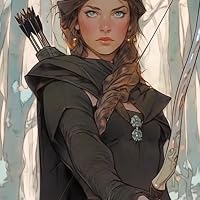
Aelie can break runes with her bare hands—magic the fae built their entire world on. They hate her for it. Fear her for it. And when she's caught, they sentence her to die.
Desperate to survive, she shatters the rune enslaving Kairos, a devastatingly handsome fae executioner with a blood-soaked past.
Big mistake.
Kairos slaughters the court and drags Aelie to his breathtaking realm—a kingdom of towering forests and shimmering mists.
Bound to the ruthless king she freed, Aelie must navigate deadly fae politics, master her forbidden power, and resist the fae who sees her as his greatest weapon... and darkest obsession.
Runebreaker is a steamy, fast-paced romantasy with forced proximity, he-falls-first tension, and captive/captor dynamics perfect for adult fans of Jennifer L. Armentrout and Sarah J. Maas. It features a feral, morally grey hero, a soft girl with a dangerous gift, mating bond tension, and immersive world building. This is book #1 of a trilogy.
Mila Finch writes dark romantasy where morally grey characters make terrible decisions, magic breaks the world, and mating bonds complicate everything.
Her debut novel RUNEBREAKER released in January 2026.
When she's not writing about feral book boyfriends, she's reading about them. Based in the Pacific Northwest, she survives on coffee, rain-soaked inspiration, and the unshakeable belief that enemies-to-lovers is the superior trope.
Runebreaker is one of those books that sounds excellent on paper and then slowly, page by page, tests your patience. The concept is compelling, but the story itself often felt like watching someone knowingly touch a hot stove and then act shocked when it burns.
The biggest hurdle for me was how casually the narrative handled destruction, death, and large-scale fallout. Massive events occur (burned villages, political collapse, floods/storms, merciless killing of innocents) yet the emotional weight of these moments barely registers before the story rushes off to the next plot beat or romantic encounter. The disconnect between what’s happening in the world and how the characters react to it made it hard to stay immersed.
That tonal imbalance becomes especially noticeable through the FMC’s decision-making, which often leans reckless rather than desperate or strategic. She repeatedly makes choices that endanger not just herself, but countless innocent people, and the story rarely pauses to let her (or the reader) fully grapple with the impact of those actions.
Mild spoilers below ‼️
It was outright infuriating when she breaks the storm gate, unleashing a flood that kills innocent people and destroys homes and businesses across the city. What disturbed me most wasn’t just the act itself, but her reaction (or lack thereof). She shows almost no guilt, and the devastation is quickly forgotten. Personally, if I had caused that level of destruction, even accidentally, I would be utterly devastated and riddled with guilt.
What makes this worse is that she does it again later in the book. Her line, “I destroyed a palace and probably killed a lot of people,” is such a lazy acknowledgement and is treated as a throwaway moment. Um… yes. You did. And that’s it? A serious lack of reflection and almost no accountability for her actions - born of negligence and stupidity, even if not malice - resulted in mass death. Moments later, it’s brushed aside entirely in favor of spicy time and a few paltry comments that she feels guilty. Seriously?
The world-building also felt thin and underdeveloped. We’re given very little background on the FMC, her sister, or how they ended up in their current circumstances. It also felt contradictory that they longed for freedom and a better life, yet were unwilling to leave Skalgard because of their desire to keep helping at the infirmary. That internal conflict was never meaningfully explored, nor why they didn’t just up and leave earlier (surely they had enough coin from all their supposed thievery).
There’s also a noticeable lack of originality. The familiar tropes pile up quickly: fae are evil and enslave mortals, the FMC hates fae as a result, she’s poor and starving, she meets a dark, feared fae known for killing mortals, he kidnaps her but turns out to be a misunderstood good guy, showers her with food and clothing that she initially refuses out of pride, her assumptions about the fae all being bad are proven wrong, and she plots an escape despite how obviously impossible it is. The similarities to ACOTAR are hard to ignore.
The characters themselves felt flat and one-dimensional, lacking depth or distinctive personalities. The romance is more of a medium burn, and while I didn’t mind that the MMC was clearly infatuated early on, their interactions lacked emotional substance. Much of their dialogue consists of short, shallow exchanges that failed to evoke any real feeling. The romantic progression felt abrupt - by around 40%, he’s talking about worshipping her, despite there being virtually no emotional build-up to justify it.
I also felt no emotional connection to the FMC’s sister. We’re told repeatedly how important she is, but we barely get to know her. As a result, the FMC’s desperation to return to her and keep her safe fell flat - I simply didn’t care. There was far too much telling us about her sister and not nearly enough showing to make that bond feel real.
Certain character dynamics also made little sense, for example, Elwen, the master healer and a warrior who effectively ruled in the MMC’s absence for a century, inexplicably acts as a handmaid to the FMC, dressing her and bringing her food. It felt bizarre given her station and responsibilities.
This may be personal preference, but I’m also not a fan of the MMC’s “burn the world down for her” trope, especially when paired with nonsensical political decision-making. Entire villages are destroyed, alliances crumble, storms and tsunamis wipe people out, and war looms - yet there’s almost no strategic thinking or concern for maintaining peace. The blasé attitude toward mass destruction was deeply unsettling. One moment characters are having sex, the next an entire village is burned down, with very little acknowledgment of the horror.
Overall, Runebreaker had potential, but weak character development, thin world-building, recycled tropes, and a troubling disregard for consequence made this a disappointing read for me. I almost feel bad listing so many issues, but they genuinely kept stacking up as I read - every time I thought we might turn a corner, another problem appeared. While the final 10% did pick up and gave me a glimpse of what the story could have been, it wasn’t enough to outweigh everything that came before it.
3.5 🌟 This was super bingeable and action packed from start to finish. Also the audiobook had a fantastic full cast of narrators who did a wonderful job! So I definitely had fun with this one but overall found I wasn’t blown away. I think I may have Romantasy burn out because despite not rating this five stars, this is absolutely a book I would and will recommend to other Romantasy readers because I can see people LOVING this. So if you’re looking for a fast paced, spicy, fae Romantasy with:
- bargains - bonds - forced proximity - he falls first - captor x captive
I'm not sure how well i can articulate what I'm thinking here, but I'm going to try. There are probably some spoilers below so proceed with caution.
This felt like bones of a book, but it was missing all the meat. There was an outline here with a lot of classic romantasy concepts, but the characters were literally soooo stupid, and it was filled with plot gaps or unexplained storylines.
The characters' emotions changed 15 times in the span of one conversation - it was giving me whiplash. They would be having a tender moment, then yelling at each other/fighting, then tender moment, and then running away again....all within 5 pages. I didn't really know why the FMC "hated" the MMC. Her emotions were as abrupt as picking petals off of a flower like "i love him, i love him not, i love him, i love him not." Like can you just relax for a second, girl? It's like the author would write something, walk away for two weeks, and then pick up the pen again without reading what she already wrote. Nothing flowed - it was really choppy. I felt like the plot and the characters were contradicting each other a lot.
The fantasy world-building also made no sense. The dragons came out of no where about halfway through the book. The dragons were trapped, but they can also speak in her subconscious (fine), but then suddenly they're able to attack a whole army above ground while still being trapped underground (or wherever they are) with a light storm (or something like that? I didn't know what was happening). I literally was so confused with the way the three runes needed to be broken in all diff realms to free the dragons just in that one realm. Also, the FMC is somehow both part dragon and part fae, but mostly human, but she has super special powers? I feel like we're just throwing mud at the wall to see what sticks here, ppl.
In the first few chapters, the two sisters kept talking about how they needed to run away over and over again, and then they just didn't. It was so repetitive. Every action scene also happened way too fast, and I had no idea how one thing led to another. Like, remember when they went INSIDE a rune for a hot second, and they come out of being INSIDE the rune, and no one ever talks about it again? What the fuck?
Also, I hated how the whole book, the FMC (I finished this book 4 seconds ago and I forget her name) keeps talking about how Vaeris "trapped her" into a faerie deal. She literally BEGGED Vaeris for the deal after he tried to refuse it. She literally forced him to grant the deal, and then she puts ALL the blame on him for the rest of the book. It made no sense to me that she was suffering the whole book for not "coming" to him right away to break a rune for him, but meanwhile, when her sister (forget her name too) fell into that pit into the dragon realm, nothing happened to Vaeris? If his part of the deal is to "keep her sister safe," I would think the faerie deal would punish him when the sister falls into a fissure in the ground into another realm. Vaeris was completely fine and was like "don't worry she's alive!" ...ok, your deal isn't to keep her alive. It's to keep her "safe," and falling down a giant cliff into a pit in the ground in another realm cannot be construed as being kept "safe."
It felt like the FMC was often just fighting the MMC because the author wanted them to be "enemies to lovers," but like they weren't really enemies? The FMC is fighting to get away from her home, and then fighting to get back to her home (and that's alll she fucking thinks about for 75% of the book). Like I get we need to free her sister, but ever think about asking for help from the 1,000 year old warrior with a whole-ass army who is doting on you nonstop? Also, why was the MMC able to kill like 100 people so easily in the blink of an eye when he was freed from his imprisonment rune, but then had a hard time killing like one soldier when he was on the battlefield?
Also, not one thing was surprising in this book. I knew what rune Vaeris was going to make her break from the very start. She could've waited for him to ask her to break the dragon rune on the city (like they thought was his main goal), but she broke that rune for free? These people are just simply idiots.
Side note, every time the MMC called her "my princess," I read it in a Gollum voice saying "my preciousssss"
Anyways, why did I still give this 3 stars when I just spent the last few minutes ranting? Thank you for asking. These stars are based completely on vibes. This book is poorly written, and I would not recommend it to others, but I was entertained by the bad story lol. It's tropey and dumb, but I had fun at times. Didn't care for the smut, but it was there. It's a very easy read because things happen very quickly. It's predictable and entertaining drivel, so don't put it at the top of your list, but it checked some boxes.
I've been waiting in anticipation for his one since I found it. I was extremely excited for a rune-based fae book that centered on rune-breaking. Buuuuuut, in my opinion, this one is a toss up. Some things I liked. Some things I didn't.
Let's get the bad out of the way:
The biggest problem I had with this book was the pacing. All the scenes moved extremely fast, then we'd have an unexplained time jump (Amount of time unknown. I literally have no clue how long time-wise this book was. Days, weeks, months???? I mean maybe I missed it but with 400+ pages I'd expect at least a few "weeks went by" or "the days following" ,etc and I seriously don't recall many if any.) Anyways, unexplained time jump, and then it would just move onto the next scene. I guess overall, it just read extremely choppy. I wished there was a better flow to it.
I wasn't surprised by the ending. The writing is just too plain and straight forward. The author tells you everything you need to know. No guessing. The writing itself reads very YA, but this is definitely an adult book so it doesn't mesh.
It was kind of repetitive? They'd change the setting, but all the high-stakes scenes end almost identically. I could go into further detail with this, but don't want to spoil an unreleased book.
The world-building was minimal. We don't get a lot of history or information on the different aspects of society.
It's marketed as enemies to lovers, but they weren't ever enemies??? It was slow burn so I'll give it that but enemies? Definitely not. The relationship itself jumped all over the place too. They never spent one on one time with each other to grow the relationship, it was just a series of weird arguments? The stuff they were arguing about was happening way too early. You're arguing about her "belonging" to someone else and you haven't even kissed yet?? I just didn't get it. It happened more than once too. Just too much back and forth and not what I'd classify as "enemies".
Now onto what I liked: I love rune magic, it's always super interesting. So having an FMC that is the ONLY one that can harness this power is especially cool. Extra points to having a sister with a unique gift too, even if we don't see her much.
I actually liked the secondary characters more than the main characters. UTHER? Yeah I'd read a book about him.
The plot was good, even if I saw the ending coming a mile away. It's definitely still entertaining enough.
We get really good history on our FMC's life. So she has good characters depth. Our MMC's depth comes towards the end.
Overall solid 3 star book. My negatives stem mainly from the writing style, which is a HUGE thing for me. It wasn't bad writing by any means, it's just not my particular taste. I think if you like SJM's earlier work you'll like this one. I happen to not be a fan of hers, but if you are perhaps you'll love this book.
***Thank you Mila Finch for this ARC. My review is voluntary and all thoughts and opinions are my own***
Ultimately I’m trying to not be scathing in this review as I believe runebreaker is self published. It’s not offensively bad, but also it’s not particularly good.
Pros include: MC looks like Sephiroth, good gore, Uther as a character (love him), moments of flowery prose.
Cons: While there is a concept of a plan, execution is wanting. FMC makes insanely bad decisions then “oops” it each time. GIRL!!! STOP!!! NEOW!! Like she has the nuke codes - TAKE THEM BACK!!! Also has chat gpt fated mates plot and I’m not going to mark this as a spoiler bc it’s very obvious from page 5.
All that to say I kinda approached this like an a03 reading; in that sense it has merit. At the end of the day there are genuinely enjoyable moments. I think if this got through a publisher with a good editor it could be quite big. As it stands, I’m not sure if it’s up to snuff for even booktok. but then again, everyone was fine w fourth wing.
It's been WEEKS without a truly fantastic book! I'm going to ride this high for as long as I can!
If you liked the overall vibe of Blood And Ash By JLA and What Lies Beyond The Veil By Harper L. Woods, you're going to LOVE this one!
The MMC is DREAMY! He's tough and closed off, but protects the FMC. He's kind and sweet with her. They also banter, trade barbs, and outwit each other on a consistent basis. It was glorious! I was giggling and kicking my feet throughout the entire book.
The FMC was tough and very much had an I'm-going-to-do-what-needs-to-be-done mentality. Due to her circumstances, it was understandable. Granted, I didn't always understand why she did what she did, but her heart was always in it. Even if her brain hadn't yet computed what she would do/what would realistically happen to her after her "escape". I loved seeing her fall for the MMC and vise versa. It was so sweet.
The ending was just plain mean! I WILL RIOT! And by riot, I mean I will ask the author politely when the release date estimate for the next book is. I made the mistake of picking up this book as a recent release, and now I'm possibly staring down a few months to a year+ of waiting for each book. I'm pretty sure I read somewhere that this was supposed to be a trilogy, and boy golly, am I early! I hate being this early. I'm already envious of the people who will get to this trilogy after it's all been published 😭
The first 20% was SO fast paced and there was so much going on that I was genuinely excited to see where it was leading. And then… the middle of the book was such a slog.
I didn't find the connection between Aelie and Kairos interesting at all, and honestly, Kairos was whiny. Man practically threw a tantrum because Aelie didn't like him. “But why not me? Wah wah wah.”
The relationship development was also just poor overall. I hate when there's a mating bond and the author uses that as an excuse not to actually develop the relationship. Like they're magically bonded, but WHY do they actually like each other? I need more!!! Otherwise, it just feels like lazy writing.
And then the ending was just a convoluted mess.
Overall, I think this book needed an editor to come in and rip it apart.
HOW IS NOBODY TALKING ABOUT THIS BOOK??? THIS IS A GEM. I recommend it to lovers of ACOTAR or the plated prisoner series.
This book sucked me in from the literal first page, which is no easy task. It was so immersive and easy to read, I devoured it in one sitting.
The magic and the world building is so intricate and unique, I really loved it. And you unlock more and more pieces as the story goes on.
The FMC was extremely likable and i absolutely loved her. I liked how she didn't have that "I'm so different from other girls vibe". She liked dresses and gifts, she was kind and although she was not a warrior, she had her strengths.
The plot is fast paced and at no point did I feel like a chapter was dragging on or getting boring. This was seriously such a good time.
Alsoooo, the spice in this??? Fantastic. Usually I'm not someone who cares much for spice, sure I appreciate it, but it's not something I include in my reviews. But I'm sorry I just had to. THE MOUTH ON THE MMC....PHEW.
*spoiIer warning*
I will say, one thing I did not like was the fact that the mmc hid the mating bond. There was no reason for it. It was obvious that the fmc would not have run away, that she would've actually really loved to know that piece of information. She kept asking him why she felt so attached and he just told her he felt the same instead of explaining anything to her.
Anyway, still loved the book obviously and the vibes were great, I cannot wait for book 2
Sadly not one for me, we’re moving through & on from things too quickly for any sense of tension or danger to stick, and I haven’t found myself wanting to pick it back up unfortunately.
This is very much an ACOTAR coded book but the pacing & romance felt rushed to me? The general plot was interesting but unfortunately I predicted everything that was going to happen
This was actually a good romantasy where I was actually intrigued by the plot. My last romantasy reads were all focused on the romance aspect than the actual plot which is usually fine with me. In my opinion this book balanced both I loved the story and the FMC more than the MMC( which is also something unusual). The MMC wasn’t that bad but he was annoying for the sake of it at first. I felt like he was leaning more on her attraction to him than him trying to win her affection. I love when the MMCs make sure that the FMC is 100% into it. He wasn’t like that I mean he didn’t rape her or anything but he knew that she was confused and didn’t know about why she was that attracted to him but he continued to be silent and even when she accepted him and admitted her love to him. he continued to be secretive and honestly I don’t see the meaning behind his actions especially that she kept asking him about what is behind all of this. However he was tolerant with the FMC faults and was willing to literally go into a war for her. So I guess he had his pros too.
The side characters were sweet. I loved the vampire sooo much and he was so snarky and funny. I hoped that he would be in a relationship with elwen ( the MMC’s sister) so much. I don’t know even why but I felt them but I guess the author has other plans for him with Rhea ( the fmc’s sister ).
•••••SPOILERS••••
One of the cons of the MMC that annoyed me was when he actually completed their bonds without actually her consulting. I don’t care if he asked her permission for his bite and she agreed because she didn’t know what this implied and the consequences. Again I don’t see the meaning behind him keeping it a secret. Also this is related to the plot why didn’t they just tell the other kingdoms that varius or what ever his name is is doing all of that because he wanted to free the dragons and he will damn them all especially that a kingdom of the Sea ( I can’t remember its name) was one of the kingdoms that helped to capture the dragons.
This book sucked me in and I couldn’t put it down. The world building is lush and picturesque, the magic system is so intricate, and the high-stakes action is addictive. The pacing of the book was great, I never felt like anything was too rushed or dragged on. I couldn’t turn the pages fast enough to see what would happen next. Aelie and Kairos had this slow burn tension that I absolutely adored. You could practically feel the sparks fly off the page. All of the characters are flawed, and their imperfections are genuine and authentic. I loved the sister bonds, the different magic in the different kingdoms, and the unique magic system. That ending had me SCREAMING and I am so emotionally invested in the next book.
𝓣𝓻𝓸𝓹𝓮𝓼 𝓪𝓷𝓭 𝓥𝓲𝓫𝓮𝓼: ✨ Fast-Paced Romantasy ✨ High-Stakes Action ✨ Hidden Magic ✨ Forced Proximity ✨ He Falls First ✨ Political Intrigue ✨ Captor x Captive ✨ Morally Gray MCs ✨ Enemies to Lovers ✨ Touch Her and ☠️
“You made me realize I don’t want vengeance. I want to be a male who deserves you.”
I'm not sure if this is this others first book but it feels like it. The first half of the book has too many minor plot holes for me to give this a better rating. I'm not sure if I'll read book 2, this one was a little too predictable. This author has potential but I don't see the same hype from other reviews.
The easiest way to explain this is that the continuity was entirely off in this one! Characters weren't consistent and the plot was all over the frickin' place. I'd be willing to bet that this author is a "pantser" and plans and plots absolutely nothing for their story. Their book has suffered greatly for it too because the puzzle pieces are forced, leaving the overall picture jagged in appearance and questionable at certain junctures, rather than locking together smoothly coming together to form a picturesque masterpiece. I don't think I'll be reading the second one, as there are other books I'm much more excited to read.
I haven’t enjoyed a book this much in a long time. It sucked me in from the first chapter and it’ll stay with me for a long time. Loved the characters and the evolution of their relationships. Love the world Mika has created. Seriously, I loved everything about this book. Holding my breath for the next one! Excellent job Ms Finch!
I have such mixed feelings about this one because there were parts I really enjoyed, while other parts felt a litttttttle messy to me..
I really loved the rune magic and I also really enjoyed the slow burn and tension between Aelie and Kairos. There were just some parts of the plot and worldbuilding that felt a little scattered, and I found myself wishing certain things had been developed or explained a bit more.
That being said, I was still entertained and I’m really curious to see where the story goes next.. so I’ll definitely be picking up the next book in the series!
Also… Uther??? I need more of him immediately🔥😂
Thank you so much to Bloom Books for sending me an ARC!✨
I am shocked that this is rated so highly. I’m a vibe reader who can look past a lot of imperfections/cheesiness/etc. but struggled with this one. This felt like a high level first draft of a book that was never further developed. The foundation for a great story was there. But the finessing was not. The book should’ve been twice as long as it was in order to fill in the gaps and make it robust. Every romantasy trope was thrown in there. But much of it done kind of meh. For example, found family. Buutttt by the end of the book I basically didn’t know those characters at all. A relationship with them wasn’t built. Enemies to lovers - but I didn’t feel it. MMC was not this tough, scary executioner. He was a softy from the beginning. They fell in love like immediately. No real tension to me. FMC was really stupid. She made poor decisions constantly and didn’t think past surface level. I saw exactly zero character growth. To me, she was more side character energy. Honestly once I got about 25% of the way through it was hard not to start scanning vs read every word. There was a lot of rambling and fluff. So many plot holes. Not sure if it’s possible to un-publish a book, finesse, and then republish ha. But if so, this could be really great.
Nowhere does it say it's a duet or a series. It's interesting, well-written written for a KU book, but not being upfront about it being an incomplete series is a deal breaker.
2.5⭐️ An unlikeable FMC who constantly sticks her nose where it doesn’t belong and brings up her sister at every possible (and impossible) moment, paired with an MMC who has literally zero personality. They hit every single well-worn trope from popular romantasy of the last few years, and the only result is pure boredom...
I loved this book. The pace was nice, we skipped the whole miscommunication trope which I loved. The FMC had a value system that she stayed true to and the MMC was everything a morally grey man should be. I hope we lean into some of the secondary characters in book two and I can’t wait to understand what the FMC and her sister really are.
This book might be one of the worst books I've read in my life. The only reason I didn't DNF it was because it was the only book I had on my flight. Although the premise of the book is fine, the writing itself is horrendous. It's equivalent to if a teenager tried to write a story for the first time. The paragraphs are disjoined, they jump from one topic to the next without any natural flow. I spent more time saying wait what and having to reread to see if the author mentioned new introductions than not. The dramatic elements would last paragraphs then vastly change topics. Instagram made me pick this book up and I truly questioning how this book has over 4 stars
I was extremely lucky to be an ARC reader, so thank you so much to Mila 💕 I want to start by saying this book genuinely got me out of my reading slump — I would have finished it in one sitting if I didn’t have to work.
Runebreaker is about a human girl living in a fae-dominated world who has the power to (you guessed it) break runes. Humans aren’t supposed to have magic, but here she is anyway. Her sister also has an ability, though we don’t see much of it in this book. The story follows Aelie, who starts out as a servant in a noble cleric household alongside her sister. They steal to survive and to help other poor humans they know — until one bad break-in lands Aelie on the path to execution.
Except she breaks the rune binding the executioner to the current king. Once freed, he slaughters everyone and kidnaps Aelie. From there it’s enemies-to-lovers, and it absolutely did not disappoint. I really liked how some things were hinted at early on but not fully revealed until later, and the pacing felt right to me. Even without clear time markers, everything felt natural and believable.
The writing was wonderful. While there isn’t a massive amount of worldbuilding, enough is revealed as the story goes on that you always know what’s happening — but not so much that it ruins the mystery. It definitely left me desperate for more.
Overall, I loved this book and I cannot wait for the second one. I’m already dying to see where it picks up and what happens to these characters.
I only have two regrets: picking this up as an ARC, because now I have to wait for the rest of the trilogy, and finishing the book while my fiancé sat next to me scrolling TikTok. How am I supposed to explain the crying, the laughing, and the dramatic pearl-clutching?
This entire review has been hidden because of spoilers.
I was chosen for an ARC reader for this book, so thank you to the author. Solid 4.5. I LOVED it. It was slow to get into in the beginning few chapters but when it took off it took off and it was a great story.
Ummm the cliffhanger, excuse me?!?! And the next book isn’t available for preorder even!!
The FMC grew through this book and found her strength in herself but to believe and rely on others. The MMC broody, morally grey, touched her and die, who did this to you, “mine” everything I love. The spice spiced but it wasn’t overshadowing the plot, the plot and story were there also. The side characters were a good time, one was morally gray also and he was my favorite. The villain was written well and you just wanted to throw him off a cliff!
At the end of it, do I recommend, yes I do. Am I going to read the next book when it comes out. Yes I will. I devoured this book.
Overall, I enjoyed this book. The story itself was engaging, and while it leans into the familiar enemies-to-lovers-who-are-actually-fated-mates trope, it had enough unique elements to keep it interesting. The worldbuilding and magic system were intriguing, but the writing style is where the book lost points for me. Much of the writing felt surface-level, and I often found myself wishing it would dig deeper. Some characters came across as flat, and moments that felt like they should have been emotionally or narratively significant passed too quickly without much exploration. At times, character motivations felt underdeveloped or unrealistic. Not because the story choices themselves felt wrong, but because their internal worlds weren’t fully explored. As a result, I struggled to fully immerse myself in the story, even though I still found it enjoyable overall.