

What do you think?
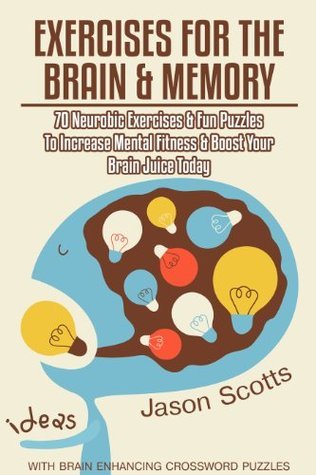
Exercises for the Brain and Memory : 70 Neurobic Exercises & FUN Puzzles to Increase Mental Fitness & Boost Your Brain Juice Today
Learn the best ways to improve mental health by grabbing a copy of this book. A lot of people today seek ways to retain and improve their memory and there is no better way to improve aside from these exercises. Just as the body needs physical exercises in order to function optimally, the brain needs to be exercised as well to prevent it from becoming sluggish. Get to know these fun and challenging exercises, do them and experience improved brain and memory function.
106 pages, Kindle Edition
First published December 13, 2013
Ratings & Reviews
Friends & Following
Create a free account to discover what your friends think of this book!
Community Reviews
Displaying 1 - 6 of 6 reviews

October 10, 2018
Meh...
Baaaasic. Meh. Boring. Limited.
It could be worse, I guess. It did have a couple of exercises I might try.
Baaaasic. Meh. Boring. Limited.
It could be worse, I guess. It did have a couple of exercises I might try.
December 12, 2017
Poorly written.
I am an avid reader and have studied and practiced both creative writing and business writing. I could not get past the introduction of this book because I was distracted by author's writing "style". I do wish him well and applaud him for his self confidence in having his book published.
I am an avid reader and have studied and practiced both creative writing and business writing. I could not get past the introduction of this book because I was distracted by author's writing "style". I do wish him well and applaud him for his self confidence in having his book published.

June 30, 2016
I recently read another of the author's books, Exercise and the Brain. I liked that book as I thought it was an interesting introduction to brain exercise and gave valuable information on how to determine what exercises may be best for you. When I found this book, I thought it would have more specific exercises in it and be more of a workbook than it is.
There's a lot of text that is similar or the same from that book into this one. This book does have some additional sections on various types of exercises but overall they were somewhat dissapointing.
I like that he gave some specific examples of exercises and explained why he thought they might be helpful. I wish there was more of this given the recent explosion of brain training games and apps as well as many physics, word, puzzle and code games/apps/books/sites available. Maybe guidance on which may be best for various age groups or experience levels could be included.
The crosswords at the end of the book didn't display properly in my Kindle edition. The game board and the solved board appeared, but no clues for filling in the blank board.
The numerical exercises section was not up to par in terms of the quality of explanation. Normally, concepts are explained in as non-technical terms as possible, which wasn't the case here. My dad taught various math courses from elementary to college age, so I'm familiar with having complex mathematical issues described simply. Also, this section didn't leave you with many ideas you could readily try, more research than should be required is left to the reader.
For the speed reading, I would've like a site, book, or app mentioned so that you'd be sure you were developing comprehension as well as speed and for more guidance on timing this.
I feel that this book should be two books or have two sections. One's more about learning what the exercises are about, what they can do, how to choose ones that are best for you, and an introduction to the concepts behind the various categories of exercises. The other would be exercises organized by category you can do without further research as well as recommendations for exercises you'd be getting from apps or games or sites. He could also make checklists so you could note what you're interested in pursuing or give example schedules of training sessions focused on specific areas and/or amount of time required. This would make the book be more usable, less overwhelming, and more organized.
There's some good stuff in this book as there was in the other one I read. There's some new (compared to the other one) information that is useful. But as currently constructed, it's sometimes too complicated or appears as a brain dump of everything he could think of relating to the subject. I received this at a free or discounted rate in exchange for my honest review.
There's a lot of text that is similar or the same from that book into this one. This book does have some additional sections on various types of exercises but overall they were somewhat dissapointing.
I like that he gave some specific examples of exercises and explained why he thought they might be helpful. I wish there was more of this given the recent explosion of brain training games and apps as well as many physics, word, puzzle and code games/apps/books/sites available. Maybe guidance on which may be best for various age groups or experience levels could be included.
The crosswords at the end of the book didn't display properly in my Kindle edition. The game board and the solved board appeared, but no clues for filling in the blank board.
The numerical exercises section was not up to par in terms of the quality of explanation. Normally, concepts are explained in as non-technical terms as possible, which wasn't the case here. My dad taught various math courses from elementary to college age, so I'm familiar with having complex mathematical issues described simply. Also, this section didn't leave you with many ideas you could readily try, more research than should be required is left to the reader.
For the speed reading, I would've like a site, book, or app mentioned so that you'd be sure you were developing comprehension as well as speed and for more guidance on timing this.
I feel that this book should be two books or have two sections. One's more about learning what the exercises are about, what they can do, how to choose ones that are best for you, and an introduction to the concepts behind the various categories of exercises. The other would be exercises organized by category you can do without further research as well as recommendations for exercises you'd be getting from apps or games or sites. He could also make checklists so you could note what you're interested in pursuing or give example schedules of training sessions focused on specific areas and/or amount of time required. This would make the book be more usable, less overwhelming, and more organized.
There's some good stuff in this book as there was in the other one I read. There's some new (compared to the other one) information that is useful. But as currently constructed, it's sometimes too complicated or appears as a brain dump of everything he could think of relating to the subject. I received this at a free or discounted rate in exchange for my honest review.

February 3, 2015
I enjoyed this book it was full of good information. The exercises can be easily done without having to buy extra stuff. I highly recommended this book to people that have family members with Alzheimer's....it's hereditary and taking the time out to doing the exercises can keep your brain active. Overall I enjoyed this book it was a good read and I plan on reading more books from this author.
February 14, 2015
Good introduction to neurobics with many simple techniques and examples to encourage, challenge and even force the brain into thinking in different ways, in the best ways for your own personal preferences and abilities. It covers a lot of techniques I have never heard of before and I have learnt a lot and already started benefiting from it.

March 17, 2015
A handy publication with unique facts to increase your brain responsiveness. Just the book to take with you when traveling and you are sitting and waiting for your transportation. The book whence your curiosity about neuroscience and offers some pathways to explore no matter your age.
Displaying 1 - 6 of 6 reviews