

What do you think?
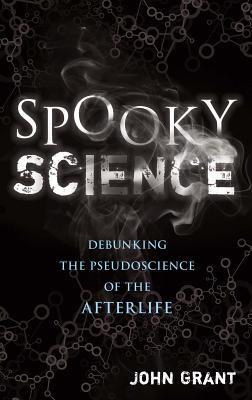
John Grant's Science
Spooky Science: Debunking the Pseudoscience of the Afterlife
Skeptics of the supernatural will enjoy this humorous jaunt through the long history of scientific inquiry into paranormal and psychic phenomena. Life after death, spirit communication, the astral plane, reincarnation: on the relatively rare occasions when scientists have tried to apply their methods to the paranormal, they've often ended up embarrassed—fooled by obvious charlatans, deluded into making irrational and unsubstantiated claims, or frustrated in their attempt to find something that just isn’t there. John Grant—author of Discarded Science and Corrupted Science—investigates the pseudoscience of spooky stuff to fascinating and often hilarious effect.
264 pages, Hardcover
First published October 6, 2015
About the author
John Grant
377 books190 followersJohn Grant is author of over eighty books, of which about twenty-five are fiction, including novels like The World, The Hundredfold Problem, The Far-Enough Window and most recently The Dragons of Manhattan and Leaving Fortusa. His “book-length fiction” Dragonhenge, illustrated by Bob Eggleton, was shortlisted for a Hugo Award in 2003; its successor was The Stardragons. His first story collection, Take No Prisoners, appeared in 2004. He is editor of the anthology New Writings in the Fantastic, which was shortlisted for a British Fantasy Award. His novellas The City in These Pages and The Lonely Hunter have appeared from PS Publishing.
His latest fiction book is Tell No Lies , his second story collection; it's published by Alchemy Press. His most recent nonfiction is A Comprehensive Encyclopedia of Film Noir . Earlier, he coedited with John Clute The Encyclopedia of Fantasy and wrote in their entirety all three editions of The Encyclopedia of Walt Disney’s Animated Characters; both encyclopedias are standard reference works in their field. Among other recent nonfictions have been Discarded Science, Corrupted Science (a USA Today Book of the Year), Bogus Science and Denying Science.
As John Grant he has to date received two Hugo Awards, the World Fantasy Award, the Locus Award, and a number of other international literary awards. He has written books under other names, even including his real one: as Paul Barnett, he has written a few books (like the space operas Strider’s Galaxy and Strider’s Universe) and for a number of years ran the world-famous fantasy-artbook imprint Paper Tiger, for this work earning a Chesley Award and a nomination for the World Fantasy Award.
His latest fiction book is Tell No Lies , his second story collection; it's published by Alchemy Press. His most recent nonfiction is A Comprehensive Encyclopedia of Film Noir . Earlier, he coedited with John Clute The Encyclopedia of Fantasy and wrote in their entirety all three editions of The Encyclopedia of Walt Disney’s Animated Characters; both encyclopedias are standard reference works in their field. Among other recent nonfictions have been Discarded Science, Corrupted Science (a USA Today Book of the Year), Bogus Science and Denying Science.
As John Grant he has to date received two Hugo Awards, the World Fantasy Award, the Locus Award, and a number of other international literary awards. He has written books under other names, even including his real one: as Paul Barnett, he has written a few books (like the space operas Strider’s Galaxy and Strider’s Universe) and for a number of years ran the world-famous fantasy-artbook imprint Paper Tiger, for this work earning a Chesley Award and a nomination for the World Fantasy Award.
Ratings & Reviews
Friends & Following
Create a free account to discover what your friends think of this book!
Community Reviews
Displaying 1 - 14 of 14 reviews

November 13, 2018
"If scientists were paid by results, the last parapsychologist would have long since died of hunger..." ~Alexander Baron
Astral Projection, Ectoplasm, ESP, EVP, Ghosts, Hauntings, Poltergeists, Heavenly Tourism, Hypnotic Regression, Levitation, Reincarnation, Spiritual Mediums, Near Death Experiences, Spirit Photography, Psychokinesis, Telekinesis... That's not a comprehensive list, but you get the picture. John Grant takes them all on with the heart of a scientist and the eye of a skeptic.
This is where psychic phenomena comes to die, or at least to be skewered with reason. Elements which are not exposed as outright fraud can be explained (with varying degrees of certainty) by physics, psycology and even neurology. And Grant accomplishes this with a sarcastic wit that sometimes (often) borders on snarky.
There are plenty of historical incidents and references. So many, in fact, that some may find it a little tedious. I, for one, thoroughly enjoyed it.
Astral Projection, Ectoplasm, ESP, EVP, Ghosts, Hauntings, Poltergeists, Heavenly Tourism, Hypnotic Regression, Levitation, Reincarnation, Spiritual Mediums, Near Death Experiences, Spirit Photography, Psychokinesis, Telekinesis... That's not a comprehensive list, but you get the picture. John Grant takes them all on with the heart of a scientist and the eye of a skeptic.
This is where psychic phenomena comes to die, or at least to be skewered with reason. Elements which are not exposed as outright fraud can be explained (with varying degrees of certainty) by physics, psycology and even neurology. And Grant accomplishes this with a sarcastic wit that sometimes (often) borders on snarky.
There are plenty of historical incidents and references. So many, in fact, that some may find it a little tedious. I, for one, thoroughly enjoyed it.

December 26, 2015
Really interesting with an edge of sarcasm and humor. Points out numerous instances of idiocy when dealing with questions about the afterlife. Not sure why the listed author is incorrect. John Grant wrote this books. Definitely worth the time.

October 24, 2024
Very basic book with awful formatting. Some of the additional side notes would be in the middle of a page or even sentence and would be 1-2 pages long. So by the time you read it you will forget what the real chapter was about.
Pretty basic information here with a lot of examples of each topic. If you're already exposed to this kind of stuff through podcasts or other books I wouldn't recommend this. I skipped the last 10ish pages. I'd had enough at that point.
Pretty basic information here with a lot of examples of each topic. If you're already exposed to this kind of stuff through podcasts or other books I wouldn't recommend this. I skipped the last 10ish pages. I'd had enough at that point.

September 21, 2019
Spooky Science is a short book and a quick read. The author touches on and debunks all nonsensical things relating to the afterlife; you name it: spirit communication, spirit photography, astral projection, EVP, poltergeists, hypnotism, cold reading, automatic writing, Ouija boards, reincarnation, near-death experiences, past life regression, the soul, and a variety of other heavenly subjects. He uses humor and draws from many experts to get his message across. The book has an extensive bibliography listing his many sources.
I really appreciate the broad scope of the book but I wish the author would've narrowed his focus and taken a deeper dive in to certain subjects, like the nonsense of near-death experiences and past life regressions, and would've spent less time writing about old-timey 19th century fraudsters. When I bought the book I was hoping that it would be based primarily on contemporary pseudoscience.
Still, I found the book enjoyable and worth the read. I especially liked the proof of heaven/ heavenly tourism section. He traces back visits to heaven back to George Ritchie in the 1940s and goes on to write about a number of other books with the same story, the most famous being Nebraska preacher Todd Burpo's Heaven is for Real: A Little Boy's Astounding Story of His Trip to Heaven and Back. This was a New York Times best seller and was made in to a big time Hollywood movie! Burpo raked in millions of dollars from this tall tale! Another popular book, The Boy Who Came Back From Heaven: A True Story, sold like hotcakes until the publisher pulled it after the heaven boy admitted me made the whole thing up. Wow. Grant does a good job in Spooky Science explaining what causes near death experiences. Hint: it's based on the brain, oxygen, and chemistry and not the soul and the supernatural. He also brings up a famous hoax that freaked me out as a youth - the Amityville Horror. How many movies did they make out of that crazy tale?
I would recommend this book to anyone with even a fleeting interest in the aforementioned topics. You won't be subjected to mind-numbing science or drowned in a cauldron of scientific terms, but rather be given a fun explanation with enough digestible science to explain the reality of the particular spiritual topic in an understandable way.
I really appreciate the broad scope of the book but I wish the author would've narrowed his focus and taken a deeper dive in to certain subjects, like the nonsense of near-death experiences and past life regressions, and would've spent less time writing about old-timey 19th century fraudsters. When I bought the book I was hoping that it would be based primarily on contemporary pseudoscience.
Still, I found the book enjoyable and worth the read. I especially liked the proof of heaven/ heavenly tourism section. He traces back visits to heaven back to George Ritchie in the 1940s and goes on to write about a number of other books with the same story, the most famous being Nebraska preacher Todd Burpo's Heaven is for Real: A Little Boy's Astounding Story of His Trip to Heaven and Back. This was a New York Times best seller and was made in to a big time Hollywood movie! Burpo raked in millions of dollars from this tall tale! Another popular book, The Boy Who Came Back From Heaven: A True Story, sold like hotcakes until the publisher pulled it after the heaven boy admitted me made the whole thing up. Wow. Grant does a good job in Spooky Science explaining what causes near death experiences. Hint: it's based on the brain, oxygen, and chemistry and not the soul and the supernatural. He also brings up a famous hoax that freaked me out as a youth - the Amityville Horror. How many movies did they make out of that crazy tale?
I would recommend this book to anyone with even a fleeting interest in the aforementioned topics. You won't be subjected to mind-numbing science or drowned in a cauldron of scientific terms, but rather be given a fun explanation with enough digestible science to explain the reality of the particular spiritual topic in an understandable way.

January 21, 2020
Fun read. There’s just no end to charlatans, shysters, and wackadoodles. While believing in ghosts or reincarnation or whatever seems silly and inconsequential, magical thinking and denial of reality have serious consequences for more pressing matters, from the fate of the country to the fate of the planet. With a light and tongue-in-cheek approach, the author makes it clear that uncritical acceptance of pseudoscience is both delusional and dangerous.

September 13, 2017
Many people believe in the paranormal--but what do they have to go on? John Grant's Spooky Science disembowels many of the popular arguments for the paranormal and gives practical explanations for the "unexplainable."
The book tackles the paranormal in four parts: mediums; ghosts; trips to heaven; and reincarnation. While these things have been widely debunked for centuries, even by former proponents, our culture is such that a book like Grant's apparently must come along every few years or so to set the record straight, and even so serious believers stick their head in the sand.
Why would that matter though? Why not merely let the credulous be so? Grant's position is that unfounded belief of any kind leads to a collective "brainrot" which effects society in worse and worse ways, i.e. politicians lying about climate change to keep the oil tycoons happy. If we don't believe in things based on evidence, we may then believe in anything, and we find ourselves in the world we currently inhabit, one of "alternative facts." Spiritualism and willful ignorance may seem a far cry apart, but they share a contempt for empirical data and the scientific method.
The book tackles the paranormal in four parts: mediums; ghosts; trips to heaven; and reincarnation. While these things have been widely debunked for centuries, even by former proponents, our culture is such that a book like Grant's apparently must come along every few years or so to set the record straight, and even so serious believers stick their head in the sand.
Why would that matter though? Why not merely let the credulous be so? Grant's position is that unfounded belief of any kind leads to a collective "brainrot" which effects society in worse and worse ways, i.e. politicians lying about climate change to keep the oil tycoons happy. If we don't believe in things based on evidence, we may then believe in anything, and we find ourselves in the world we currently inhabit, one of "alternative facts." Spiritualism and willful ignorance may seem a far cry apart, but they share a contempt for empirical data and the scientific method.

October 17, 2016
This guy wants to debunk so many things, he merely glosses over everything. He basically says any belief in something not blatantly obvious to the naked eye is silly and nonsensical. I more believe that there are things in the world that we don't understand. Or, to quote Donald Rumsfeld, "we don't know what we don't know."

December 17, 2024
Insanely bad formatting. Like, shoving an infobox in the middle of a sentence or 2 page spread in the middle of a paragraph, so you have to constantly flip back and forth. No wonder this thing was in the bargain bin; it's a PITA to read.
The entire thing reads like a very bland recall of cases from dozens of other books with as little as two or three sentences dedicated to some of them. You get a ton of disconnected stories one after the other with very little in the way of conclusion or original input by the author. So many pages may as well have been bullet points of random names to point at and go "so all these people were liars". OK? If you don't want to get into the details of something (or the details aren't interesting enough to include), why did you write a book about it? And don't get me started on the constant footnotes pointing to where you'll find elaboration on some random person's story at another point in the book, rather than just formatting it so each person gets their time and you move on. No, I'm not going to flip forward 50 pages to figure out why you think I should know this random name who happens to be connected to some other nobody.
Also this guy writes like he had a minimum source count to hit and didn't know how to use those sources in a meaningful way so he just kinda vomited fragments of them in the middle of a pre-existing essay. At the same time it feels incredibly padded like he was desperate to hit its already short page count (220, but with rather big spacing and lots of pictures) despite the fact that you could write thousands of pages on some of the topics tackled in here and still have interesting things to say. If this is how the author approaches all his books, no wonder he's published 80+ - he shits them out like a grifter shits out accounts of their past Atlantean lives.
The entire thing reads like a very bland recall of cases from dozens of other books with as little as two or three sentences dedicated to some of them. You get a ton of disconnected stories one after the other with very little in the way of conclusion or original input by the author. So many pages may as well have been bullet points of random names to point at and go "so all these people were liars". OK? If you don't want to get into the details of something (or the details aren't interesting enough to include), why did you write a book about it? And don't get me started on the constant footnotes pointing to where you'll find elaboration on some random person's story at another point in the book, rather than just formatting it so each person gets their time and you move on. No, I'm not going to flip forward 50 pages to figure out why you think I should know this random name who happens to be connected to some other nobody.
Also this guy writes like he had a minimum source count to hit and didn't know how to use those sources in a meaningful way so he just kinda vomited fragments of them in the middle of a pre-existing essay. At the same time it feels incredibly padded like he was desperate to hit its already short page count (220, but with rather big spacing and lots of pictures) despite the fact that you could write thousands of pages on some of the topics tackled in here and still have interesting things to say. If this is how the author approaches all his books, no wonder he's published 80+ - he shits them out like a grifter shits out accounts of their past Atlantean lives.

May 21, 2018
This is a fun, simple book that looks through various scamming methods and pseudoscience revolving around the afterlife: mediums, seances, ghosts stories, reincarnation, near death experiences, waking dreams, etc. It also includes scientific studies conducted looking for evidence of such. Turns out scamming people's beliefs of the afterlife can be a remarkably profitable endeavor. My only qualm is that it focused heavily on the spiritualist movement of the 1800s to the early 1900s, only briefly touching on modern circumstances like Sylvia Brown or "Heaven is for Real." I would have liked to know more about modern deception tactics. But generally, a pretty good book.

December 27, 2022
A quick and fun overview on paranormal sciences and various failed experiments and proposed theories. How much can a corpse perspire and evaporate once dead, or is the soul truly leaving the body? I also loved learning that sudden onset of language comprehension and production (like The Exorcist) has a word, xenoglossy.
December 8, 2025
The first two chapters are hard to read. Insert placement was frustrating, and there was so much bouncing around--there had to be a better way of organizing this. That said, the information was interesting.

March 31, 2018
An excellent, easy to follow book about all the ridiculous ways people get hoodwinked or fool themselves in to believing they are hearing or seeing ghosts.
January 25, 2020
Encyclopedic type entries for topics and persons related to the paranormal. Brief, but a starting point for those interested.
November 8, 2021
It was ok. Well, the parts that I read were ok. Didn't see myself reading the rest. What I read was enough to satisfy me for the month of October.
Displaying 1 - 14 of 14 reviews