The Loch Ness Monster, Bigfoot, and the yeti have long held a fascination for people the world over. Debates about their actual existence or what they might really be have continued for decades, if not centuries. Known also as cryptids, they have spawned a body of research known as cryptozoology.
This entertaining audiobook looks at the evidence of these mysterious monsters and others and explores what they might really be (if they exist at all), why they have been represented as they have, and the development of cryptozoology and how it has collected data to discover more about these unknown creatures.
Darren Naish is a British vertebrate palaeontologist and science writer. He obtained a geology degree at the University of Southampton and later studied vertebrate palaeontology under British palaeontologist David Martill at the University of Portsmouth, where he obtained both an M. Phil. and PhD.
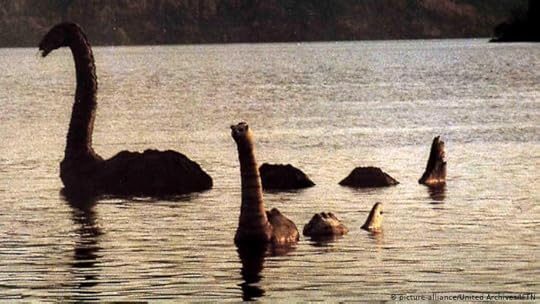
Imagine you want to fake a Loch Ness Monster hoax. You go through the effort to find actual, bona fide plesiosaur bones. and attempt to plant the bones near the Loch.
Imagine you go through this effort, only for the labs to confirm that 1) The soil from the bones doesn't match the area and 2) -
The damn bones are 66 million years old, so if you wanted to prove it was Nessie, you'd need bones that aren't fossils because you're trying to prove that she's real NOW
I love cryptozoologists.
So I would say this was an okay book. Although cryptozoology is mostly a pseudo-science, I often didn't like the authors condescending tone towards them. I feel like meeting pseudo-science with real science should be done at all times instead of writing off people as "nutcases".
Otherwise, I think this book is a fascinating look into the human psyche and our desire to believe in that which is not real. I recommend this to anyone who needs a bit of a break from complex narratives in fictional books. The section on Nessie is especially riveting.
I enjoyed this deconstruction of the hoaxes, honest mistakes, and arguments of those who believe that creatures such as sea monsters, bigfoot, and the Loch Ness monster are real animals. At the same time, I enjoyed the details of the mythology surrounding them, like awesome tales of "island monsters" and the intriguing supposed habits of bigfoot-like creatures around the world. It made me think and question—while also giving me grist for the imagination mill.
One of the most interesting points revolves around the stylized images of dinosaurs and monsters like Nessie that are so ingrained in our cultural awareness, yet our knowledge of actual animals lags behind. Therefore when we see something we can't identify, our imaginative minds often leap to some unexplained mystery monster instead of a real animal we just don't know about. For example (and this is my example—I think "pterodactyl" is a layman's term), everyone has an idea of what a pterodactyl is—inaccurate or not—but fewer people have any firm knowledge of real-world fruit bats. So if you see a rare flying fox bat, for example, for just a moment, especially if you're alone and edgy in unfamiliar territory, or if you particularly like dinosaurs, you might well think "pterodactyl!"
I did find the book quite repetitive, however, not just in the details, but in the philosophy and big themes. I got the author's main points the first time, certainly the second. By the fifth time my intelligence was feeling a little insulted. However, if you read this book in small sections with a few weeks between topics, the repetition would be more appropriate. I also recommend skipping the long captions on the pictures, since they often repeat almost word for word what is said just before or after in the text.
The illustrations and photos included add a good deal to the book. I just wish we could see a few more of the photos Naish discusses in detail. Copyright issues and other problems probably prevented it, but it would have been nice.
The writing of Hunting Monsters is clear and I learned a lot of new things, including many possibilities for what these supposed mystery monsters could really be. I also really enjoyed the bits discussing the cultural, sociological, and anthropological implications of such widespread belief in mystery monsters.
If you're interested in cryptozoology and a thorough examination of the evidence and reality of cryptids like Nessie, Bigfoot, and other less famous but no less fascinating creatures, read Hunting Monsters.
*I received a free copy in exchange for an honest review*
Too short. Could use some chapters filled out with more info. But the information and professional opinions in here are invaluable to have for anyone interested in the zoology and/or folklore of cryptids like Bigfoot, Nessie and the various hidden animals around the world. Only available in Kindle right now.
I was excited to read this book when I found it at the library. It mentions many of the cryptids that are widely known, and a few that are less well known. There are several photos that are decently reproduced. The chapters are groupings of similar creatures. In the back of the book are several references for each chapter.
However, I was a bit disappointed with the book overall. I know that sometimes the best way to prove a thing is real is to debunk as much as you can. That way whatever you're left with is the important stuff, the things that can't be explained. The author finds a way to say every sighting (or nearly every one it seemed) could be explained away. This didn't become troublesome until the explanations became almost as far fetched as the things they tried to explain away.
The largest chapter seemed to be about sea and lake monsters. Each successive chapter was smaller and smaller. I'm not sure if the water cryptids were his area of expertise or if he didn't have enough information on the other creatures, but the overall effect seemed like the author was simply running out of steam to talk about varying cryptids.
One has to be careful when reading the sizes of the creatures as well. The measurements were given first in metric and then in standard, which was very nice, but I found several that did not match up at all. I hope they were simply typos. Decimal points are important!
For someone starting out just learning about creatures such as Nessie and Bigfoot, this book offers names of several other creatures to research as well as the names of many prominent people in the field of cryptozoology and their works. Definitely good information to have.
I've always wanted to find a book like this; one that looks at cryptozoology from a basically respectful, but scientific viewpoint, with a healthy dose of incredulity. Naish examines arguments for some of the most famous cryptids. Spoiler alert - he ends up concluding that the arguments don't pass muster as proof for most cryptids' existence as real flesh and blood animals, and explains why the arguments fall short. However, he does examine what might be behind the myths, and what cryptozoology can tell us about ourselves and the natural world. He doesn't totally dismiss the field, saying there may still be hidden animals left to discover.
I'm fascinated by cryptozoology; I own Michael Newton's "Encyclopedia of Cryptozoology" and have read it cover-to-cover at least three times. The fact that I don't believe that most of the anecdotes in it describe actual encounters with real unknown animals doesn't make it any less fascinating as folklore. For hopeful skeptics like me, Naish's book is perfect. I certainly don't regret the very reasonable price I paid for this book on Kindle.
"The entire phenomenon seems to be part of a humanwide idea that we live alongside near-humans or subhumans – animals that are like us overall, but somehow bridge the gap between humanity and the rest of nature. The fact that all human cultures have a ‘need’ for nearhuman monsters of this sort probably explains why creatures interpreted as undiscovered hair-covered hominids are so ubiquitous. In other words, the idea of the near-human monster is always there in the human psyche, and it has never gone away..."
The above quote summarizes the author's opinion of the existence of a possible "Bigfoot", or "cryptohominid". Admittedly, I am generally interested and fascinated by accounts of historical "monsters" or other cryptozoological creatures, so I put this one on my list as soon as I came across it.
Author Darren Naish is a British vertebrate paleontologist, author and science communicator. As a researcher, he is best known for his work describing and reevaluating dinosaurs and other Mesozoic reptiles, including Eotyrannus, Xenoposeidon, and Azhdarchid pterosaurs.
Darren Naish: Hunting Monsters opens with an intro to the field of cryptozoology. Naish covers some of the early scientists central to establishing this reletively new scientific field.
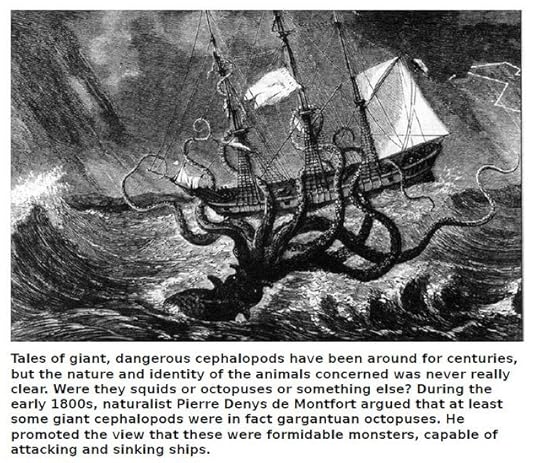
The book is a largely science-driven look into most of the famous monsters from historical accounts. Naish writes about (among others): * Giant squids and octopus. * Unkown animal carcasses identified as "monsters" that washed up on beaches. * The Loch Ness Monster. * Bigfoot/Yeti, and other "cryptohominids" * Prehistoric "survivors" such as the Congolese Mokele-Mbembe. * Mystery marsupials and other oddities.
Hunting Monsters features many illustrations and pictures throughout its pages. Many of the historical monsters are depicted here, as well as photos of the modern cryptozoological evidence. This was a nice touch here, as I always appreciate books that include numerous pictures and/or illustrations.
Despite fielding an incredibly interesting subject matter, the writing here was a bit drier than any book about monsters has a right to be. Despite Naish's best efforts, this story was not told in an exceedingly engaging or interesting way here, IMHO.
Naish mentions Jeff Meldrum's book, Sasquatch: Legend Meets Science when talking about Bigfoot. I recently read Meldrum's book and was pleasantly surprised by the case he laid out there. I wouldn't go so far as to say I was completely convinced, though, as I think more concrete evidence would be necessary before drawing a conclusion like that. Meldrum examines foot morphology, stride length, footprint depth, etc in great detail there. I would recommend his book to anyone reading this review.
The overarching theme of this book is Naish debunking the claims of the existence of these cryptozoological creatures. Naish mentions, for example, that interestingly enough - most of the unidentified "monsters" that have washed up on beaches are actually common animals that have suffered from a large amount of decomposition. Naish notes that the connective protein collagen is very robust, and can remain intact for weeks. Although it remains largely intact, it can fray and split, giving the corpse of the animal a grotesque and unfamiliar appearance.
Hunting Monsters was an interesting short read. I would recommend it to anyone interested. 3.5 stars.
A solid look into cryptozoology from a scientific, sceptical perspective, with an additional focus on asking, in a non-judgemental manner, why people see and hunt for creatures that may not be real. While he doesn't pull his punches necessarily, Naish isn't dismissive of those interested in hunting for cryptids, which I feel will make this work feel more approachable than some other, similar texts. It is a little repetitive, but that may in part be a fault of so many cryptozoologists coming from similar places and with similar tactics.
I think, unfortunately, I've rated this a little lower than it might deserve as I recently read Abominable Science! Origins of the Yeti, Nessie, and Other Famous Cryptids, which really feels like the definitive 21st-century take on debunking cryptozoology, exhaustively explaining the science and history that is really behind modern cryptids.
With that said, however, Hunting Monsters is a more accessible (and much less dense) read and would make a great first 'sceptical look at cryptids' book.
So many of the bedrock encounters/images/videos in the world of cryptozoology don't quite have the strong footing many have assumed. I've always loved Naish's deep dives into famous cryptid pictures and videos, and his book does not disappoint! A detailed and skeptical look at the world of the unknown.
I’ve been familiar with Darren Naish for a while and I’ve been a big fan of his work on certain paleontology and zoology related media. He’s a man who clearly knows his stuff and it definitely shows in this book.
I want to take some time to appreciate Darren Naish for a second. I think there’s a bit of reluctance among scientists to even engage with a topic like “cryptozoology” and I’m glad that he allows himself to work on a subject like this. As he points out several times in this beautifully researched book, cryptozoology is actually more of an intersection between folklore and anthropology rather than a genuine branch of zoology, but that doesn’t mean that there isn’t scientific value in studying these “mystery animal reports.” Taking a look at the actual “evidence” and witness accounts for cryptids reveals really interesting things about human nature and cultural attitudes, which there is certainly scientific merit in doing so.
If you’re a hardcore cryptid believer though, this isn’t the book for you. Naish tears apart tons of purported evidence for all the cryptid superstars and pretty much reduces some already flimsy stuff into basically nothing. It’s still cool to see explanations behind all of the famous cryptid sightings though, and Naish encourages the reader implicitly to think critically about information you see and hear in your daily life. This book kind of reads like a long form version of a “crypto mega thread” that Naish sometimes posts on Twitter, which are always cool to see on my timeline. I enjoyed this a bit more in some ways because I found the book much easier to read than the mega threads.
Now I’m off to watch Finding Bigfoot so I can learn both sides of the story. /s
I have always wanted a skeptical non-true believer study of cryptozoology. Most things written about the field are by shucksters who want to cultivate some contrived sense of awe and wonder. How most of these things (though not the search for new and plausible animals which could very well remain scientific) should be treated is as folklore. And obviously there is a sliding scale of probability from new type of swamp lizard to something exotic like the one-eyed, bat winged, man-raping Popobawa (of course being obviously folkloric often means being more interesting but I digress).
Naish sticks to the 'more plausible' creatures and shows how even they are probably mostly bunk. But a very important thing is missing from this narrative: the study of the culture and motivations of the cryptozoologists themselves. In a field striving for scientific recognition but delving far deeper into subculture, I feel this is the vital missing link. Perhaps sequel co-written by a sociologist or anthropologist would more complete the task.
Disappointing. I'm on Darren's "side" on the cryptozoology issue already - I study biology and am a skeptic with regard to the monsters in the book - but it still comes across as condescending and patronizing. When I borrowed this book I was hoping for a genuinely curious dive into any of the following: 1) the hypothetical biology behind monsters 2) the real biology behind the known animals that get mistaken for monsters 3) or, the psychology or anthropology behind monster folk tales But instead, it rather read as a list of debunkings. Maybe I was just expecting too much. The writing style was quite boring as well. Also, as a religious person (albeit not a young earth creationist) I don't appreciate the mean spirited way he portrays us.
I have always been fascinated by cryptozoology and have read many books which either promote a belief in them or a belief completely against them. This book is refreshing as it discusses the history of many types of cryptids and the mythology behind them. The book is very well researched and it is very interesting to note how the popularity of certain cryptids seem to change over time and how there seems to be a definite time when some cryptids seem to start to appear and others to disappear. Highly recommended for anyone interested in cryptozoology. I received a copy of this book from Arcturus Digital (thank you!) via Netgalley for free in exchange for an honest review.
Not really bad, but I think it could have been organized in a better manner to make it more readable. The earlier chapters are the most enjoyable but I believe that if you read the chapters backwards it would be just as enjoyable: each chapter follows the same pattern of presenting the alleged monster and then debunking it in the exact same way: real animal that could have been misidentified, cultural influences, unreliable human memory, etc. I'm not unhappy that I read it - the information is interesting, but the presentation is repetitious and thus not all that engaging.
I decided to give this a read after hearing it referenced so often in TREY the Explainer's cryptid videos, and it certainly didn't disappoint. Believers won't find much vindication in this book, but if you're a skeptic looking for an analysis of cryptozoology not as a real science, but as a modern extension of the mythology, folklore, and tall tales of yesteryear, definitely give Darren Naish's Hunting Monsters a read.
I've heard Darren Naish on the Monster Talk podcast a few times. The author clearly knows his stuff, and the book is well-written. Having said that, even this short book was a slog for me. If you're really into cryptozoology, you should enjoy this.
An excellent, well-referenced, skeptical introduction to the - quite often ludicrous - world of cryptozoology, Naish' book is well-written, logically argued and impressively fair-minded and respectful.
Approaching his subject from a scientific, rather than polemical viewpoint is a real strength. During his discussion of the Patterson-Gimlin film (a fairly obvious hoax) he clearly lays out his case against Patterson as the hoaxer but, at the same time, berates those so eager to assassinate Patterson's character that they too, will blindly fall for dubious testimony that suits their own beliefs.
As a historical overview, Naish writes clearly about cryptozoology 'pioneers' like Ivan Sanderson and Bernard Heuvelmans. He patiently explains just how (and why) they got so many things wrong, too. Of course, he tackles the field's big names like the Loch Ness Monster, Bigfoot but also, lesser known supposed creatures, particularly from Africa and Australia. His global scale helps to back up his convincing central point - that cryptozoological sightings are based on myths common to all cultures and to basic mis-identifications of existing animals, whether due to honest mistakes or to blatant scams.
His chapter on alleged sea monster sightings is excellent, particularly his truly grotesque explanation of the mysterious 'globsters' that are sometimes washed up on beaches and claimed as the corpses of unknown beasts: "what seems to happen is that as a floating whale carcass decomposes, the bones drop away, leaving a ragged, rotting, lumpen mass formed of the skin and associated muscles and ligaments."
Nice.
In discussing Australia and its vast, open spaces, he notes that it's perfectly possible that ARE some small, as-yet-undiscovered creatures out there. He just doesn't think (and he gives plenty of solid reasons for this view) that elephant-sized lizards have managed to escape widespread detection.
His closing chapter 'The Changing Face of Cryptozoology' is excellent, and clear enough to read as stand-alone piece, he begins by arguing that "the primary tenet of cryptozoological literalism has failed... that myths, ethnic knowledge and eyewitness accounts pertaining to mysterious creatures provide evidence for the existence of numerous undiscovered species" but notes that, divorced from the credulous trappings of Bigfoot-hunting, "reports of many mystery creatures are still worthy of investigation. They might not always include the superstars of the field, like Bigfoot and Nessie, but they're exciting and interesting nonetheless."
The book read like a university term paper. It also went out to only attempt discounting every sighting of cryptid mentioned in book. The book is set up thus:
- Explain where and what the cryptid is, including measurements sometimes - Explain why those who supposedly saw it are mistaken.
By the end of the book, if you already don't believe in cryptids, you might feel pretty clever about yourself for not being like those weirdos who seem to be mistaking this-or-that for cryptids. If you do believe in cryptids, the author will likely not convince you very well (did not convince me) that cryptids are simply products of culture and folklore. I will say after finishing the book: "Sure, it is good to remember that some or many sightings of cryptids are mistaken." But I didn't need this book to get me there, and you probably don't either.
I had been hoping for a well-rounded look at cryptids. If you are too, this book is not for you.
I would not recommend, primarily on the basis that the author does not take a look at other perspectives on this topic. Secondarily because it is dry reading.
There is a lot of interesting information in this books. It sometimes gets a little pedantic, but not bad.
The bigger conflict is that while Naish has a sincere interest in cryptozoology, he is tearing down the beliefs that most other cryptozoologists cling to. He is right to do so, but they aren't going to like it.
If you are not invested in the reality of the Loch Ness Monster, then learning the history of the stories and the various photos and things can be fascinating.
The other thing that is interesting is how often a contributor to the myths can be a lack of knowledge about what known animals are out there. I suspect there may be some lessons for that in things like QAnon. Also -- if your concern is that the myth shattering takes away a sense of wonder -- there is so much that is wonderful and amazing that is real and available for learning and study and fascination.
Again, annoyed that Goodreads doesn’t allow for .5 start ratings; this one landed in the 3.5 star range for me.
I’m often frustrated by books and “research” done around cryptids because most seem to consider any & all firsthand witness accounts as refutable fact and either discount or ignore the provably false evidence or hoaxes. This book however takes in account all the historical and scientific evidence available and looks at cryptids and related folk-lore creatures through more sociological/psychological lens. Way more fascinating to me personally, so I found a lot to enjoy in this and it was way more informative than other pop-science-culture type books. Definitely recommend if you’re interested in cryptids and the like but are a touch more skeptical than the true believers.
The author spends most of the book recounting the tales of the most well known cryptids and his explanations, why the witnesses are not to be believed show a certain distain for those cryptozoologists who (still) believe in those stories. It could have been such an entertaining read, if Naish focused on the lesser known creatures from Australia or if he had shown when and how the divide happend between the real biologists looking for unkown species and those monster hunters and what the formers work really looks like and the species that have been discovered recently... But so it ist just a lot of typical Bigfoot und Nessie stories told by a scientist who seems to have very strong, negative feelings for the people who still believe in monsters.
This book is very informative on the history of cryptozoology, human culture, anthropology and folklore. I really enjoyed reading about it although I wish there were more mentions of slightly lesser known cryptids like the mothman or the goatman. I liked that the book summarized its key point at the last chapter, it was a nice reminder of the journey we took. I also wish there were a bit more zoology integrated since I was really interested in the part where the author talks about animals which were considered cryptids or folkloric being and then eventually they got discovered and cataloged as real animals.
4 stars if you're into this sort of thing. More like 3 stars as a work of popular science or cultural studies. Naish knows his stuff, but he writes like an academic, which is to say he expects the reader to do a lot of work in either unpacking statements dense with meaning, remembering the significance of names (based on the barest of character sketches), and generally continuing to turn pages in the absence of any narrative thrust.
I'm glad I read this book. If you're curious about the topic, you should read it too. But don't go out of your way.
Very informative, something I'll definitely reread. That said, I feel some things were glossed over too quickly despite them being discussed in depth. It may seem contradictory to say, but it's almost as though the author had piles of information spread about them and absentmindedly heaped handfuls of the same stuff into the book in error.
That isn't to say it wasn't well done, just that I wish there had been less reiteration and more new information. Jolly good read, though.
An extremely easy read (meaning that it reads easily, not that it's meant for a young audience) that debunks nearly everything I loved as a kid. As bad as that sounds, this book was equally as entertaining as any of those books approaching the subject from an angle of belief with the added advantage of being factually accurate & amazingly well-sourced. I wish Naish would dig deeper into this subject, or write in depth about other scientific topics.
Finished reading Hunting Monsters by Darren Naish, about the history and science of cryptozoology and how its mostly bullshit. He debunks all the famous beasts in an entertaining way, while also talking about the culture that surrounds cryptozoology. I’ve always loved the subject, even though Ive always been a skeptic. This is for me: skeptics who love the subject and if you’re one of them you’ll enjoy this book
This is a great study examining and debunking many of cryptozoology's common claims. Naish is able to examine each alleged animal with a critical eye and directly refutes lots of specific sightings and accounts. I really liked his points about the unreliability of eyewitness evidence.
The only reason this gets 4 stars instead of 5 is that the Ropen/Mokele-mbembe and Australia chapters felt very rushed compared to others.
It was a little disappointing to learn that such beasts as the Loch Ness Monster and Bigfoot probably aren't real, but very interesting to learn about the reasoning behind that conclusion and how it relates to psychology. I would have liked the book to be a little longer, but the subjects covered within are presented in satisfactory detail.
Excellent exploration of the evidence behind various cryptids and so forth. If you're interested in this sort of thing Naish's Twitter is always entertaining, especially his megathreads about various famous photographs of alleged creatures. Anyway, this is a fun and informative discussion about Nessie, Bigfoot, Mokele-Mbembe and their more-sociological-than-zoological brethren.
I really enjoyed this book. It takes a critical (but not in a condescending or completely dismissive way) look at where cryptozoology legends come from and what was going on at the time in our social and cultural history at the times. A good read if your interested in cryptozoology stories and the break down of them.