From the #1 New York Times bestselling author of Hidden Valley Road comes the heart-wrenching journey of a family facing a tragic genetic destiny, set against the scientific search for hope for all of us who fear losing our selves to dementia
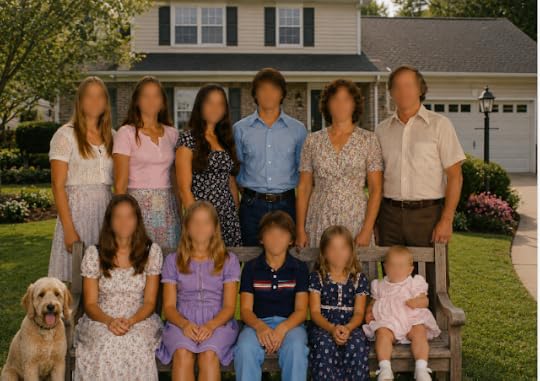
In the idyllic American town of Pleasant Hills, Pennsylvania, lived a family with nine siblings, the youngest a girl named Barb. As the older children headed off to college and started their lives, only Barb was home to see their beautiful, still-young mother fall under a gothic spell, changed into someone they don’t recognize: withdrawn, neglectful, uncaring.
Thus begins The Vanishing Family, journalist Robert Kolker’s stunning follow-up to Hidden Valley Road (“Deeply compassionate and chilling”, Washington Post). The family, we learn, has a gene mutation for dementia, but with a special cruel twist. As early as their forties, formerly loving parents and hard driving executives will lose their jobs, have affairs, take up drinking—shed all inhibitions and sense of responsibility, and become people their families hardly know. And there is a 50/50 chance that it will happen to their children, too.
Kolker follows the family over years as they realize that what happened to their mother is happening to first one, then two, three, four, and more begin to change. The Vanishing Family unfolds like a heartbreaking thriller, as the siblings struggle to cope with terrifying fates. Sue, the black sheep of the family, finds a calling in caring for the others. And Barb sets out to find a cure. She learns that their mutation for a rare form of FTD (frontotemporal dementia) might help scientists understand and cure all dementia, including the scourge of Alzheimer’s disease.
Moving, intimate, hopeful, redemptive— The Vanishing Family is a medical detective story about an unforgettable family that speaks to all of us who wonder how our own stories will end.
Imagine being the youngest in a family of nine children.
You watch your mother and several siblings fall victim to a mysterious type of dementia.
New research shows that there is a gene mutation passed down through families.
Do you want to know if you carry the gene? If so, how do you live your life going forward?
This is a thought-provoking and enlightening read, so I've been contemplating how to frame my review. I decided to use the title as an outline.
❤LOVE - What does it look like to love someone before, during, and after an FTD (frontotemporal dementia) diganosis? Kolker gives us a birds-eye view. We see the siblings grapple with whether or not to get tested, how to care for an affected family member, and how they relate to the next generation.
❓FATE - The youngest daughter Barb puts off getting tested and then ignores attempts from the Mayo Clinic to contact her about discussing her results. What we realize from reading this book is that we are all going to face trials in our lives. Our lives have meaning. We are all unique individuals with souls and intrinsic value. This book reminds us to be patient and empathetic as others struggle and to not lose hope when we are in the midst of trials.
🧬QUEST - Kolker includes some history on the research into neurological disease. The discovery of Pick's Disease, then Alzheimer's, and now FTD reveal a slow trajectory of progress. A family like this can be so valuable in studying how the gene is passed down (a 50-50 proposition) and how the disease reveals itself. Unlike some forms of dementia, FTD can become evident as early as the 40's, but does not drastically shorten the lifespan. That is what makes it so challenging to deal with, but does also provide time for research.
📚FAMILY TREE - The book begins with a family tree and then includes the names of the nine original children in the chapter headings. For a visual person like me this is a valuable way to orient my brain for the information coming. This is a wonderful example of narrative nonfiction. It reads like a novel much of the time while also including valuable scientific details to support the story.
🤗PERSONAL - I discovered an unexpected personal connection in the story. In 2012 my dad died within a few months of being diagnosed with progressive supranuclear palsy (PSP). As with FTD, PSP is caused by abnormal accumulations of the Tau protein in the brain. Research has not shown PSP to exist within families, but any research that helps contain or prevent FTD will most certainly help patients who have conditions like my dad.
Some may decide this book is not for them. I hope reading the book information combined with my review will be helpful in decided to read or not to read. Thank you to Doubleday Books and NetGalley for a DRC in exchange for an honest review. All opinions are my own. Available as of September 29, 2026.
I previously read journalist Robert Kolker's book Hidden Valley Road: Inside the Mind of an American Family, about the Galvin family of Colorado Springs, Colorado. Six sons (out of twelve children) were diagnosed with schizophrenia, and Kolker tells the Galvins' story, including the search for genetic markers for the disease, and the family's contribution to the study of mental illness.
The Galvin family
In 'The Vanishing Family', Kolker relates the story of another family that carries the gene for a hereditary illness, in this case frontotemporal dementia. It took decades for the clan to understand their plight, and Kolker relates their tale step by harrowing step.
For privacy, Kolker uses only first names.
Irish-Catholic couple Ollie and Jean were born in the late 1920s, married in 1950, and settled in a Missouri suburb called Webster Groves. Over the next 15 years, Jean became the stay-at-home mom of seven children, and Ollie worked at a series of engineering jobs, hoping to start his own business some day.
By 1967, financial difficulties and job opportunities led Ollie and Jean to settle in Pleasant Hills, Pennsylvania, and they eventually had a total of nine children: Kathy, Christy, Sue, Dutch, Mary, Peggy, Scott, Jenny, and Barb.
Kolker writes, "Jean was something of a wonder, filled with optimism and energy, reading, gardening, and playing bridge with Ollie and their friends. She shopped for the food on a strict budget, making the calculations and lists in her head, and cooked everything for the family. She made her own donuts and pizza from scratch, and served up enchiladas when they were still considered an exotic foreign dish."
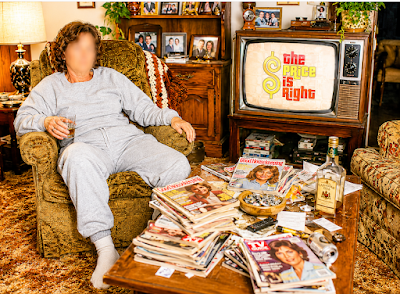
By her late forties, however, Jean became increasingly withdrawn and depressed. As time passed, Jean stopped dressing up every day like she used to to; quit going to the hair salon; neglected her hygiene; became silent; drank heavily; didn't pay bills; played solitaire and watched game shows all day; paid little attention to the children; said yes to every sales call, resulting in multiple subscriptions to the same magazines; and generally made poor decisions.
The changes were obvious to Ollie, the children, and the neighbors, who usually attributed Jean's behavior to Ollie's flagrant cheating.
Jean continued to decline for two decades, until she neglected her breast cancer for so long she couldn't be successfully treated. Jean died in 1990.
As it turns out, Jean was the first victim (in the immediate family) of frontotemporal dementia. This wasn't diagnosed until the late 1990s, however, after Ollie and Jean's daughter Christy developed symptoms similar to those of her mother. Christy was a successful marketing executive, wife, and mother before she fell ill, but her life fell apart afterwards.
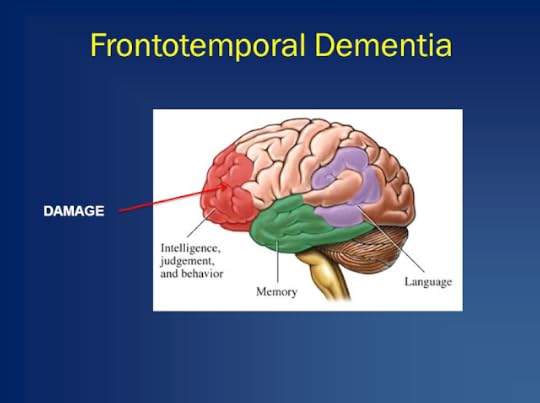
Frontotemporal dementia (FTD) is an illness in which the brain's frontal and temporal lobes gradually degenerate, causing people to lose their personality, judgment, language, and self-control. Symptoms usually begin in a victim's forties, and unlike 'old-age' dementia, patients don't lose their memories.
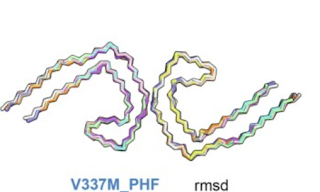
Over time, five of Ollie and Jean's nine children developed FTD. Some family members submitted blood/saliva samples for genetic testing, and researchers found their FTD resulted from an autosomal dominant gene called V337M, which causes tau mutations (tangles) in brain proteins. An autosomal dominant gene means there's a 50:50 chance a victim will pass the gene to their children.
Tau mutations caused by V337M
In Ollie and Jean's clan, Jean had the genetic defect, which she passed to five of her children, who then passed it to some of their offspring. The exact number of victims isn't known, since some family members haven't been tested (by their own choice).
Kolker provides mini-biographies of all nine siblings, most of whom went on to college; got married and had children; and had successful careers. The victims who developed FTD couldn't work (or lost their jobs) after they fell ill, and were unable to take care of themselves. Sibling Sue, who remained healthy, stepped up and took care of some family members, especially Christy.
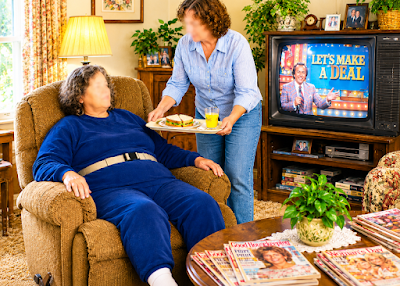
Kolker describes a typical day for Sue and Christy in their later years. 'Sue helps Christy with everything, coaxing her to the toilet and then the shower. Laundry is a constant. Christy wears adult diapers, but has accidents that call for a change of clothes, about five or six changes a day. Christy's favorite spot in the house is an easy chair in the TV area. The chair has a big leather belt, to keep Christy from roaming when Sue isn't watching. Because of Christy's compulsive overeating, Sue has to padlock the refrigerator, lock the pantry, and make all the meals. Sue is on constant alert, whether she and Christy are inside the house, outside taking a walk, or doing other things.
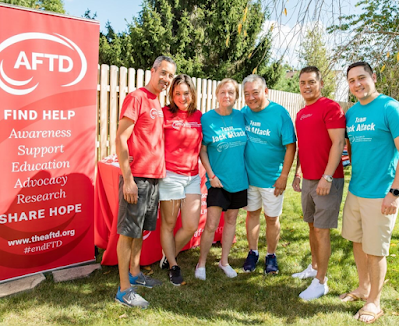
There's no cure for FTD, and until recently, minimal research about the condition. Kolker describes the formation of 'The Association for Frontotemporal Degeneration' (AFTD), whose members - including youngest sibling Barb - lobby politicians, scientists, pharmaceutical companies, etc. to support studies of FTD, with the aim of finding a treatment or cure.
In addition to telling the story of Ollie and Jean's family, Kolker writes about doctors and scientists who added to our knowledge of the brain, and provided information about the causes of psychiatric syndromes and dementia.
Examples include:
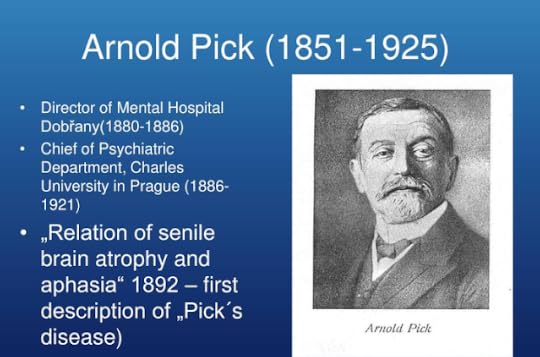
➽ Dr. Arnold Pick - In the early 20th century, Pick was the director of the psychiatric hospital at the University of Prague in Czechoslovakia. During autopsies of patients with language and/or behavior problems, Pick observed atrophy of the brain's frontal and temporal lobes. For many years, this was called Pick's disease. It's now known to be a type of FTD (but not the kind in Ollie and Jean's family).
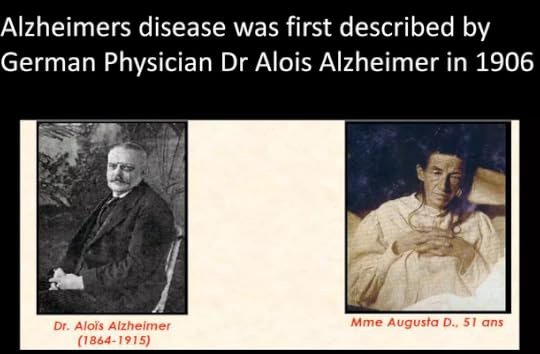
➽ Dr. Alois Alzheimer - Also in the early 20th century, Alzheimer was a German psychiatrist and brain researcher. Alzheimer had the opportunity to study the brain of Auguste D., a woman who lost her memory, forgot her way around her apartment, thought someone was trying to kill her, and descended into total delirium. When Auguste D. died, Alzheimer found 'plaques and tangles' in her brain, and this type of dementia was named Alzheimer's disease.
➽ Sir John Hardy - Hardy is a British neurogeneticist, currently at the National Institutes of Health. Hardy identified a mutation associated with Alzheimer's disease.
Sir John Hardy
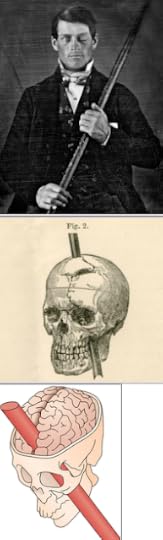
Kolker also provides anecdotes about unusual neurological cases. One of the most famous is Phineas Gage. In 1848, at the age of 25, Gage was a dependable construction foreman working on a job site. After an explosion, a long iron rod sliced through Gage's brain, and he became impulsive, profane, unreliable, and unable to plan ahead. The brain injury changed Gage's personality, and showed that specific parts of the brain control behavior.
Phineas Gage
The book is informative, interesting, and draws attention to an illness that might be treatable with a DNA tweak. Highly recommended.
Thanks to Netgalley, Robert Kolker, and Doubleday for an ARC of the book.
This book starts out super strong, it is a fascinating story and it reads a bit like a mystery, however as the book gets going and the pieces fall into place it is more just an accounting of how the family deals with their diagnosis. And we see the realities for each sibling which can feel a touch repetitive and like it could've ended early. I liked the dips back into medical history a lot. I have read all of this author's books and I liked this the best.
I am not going to lie to you. The Vanishing Family by Robert Kolker is going to crush your soul. It's about a specific type of dementia which destroys an entire family. You're going to cry. Your heart will break. However, there is hope. More importantly, there are people who stare this tragedy in the face and somehow persevere. Yes, this is sad, but I didn't finish this book feeling defeated.
The book follows a particular family which has a specific type of dementia which is early onset and genetically passed down. In pure numbers, if one of your parents has it, you have a 50/50 chance of getting it. If you have it, sometime around your 40s you will slowly stop being yourself. You will act out and say inappropriate things. You will be unable to empathize with people around you and yet you will still be able to drive, read, and live a relatively normal life for a time. Kolker tells the story mainly through the lives of the nine (!!!) children in one family, although the next generation is documented later in the book. Kolker is an excellent writer, but there is a specific trick he uses which is ingenious when dealing with so many characters. Every chapter about a family member has a list of the children in birth order with the focus of the chapter highlighted. Don't remember which one Barb is? Well, the first page will show she is the youngest and let you know she is the focus. There is another detail I won't spoil, but...well, it becomes obvious very quickly.
Kolker also intersperses chapters dealing with the science behind dementia and what medicine is doing to try and cure it. I am not a science nerd, but these chapters are wonderfully to the point and explained so well that even I understood them.
However, Kolker never loses sight of the fact that the family is the story. I found myself profoundly taken with each of the characters, hoping beyond hope that the 50/50 chance of them getting dementia was wildly exaggerated. It's not. In fact, one could say it was too optimistic. I know there is a horror genre in books and TV, but nothing I have ever read or seen compares to the dread of starting each chapter only to read the telltale signs that another family member is showing symptoms.
All that said, there is reason for hope. Science is making inroads. Medications and gene therapy offer a possible cure. However, the real hope in this book is how the family comes together when everything is falling apart. Obviously, I think this is a must-read. Just make sure to keep the tissues handy.
(This book was provided as a review copy by Doubleday Books.)
Very excited to read Kolker's latest, which takes on dementia where his last book (Hidden Valley Road: Inside the Mind of an American Family) featured a family afflicted by schizophrenia. Perhaps if I review this one on my channel, I can be spared a repeat of last time and NOT get verbally accosted by one of the subjects of the book in my comments section.
The stories I have after over a decade on YouTube, I swear. 😶
Click here to hear more about this book and my other anticipated releases of the upcoming quarter over on my Booktube channel, abookolive!
LWe follow a family with nine children as the mom’s symptoms of a specific type of dementia, FTD, takes over. She becomes someone entirely different. People with this gene mutation begin making decisions that are in no way aligned with who they are, from affairs to not showering. They lose all sense of responsibility or inhibition as early as 40 years old. A cruel twist to an already devastating diagnosis. This gene mutation is hereditary and there is a 50/50 chance that children of someone with FTD will also get. This family has nine children, and one by one, more start to show symptoms. We follow both the family and the progression of the science. These two things converge as science begins to offer testing for the mutation. The nine children and THEIR children have a choice to make…should I get tested? If I know that in a decade or so, I will no longer be myself, how will that affect the decade before it happens? Will I live better or will be drowning in sorrow in a way that ruins this last good decade too?
It’s a lot. I held my breathe while reading. And yes there’s a bit of “mystery” here, but that’s not what took me most be surprise. I did expect to be so utterly moved by the way these siblings cared for each other. Nor did I expect to be moved by the language, but I was. Kolker took great care in both his research and the way he told this story. It doesn’t seem like he was able to take his heart out of this, and I’m glad for that. I recommend checking this out when it publishes September 29th. Thank you @doubleday for this reminder that your life is the time that you have, a statement true for all of us, but never in the same way
“Would we even know if our thoughts start to betray us? And once they do, are we still us?”
According to WHO and other global organisations there were around 57 million people living with dementia in 2021, and each year another 10 million people are diagnosed. Though Alzheimer’s accounts for around 60-80% of cases, there are over 100 different forms and causes of dementia.
In the The Vanishing Family, Robert Kolker focuses on one American family devastated by a rare genetic variety of frontotemporal dementia that emerges as early as one’s forties and relentlessly attacks the part of the brain responsible for planning, organizing, expressing language, understanding social cues, and exercising judgment. Its progression is inevitable, eventually rendering the person almost unrecognisable from who they were, and there is no treatment or cure.
When Jean, wife to Ollie and the mother of nine children- Kathy, Christy, Sue, Dutch, Mary, Peggy, Scott, Jenny, and Barb- became uncharacteristically withdrawn and neglectful of both herself and her children beginning in her late forties, her behaviour was attributed to depression as a result of her husband’s infidelity and desertion. It wasn’t until almost twenty years later, after first Christy, at age 45, and then Mary, at age 42, began displaying similar symptoms to their mother, that a medical investigation prompted by an estranged maternal relative and championed by Barb, led to a diagnosis of genetic frontotemporal dementia, or FTD, as a result of a V337M mutation.
Eventually, five of Jean and Ollie’s nine children are diagnosed with the inherited the mutant gene, and as each affected person has a 50% chance of passing the disease on, so have a number of their children. Focusing sequentially on each sibling, Kolker provides comprehensive insight in to the challenges faced by the family as they reckon with the diagnosis. My heart ached for all of the very difficult situations they were faced with from wrestling with the decision to be tested, to managing the care of those afflicted.
In alternate chapters, Kolker shares the history of scientific investigation into the many variations of dementia and the search for a definitive cause in the hope of finding treatment, if not a cure. Written in an accessible manner, I found the information fascinating and enlightening, especially with regard to recent breakthroughs in research which are a source of optimism for the future.
Like millions of others, I have experienced the heartbreak of dementia (age-related Alzheimer’s) affecting a family member and the cruel way it robs them of the person they used to be so I was somewhat hesitant to read The Vanishing Family, but I found this family’s story so compelling that I barely thought of my own.
The Vanishing Family is a thought-provoking, absorbing and moving examination of dementia and the impact it has on an entire family, not just the person diagnosed. Highly readable, highly recommended.
Riveting table of family and science. I came in with sky-high expectations after Kolker's last book, and those expectations were more than met. The last book focused on schizophrenia that tore through a family, its genesis and impacts. In The Vanishing Family, we meet a family decimated by frontal lobe dementia, a form of dementia that strikes most people in their 40s. It turns productive directed people into shells, leading to dependencies and disappearances, and the most painful of legacies. The next generation is left with the impacts of emotionally and/or physically absent parents as well as a 50-50 chance they will also be victims of the illness. Kolker tells us about the science and the extraordinary people trying to isolate the illness and find a cure, and the family. What an accomplishment.
I was drawn to this book because my grandfather had the disease that shatters its titular family: frontotemporal dementia, also known as FTD. This disorder is sneaky, and as is deftly explained in the text, has long been misunderstood and understudied. It is not a form of Alzheimer's—which has a much buzzier reputation in the neuroscience community—it's a form of dementia, the true umbrella term for these degenerative diseases. And unfortunately, not being Alzheimer's is more of a curse than a blessing.
FTD typically begins development between one's mid-forties and early-sixties, but it's hard to recognize immediately. Unlike Alzheimer's, FTD has little to do with memory. Instead, it has nearly everything to do with "personality." As the name may reveal, FTD only affects two parts of the brain: the frontal and temporal lobes, responsible for behavior, inhibition, emotional regulation, etc. (and language comprehension/speech, but that's not covered as much in this book). So one's descent into the disease may disguise itself as many other things: anxiety, depression, alcoholism, or simply having an off week. It isn't until a years-long pattern emerges (or a truly concerning infraction has been committed) that people realize the true cause of this behavioral shifting. And unlike Alzheimer's, FTD has no effect on life expectancy. This drops an unbearable burden onto the patient's family—decades of nonstop caregiving.
The Vanishing Family chronicles the lives of nine siblings as they realize why their mother retreated into herself as she aged and that they each have a 50% chance of inheriting the same fate. This is due to the V337M mutation of the MAPT gene and is far from any sort of cure.
Admittedly, I am not sure whether my grandfather's FTD was genetic or random, but given that we have no further family history of the symptoms and that my mother is 62 with none either, I'd like to be optimistic. And while I can live in this optimistic land of uncertainty, the same cannot be said of the members of the "vanishing family."
I had the immense honor of attending the launch event for this book while, at that point, I had only read a third of it. This led to a confounding experience. As the event began, Kolker disclosed that some of the family members were in the audience. Jenny (one of the core siblings), Annika (her daughter), and Julian (Annika's husband), were seated directly in front of me. That's amazing, I thought. They're so strong to dedicate their lives to this cause that has taken so much from them and the people they love.
As Kolker spoke, I noticed Jenny furiously nodding. A bit more than most people would, but she might've just been a very active listener. Then, she began to repeat what had just been said to a stranger next to her. This happened several times. I saw her try to get up and leave, and that's when I knew. Because the urge to flee—that was my grandfather.
I realized in real life that Jenny had FTD. I had just been reading about this steadfast woman, and suddenly I saw her future in the present. I hadn't gotten to the verdict on her genetic coin flip in the book yet. A unique experience. Sobering.
Later in the evening, I spoke with Annika and her husband about their thoughts on the book and hopes for FTD research. Again, I was in awe of their dedication and strength, especially having just realized Annika's mother has the disease.
I finished the book by the end of the week. And while I thought I was braced for what was to come, I was sorely mistaken.
That woman I spoke to, who was so strong despite what her family has gone through, who shone bright and alive and brilliant, who is only a few years older than me—she's been tested. And she's positive.
She can't bask in the optimism of not knowing, because she does. She sees her fate every day in her mother.
Once I read this, a wave rolled over me. Of sympathy, of sorrow, of fear. It's a weird thing, I imagine, for your medical future to be public. And a weirder thing that she probably assumed I knew it, yet I didn't.
The author of Hidden Valley Road is trusted once again to share a struggling family's story. In this case, a family with nine children sees their once-polished mother descend into apathy and a changed personality, starting in her late 40s. But after her death, some of the older, now adult, children start to show similar patterns of early-onset dementia, but this dementia keeps them from recognizing the symptoms, and they act out, destroying their relationships with their partners and children. Three of the daughters, and possibly one of the sons, avoid the horrible fate, but the other five struggle. Two of the sisters (it's always the females that become the primary caregivers!) do their best to care for their siblings and lobby to get scientists and doctors to study and hopefully cure this insidious disease that has passed down to some of the next generation. Robert Kolker wrote a strong nonfiction book that humanizes the family members, highlights how medical catastrophes can destroy families, and underscores the need for more medical research and resources for those who need them.
This non fiction book is about a family where early dementia runs through the family due to a genetic mutation. This is a heartbreaking look at this family as they rearrange their lives to help each other and to try to bring attention to FTD (frontotemporal dementia). Highly recommend this one!
Imagine this: when your Mom enters her forties the loving, caring Mother you’ve known your whole life turns into a different person. A complete personality change. She becomes neglectful, doesn’t want to take showers, takes up drinking and has affairs. Heartbreaking. BUT then, when you are in your mid-forties, the same thing starts happening to you. You all but abandon your children, you lose your job, people say you’re completely different but you don’t think you’re acting differently at all. WHAT IS HAPPENING.
This is exactly what happened to the family at the center of this book. Robert Kolker shares their truly heartbreaking narrative and journey with such care while also interspersing chapters with the medical history/science of dementia, Alzheimer’s disease and the like.
I could not put this book down. I love people’s stories and I am a NERD for medical history, anatomy and physiology and the science of the body.
My heart truly, truly aches for this family as they are still walking this journey, raising money for research and searching for answers to this day. I’m so glad to have learned about FTD (frontotemporal dementia) and I highly recommend this book!
Thank you to Doubleday and Netgalley for the ARC of this book. I read it in a day. Kolker writes non fiction in such a compelling way. I really empathized with Barb, the sister that is heavily discussed in the book. I appreciated learning about a rare form of dementia caused by a genetic mutation, known as FTD. I never knew about that before and the science behind it was fascinating, but at times, the alternating chapters of the family in the story and the discussion of dementia, the history of dementia research, and the scientific progress that has been made (or not made) in the field got a bit dry for me. I kept wanting to speed through to the parts about the family. Kolker mentions Oliver Sacks at one point and I thought about all of his books, as he was a favorite of mine. Because Sacks was an actual scientist, I think he could get away with describing the more technical aspects of his cases. Though he tried to make it engaging, I think Kolker's strengths are really in telling the story of the family afflicted with the FTD gene mutation. I simply could not put the book down. I love Kolker's work and I will read anything he writes. I appreciated having access to this book early. It will be a purchase for our library for sure.
Kolker uses the same successful template he used in Hidden Valley Road - presenting a large family where a mutated gene affects every aspect of family life. In that book a highly penetrant mutation leads to schizophrenia/major affective disorder; in The Vanishing Family it's an autosomal dominant mutation causing frontotemporal dementia (FTD). Kolker covers biology and research challenges - and makes it all very real by examining the biologic/social effects on a generation where every member has a 50% chance of inheriting the allele with the mutation.
Here the proband is the mother, whose FTD was not recognized before she died, and her behavior incorrectly ascribed to alcohol and depression. When some of her children start behaving as if they had personality transplants in their 40s, the family eventually finds out the real cause. The majority of the 9 children test positive for the FTD gene, and face a bleak future. And the children of those affected - also with 50/50 chance.
Kolker superbly represents the sorrow and challenges of this particularly close, lovely and talented family. The big take home is how this family deals with their tragedy - they are heroes.
You will learn a lot about FTD, how science is done, and how clinical trials are limited by money and risks. I have a medical background, so it seemed not only clear, but true to the real world of medical science.
Wow wow wow. The last chapter had my heart in a knot and the last sentence so brilliantly captured what we all want more of—time. I was so immersed in this family’s story & thanks to Kolker’s approachable writing style, became just as invested in the science too (which is incredible and offers so much hope). What this family is navigating is unfair and cruel and hurts to read at times. They’ve faced what no family should have to face with so much grace, and there’s a quiet comfort in the love they show each other even when it’s not easy. This book really makes me want to complain less and savor time with the people I love more. So much of the future is uncertain & in the meantime, time is everything
This is the heartbreaking true story of a Pennsylvania family with 9 children and a beautiful caring mom, who gradually becomes someone none of them knows or understands. She is irresponsible with no inhibitions. They are mostly left to care for themselves while their dad lives with his new love interest. As the siblings age, some show signs of what made their mom unrecognizable as early as 40 years of age. As science progresses, their family members become the focus of studies that show that their condition is due to a gene mutation passed through generations. The diagnosis is FTD, a frontal lobe mutation, vaguely linked to Alzheimer's. The grim reality if that there is a 50/50 chance that the siblings and/or their children will be affected. The siblings do their best to care for one another as they wait and watch to see whom will be diagnosed. Sue, formerly the "black sheep," provides care taking of the siblings who once held positions of authority, while Barb, the youngest, does everything possible to delve deeply into the science and prognosis of this deadly diagnosis.
As he did in Hidden Valley Road, Kolker explores this family and the disease with unerring compassion and a thorough examination of the medical findings in this unforgettable book
The Vanishing Family by Robert Kolker is a very highly recommended intimate family drama as it presents an account of a family's experiences with a hereditary illness alternating with a medical detective/research story. This represents exceptional nonfiction.
Journalist Robert Kolker follows a family with nine siblings in Pleasant Hills, Pennsylvania. When their mother, Jean, began to change into a different person while in her forties, the youngest child, Barb, was the only one still at home to witness the change in her mother as she began drinking, her personality changed, and she became withdrawn, neglectful, and uncaring. This begins the realization that something is wrong. Then some of their siblings begin to fall into the same pattern while still young, in their middle age, while another sibling, Sue, devotes her life to caring for the inflicted. The support among family members is admirable.
This is a very intimate and heartbreaking story following a real family as they learn there is a fifty percent chance they will also succumb to the genetic disorder. Koler follows the journey of the family while five of the nine siblings are eventually diagnosed, as well as, later, some of their children. Alongside the very personal story, Kolker also follows the scientific research into dementia. There is a family tree at the opening of the novel (no last names and some first names are changed) to help you follow their story. Additionally, Notes and a Bibliography are included at the end of the text.
It is determined that the family has a rare inherited form of FTD, frontotemporal dementia, a devastating neurodegenerative disorder that "attacks the part of the brain responsible for planning, organizing, expressing language, understanding social cues, and exercising judgment.” The genetic mutation, V337M, has a fifty percent chance of being passed on to progeny. Those inflicted gradually have their personality, judgment, and language erode. It is thought that this family’s flawed genetic code and rare form of FTD might lead to a breakthrough in the prevention and treatment of all dementia, including Alzheimer’s disease. There is a discussion how gene-editing (CRISPR) and IVF genetic screening that may offer hope, but this also brings up ethical questions.
One of the big questions family members face as others succumb to FTD, is "Do I get tested? Do I want to know?" This is an age of genetic prognostication, of noting and discovering future biomarkers of illness, but do you want to know? FTD is emotionally devastating for those around you, as you become someone they don't know. For many people, as you are giving your family's medical history, you are listing off a series of symptoms and illnesses without much thought, but with some diseases, like dementia, it is different, as it is for anything with serious repercussions that can be passed on genetically to your children. Kolker handles both the deeply emotional and personal account and the scientific research background equally well.
The Vanishing Family is an excellent choice for everyone who appreciates a well written and considered account of a family and a devastating genetic disorder. as well as those who read Kolker's book Hidden Valley Road. Thanks to Knopf Doubleday for providing me with an advance reader's copy via NetGalley. My review is voluntary and expresses my honest opinion.
I've read every work by journalist Robert Kolker, and The Vanishing Family, like his other books- Hidden Valley Road, and the Lost Girls-is thoroughly researched, compellingly written, and focuses on the depth and breath of family. In this book, four of the nine siblings, their mother, and many of their children test positive for the rare genetic form of frontotemporal dementia. Kolker's work is information dense yet reads like a heartbreaking and redemptive family drama. Like his other books, this one will stay with me a while.
I thought this was a book of a family with Huntington's disease, but turns out it wasn't. It is however, a family who finds out that their mother's early on-set dementia is more than a fluke or bad luck, it's hereditary. By the time this is confirmed, many of them have already married and have children. They all face an agonizing choice of finding out for sure or not. They also see how their loved ones fade away, becoming shadows of themselves and undergoing complete personality changes. In between the chapters of the family and their trajectories, we get historical insight into neuroscience, brain physiology and dementia studies. FTD, frontotemporal dementia, is worse than many of the other kinds because the personality changes come before other loss of function.
The book almost reads like a thriller and is deeply moving and fascinating in all its real-life horror. Definitely recommended!
really great book! im not a non-fiction girl usually but i thought this book was really great and moving and fascinating. i found myself constantly thinking about it and going back to it and being sad it was over!
Thank you @netgalley and @doubledaybooks for this advance copy.
Robert Kolker, author of Oprah Book Club pick Hidden Valley Road, is back with the heart wrenching story of a family with nine children who discover they have a 50% chance of carrying a genetic mutation that causes FTD, a progressively debilitating dementia with onset in the mid forties to sixties.
Kolker presents well researched information about the history and science of FTD, but the story shines in his narrative of the siblings as they grow up and navigate their lives with an ever changing reality. There is so much to unpack and endless discussion topics, but I hesitate to bring them up here so you can experience it all for yourself as the reader. Don’t miss this one if you are a fan of narrative nonfiction.
I think this book honestly wrecked me in a really quiet, lingering way.
As someone who has had multiple family members go through dementia and Alzheimer’s, this didn’t feel like just a book I was reading, but it felt way too familiar. Almost uncomfortably so. The way Kolker describes the slow loss of self, the personality changes, the confusion… I’ve seen that up close. And reading it laid out like this brought all of that back in a way I wasn’t fully prepared for.
What really got me was the love in this family. It’s devastating, but it’s also what drives everything. They’re not just dealing with illness; they’re actively searching for answers, for a cure, for anything that could stop what they’re watching happen over and over again. That kind of devotion, that refusal to just accept it, is honestly what makes the book so hard and so meaningful at the same time.
And then there’s that horrifying realization that what happened to their mother starts showing up in the siblings too. That part is genuinely terrifying. Because I don’t have to imagine that fear... I already carry it. That constant wondering in the back of your mind, like is this going to be me someday? Is there anything I can do? Or is it just waiting?
That’s what makes this book so heavy. It’s not distant or clinical but it feels immediate. Like I am watching something unfold in real time that I already know too well.
But even with how devastating it is, there’s something really important underneath all of it. The science, the research, the decades of trying to understand this disease are what REALLY matters. And this family’s story shows exactly why it matters so much. If there’s even a chance that studying something like this can lead to answers for dementia or Alzheimer’s in general, then it has to be pursued. There’s a fragile kind of hope in that, even when everything else feels really bleak.
This book is heartbreaking, but it also feels necessary. It is definitely going to stay with me. And for anyone who has lived even a small version of this kind of loss, it hits even deeper than you expect it to.
Thank you to NetGalley, Robert Kolker, and Doubleday for the eARC of this book.
I really enjoyed Hidden Valley Road and was looking forward to reading this one, since in a previous life I worked in regulatory health policy at a pharmaceutical company and was part of an Alzheimer's disease drug development program. While all dementia is not the same, of course, it did spark a life-long interest in the way the brain can deteriorate and I was curious to see Kolker's attentions turned to this topic.
While I found the concept interesting, I must confess that I felt like I was reading HVR again albeit with a different familial disease focus this time around. That's not a bad thing necessarily - I can appreciate that large families with genetic disease will likely have at least some similarities in the way those diseases affect family dynamics - but it did feel repetitive and like I had read aspects of the story before. The interplay between parents and siblings and the dysfunction that arose from that just didn't hold my attention the same way this time.
Oddly enough, neither did the science - which really surprised me. While I didn't have the same "been there before" feeling in this aspect of the book, it just didn't grab my attention the way the schizophrenia research did in the earlier book. I'm not sure why that is...
I felt like I might have just encountered the two books too closely together in time, so double-checked when I finished HVR. Turns out that was six years ago, so perhaps this isn't about proximity in time and is about the way the stories tied together in my mind. Regardless, I enjoyed this one well enough but didn't find it as compelling as the earlier read.
Thanks to NetGalley and the publisher for my obligation-free review copy.
I really didn't know what to expect from this book. I was intrigued because I had read the authors other work, Hidden Valley Road. This book follows the exact same formula. Taking the family members and following them through whether or not they developed the FTD. At times it was heart breaking, times it was scary...waiting for the results of the tests.
However, the story isnt over. The next generation is learning about their genes. Maybe there will be new gene therapy or some kind of advancement in medicine.
This book was not the emotional roller coaster ride that Hidden Valley road was. I didn't feel as connected to this family as I had the previous book.
The author seemed to focus only on Barb and the other siblings were second squad.
Overall, a good read of the FTD and a family's reckoning with it.
Thank you to Netgalley and the publisher for the ARC in exchange for this honest review.
Having read and enjoyed the author’s previous novel, Hidden Valley Road, this is a book I anticipated. And it was as interesting as I thought it would be.
This book details a family of nine children grappling with a frightening inherited genetic mutation that causes early-onset frontotemporal dementia, known as FTD. Out of respect for the family's privacy, their real names are not given.
Based in Pennsylvania, the youngest of the nine children, Barb, describes watching her mother undergo drastic personality changes in her 40s. Becoming withdrawn, neglectful and uninhibited. As the nine siblings grow older, they begin to discover that their mother's condition is hereditary, carrying a 50/50 chance of passing on this condition.
Many similar stories are told of other family members who are later diagnosed. It was fascinating to learn about how genetics played a huge role in the family, their relationships and dynamics, and its effect on their lives and futures. I would recommend this book. It was very informative.
Extremely heartbreaking. This is a fascinating and horrible story of one family’s journey discovering that there is a 50/50 chance they will have FTD, a type of early-onset dementia. This book was well written and easy to follow as well as thought-provoking. If you had genetic testing available to find out if you have the gene for FTD, would you get tested or wait to find out? I personally don’t know what I would do in their situation. It was interesting to hear how the different family members handled their situation; for example, would you want to have children given the 50% chance that they could have the gene? I highly recommend the audiobook.
There is something especially cruel about frontotemporal dementia. It does not simply threaten to take your memories. It can take the very things that make you you. The patience. The kindness. The ambition. The restraint. The little habits that the people who love you have spent years learning by heart. A mother can still be standing in the kitchen still wearing the face her children have known all their lives, and yet somehow be disappearing right in front of them.
And then there is the knowledge that this is not a tragedy happening to one person. It is a possibility waiting in the wings for an entire family. A genetic coin toss. Heads you keep yourself. Tails you watch the person you have always been slip away, with a fifty-fifty chance that your children will someday face the same terrible bargain. This is the book you are about to read. You have been warned.
How do you live with that? How do you fall in love, raise children, make plans, or grow old when the future feels less like a promise and more like a threat? Kolker takes this question and places it in the hands of a family who have no choice but to keep living anyway.
I became so deeply attached to these siblings. I wanted to protect them from a future they could see approaching but could not outrun. I wanted the odds to be wrong. I wanted love to be enough to keep them safe. I wanted to scream at them. I wanted the people they had always been to remain where they were tucked safely inside themselves. I wanted them to all grow up and become the people they had thought they would be. But this is nonfiction and reality has never been particularly interested in giving us the endings we beg for.
There are chapters on science, history and philosophy. They are clear, accessible, and fascinating. More importantly, they never feel like interruptions to the family's story. They add so much.
Some quotes I just felt so deeply. “Your life is the time you have left.” “Identity exists in time.”
And one of the smallest, most heartbreaking declaration of all. “I am me.” Three words. A claim. A plea. A person insisting on their own existence.
I kept thinking about how desperately we want to be recognized. Not just seen but known. We want the people we love to look at us and understand who we are without our having to explain it. We want our history to matter. We want to believe that somewhere beneath all the changes life makes to us, there is a self that remains.
But perhaps being ourselves has never been something we do entirely alone. We are interdependent. Perhaps some part of our identity lives in the people who remember us. In the stories they tell. In the way they keep loving us when we can no longer make that love easy. In the person they continue to see, even when we have become difficult to recognize.
Maybe that is one of the quiet miracles of love. It remembers. I was a puddle of tears throughout this book. Bring tissues. You will need it. You will grieve for this family. You will hope so badly. You will feel your fists tighten. And you will breathe.
This story left me with this. There are people in this world who know exactly who you are, who would recognize you in a thousand different lifetimes, and who may one day have to learn how to love you when you can no longer find your way back to them. And perhaps the most hopeful thing is that they will try.
This entire review has been hidden because of spoilers.
Great. Googly. Moogly. How does one even BEGIN to review this amazing but heartbreaking book? I am going to give it my best shot, but my feelings are all over the page [even several days after finishing it] and I can only hope I do it the justice it deserves. I must say at the beginning of this review that I highly recommend this book - it will completely change you.
I have an invested interest in a book about dementia. My maternal great-aunt had dementia [possibly with Lewy-Body], my maternal grandmother had Alzheimers, and now, my beloved mother has Alzheimers [we are about 10 years in, as it took awhile to get it formally diagnosed, and it is just starting to become very difficult, but not impossible to deal with]. While ALL of these were/are very difficult things to deal with, after reading this book, I am so very grateful that we have not had to deal with Frontotemporal Dementia [FTD] and all that comes with that diagnosis. The amount of tears I shed for this family [and even now my heart just breaks for them - I'll never for get them or their ongoing fight as the second and third generations are now also dealing with the possibility of having that gene] whilst reading this felt like it might have helped a drought somewhere.
Imagine being the ninth child in a family of 9 and seeing first your mother and then some of your siblings lives fall apart in a very public and damaging way, not knowing initially what it was, all while wondering if you will be next - such is the case of Barb [the youngest of this family that the author has been shadowing for years], and she features prominently in the book and by the end, I just wanted to both cry with her AND give her big hug. She [along with Sue, who is a major caretaker] has had to deal with things that we all should thank whomever we believe in that we do not have to ever encounter and I admire just how she [and the others that do not have the gene mutation] deals with it all. I know how difficult my life if and I CANNOT even imagine just how much more difficult all of their lives are.
Brilliantly written and exhaustively researched, this is the 2026 MUST-READ book. While a tough book, what is learned between its pages is truly a must for everyone to read/learn about; for those who are already fully in it [a diagnosis], for those concerned that they may have to deal with it, and those who are wondering just how they can support the people and/or families that are dealing with this insidious disease, in ALL its iterations.
Thank you to NetGalley, Robert Kolker, and Doubleday Books/Doubleday for providing this ARC in exchange for an honest review.
This entire review has been hidden because of spoilers.