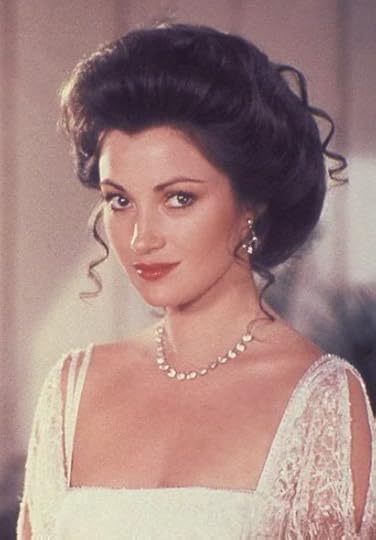
She was an honored guest in a palatial country home. "Aunt Mabel", the lovelorn columnist of Home Chats magazine, had been summoned to prevent the Duchess of Dartware’s son, Paul, from a marriage that others believed a fate worse than death. Who would have guessed that behind Aunt Mabel’s acid pen and ageless wisdom lurked the real eighteen-year-old Sally Blane… determined to make the handsome marquess her own! But how could she compete, wearing false wrinkles and a white wig? It was a challenge worthy of Sally herself: to conquer the upper-class of Dartware and bewitch her newfound Prince Charming without giving away the real secret of who Aunt Mabel really was….
Marion Gibbons (née Chesney) was a Scottish writer of romance and mystery novels. Marion wrote her historical romances under her maiden name, Marion Chesney, as well as several pseudonyms ( Helen Crampton, Ann Fairfax, Jennie Tremaine, and Charlotte Ward). Using the pseudonym M.C. Beaton she also wrote many popular mystery novels, most notably the Agatha Raisin and Hamish Macbeth mystery series. Both of these book series have been adapted for TV. Because of her great success with mystery novels her publishers both in the U.S. and abroad began using the M.C. Beaton pseudonym for all of her novels.
Sally, the plucky heroine in this novel, hasn't just been having one of those days; she's been having one of those years. Sally's just 18 yrs old and has been forced to live with her lazy, unintelligent and indifferent older sister Emily after their parents died in India. Emily is married to a bossy, money grubbing man and has 5 wayward and rude children. Sally is forced to be the unpaid and unappreciated babysitter, nanny, slave etc to these kids while Emily sits on her butt all day long pretending she's some grand lady of the manor. I've developed a great liking for Marion Chesney's ( aka Jennie Tremaine ) quaint and silly style of storytelling and this little tale didn't disappoint. The author's strength lies in her ability to craft a range of funny, annoying, engaging and diverse ensemble characters. The heroine in this Edwardian romance novel is an independent minded young miss who is determined to escape from the drudgery of life at her sister's home and she gets the right opportunity when she sees a notice in the newspaper. The young naive heroine thinks that she can run off to London and get a job writing for a newspaper or a magazine:
I could work, she thought suddenly. I could earn my own money. I could be free. Sally thought feverishly. She knew she could write, for in Bombay, hadn’t she been chosen out of all the girls to edit the school magazine? She could see it now: the Annual Magazine of the Misses Lelongs’ Seminary for the Daughters of Officers and Gentlemen—Editor, Miss Sally Blane.
Sally's a dreamer who doesn't actually use much common sense but she has a lot of street smarts for a sheltered girl of her age. Her first problem is her brother in law George. He wants to keep Sally in the house as an unpaid servant and he intends to use her inheritance ( 200 pounds ) to pay for his son's fees at a posh private school. When Sally goes to see George about getting her money he is belligerent and distant:
The cunning heroine outsmarts him and gets his signature on the bank withdrawal form, takes her money and hightails it out of that little town, on the first train for London ! When Sally arrives in London, she is immediately disillusioned when she's laughed out the building by every newspaper editor on Fleet Street. She is able to get lucky at a ramshackle hole in the corner little magazine where the advice colulmnist, Miss Mabel, falls dead from a heart attack at the same time when Sally was there begging for a job. Mr. Barton, the lazy editor, lets Sally answer the current crop of letters in order to meet the printing deadline. It all works out well for Sally because her ancient late predecessor had given rather puritanical and uncaring advice to her writers, so Sally's warm and humorous responses lead to a spike in magazine sales. Mr. Barton hires Sally to write the Dear Miss Mabel column on a permanent basis with the proviso that she never reveals to anyone that she's the little old lady. Sally also gets a salary increase that allows her to move into a decent apartment with a middle aged co worker called Miss Fleming and an elderly lady Miss Frimp. Life was suddenly wonderful and Sally was having a fabulous time, enjoying her new job and the company of her new friends:
But, all of this came to a halt when Sally received a letter from the Duchess of Dartware. That lady was seeking advice because she was worried that her son was going to propose to an unsuitable woman. Sally didn't worry too much until another letter arrived with a demand for Miss Mabel to attend one of her house parties. The heroine replied that she would be unable to accept the invitation but the haughty duchess wasn't taking that rejection lightly:
Mr. Barton sent the letter to the duchess, and the duchess replied by wire.
Stop waffling stop send Aunt Mabel stop if you do not send Aunt Mabel I shall call at your office in person stop so don’t be a silly twit stop
This is where all the fun begins in the story ! Sally's editor forces her to put on a disguise ( complete with rubber wrinkles, fat pads and a frowsy grey wig ) and pretend to be the septuagenarian Miss Mabel. I enjoyed this part a lot, in spite of all my issues about logic and the realistic impossibility that a 19 yr old can pull off this hoax. The heroine is able to pull off this hoax because the other characters at the house party are a bit too self centred to pay attention to little old working class ladies. The duchess isn't too bad but the duke is a complete buffoon who lacks dignity and is in love with a vulgar barmaid from the village pub. I couldn't believe that the handsome, intelligent H, Paul, is the son of this dimwitted unattractive couple. The other guests are a motley crew of aristocratic and nouveau riche misfits:
There's Mr and Mrs Freddie Stuart: a middle aged married couple that are penniless but keep moving from one rich friend's home to another, just to leech off them and live the high life for free. Mrs. Stuart keeps praying for Freddie to die and even hints to Sally that she might possibly poison him.
Margery Wyndham: She's the young lady to whom the duchess thinks the H might propose. Margery is actually a sweet and lovely woman but she's not interested in the H, even though he's the Marquess of Seudenham. Margery's in love with his best friend Peter Firkin.
Peter Firkin: He's a friendly, easy going guy who is often in the H's shadow and he's also in love with Margery but he's afraid to tell her.
Sally, in the role of Miss Mabel, is able to help out these people by giving them good advice. The H decides that he's not really interested in the lovely Margery and the latter and Peter soon declare their love for each other. The big problem for Sally starts to happen when she begins to fall in love with the H and can do nothing about it because she's in disguise. The positive thing about the disguise was that it enabled the MC's to communicate with each other as grand friends. Paul thinks she's just a harmless old lady so he talks to her about anything that's on his mind and this makes him a lot more likable. He doesn't have to act like a big bad alpha male H around a little old lady so the human aspect of their relationship is able to develop. Sally soon gets the opportunity to meet Paul as herself when the duchess declares that there will be a grand ball in a fortnight's time. Sally tells them that Miss Mabel is needed back in London immediately but will return after the ball. The heroine decides to accept an invitation intended for a woman called Lady Cecily. The latter is supposed to be still in Africa with her guardians so Sally is pretty sure that no one will be suspicious is she turns up and pretends to be that young lady. It's also helpful that no one has seen Lady Cecily in over a decade.
Sally gets Miss Fleming to accompany her, back to the Dartware estate, as a chaperone. The heroine pulls off the charade by the skin of her teeth and sometimes her actions border on slapstick comedy; one instance of this occurred when the heroine ( who has never ridden a horse in her life ) stubbornly accepts the H's offer to to go horseback riding. Sally was lucky that she was able to pull off that fiasco without injuring herself:
Sally left off praying and opened her mouth to call “Whoa,” but, alas, in her extreme fright, she called out “Hup!” instead and Dandelion, hearing that command from his old show jumping days and being full of oats, went straight for that five-barred gate. The marquess, hearing the frantic thud of hooves over the sound of his own horse, had reined in and turned just in time to see a splendid sight. Dandelion sailed over the gate with an inch to spare, with Sally clinging for dear life to his back. Some age-old instinct told her at the last minute to lift her bottom out of the saddle before Dandelion landed. He then galloped hell-for-leather twice around the field and then slowed and stopped finally, putting his head down and amiably beginning to crop the grass. Stunned and shaken, Sally moved her grip automatically from the pommel to the reins and sat as still as a stone.
“By Jove!” called the marquess, dismounting and opening the gate. “What splendid horsemanship. I didn’t know old Dandelion still had it in him! Wonderful riding!”
The heroine made me laugh so much in this novel ! She made up such stupid stories about pigsticking adventures in Africa and had all these bored aristocrats enthralled. She also annoyed me a bit when she kept forgetting, conveniently, that she was living a lie and that her little romantic fairytale would end after the weekend. The H falls in love with her and proposes but she's afraid to reveal that she's not lady Cecily and that she'd been masquerading as Miss Mabel. I felt so sorry for the H after Sally rejected his proposal. The poor man was so hurt and depressed. Sally rushed off to London in order to get back into her disguise as Miss Mabel and return to the Dartware estate. Paul also found out that Sally wasn't Lady Cecily and he discovered this in the most yucky manner: he attended a ball that was organized by the real Lady Cecily's guardians and his encounter with this woman nauseated him.
The marquess followed his gaze. Harry Crompton was performing a lively polka. The girl in his arms had frizzy sandy hair and a virulent pink mask.
“That’s not Lady Cecily,” said the marquess.
“None other,” said Stuffy. “And she ought to wear a mask the whole time—and a gag—if you ask me.” The marquess waited impatiently until the polka was finished. He approached the girl in the pink mask.
“Lady Cecily,” he said hesitantly. “May I have this dance?”
“Oooh! Yeth!” said Lady Cecily. “Very few people have asked me to danth,” she confided, “and I think its rotten of them, cos it’s my ball!”
With many titters and giggles, she removed her mask. Well, handsome is as handsome does, and we can’t all be pretty, but there is something rather infuriating when a really plain girl thinks she is a mixture of Venus, Cleopatra, and Lillie Langtry. Little, pale piggy eyes with white lashes ogled up at him, great rabbit teeth sprouted out from between thin lips, and, under the piled-up fuzz of her sandy hair, her ears stuck out like jug handles.
“The twouble is,” said Lady Cecily, “I’m iwwesistible!”
“Quite,” said the marquess hurriedly. “Oh, please put your mask on again, Lady Cecily,” he added with such urgency that she began to pout horribly.
I know it's cruel, mean and awful of me to admit this, but I LOVE to laugh at characters like the real Lady Cecily because they provide so much comic relief. It reminds me of a time when people weren't so afraid of being politically correct, or trying to avoid offending others, all the damn time.
When Sally returns to the Dartware estate in disguise as Miss Mabel, the H ( who is now in love with her ) sees through the disguise but he punishes her a little by having some well deserved fun at her expense. Things turn a bit tragic when Freddie Stuart drops dinner during a dinner party and Sally ( who had recalled his wife's threats to poison him ) shouts out that it's murder. It turns out, after an autopsy, that old Freddie just died of a heart attack but the duchess is so angry at Sally for making such accusations that she sends the heroine back to London. In London, Sally resigns her job as Miss Mabel and her flatmate Miss Frimp takes her place. Miss Frimp is actually a septuagenarian and a kindly woman who is equally suited for the job. The H starts to look for Sally in London because he decides he loves her, in spite of her masquerade and deception. He's unable to locate the heroine because her former editor and her flatmates refuse to give him any information. Then he's lucky to get a bit of information that leads him to Sally. At this point, Sally has been fired from her second job and is back with her uncaring and bullying relatives. She's at the beach in Brighton, babysitting the 5 little monster nephews and nieces, when Paul turns up like a shining armor to declare his love and rescue her ! Her sister and brother in law are peeved when they see the handsome man kissing Sally on the beach, while their unruly kids are running around wild and unchaperoned:
“That sister of yours is absolutely useless,” snapped George. “Keeping her savings from me. She can go to Timbuktu for all I care!”
But Sally didn’t. She ended up being married with full ceremony at St. George’s, Hanover Square, and society marveled over the bride’s choice of bridesmaids as two elderly spinsters followed Sally down the aisle. The Marquess of Seudenham entered his wife’s bedroom on his wedding night and contemplated the vision that was Sally. She was sitting up in bed—reading.
“Darling!” he said. “How unromantic. What on earth are you reading? Birth control! Really, Sally, of the books… Throw the damn thing away.”
“But, Paul,” wailed Sally, “think of the children we might have. Think of the jammy, sticky, kicking, screaming, demanding, children.”
He gathered her in his arms and began to kiss her so passionately that the book dropped from her suddenly nerveless fingers. But fighting against her swimming senses, Sally freed her mouth from his and said,
“But, children! Think, Paul!”
“Ours will be different,” he said firmly, pulling her back into his arms and silencing her effectively with his kisses. Ah, well… as Emily would have pointed out… we all think that."
An awesome ending to the Daring Debutantes series. Lucy still remains my favorite overall in the series despite that fact I despised the H. Molly runs a close second because she is a New Yorker with so much spunk and wit. I really, really disliked the hero and hoped until the end Molly would find another love-interest but it did not happen. Sadly.
If Sally was ridiculous at times, her strength of character and honesty made her quite enjoyable. Paul, the Marquess, and her love interest, was pretty darn cool. At first, I did not care for him but later on, he turned out to be truly stellar. Especially his crazy hobby that made him all the more sterling! I can't say what it is because it will lose shock -fun value. He is also true to the h while he is pining for her which is more than you can say about most heroes. Even after he has moved on, he does not give up hope. Sally does give up first! Despite how well he handles her foibles and deceit. Her family was disgusting and she was a fool for throwing away her dreams after making such a brilliant start.
This was a fun romp of story with kooky supporting characters, notable historical figures, hijinx and thrills that kept the plot lively.
Recently I decided to go back and read some of the older books of Marion Chesney (or M.C. Beaton) and came across this one. I thought I had read it before, but somehow I must have thought I did but didn't. She wrote a handful of Edwardian romances back in the 80s all with the titles of the heroine's name, although here it's labeled as a Regency.
This was a thoroughly fun, cute, engaging romance with none of her usual murderous plot twists that later showed up in her books...which eventually led the author away from writing romances and rightly to writing murder mysteries.
At the start of the book, Sally Blane is the orphaned younger sister of Emily and is made to be the unpaid caretaker of Emily's five bratty kids and wishing she could get out of her situation. At some point in her young life, she wakes up to the fact that she can, indeed, go to the city and eke out a living in a magazine or newspaper, and summons up the courage to do so. By a fortuitous chain of events, she ends up as the advice columnist Aunt Mabel, a Bible-bearing old biddy, and writes such keen and modern advice that she comes to the attention of the Duchess of Dartware, who wants advice regarding her son's imminent engagement to an unsuitable girl. 19 y/o Sally Blane is thereby summoned to the ducal estate in disguise as Aunt Mabel, complete with white wig and rubber wrinkles.
Upon reaching the ducal estate, she finds that she's inundated with a mad cast of characters who are guests there, all who seek her advice on their hilarious problems. She also meets the son, the Marquess, and promptly falls head over heels for him. For a working girl of 19 who has never had the opportunity to meet young men and who suddenly meets an urbane, older aristocrat with his share of charm, wealth, and wit, it's not completely surprising, and Sally comes up with various ways to engage his interest, including posing as another debutante at a ducal ball.
This was a delightful read and slightly deviates from Chesney's usual plots in being more straightforward and slightly more "romantic" with more development in character than her usual books.
This is the best book that I've read by Marion Chesney in a long time. I really enjoyed it. It is very different from the other historical romances in that it isn't about a poor little rich girl who has lost everything and therefore has to try to find a rich husband. The protagonist, Sally, is an orphan, forced to live as an underpaid helper for her sister's naughty children. However, she never was rich. Rather, she was the daughter of a military man stationed in India who was killed. So her background is decidedly middle class.
Rather than stay with her sister, she decides to make her own way in life and runs off to London to find a job. By sheer chance, she manages to stumble into a job writing an advice column as "Aunt Mabel," a wise elderly spinster. Then, the book turns into something of a romantic comedy. Sally (or rather Aunt Mabel) is summoned to the house of a Duchess to provide personal advice on her womanizing son and his upcoming nuptials. To protect the identity of Aunt Mabel, Sally must go in disguise. Of course, Sally falls for the son, who thinks she is an old woman. And so the comedy begins... The outcome is, of course, all but guaranteed, but it's quite an interesting read to see how the lies and misunderstandings are resolved.
Lo and behold, this book is an actual romance novel rather than a murder mystery masquerading as a romance novel! I've read at least 35 of Marion Chesney's historical novels and, disappointingly to me as a romance fan, the vast majority of them are actually murder mysteries with a subplot of romance, rather than a romance novel with a subplot of a murder mystery. In happy contrast to that trend, this MC Edwardian novel has as its main plot a romantic comedy with a slam-bang start and, I am delighted to report, there is no melodramatic murder plot diluting the humor.
Sally is a wonderful, assertive heroine, especially for a woman who is only 18 years old in an era when women had few rights. Orphaned a year before, when her British army colonel father and her mother both died of a contagious fever in India, Sally has been living with her much older sister ever since. Unfortunately, her sister and brother-in-law have relegated her to the position of an unpaid nanny who is forbidden to ever scold or spank her nieces and nephews, and Sally has come to loathe the very sight of her sister's utterly undisciplined, raucous children. To the point that her disgust with her situation has become far greater than her fear of the unknown, and she bravely sets off for London, determined to get a job as a journalist.
As luck would have it, she arrives on the very day that an elderly lovelorn columnist for a small publication geared toward women drops dead in front of her at the very moment Sally is optimistically applying for a job. It's a golden opportunity too good to miss, and Sally leaps at the chance to break into journalism by becoming the voice of "Aunt Mabel."
Her advice proves to be so amusing and on point that, in short order, Sally single-handedly launches the small newspaper to bestseller status with a huge circulation. As a direct result, she is imperiously summoned to the home of a duchess to offer sage advice to her 35-year-old son, Paul, who is a Marquess. The duchess fears he is about to make a marriage she does not approve of, and she wants wise Aunt Mabel to talk him out of it.
The trouble is, no one must know that Aunt Mabel is not a little old lady, but is actually a young, virginal woman with no direct experience of romantic relationships herself. Refusing to be daunted by this huge obstacle to her career, the ever resourceful Sally dons a disguise of a little old lady by the strategic use of stage makeup. She does such a successful job of it, in fact, no one sees through her disguise, including gorgeous, sexy Paul, on whom Sally instantly develops an enormous crush from the moment she meets him.
This story is dynamite, all the way to the end, until the Dark Period, at which point MC has Paul take an action that we diehard fans of romance find to be a huge turnoff. At least there is a mitigating factor for that romantic plotting error in that it happens offstage, and MC doesn't force the reader to wallow in Paul's Big Mistake.
In contrast, MC allows Sally to remain a wonderful, assertive, quirky, lovable heroine from beginning to end of the story. She is one of my all-time favorite MC heroines.
As is very common with MC's romance plots, resolution of the romance in order to arrive at the crucial HEA is very abrupt.
Overall, in spite of the problem with the hero and the abrupt resolution, because of Sally, in my opinion, this is one of the best historical romances in MC's huge collection of books marketed as romance novels.
I rate this book as follows: Heroine: 5 stars Hero up until the end of the book: 5 stars Hero at the end of the book: 1 star Romance plot up until the end of the book: 5 stars Romance plot at the end of the book: 2 stars Edwardian era setting: 4 stars Writing: 4 stars Overall: 4 stars
What a delightful story. One one of the author’s regencies. This one is set in the Edwardian era. I pictured the heroine as a pretty Lily Elsie.
The young orphaned heroine is living with her married sister and being used as an unpaid nanny to her bratty nieces and nephews. Her skinflint brother in law even wants to use her small inheritance to put his sons to school.
The heroine has some gumption and decides to go to London and find a job in Fleet Street working at one of the publications. The heroine’s family is middle class and the heroine has been well educated. It is the beginning of women’s emancipation, though this subject is not discussed, and it was perfectly acceptable for some women to find work as journalists or secretaries.
By good or bad luck, the heroine finds herself a job answering letters as a dear Aunt Mabel column. She is so good at her job, with her compassionate and down to earth advise, that the publication gets more popular. So much so, that she, in the persona of Aunt Mabel is summoned by a Duchess to attend her house party.
The heroine goes in disguise and well, suffice it to say that she manages to fool everyone. However she develops a crush on the Hero, the son of the Duchess. Everyone likes Aunt Mabel and confides in her. Including the Hero.
There is to be a ball and the heroine decides to attend as herself, she finds out that a certain Lady Cecily is out of town so decides to use her invitation. All goes well and she and the Hero fall in love. However, the Hero confides that he hates deception and they have all been fooled by a fraudster in the past. This confession scares the heroine and now she can never reveal that she had deceived the Hero.
She refuses the proposal of the Hero and she leaves. The Hero is in distress and when he follows to London, he encounters the real Lady Cecily and she is definitely not his lady love. He also finally suspects that the real Aunt Mabel is the heroine, but when he goes to confront her, the heroine and the editor contrive to make another old lady take her place.
The next are months of pining for each other until the Hero finally catches up with the heroine and they get their HEA.
It was nice to read about a woman in that time who didn't pick marriage as her first choice.
This is my third time reading this author and I was worried that the male protagonist would be some some kind of jackass like in the other books, but turn out he was better than the other ones.
But the the romance per se was somewhat weak? I don't know. People seem to fall in love too hard with each other for no strong good reason. There was too little chemistry bettween them.
In the end, I just wished the heroine was happy and childless, kk. I don't know if the hero was really good enough for her. I wish she had a slight better man, I don't know
I've never really been a fan of the 'disguised as a boy' trope in romance, but the 'disguised as an old woman' trope has always been really entertaining. Of course, this one came with all the campy scenarios that one would expect from this trope. And they are just as laughable and cringy as you would hope.
The love interest was a little wishy-washy, but I don't really expect more from these books. When I do get more it's always a pleasant surprise. But I'm fine with wishy-washy once in a while.
Not one of my all-time favourite Chesney's, but still worth the read.
Sally Blane has decided she is fed up of being acting unpaid nursemaid to her sister Emily’s unruly children. When she sees an article in a newspaper written by a woman she decides to leave her sister’s home, take all her small savings out of the bank and find herself a job in Fleet Street.
She ends up with a job which is not quite the sort of thing she expected – she has metamorphosed into Aunt Mabel, the agony aunt. In this role she is invited to spend a weekend at the home of a Duchess and advise her on the best way to get her son married to someone suitable.
Sally soon finds it isn’t easy to pretend to be someone else and it can lead to even more complications in her life. I enjoyed this light entertaining story set in the glamorous Edwardian era. Sally is a very determined young lady who refuses to see her destiny in settling down and raising a family. I loved the eccentric house party guests and the problems which result from Sally’s disguise.
If you want a book to relax with then try this series of Edwardian Candlelight stories. They are amusing and fast paced and have the ‘feel good factor’ ideal for dark winter evenings.
I recently read a large chunk of Marion Chesney Regencies almost entirely back to back (there was a Joan Smith to break things up in the middle). Some were better than others, but they largely recycled most of the same plot devices and character tropes, sort of like a strange Regency romance mad libs.
Sally also reuses a few things here and there (mainly turns of phrase that particularly stuck out to me on first reading -- both this book and Plain Jane, for example, describe a woman as being almost entirely curved), but the Edwardian setting allows Chesney to shake things up a bit, and the result is a delightfully ridiculous, massively fun romance.
Sally is bold and independent; she takes advantage of an unusual situation to get a job; she conducts two elaborate masquerades; and she falls in love. This is a delightful romp to read.
This is one of the few books/series I would read again. These stories of Marion Chesney started me on my adventure...reading Regency Romance/Novels/History! There is not a set of books that will teach you more about the basics about life in Regency England. There are six series with six books each. I love them all. It must be a "past life" thing:)
Light entertaining read. Percent for the long train journey to work. Not as captivating as other stories but i prefer the series books because they can have a lot more depth.