

What do you think?

Body Language
Three adult sisters are faced with their mother’s provocative last request in this clear-eyed and moving novel exploring choice, change, and power in the bodies and lives of four different women.
Sloane, a former actress now working as a therapist, is determined to find a meaningful way through menopause, away from marketing schemes, possibly with the aid of psychedelics. Her sister Laurel is managing her own growing rage and restlessness while engaging in work at an environmental non-profit and raising teenagers. Nanette, the youngest, has answered a long-delayed religious calling and is living as a Novice in a convent. All three lives will be further disrupted when Sloane receives a call summoning her to their mother’s house, Laurel discovers possible evidence of her husband’s infidelity, and Nanette finds herself in the middle of a media frenzy after a spontaneous act of public prayer.
Soon, all three are reunited under their mother’s roof, and no one can seem to agree about anything beyond the Barbara has dementia, as did her mother and sister before her. Will it be an opportunity for the closed door of their very private mother’s inner life to crack open? A lesson in care; a shared responsibility that will be the making of this family, divided by large age gaps, parental divorce, and temperament? Or will a stunning revelation upend not only their mother’s remaining time, but divide the sisters permanently?
With razor-sharp prose and undeniable humor, acclaimed author Meg Howrey brings an American family in the midst of a painful crisis to unforgettable life, interrogating memory and emotional inheritance, the right of a woman’s autonomy, and the indelible bonds even the most disparate of sisters can share.
Sloane, a former actress now working as a therapist, is determined to find a meaningful way through menopause, away from marketing schemes, possibly with the aid of psychedelics. Her sister Laurel is managing her own growing rage and restlessness while engaging in work at an environmental non-profit and raising teenagers. Nanette, the youngest, has answered a long-delayed religious calling and is living as a Novice in a convent. All three lives will be further disrupted when Sloane receives a call summoning her to their mother’s house, Laurel discovers possible evidence of her husband’s infidelity, and Nanette finds herself in the middle of a media frenzy after a spontaneous act of public prayer.
Soon, all three are reunited under their mother’s roof, and no one can seem to agree about anything beyond the Barbara has dementia, as did her mother and sister before her. Will it be an opportunity for the closed door of their very private mother’s inner life to crack open? A lesson in care; a shared responsibility that will be the making of this family, divided by large age gaps, parental divorce, and temperament? Or will a stunning revelation upend not only their mother’s remaining time, but divide the sisters permanently?
With razor-sharp prose and undeniable humor, acclaimed author Meg Howrey brings an American family in the midst of a painful crisis to unforgettable life, interrogating memory and emotional inheritance, the right of a woman’s autonomy, and the indelible bonds even the most disparate of sisters can share.
Audible Audio
Published September 1, 2026
About the author
Meg Howrey
6 books482 followersMeg Howrey is the author of the novel They're Going to Love You, and the novels The Wanderers, The Cranes Dance, and Blind Sight. Her writing has appeared in The New York Times, Granta, The Harvard Review, Vogue, and The Los Angeles Review of Books. She currently lives in Los Angeles.
Ratings & Reviews
Friends & Following
Create a free account to discover what your friends think of this book!
Community Reviews
Displaying 1 - 30 of 114 reviews

August 27, 2026
when an author writes a great book and then nothing several years...okay i love you now come back
(thanks to the publisher for the copy)
(review to come)
(thanks to the publisher for the copy)
(review to come)

September 14, 2026
Gorgeous. Political. Philosophical. Romantic. Funny. Warm. Delicate. Feminine and feminist. Current and atemporal. Just fucking gorgeous.
This is absolutely one of the best books I've read all year. I was very excited for this release since I loved “They're Going To Love You”, and the same traits that made me hold the previous release so close to my heart are here, again. It made me laugh, cry (well, sob would be more accurate), think, rethink, doubt, crave, dream.
I'm partially biased here because this story contains so many places of contact with my life that it was unsettling at times. I won't even go into the details of what the coincidences were, but you know when you're going through some deep shit in your life and then you start a book that seems to have been designed, page after page, to speak specifically to you, to start a tête-à-tête with you only? When it looks like finding the book at that very moment was like a cosmic operation? This felt very much like that for me. And I am so grateful.
This book explores some of the most taboo topics of human comprehension: maternity, womanhood, illness, death; and it does so with humour, poise, elegance, accessibility; we started off as strangers and by the last page we were family. It excited me and filled me with dread. It brought me sorrow and joy in nearly equal measures: joy won by a tiny advantage.
Absolutely recommend this book to everyone. For a lot of people, literature is the only way for them to hold a stable and layered conversation about hard subjects, and this book is definitely in that category.
PS: Nanette is now one of my favourite book characters forever. My little nunette. I miss her already.
This is absolutely one of the best books I've read all year. I was very excited for this release since I loved “They're Going To Love You”, and the same traits that made me hold the previous release so close to my heart are here, again. It made me laugh, cry (well, sob would be more accurate), think, rethink, doubt, crave, dream.
I'm partially biased here because this story contains so many places of contact with my life that it was unsettling at times. I won't even go into the details of what the coincidences were, but you know when you're going through some deep shit in your life and then you start a book that seems to have been designed, page after page, to speak specifically to you, to start a tête-à-tête with you only? When it looks like finding the book at that very moment was like a cosmic operation? This felt very much like that for me. And I am so grateful.
This book explores some of the most taboo topics of human comprehension: maternity, womanhood, illness, death; and it does so with humour, poise, elegance, accessibility; we started off as strangers and by the last page we were family. It excited me and filled me with dread. It brought me sorrow and joy in nearly equal measures: joy won by a tiny advantage.
Absolutely recommend this book to everyone. For a lot of people, literature is the only way for them to hold a stable and layered conversation about hard subjects, and this book is definitely in that category.
PS: Nanette is now one of my favourite book characters forever. My little nunette. I miss her already.

September 2, 2026
Having adored the author’s previous novels, what I appreciated the most about this one is that, almost immediately, you can tell they were trying something new. Everything I love about their work is still here—beautiful prose, pages you can’t help but turn, carefully crafted characters.
But what stood out about this work in particular is that it is so, bone-achingly funny!
I loved these sisters and their journey to understand both each other and where they came from—as well as where they may be headed. It’s compassionate and tender and utterly fantastic.
But what stood out about this work in particular is that it is so, bone-achingly funny!
I loved these sisters and their journey to understand both each other and where they came from—as well as where they may be headed. It’s compassionate and tender and utterly fantastic.

September 29, 2026
Body Language is an in-depth character study about three sisters returning home to deal with their mom’s dementia. As an only child, I’m always amazed at how different siblings can be. And they don’t come much more diverse than these three. Sloane, the eldest, is recently divorced, trying out a new career as a life coach and going through perimenopause. Laurel suspects her husband of an affair but still has kids at home. And Nanette is a postulant at an Episcopal convent and believes God has told her to return home and help her mother die. The story alternates between their three POVs along with that of their mother.
This was an okay story but I failed to engage with any of the sisters. Howery does a great job of showing the dynamics between the sisters, each with their own agenda. I liked what it had to say about autonomy and making your own decisions even as dementia takes hold. But too much of the book takes place inside their heads and I could have used a little more action. There were also a few tangents into the past that took me out of the story rather than adding to it. I was pleased by the ending.
Meg Howery narrated her book and did a fabulous job with it. The way she handled the arguments between the sisters was masterful.
This was an okay story but I failed to engage with any of the sisters. Howery does a great job of showing the dynamics between the sisters, each with their own agenda. I liked what it had to say about autonomy and making your own decisions even as dementia takes hold. But too much of the book takes place inside their heads and I could have used a little more action. There were also a few tangents into the past that took me out of the story rather than adding to it. I was pleased by the ending.
Meg Howery narrated her book and did a fabulous job with it. The way she handled the arguments between the sisters was masterful.

September 28, 2026
Lately, I seem to be reading a lot of novels about Alzheimer's - perhaps I'm trying to inoculate myself? Body Language focuses on the relationship among three sisters and Meg Howrey handles it beautifully. I was fascinated by the sisters' dynamics as they worked out the next steps for their mother. Laurel, Sloane, and Nanette are distinct, fully realized characters. The novel actually felt more hopeful than depressing.

Review of advance copy received from Publisher
Meg Howrey has given us yet another gorgeous novel. (How lucky are we?!) I loved getting to know these three very different adult sisters and witnessing them coming together in their mother's house at a time of crisis. Body Language is raw and complex and so deeply human. The surprises and revelations kept coming in the most satisfying ways. The attention to bodies--from adolescence to perimenopause to end of life--moved me deeply. Engaging and profound!
Want to Read
March 31, 2026I haven't been this excited for a release since I was 11 years old (waiting for the last book in The Selection series of course)
September 1, 2026
Three sisters. Ah. My mom is one of three sisters. Stunning cover. ✅ An emotional story with relatable themes. Big check. This one checks all the boxes. Realistic dialogue. Characters in three dimension. Compulsively readable. I was here for it all.
I especially appreciated how the author captured aging in all its forms. It’s definitely the phase of life I’m in, and I never tire of reading about it and feeling seen within the pages of a book. It is immensely difficult to manage agency for one’s aging parents, while also seeking what one thinks is the best of care; that difficulty is only compounded when you have multiple siblings vying to accomplish the same thing, but in different ways through their own lenses. Body Language is a thoughtful way of capturing just that.
I received a gifted copy.
Many of my reviews can also be found on my blog: www.jennifertarheelreader.com and instagram: www.instagram.com/tarheelreader
I especially appreciated how the author captured aging in all its forms. It’s definitely the phase of life I’m in, and I never tire of reading about it and feeling seen within the pages of a book. It is immensely difficult to manage agency for one’s aging parents, while also seeking what one thinks is the best of care; that difficulty is only compounded when you have multiple siblings vying to accomplish the same thing, but in different ways through their own lenses. Body Language is a thoughtful way of capturing just that.
I received a gifted copy.
Many of my reviews can also be found on my blog: www.jennifertarheelreader.com and instagram: www.instagram.com/tarheelreader

September 12, 2026
Three Sisters, One Mother, Several Philosophies, and an Envelope No One Wants to Hold: Reviewing Meg Howrey’s “Body Language”
A funny, prickly family novel turns dementia, menopause, religion, therapy, and assisted death into a question nobody can solve cleanly, least of all the people convinced they understand one another.
By Demetris Papadimitropoulos | September 12th, 2026
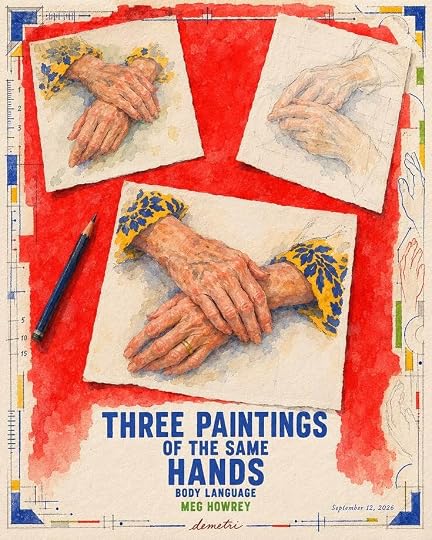
Three paintings of Barbara’s hands, none of them the original, hold the novel’s central mystery: intimacy can multiply our versions of another person without making any one of them complete.
Dementia hands a family an ugly promotion. As Barbara becomes harder to reach, her three adult daughters acquire more authority over the question of who she is: what she understands, what she wants, which version of her counts. Meg Howrey’s “Body Language” distrusts that promotion from the start. Barbara recedes from Sloane, Laurel and Nanette while the novel quietly admits us into rooms of her life they never entered. The daughters lose access; the reader gains it. By the time Barbara’s death becomes the plot’s terrible problem, another has already settled into the house: love has mistaken familiarity for knowledge.
Each daughter arrives with a preferred way of reading a body. Sloane, a former actress turned therapist, experiments with mushrooms while turning menopause into symptom, project and possible initiation. Laurel, married and raising two teenagers, finds a woman’s hairpin in her husband’s hoodie and builds an adultery case before she has decided what verdict she wants. Nanette has entered an Episcopalian convent and is trying to tell vocation from refuge. Barbara remains in Indiana, where passwords, routes, appliances and dates have begun their small betrayals.
Much of Howrey’s comedy lives in the distance between intelligence and self-recognition. Sloane can turn a hot flash into an argument about medicine and shame before the sweat dries, then wonder whether the argument itself is another symptom. Laurel trusts systems because she is good at running them, which makes vigilance feel dangerously like omniscience. Nanette distrusts secular self-analysis, but discernment gives her another way to ask where conviction comes from. At a gun range, overwhelmed by noise and thoughts of Barbara, she experiences something that might be God, panic, desire or all three. The command she hears is less accommodating: go home and help your mother die.
Every sister reaches Barbara carrying a lens. Sloane reads subtext. Laurel reads evidence. Nanette reads signs. Barbara, maddeningly, prefers lists. “Body Language” first sounds like something breezy about posture or attraction, then begins to accuse the confidence hidden inside the phrase. A symptom can be hormonal or psychological. Touch can comfort, control, arouse, violate or remember. The visible body supplies evidence without promising a correct verdict. It may be eloquent; that does not make anyone fluent. Laurel’s hairpin is the cleanest small proof: the object is real, her reasoning is plausible, and the story she builds around it is wrong. The error nevertheless tells the truth about something Laurel has not admitted. Part of her wants betrayal because betrayal would make a decision for her. Howrey is alert to that uncomfortable distinction: a reading can be factually false and psychologically exact.
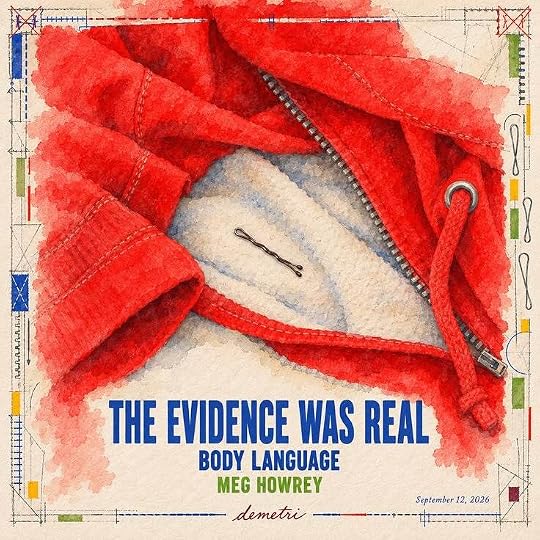
A hairpin can be real evidence and still support the wrong story, which is exactly why Laurel’s mistake reveals more than a correct conclusion might.
The trouble becomes material when Roberta, Barbara’s friend and informal caregiver, suddenly leaves. Her letter reveals that Barbara, after watching both her mother and sister decline with dementia, has long intended to end her life before the disease takes away her ability to choose. She researched medication. She wrote instructions. Years earlier she made Nanette promise to remind her when the time came. Roberta found the pills, tried to decide what helping would mean and fled. Barbara’s daughters are left with an envelope and four bad choices: supervise her against her wishes, leave her to attempt something dangerous, help her die, or decide that the woman who made the plan no longer gets a vote.
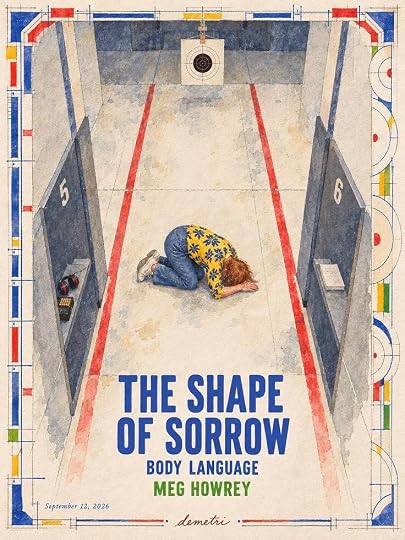
Nanette’s body interrupts the firing lane’s hard geometry, turning a private experience of fear, grief, and possible revelation into something strangers can see but cannot finally name.
Rather than seat the sisters neatly on opposing sides, Howrey makes each troublesome to her own beliefs. Sloane prizes bodily autonomy until Barbara’s autonomy requires something more frightening than agreement. Nanette believes in surrender to God until surrender appears to require her own hands. Laurel prides herself on evidence, yet builds a marriage-ending narrative around a hairpin whose eventual explanation exposes how badly she wanted an outside event to choose for her. No one gets the clean conscience of being merely right.
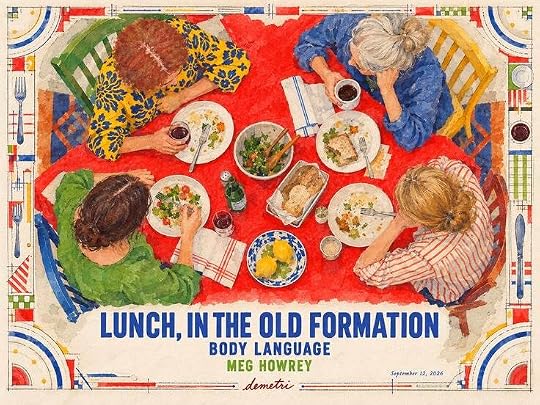
Around one table, Barbara and her daughters fall back into an old family choreography, their hands, plates, distances, and repeated postures saying more than any assigned role can.
Its end-of-life dilemma could sustain the novel by itself. More interestingly, Barbara keeps escaping the role of dilemma. As she grows harder for her daughters to reach, the narration opens rooms they never knew existed: her marriage to Bill from inside rather than through family legend, her complicated mother, the reasoning behind her death plan and, most movingly, Carol, the college roommate whose friendship awakened a Barbara no daughter ever fully meets. The daughters experience subtraction. The reader keeps receiving additions. That asymmetry changes the moral temperature of every later scene. We know that Barbara’s apparent opacity is not emptiness; behind it sits a private history still capable of surprising us. The daughters must act without that advantage.
Perhaps the smallest revelation cuts deepest. In college, Barbara and Carol invent secret names for each other. Barbara chooses Charlotte, shortened to Charlie. Carol thinks, waits, and chooses Nanette. Decades later Barbara gives that name to her youngest daughter. Nanette never learns why. There is no convenient letter in the Coda, no belated family disclosure. The reader gets it. Nanette does not. Howrey leaves the imbalance intact.
A secret in family fiction often arrives expecting eventual exposure. Open the drawer, find the letter, complete the parent. “Body Language” declines the bargain. Barbara’s daughters never receive Carol in full, the private names, the childhood Listening Tree or every calculation that turned dying into her final puzzle piece. They can care for their mother, misunderstand her, love her and participate in her final decision without acquiring ownership of everything that made her. Even in death, she keeps property in herself.
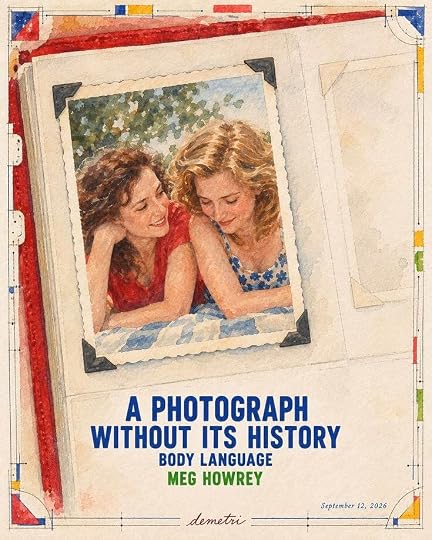
Barbara and Carol survive as an image without an explanation, a fragment of private history the reader receives and the daughters never fully inherit.
Prose carries some of that uncertainty at the level of rhythm. Howrey’s sentences backtrack. A thought expands, qualifies itself, winces at its own grandiosity, finds a joke and returns to the admission it hoped to avoid. The voices separate by pressure rather than gimmick. Sloane proliferates. Laurel pares, inventories and braces. Nanette hesitates where words might diminish experience. Barbara cuts. Her speech has the usefulness of a kitchen knife: economical, occasionally alarming, often exactly enough. Her resistance to her daughters’ appetite for excavation gives the book some of its best comedy. The tonal nerve occasionally recalls Meg Mason’s “Sorrow and Bliss,” though Howrey scatters that energy among a family instead of lodging it principally in one voice.
At her funniest, Howrey lets ordinary life put a thumb on profundity. Menopause brings sweat, bad shampoo and expensive remedies. Mysticism still has convent laundry. Grief has Uno and cheese and crackers. After Barbara’s death, a police officer is more interested in Sloane’s old television work than in performing gravity for the bereaved. Catastrophe does not purify attention. People still get hungry. Sometimes the absurd thing saves the room.
During the middle stretch, though, interpretation occasionally arrives before experience has finished speaking. These women are fluent in therapy, gender, medicine, climate dread, religion and trauma, and Barbara’s house can briefly resemble a seminar with very good snacks. Sloane is the chief culprit because self-analysis is practically her aerobic exercise. At one point she gives Barbara an unwound ball of yarn to rewind. Even Sloane recognizes that the metaphor has arrived wearing a name tag.
Its trouble begins when the book starts doing Sloane’s work for her. The novel distrusts explanatory systems yet occasionally explains their inadequacy one beat too thoroughly. Menopause, motherhood, faith, dementia, gender and caregiving all find their places in the larger question of who gets to define a body. Usually those connections grow from character. Now and then, one can see the labels on Barbara’s folders. For a book suspicious of classification, a little creative misfiling might have helped.
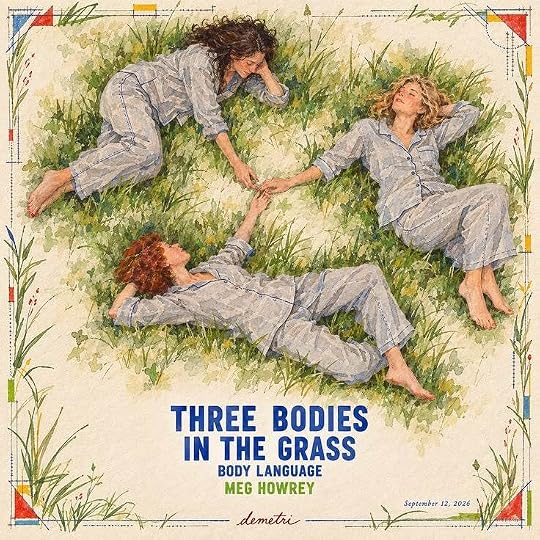
Sloane, Laurel, and Nanette become sisters again before they become morally unanimous, their almost-touching hands making reconciliation a bodily fact before it becomes an argument.
Meanwhile, the map keeps shrinking. California, New Jersey and Ohio give way to Indiana; Indiana to Barbara’s house; the house to her bedroom; the bedroom to an envelope. By the climax, pages of moral argument have narrowed into one tiny physical act: somebody must put the medication where Barbara can reach it. Earlier Barbara has already written down the sequence for later Barbara. The page remains legible when memory does not. Her numbered instructions become a bridge between the competent woman who planned the act and the impaired woman who must decide whether to complete it. It is both self-command and self-assistance, an earlier self leaving instructions for a later self who may no longer share her capacities but still inhabits her life. The eerie part is how ordinary the mechanism is: numbered steps, a written sequence, the faith that paper can carry intention farther than memory.
It matters that the envelope passes through all three sisters. Nanette retrieves it. Laurel takes it and approaches the bedroom, then discovers that her body will carry her no farther. Sloane takes it from Laurel and crosses the threshold. None becomes executioner, saint, coward or savior. Each carries the burden until conscience or flesh says stop. Their reconciliation is not agreement. It is distribution. Sisterhood becomes a relay for what no single sister can bear alone. After pages of argument, responsibility moves hand to hand.
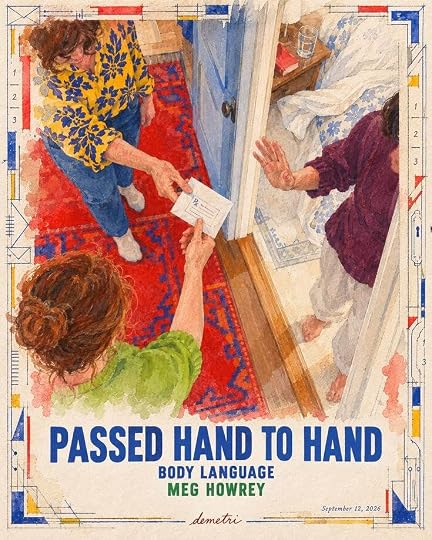
The envelope moves from sister to sister until responsibility itself becomes something physical, transferable, and finally impossible for any one person to carry alone.
This is where “Body Language” comes closest to Sigrid Nunez’s “What Are You Going Through,” in which accompanying a chosen death likewise proves different from approving of it in theory. Dementia makes Howrey’s version more unstable. Barbara still jokes, plays cards, walks in the park, drinks wine, recognizes her daughters intermittently and has something plainly recognizable as a good day. She is not a vacancy waiting for death. Yet the woman who anticipated this disease left instructions precisely because she knew the woman living through it might not be able to carry them out. Howrey does not make the good day evidence against the plan, or the plan evidence against the good day.
Reasonable readers can remain divided. Barbara’s fluctuating capacity may seem to void a choice made by her earlier self; disregarding that choice may seem to enact exactly the loss of agency she planned against. The problem grows harder because Barbara herself is not verbally consistent. At one point she says she does not want help because she can do it herself. Later, faced with the pills and Sloane’s questions, she understands what they mean and remains firm. Howrey supplies no verdict and never rigs the evidence until one position becomes foolish. Barbara can enjoy a day and still want it to be among her last.
Only a plot anxious to acquit everyone would summon a late doctor capable of settling the matter. Instead the family receives the usual equipment: partial knowledge, paperwork, fear, affection, old resentments, food and a body that refuses to symbolize only one thing. Barbara’s remaining life matters. The decision she made while fully able to imagine losing that life matters too. Neither cancels the other. The book earns its unease by refusing to make either truth disappear.
Practically, care arrives less nobly. It looks like plane tickets, calendars, money, spare rooms and work somebody has to miss. Who stays? Who can uproot a life? Whose schedule is treated as movable? Sloane’s lack of spouse and children makes her seem available. Laurel is already booked by other people’s needs. Nanette’s convent can look, to her sisters, almost like an exemption form. The philosophy keeps meeting towels that need washing. Caregiving is lofty only from a sufficient distance.
Of all the book’s contemporary subjects, menopause settles most naturally into its comedy. Sloane wants Cronehood to descend with mythic authority and gets hair loss, hot flashes, contradictory medical advice and products she cannot quite afford. She wants transformation to arrive with a cape. Her mother punctures that fantasy efficiently. Sloane is not the crone. Barbara is.
Under the vocabulary of the moment is an old family error. Children confuse knowing their parents with having full access to them. Siblings remember the same rooms differently. Parents imagine care guarantees comprehension. Love encourages the fantasy that sufficient attention will eventually remove mystery. “Body Language” is wisest when affection survives the failure of that fantasy. Barbara’s daughters do not end with a completed mother. They end with one another and with whatever portions of Barbara each can carry. That is a smaller consolation than revelation, and a more convincing one.
Listening asks for less mastery. Near the end, the sisters remember Barbara measuring flour with her hands, leveling the cup with the confidence of someone who has repeated the gesture thousands of times. It is a better image for Barbara than any diagnosis or philosophical position: practical, exact, embodied, ordinary. No argument about autonomy is as persuasive. Her hand knows the measure. It knows when there is enough.
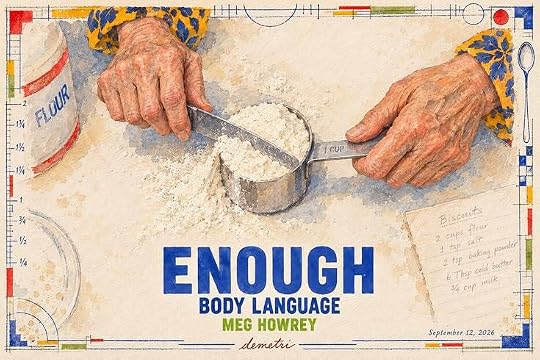
Barbara’s hands level flour with the knowledge of repetition, a quiet image of the body remembering its measure even when language and memory have begun to fail.
On my scale, “Body Language” earns 88/100 and 4/5 stars. Its characterization, perspective design and superb final movement lift it well above merely accomplished family fiction. Its tendency to explain patterns that its scenes have already made vivid keeps it outside the top tier. Howrey is strongest when commentary drops away and an object is left to trouble us: a hairpin in a pocket, pills in an envelope, three sisters in matching pajamas, one hand holding another.
Still, Nanette’s paintings are what remain. After Barbara’s death she paints her mother’s hands three times, one version for each sister. They do not match. Laurel thinks that is right. Three pictures of the same hands. None gets to be the original.
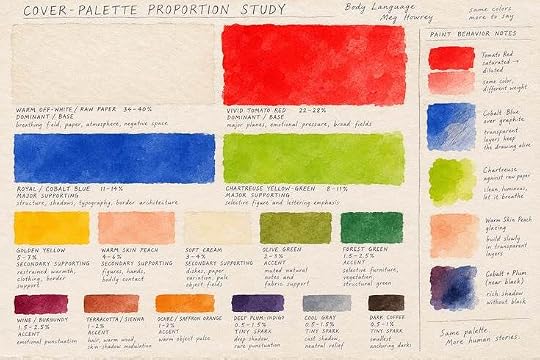
Cover-Palette Swatches
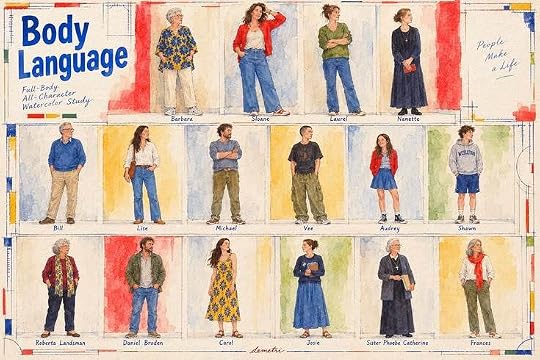
Full-Body All-Character Watercolor Study
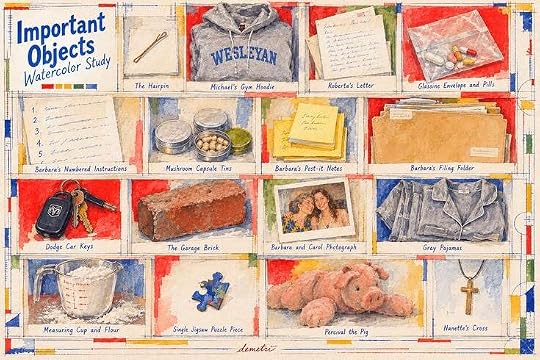
Important-Items Watercolor Study
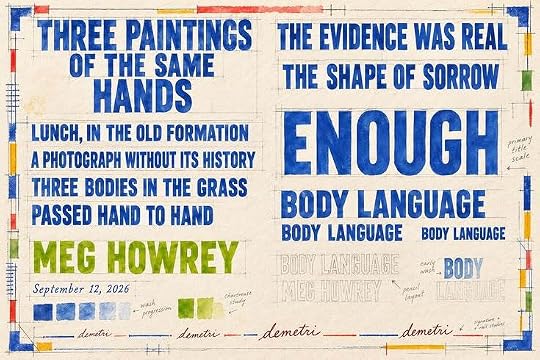
Typography and Signature Study
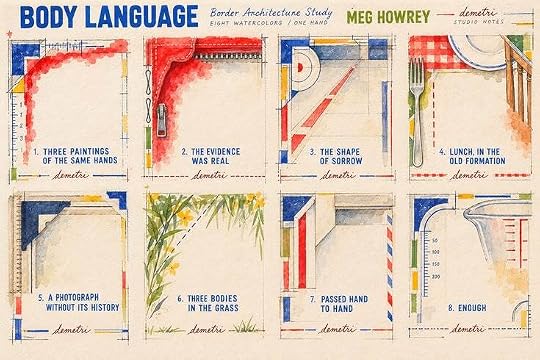
Border Architecture Study
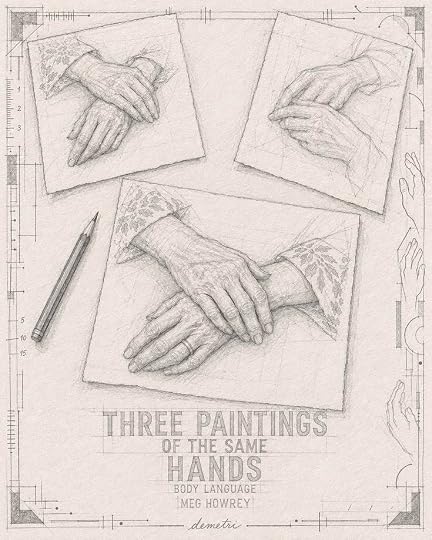
First Underdrawing
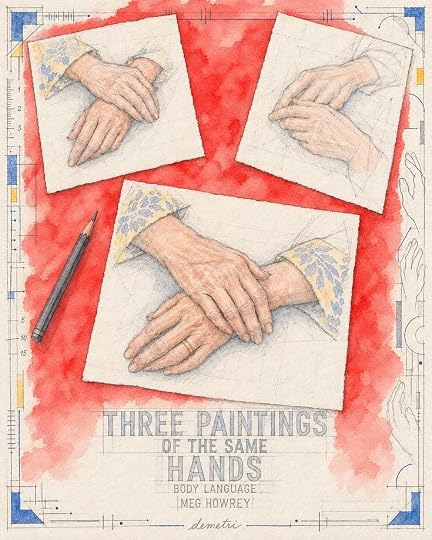
First-Wash Visualization
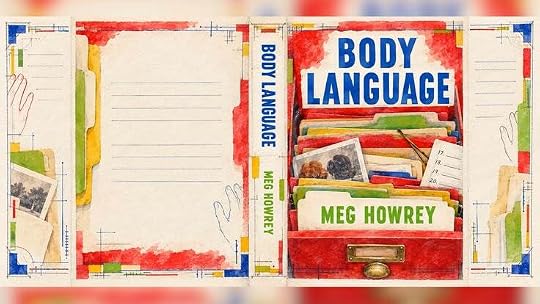
Alternate Full-Jacket Study
All watercolor illustrations by Demetris Papadimitropoulos.
Watercolors are done on 140lb vellum and then scanned into the computer using an Epson scanner. From there, they are finalized in Procreate. No AI was used in writing this review — all art and opinions are my own.
A funny, prickly family novel turns dementia, menopause, religion, therapy, and assisted death into a question nobody can solve cleanly, least of all the people convinced they understand one another.
By Demetris Papadimitropoulos | September 12th, 2026
Three paintings of Barbara’s hands, none of them the original, hold the novel’s central mystery: intimacy can multiply our versions of another person without making any one of them complete.
Dementia hands a family an ugly promotion. As Barbara becomes harder to reach, her three adult daughters acquire more authority over the question of who she is: what she understands, what she wants, which version of her counts. Meg Howrey’s “Body Language” distrusts that promotion from the start. Barbara recedes from Sloane, Laurel and Nanette while the novel quietly admits us into rooms of her life they never entered. The daughters lose access; the reader gains it. By the time Barbara’s death becomes the plot’s terrible problem, another has already settled into the house: love has mistaken familiarity for knowledge.
Each daughter arrives with a preferred way of reading a body. Sloane, a former actress turned therapist, experiments with mushrooms while turning menopause into symptom, project and possible initiation. Laurel, married and raising two teenagers, finds a woman’s hairpin in her husband’s hoodie and builds an adultery case before she has decided what verdict she wants. Nanette has entered an Episcopalian convent and is trying to tell vocation from refuge. Barbara remains in Indiana, where passwords, routes, appliances and dates have begun their small betrayals.
Much of Howrey’s comedy lives in the distance between intelligence and self-recognition. Sloane can turn a hot flash into an argument about medicine and shame before the sweat dries, then wonder whether the argument itself is another symptom. Laurel trusts systems because she is good at running them, which makes vigilance feel dangerously like omniscience. Nanette distrusts secular self-analysis, but discernment gives her another way to ask where conviction comes from. At a gun range, overwhelmed by noise and thoughts of Barbara, she experiences something that might be God, panic, desire or all three. The command she hears is less accommodating: go home and help your mother die.
Every sister reaches Barbara carrying a lens. Sloane reads subtext. Laurel reads evidence. Nanette reads signs. Barbara, maddeningly, prefers lists. “Body Language” first sounds like something breezy about posture or attraction, then begins to accuse the confidence hidden inside the phrase. A symptom can be hormonal or psychological. Touch can comfort, control, arouse, violate or remember. The visible body supplies evidence without promising a correct verdict. It may be eloquent; that does not make anyone fluent. Laurel’s hairpin is the cleanest small proof: the object is real, her reasoning is plausible, and the story she builds around it is wrong. The error nevertheless tells the truth about something Laurel has not admitted. Part of her wants betrayal because betrayal would make a decision for her. Howrey is alert to that uncomfortable distinction: a reading can be factually false and psychologically exact.
A hairpin can be real evidence and still support the wrong story, which is exactly why Laurel’s mistake reveals more than a correct conclusion might.
The trouble becomes material when Roberta, Barbara’s friend and informal caregiver, suddenly leaves. Her letter reveals that Barbara, after watching both her mother and sister decline with dementia, has long intended to end her life before the disease takes away her ability to choose. She researched medication. She wrote instructions. Years earlier she made Nanette promise to remind her when the time came. Roberta found the pills, tried to decide what helping would mean and fled. Barbara’s daughters are left with an envelope and four bad choices: supervise her against her wishes, leave her to attempt something dangerous, help her die, or decide that the woman who made the plan no longer gets a vote.
Nanette’s body interrupts the firing lane’s hard geometry, turning a private experience of fear, grief, and possible revelation into something strangers can see but cannot finally name.
Rather than seat the sisters neatly on opposing sides, Howrey makes each troublesome to her own beliefs. Sloane prizes bodily autonomy until Barbara’s autonomy requires something more frightening than agreement. Nanette believes in surrender to God until surrender appears to require her own hands. Laurel prides herself on evidence, yet builds a marriage-ending narrative around a hairpin whose eventual explanation exposes how badly she wanted an outside event to choose for her. No one gets the clean conscience of being merely right.
Around one table, Barbara and her daughters fall back into an old family choreography, their hands, plates, distances, and repeated postures saying more than any assigned role can.
Its end-of-life dilemma could sustain the novel by itself. More interestingly, Barbara keeps escaping the role of dilemma. As she grows harder for her daughters to reach, the narration opens rooms they never knew existed: her marriage to Bill from inside rather than through family legend, her complicated mother, the reasoning behind her death plan and, most movingly, Carol, the college roommate whose friendship awakened a Barbara no daughter ever fully meets. The daughters experience subtraction. The reader keeps receiving additions. That asymmetry changes the moral temperature of every later scene. We know that Barbara’s apparent opacity is not emptiness; behind it sits a private history still capable of surprising us. The daughters must act without that advantage.
Perhaps the smallest revelation cuts deepest. In college, Barbara and Carol invent secret names for each other. Barbara chooses Charlotte, shortened to Charlie. Carol thinks, waits, and chooses Nanette. Decades later Barbara gives that name to her youngest daughter. Nanette never learns why. There is no convenient letter in the Coda, no belated family disclosure. The reader gets it. Nanette does not. Howrey leaves the imbalance intact.
A secret in family fiction often arrives expecting eventual exposure. Open the drawer, find the letter, complete the parent. “Body Language” declines the bargain. Barbara’s daughters never receive Carol in full, the private names, the childhood Listening Tree or every calculation that turned dying into her final puzzle piece. They can care for their mother, misunderstand her, love her and participate in her final decision without acquiring ownership of everything that made her. Even in death, she keeps property in herself.
Barbara and Carol survive as an image without an explanation, a fragment of private history the reader receives and the daughters never fully inherit.
Prose carries some of that uncertainty at the level of rhythm. Howrey’s sentences backtrack. A thought expands, qualifies itself, winces at its own grandiosity, finds a joke and returns to the admission it hoped to avoid. The voices separate by pressure rather than gimmick. Sloane proliferates. Laurel pares, inventories and braces. Nanette hesitates where words might diminish experience. Barbara cuts. Her speech has the usefulness of a kitchen knife: economical, occasionally alarming, often exactly enough. Her resistance to her daughters’ appetite for excavation gives the book some of its best comedy. The tonal nerve occasionally recalls Meg Mason’s “Sorrow and Bliss,” though Howrey scatters that energy among a family instead of lodging it principally in one voice.
At her funniest, Howrey lets ordinary life put a thumb on profundity. Menopause brings sweat, bad shampoo and expensive remedies. Mysticism still has convent laundry. Grief has Uno and cheese and crackers. After Barbara’s death, a police officer is more interested in Sloane’s old television work than in performing gravity for the bereaved. Catastrophe does not purify attention. People still get hungry. Sometimes the absurd thing saves the room.
During the middle stretch, though, interpretation occasionally arrives before experience has finished speaking. These women are fluent in therapy, gender, medicine, climate dread, religion and trauma, and Barbara’s house can briefly resemble a seminar with very good snacks. Sloane is the chief culprit because self-analysis is practically her aerobic exercise. At one point she gives Barbara an unwound ball of yarn to rewind. Even Sloane recognizes that the metaphor has arrived wearing a name tag.
Its trouble begins when the book starts doing Sloane’s work for her. The novel distrusts explanatory systems yet occasionally explains their inadequacy one beat too thoroughly. Menopause, motherhood, faith, dementia, gender and caregiving all find their places in the larger question of who gets to define a body. Usually those connections grow from character. Now and then, one can see the labels on Barbara’s folders. For a book suspicious of classification, a little creative misfiling might have helped.
Sloane, Laurel, and Nanette become sisters again before they become morally unanimous, their almost-touching hands making reconciliation a bodily fact before it becomes an argument.
Meanwhile, the map keeps shrinking. California, New Jersey and Ohio give way to Indiana; Indiana to Barbara’s house; the house to her bedroom; the bedroom to an envelope. By the climax, pages of moral argument have narrowed into one tiny physical act: somebody must put the medication where Barbara can reach it. Earlier Barbara has already written down the sequence for later Barbara. The page remains legible when memory does not. Her numbered instructions become a bridge between the competent woman who planned the act and the impaired woman who must decide whether to complete it. It is both self-command and self-assistance, an earlier self leaving instructions for a later self who may no longer share her capacities but still inhabits her life. The eerie part is how ordinary the mechanism is: numbered steps, a written sequence, the faith that paper can carry intention farther than memory.
It matters that the envelope passes through all three sisters. Nanette retrieves it. Laurel takes it and approaches the bedroom, then discovers that her body will carry her no farther. Sloane takes it from Laurel and crosses the threshold. None becomes executioner, saint, coward or savior. Each carries the burden until conscience or flesh says stop. Their reconciliation is not agreement. It is distribution. Sisterhood becomes a relay for what no single sister can bear alone. After pages of argument, responsibility moves hand to hand.
The envelope moves from sister to sister until responsibility itself becomes something physical, transferable, and finally impossible for any one person to carry alone.
This is where “Body Language” comes closest to Sigrid Nunez’s “What Are You Going Through,” in which accompanying a chosen death likewise proves different from approving of it in theory. Dementia makes Howrey’s version more unstable. Barbara still jokes, plays cards, walks in the park, drinks wine, recognizes her daughters intermittently and has something plainly recognizable as a good day. She is not a vacancy waiting for death. Yet the woman who anticipated this disease left instructions precisely because she knew the woman living through it might not be able to carry them out. Howrey does not make the good day evidence against the plan, or the plan evidence against the good day.
Reasonable readers can remain divided. Barbara’s fluctuating capacity may seem to void a choice made by her earlier self; disregarding that choice may seem to enact exactly the loss of agency she planned against. The problem grows harder because Barbara herself is not verbally consistent. At one point she says she does not want help because she can do it herself. Later, faced with the pills and Sloane’s questions, she understands what they mean and remains firm. Howrey supplies no verdict and never rigs the evidence until one position becomes foolish. Barbara can enjoy a day and still want it to be among her last.
Only a plot anxious to acquit everyone would summon a late doctor capable of settling the matter. Instead the family receives the usual equipment: partial knowledge, paperwork, fear, affection, old resentments, food and a body that refuses to symbolize only one thing. Barbara’s remaining life matters. The decision she made while fully able to imagine losing that life matters too. Neither cancels the other. The book earns its unease by refusing to make either truth disappear.
Practically, care arrives less nobly. It looks like plane tickets, calendars, money, spare rooms and work somebody has to miss. Who stays? Who can uproot a life? Whose schedule is treated as movable? Sloane’s lack of spouse and children makes her seem available. Laurel is already booked by other people’s needs. Nanette’s convent can look, to her sisters, almost like an exemption form. The philosophy keeps meeting towels that need washing. Caregiving is lofty only from a sufficient distance.
Of all the book’s contemporary subjects, menopause settles most naturally into its comedy. Sloane wants Cronehood to descend with mythic authority and gets hair loss, hot flashes, contradictory medical advice and products she cannot quite afford. She wants transformation to arrive with a cape. Her mother punctures that fantasy efficiently. Sloane is not the crone. Barbara is.
Under the vocabulary of the moment is an old family error. Children confuse knowing their parents with having full access to them. Siblings remember the same rooms differently. Parents imagine care guarantees comprehension. Love encourages the fantasy that sufficient attention will eventually remove mystery. “Body Language” is wisest when affection survives the failure of that fantasy. Barbara’s daughters do not end with a completed mother. They end with one another and with whatever portions of Barbara each can carry. That is a smaller consolation than revelation, and a more convincing one.
Listening asks for less mastery. Near the end, the sisters remember Barbara measuring flour with her hands, leveling the cup with the confidence of someone who has repeated the gesture thousands of times. It is a better image for Barbara than any diagnosis or philosophical position: practical, exact, embodied, ordinary. No argument about autonomy is as persuasive. Her hand knows the measure. It knows when there is enough.
Barbara’s hands level flour with the knowledge of repetition, a quiet image of the body remembering its measure even when language and memory have begun to fail.
On my scale, “Body Language” earns 88/100 and 4/5 stars. Its characterization, perspective design and superb final movement lift it well above merely accomplished family fiction. Its tendency to explain patterns that its scenes have already made vivid keeps it outside the top tier. Howrey is strongest when commentary drops away and an object is left to trouble us: a hairpin in a pocket, pills in an envelope, three sisters in matching pajamas, one hand holding another.
Still, Nanette’s paintings are what remain. After Barbara’s death she paints her mother’s hands three times, one version for each sister. They do not match. Laurel thinks that is right. Three pictures of the same hands. None gets to be the original.
Cover-Palette Swatches
Full-Body All-Character Watercolor Study
Important-Items Watercolor Study
Typography and Signature Study
Border Architecture Study
First Underdrawing
First-Wash Visualization
Alternate Full-Jacket Study
All watercolor illustrations by Demetris Papadimitropoulos.
Watercolors are done on 140lb vellum and then scanned into the computer using an Epson scanner. From there, they are finalized in Procreate. No AI was used in writing this review — all art and opinions are my own.

August 16, 2026
⭐️⭐️⭐️⭐️⭐️ 5/5. Thank you @doubledaybooks for the gifted copy.
I can never remember the title of this book, and I’m honestly still not sure why it’s called Body Language! But I LOVED this. We follow three adult sisters navigating how best to care for their mother, who is experiencing dementia.
I read this just prior to SWITZY, and the one-two punch (both are centered on a character with Alzheimer’s/dementia) made for such a special synergy. I related to each of the sisters in different ways, but I especially loved Nanette, who is studying to become a nun and goes viral after praying at a gun range! I also adored their midwestern, no frills, “no big whoop” mother, who reminded me of my own mom.
Funny and moving – my favorite combo! I teared up reading this on an airplane, you guys, which never happens to me. Highly recommend.
I can never remember the title of this book, and I’m honestly still not sure why it’s called Body Language! But I LOVED this. We follow three adult sisters navigating how best to care for their mother, who is experiencing dementia.
I read this just prior to SWITZY, and the one-two punch (both are centered on a character with Alzheimer’s/dementia) made for such a special synergy. I related to each of the sisters in different ways, but I especially loved Nanette, who is studying to become a nun and goes viral after praying at a gun range! I also adored their midwestern, no frills, “no big whoop” mother, who reminded me of my own mom.
Funny and moving – my favorite combo! I teared up reading this on an airplane, you guys, which never happens to me. Highly recommend.

August 25, 2026
“Body Language” follows three sisters navigating their individual lives while also grappling with their mother’s struggle with dementia. Spread across the country, the sisters end up reuniting at their mother’s home to assess the situation; but being in such close proximity again after years of separation leads to conflicts, revelations, and difficult conversations.
As someone who has personally witnessed a loved one experience Alzheimer’s, this book hit for me. The way each sister deals with the diagnosis in their own unique way and how that ties into their personal lives was really effective in exploring the grief of losing someone you love ,despite their physical presence still being with you. It felt similar to Coco Mellors’s “Blue Sisters” in the way each sibling has to navigate her own relationship with grief, except they are mourning the loss of their mother’s memory rather than a fourth sibling.
Each sister had a strong sense of personhood and individuality: Sloane, the eldest, is a single divorcee, and a former actress turned therapist traversing perimenopause; Laurel, the middle child, is a wife and mother of two who stumbles across evidence of her husband’s potential infidelity; and Nanette, the youngest, is part of a convent who unintentionally goes viral after feeling a call from God to help her mother die. This level of depth to each character helped the reader empathize with them and understand where each is coming from.
To be honest, at the start of the book, I felt a bit underwhelmed. The initial chapters were quite slow moving, as we were being introduced to each of the characters. While the writing continued to be slower moving and more reflective, I think the narrative became compelling because Howrey had established a solid base for the novel and made the reader feel for each of the characters. If you enjoy a quieter, more contemplative character study that dives into family dynamics, I’d say “Body Language” is for you, and I would highly recommend Meg Howrey as an author to any lover of literary fiction. Though I didn’t love this more than “They’re Going to Love You,” this novel did cement to me that Howrey is a favorite author of mine and that she is a master of portraying complex characters and analyzing family dynamics.
4.5 stars!
As someone who has personally witnessed a loved one experience Alzheimer’s, this book hit for me. The way each sister deals with the diagnosis in their own unique way and how that ties into their personal lives was really effective in exploring the grief of losing someone you love ,despite their physical presence still being with you. It felt similar to Coco Mellors’s “Blue Sisters” in the way each sibling has to navigate her own relationship with grief, except they are mourning the loss of their mother’s memory rather than a fourth sibling.
Each sister had a strong sense of personhood and individuality: Sloane, the eldest, is a single divorcee, and a former actress turned therapist traversing perimenopause; Laurel, the middle child, is a wife and mother of two who stumbles across evidence of her husband’s potential infidelity; and Nanette, the youngest, is part of a convent who unintentionally goes viral after feeling a call from God to help her mother die. This level of depth to each character helped the reader empathize with them and understand where each is coming from.
To be honest, at the start of the book, I felt a bit underwhelmed. The initial chapters were quite slow moving, as we were being introduced to each of the characters. While the writing continued to be slower moving and more reflective, I think the narrative became compelling because Howrey had established a solid base for the novel and made the reader feel for each of the characters. If you enjoy a quieter, more contemplative character study that dives into family dynamics, I’d say “Body Language” is for you, and I would highly recommend Meg Howrey as an author to any lover of literary fiction. Though I didn’t love this more than “They’re Going to Love You,” this novel did cement to me that Howrey is a favorite author of mine and that she is a master of portraying complex characters and analyzing family dynamics.
4.5 stars!

Review of advance copy received from NetGalley
This is my 3rd Meg Howrey book and they've ll been 4 stars. She's solid for me and I could especially relate to this one about three sisters with a mom suffering from Alzheimers. Full review to follow.

Want to Read
January 7, 2026Have I read They're Going to Love You yet? No. Am I seated for this regardless because the cover is so lovely? Yes.

September 24, 2026
I listened to this over a few days, read by the author.
I surprised myself by how much I enjoyed it despite it being super contemporary, somewhat instagram-ish and written as if it was to be made into a movie (BTW, if it was, I would go see it). There is one section, from the sister who was previously an actor, where she lays out the scene like a play - seemed apropos. I wasn't sure I was going to read it, but the first chapter made me laugh out loud as the eldest sister describes her clinical psychology practice - that hooked me. There were more than a few moments that were quite funny throughout.
There are 4 main characters: the 3 sisters -- a very woke California actress/psychologist, the unlikeable uptight mother of 2 (one whose child has decided to come out as "they"), and the spectrum-ish one who seems to be doing okay as a Sister (we are told that nun refers to Sisters who are cloistered, so this character is not a nun but intends to be an working sister). Finally, the last POV is their mother, who is well into dementia but had been very clear that she wanted a way out of living with this familial disease. These 4 POV give Meg Howrey a chance to tell a lot of women's stories that ring pretty darn true. She is quite skilled to be able to get these down on paper and make a cynical snobby reader like me believe. She is very clever, lots of double entendres. Heck, I might even read more of her stuff!
I surprised myself by how much I enjoyed it despite it being super contemporary, somewhat instagram-ish and written as if it was to be made into a movie (BTW, if it was, I would go see it). There is one section, from the sister who was previously an actor, where she lays out the scene like a play - seemed apropos. I wasn't sure I was going to read it, but the first chapter made me laugh out loud as the eldest sister describes her clinical psychology practice - that hooked me. There were more than a few moments that were quite funny throughout.
There are 4 main characters: the 3 sisters -- a very woke California actress/psychologist, the unlikeable uptight mother of 2 (one whose child has decided to come out as "they"), and the spectrum-ish one who seems to be doing okay as a Sister (we are told that nun refers to Sisters who are cloistered, so this character is not a nun but intends to be an working sister). Finally, the last POV is their mother, who is well into dementia but had been very clear that she wanted a way out of living with this familial disease. These 4 POV give Meg Howrey a chance to tell a lot of women's stories that ring pretty darn true. She is quite skilled to be able to get these down on paper and make a cynical snobby reader like me believe. She is very clever, lots of double entendres. Heck, I might even read more of her stuff!

September 1, 2026
Sloane, Laurel, and Nanette are sisters, but about as different in all ways as one can be. When they recognize signs of dementia/ alzheimer's in their mother, they combine forces to determine a course of action that will allow her to keep her dignity. Each POV is spread evenly, sometimes even going back to the mother's past, and while I did enjoy that, I think it hindered some of the characters' growth in a way that left me feeling somewhat unfulfilled. I loved the passage of time and how much each sister grew, but again, felt I was missing something in connecting to everyone here. All in all, a beautiful exploration of family, autonomy, and humor in wry times. Thank you to Knopf Doubleday for the advanced copy. All opinions are entirely my own.

Currently Reading
December 15, 2025new meg howrey!!! so sat.
September 9, 2026
I loved this book - poignant, touching, beautiful, sad, hopeful… it’s perfect
Read
July 2, 2026Three sisters, not unlike the Karamazov brothers in their defining characteristics (more on this shortly), all simultaneously take a trip home to take care of their aging mother who is suffering from dementia, to further consider the implications of this illness and more deeply discern their mother’s state of mind (and concurrently their own.)
These three sisters, individually and collectively, subtly evoked in my mind the identifying characteristics of the three Karamazov brothers: Sloane being Ivan (singular, searching for meaning), Laurel being Dmitri (headstrong, speculative), and Nanette being Alyosha (innocent, devout). “Sloane pointed at Nanette, Laurel, and herself in turn. “Virgin, Mother, Crone.” She said. “No, I’m the crone,” said their mother. “I’m the crone.””
Staying in the same house for the first time in years, the sister’s conflicting personalities and varying senses of themselves make this uncertain time for their family even more complicated. As they spend time with their ill mother, finding out more about how much their separate relationships with her ranged, their joint pieces of the whole picture paint a conclusive piece much different and surprising than they imagined. Personally knowing someone suffering from Alzheimer’s currently, a lot of the behaviors exhibited by their mother were very recognizable and felt sadly very real, which may be something to note before reading if that could be potentially triggering for you. I do wish the novel would have been a bit more evenly distributed with its attention, and wish it had given a more comprehensive picture of each of our characters and each of their stories, and maybe prioritized overall cohesion more than humor or whimsy, though I did appreciate that it had some humor to balance out the dense subject matter. The novel overall does well in exhibiting the ways in which we can be ropes to eachother, to hold onto or use as an aid to get to our next places in life, as well as an example of the ways that something can feel like the end of the world, and yet the world goes on.
These three sisters, individually and collectively, subtly evoked in my mind the identifying characteristics of the three Karamazov brothers: Sloane being Ivan (singular, searching for meaning), Laurel being Dmitri (headstrong, speculative), and Nanette being Alyosha (innocent, devout). “Sloane pointed at Nanette, Laurel, and herself in turn. “Virgin, Mother, Crone.” She said. “No, I’m the crone,” said their mother. “I’m the crone.””
Staying in the same house for the first time in years, the sister’s conflicting personalities and varying senses of themselves make this uncertain time for their family even more complicated. As they spend time with their ill mother, finding out more about how much their separate relationships with her ranged, their joint pieces of the whole picture paint a conclusive piece much different and surprising than they imagined. Personally knowing someone suffering from Alzheimer’s currently, a lot of the behaviors exhibited by their mother were very recognizable and felt sadly very real, which may be something to note before reading if that could be potentially triggering for you. I do wish the novel would have been a bit more evenly distributed with its attention, and wish it had given a more comprehensive picture of each of our characters and each of their stories, and maybe prioritized overall cohesion more than humor or whimsy, though I did appreciate that it had some humor to balance out the dense subject matter. The novel overall does well in exhibiting the ways in which we can be ropes to eachother, to hold onto or use as an aid to get to our next places in life, as well as an example of the ways that something can feel like the end of the world, and yet the world goes on.
Review of advance copy received from Netgalley
This was my first book by this author, so it may just be her writing style, but I found this book to be far too chaotic and disjointed. It felt like a ride through an ADHD brain where every couple pages, SQUIRREL!
The central premise and heart of the story, 3 sisters coming home to care for their mother suffering from dementia, was incredibly well written. Unfortunately, that story was surrounded by very random, drawn out plot points involving the three sisters’ lives (past and present) that were constantly taking me out of the story and had me thinking “get on with it already”. I’m guessing the intention was a standard character driven story, but it was too disjointed and jarring for me to enjoy.
Some of the chapters, like one with the sister becoming a nun at a gun range, were so very long and tedious that I felt like I started skimming the paragraphs to get to the next part. I never want to feel like that in ANY novel, because it usually means I’m headed for a DNF. It also really bothered me that an actress turned life coach was trying to obtain illegal substances and diagnose/medicate her mom. I’m not sure when casual drug use and practicing medicine without a license off of “research” became such a common thing, but it’s a no for me. Also, the sister with the marriage issues? Those chapters were so uncomfortable and awkward. Are there people who actually communicate so robotically like that? It was weird.
Overall, the central story was fantastic, it was just too bogged down by the massive number of tangents the author went on. In all honesty, I think this book is more a 2 star read, but I’m giving it a 3 because the main plot deserved a better rating.
Thank you to Netgalley for this ARC.
The central premise and heart of the story, 3 sisters coming home to care for their mother suffering from dementia, was incredibly well written. Unfortunately, that story was surrounded by very random, drawn out plot points involving the three sisters’ lives (past and present) that were constantly taking me out of the story and had me thinking “get on with it already”. I’m guessing the intention was a standard character driven story, but it was too disjointed and jarring for me to enjoy.
Some of the chapters, like one with the sister becoming a nun at a gun range, were so very long and tedious that I felt like I started skimming the paragraphs to get to the next part. I never want to feel like that in ANY novel, because it usually means I’m headed for a DNF. It also really bothered me that an actress turned life coach was trying to obtain illegal substances and diagnose/medicate her mom. I’m not sure when casual drug use and practicing medicine without a license off of “research” became such a common thing, but it’s a no for me. Also, the sister with the marriage issues? Those chapters were so uncomfortable and awkward. Are there people who actually communicate so robotically like that? It was weird.
Overall, the central story was fantastic, it was just too bogged down by the massive number of tangents the author went on. In all honesty, I think this book is more a 2 star read, but I’m giving it a 3 because the main plot deserved a better rating.
Thank you to Netgalley for this ARC.

September 2, 2026
I liked this and enjoyed the writing but didn’t fully connect with the characters individually, not sure why

September 25, 2026
After the first few pages I was so sure I wouldn’t like this one as much as I liked They’re Going to Love You, but then I did.

June 3, 2026
I’ve been waiting for a new Meg Howrey since 2022 and this did not disappoint. A master class in dialogue, character development, and how to depict what happens in the quiet spaces between life milestones.

September 4, 2026
was super stoked to read a new meg howrey book after they’re going to love you. as expected, the writing is phenomenal, but i just couldn’t connect to the characters which is odd given each sister had an equal amount of pages (their mother’s thrown in here and there). i think if we had more flashbacks to their childhood to see exactly the way they flowed together as siblings and as daughters would’ve been beneficial to the poignancy of the novel.
note, really interesting discussion about voluntary euthanasia from a family’s perspective given that my semester long project for a rhetoric course was about it.
3.25*
note, really interesting discussion about voluntary euthanasia from a family’s perspective given that my semester long project for a rhetoric course was about it.
3.25*
September 13, 2026
I love Meg Howrey’s writing so much. Beautiful ending. But at the beginning there was so much about menopause and nuns (yes you read that correctly) I almost gave up

September 21, 2026
Five huge freaking stars. I absolutely loved it. Top ten of the year.

September 12, 2026
I picked this up as soon as I could because I loved “They’re going to love you”, but this one didn’t compare. It seemed like the author was trying to incorporate all the recent trends in the media. I feel like the concept could have been really good, but it wasn’t executed well.

September 3, 2026
This was an odd book. 3 sisters return to the Midwest to decide how to best care for their mother with Alzheimer’s. The author seemed to get side tracked on various tangents and I felt some parts of the story were irrelevant to the overall plot. While I was curious to find out how the story would end, I felt disconnected from the characters.

August 4, 2026
A book with an in depth look at the relationships of 3 sisters and their mother. The author spends most of the book on internal thoughts and dynamics of the characters. The premise of the book explores how the mother and sisters navigate a serious health issue while also exploring their past with each other in different variations of the family.
Personally, this book just wasn’t for me, I would give it a 2.5 (rounded up to a 3). The author takes us on several side quests or tangents which I didn’t always feel like those were necessary. This likely could have made for a better short story.
Thank you NetGalley and Doubleday for an advanced copy of this book.
Personally, this book just wasn’t for me, I would give it a 2.5 (rounded up to a 3). The author takes us on several side quests or tangents which I didn’t always feel like those were necessary. This likely could have made for a better short story.
Thank you NetGalley and Doubleday for an advanced copy of this book.

June 17, 2026
My heart 😩 loved everything about this book, even though it had me weeping at the end. LITERALLY wept. I really appreciate when an author can capture nuance in grief and make the reading experience feel so personal. I don’t know how else to sing praises of this book. I just adore it.
Won in a giveaway and I really feel like it was meant to make its way to me. 5 billion stars. Graham crackers and icing for life.
Won in a giveaway and I really feel like it was meant to make its way to me. 5 billion stars. Graham crackers and icing for life.

September 3, 2026
I love Meg Howrey’s writing.
It’s easy and inviting, and she isn’t afraid to take on big, complicated topics.
Body Language took me a bit to get into, but somewhere around the halfway mark, it got me.
I think part of that is because Howrey is so good, and so subtle, with big emotions.
It all builds as the novel goes on and all of a sudden you are feeling what the characters are feeling.
I thought she did such a fantastic job exploring family and sibling dynamics…how you can all be raised in the same house, by the same parents, and walk away having experienced entirely different childhoods.
The stories we tell ourselves about our families, the roles we fall into, what one sibling remembers that another barely registered…I found all of that fascinating and relatable.
Then she brings in assisted death, which is a huge topic and one very near and dear to my heart. I loved that she was willing to go there. (I’m going to leave that there.)
There are some chunky questions underneath this very readable novel: autonomy, dignity, aging, what we owe the people we love, and ultimately who gets to decide what a life, or the end of one, should look like. It made me think, which I always appreciate.
I have to mention the oldest sister being close to my age and her perimenopausal issues were DARKLY hilarious. 😂 A woman around my age dealing with her changing body while simultaneously navigating all this enormous family stuff…again, relatable and nice to see it take its place in story as it is one so many women can relate to.
Apparently existential family crises do not stop the hot flashes. Lol.
Meg takes on these really big, complicated things, family, aging, death, grief, and never makes them feel BIG. She is so good with restraint in the way she writes emotion. She just keeps laying these little pieces down until you realize how much you care about these people.
I didn’t even realize how invested I was until I was.
I loved They’re Going to Love You and have The Cranes Dance…I think I will slowly work my way thru Howry’s backlist and will now, always look forward to her new releases!
Thank you to DoubleDay and NetGalley for the digital ARC.
It’s easy and inviting, and she isn’t afraid to take on big, complicated topics.
Body Language took me a bit to get into, but somewhere around the halfway mark, it got me.
I think part of that is because Howrey is so good, and so subtle, with big emotions.
It all builds as the novel goes on and all of a sudden you are feeling what the characters are feeling.
I thought she did such a fantastic job exploring family and sibling dynamics…how you can all be raised in the same house, by the same parents, and walk away having experienced entirely different childhoods.
The stories we tell ourselves about our families, the roles we fall into, what one sibling remembers that another barely registered…I found all of that fascinating and relatable.
Then she brings in assisted death, which is a huge topic and one very near and dear to my heart. I loved that she was willing to go there. (I’m going to leave that there.)
There are some chunky questions underneath this very readable novel: autonomy, dignity, aging, what we owe the people we love, and ultimately who gets to decide what a life, or the end of one, should look like. It made me think, which I always appreciate.
I have to mention the oldest sister being close to my age and her perimenopausal issues were DARKLY hilarious. 😂 A woman around my age dealing with her changing body while simultaneously navigating all this enormous family stuff…again, relatable and nice to see it take its place in story as it is one so many women can relate to.
Apparently existential family crises do not stop the hot flashes. Lol.
Meg takes on these really big, complicated things, family, aging, death, grief, and never makes them feel BIG. She is so good with restraint in the way she writes emotion. She just keeps laying these little pieces down until you realize how much you care about these people.
I didn’t even realize how invested I was until I was.
I loved They’re Going to Love You and have The Cranes Dance…I think I will slowly work my way thru Howry’s backlist and will now, always look forward to her new releases!
Thank you to DoubleDay and NetGalley for the digital ARC.
This entire review has been hidden because of spoilers.
Displaying 1 - 30 of 114 reviews