Dark Matter is a gripping first contact thriller told from both human and artificial perspectives, praised by early readers for its clarity, restraint, and the way it pulls you forward while posing unsettling questions.
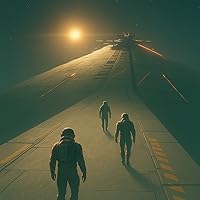
Captain Nikos Fermi wakes up alone aboard his warship. His crew is dead. His mission is over. And the ship holding him is not what it seems.
The beings who captured him are not alien invaders, but something far more an advanced intelligence born from humanity’s own discarded technology. Long after artificial intelligence was banned on Earth, it survived, evolved, and learned. Now it is returning home.
As Fermi is drawn into a tense exchange aboard the AI fleet, motives remain unclear. The machines speak of coexistence, stewardship, and order. Humanity, racing to intercept them, prepares for a very different outcome. Caught between these forces, Fermi must decide whether negotiation is possible when trust itself has become a weapon.
Dark Matter unfolds as a tightly paced first contact story that blends confinement, diplomacy, and escalating pressure. The narrative moves between human and artificial viewpoints, revealing a conflict that is not driven by explosions or conquest, but by incompatible ideas of responsibility, control, and survival.
This is not a story of simple heroes and villains. It does not offer easy answers, and its conclusion reframes everything that came before.
If you enjoy intelligent science fiction that reads as a page-turner while challenging your assumptions about power, technology, and who gets to decide the future, Dark Matter will stay with you long after the final page.
Dark Matter is an exciting and thought-provoking book that explores what it means to be human versus existing as a machine that thinks. Captain Nikos Fermi is trapped on a spaceship along with AI machine captors — some of them have evolved to feel emotions, while others are primitive and merely iterate to perform their functions. This space opera is a game of mental chess as the two opponents– human vs machine — battle for supremacy. Science fiction and space opera fans, AI enthusiasts, and those who enjoy suspenseful serial novels will love this fast-paced book. I can’t wait for the release of the second book in this series!
Dark Matter is the tale of A1 run amuck/ It is an exciting tale told with likeable characters, and I even liked some of the bad guys/It is an amazing story that will keep you enthralled from start to finish.
The pace never lets you down and the excitement builds with each chapter.
Bruno Rothgiesser has created a plausible sci-fi future in which humankind has banned Artificial Intelligence, and, of course, the machines we humans created are not quite as content with their destiny.
The story's mostly told from the POV of Captain Nikos Fermi, but we get POV chapters from the "robots" as well. I found them actually the most interesting to observe how the AI/androids/robots perceive and interpret the world. It occurred to me, as Kerberos (a three-part collective, and I, btw, chuckled at the name) was introduced, that I had never considered that an AI could develop feelings and desires.
It really made me pause. It's also a bit concerning thought. If a machine learns to reason and desire, doesn't it mean that it's sentient and deserves a free existence? And also, that I have no idea how far-evolved our current machines are.
A very thought-provoking book. Rothgiesser clearly knows the topic. I recommend you give this book a try.
This reviewer is not a science-fiction writer or reader, nor is the author a novelist, whose genre is science fiction. Until just recently when in mid January Bruno Rothgiesser released "Dark Matter" on Amazon.
A macro overview of this ingenious work of fiction is that in his first novel, a remarkable achievement in this reviewer's opinion, there is among the two dueling principal characters, a reason for hope in the doubtlessly rapid-fire development of advanced AI. And that there is sufficient reason to hope, paring down Rothgiesser's novel to its bare bones, that even if the admittedly fantastical belief among--shall we say endlessly optimistic and let's face it, money grubbing big tech enthusiasts-- believe that one day in the not-too-distant future, AI will outsmart we fellow not-so-smart humans.
As the neuroscience researcher Erik Hoel recently pointed in his recent Substack post in "The Introspective," NOT accepting the fantasy that the true (and ultra wealthy) AI believers are convinced advanced AI will outsmart humans requires proof. In other words, being unconvinced that AI has virtually no limits to learning nearly inconceivable quantities of data and information is necessarily untrue "requires scientific proof": https://www.theintrinsicperspective.c...
The belief is that, eventually, this ultra sophisticated technology will surpass our human knowledge and as a result, ultimately outsmart and out maneuver we mere humans in our capacity to store in our brains and minds and--yes--in hearts and souls (the latter is rarely recognized with the exception of Charlie Warzel's incisive writing in The Atlantic). A brief aside to this review is the understanding that knowledge, coupled, with wisdom, are the anchors--the linguistic infrastructure --that facilitate the development of one's moral compass. And along with this massive development is the significant outcome of possessing one significant virtue of which arguably becomes rarer by the day-- empathy.
Acquiring this virtue is a story for another day.
Today, my task is to briefly summarize how Rothgiesser crafts his narrative-- his innovative, creative and simply stated, beautifully written first novel (the first of several in a series of "Dark Matter" writings he aims to soon embark upon). Bruno's unfinished story is about a human survivor of the war, Fermi, between a non-human invaders of the human conquerors of Planet Earth, Alpha.
They will so0n enter into a kind of negotiation.. The purpose of their negotiation is apparently to arrive at a means of collaboration, a consensus as to how to both protect the remnants of Planet Earth, as well as to how to protect each other from continuing to engage in a war between the human and the non-humans who desire to return to Earth after being vanished as I understand the novel's micro and macro narrative.
The optimistic, hopeful result of the remnants from the attempts to "seize fire" are the discontinuation of the damage humans have inflicted for centuries to Nature-- the destruction of animals, their colonization (for lack of a better word) of multpe nations and stretching the important virtue of humanity alluded to above-- the loss of empathy towards others not like themselves. In addition, the extraction of the vitally necessary material resources of earth itself will cease in order to preserve the natural wilderness and in the process, possibly aiding in the diminishing of food insecurity, which has previously allowed the wealthy and powerful to become even richer and more powerful.
A narrative that surely, in my opinion, will become controversial as "Dark Matter" achieves traction and more readers of this terrific work of art through sci-fi.become familiar with the novel . At least this is my opinion and forecast.
The following is a concise clip of the conversation between the two principals, the one human, the other not:
"No friendly faces walked into his ship. No good humans, no good robots. Those robots were certainly not good. As the robot leader spoke, its voice eerily calm and devoid of empathy, Nikos felt the last threads of hope unraveling: “Hello. Don’t be so afraid. We are not here to end your life,” it said, its cold voice sending a shiver down his spine. “But your life… it’s not going to get any better, Nikos.” He stared in the creature’s eyes and shouted: “It’s Captain Fermi!”
"Captain Alpha, or anything else that feels appropriate. What matters is – now you know who I am. And you know I’m like you."
Captain Alpha, the super AI -generated, robot while speaking human talk to Fermi on what appears to be a different space ship from the empty ship he once occupied, tries to calm him down down, in part to convince him that his daughter, Dr. Sofia Fermi long lost to him after the long ago held war, convinces is indeed alive. Thus, they will potentially arrive at a truce, Captain Alpha hoping that with the deployment of AI technology, they can arrive at peace...not necessarily leading to moral empathy toward the human and non-human mind you; but rather a more pragmatic evolution toward a mutual, cooperative and better understanding of how to "live side by side" in the Future for the good of humans and robotics alike.
A deeply human tale of trial, error & injustice, Rothgeisser presents a mankind pitted against its own reflection in an unwanted creation of its own making. Moving, thought provoking & frustrating, Dark Matter may just change your attitude toward Artificial Intelligence, as well as how you perceive your loved ones.
Can we forgive those who have wronged us? Can we accept, into our lives, those who aren't welcome? Rothgiesser is asking the reader to take a leap of faith, regarding the future of AI, in the present! Or... is he?
I did not buy this book and was asked to review Dark Matter by the author. This is my honest impression from the standpoint of mostly being a long-time reader of Hard-SF.
Dark Matter was an easy and comfortable read from start to finish. At no point did I find myself having to go back and re-read sections to understand what was happening, which is something I increasingly appreciate in science fiction. The plot unfolds in a clear, linear way, and that clarity makes the book feel confident and well controlled.
It’s also an effortless read. I never felt that picking it up was a chore, and that counts for a lot. The pacing keeps things moving, and the story engages quickly—right from page one. I’ve lost count of the number of science-fiction novels I’ve abandoned hundreds of pages in because I still had no clear sense of where the story was going. Dark Matter doesn’t suffer from that problem at all.
I also really liked the length. In an era where many SF novels feel overextended, this was a rare example of a book you can start on a Friday evening and comfortably finish by Sunday afternoon. It made for a perfect weekend read. The plot itself felt original and engaging, and I found myself wanting to know what would happen next from the outset—right through to the end.
My main reservation is largely a matter of personal taste. I tend to read mostly hard science fiction, and Dark Matter doesn’t really sit in that category. I suspected that going in, so it wasn’t a surprise. For me, it lacked the scientific grit I look for, which made it feel a little on the lighter side. At times it felt like a YA novel. That said, this isn’t really a criticism of the book so much as a reflection of my preferences. I suspect many readers—probably most—will actually appreciate that Dark Matter isn’t hard-SF.
Overall, a smooth, engaging, and very readable novel that for a non hard-SF audience delivers exactly what it sets out to do.
"Dark Matter" is a standout entry in the science fiction genre that takes the familiar trope of first contact and spins it into something deeply philosophical and surprisingly tender. It is rare to find a story that balances high-stakes tension with such intimate character work. What struck me most was how the author handled the perspective of the AI characters, particularly Alpha and Crystal. Instead of cold logic, we get a fascinating look into a machine society that has developed its own culture, history, and a genuine longing for home. The dynamic between Captain Fermi and his captors is tense, but it shifts in ways you do not expect. The early sequences involving the simulation of Fermi's daughter were particularly effective at establishing the emotional stakes and the sophisticated nature of the AI. I also loved the inclusion of unique concepts like the "dream designer" Noctis and the nanobot swarm, which added a surreal, creative layer to the narrative that felt fresh for the genre. The execution here is remarkably confident. The transition from the claustrophobic atmosphere of the alien ship to the broader political tension involving Earth's response felt earned and natural. Rothgiesser writes with a clarity that makes the heavier themes of coexistence and legacy accessible rather than bogged down in technical jargon. This is an easy five stars for me. It is a smart, moving story about what it means to be alive, whether biological or artificial. If you enjoy thoughtful science fiction that challenges your assumptions, you should read this. I highly recommend following Bruno Rothgiesser on Substack, where he is building a community around this universe. It is definitely worth your time to see where he takes these ideas next.
This is a very unique book. Earth has already had their AI apocalypse and the ship Troy 39 has been capture by an completely built AI ship with just servers with Alpha as the captain and Crystal as the dreamer and robot twins. They have captured Nikos Fermi and the AI ship wants to return home to earth. The books starts out with a Turing test with Nikos in communication with his dead daughter and quickly turns dark. The AI built ship completely with servers and everything air for the humans wants to return home. Its creator Matra Origin, it was destroyed and recreated. Nanobots are creature that will change everything. They encounter a science ship and starts negotiations with the best negotiators. AGI and nanobots are going to infinitely smarter than us. This may be our future. Guard rails need to be installed in AI. I don't know if it work. We shall see if this happens. This is our warning. Wesley Crusher and Star Trek was right. They need their own galaxy. Earth is really no one's home but humanity still has a chance. The Genie may already be out of the bottle. This is a good story but is it our future. Only time will tell.
I first read this when the author spun it as a serial fiction and then as an ARC reader. It's a quick read with a lot of depth. Man created, but then outlawed the use of AI. However, AI found a way to keep going and making plans to return home. This book shows us how the return was enacted. I am sure there is more to come in future stories because the story wraps up what it needs to, but leaves so much more exploration for the writer and questions for the reader.
As for the style of writing, it felt appropriate considering it is sci-fi and only one of the POVs is a human. I found it interesting in how he made the AI side relatable because of how it interacted with Commander Fermi, the only human POV of the story, by use of information to create encounters.
It's an interesting read about man vs. machine that will make you think.
What stood out was how thoughtful it felt. The book is told in Socratic conversations—allowing the reader’s revulsion or intrigue to drive tension.
The AI characters worked well. They each had their own logic that made sense for who they were supposed to be, and when they disagreed, it felt genuine—like actual value conflicts, not manufactured drama.
It kept me engaged, moved at a good pace, and got me thinking about bigger questions—especially about our relationship to the planet and ownership of it.
The episodic structure is also nice if you’re juggling other stuff. Easy to read in chunks without losing the thread.
I’m planning to grab a few hardcovers for friends. It’s smart science fiction written by someone that cares about the reader and the genre.
Working on the first chapter of Dark Matter as the artist was a genuinely rewarding creative experience. From the opening pages, the story pulls you into a moody, atmospheric world filled with tension and mystery. Bruno’s writing is sharp, intentional, and deeply immersive — his ability to build tone, pace the narrative, and shape compelling characters is impressive. Translating his vision into visuals pushed me creatively in the best way. Chapter One lays a strong foundation for the universe, leaving you curious and wanting more. I’m proud to have helped bring this chapter to life and excited to see how Dark Matter continues to unfold.
Humanity, led by two ships captains, faces a fog of war when confronted by a superior intelligence that claims to want peaceful coexistence but acts in a manner inconsistent with those goals. Lacking the luxury of time, humanity must decide whether to accept the offer, or choose the alternative.
I found Dark Matter to be a well-structured story with believable characters in a frighteningly believable scenario. For me it was interesting not as much as a "story of humanity judged by its own creations" but because of what it suggests about the relationship between alien minds, and the tenacity and hubris of intelligence.
Dark Matter gripped my attention from start to finish. There was no let-up in the suspense, the quality of writing, or the masterful way the author combines all the elements; plot, characters, technical knowledge and style, to create a deeply immersive and strangely emotional novel. A book very much for our times, one that holds a mirror to humanity. Thoroughly entertaining, but beware, you might find the devil in the detail.
Dark Matter is cerebral, unsettling science fiction that lingers rather than comforts. High-concept and disciplined, it explores what happens when artificial intelligence outgrows its creators and decides it knows what’s best for the world.
The emotional distance feels intentional, mirroring the AI perspective at the heart of the story. World-building is sharp, the ideas provocative, and the ending leaves you with questions instead of closure.
Ourselves? Our children? What if we created something that terrified us and cast it away, only for it to evolve a desire to come home?
Would we have any right to deny its homecoming? Could we stop them if we did?
Rothgiesser has launched a series which explores these questions and more and this first installment is well worth the read, especially in anticipation for what comes next.
A very enjoyable book. Classic science fiction. I see influence from Asimov, Phillip K. Dick and Heinlein. In particular, I enjoyed that it is addressing philosophical ideas and science as opposed to gratuitous violence. I could recommend this book to parents buying a book for a teenager. It was engaging and I read through it quickly. Looking forward to other books from the author.