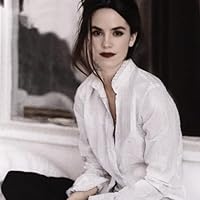
The Future is a book about time. The tender, vulnerable, and bitingly funny poems of Monica Ferrell's third collection confront the hours as they stream by, our relatively brief lives that feel so long while we are living them, successive generations and the unwinding story of our species, and the bewilderingly vast geological age of the planet. Traveling across eras, through ice ages to the eighteenth century and the modern day of Ozempic and chatbots, these poems also square up to the obscurity of what comes next as they peer forward into time still to come.At once irreverent yet elegant, sophisticated yet conversational, these poems capture what it means to get by day to day in a 21st century destabilized by ecological collapse, political havoc, and the incursion of technology into our most private and intimate spaces. “Every day I wake up,” Ferrell writes, “and ask, is it today? The volcano?” Restless in their imaginative scope, these poems leap across the world, from the enduring statues at Angkor Wat and Hampi to Alpine meadows contaminated with plastic to a supermarket in Vermont. Without papering over any of the difficulties we face today, Ferrell nonetheless expands our capacity to wonder, especially about the experience of motherhood, how the future keeps finding a way of breaking through.This book manifests as that impossible, unimaginable collision that annihilates the world as we thought it was and sees it emerge as pure energy. Ferrell includes us in “the bequest of this battered planet, this sweetly belabored thing,” from one generation to the next, reminding us of the genesis contained inside “one November night I too once opened my eyes to the bright.”
Monica Ferrell’s collection, “The Future’, considers the weighty question of what’s next? Partly in the context of art and history’s glaring cultural omissions; whilst colliding with outdated expectations, by refusing them in favor of a more visionary approach. It’s as much about what isn’t said, as what is; for example with titles like: ‘I Appreciate Your Visibility,’ which mock the shallow ‘dialing in’ of political correctness.
Born in New Delhi, living in the U.S., Ferrell won the prestigious Kathryn A. Morton Prize for her previous poetry collection, her writing here is almost recollectively mournful, rounding corners of her life in parallel to each life’s proclivity to echo a universal experience, asking: Is it our individuality that shapes us, or our similarities? Ferrell isn’t timid in her tackling of such an overreaching subject; her vision rejects linearity, catapulting readers from one epoch to the next, in a riotous, oft humorous, sometimes quietly horrifying exposé.
Somewhere in the history books,
The 400 ships are still burning
On a trash-spattered ocean, (Lepanto).
Ferrell’s writing opens like a pomegranate, each seed a furthering consideration, dispelling sterotype, shaking the tree to discover what else will fall out. Sometimes this is written surrealistically—layers of imagery and metaphor bounding over few lines like: “What’s worse—the automaton or a thing / With wishes? Reason or the dream?” (Twelve Variations On Etchings By Goya). Other times, her combination of history in relation to creativity, alongside philosophical considerations; keeps the reader off-balance, forcing them to query their own assumptions:
You have no proof of anything. Your only data
Is years spent here, though every decade
The view changes. The wheel turns. (The Eighteenth Century).
Is Farrell telling us: “The story has it all wrong”(Andromeda) as in, history is written by the victor not the truth? Or is this more personal, musings over our intrinsic worth in relation to bigger concepts?
Always I knew I was a pen-knife, a key,
Was bits of lapis lazuli fallen
From some lost statue’s eyes—I must have a use. (The Book Of Judith).
As a woman of color, from a former colonized/oppressed land written largely out of Western history, despite its far longer, more powerful legacy; this Indian poet doesn’t write with gilded imagery atop recollections of her ancestral birthplace, so much as locate her argument within modern and ancient culture; continually shifting the reader to overlooked stories within repressed histories:
When I point out This doesn’t feel right
This isn’t our map
You lie right to my face
From inside it (Little Voice).
Interestingly, ‘Little Voice,’ could equally juxtapose the eponymous British film about a shy girl who wished to sing; another example of stripping out confines, using the tools of the oppressor, not as Audrey Lorde warned against, but in an intelligent, conscious way forward (to the future), where in the poem ‘Angkor Wat,’ Farrell writes of the shifting powers of future and past: “A passenger, a stare, terrified down,” when she examines: “Between these two points like a gondola lift / Time shuttles back and forth the whole day.” This is an honest interpretation of where our rewriting of and denying history, has brought us to. A place many feel dislocated in:
is it all right if I tell you my true name
which won’t be found on any paperwork (Is It All Right).
The deliberate omission of a question mark, suggests it’s rhetorical, because the speaker doesn’t possess enough power over (truth telling) and:
someday I’ll go
live in caves alone
I won’t ask anymore
for permissions
Farrell encapsulates an intrinsic understanding of the fabric of existence and concept of transitions: “soon they will become the is and I the was” (Cosmos). Whereby reconciliation is in knowing she may have been born elsewhere and not fit easily in any one space, but: “I don’t belong to anybody” (Childhood). At its heart, ‘The Future’ is attempting to reclaim appropriated cultural and emotional heritage(s), through a modern, well-informed lens that is unapologetic in not asking for equality, but enforcing it through language and deed, knowing for any of us, there is not very long:
Death is with us, us real ones.
Animal, vegetable.
The rot leaks out, (At The Price Chopper).
Instead of passively accepting the reduction, Farrell’s writing of “sky burial” and wish to, “take the sky,” speaks to more, as in the same poem she states: “I’d rather take my luck / With a bruise, take flesh / softly mush-spotted / As an old woman’s thigh.” Even here, we’re not talking apples or Rilke, as much as who we can become (in the future): “ To some confection that refuses decay,” In a sense, embracing the inevitable, at the exclusion of being dictated to, at one’s core, one’s existence: