

What do you think?

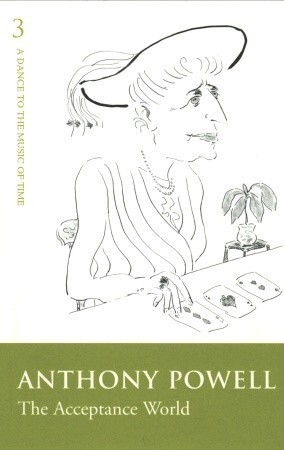
A Dance to the Music of Time #3
The Acceptance World
A Dance to the Music of Time – his brilliant 12-novel sequence, which chronicles the lives of over three hundred characters, is a unique evocation of life in twentieth-century England.The novels follow Nicholas Jenkins, Kenneth Widmerpool and others, as they negotiate the intellectual, cultural and social hurdles that stand between them and the “Acceptance World.”
214 pages, Hardcover
First published December 1, 1955
About the author
Anthony Powell
128 books347 followersPeople best know British writer Anthony Dymoke Powell for
A Dance to the Music of Time
, a cycle of 12 satirical novels from 1951 to 1975.
This Englishman published his volumes of work. Television and radio dramatizations subjected major work of Powell in print continuously. In 2008, The Times newspaper named Powell among their list of "the fifty greatest British writers since 1945."
https://en.wikipedia.org/wiki/Anthony...
This Englishman published his volumes of work. Television and radio dramatizations subjected major work of Powell in print continuously. In 2008, The Times newspaper named Powell among their list of "the fifty greatest British writers since 1945."
https://en.wikipedia.org/wiki/Anthony...
Ratings & Reviews
Friends & Following
Create a free account to discover what your friends think of this book!
Community Reviews
Displaying 1 - 30 of 183 reviews

July 20, 2020
Anthony Powell still coming across as a crusty old Tory. And the Proust comparisons are ever more hyperbolically offbeat. I still think he's much more like an inferior Evelyn Waugh. One thing I hate in life is not hearing the end of stories, but Powell hasn't convinced me his story is worth another eight volumes of my time so I'm giving this up even though I am curious what happens to his narrator and Jean.

February 10, 2016

3 -- The ACCEPTANCE WORLD
With the third period of the Dance, we track the configuration of stronger connections. The complex web formed by love affairs, marriages, work associations and cousin-ships continues to spin itself—along time. Just as it happens in life. Fittingly, Powell writes:
..nothing in life is planned—or everything is—because in the dance every step is ultimately the corollary of the step before; the consequence of being the kind of person one chances to be.
If on the second period the various dancers began to coalesce in two groups: those dancing to the demands of Power, and those inspired by the Arts. Images of Prokofiev’s version of the street fight of the Capulets and Montagues came in full colours to my mind. The bands springing on their feet flexing and taunting their thigh muscles readying for their ultimate attack.
Politics with the Capital Letters of the 1930s are forming their redoubtable squads.
The painterly and literary references continue to abound in the third volume and that to me is part of the entertainment in reading this saga, although they require an easier complementary exploration than with Proust. Painting makes itself visible through name dropping of famous painters--unlike in La recherche where specific paintings are imbedded like little jewels.
Writers also pen themselves in, but so far form a smaller population in the Dance. The exception would be the veiled reference to John Galsworthy. Presumably one of the characters is based on this writer who appalled Powell strongly. The fictional transmutation can be read as an encrypted literary criticism.
This novel certainly feels like a chain of riddles.
Along with the shaping of the ongoing plot—mostly the interrelationships of the characters—what keeps my reading impetus is the élan of Powell’s writing. The very fluidity of the prose, even if adorned with intricate steps or splendid vocabulary, is a marvel in itself. Viscous but light flow it is.

February 28, 2015
Occult sciences unexpectedly work, all the commotion round about arts is mostly futile and politics is a sheer caricature…
And only love reigns over everybody – a whole lot of love that is somewhat on the bittersweet side.
You are ready to be accepted by the world. But is the world ready to accept you?
And only love reigns over everybody – a whole lot of love that is somewhat on the bittersweet side.
There is always a real and an imaginary person you are in love with; sometimes you love one best, sometimes the other.
You are ready to be accepted by the world. But is the world ready to accept you?

July 12, 2014
This is the third volume in the twelve novel, “Dance to the Music of Time.” The books are organised in terms of the seasons and so the first three novels are the Spring of our narrator’s life, consisting of A Question of Upbringing, A Buyer’s Market and The Acceptance World. This novel is set in 1931 and follows many of the characters we have already become fond of, as well as some new introductions.
At the end of A Buyer’s Market, we found Nick Jenkins feeling slightly dissatisfied with his life and career. When we meet him again, he is still working at a publisher and involved with art books. In the first of five chapters he meets Myra Erdleigh through his Uncle Giles and has his fortune read. There is, indeed, much in this volume which touches on fate and love.
Many familiar characters appear in this book – Charles Stringham, Widmerpool, Quiggins, Peter Templer and his sister Jean, Sillery, Le Bas and others all feature. Nick stays with Peter Templer and his new wife, Mona, has a love affair, visits an art exhibition, sees a demonstration with some unlikely participants and attends an Old Boys dinner.
From the start, you are very much aware that this is set in the 1930’s. The entire feel is different from the party atmosphere of the 1920’s. Rather than wild parties, people are discussing politics and poetry. The London of the Bright Young Things has entered a period of depression, finance and business. We are aware that Nick is certainly entering his summer years and his youth is passing. Friends are not only getting married, but divorced, and perhaps Nick is also moving on and wanting more stability in his romantic life and career path. This is a stunning series and I look forward to reading on. The next book in the series is At Lady Molly’s.
At the end of A Buyer’s Market, we found Nick Jenkins feeling slightly dissatisfied with his life and career. When we meet him again, he is still working at a publisher and involved with art books. In the first of five chapters he meets Myra Erdleigh through his Uncle Giles and has his fortune read. There is, indeed, much in this volume which touches on fate and love.
Many familiar characters appear in this book – Charles Stringham, Widmerpool, Quiggins, Peter Templer and his sister Jean, Sillery, Le Bas and others all feature. Nick stays with Peter Templer and his new wife, Mona, has a love affair, visits an art exhibition, sees a demonstration with some unlikely participants and attends an Old Boys dinner.
From the start, you are very much aware that this is set in the 1930’s. The entire feel is different from the party atmosphere of the 1920’s. Rather than wild parties, people are discussing politics and poetry. The London of the Bright Young Things has entered a period of depression, finance and business. We are aware that Nick is certainly entering his summer years and his youth is passing. Friends are not only getting married, but divorced, and perhaps Nick is also moving on and wanting more stability in his romantic life and career path. This is a stunning series and I look forward to reading on. The next book in the series is At Lady Molly’s.

February 8, 2016
The spring of love becomes hidden and soon filled up.
-- Max Muller

"Emotional crises always promote the urgent need for executive action, so that the times when we most hope to be free from the practical administration of life are always those when the need to cope with the concrete world is more than ever necessary"
-- Anthony Powell, The Acceptance World
There is something amazing about Powell's attempt to gather the passage of time, the progression of life, the dynamic of relationships over 12 novels. When I read Proust and as I read Powell and even Knausgaard, I am always a bit shocked by the boldness of folding together six (Knausgaard), seven (Proust), or twelve novels into a narrative that actually works.
Reading Powell reminds me of reading an Evelyn Waugh that is stretched out over decades, or reading Proust where instead of the narrator focusing in, the narrator is actually ignoring the inner-life and capturing the world and the people around him. It is kind of dizzying if you step back and think about it. It is like reading Downton Abbey serialized from the 30s into the 60s with more characters, more art, and a bit more London and bit less Abbey.
So, I'm done with Book 3, done with 'the Acceptance World', and done with Spring. Bring on Summer and I'm guessing World War 2.
-- Max Muller
"Emotional crises always promote the urgent need for executive action, so that the times when we most hope to be free from the practical administration of life are always those when the need to cope with the concrete world is more than ever necessary"
-- Anthony Powell, The Acceptance World
There is something amazing about Powell's attempt to gather the passage of time, the progression of life, the dynamic of relationships over 12 novels. When I read Proust and as I read Powell and even Knausgaard, I am always a bit shocked by the boldness of folding together six (Knausgaard), seven (Proust), or twelve novels into a narrative that actually works.
Reading Powell reminds me of reading an Evelyn Waugh that is stretched out over decades, or reading Proust where instead of the narrator focusing in, the narrator is actually ignoring the inner-life and capturing the world and the people around him. It is kind of dizzying if you step back and think about it. It is like reading Downton Abbey serialized from the 30s into the 60s with more characters, more art, and a bit more London and bit less Abbey.
So, I'm done with Book 3, done with 'the Acceptance World', and done with Spring. Bring on Summer and I'm guessing World War 2.

March 9, 2016
[9/10]
... But what is the Acceptance World?
If you have goods to sell to a firm in Bolivia, you probably do not touch your money in the ordinary way until the stuff arrives there. Certain houses, therefore, are prepared to 'accept' the debt. They will advance you the money on the strength of your reputation. It is all right when the going is good, but sooner or later you are tempted to plunge. Then there is an alteration in the value of the Bolivian exchange, or a revolution, or perhaps the firm just goes bust - and you find yourself stung. That is, if you guess wrong.
One of the recurring characters in the series, Widmerpool, is getting a new job in the City of London, working for a kind of securities firm. The narrator, Nick Jenkins, now in his late twenties, is facing decision times in his own life regarding his career path (he publishes his first novel), his love life ('it's complicated'), and his social life (reuniting with old school friends and making new acquaintances). Over the course of this third novel, Nick starts to examine the metaphorical, universal symbolism of this business system:
When, in describing Widmerpool's new employment, Templer had spoken of 'the Acceptance World', I had been struck by the phrase. Even as a technical definition, it seemed to suggest what we are all doing; not only in business, but in love, art, religion, philosophy, politics, in fact all human activities. The Acceptance World was the world in which the essential element - happiness, for example - is drawn, as it were, from an engagement to meet a bill. Sometimes the goods are delivered, even a small profit made; sometimes the goods are not delivered, and disaster follows; sometimes the goods are delivered, but the value of the currency is changed. Besides, in another sense, the world is the Acceptance World as one approaches thirty; at least some illusions discarded. The mere fact of still existing as a human being proved that.
I have met Nicholas Jenkins in his school days, when he impressed me with his shyness and his curiosity, standing on the sidelines of life and taking notes about the behaviour of his peers. In the second book he was still cast in a spectator role, but his personality was taking shape under my eyes, and his narrative style developed with added subtlety and insight. Part of the attraction of Nick approaching a more mature age is by now the discovery of the passionate side of his nature and the further evolution of his literary style, in full control of metaphor, characterization and synthesis. Nick may have shed some of his youthfull illusions about the world, but there is still a keen sparkle of interest in his eye, and a passionate heart hiding behind the traditional stiff-upper-lip.
I reflected, not for the first time, how mistaken it is to suppose there exists some 'ordinary' world into which it is possible at will to wander. All human beings, driven as they are at different speeds by the same Furies, are at close range equally extraordinary.
Many of the characters in this third episode are people we have already met, which makes it easier for the reader to follow the events and the dynamics of their relationships. Some of them have been brought low by the recent economic crash of 1929 (Templer), some of them have been pushed forward by ambition and diligence ( Widmerpool, once so derided by all of us, had become in some mysterious manner a person of authority. ), some have remained unchanged, like milestones on the path through life of our narrator/protagonist (Uncle Giles). All of them though, as the series progresses, are revealed both as individuals and as allegorical figures of the Dance, symbols of the changing society and of the universal human nature that transcends time and place.
To be circumscribed by people constituting the same professional community as myself was no wish of mine, rather the contrary. However, an inexorable law governs all human existence in that respect, ordaining that sooner or later everyone must appear before the world as he is. Many are not prepared to face this sometimes distasteful principle. Indeed, the illusion that anyone can escape from the marks of his vocation is an aspect of romanticism common to every profession; those occupied with the world of action claiming their true interests to lie in the pleasure of imagination and reflection, while persons principally concerned with reflection or imaginative pursuits are for ever asserting their inalienable right to participate in an active sphere.
Powell argues not so much in favor of inflexible Fate ( a funny opening sequence has an older lady reading Nicks fortune in Tarot cards), as in a form of social determinism where nature and nurture combine with past actions to set a person down his or her path in life. "A Question of Upbringing" first proposed the theme, and I was waiting to find out how this theory and the traditional way of life will change over the course of the series.
Certainly the chief attraction of the projected visit would be the absence of all previous plan. But, in a sense, nothing in life is planned - or everything is - because in the dance every step is ultimately the corollary of the step before; the consequence of being the kind of person one chances to be.
The first cracks in the old caste system are already evident as Templer, Strickham and other members of the early twenties generation seem to be pushed to the sidelines and new blood is brought in by Widmerpool, Mark Members and Quiggin. For the artistic minded Nick Jenkins the social turbulence is reflected in the changing fashions in painting and literature and in his own literary efforts. The painter Isbister and the author St John Clarke are the exponents of the old generation while Nick's friends Barnsby, Members and Quiggin and even Nick himself are the rebels in search of a new, truer form of expression. In a novel and series that seems little interested in conventional plot, this third volume is anchored in an incident related to the publishing of an autobiography of Isbister by St John Clarke, with Nick as the go-between and perennial spectator of the Dance:
Taking into account the fact that St. John Clarke had made the plunge into 'modernism', the project seemed neither more nor less extraordinary than tackling Isbister's pictures from the point of view of Psychoanalysis, Surrealism, Roman Catholicism, Social Credit, or any other specialised approach.
Nick Jenkins though no longer seems content to sit on the sidelines, and in this third novel he is more ready to lay his heart down on the line, casting a wary eye at the mostly broken marriages of his friends, yet joining the emotional Acceptance World, where love may be imperfect and fragile and often painful, yet still better than the alternative. At the start of the novel Nick confesses his disillusionment over past relationships:
The situation in that quarter was at the moment confused. In fact, so far as 'love' was concerned, I had been living for some years past in a rather makeshift manner. This was not because I felt the matter to be of little interest, like a man who hardly cares what he eats provided hunger is satisfied, or one prepared to discuss painting, should the subject arise, though never tempted to enter a picture gallery. On the contrary, my interest in love was keen enough, but the thing itself seemed not particularly simple to come by.
By the end though, Nick no longer considers himself an outsider, and views his emotional investment as well spent. The closing pages of this third episode have Nick looking at a cheap, sugary French postcard of two lovers embracing in a plush armchair:
Outside a clock struck the hour. Though ominous, things still had their enchantment. After all, as St. John Clarke was reported to have said at the Huntercombes, 'All blessings are mixed blessings'. Perhaps, in spite of everything, the couple of the postcard could not be dismissed so easily. It was in their world that I seemed now to find myself.
What else is left to say? I am planning to continue with Anthony Powell's magnum opus, and the main attraction appears to be the quality of the social observations and the beauty, the elegance of the prose. A few final quotes should exemplify my continuing interest. In describing a decrepit grand hotel in London, the preferred residence of his cranky uncle Giles, Nick goes for inspiration to the works of Joseph Conrad:
Not only the battleship-grey colour, but also something at once angular and top-heavy about the block's configuration as a whole, suggested a large vessel moored in the street. Even within, at least on the ground floor, the Ufford conveyed some reminder of life at sea, though certainly of no luxuriously equiped liner; at best one of those superannuated shooners of Conrad's novels, perhaps decorated years before as a rich man's yacht, now tarnished by the years and reduced to ignoble uses like traffic in tourists, pilgrims, or even illegal immigrants; pervaded - to use an appropriately Conradian mannerism - with uneasy memories of the strife of men. That was the feeling the Ufford gave, riding at anchor on the sluggish Bayswater tides.
In describing the wife of a friend, Nick leaves behind youthful infatuation for a more pragmatic assessment, while keeping faith with his earlier custom of referencing paintings when describing people:
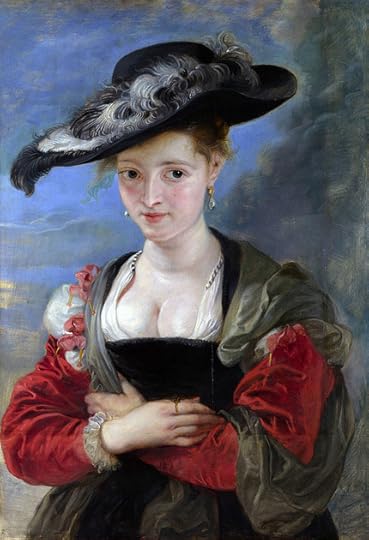
Rubens - Chapeau de Paille
She was like some savage creature, anxious to keep up appearances before members of a more highly civilised species, although at the same time keenly aware of her own superiority in cunning. There was something hard and untamed about her, probably the force that had attracted Templer and others.
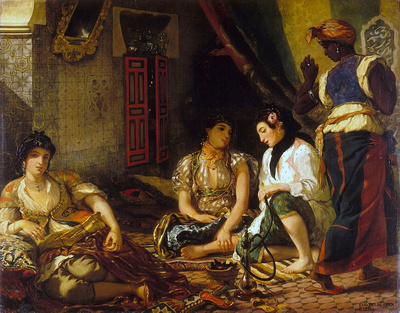
Delacroix - Femmes d'Alger dans leur appartement
A final obervation on the difficulties of writing about a society that prides itself on keeping up appearances and hiding emotions behind an imperturbable facade:
Intricacies of social life make English habits unyielding to simplification, while understatement and irony - in which all classes of this island converse - upset the normal emphasis of reported speech.
... But what is the Acceptance World?
If you have goods to sell to a firm in Bolivia, you probably do not touch your money in the ordinary way until the stuff arrives there. Certain houses, therefore, are prepared to 'accept' the debt. They will advance you the money on the strength of your reputation. It is all right when the going is good, but sooner or later you are tempted to plunge. Then there is an alteration in the value of the Bolivian exchange, or a revolution, or perhaps the firm just goes bust - and you find yourself stung. That is, if you guess wrong.
One of the recurring characters in the series, Widmerpool, is getting a new job in the City of London, working for a kind of securities firm. The narrator, Nick Jenkins, now in his late twenties, is facing decision times in his own life regarding his career path (he publishes his first novel), his love life ('it's complicated'), and his social life (reuniting with old school friends and making new acquaintances). Over the course of this third novel, Nick starts to examine the metaphorical, universal symbolism of this business system:
When, in describing Widmerpool's new employment, Templer had spoken of 'the Acceptance World', I had been struck by the phrase. Even as a technical definition, it seemed to suggest what we are all doing; not only in business, but in love, art, religion, philosophy, politics, in fact all human activities. The Acceptance World was the world in which the essential element - happiness, for example - is drawn, as it were, from an engagement to meet a bill. Sometimes the goods are delivered, even a small profit made; sometimes the goods are not delivered, and disaster follows; sometimes the goods are delivered, but the value of the currency is changed. Besides, in another sense, the world is the Acceptance World as one approaches thirty; at least some illusions discarded. The mere fact of still existing as a human being proved that.
I have met Nicholas Jenkins in his school days, when he impressed me with his shyness and his curiosity, standing on the sidelines of life and taking notes about the behaviour of his peers. In the second book he was still cast in a spectator role, but his personality was taking shape under my eyes, and his narrative style developed with added subtlety and insight. Part of the attraction of Nick approaching a more mature age is by now the discovery of the passionate side of his nature and the further evolution of his literary style, in full control of metaphor, characterization and synthesis. Nick may have shed some of his youthfull illusions about the world, but there is still a keen sparkle of interest in his eye, and a passionate heart hiding behind the traditional stiff-upper-lip.
I reflected, not for the first time, how mistaken it is to suppose there exists some 'ordinary' world into which it is possible at will to wander. All human beings, driven as they are at different speeds by the same Furies, are at close range equally extraordinary.
Many of the characters in this third episode are people we have already met, which makes it easier for the reader to follow the events and the dynamics of their relationships. Some of them have been brought low by the recent economic crash of 1929 (Templer), some of them have been pushed forward by ambition and diligence ( Widmerpool, once so derided by all of us, had become in some mysterious manner a person of authority. ), some have remained unchanged, like milestones on the path through life of our narrator/protagonist (Uncle Giles). All of them though, as the series progresses, are revealed both as individuals and as allegorical figures of the Dance, symbols of the changing society and of the universal human nature that transcends time and place.
To be circumscribed by people constituting the same professional community as myself was no wish of mine, rather the contrary. However, an inexorable law governs all human existence in that respect, ordaining that sooner or later everyone must appear before the world as he is. Many are not prepared to face this sometimes distasteful principle. Indeed, the illusion that anyone can escape from the marks of his vocation is an aspect of romanticism common to every profession; those occupied with the world of action claiming their true interests to lie in the pleasure of imagination and reflection, while persons principally concerned with reflection or imaginative pursuits are for ever asserting their inalienable right to participate in an active sphere.
Powell argues not so much in favor of inflexible Fate ( a funny opening sequence has an older lady reading Nicks fortune in Tarot cards), as in a form of social determinism where nature and nurture combine with past actions to set a person down his or her path in life. "A Question of Upbringing" first proposed the theme, and I was waiting to find out how this theory and the traditional way of life will change over the course of the series.
Certainly the chief attraction of the projected visit would be the absence of all previous plan. But, in a sense, nothing in life is planned - or everything is - because in the dance every step is ultimately the corollary of the step before; the consequence of being the kind of person one chances to be.
The first cracks in the old caste system are already evident as Templer, Strickham and other members of the early twenties generation seem to be pushed to the sidelines and new blood is brought in by Widmerpool, Mark Members and Quiggin. For the artistic minded Nick Jenkins the social turbulence is reflected in the changing fashions in painting and literature and in his own literary efforts. The painter Isbister and the author St John Clarke are the exponents of the old generation while Nick's friends Barnsby, Members and Quiggin and even Nick himself are the rebels in search of a new, truer form of expression. In a novel and series that seems little interested in conventional plot, this third volume is anchored in an incident related to the publishing of an autobiography of Isbister by St John Clarke, with Nick as the go-between and perennial spectator of the Dance:
Taking into account the fact that St. John Clarke had made the plunge into 'modernism', the project seemed neither more nor less extraordinary than tackling Isbister's pictures from the point of view of Psychoanalysis, Surrealism, Roman Catholicism, Social Credit, or any other specialised approach.
Nick Jenkins though no longer seems content to sit on the sidelines, and in this third novel he is more ready to lay his heart down on the line, casting a wary eye at the mostly broken marriages of his friends, yet joining the emotional Acceptance World, where love may be imperfect and fragile and often painful, yet still better than the alternative. At the start of the novel Nick confesses his disillusionment over past relationships:
The situation in that quarter was at the moment confused. In fact, so far as 'love' was concerned, I had been living for some years past in a rather makeshift manner. This was not because I felt the matter to be of little interest, like a man who hardly cares what he eats provided hunger is satisfied, or one prepared to discuss painting, should the subject arise, though never tempted to enter a picture gallery. On the contrary, my interest in love was keen enough, but the thing itself seemed not particularly simple to come by.
By the end though, Nick no longer considers himself an outsider, and views his emotional investment as well spent. The closing pages of this third episode have Nick looking at a cheap, sugary French postcard of two lovers embracing in a plush armchair:
Outside a clock struck the hour. Though ominous, things still had their enchantment. After all, as St. John Clarke was reported to have said at the Huntercombes, 'All blessings are mixed blessings'. Perhaps, in spite of everything, the couple of the postcard could not be dismissed so easily. It was in their world that I seemed now to find myself.
What else is left to say? I am planning to continue with Anthony Powell's magnum opus, and the main attraction appears to be the quality of the social observations and the beauty, the elegance of the prose. A few final quotes should exemplify my continuing interest. In describing a decrepit grand hotel in London, the preferred residence of his cranky uncle Giles, Nick goes for inspiration to the works of Joseph Conrad:
Not only the battleship-grey colour, but also something at once angular and top-heavy about the block's configuration as a whole, suggested a large vessel moored in the street. Even within, at least on the ground floor, the Ufford conveyed some reminder of life at sea, though certainly of no luxuriously equiped liner; at best one of those superannuated shooners of Conrad's novels, perhaps decorated years before as a rich man's yacht, now tarnished by the years and reduced to ignoble uses like traffic in tourists, pilgrims, or even illegal immigrants; pervaded - to use an appropriately Conradian mannerism - with uneasy memories of the strife of men. That was the feeling the Ufford gave, riding at anchor on the sluggish Bayswater tides.
In describing the wife of a friend, Nick leaves behind youthful infatuation for a more pragmatic assessment, while keeping faith with his earlier custom of referencing paintings when describing people:
Rubens - Chapeau de Paille
She was like some savage creature, anxious to keep up appearances before members of a more highly civilised species, although at the same time keenly aware of her own superiority in cunning. There was something hard and untamed about her, probably the force that had attracted Templer and others.
Delacroix - Femmes d'Alger dans leur appartement
A final obervation on the difficulties of writing about a society that prides itself on keeping up appearances and hiding emotions behind an imperturbable facade:
Intricacies of social life make English habits unyielding to simplification, while understatement and irony - in which all classes of this island converse - upset the normal emphasis of reported speech.

May 18, 2014
Ten years on from the beginning of A Question of Upbringing, which starts with narrator Nick Jenkins recounting his last few years at public school, The Acceptance World begins in London in 1931. Many of the primary characters have undergone significant change. Some that seemed to have the world at their feet have squandered their gifts, whilst others who were more pitiful in their younger incarnations are enjoying success.
The economic gloom that characterised the 1930s seems to permeate this part of A Dance to the Music of Time, despite this The Acceptance World is supremely enjoyable.
This volume introduces a hint of mysticism, a new character called Myra Erdleigh tells Nick's fortune through the ancient practice of cartomancy (reading ordinary playing cards) and, later in the story, there is an incident with a planchette. I'd never heard of them before but apparently planchettes came to prominence in the years following the establishment of Spiritualism in America in the mid-nineteenth century, kick starting a craze for supernaturally tinged parlour games, séances etc. that must have continued into the early 1930s (probably with a resurgence after World War One).
The Acceptance World is certainly the most dramatic volume so far, complete with a merry-go-round of relationship changes. No sooner do two disparate characters meet than a possible change in relationship status is in the offing.
As I work through the series, it is becoming clearer how some of what happens in the early stages, sets up the Dance as we move forward in time. This is making the series progressively more enjoyable, rewarding and compelling. I raced through The Acceptance World such was the pleasure it gave me. I've enjoyed all of the first three volumes however this has been the most enjoyable so far.
I encourage anyone who starts the series, and is unsure about whether to commit, to stick with it. It becomes ever more enjoyable and rewarding.
My other tip is to refer to AnthonyPowell.org where there are lists that help the reader to keep track of who is who, along with a synopsis of every volume, and interesting and insightful essays.
5/5
A Dance to the Music of Time is a twelve-volume cycle of novels by Anthony Powell, and The Acceptance World is the third of the twelve volumes
The twelve books of A Dance to the Music of Time are available individually or as four volumes
Spring
A Question of Upbringing – (1951)
A Buyer's Market – (1952)
The Acceptance World – (1955)
Summer
At Lady Molly's – (1957)
Casanova's Chinese Restaurant – (1960)
The Kindly Ones – (1962)
Autumn
The Valley of Bones – (1964)
The Soldier's Art – (1966)
The Military Philosophers – (1968)
Winter
Books Do Furnish a Room – (1971)
Temporary Kings – (1973)
Hearing Secret Harmonies – (1975)
(dates are first UK publication dates)
The economic gloom that characterised the 1930s seems to permeate this part of A Dance to the Music of Time, despite this The Acceptance World is supremely enjoyable.
This volume introduces a hint of mysticism, a new character called Myra Erdleigh tells Nick's fortune through the ancient practice of cartomancy (reading ordinary playing cards) and, later in the story, there is an incident with a planchette. I'd never heard of them before but apparently planchettes came to prominence in the years following the establishment of Spiritualism in America in the mid-nineteenth century, kick starting a craze for supernaturally tinged parlour games, séances etc. that must have continued into the early 1930s (probably with a resurgence after World War One).
The Acceptance World is certainly the most dramatic volume so far, complete with a merry-go-round of relationship changes. No sooner do two disparate characters meet than a possible change in relationship status is in the offing.
As I work through the series, it is becoming clearer how some of what happens in the early stages, sets up the Dance as we move forward in time. This is making the series progressively more enjoyable, rewarding and compelling. I raced through The Acceptance World such was the pleasure it gave me. I've enjoyed all of the first three volumes however this has been the most enjoyable so far.
I encourage anyone who starts the series, and is unsure about whether to commit, to stick with it. It becomes ever more enjoyable and rewarding.
My other tip is to refer to AnthonyPowell.org where there are lists that help the reader to keep track of who is who, along with a synopsis of every volume, and interesting and insightful essays.
5/5
A Dance to the Music of Time is a twelve-volume cycle of novels by Anthony Powell, and The Acceptance World is the third of the twelve volumes
The twelve books of A Dance to the Music of Time are available individually or as four volumes
Spring
A Question of Upbringing – (1951)
A Buyer's Market – (1952)
The Acceptance World – (1955)
Summer
At Lady Molly's – (1957)
Casanova's Chinese Restaurant – (1960)
The Kindly Ones – (1962)
Autumn
The Valley of Bones – (1964)
The Soldier's Art – (1966)
The Military Philosophers – (1968)
Winter
Books Do Furnish a Room – (1971)
Temporary Kings – (1973)
Hearing Secret Harmonies – (1975)
(dates are first UK publication dates)

February 15, 2016
Anthony Powell's third book in his lovely "A Dance to the Music of Time" series is set in Great Britain in the early 1930s. Below the surface the Great Depression looms, and some of the characters are involved in leftist organizations and workers' marches. Nick, who works for a publisher of art books, drops names of artists into conversations and the Impressionists are being mentioned more now. The introduction of the fortune teller Myra Erdleigh, and a seance using a planchette adds an interesting element to the socializing. Le Bas hosts a reunion of his former students at the Ritz, an opportunity for Nick to catch up with his upper class friends who are working their way up the business ladder. Nick becomes involved again with his first love, but it's questionable whether the relationship will last. So it's on to book four to see where the dance of time will take Nick Jenkins and his friends in 1934.

April 10, 2026
The Acceptance World by Anthony Powell is the third book in the roman fleuve A Dance To The Music of All Time, which is included on The Modern Library’s Top 100 Novels, among the 1,000 Novels Everyone Must Read, it is ranked 339th on The Greatest Books of All Time site, and more importantly for this space, it is among my Top 20 – you find thousands of reviews -not necessarily crème de la crème – on magnum opera from the aforementioned and other lists on my blog https://realinibarzoi.blogspot.com/20... and YouTube channel, in case I am not on Goodreads anymore
10 out of 10
I have been thrilled by A Dance To The Music of Time https://realinibarzoi.blogspot.com/20... the first time I had the chance to read it, and now I am blessed again, The Acceptance World is the third volume, part of this repeated joy ride, seeing as I still have the Kingsley Amis oeuvre…
I am set for this year, maybe some way into the next, what with Marcel Proust on the agenda again – A Dance To the Music of Time has been compared with the chef d’oeuvre A La Recherche du Temps Perdu, which is second on The GOAT site, and first on my own list, together with the magnum opera of Magister Ludi Amis
Nick Jenkins meets with Uncle Giles at the beginning of this third part in the roman fleuve and the latter introduces Myra Erdleigh, a clairvoyant, who will enter the stage later, in unexpected circumstances, she ‘reads the cards’ the first time, and then she is drawn into a plaquette game on the second encounter, talking to spirits
Karl, as in Karl Marx, will address the gathering from…beyond the grave, and that was just one of the outré, amusing situations the reader is lucky to have: Kenneth Windmerpool will give an unsolicited, rude speech at some point (spoiler alert would be required, but who reads here anyway?) which might kill Le Bas
St John Clarke’s presence is amusing and dramatic, the character is based on John Galsworthy https://realinibarzoi.blogspot.com/20... and he has one assistant, Mark Members, disputing with another personage J.G. Quiggin, a Marxist writer, the position close to the older man
Under the influence of Quiggin, St John Clarke changes his political views, from liberal, he becomes a Marxist, he is even pushed in a wheelchair to attend a march, along Quiggin and Mona, the latter was Peter Templer’s wife when she decides to elope with the ‘revolutionary writer’, a very peculiar decision as explained
Nick Jenkins or else the author explains this clearly: it is as if Anna Karenina https://realinibarzoi.blogspot.com/20... is chatting on husband Vronsky with lover Karenin, for Peter Temple has always had a way with women, charming, attractive…
Whereas Quiggin is shabby, arrogant, scheming, I wonder where this and other connections will go from here, for we have had a lot of surprises https://realinibarzoi.blogspot.com/20... Le Bas was arrested in the First Movement an we are reminded of that at the end of The Acceptance World
10 out of 10
I have been thrilled by A Dance To The Music of Time https://realinibarzoi.blogspot.com/20... the first time I had the chance to read it, and now I am blessed again, The Acceptance World is the third volume, part of this repeated joy ride, seeing as I still have the Kingsley Amis oeuvre…
I am set for this year, maybe some way into the next, what with Marcel Proust on the agenda again – A Dance To the Music of Time has been compared with the chef d’oeuvre A La Recherche du Temps Perdu, which is second on The GOAT site, and first on my own list, together with the magnum opera of Magister Ludi Amis
Nick Jenkins meets with Uncle Giles at the beginning of this third part in the roman fleuve and the latter introduces Myra Erdleigh, a clairvoyant, who will enter the stage later, in unexpected circumstances, she ‘reads the cards’ the first time, and then she is drawn into a plaquette game on the second encounter, talking to spirits
Karl, as in Karl Marx, will address the gathering from…beyond the grave, and that was just one of the outré, amusing situations the reader is lucky to have: Kenneth Windmerpool will give an unsolicited, rude speech at some point (spoiler alert would be required, but who reads here anyway?) which might kill Le Bas
St John Clarke’s presence is amusing and dramatic, the character is based on John Galsworthy https://realinibarzoi.blogspot.com/20... and he has one assistant, Mark Members, disputing with another personage J.G. Quiggin, a Marxist writer, the position close to the older man
Under the influence of Quiggin, St John Clarke changes his political views, from liberal, he becomes a Marxist, he is even pushed in a wheelchair to attend a march, along Quiggin and Mona, the latter was Peter Templer’s wife when she decides to elope with the ‘revolutionary writer’, a very peculiar decision as explained
Nick Jenkins or else the author explains this clearly: it is as if Anna Karenina https://realinibarzoi.blogspot.com/20... is chatting on husband Vronsky with lover Karenin, for Peter Temple has always had a way with women, charming, attractive…
Whereas Quiggin is shabby, arrogant, scheming, I wonder where this and other connections will go from here, for we have had a lot of surprises https://realinibarzoi.blogspot.com/20... Le Bas was arrested in the First Movement an we are reminded of that at the end of The Acceptance World

March 2, 2016
I'll give this third book in the 12 part series another 4 stars, but the entire 3 books in this volume would rate a 5. It takes us from school days and through their twenties of Nick Jenkins and his school mates. I feel as if I know them all quite well now, and care about the rest of their lives. This finishes the Spring portion of The Dance of Time.

March 22, 2026
This marks the end of the first 3 books, usually considered together as 'Spring' in the cycle. It follows on with much the same trends as volume two, though for some inexplicable reason I preferred this one. Nick Jenkins is still selling art books and is still, at almost every turn (or so it seems) bumping into people he knows. Powell's London is quite small. There are some new characters, but mostly the same. Divination is a running motif of this one; at one point, at a party, a planchette comes out and they seem to commune with the ghost of Karl Marx. Widmerpool arrives again, towards the end of the book, as does Stringham, who is one of my favourite characters. This volume ends with a very humorous, and sad, scene involving Stringham getting wankered at a party. Jenkins and Widmerpool conduct him home. He comes out of his drunken stupor as they try to manoeuvre him into bed.
He is, at least, a reasonable drunk. Though a few pages later he and Widmerpool begin wrestling when he tries to get out of bed again.
'Look here,' he said, suddenly sitting up on the bed, 'what is happening? People seem to be treating me roughly. Am I being thrown out of somewhere? If so, where? And what have I done to deserve such treatment? I am perfectly prepared to listen to reason and admit that I was in the wrong, and pay for anything I have broken. That is provided, of course, that I was in the wrong. Nick, why are you letting this man hustle me? I seem for some reason to be in bed in the middle of the afternoon. Really, my habits get worse and worse. I am even now full of good resolution for getting up at half-past seven every morning. But who is this man? I know his face.'
He is, at least, a reasonable drunk. Though a few pages later he and Widmerpool begin wrestling when he tries to get out of bed again.

June 1, 2018
I just adore this series, the slow episodic twisting and turning, the rich characterisation, the elegant writing and philosophical discussions - what a book!
September 6, 2024
Even more addictive than book 1? The narrator / Jean Templer relationship drives this volume as does, you guessed up, the authority/escapades of Widmerpool. I can't wait to see what happens in the next 9 books. Reminds me of high school and college, seeing the same people everyday but still fascinated, thrilled to see them, wondering if they are changing like I am.

October 29, 2014
Anthony Powell changed his writing style between books 2 and 3 of "A Dance to the Music of Time". Having got used to those long and convoluted sentences to be found in the first two books, I found they had shortened somewhat in the third volume, "The Acceptance World". Whether this is because he was writing about the thirties and felt the need to pare things down a bit, or because his editor told him to do so, I must admit that this volume was easier to read.
Curiously, there were only a couple of references to "the slump", which certainly didn't seem to affect the narrator, Nicholas Jenkins, or his contemporaries. Given that he worked with a firm that published art books, I found that a bit surprising, but maybe these gilded young men did manage to escape the worst of the Great Depression.
The title is explained at the beginning of the fifth and final chapter:
"The Acceptance World was the world in which the essential element - happiness, for example - is drawn, as it were, from an engagement to meet a bill. Sometimes the goods are delivered, even a small profit made; sometimes the goods are not delivered, and disaster follows; sometimes the goods are delivered, but the value of the currency is changed. Besides, in another sense, the whole world is the Acceptance World as one approaches thirty; at least some illusions discarded. The mere fact of still existing as a human being proved that."
This concludes the first volume of the sequence, subtitled "Spring", so I shall pause here and read a couple of different authors before returning to Powell's magnum opus.
Curiously, there were only a couple of references to "the slump", which certainly didn't seem to affect the narrator, Nicholas Jenkins, or his contemporaries. Given that he worked with a firm that published art books, I found that a bit surprising, but maybe these gilded young men did manage to escape the worst of the Great Depression.
The title is explained at the beginning of the fifth and final chapter:
"The Acceptance World was the world in which the essential element - happiness, for example - is drawn, as it were, from an engagement to meet a bill. Sometimes the goods are delivered, even a small profit made; sometimes the goods are not delivered, and disaster follows; sometimes the goods are delivered, but the value of the currency is changed. Besides, in another sense, the whole world is the Acceptance World as one approaches thirty; at least some illusions discarded. The mere fact of still existing as a human being proved that."
This concludes the first volume of the sequence, subtitled "Spring", so I shall pause here and read a couple of different authors before returning to Powell's magnum opus.

July 24, 2021
Volume 3 of Powell’s addictive saga is starting to display qualities of the stellar British documentary series ‘Seven-Up.’
We have become familiar with the characters, are drawn to some more that others, and look forward to the next instalment with anticipation. Fortunately, in the case of ‘A Dance to the Music of Time,’ there is no seven-year wait between courses.
We have become familiar with the characters, are drawn to some more that others, and look forward to the next instalment with anticipation. Fortunately, in the case of ‘A Dance to the Music of Time,’ there is no seven-year wait between courses.

March 1, 2016
My favorite of the first three.

February 6, 2015
OCTOBER 2023 RE-READ: The Acceptance World is more fractured than A Buyer's Market but more skilfully handled - reading the two in close succession I was struck by how much tighter Powell's style is, how immediately funny the novel is after the long throat-clearing passages in the first two books. He's also revelling in his large cast - there are a few chapters which simply feel like he's put 5 or so minor characters in a room together to have fun with them. There's no set-piece as bravura as the Andriadis party night in Book 2 (in fact I'm not sure there ever is again) but this is the smoothest of the books so far, even if it's impossible to follow on its own.
--Original review below...--
The main storyline of The Acceptance World - the narrator's love affair with a married woman - makes it one of the few parts of the novel sequence where his own story takes centre stage. That doesn't make 'our hero' much more forthcoming. Most of the cast of couples that forms and parts through the book are subject to much speculation around the motives of attraction, while the progress of his own relationship is told across brief, sketched vignettes - he and his lover are hardly ever alone together, and he's more often found observing others at what turn out (inevitably) to be pivotal moments.
If the narrator were more demonstrative, the Dance would be a very different (and more ordinary) kind of a novel. (On a second reading, this book reinforces Nick's subtle unreliability as a narrator, particularly where his love life is concerned). In any case, the contrast works well - his relationship glanced more often in reflection as he catalogues the ups and downs of his friends' romances and partnerships. The other main storylines - professional pique and intrigue in left-wing literary circles, and the surprising collapse of a schoolfriend's glamorous marriage - let Powell enjoy the more farcical elements of love and friendship, with commentary from the novels' philosopher of women, Barnby, never far away. Barnby is an artist of the bullshit as well as the visual kind - the progress of his own romances generally fraught. His constant indirect presence is a reminder that the Dance as a novel has as much to say about friendship as love.
Powell's rococo style has tightened up noticeably from the second book, whose events and encounters (wondrous and exotic at the time) are by this point commonplace for the narrator. Taken as one of the Dance's four seasons, the first three books capture well different phases of youth - the self-consciously vital (but ultimately often insignificant) incidents of school and university; the wild, almost random opportunities and frustrations of your early 20s, and then, as social milieus settle and self-knowledge hardens, a time when still immature choices begin to leave more lasting scars.
--Original review below...--
The main storyline of The Acceptance World - the narrator's love affair with a married woman - makes it one of the few parts of the novel sequence where his own story takes centre stage. That doesn't make 'our hero' much more forthcoming. Most of the cast of couples that forms and parts through the book are subject to much speculation around the motives of attraction, while the progress of his own relationship is told across brief, sketched vignettes - he and his lover are hardly ever alone together, and he's more often found observing others at what turn out (inevitably) to be pivotal moments.
If the narrator were more demonstrative, the Dance would be a very different (and more ordinary) kind of a novel. (On a second reading, this book reinforces Nick's subtle unreliability as a narrator, particularly where his love life is concerned). In any case, the contrast works well - his relationship glanced more often in reflection as he catalogues the ups and downs of his friends' romances and partnerships. The other main storylines - professional pique and intrigue in left-wing literary circles, and the surprising collapse of a schoolfriend's glamorous marriage - let Powell enjoy the more farcical elements of love and friendship, with commentary from the novels' philosopher of women, Barnby, never far away. Barnby is an artist of the bullshit as well as the visual kind - the progress of his own romances generally fraught. His constant indirect presence is a reminder that the Dance as a novel has as much to say about friendship as love.
Powell's rococo style has tightened up noticeably from the second book, whose events and encounters (wondrous and exotic at the time) are by this point commonplace for the narrator. Taken as one of the Dance's four seasons, the first three books capture well different phases of youth - the self-consciously vital (but ultimately often insignificant) incidents of school and university; the wild, almost random opportunities and frustrations of your early 20s, and then, as social milieus settle and self-knowledge hardens, a time when still immature choices begin to leave more lasting scars.

July 31, 2016
What a master of the big scene Powell is. Not scenes of huge energy with violence and things being destroyed (such as occur in Dickens' historical novels, for instance), but long scenes about people sharing time together, often at meals. There are quite a lot of meals of some sort or other in this book (probably in the previous two as well, but I don't remember them so vividly there: I think parties were a bigger focus in A Buyer's Market.
Towards the end of this book the three characters who are most to the fore in the series, Stringham, Widmerpool and of course the narrator, Nick Jenkins, come together for the first time in some years. Stringham is on the way down and Widmerpool on the way up. This is the reverse of how the series started, when Widmerpool was the butt of the jokes. He's as obnoxious as ever, but plainly is destined to succeed by sheer will power. Stringham has almost come to the point of having very little will power, and you feel sorry for him.
What else happens? A bunch of seemingly unconnected things, yet Powell continually connects them unexpectedly. There is some peculiar delving in the occult on two occasions through cards and a planchette; there is the constant flux of wives divorcing husbands and husbands divorcing wives and then the various partners turning up with someone else in the story. It's chaotic and demoralising. Jenkins is in love (again) with Jean Templar; she's officially still married and not only that has also had a lover at some point, a man who seems to be a ridiculous match for her - according to Nick.
There's quite a lot of philosophising about what and who women are. Are these Nick's views, or Powell's? Are they true or the ideas of a possibly unreliable narrator? Powell doesn't let us know, since his voice and Nick's often seem to be one and the same. How reliable is Nick, in fact? We have to decide; even though we take his side, because he seems relatively trustworthy, there are hints that not all is at it seems.
This is the third in the series; I've now read the second and third very close to each other, with some other books between. It's plain that it helps to read the series as a whole within a shortish period of time; say a year, rather than leaving a long gap between any two volumes (as I did between the first and second).
Towards the end of this book the three characters who are most to the fore in the series, Stringham, Widmerpool and of course the narrator, Nick Jenkins, come together for the first time in some years. Stringham is on the way down and Widmerpool on the way up. This is the reverse of how the series started, when Widmerpool was the butt of the jokes. He's as obnoxious as ever, but plainly is destined to succeed by sheer will power. Stringham has almost come to the point of having very little will power, and you feel sorry for him.
What else happens? A bunch of seemingly unconnected things, yet Powell continually connects them unexpectedly. There is some peculiar delving in the occult on two occasions through cards and a planchette; there is the constant flux of wives divorcing husbands and husbands divorcing wives and then the various partners turning up with someone else in the story. It's chaotic and demoralising. Jenkins is in love (again) with Jean Templar; she's officially still married and not only that has also had a lover at some point, a man who seems to be a ridiculous match for her - according to Nick.
There's quite a lot of philosophising about what and who women are. Are these Nick's views, or Powell's? Are they true or the ideas of a possibly unreliable narrator? Powell doesn't let us know, since his voice and Nick's often seem to be one and the same. How reliable is Nick, in fact? We have to decide; even though we take his side, because he seems relatively trustworthy, there are hints that not all is at it seems.
This is the third in the series; I've now read the second and third very close to each other, with some other books between. It's plain that it helps to read the series as a whole within a shortish period of time; say a year, rather than leaving a long gap between any two volumes (as I did between the first and second).

August 7, 2015
Here we find Nicholas starting to blossom as a writer and as an employee of a publishing firm, and also as a person, with his first full blown love story. What has struck me so far is what to me comes across as Nicholas' detachment from most of what is happening around him. Even in his love affair I could not detect much tension between him and his beau. But maybe one should not get too hang up on this, after all Nicholas is a mouthpiece for the times he is living through - indeed there is scarcely any mention of his own family, save for the recurring uncle Giles. As for his parents, little is known, and I cannot recall any siblings being mentioned in these first three books.
The picture he paints of British (well, English actually) high society in those days is very interesting, and what struck me most was the frequency and apparent ease with which couples could divorce - being from a country where divorce was only introduced in 1970, this detail struck a chord with me.
What is I guess more generally interesting is a depiction of "the establishment" - the schools you go to, the circles you move in, are so fundamental in your situation in life, and make an issue of class without addressing it explicitly.
In all this, however, our main character and hero is still somewhat to the sidelines - his writing career has not picked up, and his love life could be at a dead end.. looking forward to reading the rest!
The picture he paints of British (well, English actually) high society in those days is very interesting, and what struck me most was the frequency and apparent ease with which couples could divorce - being from a country where divorce was only introduced in 1970, this detail struck a chord with me.
What is I guess more generally interesting is a depiction of "the establishment" - the schools you go to, the circles you move in, are so fundamental in your situation in life, and make an issue of class without addressing it explicitly.
In all this, however, our main character and hero is still somewhat to the sidelines - his writing career has not picked up, and his love life could be at a dead end.. looking forward to reading the rest!

April 4, 2016
This is book 3 of 12 in the "A Dance to the Music of Time series", written in the period of 1951-1975. Nick Jenkins continues the narration of his life and encounters with friends and acquaintances in London, between 1931 and 1933.
This third book was written in 1955.
4* A Question of Upbringing (A Dance to the Music of Time, #1)
4* A Buyer's Market (A Dance to the Music of Time #2)
4* The Acceptance World (A Dance to the Music of Time, #3)
TR At Lady Molly's (A Dance to the Music of Time, #4)
TR Casanova's Chinese Restaurant (A Dance to the Music of Time, #5)
TR The Kindly Ones (A Dance to the Music of Time, #6)
TR The Valley of Bones (A Dance to the Music of Time, #7)
TR The Soldier's Art (A Dance to the Music of Time, #8)
TR The Military Philosophers (A Dance to the Music of Time, #9)
TR Books Do Furnish a Room (A Dance to the Music of Time, #10)
TR Temporary Kings (A Dance to the Music of Time, #11)
TR Hearing Secret Harmonies (A Dance to the Music of Time, #12)
This third book was written in 1955.
4* A Question of Upbringing (A Dance to the Music of Time, #1)
4* A Buyer's Market (A Dance to the Music of Time #2)
4* The Acceptance World (A Dance to the Music of Time, #3)
TR At Lady Molly's (A Dance to the Music of Time, #4)
TR Casanova's Chinese Restaurant (A Dance to the Music of Time, #5)
TR The Kindly Ones (A Dance to the Music of Time, #6)
TR The Valley of Bones (A Dance to the Music of Time, #7)
TR The Soldier's Art (A Dance to the Music of Time, #8)
TR The Military Philosophers (A Dance to the Music of Time, #9)
TR Books Do Furnish a Room (A Dance to the Music of Time, #10)
TR Temporary Kings (A Dance to the Music of Time, #11)
TR Hearing Secret Harmonies (A Dance to the Music of Time, #12)
Read
November 14, 2017I think—typical me that after 72 readings I can still be uncertain—this is the last time in the sequence that we see Jenkins, Templer, Stringham, and Widmerpool all in the one setting. Ever more moved by Chapter 5 in which the colossal rearrangement of the universe occurs and Widmerpool becomes the agent to Stringham’s alcoholic patient. Together with Chapter 3 of Casanova’s Chinese Restaurant, the end of TAW explores Stringham’s alcoholism in dark, sympathetic, judgmental, open-minded, furious, calming terms. “So familiar,” as in the Blue Oyster Cult line, “like last life’s nursery rhyme.” Or in Stringham's own words, "One feels awful if one drinks and worse if one's sober." Acceptance is difficult, yet, as Jenkins says, that's where we all seemed to be in our late 20s. Some of us are still struggling to be/get there.

April 15, 2009
Three from twelve...now one fourth into 'A Dance to the Music of Time," Powell's multi-novel saga. The experience grows richer as we follow Powell's characters as they establish careers and relationships. Stringham, who was peripheral in 'A Buyer's Market,' reappears, sadly dissolute and with his marriage failed. Templer, although successful financially, also sees his wife leave, and Nick, surprisingly, takes up with Templer's sister, Jean. And there is the rather startling ascendance of Widmerpool and the comic antics of Uncle Giles and others in the large cast. If it sounds like a sophisticated soap opera, that's true, with the enhanced value of Powell's always cogent observations on life and love. What fun. I can't wait for number four, 'At Lady Molly's.'

February 18, 2016
I'm having such a wonderful time on this journey through the Dance series. Having finished the third book, I feel thoroughly drawn into Nick's world; happy to visit with friends and acquaintances as they whirl in and out of his immediate experience. Although, I suspect I'm going to reread the whole thing again in order to truly appreciate not only the characters, but the commentary on the times in which they live. There's just so much to take in! Not that I'm complaining. I definitely feel immersed floating in a river of language and impression.

April 16, 2015
This was the 3rd installment of Anthony Powell's Dance to the Music of Time. The theme of this volume is the uneven pace at which characters mature. I loved this quote from the book, "People can only be themselves, if they possessed the qualities you desire in them, they would be different people." I found this novel very entertaining and look forward to reading the next installment.

February 2, 2016
Really enjoyable. More a 4.5 star book. After book 3 in the series, I am starting to feel like I am with old friends and acquaintances. Just as in life, I enjoy some of them and get very frustrated with others. My guess is that I am going to get more and more involved and care more about the characters as I continue the series.

August 7, 2022
Winderpool’s new employment, ‘the Acceptance World’ ‘… seemed to suggest what we are all doing; not just in business, but in love, art, religion, philosophy, politics, in fact all human activities.’
This third volume from 1955 in Powell’s A Dance to the Music of Time series is marginally better than the largely pointless first entry and provides just a tad more engagement than the tepid degree I felt with the second. Still, in covering the social interactions of the narrator Nick Jenkins in and around London from 1931 to 1933, is seems to amount to little more than an assemblage of several disparate threads, each of relatively inconsequential value due to their apparent lack of any overriding connection.
The ’novel’ (which I continue to regard it more as a memoir) moves from meeting Uncle Giles at the Ufford Hotel through talking to Barnby at his studio, Templer at the Ritz, Myra Erdleigh for the second time at the Templer’s home, various encounters at Isbister’s exhibition, a demonstration observed while crossing Hyde Park to a girlfriend’s flat where Nick meets his lover, a sojourn at an Italian club where they meet Manners, a trip to visit Milly Amdriadis with Dicky Umfraville, an old boys gathering at the Ritz, a trip with Windepool to Stringham’s flat and a final journey to meet Jean. In other words, twelve discreet interludes or short stories. Not a novel.
Artistic endeavour seems semi-central to Nick’s concerns, as his novels and those of St. John Clarke, the poetry of both Manners and Quiggins and the paintings of Isbister and Barnby all are referenced, albeit with little real analysis.
A semi-major plot thread occurs over Nick’s virtually fruitless attempt to get his employer’s planned book finally published by getting Clarke to write the introduction he’d promised.
There is a semi-serious love interest in Nick’s passionate desire for Jean, a yearning which due to the diffidence which seems to affect the behaviour of almost all members of this social circle seems rather doomed to failure. Still, it is going strong at the novel’s close, and is Powell’s choice for whatever summary with which he did manage to conclude the work.
There is a hint, at the beginning of the Depression, herein referred to as ‘the Slump’, of semi-radical ideas. They are much more affectation than sincere principle. Materialism as a principle is derided, novelists of traditional values now are critical of both political and military leaders, who are also finding their portraits done in the ‘modern’ style and lacking the grandiose simplicity since they seem to highlight idiosyncrasies of both feature and situation. The specificity of the ‘modern’ ideas is kept deliberately vague, and the leading banner at the demonstration in the park doesn’t even merit quoting. A change in employment results from one character becoming a Trotskyist and another character refers to himself as ‘a practicing Marxist’, if this is even possible while he is fighting to become a celebrated writer’s secretary and thereby possibly secure part or all of his inheritance.
There is a bit of the occult: a fortune is told, which indeed seems to come true later on. A game of ‘Planchette’ is played, with the supernatural powers seemingly directing writings of increasing obscure and questionable phrases in elegant calligraphy.
The title itself refers to a company of ‘bill brokers’ who seem to provide liquid capital to facilitate trade deals. However, there may be a more symbolic application to this title, as whether Jean will accept Nick, Clarke will accept Quiggins, Templer’s wife Mona will accept him and Jimmy will accept his subservient role to Myra are all relatively open-ended issues.
These almost half-dozen or so threads are each woven into a lacklustre tapestry of an overall design the point of which, if there ever indeed was one, continues to elude me. Seemingly all members of the upper middle class, if it was not for the almost universal lack of servants, I would dismiss them all as relatively worthless and meaningless drones. Nonetheless, there is the cloying presence of that omnipresent British social class system forever present just under the surface. It actually breaks through in the disparagement of one character by another since ‘He is the kind of man who knows about as much about placement as to send the wife of a younger son of a marquess into dinner before the daughter of an earl married to a commoner’. How gauche!
Not recommended.
This third volume from 1955 in Powell’s A Dance to the Music of Time series is marginally better than the largely pointless first entry and provides just a tad more engagement than the tepid degree I felt with the second. Still, in covering the social interactions of the narrator Nick Jenkins in and around London from 1931 to 1933, is seems to amount to little more than an assemblage of several disparate threads, each of relatively inconsequential value due to their apparent lack of any overriding connection.
The ’novel’ (which I continue to regard it more as a memoir) moves from meeting Uncle Giles at the Ufford Hotel through talking to Barnby at his studio, Templer at the Ritz, Myra Erdleigh for the second time at the Templer’s home, various encounters at Isbister’s exhibition, a demonstration observed while crossing Hyde Park to a girlfriend’s flat where Nick meets his lover, a sojourn at an Italian club where they meet Manners, a trip to visit Milly Amdriadis with Dicky Umfraville, an old boys gathering at the Ritz, a trip with Windepool to Stringham’s flat and a final journey to meet Jean. In other words, twelve discreet interludes or short stories. Not a novel.
Artistic endeavour seems semi-central to Nick’s concerns, as his novels and those of St. John Clarke, the poetry of both Manners and Quiggins and the paintings of Isbister and Barnby all are referenced, albeit with little real analysis.
A semi-major plot thread occurs over Nick’s virtually fruitless attempt to get his employer’s planned book finally published by getting Clarke to write the introduction he’d promised.
There is a semi-serious love interest in Nick’s passionate desire for Jean, a yearning which due to the diffidence which seems to affect the behaviour of almost all members of this social circle seems rather doomed to failure. Still, it is going strong at the novel’s close, and is Powell’s choice for whatever summary with which he did manage to conclude the work.
There is a hint, at the beginning of the Depression, herein referred to as ‘the Slump’, of semi-radical ideas. They are much more affectation than sincere principle. Materialism as a principle is derided, novelists of traditional values now are critical of both political and military leaders, who are also finding their portraits done in the ‘modern’ style and lacking the grandiose simplicity since they seem to highlight idiosyncrasies of both feature and situation. The specificity of the ‘modern’ ideas is kept deliberately vague, and the leading banner at the demonstration in the park doesn’t even merit quoting. A change in employment results from one character becoming a Trotskyist and another character refers to himself as ‘a practicing Marxist’, if this is even possible while he is fighting to become a celebrated writer’s secretary and thereby possibly secure part or all of his inheritance.
There is a bit of the occult: a fortune is told, which indeed seems to come true later on. A game of ‘Planchette’ is played, with the supernatural powers seemingly directing writings of increasing obscure and questionable phrases in elegant calligraphy.
The title itself refers to a company of ‘bill brokers’ who seem to provide liquid capital to facilitate trade deals. However, there may be a more symbolic application to this title, as whether Jean will accept Nick, Clarke will accept Quiggins, Templer’s wife Mona will accept him and Jimmy will accept his subservient role to Myra are all relatively open-ended issues.
These almost half-dozen or so threads are each woven into a lacklustre tapestry of an overall design the point of which, if there ever indeed was one, continues to elude me. Seemingly all members of the upper middle class, if it was not for the almost universal lack of servants, I would dismiss them all as relatively worthless and meaningless drones. Nonetheless, there is the cloying presence of that omnipresent British social class system forever present just under the surface. It actually breaks through in the disparagement of one character by another since ‘He is the kind of man who knows about as much about placement as to send the wife of a younger son of a marquess into dinner before the daughter of an earl married to a commoner’. How gauche!
Not recommended.

March 1, 2014
The third instalment of Anthony Powell’s epic sequence sees Nick Jenkins struggling over the publication of an art book for which he is awaiting an introduction, due to be written by a well-known novelist St. John Clarke. As the novel opens Nick meets his Uncle Giles for tea –at the Ufford; a private hotel in Bayswater, whilst they take tea in the deserted lounge they are joined by an acquaintance of Uncle Giles, Mrs Myra Erdleigh who is persuaded to’ get out her cards’ and proceeds to tell their fortunes. Mrs Erdleigh proceeds to promise Nick that he will fall in love, and that the two of them shall meet again in a year’s time. She also predicts that Nick will be involved in a struggle involving one older and two younger men. All this of course sets the scene perfectly for all that follows.
As events move forward a year, Nick is thrown together again with old school friend Peter Templer, and his sister Jean who separated from her husband is living in London with her young child. Peter Templer is now married to a former artist’s model Mona. The art book remains unpublished, the introduction unwritten, and St. John Clarke has ridden himself of his secretary Mark Members and taken on instead Quiggin – both of whom Jenkins knew at the university and who each seem to be forever associated with the other in the minds of most people. Quiggin develops a proprietary jealousy over his position with St. Jon Clarke who he refers to as St.J, worrying that Members will somehow sneak back into his old position. However it seems St.J has turned Trotskyist and requires his secretary to hold the same political beliefs, so Quiggin too is eventually replaced.
Naturally drawn back to his old feelings for Jean, Nick takes full advantage of the hospitality of the Templers, although is puzzled by Mona’s apparent interest in Quiggin and the subsequent last minute invitation she extends him. There’s a wonderfully bizarre moment in Hyde Park when Jenkins and Members see St J. being pushed in a wheelchair by Quiggin accompanied by Mona Templer on a demonstration.
“Three persons immediately followed the group of notables with whom Sillery marched. At first, moving closely together through the mist, this trio seemed like a single grotesque three-headed animal, forming the figure-head of an ornamental car on the roundabout of a fair. As they jolted along, however, their separate entities became revealed, manifesting themselves as a figure in a wheeled chair, jointly pushed by a man and a woman. At first I could not believe my eyes, perhaps even wished to disbelieve them, because I allowed my attention to be distracted for a moment by Sillery’s voice shouting in high, almost jocular tones: ‘Abolish the Means Test!’ He had uttered this cry just as he came level with the place where Members and I stood; but he was too occupied with his own concerns to notice us there, although the park was almost empty.
Then I looked at the three other people, thinking I might find myself mistaken in what I had at first supposed. On the contrary, the earlier impression was correct. The figure in the wheeled chair was St. John Clarke. He was being propelled along the road, in unison, by Quiggin and Mona Templer.
‘My God’ said Members, quite quietly.”
During the constant round of social events that pepper the year, Jenkins does run into Mrs Erdleigh, about a year after they had first met. An old boys reunion, organised by former housemaster Le Bas at the Ritz, allows for Jenkins to meet up again with his and Templer’s other former schoolmate, Stringham, bringing those three young men who we first met in A Question of Upbringing back together again in their early thirties. Widmerpool plays a much smaller part in this novel – referred to just once or twice – he doesn’t appear in the flesh so to speak until the final chapter. Just as ambitious as ever; Widmerpool manages to have quite an effect upon the gathered guests at the Ritz, his presence as ever, slightly bizarre and quite humorous.
As I (and others) have said before – Powell’s writing is superb, he is a master of set pieces, his observation for people and social absurdities wonderfully acute. I enjoyed this latest instalment a lot – Jenkins remains a little at a distance – but Powell’s world is now really taking shape for me – and it’s a place I’m starting to like spending time.
As events move forward a year, Nick is thrown together again with old school friend Peter Templer, and his sister Jean who separated from her husband is living in London with her young child. Peter Templer is now married to a former artist’s model Mona. The art book remains unpublished, the introduction unwritten, and St. John Clarke has ridden himself of his secretary Mark Members and taken on instead Quiggin – both of whom Jenkins knew at the university and who each seem to be forever associated with the other in the minds of most people. Quiggin develops a proprietary jealousy over his position with St. Jon Clarke who he refers to as St.J, worrying that Members will somehow sneak back into his old position. However it seems St.J has turned Trotskyist and requires his secretary to hold the same political beliefs, so Quiggin too is eventually replaced.
Naturally drawn back to his old feelings for Jean, Nick takes full advantage of the hospitality of the Templers, although is puzzled by Mona’s apparent interest in Quiggin and the subsequent last minute invitation she extends him. There’s a wonderfully bizarre moment in Hyde Park when Jenkins and Members see St J. being pushed in a wheelchair by Quiggin accompanied by Mona Templer on a demonstration.
“Three persons immediately followed the group of notables with whom Sillery marched. At first, moving closely together through the mist, this trio seemed like a single grotesque three-headed animal, forming the figure-head of an ornamental car on the roundabout of a fair. As they jolted along, however, their separate entities became revealed, manifesting themselves as a figure in a wheeled chair, jointly pushed by a man and a woman. At first I could not believe my eyes, perhaps even wished to disbelieve them, because I allowed my attention to be distracted for a moment by Sillery’s voice shouting in high, almost jocular tones: ‘Abolish the Means Test!’ He had uttered this cry just as he came level with the place where Members and I stood; but he was too occupied with his own concerns to notice us there, although the park was almost empty.
Then I looked at the three other people, thinking I might find myself mistaken in what I had at first supposed. On the contrary, the earlier impression was correct. The figure in the wheeled chair was St. John Clarke. He was being propelled along the road, in unison, by Quiggin and Mona Templer.
‘My God’ said Members, quite quietly.”
During the constant round of social events that pepper the year, Jenkins does run into Mrs Erdleigh, about a year after they had first met. An old boys reunion, organised by former housemaster Le Bas at the Ritz, allows for Jenkins to meet up again with his and Templer’s other former schoolmate, Stringham, bringing those three young men who we first met in A Question of Upbringing back together again in their early thirties. Widmerpool plays a much smaller part in this novel – referred to just once or twice – he doesn’t appear in the flesh so to speak until the final chapter. Just as ambitious as ever; Widmerpool manages to have quite an effect upon the gathered guests at the Ritz, his presence as ever, slightly bizarre and quite humorous.
As I (and others) have said before – Powell’s writing is superb, he is a master of set pieces, his observation for people and social absurdities wonderfully acute. I enjoyed this latest instalment a lot – Jenkins remains a little at a distance – but Powell’s world is now really taking shape for me – and it’s a place I’m starting to like spending time.

September 18, 2017
More of the same, which is mostly a good thing.
This is round three (3) in Powell's extraordinary period piece, which, thankfully, the University of Chicago has brought to the world of Kindles and e-readers.
As literary fiction - and, frankly, historical fiction - goes, I'm enjoying it immensely, although I'm far more taken with the whole (the story line, the slow evolution, the maturation of the characters, the relentless march of time) than any of the individual volumes (which, alas, are probably 100 pages shorter than I'd like, but it is what it is).
Of course, no one should start with volume 3, but - if you happen upon this review, just consider the following excerpt from Marjorie Hakala's fulsome review - which I think sums things up nicely:
....
[The] Dance [series] is a sequence of 12 novels ... [that] takes its name from a 17th-century painting by the French artist Nicholas Poussin, which depicts the four seasons as nymphs dancing in a circle while a winged Father Time plays for them on the harp. (The American editions of the books, published by the University of Chicago Press, use Poussin’s artwork and put one of the nymphs on the spine of each volume, so that when lined up the four volumes create an eye-catching work of art on one’s shelf.) [Of course, this is all lost on the modern Kindle reader, but I digress.]
The books take place in England over the course of nearly 60 years, starting between the World Wars and ending in the 1970s.
Various people have claimed that Dance is the definitive work of the British 20th century. The whole series is one entry on the Modern Library’s list of the 100 best novels of the century, which is a bit of a cheat, although there’s no good way to select one novel from the set.
....
No doubt, I'll keep reading, but I can't imagine reading a number of them back-to-back. Conversely, I'm finding that I'm disinclined to wait too long between installments. Curiosity killed the cat, and, of course, the books - so far - have been a joy to read.
This is round three (3) in Powell's extraordinary period piece, which, thankfully, the University of Chicago has brought to the world of Kindles and e-readers.
As literary fiction - and, frankly, historical fiction - goes, I'm enjoying it immensely, although I'm far more taken with the whole (the story line, the slow evolution, the maturation of the characters, the relentless march of time) than any of the individual volumes (which, alas, are probably 100 pages shorter than I'd like, but it is what it is).
Of course, no one should start with volume 3, but - if you happen upon this review, just consider the following excerpt from Marjorie Hakala's fulsome review - which I think sums things up nicely:
....
[The] Dance [series] is a sequence of 12 novels ... [that] takes its name from a 17th-century painting by the French artist Nicholas Poussin, which depicts the four seasons as nymphs dancing in a circle while a winged Father Time plays for them on the harp. (The American editions of the books, published by the University of Chicago Press, use Poussin’s artwork and put one of the nymphs on the spine of each volume, so that when lined up the four volumes create an eye-catching work of art on one’s shelf.) [Of course, this is all lost on the modern Kindle reader, but I digress.]
The books take place in England over the course of nearly 60 years, starting between the World Wars and ending in the 1970s.
Various people have claimed that Dance is the definitive work of the British 20th century. The whole series is one entry on the Modern Library’s list of the 100 best novels of the century, which is a bit of a cheat, although there’s no good way to select one novel from the set.
....
No doubt, I'll keep reading, but I can't imagine reading a number of them back-to-back. Conversely, I'm finding that I'm disinclined to wait too long between installments. Curiosity killed the cat, and, of course, the books - so far - have been a joy to read.

February 5, 2011
This is the third book in Anthony Powell's extraordinary 12-volume series, A Dance to the Music of Time.
In each of my reviews of this series, I repeat the following two paragraphs. If you wish, simply skip ahead to the last.
If you enjoy Marcel Proust, Evelyn Waugh and Graham Greene, you'll take to this like a Duke to Porter. But if you aren't really into them, but simply like a long drawn out yarn, beautifully written, spanning a large part of the 20th century, this series will entrance you.
The parallels with Evelyn Waugh's work (a mixture of Brideshead Revisited and the Sword of Honour series) are striking, in subject matter, atmosphere and style. Waugh had a gift for conciseness - in contrast Powell is far more languid - but both styles are masterly. I'm pleased to have read recently that Waugh greatly admired Powell, who must be one of the most underrated writers of the 20th century.
This volume, published in 1955 (the year of my birth, so it holds a special place in my consciousmess), has our protagonists embarking on their first taste of serious adulthood. Uncle Giles re-appears, clearly infatuated with the clairvoyant Mrs. Erdleigh. Quiggin and members jockey for the position of secretary to overblown novelist St John Clarke. Nick Jenkins spends time with Peter & Mona Templer and Jean Duport, and starts an affair with Peter's sister, Jean, whom he admired years before. Quiggin and Mona link up, and there is that rather famous demonstration in which St John Clarke is wheeled along by Quiggin and Mona (a scene from the TV production that, for some reason, has always stuck in my mind). And so it goes ...
In each of my reviews of this series, I repeat the following two paragraphs. If you wish, simply skip ahead to the last.
If you enjoy Marcel Proust, Evelyn Waugh and Graham Greene, you'll take to this like a Duke to Porter. But if you aren't really into them, but simply like a long drawn out yarn, beautifully written, spanning a large part of the 20th century, this series will entrance you.
The parallels with Evelyn Waugh's work (a mixture of Brideshead Revisited and the Sword of Honour series) are striking, in subject matter, atmosphere and style. Waugh had a gift for conciseness - in contrast Powell is far more languid - but both styles are masterly. I'm pleased to have read recently that Waugh greatly admired Powell, who must be one of the most underrated writers of the 20th century.
This volume, published in 1955 (the year of my birth, so it holds a special place in my consciousmess), has our protagonists embarking on their first taste of serious adulthood. Uncle Giles re-appears, clearly infatuated with the clairvoyant Mrs. Erdleigh. Quiggin and members jockey for the position of secretary to overblown novelist St John Clarke. Nick Jenkins spends time with Peter & Mona Templer and Jean Duport, and starts an affair with Peter's sister, Jean, whom he admired years before. Quiggin and Mona link up, and there is that rather famous demonstration in which St John Clarke is wheeled along by Quiggin and Mona (a scene from the TV production that, for some reason, has always stuck in my mind). And so it goes ...

January 9, 2013
Perhaps it's because I'm in my mid twenties (though at the opposite end of the social spectrum) but I'm starting to feel an affinity towards these young men and women. After two books of character establishment, it seems Powell is now starting to peak into each consciousness and see what they are made of. Through doing this it's now clear that each has their own conflicts brewing, and while they may now be part of "The Acceptance World". This acceptance brings with it responsibility and therefore, consequences.
In addition to the interesting insights. I also found this episode much funnier than the previous two. This might be because now the characters are older they are getting into adult situations and therefore, experience adult, deadpan humour. This, coupled with Powell's consistently excellent prose makes the overall reading experience enjoyable.
One aspect I wasn't expecting to be touched on was the political and social atmosphere of the time. It's quite extraordinary to see characters reporting on the 1930s depression in much the same way our own depression is reflected. This aspect is really only touched on at this point, evoking the initial tone to suggest the siren of change. But nevertheless, I'm glad he touched on it.
The main criticism I have is one that carries over from the previous novels. Character's bump into each other too easily. It takes happenstance to the very edges of believability and worked to jerk me out the reading experience. It's acceptable that this social strata would come into contact while enjoying a ball or party. But characters often coincidently meeting on the streets of London, I find hard to believe.
In addition to the interesting insights. I also found this episode much funnier than the previous two. This might be because now the characters are older they are getting into adult situations and therefore, experience adult, deadpan humour. This, coupled with Powell's consistently excellent prose makes the overall reading experience enjoyable.
One aspect I wasn't expecting to be touched on was the political and social atmosphere of the time. It's quite extraordinary to see characters reporting on the 1930s depression in much the same way our own depression is reflected. This aspect is really only touched on at this point, evoking the initial tone to suggest the siren of change. But nevertheless, I'm glad he touched on it.
The main criticism I have is one that carries over from the previous novels. Character's bump into each other too easily. It takes happenstance to the very edges of believability and worked to jerk me out the reading experience. It's acceptable that this social strata would come into contact while enjoying a ball or party. But characters often coincidently meeting on the streets of London, I find hard to believe.
Displaying 1 - 30 of 183 reviews