

What do you think?

Neptune's Fortune: The Billion-Dollar Shipwreck and the Ghosts of the Spanish Empire
The riveting true story of a legendary Spanish galleon that sunk off the coast of Colombia with over $1 billion in gold and silver—and one man’s obsessive quest to find it—from the
New York Times
bestselling author of
Madhouse at the End of the Earth
Roger Dooley wasn’t looking for the San Jose. But an accidental discovery in the dusty stacks of a Spanish archive in the 1980s led him to the story of a lifetime—the journey of a ship that had gathered a mountain of riches from the New World for a long-awaited delivery to the King of Spain nearly three centuries earlier. But that ship, the galleon San Jose, never reached its destination. Instead, the Spanish treasure fleet was drawn into a pitched battle with British ships of war off the coast of Cartagena. When the smoke cleared, the San Jose had disappeared into the ocean.
Though a diver at heart, Dooley was an unlikely candidate to find the San Jose. Half Cuban by birth, he lived a life that stretched from the ballfields of Brooklyn to the shores of Castro’s Havana at the dawn of revolution, where he would help birth a fledgling nation’s diving program and make films with the likes of Jacques Cousteau before finding himself placed on an international watch list and barred from the United States. Dooley had little in the way of serious credentials, yet his tenacity and single-minded devotion to finding the San Jose—led him to breakthroughs once thought impossible. As he jousted with famous treasure hunters and well-funded competitors, Dooley ultimately homed in on a patch of sea that might contain a three-hundred-year-old shipwreck—or nothing at all.
Neptune's Fortune plunges into a rarified world through the eyes of an idiosyncratic protagonist, one whose work would spark the hopes of presidents and make real the dreams of a nation. This tale of temerity and treasure is a one-of-a-kind story of a lost fortune and the decades-long quest to shine a light on the bounty at the bottom of the sea.
Roger Dooley wasn’t looking for the San Jose. But an accidental discovery in the dusty stacks of a Spanish archive in the 1980s led him to the story of a lifetime—the journey of a ship that had gathered a mountain of riches from the New World for a long-awaited delivery to the King of Spain nearly three centuries earlier. But that ship, the galleon San Jose, never reached its destination. Instead, the Spanish treasure fleet was drawn into a pitched battle with British ships of war off the coast of Cartagena. When the smoke cleared, the San Jose had disappeared into the ocean.
Though a diver at heart, Dooley was an unlikely candidate to find the San Jose. Half Cuban by birth, he lived a life that stretched from the ballfields of Brooklyn to the shores of Castro’s Havana at the dawn of revolution, where he would help birth a fledgling nation’s diving program and make films with the likes of Jacques Cousteau before finding himself placed on an international watch list and barred from the United States. Dooley had little in the way of serious credentials, yet his tenacity and single-minded devotion to finding the San Jose—led him to breakthroughs once thought impossible. As he jousted with famous treasure hunters and well-funded competitors, Dooley ultimately homed in on a patch of sea that might contain a three-hundred-year-old shipwreck—or nothing at all.
Neptune's Fortune plunges into a rarified world through the eyes of an idiosyncratic protagonist, one whose work would spark the hopes of presidents and make real the dreams of a nation. This tale of temerity and treasure is a one-of-a-kind story of a lost fortune and the decades-long quest to shine a light on the bounty at the bottom of the sea.
13 pages, Audiobook
First published January 27, 2026
About the author
Julian Sancton
7 books355 followersJulian Sancton has written for Vanity Fair, Departures, Esquire, The New Yorker, Wired, and Playboy, among other publications. He spent most of his childhood in France and attended Harvard University, where he studied European history. He lives in Larchmont, New York, with his partner, Jessica, and their two daughters.
Ratings & Reviews
Friends & Following
Create a free account to discover what your friends think of this book!
Community Reviews
Displaying 1 - 30 of 200 reviews

November 20, 2025
I had high hopes for Julian Sancton's newest, Neptune's Fortune. After all, Madhouse at the End of the Earth is a perfect mixture of claustrophobic horror and perseverance in the age of polar exploration. It was a tight narrative, which left me, a shipwreck addict, supremely satisfied. Of course, seeing that Sancton was taking on a different shipwreck meant I knew what I was going to get all over again. I was psyched.
Instead, Sancton went the complete opposite way. Neptune's Fortune is a story that crosses hundreds of years, tackles international politics, and follows a man who may not be able to be trusted. This isn't Madhouse Part 2. This is completely different and still utterly fantastic. I demand that Sancton never write about anything but shipwrecks. (Please.)
This book is three parts. The first tells the story of how a Spanish galleon, the San José, ends up on the seafloor with over a billion dollars in gold and silver. While this is only the first part of the book, Sancton is not rushing. The battle was so engaging I literally stayed up too late to make sure I finished that part. The second part follows Roger Dooley. Who is Roger Dooley? Probably easier to say what he isn't. Let's just say he is a treasure hunter. For good or bad, well, like everything else about him, it's complicated. The third part follows Dooley as he goes searching for the San Jose.
Literally nothing about this story is simple. Did the San José blow up? Is Dooley a liar or an obsessive genius? Even if the San José is found, who actually owns it? There are so many ways to take this narrative and Sancton always makes the right choice. It's a must-read.
(This book was provided as an advance copy by NetGalley and Crown Publishing.)
Instead, Sancton went the complete opposite way. Neptune's Fortune is a story that crosses hundreds of years, tackles international politics, and follows a man who may not be able to be trusted. This isn't Madhouse Part 2. This is completely different and still utterly fantastic. I demand that Sancton never write about anything but shipwrecks. (Please.)
This book is three parts. The first tells the story of how a Spanish galleon, the San José, ends up on the seafloor with over a billion dollars in gold and silver. While this is only the first part of the book, Sancton is not rushing. The battle was so engaging I literally stayed up too late to make sure I finished that part. The second part follows Roger Dooley. Who is Roger Dooley? Probably easier to say what he isn't. Let's just say he is a treasure hunter. For good or bad, well, like everything else about him, it's complicated. The third part follows Dooley as he goes searching for the San Jose.
Literally nothing about this story is simple. Did the San José blow up? Is Dooley a liar or an obsessive genius? Even if the San José is found, who actually owns it? There are so many ways to take this narrative and Sancton always makes the right choice. It's a must-read.
(This book was provided as an advance copy by NetGalley and Crown Publishing.)

March 1, 2026
While not as riveting as Julian Sancton’s inaugural effort, the highly enjoyable “Madhouse At The End of The World”, this is nonetheless an engaging story on one man’s quest, Cuban-American Roger Dooley, to locate what can be considered the mother lode in the era of galleons of the Spanish treasure fleets of the 16th-17th century period, the vessel San Jose.
The book is divided into three parts: the story of how San Jose came to fall victim to an English fleet of marauders seeking to hijack the enormous stash of gold and silver aboard. Part 2, which bogs things down a bit is a profile of the 5 most illustrious shipwreck hunters/marine salvage specialists, focusing on the discovery of the infamous Atocha in 1968, as well as Nuestra Señora de la Concepcion and others.
Part 3 focuses on Dooley’s obsessive hunt to locate the San Jose, which, aided by then new technology courtesy of Woods Hole Oceanographic Institute as well as archival documents and maps, he manages to locate. The story ends on a bit of a bittersweet note, as the reader is apprised of all the geopolitical pitfalls that come with discovering a shipwreck. Who benefits? The nation of origin…the country which served as the port of departure…the nation whose territorial waters the vessel resides in? What about the nation(s) that had its inhabitants exploited to mine for the gold and silver contained therein? It’s all a classic study of being careful what you wish for and how politics and money become embroiled when all one wanted (in the case of Dooley) is to preserve and honor the past.
The book is divided into three parts: the story of how San Jose came to fall victim to an English fleet of marauders seeking to hijack the enormous stash of gold and silver aboard. Part 2, which bogs things down a bit is a profile of the 5 most illustrious shipwreck hunters/marine salvage specialists, focusing on the discovery of the infamous Atocha in 1968, as well as Nuestra Señora de la Concepcion and others.
Part 3 focuses on Dooley’s obsessive hunt to locate the San Jose, which, aided by then new technology courtesy of Woods Hole Oceanographic Institute as well as archival documents and maps, he manages to locate. The story ends on a bit of a bittersweet note, as the reader is apprised of all the geopolitical pitfalls that come with discovering a shipwreck. Who benefits? The nation of origin…the country which served as the port of departure…the nation whose territorial waters the vessel resides in? What about the nation(s) that had its inhabitants exploited to mine for the gold and silver contained therein? It’s all a classic study of being careful what you wish for and how politics and money become embroiled when all one wanted (in the case of Dooley) is to preserve and honor the past.

June 6, 2026
True story of ship carrying gold, silver back from South America during Spanish Empire in 1700s sunk by Brit. Navy. Long a legend where it might be with its precious cargo worth billions. But as much a story of one man spent his whole life trying to find it-a self-taught American/Cuban, worked for Castro, made films with Jacques Cousteau, never gave up in his determination despite many setbacks. We're rooting to see if he finally pulls it off and if he gets his reward.

September 13, 2026
This book tells the story of the search for the wreck of the San José, a 62-gun, three-masted Spanish galleon, about 128 feet in length and 40 feet across the beam. It was carrying gold and silver to Spain during the War of the Spanish Succession when British ships, seeking to confiscate its treasure, intercepted it near Cartagena on June 8, 1708. It sank that day with only a handful of survivors. Several eyewitnesses said it exploded.
The wreck and its cargo have been tied up for years in an international legal dispute involving Colombia, Spain, a private company that claims to have found the site first, and the countries and descendants of the people who were forced to mine the ore. Treasure hunters want the riches. Maritime archaeologists want the site treated as a cultural heritage site and a war grave.
Sancton structures the book around Roger Dooley, who made the search for the San José his life's work. Dooley was born in New Jersey to Cuban parents, He grew up in Cuba during the Batista regime and witnessed Castro's takeover. He trained in the Cuban military to fly Russian planes and was cut from the program when the authorities learned he had been born in the US. While living in Miami, Dooley’s wife worked out whom he needed to contact in Colombia to get the search going.
Sancton started out skeptical of Dooley and ended up believing him. Do read the author's note on sources. It explains where he got his information and how he corroborated it, and it is part of what makes this book so compelling.
I came to this book after reading Sancton's outstanding debut, Madhouse at the End of the Earth. That book is more narrowly focused on one ship and crew. This one covers three centuries, four sets of legal claims, and the life of an eccentric archaeologist. It is much bigger in scope and Sancton handles it impressively. There’s nothing dry about this history. I already want to read whatever he writes next.
The wreck and its cargo have been tied up for years in an international legal dispute involving Colombia, Spain, a private company that claims to have found the site first, and the countries and descendants of the people who were forced to mine the ore. Treasure hunters want the riches. Maritime archaeologists want the site treated as a cultural heritage site and a war grave.
Sancton structures the book around Roger Dooley, who made the search for the San José his life's work. Dooley was born in New Jersey to Cuban parents, He grew up in Cuba during the Batista regime and witnessed Castro's takeover. He trained in the Cuban military to fly Russian planes and was cut from the program when the authorities learned he had been born in the US. While living in Miami, Dooley’s wife worked out whom he needed to contact in Colombia to get the search going.
Sancton started out skeptical of Dooley and ended up believing him. Do read the author's note on sources. It explains where he got his information and how he corroborated it, and it is part of what makes this book so compelling.
I came to this book after reading Sancton's outstanding debut, Madhouse at the End of the Earth. That book is more narrowly focused on one ship and crew. This one covers three centuries, four sets of legal claims, and the life of an eccentric archaeologist. It is much bigger in scope and Sancton handles it impressively. There’s nothing dry about this history. I already want to read whatever he writes next.

February 18, 2026
i liked part 1 retelling how the galleon ended up sunk, but i couldnt get into the rest.

November 1, 2025
A mostly self taught diver and ocean archeologist yearns of finding the big treasure. From his childhood in Cuba to moving to the U.S. Roger Dooley was determined to find the largest Spanish sunken treasure shipwreck in history. The problem is he had to locate it without knowing the general area where it sank, searching for any documents over 300 years ago, then finance it and then put a claim on it before local governments or other treasure seekers could. In superb storytelling Julian Sancton shares Roger Dooley's life and obsession with finding the San Jose as well as the history of Europe's thirst for gold and silver that led to the fateful battle and ship sinking and the early history of deep sea wreck exploration and treasure salvage. The one and a million chance he would find it and the toll it would take. Armchair history buffs, wannabe treasure seekers and curious readers who enjoy a biography of a man who wouldn't give up on his dream. It is an enjoyable and thrilling journey that readers of the Key West Florida treasure hunters, the search for the Titanic and THE WIDE WIDE SEA will enjoy. My thanks to the publisher for the advance copy.

February 4, 2026
An exhaustive (and exhausting) tale of the shipwreck of the Spanish galleon San Jose. Unfortunately the book focuses on the legal minutiae of treasure hunting instead of the actual discovery of an important shipwreck. In hindsight I probably should have expected this.

April 23, 2026
I knew nothing about the Spanish galleon San José (or its wreck) before I picked up this book, but Julian Sancton's writing has me hooked from start to finish. Got goosebumps several times, maybe almost shed a tear. I will protect Roger Dooley with my life, why does this man not have a Wikipedia page!
I'm already looking forward to whatever Sancton will dive into next.
I'm already looking forward to whatever Sancton will dive into next.

January 25, 2026
Thanks to NetGalley for the e-ARC -- this is a tricky one to rate because the first part of the book, featuring the history of the Spanish Armada's routes through the Caribbean as well as the engagement with an English squadron that ultimately sank the San Jose was excellent. Couldn't put it down, great history, and I learned a bunch about Spanish galleons of the period. Once the second part of the book got going, this was firmly a biography of Roger Dooley's life, with the occasional chapter veering into other revelant information, and while some chunks, such as Dooley's adolescent years alongside the early years of Castro's regime in Cuba, were very interesting for how little I knew about the period and region, the in-depth writing on his whole life definitely dragged in places, and unfortunately the lead-up to the discovery of the San Jose wreckage was one of those places. It was a good book, it just didn't seem to hold the momentum throughout. Very much worth reading if you're interested in shipwrecks and undersea archeology!

May 12, 2026
I’m utterly intrigued by shipwrecks as time capsules in general, and I feel a particular fascination for the Age of Sail’s most opulent ships, such as the Spanish galleons. Even more so because no accurate building plans for these ships exist, and any attempts at reconstruction can only approximate the originals, never reproduce them faithfully.
In that sense, I sympathize with Roger Dooley, the man who developed a glowing, lifelong passion for one of the last glorious galleons, the San José, which sank after a battle off the coast of Colombia (then Viceroyalty of Peru) in 1708. Although the ship carried a treasure of mind-boggling value, he was even more fascinated by the likelihood that the wreck had remained exceptionally well preserved due to the depth at which it found its final resting place.
This documentary covers not only the fateful voyage of the San José, but also the story of the man who rediscovered it and the trials and tribulations he had to endure along the way. Locating this wreck at a depth of 600 meters is not only an immense technical and financial challenge; above all, sadly, it is a political one (Spain appears to be in the stronger position when it comes to the question of cultural heritage. It would also likely be well equipped to recover the wreck and complete the operation in due time. But that's only one of several points of contention.).
Yes, the treasure it holds is unfathomable, but to me the historical information provided by the galleon itself and its artefacts is far more fascinating. It amazes me that the Titanic — discovered at a depth of nearly 4,000 meters in 1985 — has yielded numerous salvaged artefacts, while one of the most historically valuable Age of Sail wrecks ever discovered still remains virtually untouched at 600 meters depth without only a handful of artefact having been recovered so far, largely because of said political and financial disputes.
Like Roger Dooley, I hope the wreck will soon be recovered with proper archaeological care, studied thoroughly, and eventually exhibited. An incredibly well-researched and well-written documentary.
I want to know more about the San José.
In that sense, I sympathize with Roger Dooley, the man who developed a glowing, lifelong passion for one of the last glorious galleons, the San José, which sank after a battle off the coast of Colombia (then Viceroyalty of Peru) in 1708. Although the ship carried a treasure of mind-boggling value, he was even more fascinated by the likelihood that the wreck had remained exceptionally well preserved due to the depth at which it found its final resting place.
This documentary covers not only the fateful voyage of the San José, but also the story of the man who rediscovered it and the trials and tribulations he had to endure along the way. Locating this wreck at a depth of 600 meters is not only an immense technical and financial challenge; above all, sadly, it is a political one (Spain appears to be in the stronger position when it comes to the question of cultural heritage. It would also likely be well equipped to recover the wreck and complete the operation in due time. But that's only one of several points of contention.).
Yes, the treasure it holds is unfathomable, but to me the historical information provided by the galleon itself and its artefacts is far more fascinating. It amazes me that the Titanic — discovered at a depth of nearly 4,000 meters in 1985 — has yielded numerous salvaged artefacts, while one of the most historically valuable Age of Sail wrecks ever discovered still remains virtually untouched at 600 meters depth without only a handful of artefact having been recovered so far, largely because of said political and financial disputes.
Like Roger Dooley, I hope the wreck will soon be recovered with proper archaeological care, studied thoroughly, and eventually exhibited. An incredibly well-researched and well-written documentary.
I want to know more about the San José.

May 1, 2026
This was such an engaging read. Started it in the waiting room at my GP and did not even mind NOR notice the wait time because I was INHALING this book. It's rare that someone gives me the feeling they're obsessed with the subject they're writing about but also self aware enough of that obsession to turn it to the advantage of the research and the story and this book strikes the balance for me.

September 17, 2025
"The sea is broad and her paths are many."
I read Sancton's other book, Madhouse at the End of the Earth: The Belgica's Journey into the Dark Antarctic Night, as part of my deep dive into arctic exploration, and was really pleased with the result. I somehow missed(!) that he has another book coming next month (and will absolutely pick it up soon), but did manage to snag the ARC for this upcoming book of his. I went into it basically blind; I didn't know much about either the San Jose or treasure hunting in general, but I ended up walking away with more treasure hunter knowledge, historical and naval knowledge, and information about the players involved than I expected.
This book covers a lot of ground in its journey to the San Jose. The opening few chapters recounting how and why it sunk in the first place set the stage for later on, but also were interesting in their own right. I thought the different accounts for the lead up to and the actual battle of was a nice touch; you get to experience multiple angles of the incident. After this introduction of sorts, we're thrust into the role of Dooley-watcher, where we're introduced to him first later in life and then from childhood on up in Cuba. I sort of thought the Dooley life chapters were a mixed bag; some were really interesting, and sort of shows how and why Dooley made the choices he made later on, and some felt a bit extraneous and made things feel a bit slow. The treasure hunter asides were universally interesting to me, as was the actual search for the San Jose later on. Lots of neat footnotes are included here, particularly about the preponderance of shells around the wreck site and the connection between them and bones. Nature is metal.
I will say that I sort of expected a bit more about the wreck itself. It felt like by the time it was located, the book was basically over. With what happens later, I guess that's to be expected, but it felt a bit anticlimactic given the title of the book. But as a book about treasure hunting vs. deep sea archaeology, I was very pleased.
Thanks to the publisher and NetGalley for a free e-copy of this book in exchange for an honest review.
I read Sancton's other book, Madhouse at the End of the Earth: The Belgica's Journey into the Dark Antarctic Night, as part of my deep dive into arctic exploration, and was really pleased with the result. I somehow missed(!) that he has another book coming next month (and will absolutely pick it up soon), but did manage to snag the ARC for this upcoming book of his. I went into it basically blind; I didn't know much about either the San Jose or treasure hunting in general, but I ended up walking away with more treasure hunter knowledge, historical and naval knowledge, and information about the players involved than I expected.
This book covers a lot of ground in its journey to the San Jose. The opening few chapters recounting how and why it sunk in the first place set the stage for later on, but also were interesting in their own right. I thought the different accounts for the lead up to and the actual battle of was a nice touch; you get to experience multiple angles of the incident. After this introduction of sorts, we're thrust into the role of Dooley-watcher, where we're introduced to him first later in life and then from childhood on up in Cuba. I sort of thought the Dooley life chapters were a mixed bag; some were really interesting, and sort of shows how and why Dooley made the choices he made later on, and some felt a bit extraneous and made things feel a bit slow. The treasure hunter asides were universally interesting to me, as was the actual search for the San Jose later on. Lots of neat footnotes are included here, particularly about the preponderance of shells around the wreck site and the connection between them and bones. Nature is metal.
I will say that I sort of expected a bit more about the wreck itself. It felt like by the time it was located, the book was basically over. With what happens later, I guess that's to be expected, but it felt a bit anticlimactic given the title of the book. But as a book about treasure hunting vs. deep sea archaeology, I was very pleased.
Thanks to the publisher and NetGalley for a free e-copy of this book in exchange for an honest review.

March 25, 2026
4.65/5 - I’m really not sure how I came about this book but it was an entertaining and educational read. Written by a journalist, you follows the life’s journey of Roger Dooley who is a Cuban “maritime archaeologist” whose life mission is to discover and excavate the famous Spanish galleon, the San Jose. The story shows the purest form of determination and passion. The writer spent 5 years interviewing and piecing together this story. What was craziest to me was that a ship that sank off of the Colombian coast in 1708 was being investigated, studied and searched for in the 2010s. I had no idea that governments and researches were working on this project.
June 22, 2026
Yep. Still like boats.

March 18, 2026
I thought the ending dragged on a bit but overall a fascinating story

February 21, 2026
Quite enjoyable, a blend of history of the Spanish empire with modern day treasure hunting, all with a keen eye for human interest.
July 22, 2026
As a huge fan of all things polar exploration, Julian Sancton's Madhouse At The End Of The Earth is one of my favourite nonfiction books I've read to-date, so it was a no-brainer to also pick up his newest release. Sancton's writing style is one of the most engaging and entertaining I've encountered in nonfiction, and where Madhouse is a purely historical account, Neptune's Fortune delves into a tale spanning centuries, from the dramatic battle that sank the treasure galleon San José to Castro's Cuba and the adventure and bitter legal battles of modern-era treasure hunting, but most of all the incredible life and dedication of archaeologist and unflappable dreamer Roger Dooley, whose unlikely and tumultuous life and decades-long search for the San José sounds like straight out of an adventure movie and left me really moved by the end.
April 25, 2026
Uit mijn nieuwsbrief Strook
De San José was een van de spectaculairste galjoenen die ooit gebouwd is. Én het waardevolste scheepswrak ooit: de lading goud en zilver wordt geschat op miljarden. Zijn einde was ook spectaculair, de Britse vloot bracht het schip tot zinken, daarmee is de San José een van de weinige galjoenen die in een zeeslag tot zinken is gebracht. De meeste zonken door storm of ondiepe riffen. Dit maakt het schip tot dé droom van zowel archeologen als schatzoekers. Maar waar ligt hij?
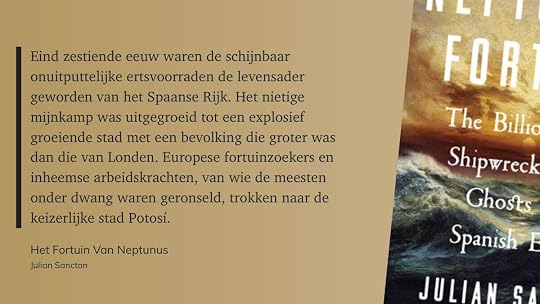
Julian Sancton’s nieuwste boek gaat over de San José, maar vooral over de zoektocht naar de locatie van het wrak. Centraal staat Roger Dooley, die eind twintigste eeuw zijn hele leven in het teken stelt van het vinden van het schip. De Amerikaanse Dooley belandt als kind samen met zijn broer op Cuba, net op het moment dat de jaren van Castro aanbreken. De broers houden van duiken, net als Castro, en worden zo een autoriteit op dat gebied. Het leven op Cuba in deze periode is interessant om over te lezen, maar Sancton bewandelt wel erg veel zijpaden.
Pas op zeventigjarige leeftijd krijgt Dooley de kans zijn onderzoek van tientallen jaren om te zetten in actie. Julian Sancton geeft een interessant inkijkje in schatjagen, maar het is geen thriller zoals zijn geweldige Waanzin aan het einde van de aarde.
De San José was een van de spectaculairste galjoenen die ooit gebouwd is. Én het waardevolste scheepswrak ooit: de lading goud en zilver wordt geschat op miljarden. Zijn einde was ook spectaculair, de Britse vloot bracht het schip tot zinken, daarmee is de San José een van de weinige galjoenen die in een zeeslag tot zinken is gebracht. De meeste zonken door storm of ondiepe riffen. Dit maakt het schip tot dé droom van zowel archeologen als schatzoekers. Maar waar ligt hij?
Julian Sancton’s nieuwste boek gaat over de San José, maar vooral over de zoektocht naar de locatie van het wrak. Centraal staat Roger Dooley, die eind twintigste eeuw zijn hele leven in het teken stelt van het vinden van het schip. De Amerikaanse Dooley belandt als kind samen met zijn broer op Cuba, net op het moment dat de jaren van Castro aanbreken. De broers houden van duiken, net als Castro, en worden zo een autoriteit op dat gebied. Het leven op Cuba in deze periode is interessant om over te lezen, maar Sancton bewandelt wel erg veel zijpaden.
Pas op zeventigjarige leeftijd krijgt Dooley de kans zijn onderzoek van tientallen jaren om te zetten in actie. Julian Sancton geeft een interessant inkijkje in schatjagen, maar het is geen thriller zoals zijn geweldige Waanzin aan het einde van de aarde.

March 2, 2026
There was an audible gasp out of me, when I saw this book was coming out. I so dearly loved the first book by this author, and eagerly started this newest story, expecting to get wrapped up in the history, the writing, the journey.
And I did. At first. The history of treasure galleons, of the cities that popped up along the shipping lanes and the people that ruled them, of the sheer amount of money, goods, treasure that floated around the globe, that was lost at the bottom of the ocean…it captivated me.
And then the story shifted. I didn’t hate that the author moved to the history of Roger Dooley - didn’t even really mind when he took us through the history of Cuba, Castro, and diving in Cuba. It was fascinating, and still managed to keep my interest for a while longer, but it was when the story moved into covering The Big Five that my interest waned.
Just…the avarice. The machismo. The disregard of the men who literally blew up history to satisfy their need.
And it’s nothing against the author or the history he shared. But this one just didn’t move me - didn’t draw me in - as easily or quickly as Madhouse. And maybe I was expecting too much, but how could I not?
It was like reliving my playthrougsh of Sid Meier’s Pirates! reading through the first few chapters. It was an adventure, just what I was looking for from the book. And then…it wasn’t.
And I did. At first. The history of treasure galleons, of the cities that popped up along the shipping lanes and the people that ruled them, of the sheer amount of money, goods, treasure that floated around the globe, that was lost at the bottom of the ocean…it captivated me.
And then the story shifted. I didn’t hate that the author moved to the history of Roger Dooley - didn’t even really mind when he took us through the history of Cuba, Castro, and diving in Cuba. It was fascinating, and still managed to keep my interest for a while longer, but it was when the story moved into covering The Big Five that my interest waned.
Just…the avarice. The machismo. The disregard of the men who literally blew up history to satisfy their need.
And it’s nothing against the author or the history he shared. But this one just didn’t move me - didn’t draw me in - as easily or quickly as Madhouse. And maybe I was expecting too much, but how could I not?
It was like reliving my playthrougsh of Sid Meier’s Pirates! reading through the first few chapters. It was an adventure, just what I was looking for from the book. And then…it wasn’t.

August 11, 2026
«The pessimist complains about the wind; the optimist expects it to change; the realist adjusts the sails.» —William Arthur Ward, p173.
«Madhouse at the End of the Earth» is Julian Sancton’s magnificent account of the first successful expedition to Antarctica. In «Neptune’s Fortune» he turns to the relentless quest of Roger Dooley for the wreck of the ‘capitana’ San José. In 1622, bound from Portobelo for Havana and Spain, the Spanish galleon was attacked by the English admiral Wager and sank before ever reaching Cartagena.
Roger Dooley —American-Cuban, born 21 December 1944— is a true hero who deserves a lasting place in the annals of exploration. His extraordinary knowledge and vast documentation of seventeenth-century shipwrecks in South American waters are unmatched. Through tireless diligence, angelic patience and unflagging optimism, he located the San José in Colombian waters: the Spanish galleon that carried the greatest gold treasure ever to leave the New World.
Sancton has rigorously verified the curriculum vitae of this pivotal figure—Roger Edward Dooley, also known as Roger Montañes Caballero—interviewed him at length, and rendered his astonishing life into a gripping narrative. «Neptune’s Fortune» is a genuine page-turner that reads like a novel, yet it remains above all a historical document and a moving tribute to passion, perseverance and resilience.
«The sea is broad and her paths are many.» —Admiral Miguel Agustin de Villanueva, p21.
«Madhouse at the End of the Earth» is Julian Sancton’s magnificent account of the first successful expedition to Antarctica. In «Neptune’s Fortune» he turns to the relentless quest of Roger Dooley for the wreck of the ‘capitana’ San José. In 1622, bound from Portobelo for Havana and Spain, the Spanish galleon was attacked by the English admiral Wager and sank before ever reaching Cartagena.
Roger Dooley —American-Cuban, born 21 December 1944— is a true hero who deserves a lasting place in the annals of exploration. His extraordinary knowledge and vast documentation of seventeenth-century shipwrecks in South American waters are unmatched. Through tireless diligence, angelic patience and unflagging optimism, he located the San José in Colombian waters: the Spanish galleon that carried the greatest gold treasure ever to leave the New World.
Sancton has rigorously verified the curriculum vitae of this pivotal figure—Roger Edward Dooley, also known as Roger Montañes Caballero—interviewed him at length, and rendered his astonishing life into a gripping narrative. «Neptune’s Fortune» is a genuine page-turner that reads like a novel, yet it remains above all a historical document and a moving tribute to passion, perseverance and resilience.
«The sea is broad and her paths are many.» —Admiral Miguel Agustin de Villanueva, p21.

Review of advance copy
A while back, I read the author’s Madhouse at the End of the Earth: The Belgica's Journey into the Dark Antarctic Night as part of my sad boat obsession, and absolutely loved it. I had gone into my local indie bookstore, and the owner gave me this ARC to read, knowing how much I enjoyed Sancton’s earlier book. I admit it took me entirely too long to read it, but it was quite the ride!!
The book opens with a discussion of the Spanish empire and from where came the precious metals that European colonizers were obsessed with. It’s insane to think of how much literal treasure was on these ships that were bound back to Europe; everyone on the ships would have huge quantities of contraband that was hidden from the Spanish authorities, so it’s difficult to know exactly how much riches were on each journey. But suffice it to say it was A LOT. Hence why there have been so many treasure hunters wanting to find these shipwrecks as a quick way to become insanely wealthy.
We also see the battle that sunk the San Jose from multiple angles. This gives a really clear picture of what exactly had happened, though for hundreds of years it was unclear exactly where.
Enter Roger Dooley, an American raised in Cuba during the Castro years who found refuge under the sparkly waters of the Caribbean. Though initially he comes across as a little suspect, Sancton shows that Dooley was motivated mostly by the hopes of learning new information from these wrecks. For him, the treasure was secondary. He wasn’t in it to make money, unlike many of the other treasure hunters Sancton profiles. It hurts my heart so much to think of the damage these men did to these historical sites by blowing up the coral and the wrecks in hopes of getting their hands on gold and silver. Knowledge meant nothing to them.
It was also interesting to see how Colombia handled the discovery of the San Juan site, and how it changed depending on who was president. Having one president act out of spite regarding his predecessor is somewhat amusing, though sad at the same time.
I really hope people enjoy this book. I wish I had been able to give it more of my attention, but I am so glad to have read it. Sancton is quickly becoming a must-read author for me.
The book opens with a discussion of the Spanish empire and from where came the precious metals that European colonizers were obsessed with. It’s insane to think of how much literal treasure was on these ships that were bound back to Europe; everyone on the ships would have huge quantities of contraband that was hidden from the Spanish authorities, so it’s difficult to know exactly how much riches were on each journey. But suffice it to say it was A LOT. Hence why there have been so many treasure hunters wanting to find these shipwrecks as a quick way to become insanely wealthy.
We also see the battle that sunk the San Jose from multiple angles. This gives a really clear picture of what exactly had happened, though for hundreds of years it was unclear exactly where.
Enter Roger Dooley, an American raised in Cuba during the Castro years who found refuge under the sparkly waters of the Caribbean. Though initially he comes across as a little suspect, Sancton shows that Dooley was motivated mostly by the hopes of learning new information from these wrecks. For him, the treasure was secondary. He wasn’t in it to make money, unlike many of the other treasure hunters Sancton profiles. It hurts my heart so much to think of the damage these men did to these historical sites by blowing up the coral and the wrecks in hopes of getting their hands on gold and silver. Knowledge meant nothing to them.
It was also interesting to see how Colombia handled the discovery of the San Juan site, and how it changed depending on who was president. Having one president act out of spite regarding his predecessor is somewhat amusing, though sad at the same time.
I really hope people enjoy this book. I wish I had been able to give it more of my attention, but I am so glad to have read it. Sancton is quickly becoming a must-read author for me.

September 20, 2026
This is both a fascinating history and a compelling character study. The push/pull between treasure hunters and marine archeologists is even more heated than I’d imagined, and once you add international politics into the mix it gets ugly. For a while there I thought finding the wrecked ship from a war 300 years ago would touch off another war today.
And this really is nearly today. It runs right up to just a couple years ago. With all the stuff going on across the planet the past half-dozen years, there was also this adventure to find the sunken ship simultaneously with the political and legal maneuvering to wrest control of it once it was found.
Sancton wrote the equally compelling Madhouse at the End of the Earth: The Belgica's Journey into the Dark Antarctic Night which is another 5-star read. I kinda hope he writes another book about this sailing business, because he’s crushing it.
And this really is nearly today. It runs right up to just a couple years ago. With all the stuff going on across the planet the past half-dozen years, there was also this adventure to find the sunken ship simultaneously with the political and legal maneuvering to wrest control of it once it was found.
Sancton wrote the equally compelling Madhouse at the End of the Earth: The Belgica's Journey into the Dark Antarctic Night which is another 5-star read. I kinda hope he writes another book about this sailing business, because he’s crushing it.

May 21, 2026
Very interesting book about the search for a Spanish Galleon which sank of the coast of Columbia over 300 years ago, with over a billion dollars worth of gold and silver on board. The book centers around one person's quest to locate the wreck of the San Jose. Roger Dooley was a Cuban American who became obsessed with finding the wreck. The book details his life as a diver and an archeologist, and his quest to locate the famous wreck. The book goes into the history of the ship and how it came to sink, and Dooley's efforts to locate it over 300 years later. I enjoyed this book because I enjoy history, and although I have not done so in quite a long time, I used to be an avid SCUBA diver, and have dove on may wrecks in the past. While this wreck lies in water far too deep to dive on, they used submersible subs to assist in locating the wreck. The book also goes into some detail of all the legal battles involved in who should have ownership of the wreck and its treasure.

September 27, 2026
Julian Sancton really set the bar high when he wrote his absolute masterpiece Madhouse At The End Of The Earth. Safe to say I was incredibly excited to read this and yet here I am, sad to say, disappointed.
All credit, this book is still interesting, especially the first quater where Sancton tells the story of the San Jośe in beautiful description, bringing the 18th Century and the characters aboard the ship alive.
What started to bore me however was the drawn out story of Roger Dooley, the law suits and the back and forward of rights. Finding the ship took so long - which is very much reflected in the drawn out ending of this book.
Yes, this was a story of perseverance, adventure, interesting characters and magnificent ships, but unlike Madhouse where all of these things were included in an incredibly well written story, where it kept you on the edge of the seat and felt as if you were freezing along with all of the crew, this just felt like a slog where I couldn't care less if that ship stayed buried for another 300 years.
All credit, this book is still interesting, especially the first quater where Sancton tells the story of the San Jośe in beautiful description, bringing the 18th Century and the characters aboard the ship alive.
What started to bore me however was the drawn out story of Roger Dooley, the law suits and the back and forward of rights. Finding the ship took so long - which is very much reflected in the drawn out ending of this book.
Yes, this was a story of perseverance, adventure, interesting characters and magnificent ships, but unlike Madhouse where all of these things were included in an incredibly well written story, where it kept you on the edge of the seat and felt as if you were freezing along with all of the crew, this just felt like a slog where I couldn't care less if that ship stayed buried for another 300 years.

March 19, 2026
Interesting story full of adventure and intrigue. Disappointing ending,not on part of the author but just the malaise of events and frustration experienced by the reader at the lack of a satisfactory outcome.
May 18, 2026
Leuk en spannend boek. Hoewel de titel beter kan worden omgevormd naar Dolly's leven en zijn zoektocht naar het Spaanse fregat de "San José". Nogsteeds echt een leuk en interessant boek.
4 sterren
4 sterren
May 20, 2026
Fascinating story about Roger Dooley's quest to find and study one of the most sought after Spanish shipwrecks of all time, the San Jose. It carried, in terms of today's money, billions of dollars worth of gold and silver. But, as they say in the book, "The bigger the treasure, the bigger the troubles."
June 29, 2026
Solid 4 stars.

September 10, 2026
This is just National Treasure but true and in Spanish. Nic Cage has nothing on Roger.

September 28, 2026
This book is completely up my alley. I was enthralled from the beginning.
Displaying 1 - 30 of 200 reviews