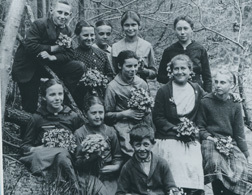
More than a hundred years ago, Bertha Shambaugh set out to photograph the Amana Colonies, the utopian religious community twenty miles northwest of Iowa City. Following her example, several Amana members ignored their community's prohibition against photography and took up cameras to record the people and events around them. Picturing Utopia celebrates their artistic vision and offers a rare glimpse into a 19th-century religious utopia, providing an unbroken photographic record beginning with Shambaugh's work in the 1890s and continuing through the Colonies' transition to mainstream American life with the Great Change in 1932.Abigail Foerstner, whose great uncle was one of the Amana photographers included in this book, brings together this stunning collection of photographs along with the stories of the photographers who took them. Together the pictures and text fill in an untold chapter in American photographic history and provide an insider's view of life in Amana.
Dr. Foerstner teaches news writing and science writing at Northwestern University’s Medill School of Journalism. In addition, Dr. Foerstner served as a staff reporter for the suburban sections of the Chicago Tribune for ten years, where she wrote articles about science and the environment. She is the author of Picturing Utopia: Bertha Shambaugh and the Amana Photographers (University of Iowa Press, 2000), as well as multiple articles on science, history and the visual arts. Her newest book, James Van Allen: The First Eight Billion Light Miles, took her seven years to research and write. Carl McIlwain, research professor of physics at University of California at San Diego, claims that “This in-depth portrayal of the life and work of an important twentieth-century scientist should take an important place both as a biography of an interesting life and as a resource for future historians of space physics
The title is what caught my eye: Picturing Utopia, what a great idea for a collection, you could include all sorts of -- oh, it's just about some commune in Iowa? Well, okay, I like photography, could be interesting.
It isn't, though. Interesting. Or full of photography. It is mostly about the people involved in the photography. There aren't that many photographs reproduced, and the images aren't especially good (aesthetically) or fascinating (in subject matter).
Look, some people!
I can't imagine this book appealing to anyone who didn't have a specific niche interest, such as having family in the Amana community (as the author does) or being a local historian.