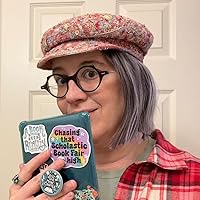
I didn’t really understand what this book was about but saw it on Reading Challenge and there were none here in time for end of March. Wouldn’t you know it, it came the evening of March 31. I didn’t have anywhere near enough time to finish it before month end, so I’m hoping Goodreads, with prior notes I’ve written, will give me credit for it.
Anyway, arts and craps (crafts) as my dad used to call it was always going on in our home from the time I was about 10, off and on until just this morning. Done many types such as knitting, crocheting, embroidery, quilting, card making, rubberstamping, origami, sewing, and more. My mom was amazing, my sister is amazing, and I’m trying, but get better in some and less in others. Health issues have slowed me down, but I still have a love for the art of it and for the joy it can bring to my heart.
This book “With Her Own Hands” is a wonder. It is written by Nicole Nehrig, who has done more and learned more than anyone I know in the thousands of ways to work with fabrics, textiles, threads, dyes, looms, and so forth. It was really hard to decide how to address this book in my review. So, I picked out of the gazillion examples and picked some of what I thought were interesting ones to give you examples of items in there.
1. Creation stories and procreative powers are often associated with weaving in mythological traditions. One of the oldest Egyptian goddesses, Neith whose representations date back to nearly 3000 BCE, was the goddess of creation, wisdom, weaving and war. She was thought to be creator of the universe and everything in it. She was thought to weave and reweave the world on her loom daily so that all she conceived of in her heart came into being. In Incan mythology, Mama Ocllo, the personification of Pachamama or Mother Earth, is a fertility goddess who taught the Incans to spin, weave and sew. They learn how to make linen from flax by Mother Holle. Saule’, a Baltic sun goddess considered the mother of all planets, spins the sunbeams on her wheel, generating light like thread. Like the sun, she is associated with fertility and growth.
2. In the Navajo creation story, the holy ones told Spider Woman, a powerful deity, that she had the ability to save a map of the universe and the geometric patterns of the spirit beings in the night sky. She had no idea what they meant or how it could be done, but curiosity drove her to find out. One day, while she was out exploring and gathering food, she wrapped her fingers around the branch of a small, young tree, and when she let go, a string streamed out of the center of her palm and wrapped around the tree branch. She shook her hand to release the string, but it didn’t work. She began to run out of space on the branch, so she started wrapping the string around another branch on the tree, and the strings began to form shapes and patterns. She realized that this was the weaving that the holy ones had told her about. She stayed by the tree all day wrapping the string into patterns on the branches. When she came home that evening, she told Spider Man about her new skill. The holy ones instructed Spider Man to make a loom and tools so she could weave the universe at home. Wondered it this is the starting root for the cartoon and movies of Spider Man? Do ya think?
3. Weaving artist and textile scholar Deborah Valoma told our author about a hooked rug that her ex-husband’s Scandinavian grandmother had made using all the pieces of her children’s outgrown clothing. The rug depicted the tree of life design, with branches forming a circular, or Celtic, knot reflecting the never-ending cycle of life. “It took her forty years. She was a farm wife and had six sons—a super strong woman. You wouldn’t know by looking at it but there was the history of her life and her accomplishments just in the material.” The rug consisted of all the clothes she had made for all the children she had—clothes that had been grown into and out of, passed down from older to younger siblings. The pants got ripped, elbows got patched. If they scraped their knees, the blood is in the fibers. Cloth also contains cells of the maker—our sweat, skin, and blood as it moves through our hands. Not only does it contain the history, but the essence of the family.
4. In many cultures, cloth is an essential part of mourning rituals. In early modern Europe, the linen bed sheets and underclothes that a person died in were often given to surviving loved ones. Sheets and clothing contained the life essence—the sweat and blood—of the dying person who convalesced in them. They were imbued with the person who died and became one of the most valuable things a loved one could receive to hold onto the person after death. Among the Hanunuo Mangyan in the Philippines, the Kutkot ritual involves exhuming their dead and dressing them in cloth to bring them to life again, often several years after their death. The cloth serves as a sort of skin to give the spirit form so they can remain among the living.
Textiles are one way to express political protest, convey coded messages, record historical events, celebrate, earn an income, show cultural ideology and mourn, from this book.
5. Sharing a quote from a review I liked: “The book’s greatest strength lies in its global tapestry of stories, each thread revealing how textiles serve as both refuge and revolt. The juxtaposition of eighteenth-century Quaker Samplers as covert educational tools with contemporary Quechua weavers preserving indigenous knowledge moved me deeply, highlighting how generational wisdom is literally woven into fabric. As a reader, I found myself pausing to reflect on my own relationship with “women’s work”—the quiet evenings spent knitting with my grandmother, once dismissed as mundane, now reframed as an act of legacy." Thank you for your inspiring comment.
You probably need the right temperament to read this book. Hobbies and talents need to be under your skin to appreciate this type of book. However, if you are curious, by all means give it a try. I hope you love it and are enchanted by it. Learned so much history of a different sort. Enjoy!!!
Definitely recommend. Rated: 4.5 Stars