Jump to ratings and reviews
Rate this book

Full Bloom: The Art and Life of Georgia O'Keeffe

Rate this book
"The definitive life of O'Keeffe." ―Hilton Kramer, Los Angeles Times Georgia O'Keefe (1887?-1986) was one of the most successful American artists of the twentieth century: her arresting paintings of enormous, intimately rendered flowers, desert landscapes, and stark white cow skulls are seminal works of modern art. But behind O'Keeffe's bold work and celebrity was a woman misunderstood by even her most ardent admirers. This large, finely balanced biography offers an astonishingly honest portrayal of a life shrouded in myth. 16 pages of b/w illustrations, 32 pages of color.

640 pages, Paperback

First published September 1, 2004

41 people are currently reading
444 people want to read

About the author

Hunter Drohojowska-Philp

10 books1 follower
Hunter Drohojowska-Philp is the author of Full Bloom: The Art and Life of Georgia O'Keeffe - "the definitive life of O'Keefe" (Los Angeles Times). She lives in Los Angeles, where she is a journalist and art critic for Art and Auction, ARTnews and the Los Angeles Times.
"

Ratings & Reviews

What do you think?
Rate this book

Friends & Following

Create a free account to discover what your friends think of this book!

Community Reviews

5 stars
84 (34%)
4 stars
111 (45%)
3 stars
43 (17%)
2 stars
4 (1%)
1 star
0 (0%)
Displaying 1 - 30 of 43 reviews
Profile Image for Sabelka.
97 reviews4 followers
May 7, 2020
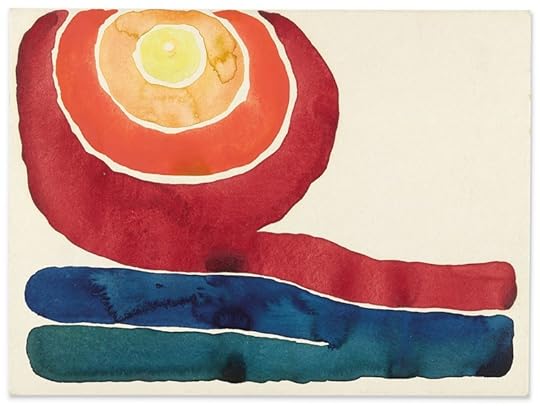
(Tristísima por que non se vexan as imaxes se non é dándolle a "see review" despois do traballo de recopilación que me acabo de pegar e porque isto non será unha reseña, pero é algo moito mellor.)

I'm SO in love with O'Keeffe.


"I had been taught to work like others and after careful thinking I decided that I wasn't going to spend my life doing what had already been done. (...) I said to myself 'I have things in my head that are not like what anyone has taught me —shapes and ideas so near to me— so natural to my way of being and thinking that it hasn't occurred to me to put them down'."


"This was one of the best times in my life. There was no one around to look at what I was doing —no one interested— no one to say anything about it one way or another. I was alone and singularly free, working into my own, unknown —no one to satisfy but myself."
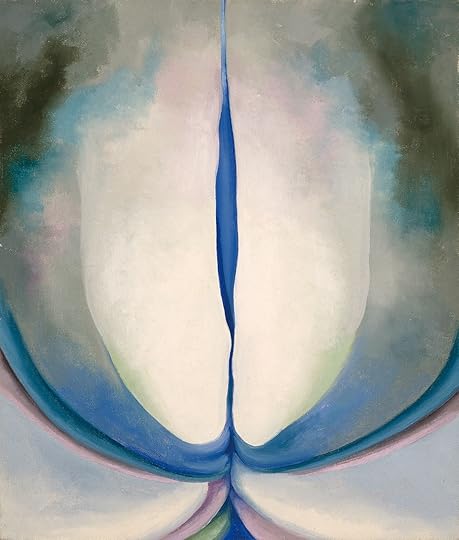


"I feel that a real living form is the natural result of the individual's effort to create the living thing out of the adventure of his spirit into the unknown—where it has experienced something—felt something—it has not understood—and from that experience comes the desire to make the unknown—known."


"Making your unknown known is the important thing—and keeping the unknown always beyond you. Catching, crystallising your simpler clearer vision of life—only to see it turn stale compared to what you vaguely feel ahead—that you must always keep working to grasp."


"I am learning something about myself. I don't know exactly what it is. (...) I am one of the intuitives. Don't think that I really underrate my way of thinking... I have just wits enough to know that if you really sift to the bottom [of] any more reasonable approach to life... it really isn't any more rational than mine."

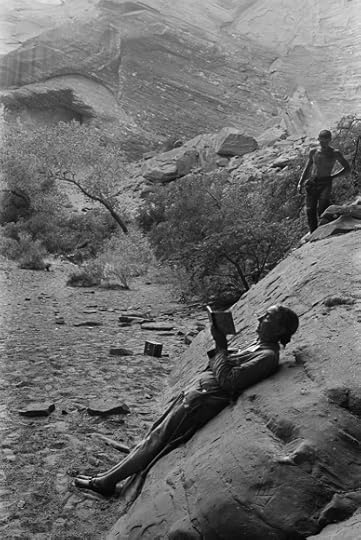


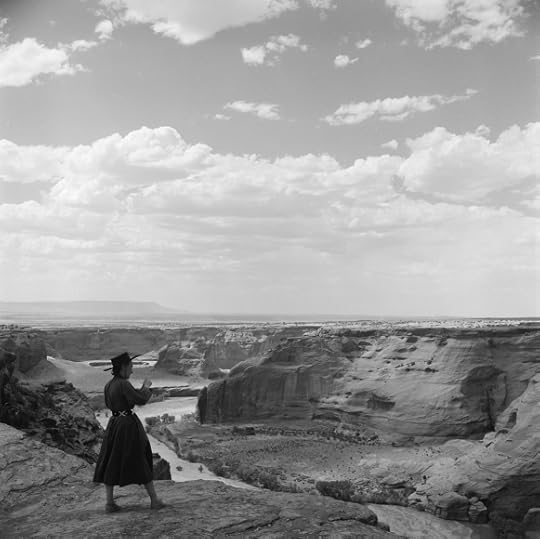
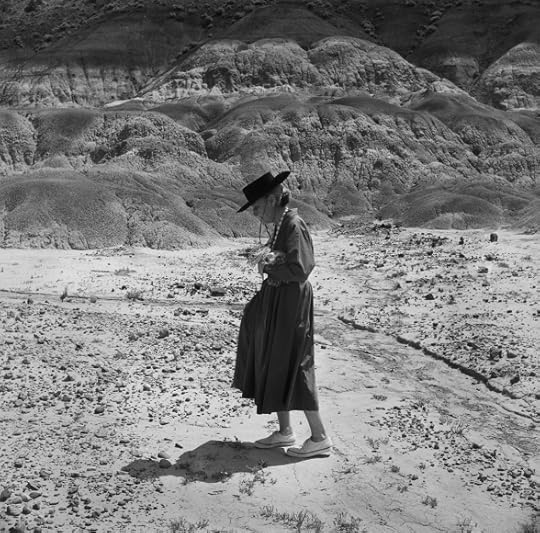


"Such a beautiful untouched lonely-feeling place —part of what I call the Far Away."


"The bones seem to cut sharply to the centre of something that is keenly alive on the desert even tho' it is vast and empty and untouchable —and knows no kindness with all its beauty."


"When I started painting the pelvis bones I was most interested in the holes in the bones —what I saw through them— particularly the blue from holding them up in the sun against the sky as one is apt to do when one seems to have more sky than earth in one's world. They were most wonderful against Blue —That Blue that will always be there after all man's destruction is finished."
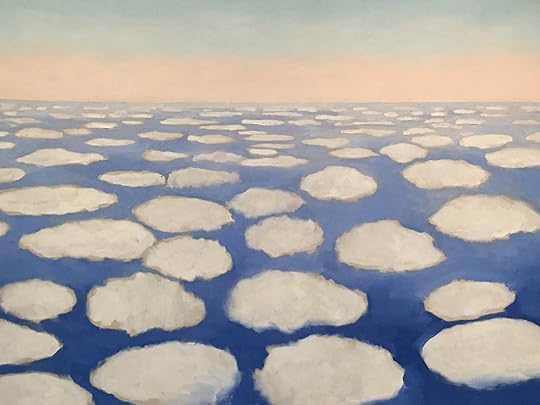


“I think it’s so foolish for people to want to be happy. Happy is so momentary — you’re happy for an instant and then you start thinking again. Interest is the most important thing in life; happiness is temporary, but interest is continuous.”

"The painting is like a thread that runs through all the reasons for the other things that make one's life."

Profile Image for Zinta.
Author 4 books268 followers
October 7, 2009
In meticulous, even painstaking detail, biographer and art critic, Hunter Drohojowska-Philp has recorded the near century of Georgia O’Keeffe’s life and art. O’Keeffe (1887-1986) is known even by those who know next to nothing about art—her paintings of gargantuan flowers and bleached white bones are well-known by the general public, even those who may never step inside an art museum or gallery. Being able to identify an O’Keeffe painting, however, has no relation to understanding the artist and the influences upon her life and creativity.

Coming from a family of artists, I am far more inclined to step inside an art gallery than, say, a sports stadium, and so I knew Georgia O’Keeffe’s work well. Or, at least … I thought I did. What I knew was actually more the myth than the woman, the sales pitch rather than the art.

In 2007, I had the opportunity to travel to Santa Fe, New Mexico. I was traveling alone, and the experience of a woman alone in the world and on the road was very much on my mind. Wandering around Santa Fe, a unique town of adobe buildings that is deeply immersed in the arts, and the arts of this area deeply immersed in the surrounding physical geography of the land, I came face to face with Georgia. Granted, by 2007, Georgia herself was long gone. Yet her presence was very real in this area where she lived the last third or so of her life, and where she seemed to have found her true identity and free spirit—a woman supremely alone. Center of town was the Georgia O’Keeffe Museum. I went inside … and stayed for a very long time. Indeed, I lost all track of time. And by the time I did emerge, I had an entirely new perception of this woman artist, and an expanding curiosity to learn more. I headed out to Abiquiu and Ghost Ranch, her two homes nearby, searching for Georgia’s spirit. I believe I found it.

And so back to this biography, Full Bloom, to learn more. As with any celebrity, and Georgia certainly became that, biographies abound. One has only to determine which one might offer more truth than imagination, and in this case, I imagine the autobiography Georgia herself authored may not be the most truthful. It can be difficult to be objective about oneself, and when a woman has suffered some of the indignities that this woman suffered, the reaction can often be to sweep under the carpet some of the ugliness of life, and leave on exhibit only the beauty and the recovery from that ugly suffering.

Georgia O’Keeffe’s life was not all roses. More thorn, perhaps. More a cutting down to the bone. Born in a small rural town near Madison, Wisconsin, she grew up without material advantage, making her own way in the world. Her art education began at the Art Institute of Chicago, continued in New York at the Art Students League. The discovery and subsequent exposure to the art world of her work is attributed to Alfred Stieglitz, art dealer and owner of Gallery 291 in New York. The gallery was known for being edgy and innovative, bringing to light new and abstract, groundbreaking art. Stieglitz was also a photographer, one of the firsts, breaking ground of his own. A friend of Georgia’s had brought samples of her work to Stieglitz and he was thrilled at the find, remarking that at last, here was a woman who could paint, and who painted as a woman.

At that point, an important door opens in Georgia’s life. Doors are an important theme in her artwork, an important metaphor—one that appears often in her paintings in synchronicity with the opening and closing of doors in her own life—and this door opened onto a relationship that affected her life and psyche deeply for a long time to come. Stieglitz, without her permission, put her artwork on exhibit in his gallery. When she stopped in and saw her work on his walls, she indignantly insisted he take it down. This exchange seemed to set a certain tone for their partnership: he was a controller; she was a young woman just finding her way, not yet in control, but struggling to find it. As the story unfolds, we see how the older man, then married, seduces Georgia into an affair, as much because he falls in love with her art as he does with her. Alas, Stieglitz, we soon learn, is a womanizer. Today, we call his sort sex addicts. Indeed, he and pal Auguste Rodin, also known as a womanizer, and whose sculptures (“The Thinker”) and drawings he is first on American soil to put on exhibit, exchange pornographic drawings and photos over the years, feeding each other’s seedier appetites.

The years to follow this meeting at Gallery 291 are the years of a tormented marriage. Stieglitz divorces his wife to marry Georgia, who had no interest whatsoever in marriage, but finally agrees to it—insisting she still keep her own name—more to save his reputation than her own. Stieglitz’s first wife and daughter both end up handling nervous breakdowns and mental illness brought on by his treatment of his first family. Cheat once, cheat again. And again. And yet again. The marriage of Stieglitz and O’Keeffe is riddled with affairs (his), and O’Keeffe finds her time away from him of ever greater solace. Yet there it is: for all his womanizing, Stieglitz adores his wife, loves her and will not leave her. He, in fact, is the one to deal with increasing anxiety that someday she will leave him. The affairs continue, nonetheless, with most any woman he photographs in the nude (and there are many). Finally, there is the more longstanding affair with Dorothy Norman, a young woman who takes great pleasure in tormenting the older woman and wife with her victories over Stieglitz, using and manipulating his weakness against him every chance she gets. His blatant and open involvement with this mistress eventually causes Georgia to suffer a complete nervous breakdown, requiring hospitalization, while he seems to remain weirdly oblivious to how much pain he is causing her.

Projecting perhaps more what is on his mind than on Georgia’s, Stieglitz promotes her work to the public as heavily sexualized. These aren’t just flowers she is painting … these are the damp petals of a woman’s genitalia. A white bone standing out against the sky? He saw phallic symbols. Georgia abhorred Stieglitz’s marketing of her work, yet she had to admit: it worked. It’s hard to say if her paintings would have reached such a tremendous audience if it hadn’t been for the manner of Stieglitz’s promotions. Adding to that effect, he took hundreds of photographs of his wife, many of which were in the nude. He exhibited these, too, and without her permission. She was horrified. She had agreed to the photos as a gift of intimacy to her husband alone, in part to try to regain his wandering eye and attention. This did not work, but his photos of her did have measurable affect on her growing popularity.

Today, Georgia O’Keeffe is seen as one of the first feminists, certainly in the field of art. Increasingly leaving her husband to his ways in New York, she developed her own home and life in New Mexico, in the desert she so grew to love. From a distance, she was able to continue to love him in her own way. She learned to detach herself enough that his affairs would no longer break her. She learned to find her own style, her own artistic expression on the opposite side of the country. When Stieglitz died of a heart attack, she grieved him even while embracing her solitude, her independence, her freedom. Ghost Ranch became her permanent home, and her work had sold so well, not only in the United States, but internationally, that she had become one of the wealthiest women of her time. Her personality, molded no doubt in part by an emotionally abusive relationship, hardened into a determined control over her own world and her image. Whereas Stieglitz had taken control of her image in her beginning years, now she was free to move in a direction true to her. Dropping the Freudian allusions, she focused on vibrant color, on paintings that were an expression of emotion rather than subject. She searched for simplicity, for clean lines, for the shapes she found in nature. Her work is definitely feminine, a combination of power and grace, the soft and the hard, the straight line and the gentle curve.

In her later years, the artist was known to be eccentric at times, even prickly, not allowing just anyone into her life, even while she would later grow to trust again when she should not (a portion of the book is about a younger man, John Hamilton, who takes advantage of her in her aging years, when Georgia again needs assistance in basic daily chores, and he convinces her to leave much of her estate to him).

As detailed as this biography is, and perhaps it is too much so, it did give me a much better understanding of the woman and her art. Too long, I had bought into the marketing of Stieglitz, not realizing the artist herself resented this view of her paintings, of those great, lush flowers, beautiful for their own sake, without the attachment of metaphor. If for no other reason, I am grateful to this book’s author for separating the sales pitch from the true intent of a remarkable artist. Georgia O’Keeffe accomplished the opening of a path to women artists. She stood up, and survived, and thrived, becoming an inspiration for women in abusive and stifling relationships. She showed the ability to love, if at a safe distance, even under the most callous treatment. She exhibited a woman’s ability to create out of personal suffering, and from something ugly, to develop a lasting beauty. If an oyster creates pearls out of painful grit caught in its tender flesh, so, too, does Georgia O’Keeffe create her pearls, too immense to miss, too vibrant to ignore, too unique to mistake for any other.
Profile Image for Susan Albert.
Author 120 books2,375 followers
May 24, 2017
The latest and perhaps the best of the O'Keeffe biographies--to my mind the most honest in dealing with the artist's personal relationships, especially those with Stieglitz and Hamilton. Drohojowska-Philp is more sympathetic to Juan Hamilton (O'Keeffe's assistant/agent in the last decade of her life) than earlier biographers; she sees the challenges Hamilton faced in working for (and with) the aging O'Keeffe. An important corrective to earlier biographies that emphasize and reinforce the myth of O'Keeffe's staunch personal independence. Excellent, easy to use notes, full documentation.
Profile Image for Lbaker.
916 reviews8 followers
May 31, 2011
The art that Georgia O'Keeffe produced through her life, her relationships and her evolution from a child to a icon.

This book sometimes lectures one and doesn't flow in an easy manner, but the information and detail of the artist's life is incredible.
Profile Image for Debbie Hoskins.
Author 1 book58 followers
January 9, 2017
This was the most interesting looking biography I could find in the library. I didn't want to take the time to find the most critically acclaimed biography. It has a collection of her paintings and pictures throughout her life, so I got a feel for the different periods in her life. There are some interesting photographs, including a couple of her in the nude taken by Steiglitz.
I skimmed, but there's a lot of meaty, helpful stuff to skim.
In one of those, duh moments - why did it take me so long to figure that out? - I realized that the desert was Georgia's art landscape. Waterfalls and Michigan's landscape is mine.
I love the design aspect of her contribution to fine art.
This book is well documented with detailed notes listing sources. There is an extensive index which is helpful when making a timeline of her life, like I was. I wanted this timeline, so when looking at "One Hundred Flowers" I would have general knowledge of what she was doing in her life when she painted the flowers.
Since I'm using her as a role model, because of the similarity of subjects, her design approach to painting, her lifetime of creativity, -I also am doing a lot of detailed dark pencil work that feel reminiscent of her graphite work - I decided she wasn't very cool. At first I had to fight my envy over her acclaim. Then I became grateful that unlike her, I chose motherhood over art. I am blossoming in my 50's partly due to having my son grown. For me my choice was the right one and I believe motherhood has fueled my creative growth.
The book portrays her as a mean, grumpy, lonely lady in her later years.
I have a desire and intent to grow spiritually as I age.
Profile Image for Robyn.
204 reviews
February 21, 2019
This book is a commitment; text ends on page 550 and is followed by 80 pages of notes / bibliography / index. Includes 16 pages of historic photos (B&W), and 32 pages of O'Keeffe's art reproduced in color. It is a well researched and balanced biography, but could have been vastly improved by a judicious editor. (Misspellings, missing words, and an excruciating level of unnecessary detail detract from overall quality.)


Profile Image for Karina Manarin.
14 reviews
May 11, 2020
I learned a lot about Georgia but this book is sooo long. After weeks of "mornings with Georgia" I was able to get through this overly thorough text which delves into different adjacent people seemingly every page. I couldn't keep up with all the names and just stopped trying.

I also learned I kind of don't like Georgia, either. She does have impeccable style and I enjoyed the bits about her homes and art process/insights.
Profile Image for Beth Bonini.
1,414 reviews326 followers
August 25, 2016
I bought this biography at the Georgia O'Keeffe Museum in Santa Fe, Mexico. It was one of three major biographies on offer, and it was difficult to choose between them; I settled on this one because it had the best selection of coloured illustrations of the artist's work. What makes a good biography? How does any biographer choose what to include and what to exclude? What are the telling details, and how does a biographer build them up to create a sense of the person under examination? I feel like I would need to read some other biographies of O'Keeffe to completely evaluate the worth of this one, but as far as I could tell, it was both exhaustive and fair.

O'Keeffe had a long, long life - and she was a prolific artist as well. Creating a detailed portrait of her life and work, in its many stages and phases, was no easy task. Complicating matters was O'Keeffe herself - who seemed to be very invested in telling a specific, mythical version of her own story. (One definitely gets the idea that O'Keeffe was a highly obstructive subject - and did her best, over the years, to distort the facts to suit herself. She could be brutal about protecting what she thought of as her own interests, reputation and legacy.) It seems undeniable that O'Keeffe is one of the (if not THE) best-known American female artist. Furthermore, she had a distinctive and recognisable style and subject matter - and certainly had a solid claim for being both 'original' and true to her own vision.

Having said all that, Alfred Stieglitz (O'Keeffe's husband) was a hugely influential person in O'Keeffe's life and work - and he looms large in this biography. He did not create O'Keeffe as an artist, but he certainly gave her a start, connected her with influential people, and influenced her art with his own ideas, theories and photographic experiments. He supported her and inspired her; he also held her back. In some ways, he was monstrously selfish and emotionally abusive. After his death, it seems that O'Keeffe determined that from that point onward it was her right to be the self-centred one - and she did her best to downplay Stieglitz's role in her life (both as a woman and an artist). There are other family members, many friends and associates, caretakers, other painters and famous people of the time period - but only Stieglitz seems completely central and germane to O'Keeffe's story.

O'Keeffe's childhood was fascinating to me. Her family started off as wealthy landowners in Wisconsin and ended up fractured and poor in Virginia. There was a lot of tragedy in those years, but losing her parents in young adulthood was also liberating for O'Keeffe. A stint as an art teacher in Canyon, Texas seems to have been one of the defining experiences of her life. Not only did she discover the landscape that would inspire her all of her life, but she adopted habits of independence which certainly allowed her to become an artist. In many ways, O'Keeffe was a deeply unlikable person - particularly after she grew older. She seemed to have had a fierce desire to live life on her own (usually selfish and uncompromising) terms. The biographer was scrupulous about showing O'Keeffe's less flattering side, while refraining from too much judgement or explanation. Many biographies trail off in the period of anticlimactic (or tragic) old age, but this one didn't. O'Keeffe seemed to have retained her curiosity and her desire to work all of her life, and I was fascinated by the extensive travels she undertook when quite elderly. Her attempts to keep creating, even when she was very frail and virtually blind, give the most poignant sense of the woman whose art was always the most important part of her.


Profile Image for Natalia Weissfeld.
287 reviews18 followers
December 31, 2014
No soy muy amante de las biografías. Las pocas veces que me animé a una fue porque el personaje en cuestión me inteteresaba mucho. Siempre encuentro que los autores se van en muchos detalles que para mí resultan irrelevantes, aún bajo una mirada psicoanalítica. Finalmente, después de muchos intentos, aprendí que las biografías no se leen como cualquier libro, de principio a fin, que hay una forma de leerlas. Esta biografía de Giorgia O'Keefe es sumamente placentera y su diagramación es perfecta, mérito tanto del escritor como del editor. Permite una lectura caótica y errática sin correr el riesgo de quedar atrapados en un laberinto de incomprensión y aburrimiento. La recomiendo.
Profile Image for Patsy.
707 reviews8 followers
July 31, 2013
This was a very informative book. I've read a few books about Georgia O'Keeffe, but this is by far the most detailed of all the years of her life. It is a little daunting, because it is well over 500 pages, but Hunter writes in an easy-to-read and relaxing manner. I'm sure that made the difference for me in sticking with this particular biography. I was already familiar with a great deal about Georgia O'Keeffe, so that also helped.

I would highly suggest this book if you want to know her life story. I think it is a meticulous, detailed and well-planned out read.

Enjoy!
Profile Image for Kate.
407 reviews3 followers
December 9, 2019
This was included as a textbook for an online post-graduate class I took. Admittedly I've always been a fan of O'Keeffe's most famous works (flowers and skulls) but I remained ignorant to a lot of her achievements, and while I knew that she was married to the famed photographer Alfred Stieglitz, I didn't fully realize how large of an impact (both positive and negative) that relationship had on her work, her career and her self esteem as an artist.

Hunter Drohojowska-Philp's book is an incredibly in-depth, detailed, and enjoyable read on the life of an artist who lived well into her 90's and created over 2,000 works of art. At times, as I'm sure is true of any 600+ page book, some sections felt a little dry or repetitive, but that means that Drohojowska-Philp stayed as close and as true to all of all the major and seemingly minor events of O'Keeffe's life. And when I say sections, I literally mean just a few pages. Drohojowska-Philp breaks up the book into three clear parts, but he also divides each part into smaller "sections" that don't last more than 3-4 pages at a clip. It makes digesting this woman's amazing life and experiences so much easier.

After reading this book, I feel I've learned all there is to know about this iconic artist from her humble upbringing to her rocky marriage to her career, which skyrocketed in her old age, to her complicated relationships with friends and family. I can't imagine there being a more thorough assessment of her life. (Although, I haven't read Anita Pollitzer's biography on O'Keeffe, which took 15 years to write. However, once O'Keeffe got a draft, she wrote a 31 page manifesto of corrections, and *refused* to give her permission for it to be published, which promptly ended their 30 year friendship. CAN YOU BELIEVE!? Pollitzer's nephew did have the book published, eventually, but how cold is that?!)

This is a great read for anyone who is genuinely interested in the very detailed ins and outs of O'Keeffe's life. I wouldn't consider this light reading, but it's not nearly as academic or boring as you may be expecting from a "textbook" of this size. My only complaint/suggestion would be to include more color photos throughout the text. There were many times when the author addressed several specific paintings or drawings on a page, and I had to pull up google images to see them. There are a few color photo examples in two sections of the book, but there are not nearly as many as are mentioned and the vast majority of images are out of context. That made it hard to see a map of the visual evolution in her work. Although, I realize including that many color photos through out would make the book about one million pages and prohibitively expensive to print/distribute.
Profile Image for Gail.
Author 5 books6 followers
May 13, 2018
This was a rich read -- beautifully written and meticulously researched. I loved reading the author's descriptions of Georgia O'Keeffe's paintings. Hunter's use of descriptive colors and various art treatments made everything come alive, and there's quite a body of work to bring to the reader. I kept my phone by my side to look up paintings that weren't in the book, as well as vocabulary words. (The first book this year to have me regularly consult a dictionary.) It was interesting to see how certain themes repeated themselves in her work throughout her life, to learn more about her parents and siblings, her relationship with Stieglitz, how New Mexico captured her heart, and what the significant relationships were at the end of her life.
Profile Image for Tina Baxter.
27 reviews
July 5, 2024
I knew quite a bit about O'Keefe already but this book helped fill in some gaps and make me what to explore more fully the other characters in her story. The read is long and sometimes over worked with lots of details about each painting but it is a fine book and is definitely gives you a good idea of how Modern Art came to America and how the american born artists wanted to create their very own style.

I will continue my quest in search of Georgia O'Keefe I will be visiting Ghost Ranch again this year but spending time there to 'walk in her footsteps' and get back to Santa Fe and the museum.

The book will be my go to at the moment well indexed and lots of interesting notes.
Profile Image for Ashley.
111 reviews
August 17, 2020
This biography was very well-done. I really like the color pictures in the middle of Georgia, the people she knew and loved, and her art work. I would have liked to see even more but thought the author did a good job picking from thousands of photos. This book was extremely long, but I feel like I really knew Georgia after reading it. I enjoyed learning about the works of others who touched her life, particularly Alfred Stiegler. This is a good book to expand knowledge and study how a person came to be the way she was.
Profile Image for Sharon.
73 reviews
April 10, 2022
After reading this book I have a strong visual picture of Georgia O'Keeffe and how deeply her life is reflected in her artwork.
Yes, her relationship with Arthur Stieglitz is heavily detailed and you learn just as much about him as you do about Georgia, but it's done so well and woven into her story as it had to be.
I was intimated by the number of pages when I started the book, but that feeling ended after the first 100 pages. It was a great biography and captured so many highs and lows in her life.
588 reviews11 followers
November 12, 2024
If you want the most comprehensive bio of Georgia this is definitely it! NOTHING is left out-personal or professional. In the beginning I thought I'm not so sure I'll finish all 545 pages-but halfway through my approach changed. Instead of thinking I had so much left in the book to go after I just let it come to me. That may sound strange but it worked and I really settled into her world nicely. The photos of her life and art are terrific. An excellent bio!
486 reviews13 followers
June 17, 2017
Drohojowska-Philp writes for art magazines (and is an artist herself) so this book delves more deeply into O'Keeffe's art than some biographies do. Sometimes the lists of names of paintings, and verbal descriptions of the paintings, gets tedious, especially without images of those paintings. Well-written, engaging, enjoyable.
Profile Image for Tiffiny.
316 reviews
December 2, 2019
Very detailed and well written... but, I felt it was more about Alfred Stieglitz, for a majority of the book. I don't like Alfred Stieglitz. I feel like he hindered Georgia and she just went a long with it.

Nothing to do with the book... I realize now that I actually don't like Georgia O'Keeffe.
Profile Image for Terri.
155 reviews
April 30, 2019
Lots of detail but the writing style was pretty bland.
Profile Image for Olga Vannucci.
Author 2 books18 followers
March 1, 2023
Hew own person, a perfectionist,
Lived her life as a great artist.
Profile Image for Jerry.
255 reviews
March 28, 2025
What an amazing person and artist. I admire how she lived and what she accomplished. She lived life.
Profile Image for Sonja.
433 reviews10 followers
October 26, 2015
"I feel that a real living form is the natural result of the individual's effort to create the living thing out of the adventure of his spirit into the unknown-where it has experienced something - felt something - it has not understood - and from that experience comes the desire to make the unknown - known." Georgia O'Keeffe to Sherwood Anderson, 1925

Quote
She did not start enlarging the blossoms until she began planting her own flowers in the summer of 1924. It was no coincidence that these big blooms were to be exhibited in her first group show with "the men." Her petunias were meant to compete in scale and power with the skyscrapers shooting up aroung New York, a subject photographed by Stieglitz and Strand. As she put it, "If I could paint that flower in a huge scale, then you could not ignore its beauty." (p. 246)
End of quote

Quote
O'Keeffe ascertained that the only true manner by which women could make art as equals was to make art differently, and according to their own sensibilities, experience, and context. (p.247)
End of quote

Quote
"Everyone has many associations with a flower. You put out your hand to touch it, or lean forward to smell it, or maybe touch it with your lips almost without thinking, or give it to someone to please them. But one rearely takes the tie to really see a flower. I have painted what each flower is to me and I have painted it big enough so tht others would see what I see." (p. 258)
End of Quote

Quote
In Yellow Calla, the spadix points impertinently out of the petals like a pron, L.K. White Calla and Roses treats the calla as swirls of white bedding around an erect yellow spadix and surrounded by carnelian roses. The dramatic and sexually evocative canvas was dedicated to critic Louis Kalonyme, who had written that spring in Arts and Decoration, "The world she paints is maternal, its swelling hills and rolling valleys are pregnant with beauty born of a primeval sun. These sun's ray points piercing the human forms of the earth give birth to singing flowers, which are fragrant chalices of a distilled golden radiance. Though there are greater painters, no one in American can paint the living quality of flowers and branches and leaves as Georgia O'Keeffe does." (p.265)
End of quote

Quote
Dorothy Lefferts Moore wrote that O'Keeffe "has painted as a woman feels, without confusing her vision with that of men...O'Keeffe, having succeeded with an extraordinary power of concentration, inevitably gives us a woman's personality...she is capable of isolating a moment and making it seem eternal." (p.293)
End of quote

Quote
Years later, she (O'Keeffe) frankly assessed her difficult marriage: "I believe it was the work that kept me with him though I loved him as a human being. I could see his strengths and weaknesses. I put up with what seemed to me a good deal of contradictory nonsense because of what seemed clear and bright and wonderful." (p. 293)
End of quote

Quote
O'Keeffe camped near the ivory towers of gypsum around Abiquiu (she) had named the White Place. Tis proximity to the stone formations led her to paint them as pale wedges of stone framing a triangle of blue in White Place in Shadow and Blue Sky. These paintings reveal what O'Keeffe sought: "The unexplainable thing in nature that makes me feel the world is big far beyond my understanding - to understand maybe by trying to put it into form. To find the feeling of infinity on the horizon line or just over the next hill." (p. 393)
End of quote

Quote
...(F)ascination for the severe hillsides of the Black Place, continued - she painted it in the funerary hues of jasper and porphyry striated with crimson and cream. In her pastel The Black Place III, as in that of the Pedernal, she took great liberties. Her elimination of the horizon line meant the landscape could be read as undulating waves of blush and dove and coal gray. This freedom from exactitude continued in Black Place I, a canvas rolling with mounds of rose and flesh, mauve and charcoal. (p. 408)
End of quote

Quote
O'Keeffe shared the perspective of Frank Lloyd Wright, who said, "I put a capital N on Nature and call it my church." O'Keeffe worshiped at the literal rock of ages, the Pedernal. She embraced the rapture of the hallucinatory landscape around the Abiquiu region and found her solace in nature itself...."When I stand alone with the earth and sky a feeling of something in me going off in every direction into the unknown of infinity means more to me than any thing any organized religion gives me." (p. 438)
End of quote
Profile Image for Susan.
1,321 reviews44 followers
March 29, 2017
Very in-depth biography of Georgia O'Keeffe. Much information on Stieglitz and other artists and photographers who she came in contact with. Wished for many more illustrations. We had an excellent discussion in our Art Book Club. Had a new member who added a lot to the group.
Profile Image for Feisty Harriet.
1,274 reviews39 followers
February 1, 2016
The more I read about Georgia O'Keeffe the more I admire her. She was a trailblazer in modern art, creating abstract images that rivaled any other painter of her time. As I read this book I couldn't help but loathe Alfred Steiglitz, he used her career to propel his own, and he had a difficult/impossible time allowing her to stand on her own, always wanting and needed to be seen as her creator and benefactor. He hindered her abstract painting more than anyone else, I think, and was never okay with the fact that O'Keeffe was far more talented than he was. I realize that he did some fantastic things at the beginning of her career to get her work seen in the modern, New York art scene, however he was never willing to let her fly, and that drove me crazy.

257 reviews1 follower
May 8, 2016
Good biography of O'Keeffe from her childhood to her death in 1986. She had a long relationship and marriage to Alfred Stieglitz and a long life after his death. She struggled with finding her place in the male-dominated art world where she was seen as a "woman" artist and judged as such. For her part, according to the author, O'Keeffe "never learned the rules of the game between the sexes." She gained fame and wealth but the end of her life was sad because she lost her eyesight and her mobility.
Profile Image for Carla.
167 reviews1 follower
May 6, 2009
I've always loved her artwork, but knew relatively little about her. This book sometimes reads a little too much like an art history textbook, but makes up for it in the fascinating detail on the persona, approach, themes and life of Georgia O'Keefe. I thoroughly enjoyed it and will keep to re-read. I'd love to take it with me on a trip to the southwest.
Displaying 1 - 30 of 43 reviews

Can't find what you're looking for?

Get help and learn more about the design.