

What do you think?
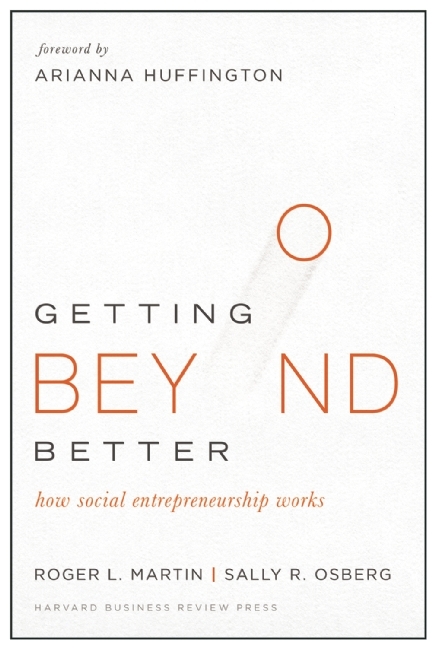
Getting Beyond Better: How Social Entrepreneurship Works
Who drives transformation in society? How do they do it? In this compelling book, strategy guru Roger L. Martin and Skoll Foundation President and CEO Sally R. Osberg describe how social entrepreneurs target systems that exist in a stable but unjust equilibrium and transform them into entirely new, superior, and sustainable equilibria. All of these leaders--call them disrupters, visionaries, or changemakers--develop, build, and scale their solutions in ways that bring about the truly revolutionary change that makes the world a fairer and better place. The book begins with a probing and useful theory of social entrepreneurship, moving through history to illuminate what it is, how it works, and the nature of its role in modern society. The authors then set out a framework for understanding how successful social entrepreneuars actually go about producing transformative change. There are four key understanding the world; envisioning a new future; building a model for change; and scaling the solution. With both depth and nuance, Martin and Osberg offer rich examples and personal stories and share lessons and tools invaluable to anyone who aspires to drive positive change, whatever the context. Getting Beyond Better sets forth a bold new framework, demonstrating how and why meaningful change actually happens in the world and providing concrete lessons and a practical model for businesses, policymakers, civil society organizations, and individuals who seek to transform our world for good.
272 pages, Hardcover
First published October 6, 2015
About the author
Roger L. Martin
43 books230 followersRoger Martin is the Institute Director of the Martin Prosperity Institute and the Michael Lee-Chin Family Institute for Corporate Citizenship at the Rotman School of Management and the Premier’s Chair in Productivity & Competitiveness. From 1998 to 2013, he served as Dean. Previously, he spent 13 years as a Director of Monitor Company, a global strategy consulting firm based in Cambridge, Massachusetts, where he served as co-head of the firm for two years.
His research work is in Integrative Thinking, Business Design, Strategy, Corporate Social Responsibility and Country Competitiveness. He writes extensively and is a regular contributor to: Harvard Business Review’s The Conversation blog, the Financial Times’ Judgment Call column, and the Guardian Sustainable Business. He has written 24 Harvard Business Review articles and published 10 books: Getting Beyond Better (with Sally Osberg); Harvard Business Review Press (HBRP, 2015); Playing to Win (with A.G. Lafley) (HBRP, 2013); Fixing the Game (HBRP, 2011); The Design of Business (HBRP, 2009); The Opposable Mind (HBRP, 2007); The Responsibility Virus (Basic Books, 2002); Canada: What It Is, What It Can Be (with Jim Milway, Rotman-UTP Publishing, 2012); and Diaminds (with Mihnea Moldoveanu, University of Toronto Press, 2009), and The Future of the MBA (with Mihnea Moldoveanu, Oxford University Press, 2008). In addition, he co-edited Rotman on Design (with Karen Christensen, Rotman-UTP Publishing, 2013).
In 2013, Roger placed 3rd on the Thinkers50 list, a biannual ranking of the most influential global business thinkers, moving up from 6th in 2011 and 32nd in 2009. In 2010, he was named one of the 27 most influential designers in the world by Business Week. In 2007 he was named a Business Week 'B-School All-Star' for being one of the 10 most influential business professors in the world. Business Week also named him one of seven 'Innovation Gurus' in 2005.
He serves on a number of public service boards: Skoll Foundation, Canadian Credit Management Foundation, Tennis Canada (past chair), and Bridgespan Group (academic advisory board chair).
A Canadian from Wallenstein, Ontario, Roger received his AB from Harvard College, with a concentration in Economics, in 1979 and his MBA from the Harvard Business School in 1981.
His research work is in Integrative Thinking, Business Design, Strategy, Corporate Social Responsibility and Country Competitiveness. He writes extensively and is a regular contributor to: Harvard Business Review’s The Conversation blog, the Financial Times’ Judgment Call column, and the Guardian Sustainable Business. He has written 24 Harvard Business Review articles and published 10 books: Getting Beyond Better (with Sally Osberg); Harvard Business Review Press (HBRP, 2015); Playing to Win (with A.G. Lafley) (HBRP, 2013); Fixing the Game (HBRP, 2011); The Design of Business (HBRP, 2009); The Opposable Mind (HBRP, 2007); The Responsibility Virus (Basic Books, 2002); Canada: What It Is, What It Can Be (with Jim Milway, Rotman-UTP Publishing, 2012); and Diaminds (with Mihnea Moldoveanu, University of Toronto Press, 2009), and The Future of the MBA (with Mihnea Moldoveanu, Oxford University Press, 2008). In addition, he co-edited Rotman on Design (with Karen Christensen, Rotman-UTP Publishing, 2013).
In 2013, Roger placed 3rd on the Thinkers50 list, a biannual ranking of the most influential global business thinkers, moving up from 6th in 2011 and 32nd in 2009. In 2010, he was named one of the 27 most influential designers in the world by Business Week. In 2007 he was named a Business Week 'B-School All-Star' for being one of the 10 most influential business professors in the world. Business Week also named him one of seven 'Innovation Gurus' in 2005.
He serves on a number of public service boards: Skoll Foundation, Canadian Credit Management Foundation, Tennis Canada (past chair), and Bridgespan Group (academic advisory board chair).
A Canadian from Wallenstein, Ontario, Roger received his AB from Harvard College, with a concentration in Economics, in 1979 and his MBA from the Harvard Business School in 1981.
Ratings & Reviews
Friends & Following
Create a free account to discover what your friends think of this book!
Community Reviews
Displaying 1 - 26 of 26 reviews

September 17, 2015
Change is usually led or inspired by a few, their actions creating a wave and latterly change as people either follow suit, adapt or switch course. Not every pioneer will effect change and one current term de jour is “social entrepreneur” and in this book the authors argue that such people are helping push change by observing systems and technologies that are ripe for transformation, sometimes going out on a limb, but nonetheless trying…
This is a bit of a specialist read, looking at the theory of social entrepreneurship, its activities in history and how it works in the present day. A framework has been designed by the authors to try and explain how successful social entrepreneurs actually go about producing meaningful, transformative change, split between four key stages of understanding the world, envisioning a better future, building a model for change and scaling up the solution.
Despite the book containing a lot of powerful information, it deserves to be more accessible and inviting; as it stands it might not get such a wide audience as it deserves.
Many people today may try and shoehorn powerful figures of the past into the role of social entrepreneur. The author highlights Mother Theresa or Martin Luther King Jr. as prime candidates that, despite doing great works, are not social entrepreneurs, noting: “Without question, each of these leaders had enormous impact on the world. But were they social entrepreneurs? Calling them by this name, as some might be inclined to do, is based on a desire to validate important work leading to real and significant social benefits. While such an impulse is understandable, it is also unhelpful. If the term social entrepreneurship is used to characterize every act of leadership generating public benefit, it will simultaneously become everything and nothing. Striving for social good, as Mother Theresa did, or advocating for social justice as Martin Luther King did do not mark one as a social entrepreneur, nor does creating a business that happens to help the world while driving profit, as Henry Ford did.”
Yet the authors bring up Andrew Carnegie, viewed by many as a “robber baron” for his union-busting activities, whilst supporting union rights at a time when he was the richest person in U.S. history and he then sought to give it away. Carnegie, they argue, is a social entrepreneur as he used his insight, riches and position to do things such as fund libraries in the U.S. and many other countries. Access to education and enlightenment was being democratised and brought closer to the average person who did not have a vast private family library or restricted university library at their disposal. Once Carnegie started to fund public libraries, others did too and now a century later the library is still a very important institution.
Once a social entrepreneur has been defined, moving forward with seeking to develop a way for “future Andrew Carnegies” to function is the goal of the authors. It need not necessarily be a massive gesture; many smaller gestures can work and lead the masses to great things.
In places it felt as if the book was losing its way, getting thrown around on the literary high seas and not moving forward, despite it being an engaging subject to consider. It may be a book worthy of persevering with, should you have a need, but it is probably not going to fall into the casual, general reader’s lap; in many ways that is a shame as it does give a lot of interesting insight if you can successfully extract it.
Autamme.com
This is a bit of a specialist read, looking at the theory of social entrepreneurship, its activities in history and how it works in the present day. A framework has been designed by the authors to try and explain how successful social entrepreneurs actually go about producing meaningful, transformative change, split between four key stages of understanding the world, envisioning a better future, building a model for change and scaling up the solution.
Despite the book containing a lot of powerful information, it deserves to be more accessible and inviting; as it stands it might not get such a wide audience as it deserves.
Many people today may try and shoehorn powerful figures of the past into the role of social entrepreneur. The author highlights Mother Theresa or Martin Luther King Jr. as prime candidates that, despite doing great works, are not social entrepreneurs, noting: “Without question, each of these leaders had enormous impact on the world. But were they social entrepreneurs? Calling them by this name, as some might be inclined to do, is based on a desire to validate important work leading to real and significant social benefits. While such an impulse is understandable, it is also unhelpful. If the term social entrepreneurship is used to characterize every act of leadership generating public benefit, it will simultaneously become everything and nothing. Striving for social good, as Mother Theresa did, or advocating for social justice as Martin Luther King did do not mark one as a social entrepreneur, nor does creating a business that happens to help the world while driving profit, as Henry Ford did.”
Yet the authors bring up Andrew Carnegie, viewed by many as a “robber baron” for his union-busting activities, whilst supporting union rights at a time when he was the richest person in U.S. history and he then sought to give it away. Carnegie, they argue, is a social entrepreneur as he used his insight, riches and position to do things such as fund libraries in the U.S. and many other countries. Access to education and enlightenment was being democratised and brought closer to the average person who did not have a vast private family library or restricted university library at their disposal. Once Carnegie started to fund public libraries, others did too and now a century later the library is still a very important institution.
Once a social entrepreneur has been defined, moving forward with seeking to develop a way for “future Andrew Carnegies” to function is the goal of the authors. It need not necessarily be a massive gesture; many smaller gestures can work and lead the masses to great things.
In places it felt as if the book was losing its way, getting thrown around on the literary high seas and not moving forward, despite it being an engaging subject to consider. It may be a book worthy of persevering with, should you have a need, but it is probably not going to fall into the casual, general reader’s lap; in many ways that is a shame as it does give a lot of interesting insight if you can successfully extract it.
Autamme.com

April 21, 2021
The book is a good read to understand the position of social entrepreneurs in the overall world, their mindset and what kind of steps do they take. It is filled with definitions, examples and is a well structured piece of writing.
If you are someone who are fascinated by the idea of being a social entrepreneur, you may better understand it after reading this. Its' not a must read, but is worth reading.
If you are someone who are fascinated by the idea of being a social entrepreneur, you may better understand it after reading this. Its' not a must read, but is worth reading.

April 7, 2026
Items of Note:
* Social entrepreneurs don’t just build organizations; they change the world by shifting the equilibrium of a system.
* An unjust equilibrium is a stable state of affairs that persists, despite its suboptimal outcomes, because no one has the incentive or the power to change it.
* The social entrepreneur’s mission is to move the world from one equilibrium to a better one.
* Social entrepreneurs don’t just build organizations; they change the world by shifting the equilibrium of a system.
* An unjust equilibrium is a stable state of affairs that persists, despite its suboptimal outcomes, because no one has the incentive or the power to change it.
* The social entrepreneur’s mission is to move the world from one equilibrium to a better one.

March 1, 2017
Great book for anyone who is looking to make social impact. It clearly addresses how we have to do more than "do good," we have to "to good better." I gave only 3 stars, because the writing wasn't as intriguing to me.

August 27, 2022
One of the seminars works that seek to define Social Entrepreneurship by description. It provides a broad framework of Social Entrepreneurship and sets the stage for further inquiry. The book also illustrates these concepts through SE organizations in various stages of their journey to help the reader understand what its trying to convey. Written in 2015, I would've given a lower rating but since then the concept and field has evolved that beseeches another updated edition. It's a good read to get a background of Social Entrepreneurship and its many facets. But would be to read "How to Change the World" by David Bornstein as well.
November 8, 2017
I think this book provided some really interesting background to social entrepreneurship and how social entrepreneurship works (which, as the subtitle of the book, is the main point), even if some parts seemed fluffy or repetitive. I found it easy to read and engaging, which are two very good perks to assigned school reading.

December 30, 2018
Speaking of social entrepreneurship, this was the last book I read for the year. This was, by far, the best introduction to social entrepreneurship I’ve ever read. They focus on each phase of creating a social solution with insights like understanding the world; envisioning a new future; building a model for change; and scaling the solution.

September 8, 2026
This book gave me a better understanding of what social entrepreneurship looks like in practice and how entrepreneurs can create meaningful, lasting change. I especially appreciated the real-world examples that helped bring the concepts to life. An interesting and worthwhile read for anyone interested in social entrepreneurship.

January 11, 2022
This book is not to be confused with social enterprises. Social entrepreneurship is a more advanced level. There were some great examples and we definitely need more social entrepreneurs. As an assignment, I’m finding this more difficult than anticipated.

November 15, 2017
FAVORITE BOOK ON SOCIAL INNOVATION. So good.
August 13, 2019
This taught me a lot about the basics of social enterprise & inspired me to set my goal as shorting the equilibrium not just doing good in the world.
January 7, 2021
If you have no idea what social entrepreneurship is, this is a good start. I didn't find any of the insights mind-bending, but I did find it inspiring.
November 6, 2023
First introduction to social entrepreneurship.

January 22, 2025
I had to read this for class, and really enjoyed it. It was somewhat clinical and repetitive to reinforce ideas, but the case studies used were interesting and engaging.
December 12, 2019
I could only get through about 30% of the book, so take my review with a grain of salt. But with the initial chapters and anecdotes, I feel justified for this decision and review. The book begins with high praises for robber baron and philanthropist Andrew Carnegie for having a nice idea to start free libraries. There is no enthralling or compelling history of how Andrew Carnegie crushed the immigrant employees in his steel factories and railroads with blood and force; how he suppressed wages leading to widespread poverty; and how he decimated the American labor movement, which was the only way workers could find a voice for their brutal working conditions. Furthermore, Carnegie built the libraries, wiped his hands of the trouble, and let the town's tax dollars and volunteers pay for themselves in perpetuity. He is no hero of mine, and we need to stop praising the "thoughtful deeds" of robber barons without a sober look at the dark side of whence their riches came, and their motivation to help the lower classes, which their norms created.
The second anecdote is about a white woman who (helped to?) stop FGM in West Africa. That being said, it was unclear how her work qualified her a social enterprise, specifically.
This book was incredibly dense and overwrought with mind-numbing charts and models about what separates social advocates from social service providers to social entrepreneurs. From what I read, the public sector is framed as a mostly lumbering bureaucracy, which adds to the stereotype that governments throughout the world are inefficient to solve the problems of the people who take the time to vote for their elected officials to help them do just that. But, decades of evidence shows that, when the public sector is supported, it works. From national health care to public schools to even food safety regulations and utility regulations, government can work when it is respected and well-funded. But when smart people rhetorically belittle government employees for being inefficient, ineffective,and concentrated only on widespread public good (as if that's a bad thing) - and we need fancy businessfolk to tell us how to do it better - it takes away from the power and legitimacy of democracy. This constant chipping away at the credibility of democracy and government for its ability to make social impact, I believe, it what has given risen to the autocratic governments we see today. I don't want to live in a world where social enterprise and Andrew Carnegie can provide nice libraries in exchange for worker safety laws, prevailing wages, social welfare programs, robust, affordable, non-competing health care, clean water, civil rights for marginalized people, reasonable military spending, etc. etc. We need more legal protections and public services for the average person, which only the vast, mission-driven scale of government can provide.
For an interesting, compelling look at social impact and the public backlash against market-driven solutions in the new world order, check out the latest work by Anand Giridharadas. And in the future, maybe the authors adjust their introduction and wide-scale appraisal of Mr. Carnegie and his ilk. Carnegie's libraries are monuments to his wealth - and though they are enjoyed and supported by mostly tax dollars today, each of their origin stories are a spectacular failure of public policy.
The second anecdote is about a white woman who (helped to?) stop FGM in West Africa. That being said, it was unclear how her work qualified her a social enterprise, specifically.
This book was incredibly dense and overwrought with mind-numbing charts and models about what separates social advocates from social service providers to social entrepreneurs. From what I read, the public sector is framed as a mostly lumbering bureaucracy, which adds to the stereotype that governments throughout the world are inefficient to solve the problems of the people who take the time to vote for their elected officials to help them do just that. But, decades of evidence shows that, when the public sector is supported, it works. From national health care to public schools to even food safety regulations and utility regulations, government can work when it is respected and well-funded. But when smart people rhetorically belittle government employees for being inefficient, ineffective,and concentrated only on widespread public good (as if that's a bad thing) - and we need fancy businessfolk to tell us how to do it better - it takes away from the power and legitimacy of democracy. This constant chipping away at the credibility of democracy and government for its ability to make social impact, I believe, it what has given risen to the autocratic governments we see today. I don't want to live in a world where social enterprise and Andrew Carnegie can provide nice libraries in exchange for worker safety laws, prevailing wages, social welfare programs, robust, affordable, non-competing health care, clean water, civil rights for marginalized people, reasonable military spending, etc. etc. We need more legal protections and public services for the average person, which only the vast, mission-driven scale of government can provide.
For an interesting, compelling look at social impact and the public backlash against market-driven solutions in the new world order, check out the latest work by Anand Giridharadas. And in the future, maybe the authors adjust their introduction and wide-scale appraisal of Mr. Carnegie and his ilk. Carnegie's libraries are monuments to his wealth - and though they are enjoyed and supported by mostly tax dollars today, each of their origin stories are a spectacular failure of public policy.

February 24, 2022
I read this book Getting Beyond Better: How Social Entrepreneurship Works for a class. I really enjoyed reading this book. It was a great introduction for me into social entrepreneurship. I felt that my understanding of social entrepreneurship was deepened. The book is very easy to understand *only if* the reader is familiar with specific terms such as social entrepreneurship, change-making, equilibrium etc. The point of this book is to encourage folks to create lasting change, not necessary introduce them to social entrepreneurship jargon, which my teacher was doing on the side.
I like that their overall message was to change the existing equilibrium to a new one that can create lasting change. And while this is a big feat for many people to do, it is a wonderful goal to continually reach especially since many businesses seek to create solutions without changing the factors that create these issues. It was extremely important for me to read that they emphasized going into communities to understand their need, addressing past solutions that didn’t work and then continuing community engagement to create the solution or set of solutions. The overall message is to first learn about what makes the equilibrium exist and maintains it, and then to create a lasting change that would positively impact the community (84).
The part that was most educational and useful for me is the four step method. It is one that I think I’ll use moving forward:
1. Understand the world
2. Envision a new future
3. Build a model for change
4. Scale the solution
Although this framework can be quite difficult to actually implement because of the work that goes behind it, I think that the writer did a great job in describing each step.
The book also provides engaging short snippets of origin stories from different social entrepreneurs’ which includes their struggles, original problem, potential solutions and where they took their venture. These snippets detailed their overall trajectory of their venture, which made the book much easier to read. I felt that I was able to see other people’s ventures reflect a bit about my own trajectory and I felt comforted by that. It proves that their framework is useful when beginning a social entrepreneurship venture.
One thing that I did not like about the book was that I felt that there needed to be a list of definitions or resources for others to understand the social entrepreneurship jargon. Without the class, I think that this book would have been difficult to read. It would have been helpful if they had additional reading materials or a references list for the absolute beginner that wouldn’t know what social entrepreneurship is. All in all, this book was extremely valuable for me to understand how social entrepreneurship works, what doesn’t work, and what are the best steps to take.
Despite this, I never felt like I was reading to finish the chapter, but rather I was reading because I wanted to read more! For this reason, I would definitely recommend this book to others to read especially for those that are already doing social impact work, have an interest in business and/or have a passion for creating lasting change.
I like that their overall message was to change the existing equilibrium to a new one that can create lasting change. And while this is a big feat for many people to do, it is a wonderful goal to continually reach especially since many businesses seek to create solutions without changing the factors that create these issues. It was extremely important for me to read that they emphasized going into communities to understand their need, addressing past solutions that didn’t work and then continuing community engagement to create the solution or set of solutions. The overall message is to first learn about what makes the equilibrium exist and maintains it, and then to create a lasting change that would positively impact the community (84).
The part that was most educational and useful for me is the four step method. It is one that I think I’ll use moving forward:
1. Understand the world
2. Envision a new future
3. Build a model for change
4. Scale the solution
Although this framework can be quite difficult to actually implement because of the work that goes behind it, I think that the writer did a great job in describing each step.
The book also provides engaging short snippets of origin stories from different social entrepreneurs’ which includes their struggles, original problem, potential solutions and where they took their venture. These snippets detailed their overall trajectory of their venture, which made the book much easier to read. I felt that I was able to see other people’s ventures reflect a bit about my own trajectory and I felt comforted by that. It proves that their framework is useful when beginning a social entrepreneurship venture.
One thing that I did not like about the book was that I felt that there needed to be a list of definitions or resources for others to understand the social entrepreneurship jargon. Without the class, I think that this book would have been difficult to read. It would have been helpful if they had additional reading materials or a references list for the absolute beginner that wouldn’t know what social entrepreneurship is. All in all, this book was extremely valuable for me to understand how social entrepreneurship works, what doesn’t work, and what are the best steps to take.
Despite this, I never felt like I was reading to finish the chapter, but rather I was reading because I wanted to read more! For this reason, I would definitely recommend this book to others to read especially for those that are already doing social impact work, have an interest in business and/or have a passion for creating lasting change.
December 31, 2015
I'm not exactly sure why, but I had high hopes for this book. I feel that it has been frequently referenced in various conversations I've had regarding social impact / innovation. But after reading the forward and intro, I realized that I needed to shift my expectations and recognize that the book is intended to be a guide for understanding their social entrepreneurship framework, which although seems pretty straight-forward, was really brought to life in context through the various "case studies" shared by the Skoll award recipients featured.
The framework:
1. Understanding the world
2. Envisioning a new future
3. Building a model for change
4. Scaling the solution
Is clearly laid out and is a great source of information (and some inspiration). I'm just not sure how easily the concepts are to apply for creating future change. Seems easier to categorize / reflect on things after the fact. Might just be my inexperience showing.
The framework:
1. Understanding the world
2. Envisioning a new future
3. Building a model for change
4. Scaling the solution
Is clearly laid out and is a great source of information (and some inspiration). I'm just not sure how easily the concepts are to apply for creating future change. Seems easier to categorize / reflect on things after the fact. Might just be my inexperience showing.
December 24, 2015
I had reviewed this book for the Hindu Business Line. A link to that is pasted here
https://balablogsdotcom.wordpress.com...
I was a little disappointed at their Indian choices of companies or ventures. AMUL was a glaring omission. Lijjat was another bottom up one. And the choice of Aadhaar is mystifying. The only explanation I have is that Aadhaar was included because of Nandan Nilekani. Otherwise, how can principles of a business be applied to something that is part of an infrastructure and not a self sustaining activity?
The authors perhaps are so focused on contemporary that they were driven to what is current, popular etc.
However, not to belittle their efforts in putting together something for those who want to pursue a profitable venture in social entrepreneurship.
https://balablogsdotcom.wordpress.com...
I was a little disappointed at their Indian choices of companies or ventures. AMUL was a glaring omission. Lijjat was another bottom up one. And the choice of Aadhaar is mystifying. The only explanation I have is that Aadhaar was included because of Nandan Nilekani. Otherwise, how can principles of a business be applied to something that is part of an infrastructure and not a self sustaining activity?
The authors perhaps are so focused on contemporary that they were driven to what is current, popular etc.
However, not to belittle their efforts in putting together something for those who want to pursue a profitable venture in social entrepreneurship.

February 10, 2017
Great introduction to a handful of organizations that have made massive impact on the lives of the poor -- and a framework from which to consider new approaches. A very readable guide for newbies like me in the global development world.
January 23, 2016
A quick read but one of the scholarly books on the subject of social entrepreneurship. The authors provide a definition and a framework for it, contrasting it with government and private business, and arguing that social entrepreneurship does have a place, indeed, is necessary in today's world. The bar is set high for one to be a social entrepreneur: they must change the existing equilibrium to a new one, and not just provide incremental solutions, very much in the spirit of Peter Thiel's Zero to One.

April 5, 2016
A must-read for anybody trying to make something in the world better, and then get beyond "better". Even if you're trying to do it through a business start-up, this book will open your eyes to new ways to enhance and expand your vision that you may not have otherwise thought of.
A quick-reference guide to changing the world through social entrepreneurship:
Step 1: Understanding the World
Step 2: Envisioning a New Future
Step 3: Building a Model for Change
Step 4: Scaling the Solution
A quick-reference guide to changing the world through social entrepreneurship:
Step 1: Understanding the World
Step 2: Envisioning a New Future
Step 3: Building a Model for Change
Step 4: Scaling the Solution

February 16, 2016
This reads like an academic book and should be approached that way too. You have to be extremely interested in social entrepreneurship or leadership for this to be valuable to you. That being said, the case studies were amazing, but it made me redefine myself because after hearing of such transformative social impact I feel like my own endeavor is barely making a scratch.
March 4, 2020
This book is for Bill Gates, not for me.
Technically, some insights, but badly written, too many stories, too much detail.
When will these authors understand, nobody cares about those details. Why not save both of our time?
Technically, some insights, but badly written, too many stories, too much detail.
When will these authors understand, nobody cares about those details. Why not save both of our time?
Read
November 16, 2015658.408 M3829 2015

June 2, 2017
inspirational

February 22, 2018
Good read. This really gave me a good view of the process for starting and growing a social enterprise. There could have been more examples analyzed through all four steps, though, and it would have been nice to read about examples that failed or read about the struggles some went through before reaching success.
Displaying 1 - 26 of 26 reviews