Long before we were immersed in artificial intelligence, we met it in the movies—in HAL, R2D2, and the Terminator. Obsequious robots, homicidal mainframes, and uncanny virtual companions prepared us for a future that has now arrived. Today, AI shapes daily life through chatbots like ChatGPT, autonomous systems that navigate our streets, and financial algorithms that track our spending. With AI everywhere, we need to understand how these systems work, what their limits are, and where they may take us next.
In Understanding Artificial Of Minds and Machines, philosopher Patrick Grim traces the story of AI from ancient legends to the neural networks behind today’s breakthroughs. You see how modern systems became so powerful so quickly.
You also explore the very meaning of “intelligence,” discovering how modern AI succeeds by drawing on three vast datasets that let systems learn from examples; deep-learning architectures loosely modeled on the brain’s layers; and feedback loops that help models refine their behavior. Together, these give AI the flexibility that lets it mimic intelligence.
But there are downsides that the course brings these into sharp black-box opacity, where systems offer answers with no explanation; deepfakes that blur the boundary between real and fabricated; and the much-debated “Singularity,” the point at which machines might one day outpace human intelligence.
Knowing how AI works is the best strategy for navigating what comes next. If AI follows the pattern of past technological revolutions, it may eventually slow and plateau. Or future advances, such as quantum computing, may push it far beyond where it stands today. As Jean-Jacques Rousseau warned over 250 years ago, it’s crucial “to foresee that some things cannot be foreseen.”
PLEASE When you purchase this title, the accompanying PDF will be available in your Audible Library along with the audio.
Dr. Patrick Grim is Distinguished Teaching Professor of Philosophy at the State University of New York at Stony Brook.
He graduated with highest honors in anthropology and philosophy from the University of California, Santa Cruz. He was named a Fulbright Fellow to the University of St. Andrews, Scotland, from which he earned his B.Phil. He earned his Ph.D. from Boston University.
Professor Grim is the recipient of several honors and awards. In addition to being named SUNY Distinguished Teaching Professor, Dr. Grim has been awarded the President and Chancellor’s awards for excellence in teaching and was elected to the Academy of Teachers and Scholars. The Weinberg Distinguished Visiting Professor at the University of Michigan in 2006, Professor Grim has also held visiting fellowships at the Center for Complex Systems at Michigan and at the Center for Philosophy of Science at the University of Pittsburgh.
Professor Grim, author of The Incomplete Universe: Totality, Knowledge, and Truth; coauthor of The Philosophical Computer: Exploratory Essays in Philosophical Computer Modeling; and editor of the forthcoming Mind and Consciousness: 5 Questions, is widely published in scholarly journals. He is the founder and coeditor of 25 volumes of The Philosopher’s Annual, an anthology of the best articles published in philosophy each year.
Somehow I naively expected the lecturer's background would be a little bit more technical, while in fact Patrick Grim's credentials are in anthropology and philosophy. Mea colpa -- I didn't really bother to check as this course was free for me with my audible.it monthly subscription. The philosophical leaning of these 12 half-hour lectures became obvious soon after I began listening. That was when I discovered I already had a few courses on philosophy by Patrick Grim in my TBR list.
All in all, this short course is a good introduction into the topic of AI, especially for those who have no technical background whatsoever.
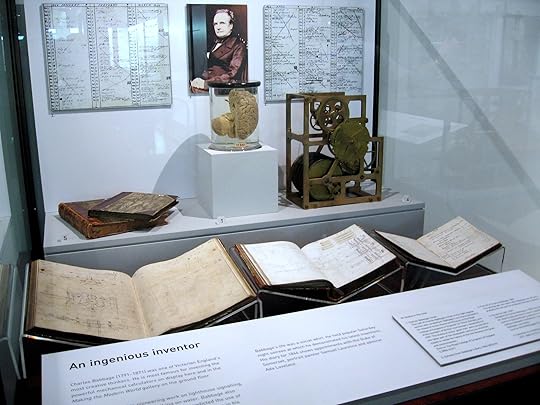
I don't think the history of AI equals the history of computing and should be told starting from Lord Byron, Ada Lovelace (his daughter) and Charles Babbage, but well, at least Patrick Grim knows how to tell a good story.
Charles Babbage case at the Science Museum, London. (Image credit: Marcin Wichary from San Francisco, U.S.A., CC BY 2.0 , via Wikimedia Commons).
I also didn't appreciate weird audio enhancements -- for example, the mention of chimpanzees is accompanied with chimpanzee noises in the background. There are many more similar "enhancements", which I found annoyingly distracting.
On the positive side, the mention of singularity in AI was followed by a discussion of different opinions on inevitability of singularity, which I found interesting and thought-provoking.
Portrait of Ada King, Countess of Lovelace (Ada Lovelace). (Image credit: Alfred Edward Chalon, Public domain, via Wikimedia Commons.)
Another of many thought-provoking highlights dealt with creativity. According to Alang Turing, before asking whether machines can “think,” we should clarify what we mean by “thinking.” We could reapply this statement to creativity -- what is creativity and how do we define it? Does human creativity exist in a vacuum? Isn't it connected to the world of human experience and to all the previous human creations the same way Generative AI's creativity is based on the input data used for its training? I personally am not interested in AI generated artistic output -- for me an artistic output devoid of person, of a living being with emotions, doubts, joys, sufferings, has no meaning and interest. Will AI ever be able to become self-aware and feel emotions? More food for thought.
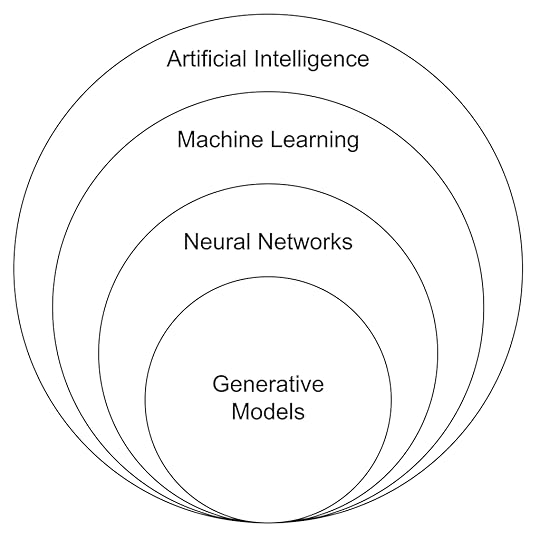
AI's relation to Generative Models subset, Venn diagram. (Image credit: The Original Benny C, CC BY-SA 4.0 , via Wikimedia Commons.)
There is really not much of interest in these lecture notes. He talks about very general aspects in uninteresting ways and does not add many new things. I would say, disregard these notes and go read a textbook.
I liked this, very helpful. A lot of people (including myself) don’t understand the first thing about AI. I felt I needed something more useful than Reddit to form a mental concept of this technology, to better use it, and better apply wider concepts of its application to my decisions and life. Understanding AI served this introductory purpose satisfactorily. Interesting lecturer as well, I’d like to hear some more of his stuff.
THAT BEING SAID: WHAT THE FUCK WAS WITH THOSE EAR RAPE SOUND EFFECTS FUCK THAT OH MY GOD. THAT BULLSHIT TECHIE MUSIC AND VACCUM SOUNDS? FUUUUUUCK IM IRRITATED, I HOPE THATS NOT THE MODUS OPERANDI OF THE GREAT COURSES NOW. 🤨
Interesting exploration on the Philosophy of AI and how the ultimate goal is to replicate ‘human’ and ‘intelligence.’ Intelligence comprised of the ability to learn, reason, understand, and be environmentally flexible.
Brought forth interesting questions: ✰ Is the only way to obtain genuine understanding by way of consciousness? ✰ Can AI be creative, or is it just pattern recognition? ✰ Are humans also just combining inputs? Are we actually creating anything new? ✰ If AI systems are only being quantified and observed based on System 2 thinking (logical and analytical calculations) will they ever be able to truly replicate human intelligence that also utilizes System 1 thinking (automatic and unconscious)? ✰ How will information cascade ultimately affect AI and what will the end result look like?
Side notes: ✰ Wish there was a further discussion on the broader scope of ethics of AI, particularly environmental. ✰ Strategy game with unchanging rules: AI system training on logic only > AI trained using a human model > human
This is my first foray into the study of artificial intelligence, and Grim's lectures serve as a fine introduction - not too heavy, not too deep, and definitely provocative. He begins with providing historical context for AI, going back to the early development of computational machines, the predecessors of computers. His definition of AI is perhaps more expansive and inclusive than most people today recognize, but he does make readers pause to think about the many different components that converge to make it all possible.
Massive amounts of stored and accessible historical data seem to be at the center of the current AI revolution, along with programs that can make predictions and assumptions based on input of information. However, the future of AI may end up expanding far beyond rapid gathering and presentation of information. Grim gives overviews of how modern AI programs like ChatGPT work, which surprised me because of how simple they are but how effective they can be, even though they misfire sometimes.
Grim's lectures have an academic feel. He doesn't really come down with a judgment on one side or the other about the benefits or dangers of AI, although he does present popular opinions, analysis, and prognostications. He is also careful to warn us how often predictions from experts in the past have failed miserably, especially regarding computers. He does a good job of reminding readers how much AI applications are already impacting our lives every minute of the day, from GPS to medical diagnoses and treatments. My take away is that AI is here to stay, but it's full impact on humanity and even the world at large is yet to be determined.
This is not my field so there is no way I was capable of absorbing it all. However, the presenter provided a good introduction which I may revisit when I know more about this topic. AI is becoming an integral part of our lives so it is essential that I develop a reasonable understanding of what it is and how it may impact all of us in the near future.
"The Great Courses" almost always provide valuable knowledge on so many subjects.
In my opinion, a very solid overview of AI derived from computing's first principles: from Ada Lovelace, to Alan Turing, to the 1956 Dartmouth Conference, to the "AI Winter", and finally, to the current "AI Spring." Even if you're broadly familiar with some of these, this is likely to be a good reinforcement of what you already know and a welcome introduction to what you don't. (Myself, I found his explanations of essential concepts like the Perceptron and neural nets to be more understandable than those I've encountered elsewhere.) And if you're new to the topic, it'll prepare you to intelligently interpret the debates that are raging about AI now, both in terms of the technology itself and the ethics surrounding its continued use and further development.
Understanding Artificial Intelligence from The Great Courses provides a good overview of various AI topics. It covers several interesting concepts and gives a useful introduction to the field without going too deeply into any one subject. Overall, it is an informative course and a good starting point for anyone interested in understanding AI.
The lecture series reads extremely dated because of the pace of change in the field's development. Many of the concerns expressed are largely addressed. And as a result, they could provide a misleading view to anyone attempting to learn the basics from the course.
I will need to relisten to this. It has enough science in it to cover the topic well, but goes beyond that into some moral and ethical questions that need consideration. I would recommend this one.