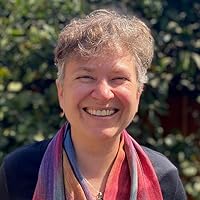
Kathleen Dowling Singh is a longtime dharma practitioner and a spiritual growth mentor. She is the author of The Grace in Dying: How We Are Transformed Spiritually As We Die and The Grace in Aging: Awaken As You Grow Older as well as numerous articles and anthology chapters. She speaks in broad language about spiritual transformation and meditative/contemplative practices, developing compassionate presence, and a variety of end-of-life issues. She is currently working on a new book, Pilgrimage: Your Life through the Lens of Awakening.
Unless you believe that when we die, we cease to exist (period, end of life), and whether or not you work with the terminally ill, this book is a must read. This book does not tell us other people's stories, nor is it for those who are dying, or dealing with the immediate death of a loved one. It is for the rest of us. Be advised - this is not an easy read - my copy of the book, which took 5 times longer to read than my usual reading choice - is riddled with scribbled comments, question-marks, exclamation points, and words circled and underlined. Let me also add, this is not my style. I'm a lazy reader.
This is a well-written course in the evolution and retrogression of our individual lives, for (deny it though we might), you and I are going to die. The questions that worry us most are most probably "when" and "how." Singh cannot answer the former, but this book will help with parts of the latter.
Much of what Singh tells us is based on experiences of those who have worked with those who are terminally ill, in addition to her own observations. Whether we believe in Jesus, Buddha, Mohammed, a Higher Power, Nature, Singh maintains that the point of dying is to return us to the place from which we came.
She reminds us that we come into the world thinking we are the center of the Universe. Perhaps we were right, for it may be that at birth we are as close to the Creator as we will get, until death takes us back. She describes how we spend our youth and young adult life developing, then defending our sense of self. We live, often most pleasantly, in constant denial of our own mortality, a truth that seems too bleak to accept.
In the latter part of life, we may hold tightly to our ego, but our body begins to betray us. If we are slowly dying of cancer, AIDS, or the illnesses of old age, we can grow into acceptance of the insulting truth that our ego is not the true "us." One dying woman described it as having an "ego-ectomy.
Singh presents us with additional stages of dying, expanding on Elizabeth Kubler-Ross' denial; anger; bargaining; depression; acceptance. Kubler-Ross' stages dealt with the affects on the ego, or mind; medical science gives us physical stages. Singh offers the theory that we go through necessary spiritual stages before dying, whether or not we have been looking for spiritual transformation. Dying offers us a crash course, the equivalent of a spiritual shotgun wedding.
When we are stripped of everything we thought made us unique, a universal specialness is revealed. Regardless of when it happens - years, months or seconds from our death - we will come to realize the unimportance of what was once important. And despite ourselves we will stumble upon our own unity with that Force we call many things - God, Universe, Light.
I feel more convinced than ever that death is not a negative, dark force I must flail against, but the other side of living, a door I must go through. That I'll figure it out at the end doesn't encourage me to stop seeking now - perhaps my exit/entrance will go better if I stop running from my fear of death, and truly live my life. This book is an excellent start in learning now how to make our own living fuller, so we will be closer to home when we die.
This is truly a remarkable book. I *highly* recommend it to anyone who is interested in comparative wisdom and spiritual systems.
Singh, a psychologist who has worked in hospice centers for (20+?) years, does a remarkable job of arguing that "the nearing-death experience" is an incredible opportunity. It is the one time when most people have the chance to transcend their own personal awareness, and enter a state of grace, until then only experienced by those engaged in the most rigorous of contemplative practices (such as monks, nuns, yogis, sufis, etc.). This is because the individual who is nearing death must come to terms with the fiction of her/his own personhood, and in doing so, come out on the other side, and embrace what Singh argues is at the core of all wisdom traditions: "a unity consciousness and The Ground of Being." In this way, she exposes that what we think of as death is actually the death of the ego. In a culture that is completely invested in the absolute dominion of the ego, this is, obviously terrifying.
A must-read for anyone engaged in contemplative practice (meditation, yoga, prayer, Tai Chi, etc.), or anyone considering pursuing one. I know it would also be comforting to anyone who is grappling with death of someone close to them, or even their own mortality.
Death is not an outrage, nor an abyss of nihilistic darkness. Death is the threshold from which our encased consciousness pouring through the confines of Ego to the Ground of Being. This is the foundational theme of Singh’s Grace of Dying. It is a spiritual guide based on Eastern religions and Sufi and Christian mysticism. Theological symbols and doctrines are treated lightly and respectfully. In addition to her erudite in philosophy and religions works, Dr. Singh also has many first-hand experience in accompanying hundreds of dying patients and their family. She has seen dying over and over again; she is as close as anyone watching how others traveling toward the “undiscovered country”. Her observations and studies are for the Nearing Death Experience which is markedly different from the commonly known Near Death Experience. The “nearing” is the process of Ego crumbling in a more observable process. (See appendix for the exact Sufi cartography of development).
This book is writing with an erudite lucidity that balanced between a spiritual guide and anecdotal experience. Among self-help spiritual aid books, this one is the best ones I have encountered.
The overall arch of human development goes from “pre-ego”, to an individualized “ego”, then the “transpersonal”. The final trans-personal comes with a different attitude toward the dying process, the compassion toward both the body and the mind. The pre-ego is the stage of development from childhood, a state of undifferentiated existence, a budding individual coming from the great “Ground of Being”. There is the delight and innocence, a translucency in its existence with nature. Most of adults can only vaguely appreciate this quality in observing children; we don’t really have an innate connections any more. A childlike behavior can be associated with mental disorder and source of contempt.
However, our maturation takes to develop a mental Ego, an operational Self that creates and fortifies its identity in society. We build a personality, participate in the world of material forms and social life in order to survive and procreate. This is where we are mostly acutely aware; the Ego is what we call our home identity, the walled citadel against the chaos of nature and others. Initially, there are three stages of Ego: the Belief, the Social Contract, and the Ego Sainthood. We follow a Belief (e.g., “if you work hard, you will be successful”), the Social Contract (employment and financial stability, family creation and standing in a social class), and for some, the final stage of Ego Sainthood (e.g., “I am a pillar of my family/community”). It is not necessarily through some pernicious mechanism that modern society fortifies and encourages Ego project, but a collective consciousness from individuals. Inevitably, aging and illness set in, bodies are worn thin, individual Ego is left at the insouciantly flow river of Life: the Universe does not care whether I live or die, Life goes on. The rest of the steps are various forms of crises and coping mechanism from Philosophic Charlatanism to Suicidal Intent, as well as chaos and anger. The author mentioned about the “pure hatred” against others who live on, including their own children. It is the Ego Saint in its own mired terror; it can not see beyond Self. The Wall is crumbing down, the world is jolly going-on, the Saint screams to the darkness close in to its own individual dwelling. And no one cares; the Self was not trained to see beyond its walled Ego. The Ego was the boundary, now it is gone, along with our security in this world. That is the terror stored for all.
A good “transpersonal” stage comes with a nurturing culture that guides the Ego possessed Self to the great Ground of Being. In some traditions, this process is firmly guided and supported through observation to participation. The secular modern culture has either denied such transformation (human immortality project through medico-technological fantasies), or marked it with social taboos or failure. We have forgotten the caged panther in Rilke —
His vision, from the constantly passing bars, has grown so weary that it cannot hold anything else. It seems to him there are a thousand bars; and behind the bars, no world.
As he paces in cramped circles, over and over, the movement of his powerful soft strides is like a ritual dance around a center in which a mighty will stands paralyzed.
Only at times, the curtain of the pupils lifts, quietly--. An image enters in, rushes down through the tensed, arrested muscles, plunges into the heart and is gone.
We have become the bars of our cage; the Spirit can not remember the pasture and the forest. The panther can not see the world beyond. We die within the cage. But some of us, possess Ego strong enough to look beyond by overcoming the instinct of cowering. These may have been Stoics, or the adventurous in heart, to explore the existential terror. However, the author observed that in most cases such movement beyond Ego are involuntary, like a birthing. This book offers an alternative, warm and persuasive view of dying and death.
The following is the Appendix —
THE SUFI CARTOGRAPHY OF LEVELS OF CONSCIOUSNESS
PERSONAL LEVELS:
BELIEF: I live my life in an unexamined, robotic, reactive way. My ideas are rigid and somewhat superstitious, I am filled with “shoulds” and “musts.” I am most comfortable with people who see things as I do, but I never really experience deep trust. I am completely separate, without awareness of having chosen to be completely separate or having chosen the consequences of being completely separate.
SOCIAL CONTRACT: I can see a tiny bit behind the rules now and choose the path of roles. I have agreements with those in the roles around my role in which we “cover” each other’s pain and believe in the reality of each other’s egos and dramas. I am angry when those usually unarticulated contracts are not honored.
EGO SAINT: I am convinced the ego I have constructed is better than the egos other people have constructed. I believe in my personal power to deceive other people into believing that my act is who I am and that I am totally “together.” I do not believe that the rules created for others necessarily apply to me. Everyone else is there for me.
PHILOSOPHER CHARLATAN: A profound disappointment has seeped into me and a pervasive sense of dissatisfaction. I see other people believing in the dream and the promise, but I can also see how they are duped. Isolated in my head, in perpetual existential angst, I hide behind cosmologies and words.
DISILLUSIONMENT: I feel humiliation, regret, self-loathing, and utter despair. My words and my cosmologies no longer support me. I am lost, spinning, drifting, and in chronic psychic pain of a radiating nature. I am filled with remorse and deeply depressed.There is nothing in the world that interests me.
SUICIDAL PANIC: My psychic pain is now shooting and searing—unbearable. I feel as if I cannot stand it for a second more. There is no relief from the pain. It has to end.
THE TRANSFORMATIVE FIELDS:
(We circle through these fields many times, each time healing a boundary. These fields are the entrance to transpersonal dimensions.)
EXPERIENCE: I have now become my pain. I am nothing but the pain. And, somehow, in merging with it, in being it, the pain lessens or dissolves and just is. I am what is, but I don’t know that yet.
EMPTY MIND: I am quiet. I am behind my experience, my emotions, and my thoughts, just watching.
WISDOM: I am beginning to recognize the nature of mind and the nature of what is. In the light of this clarity, crystallized patterns I used to think of as myself begin to dissolve. My sense of self has expanded greatly and I am aware of a new openness, compassion, wonder.
TRANSPERSONAL LEVELS:
THE WITNESS: I am aware of the succession of events, arising and falling and of the connection between events and between beings. My awareness, as I live each moment, is of wholeness, of interrelatedness.
DIVINE LIFE: Increasingly self-forgetful, I am aware of the dance of the infinite universe with each breath. I feel all of life flowing in, around, through me. Grace, fluidity, gratitude … words begin to fail here. I am getting a feeling for the word “is.”
DIVINE LOVE: My heart breaks open with fullness. My mind empties.
DIVINE CONTEMPLATION: Only two … the veil is a cloud of smoke, a thought, an image, a fleeting longing, I pulsate between the most subtle relaxation, the most subtle contraction. I am in awe.
Difficult as this book was to read, I am profoundly grateful for all the thought, experience, and contemplative practice that formed the wisdom on these pages. I can imagine Singh's work would bring great comfort to those working and living at the edges of death and dying because she describes (with great detail and clarity) how death is a "universal process marked primarily by the dissolution of the body and the separate sense of self and the ascendancy of spirit." We're biologically programmed to release our small ego self and transcend into a warm, welcoming unity. We can achieve this now or when we die, but it's our destiny.
I read this book looking in the other direction, at what death and dying might teach me about spiritual transformation. Singh brings wisdom from her personal practice and from heritages around the globe that speak to death of the ego and the body. She brilliantly sets "cartographies" of spiritual transformation side-by-side with the dying process which helped me get a bigger picture of what's happening in the minutia of my daily practice.
This book starts with the sentiment that we are safe- that dying is safe...it is a deeply spiritual book in a broad sense, allowing the dying process to stand alone for what it is: harsh, tragic, horrible, excruciatingly lonely. But it goes on. It explains, from the viewpoint of a seasoned hospice worker,that a transformation occurs for the dying person, and this transformation is almost enviable. The author touches on some quasi new-age sentiments, but those can be overlooked in order to appreciate her insight into the final journey. Worth reading.
First published 1998. The year Chuck died. I liked a lot about this book: the approach to the spiritual transformations of dying is hopeful, and often resonates with my experience as caregiver and chaplain.
Yet something about it didn't ring in the depths of my soul. It reports, systematizes, theorizes, but for me it did not call forth the deep responses of assent, the songs of the spirit.
It's very interfaith--kind of bland, really, avoiding specific religious language, describing similarities without really going deep into each or any tradition. So there is not a lot of deeply rooted poetry, imagery, metaphor for it to reach the depths.
However, I do keep coming back to it, especially the description of ego as a halfway point, neither virtuous nor inimical. And the affirmation of chaos and transition as parts of a longer journey.
This book is mind blowing and was very helpful to me as a hospice nurse. Singh does a great job of communicating some difficult concepts and added to Kubler Ross stages of dying with additional phases and insights to the process. I had to read the book slowly. It is deep and nothing you can crank through in a weekend. She talks about the spiritual journey in a very ecumenical and beautiful way as she guides us through Transpersonal realms that eventually lead us back to our Ground of Being. Very interesting and helpful.
This book is a significant contribution to the ongoing national conversation about death. I took it up in order to better understand what a close friend, who has terminal cancer, might be experiencing. In doing that, Kathleen Dowling Singh, a veteran hospice worker, has helped me see that it's me, too...in fact, it's all of us who are involved in a breathtaking journey of emerging into being in the world of form, and the remerging back into oneness with the Ground of Being. This statement struck me towards the end of the book: "Coming in closer to death allows us to view the fragility, the transience, of the human condition with great compassion, with respectful understanding for the difficulty of being a person." She echoes sentiments from Rainer Maria Rilke who finds it "inexpressible" that a human being "can hold [death] to one's heart gently and not refuse to go on living..."
Singh gives an incredibly complete overview -- almost to the point of continual repetition -- of how a person is transformed, physically, psychologically, and spiritually, as s/he lives through the "Nearing Death Experience". Contrary to our American culture's misplaced & fearful myths, she draws on her own, on patients' and on other experts' experiences in giving a message of hope and awesomeness about the most significant and revealing moment of human life.
It helped me greatly to hear Singh verbalize that perhaps our culture doesn't so much suffer from the forces of darkness, but from the forces of shallowness. Read her book, and you'll discover why she says: "We will discover for ourselves that the tragedy is not in dying, the tragedy is in living disconnected from Life."
I read 33% of the book. In that part there were quite a few descriptions of the author's experience with the spiritual transformation of persons going through the dying process. That was what I wanted to read about. Eventually I felt bogged down with explanations or philosophy and decided that the book had met what I had hoped to get and I could quit reading.
I should add that I read this in the paperback edition with, what was for my eyes, tiny print and rather yellowing paper. That had a lot to do with my willingness to give up reading it. You can imagine that the book was pretty good for me to be willing to put in the effort to read 90 pages of that print. I would rate it a 4 star if I had read the whole thing.
Wow...incredible. I know a book is excellent when immediately after I finish it I want to read it again.
Beautifully written in a contemplative, centering way, comprehensive and thorough in dealing with all the aspects of the psychospiritual dynamics in the dying process, and open and inclusive in its religious orientation/perspective. This will be a book I continue returning to. For me, this book is not just about the stages of dying and what it is to die well, but also recognizing what it is to live well, and learning what it might be to live a life that prepares for death.
For any one interested in spirituality and dying, The Grace in Dying is highly recommended.
This is a life-transforming book. The author, a transpersonal psychologist and hospice worker, gathered her wisdom from dying persons themselves. She goes way beyond most books on dying, explaining what is happening spiritually to the person near death and how it relates to what is happening physically and emotionally. I read the book while my sister was dying, and I witnessed in her virtually all the transitions Singh describes. It's hard to imagine reading this book and not letting go of ones fear of dying. It instills peace and profound hope.
This was a beautifully written and very thoughtful book from the Buddhist point of view; it discussed in nice detail the way in which many people who were near death or near-dying (in their final days) were able to transcend the ego-based fears of clinging to their life and egoic projects and find some sense of inner peace. I enjoyed the book very much, but am not sure that those unfamiliar with Buddhist tenets and Buddhist metaphysical beliefs would find it as interesting as I did.
I've been reading a lot on death and dying lately (I have a loved one with terminal cancer), and so far this is the best. Its emphasis on the spiritual aspects of death (without pushing any specific religion) is reassuring and actually confirms my own beliefs about what happens. I'm sure I'll read it again and again, including when I'm on my own deathbed.
I don't doubt the author's sincerity in attempting to put meaning to her vast exposure to the human dying process, but it came across as a hodgepodge of mystical wishes.
I made 2 honest attempts and got through about 50 pages. Paged through the rest.
This is a much needed beautifully written book. It gives comfort to those who are dying and those who are dealing with the dying. It's the best book that I have read on this subject.
This book is an account of people's death experiences through one persons eyes. Singh talks about the psychological and spiritual stages of dying. It is helping me understand the stages of death.
This is a beautiful, deep, and challenging book that explores the dying process and how it strips away our ego and cherished identities to allow us to transcend ordinary life and return to union with the “ Ground of Being” ( Tillich’s term for the Divine) as we approach death.
I began reading midway through the book, as the author and some reviewers suggested. Here Singh reviews Kubler-Ross’s 5 psychological stages of dying ( denial, anger, bargaining, depression, and acceptance) and then adds her stages of what she calls the “psychospiritual journey”: chaos, surrender, and transcendence. She gives numerous examples from her own work with the dying to illustrate these steps, and in the process paints bittersweet yet beautiful pictures of human awareness and consciousness expanding,even as each person’s body was fading away. And to be clear, she does not sugarcoat the suffering that is experienced but manages to portray the gift of transcendence that is given in the dying process.
I then returned to the first half of the book, which provides an overview of the development of the ego and identity, a necessary task for each human, yet one that increasingly separates us from the Ground of Being. Ideally, by midlife, we become disenchanted with our rigid identities and dualisms as we then begin to shift, explore and begin the return to finding meaning in the Divine. She offers a section on “Special Conditions of Transformation” , practices such as meditation, withdrawal, humility, silence and more,to help those interested in growing closer to the Ground of Being before we are dying.
This book was recommended by Richard Rohr as a companion book to read alongside his book “Immortal Diamond”. It was a lot to digest but well worth the effort. I have a feeling I will be returning to it again, both as my loved ones enter the dying process and as I myself enter it as well. I also intend to read her other books “ The Grace in Aging” and “The Grace in Living”.
This was a great book! Really explained a lot about the dying process in spiritual terms and what it all means in that sense. the first half is great in that she explains a lot about different stages of consciousness and certain transpersonal stages. second half she gets more into dying and she seems to compare the “nearing death experience” to entering into the transpersonal realms of consciousness. I like what she’s saying in this regard and I like the comparisons and all. It seems pretty legit, the whole process bringing us back to who we really are. Connects to the idea of “dying before we die” and all that. cool stuff! The book was really dense though and sometimes it felt like she was repeating herself, and going on about the same thing. Sometimes this would ensue and the message or subject would lose its luster. I felt that in the very end. She crammed in a bunch of really useful stuff on this one subject right at the very end and listed all these things and i’m like feeling “really? now you’re gonna talk about this, of all times?” it made me want to speed read it all just to get the book over with. That’s how I felt by the end I just wanted to finish it so I could move on to other books. Great subject and great read for the most part but yea. and it felt indulgent at times too but maybe just me. But again a great read, it really affected me in certain moments especially in the beginning, and also was instrumental in a very important synchronicity for me in real life. So I gotta hand it to her she did something right!! ;)
So much depth and wisdom in this delving into the psycho-spiritual processes of dying that it will take many more readings to be able to absorb it all.
“The Grace In Dying” by Kathleen Dowling Singh is a novel that combines the views of transpersonal psychology, personal experiences, alongside her Buddhist practices and believes on death, that so many people choose to ignore due to its overpowering fear. With these she is able to produce a novel where she differentiates and explains the faint stages of transformation in the transpersonal, spiritual, psychological, philosophical, energetic and physiological experiences of a person going through a near death experience.
The book offers a very orthodox Buddhist image to advocate the experience of death as if it were like, “an empty vase in which the space inside is exactly the same as the space outside. Only the fragile walls of the vase separate one from the other. Our Buddha mind is enclosed within the walls of our ordinary mind. When we die, it is as if the vase shatters in pieces. The space “inside” merges into the space “outside.” They become one. There and then we realise that they were never separate or different.” (Sogyal Rinpoche) Many Buddhists would agree that this is the return to the Ground Being, as Christians put it, and that we are enveloped into the arms of God. However, all these words are entirely fingers pointing to different parts of the truth. In the novel though, Singh does an exceptional job on traversing the spiritual transformation of the dying process and finally points our fingers and minds into the ultimate truth.
The way that Singh wrote this novel, using high level of vocabulary and explanations of very complex concepts that occur during near death experiences, made this a challenging and long read. However, this didn’t make this book less impactful or informative, in fact it made it a lot more straightforward and realistic. I really enjoyed the connections the book had with Buddhist believes of Samsara and especially re-incarnation. My favourite and most poignant part of the novel, had to be the constant reassurance that dying is safe. From the start Singh writes, “Dying is safe. You are safe. Your loved one is safe. That is the message of all the words here.” As a teenager, I’m constantly told to, “Live life to the fullest,” and “life is too short, so make the most out of it,” and that creates a frightening response to any thought of death. We are all humans, and as humans we will do anything to “save” our lives, so thinking about the end of our existence, creates an automatic negative feeling. This book however, really opened a door that I’ve been trying to keep closed for years, the thought of death. During the novel, Singh reminds us that dying is just returning to the place from where we first came from, and the thought of that really changed my whole perspective on this sensitive topic.
Altogether, I give this novel 4 out of 5 stars, because as informative and eye opening this novel was, it was also one of the hardest to understand. I really acknowledge the attention to the Buddhist believes and how she connected that to everyone’s, inevitable, experience of death. Now I feel a lot more assured that death is not this “dark energy” that takes upon us all at some point, but just another door that I must progress through. Perhaps our next “door” and experience will go better, if we stop running away from this unnecessary fear of death. I would recommend this reading to anyone that is still struggling with the loss of a loved one or someone who just doesn’t understand the whole process of our existence and is curious to find out more, like myself.
I actually skimmed this book, not reading it cover to cover. Might come back to it later.
I found the quote below while I was skimming, and stopped to read it over several times. It is worth reading, and worth thinking about regarding the fears anyone might have as they experience illness or decline.
Norman Cousins, who wrote “Anatomy of an Illness as Perceived by the Patient: Reflections on Healing and Regeneration", 1979
"There was first of all the feeling of helplessness — a serious disease in itself. There was the subconscious fear of never being able to function normal again — and it produced a wall of separation between us and the world of open movement, open sounds, open expectations. There was the reluctance to be thought a complainer. There was the desire not to add to the already great burden of apprehension felt by one’s family; this added to the isolation. There was the conflict between the terror of loneliness and the desire to be left alone. There was the lack of self-esteem, the subconscious feeling perhaps that the illness was a manifestation of our inadequacy. There was the fear that decisions were being made behind our backs, that not erecting was made known that we wanted to know, yet dreaded knowing. There was the morbid fear of intrusive technology, fear of being metabolized by a data base, never to regain our faces again. There was the resentment of strangers who came at us with needless and vials — some of which put supposedly magic substances in our veins, and others which took more of our blood that we thought we could afford to lose. There was the distress of being wheeled through white corridors to laboratories for all sorts of strange encounters with compact machines and blinking lights and whirling discs. And there was the utter void created by the longing — ineradicable, unremitting, pervasive — for warmth of human contact. "