Jump to ratings and reviews
Rate this book

Three Plays: Six Characters in Search of an Author, Henry IV, The Mountain Giants

Rate this book
SIX CHARACTERS IN SEARCH OF AN AUTHOR * HENRY IV * THE MOUNTAIN GIANTS

Pirandello ranks with Strindberg, Brecht, and Beckett as a seminal figure in modern drama. Innovative and influential, he broke decisively with the conventions of realist theatre to foreground the tensions between art and reality. In his best known play, six characters, imagined but then abandoned by their author, intrude on the rehearsals of a provincial theatre company in an attempt to play out their family drama. In the brilliant Henry IV, a young man believes himself to be the Holy
Roman Emperor; attempts to cure him of his delusion have disastrous consequences. The Mountain Giants is Pirandello's last, unfinished masterpiece, in which he moves towards the mythical, and make-believe and real life once more become entangled. The play reflects its author's growing anxiety about the
function of art under a fascist regime.

This new edition includes Pirandello's important Preface to Six Characters, an essential critical document for understanding the play that made him famous. Anthony Mortimer's lively and performable translations remain scrupulously faithful to the letter and spirit of the originals.

241 pages, Kindle Edition

First published March 25, 2014

10 people are currently reading
76 people want to read

About the author

Luigi Pirandello

1,500 books1,432 followers
Luigi Pirandello; Agrigento (28 June 1867 – Rome 10 December 1936) was an Italian dramatist, novelist, poet, and short story writer whose greatest contributions were his plays.

He was awarded the 1934 Nobel Prize in Literature for "his bold and ingenious revival of dramatic and scenic art"

Pirandello's works include novels, hundreds of short stories, and about 40 plays, some of which are written in Sicilian. Pirandello's tragic farces are often seen as forerunners of the Theatre of the Absurd.

Ratings & Reviews

What do you think?
Rate this book

Friends & Following

Create a free account to discover what your friends think of this book!

Community Reviews

5 stars
14 (25%)
4 stars
24 (44%)
3 stars
13 (24%)
2 stars
3 (5%)
1 star
0 (0%)
Displaying 1 - 9 of 9 reviews
Profile Image for Parthiban Sekar.
95 reviews185 followers
June 13, 2016
This quote perfectly summarizes this book:


"A character, sir, may always ask a man who he is. Because a character has really a life of his own, marked with his especial characteristics; for which reason he is always "somebody." But a man—I'm not speaking of you now—may very well be 'nobody'."
Profile Image for Noam.
253 reviews38 followers
October 26, 2025
To be, or pretend to be; that is the question.

These three fascinating plays by Luigi Pirandello make it clear: For him reality is far beyond our reach. After reading these plays you’ll realise that you know even less than you knew before reading them, but the reading experience is delightful.

SIX CHARACTERS IN SEARCH OF AN AUTHOR

If you think you know what theatre is, just read this play.

A theatre company gathers to work on a new play when suddenly unexpected guests arrive: Six characters, claiming to be in search of an author. The characters tell the unbelievable story of their lives (?) while discussing with the director and actors how to present it on stage (As if it's not on stage already!). Although this may sound like a complex construct of the mind, reading Pirandello’s preface of the 1925 edition of this play (An enchanting preface which is included in this edition) makes things clear: Characters coming to life were for him the reality of writing plays.
‘But not for nothing does one give life to a character.
Creatures of my spirit, those six were already living a life that was their own and no longer mine, a life that I no longer had the power to deny them.' p.188
The characters, except of Madame Pace, are a family and are called by their role in the family: The Father, The Mother, The Stepdaughter etc. The actors are called by their roles: The Leading Lady, The Young Actor etc. Obviously, The Director, The Stage Manager, The Technician and all their colleagues exist (?) too.

Confronting theatre staff with living characters shakes reality: What is reality other than an illusion of some people? Aren't we all just playing a role? Are the characters less real than the actors? Do the characters need an author or do they have their own story? Who's writing about who? Are the characters looking for a stage or is this their stage? Who plays whom? Who’s watching whom? If the actors can play the characters, doesn’t it mean that the characters are real? What happens when all this takes place within a play? Now even the actors become characters! Aren't we, readers / actors / characters, all real? Aren't we all characters in a play? What's theatre? Who’s gone, so to speak, through the looking-glass?

The subtitle of this play is ‘A play in the making’. It made me think: Which play is actually in the making? The one the characters, director and actors are working on? Or maybe ‘Six Characters in Search of an Author’? Or maybe both? Or our lives?

Obviously, I kept thinking of William Shakespeare’s As You Like It:
'All the world's a stage,
And all the men and women merely players;
They have their exits and their entrances,
And one man in his time plays many parts,
His acts being seven ages.'
A mesmerizing comedy of errors with an endless Droste effect. A play that was written before the world was ready for it.

Quotes
‘DIRECTOR [jumping up in a fury]. Ridiculous! Ridiculous! What can I do about it if we don't get any more good plays from France, so that we're reduced to putting on stuff by Pirandello that you have to be super-clever to understand, plays that seem cut out to please nobody - not the actors, not the critics, not the public?' p.6

'FATHER. But this is where all the trouble starts! With words! We all have a world of things inside us; everyone has his own world of things! And how can we understand each other if in my words I put the meaning and the value of the things inside me; while my listener inevitably receives them with all the meaning and value that they have for him, in his own inner world? We think we understand each other: we never understand each other!' p.17

'FATHER. What other reality do we have? What for you is an illusion that has to be created is for us, on the contrary, our only reality. [Brief pause. He takes a few steps towards the DIRECTOR and adds] But not just for us, come to that. Just think about it. [Looking him in the eye] Can you tell me who you are? [He stands pointing at him]
DIRECTOR [troubled, with a half-smile]. What? Who am I? I'm me.
FATHER. And if I said that's not true because you are me?
DIRECTOR. I'd answer that you were mad.' p.48

'SON. But haven't you understood yet that you can't possibly do this play? We're not inside of you and your actors only stand and look at us from the outside. Do you think we can keep on living in front of a mirror, and one that is not content with freezing us in our own expression, but sends that image back to us as an unrecognizable caricature of ourselves?' p.56
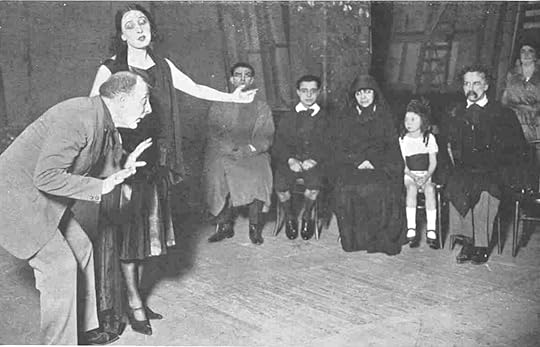
Scene from the London production, in Italian, of Six Characters in Search of an Author, 1925, via Wikimedia Commons

Scene from the London production, in Italian, of ‘Six Characters in Search of an Author, 1925, via Wikimedia Commons

HENRY IV

An unnamed Italian aristocrat fell off his horse and injured his head. When he regained consciousness, he was convinced that he is Henry IV, the 11th century king of Germany and Roman emperor. The past 20 years his family pretended that this is true. How far should or can everyone go with this game? Can someone end it? Who’s actually pretending? Who’s fooling who? Who’s mad? When does pretending become reality? Everyone has his own role, chosen or assigned to him by others. A game which can only go wrong…

By the way, the real (?) Henry IV was the one who took the road to Canossa in search of absolution. This Henry IV was excommunicated by his own family because they thought he was insane. Who should forgive whom in this case? Pirandello didn’t choose this theme by chance: His own wife was mentally ill too.

Quotes
‘BELCREDI. Everyone was having fun acting his own part. It was a real Babel. LADY MATILDA. You can imagine how alarmed we were when we realized that, unlike us, he had taken on his role in deadly earnest.
DOCTOR. Ah, because he too then...
BELCREDI. Yes. He came and joined in. We thought he'd recovered and that he'd started acting again, like the rest of us... better than the rest of us, because, as I told you, he was a splendid actor. In short, we thought he was joking.' p.80

'BELCREDI. This is the illusion: that we leave this life by a door that lies ahead of us. It's not true. If you start dying as soon as you're born, the one who started first is the furthest ahead. And the youngest of all is Old Father Adam.' p.100

'HENRY IV. Now look at this idiot here who's standing and staring at me with his mouth open. [He shakes him by the shoulders] Don't you understand? Don't you see how I dress them up, how I set them up, how I make them come before me like a bunch of frightened clowns. And they're only scared of one thing: that I'll tear off their silly masks and show that they're all in disguise. As if it weren't me who had forced them to wear masks in the first place, to satisfy my taste for playing the madman!' p.107

'HENRY IV. And Lord help the man who one fine day finds himself stamped with one of those words that everybody repeats! For example, ‘madman’. For example, let's say, 'imbecile'. Well, you tell me how a man can sit there quietly, knowing that there's someone who's busy persuading others that you're the way he sees you, fixing his judgement of you on their minds?' p.108

'HENRY IV. It suits everyone, you see. It suits everyone to convince others that certain people are mad, so there's a good excuse for keeping them locked up. Do you know why? Because it's unbearable to hear them speak.' p.109

'HENRY IV. It must seem true. Because that's the only way truth stops being a joke.' p.113
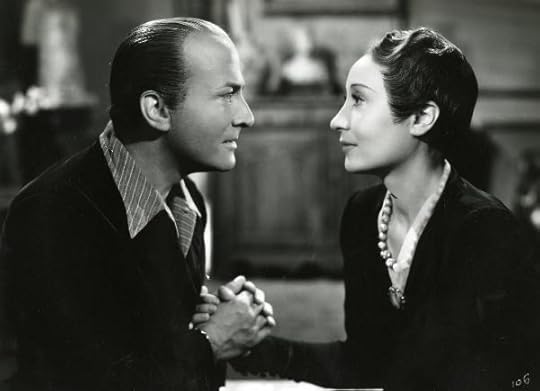
Scene from the film ‘Enrico IV’ – directed by Giorgio Pastina, 1943 - Osvaldo Valenti and Clara Calamai, via Wikimedia Commons

Scene from the film ‘Enrico IV’ – directed by Giorgio Pastina, 1943 - Osvaldo Valenti and Clara Calamai, via Wikimedia Commons

THE MOUNTAIN GIANTS

A group of awkward people spend time in the dilapidated villa 'La Scalogna'. Their leader is Cotrone, the magician. When a group of actors arrive with their sick leader, countess Ilse, sitting on top of a cart, everything changes. Ilse’s life is still dedicated to the play ‘The Fable of the Changeling Son’, which she performs all over the country with what’s left of her declining ensemble and very little success. Now, being ill and without enough actors and décor, performing the play in the villa seems to be impossible. Cotrone claims that the play can play itself and invites countess Ilse and her ensemble to stay. Performing the play at the wedding which unites two families known as the Mountain giants is the last chance countess Ilse and her actors has…

Luigi Pirandello didn’t live long enough to finish writing this play. In this version, his son Stefano completed the play according to his father’s ideas.

By the way, the play ‘The Fable of the Changeling Son’ which is mentioned in this play really exists: It’s a piece that was written by… Luigi Pirandello himself. Paradoxically, countess Ilse mentions in this play that the writer of ‘The Fable of the Changeling Son’ killed himself, even though Pirandello obviously lived long enough to write this by himself and his own death was natural. One should bear in mind however that Pirandello wrote ‘The mountain giants’ during the fascist regime of Italy, obviously an enormously difficult period for him. Even though his attitude towards the fascist regime seems to have been ambivalent, the play has been interpreted as a signal that fascists are against culture. If this was indeed Pirandello’s intention the play may be seen, in a certain sense, as his artistic suicide.

A play about what reality and fantasy are, about who’s playing who and wat and about the limits of theatre. Apparently, the show indeed must go on, no matter what.

Definitely a Fellini-like play, but since Fellini was born much later than Pirandello I guess I should say from now on that Fellini’s films are Pirandello-like.

Quotes
'ILSE. Who owns this villa?
COTRONE. Us and nobody. The Spirits.
COUNT. What Spirits?
COTRONE. Yes. The villa is said to be haunted by Spirits. That's why the previous owners abandoned it in terror and even left the island, a long time ago.
ILSE. But you don't believe in Spirits...
COTRONE. Of course I do. We create them.
ILSE. Ah, you create them
COTRONE. Forgive me, Countess. I never expected you to talk to me like that. It's impossible that you shouldn't believe in them, just as we do. You actors take phantoms and give them your bodies so that they can live - and they do live! We do the opposite: we take our bodies and turn them into phantoms: and we too make them live. Phantoms... no need to go looking for them: it's enough to just draw them out of ourselves.' p.153-154

'COTRONE: So, ladies and gentlemen, let me say to you what they used to say to pilgrims: unfasten your sandals and put down your staff. You have reached your goal. For years I have been waiting for folk like you to give life to other phantoms that I have in mind. But we shall also put on your Fable of the Changeling Son as a wonder in itself without asking anything from anybody.
ILSE. Here?
COTRONE. Just for ourselves.
CROMO. He's inviting us to stay here for ever, don't you see?
COTRONE. Of course. What do you keep looking for in the world of men? Can't you see where it has got you?' p.158

‘CROMO [putting a hand over her mouth], Be quiet. There's no need to scream. I found my body too, back there deep in a splendid sleep. We awoke outside, do you see what I mean?
DIAMANTE. Outside? Outside what?
CROMO. Outside ourselves. We're dreaming. Can't you see? We're ourselves, but in a dream, outside our bodies which are sleeping back there.' p.169-170
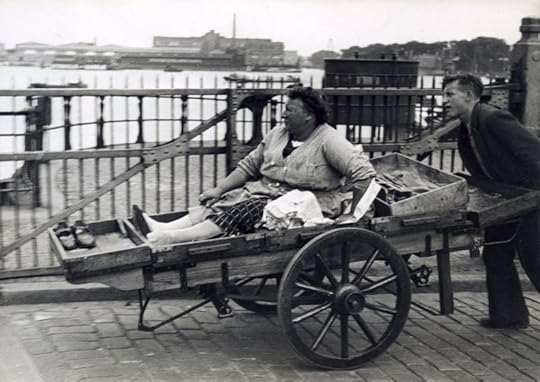

An old woman being transported on a handcart in Amsterdam. November 24, 1934. Spaarnestad Collection, via Wikimedia Commons. Did countess Ilse looked like this upon arriving at the villa?

An old woman being transported on a handcart in Amsterdam. November 24, 1934. Spaarnestad Collection, via Wikimedia Commons. Did countess Ilse looked like this upon arriving at the villa?
This entire review has been hidden because of spoilers.
Profile Image for Ben.
55 reviews
July 14, 2025
Friggin Hell, it’s just great. This my third time through and it gets better each time. The Mortimer 2014 translation from Oxford World Classics is the best, better than Musa's which is slightly out of date, has strange phraseology, and just doesn't flow as well. But the play itself is great for me--not for the meta-theatrical stuff, tho’ that’s really stupendous too. It’s the HISTRIONIC “Unfinished Play” by the Unnamed Author. It’s the power of Pirandello’s prose, the over-the-top Operatic Heights.

The Unfinished Play is never “played” as a play. It is spoken of, it is narrated, and especially, it is present for REACTIONS. Because all the characters are always there, even when they weren’t in the original scene, so they too are audience for the private scenes. Perhaps they function as a CHORUS, a constant chorus of reactions by the participants themselves. The Character of the Mother is especially vital, the heartrending suffering of a mother, in all its guises, on stage. All the supplications, all the wails, the crying, the suffering.

I've read that Pirandello was using French melodrama from his youth--antiquated and overwrought--to contrast his modernist experiment on theatrical reality. At this late date we've lost what the original audiences would clearly find in this play--a pointed parodic use of popular theater. But the key is that Pirandello did melodrama so well that it overcomes mere parody, even exceeding its models.

I never liked the sections featuring the Real Actors, but this time saw them as a way to comment on the artificiality, sentimentality, and goosed-up showmanship of The Theatre. Pirandello may be saying that "life" can never exist on the stage.

It's a splendid play, the best he wrote, better than Henrico IV, which is very good. It should be produced more.
Profile Image for Ali Nazifpour.
400 reviews20 followers
March 20, 2025
Six Characters in Search of an Author: a metatheatrical play about six characters who interrupt the rehearsal of a play, asking their story to be finished. It's a funny and plays with the conventions of the genre. Must have been really ahead of its time.

Henry IV: I consider this play to be Pirandello's masterpiece. It's the story of an Italian nobleman who due to an accident has a delusion and thinks he's Henry IV, the 11th century Holy Roman Emperor. His entire house changes itself in order to accommodate his delusions (dressing up and roleplaying acting as medieval characters). There are many ways to interpret this play, but to me, it was a great satirical portrayal of how lies and delusions of powerful people are perpetuated by sycophants around them, until the entire system is made up of only lies.

Mountain Giants: and unfinished play about a group of people who come across a theater troupe and then the border between reality and fiction breaks down. It seems a rehash of Six Characters in Search of an Author, and not as interesting.
Profile Image for Pari.
80 reviews
February 3, 2019
Such a unic imagination and spectacular scenary description power from Pirandello. Can not believe, I was not aware of the depth of his works before reading this book!! Defenately recommending it.
Profile Image for John.
767 reviews2 followers
September 11, 2015
This is an excellent introduction for the English reader to the plays of Pirandello. As the title says, it contains three plays: Six Characters, Henry IV, and the Mountain Giants. I enjoyed the first two plays, although I can't see how Henry IV would interest me in the theatre. I could have done without the Mountain Giants, which was unfinished at his death and was starting to bore me. I suspect the editor included the play to demonstrate Pirandello's ultimate disenchantment with Italian fascism.

22 reviews1 follower
Want to read
August 19, 2017
Reading because Pino read it as a kid. Beneath a Scarlet Sky Ch 6.
Displaying 1 - 9 of 9 reviews

Can't find what you're looking for?

Get help and learn more about the design.