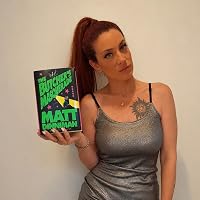
Thank you to NetGalley for an advance audiobook copy.
Narration: 4 stars
Characters: 3 stars (the satire is heaviest here)
Setting: 2.5 stars
Writing style, tone: 3 stars
Plot: 3 stars (episodic, events happen to and around Flip, not exactly a plot)
The book covers roughly 20 years in the life of the second child born on Mars, a descendant of Buzz Aldrin, the second man to set foot on the Moon. We are in a near-future world (Flip, the narrator, was born in 2059). That they are always second, never first is a family burden that defines the path Flip takes through life.
I had some difficulty with this book. In no particular order:
- There’s a very teenaged quality to the book, both the narrative style and the specific events, and especially the protagonist’s relationship to his parents,
- The close first person POV contributes to a narcissistic element, reinforcing the teenaged angst, even though the events go well beyond teen years,
- Flip definitely sees himself as the main character,
- It’s described as satire, and I think it is mostly satirical, but there are some very painful events that conflict with satirical tone, although these are mainly evaluated in terms of the impact on the protagonist,
- It’s very episodic, with relatively little emotional evaluation,
- Some elements are a little trite, including the relationships between men and women (girls and boys? These characters all seem quite young.
- It’s a bit like a TV series set on Mars. An afterschool special? Shitt's Creek on Mars?
I happened to be reading another book set on an inhospitable planet, this one extrasolar, at the same time, so my view is slightly colored by the differences between the two.
This book beautifully captures the use of snark as a coping mechanism. Flip’s parents are both alcoholics, with little time for him. His father, Buzz, is an opportunist, always looking for a way to be first. His mother, Iris, retreats into a wine bottle, with several escapes. There’s little space for Flip. He finds that space with his gang, The Catfish Trolls. (Gang in the Our Gang sense, not the drug cartel sense.)
There’s no discussion of the economy that supports the resource-intensive life under a dome. That would have pulled the book out of its satirical, episodic arc as Flip, always overlooked, forges his way through to his own life (one assumes, as it ends with him leaving Mars for "an exoplanet."
I found the "I am the center of my universe" tone a little irritating, as it took the pain of others and viewed them through the lens of Flip’s reaction. This would have been fine when he was 15, harder to reconcile with a 28 year old. I do not think I am the target audience for this book.
It might have worked great as a graphic novel. I think I wouldn’t have expected emotional depth or elaboration in that form, or have been irritated by Flip's always centering himself.
I listened to the audiobook, narrated by Ted Evans. He seamlessly switched among the various voices. Sometimes, a narrator seems to emphasize the "she said", "he replied", etc., but Ted Evans did not. I was fully within the setting at all times.
His tone perfectly captures the snark that Flip uses to filter the world around him.