A riveting Latin American dark horror-fantasy about two survivors finding one another amidst monstrous creatures and a brutal political regime, perfect for fans of Silvia Moreno-Garcia and T. Kingfisher
Guls can be brutal. Few people know this better than Ariadne, who lost half her body to their appetites, but she finds their brutality a predictable constant amid the political chaos of Brazil. Now she treats them in the specialized clinic she inherited from Erik Yurkov—the mentor who rescued her from captivity as a child, trained her in medicine, built her prostheses, and then disappeared without a trace.
Ariadne’s routine is disturbed when a dapper gul covered in tattoos knocks on her door, introducing himself as Quaint and claiming to be Erik’s oldest friend. As unsettling as the presence of a healthy adult gul can be, there is something familiar—almost intimate—about him. Quaint suspects foul play in Erik’s disappearance, and his suspicion proves real when they discover Erik sought asylum at Cabaré, an infamous club in Rio de Janeiro frequented by the gul elite.
Together, Ariadne and Quaint will unravel the conspiracy behind their friend’s disappearance, navigate the labyrinthine world of Ariadne’s memories, and discover what Erik means to them—and what they are starting to mean to each other.
Hache Pueyo is the Argentine-Brazilian writer and translator of Cabaret in Flames, But Not Too Bold and A Study in Ugliness & Outras Histórias. She was nominated to the Nebula award, and has won an Otherwise Fellowship for her work with gender in speculative fiction. She keeps a biweekly column about literature in translation on Reactor Magazine, and her short stories have appeared as H. Pueyo in The Magazine of Fantasy & Science Fiction, Clarkesworld, Strange Horizons, and The Year’s Best Dark Fantasy & Horror. Born in 1992.
I wanted to love this sooo bad, but I was left a bit underwhelmed. The thing is, so much was going on, and the novella was packed with worldbuilding, so the bones were there, but I think I would've liked it much better as a longer read.
The pacing left some to be desired, the story jumped from one thing to another, the characters barely had any development, and I honestly didn't like the writing here as much as I did in the author's previous work (but it wasn't bad).
The book deals with some heavier subjects, so be aware of that going in, and it's a bit more romance focused than it should've been, in my opinion. But, I would still recommend giving it a try, you might like it more than I did.
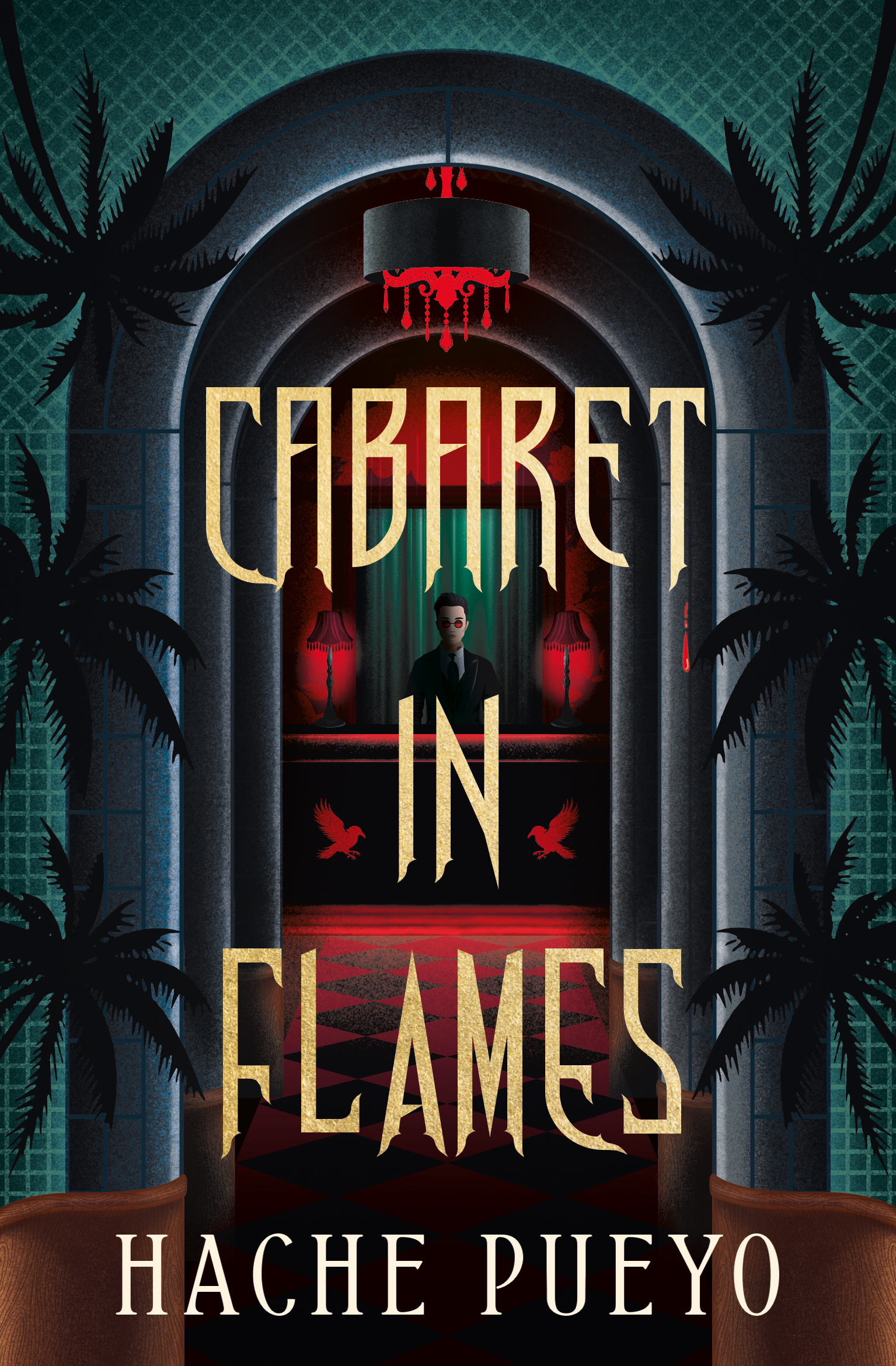
I went into Cabaret in Flames by Hache Pueyo basically blind, because I really enjoyed But Not Too Bold, I loved this cover, and that was all I needed. And honestly, I loved that experience, because this really is the kind of novella that works best when you just let it grab you by the throat and don’t ask too many questions until it’s already too late.
And yeah, it gets real dark, real fast, which I loved. We follow Ariadne, a quadruple amputee living in this chaotic alternate Brazil already falling apart thanks to politics and death squads, and then you add the unique twist on vampires with these human flesh-eating guls that she lost half her body to. Like, that already had me so hooked, but then Quaint shows up, all charm and suspicion, and suddenly we’re in a mystery surrounding her missing mentor, a shady cabaret, buried memories, and emotional damage everywhere you look, and I loved how that all spiralled into something so painful and personal.
This little novella is really doing a lot of things at once, hopping from horror to mystery to romance to psychological thriller, but somehow it all just worked together. Yes, the pacing and narrative focus can get a little messy at times, but the fact that I read it in a single sitting should say enough about how captivated I was. Pueyo's writing is just so immersive, the moody atmosphere is heavy and suffocating, and I found Ariadne’s backstory with the childhood abuse and sexual trauma morbidly fascinating in a way where I kind of hated reading it but also couldn’t look away.
I do think I might have loved this even more as a full-length novel just to give the relationships, themes, and the romance more room to develop and hit harder, but as it is, this was a very satisfying little trauma fest. Pueyo is now two for two in my book, and at this point I’ll read whatever unsettling thing she decides to write next.
I absolutely loved the dark and creepy worldbuilding. You've got monster people eating human flesh and drinking human blood, creepy human experimentation, human and guls having sex, etc. Super gross and super cool.
But since this is a novella, it felt like too much worldbuilding for too little payoff.
I know it's totally unfair to say that the novella word count is too short, but I think that this story would definitely work so much better as a novel. There was so much going on—too much going on tbh—that the story begged for a much longer word count.
Also, I'm not an insta-love fan, so the romance didn't work for me. It felt like it came out of nowhere. I'm happy for the characters and all, but I wish there was more of a buildup. But then again, there's only so much you can do in a novella.
I'll take it for what it is. It was a dark read and exactly the type of thing I'm into, so I did enjoy it, despite all of my complaints. I really wish this was a duology because I would've loved to read more from this world and these characters. I wanted to revel in the dark fantasy and supernatural horror-ish vibes, but the story ended all too quickly.
Thank you to Tordotcom and NetGalley for this arc.
DNF Title/Author: Cabaret in Flames Format Read: digital ARC/netGalley Pub date: March 10, 2026 Publisher: Tordotcom Page Count: 160 Affiliate Link: https://bookshop.org/a/7576/978125037... Recommended for readers who enjoy: - Dark Fantasy/Horror/Translations/Romance - Memories/Missing Persons/Mystery - Creature-Features/Vampires - Political themes - Alternate histories/timelines *Brazil - Mentors/Toxic relationships/Physicians "Guls can be brutal. Few know this better than Ariadne, who lost half her body to their appetites. Now, she treats them in the specialized clinic she inherited from Erik Yurkov—the mentor who disappeared without a trace. Ariadne’s routine is disturbed when Quaint knocks on her door, claiming to be Erik’s oldest friend. Quaint suspects foul play in Erik’s disappearance, and they soon discover Erik sought asylum at Cabaré, an infamous club in Rio de Janeiro. Together, Ariadne and Quaint will unravel the conspiracy behind their friend’s disappearance, navigate the labyrinthine world of Ariadne’s memories, and discover what Erik means to them—and what they are starting to mean to each other." __ Minor complaints: - The storytelling style didn't appeal to me and it was the same for Not Too Bold but I thought I would try again
Final recommendation: I enjoyed the glam and dazzle of Rio de Janeiro, the mystery and suspense but I didn't enjoy the political threads of the story or the monster romance (which reminded me so much what I didn't like about But Not Too Bold). I guess this author's books just are not for me, and that's ok Comps: The Fox and the Devil by Kiersten White (Gothic, Dark Fantasy, Physicians)
The pacing in this is a mess. It felt like chunks of the story had been cut out which often left me confused or unsatisfied. The ideas are cool but the focus is too narrow. This really does not work as a novella.
I think I understand why people rave about Cabaret in Flames even if I didn’t fall for it quite as hard.
For me, it’s a solid 3/5.
A lot of it works, and when it works, it’s really good. The writing does the heavy lifting here. It’s moody, textured, and pulls you in. That dark, neo-noir vibe never lets up. Brazil feels gritty, and unstable. The gul society is predatory and elegant, and believable. The worldbuilding is top tier.
Ariadne makes a strong lead. She’s a quadruple amputee, survived a gul attack as a kid, now runs a clinic treating those same creatures. That push-and-pull (living with trauma, finding a way to coexist) hooked me. Her relationship with her body, her memories, just making it through the day, all of it comes across with real care.
Then Quaint shows up. Tattooed, ancient, and a gul who claims he’s Erik’s oldest friend. From there, the story splits: you get a slow-burn romance between Ariadne and Quaint, a grim thriller about Erik’s disappearance, political unrest bubbling up, a decadent cabaret where the gul elite party, and darker stuff - people getting taken for body parts.
The book jumps between romance, thriller, social drama, and gothic horror. Each part is solid, but when you piece them together, the mood gets choppy. I admired what the book tried to do more than I actually got lost in it.
Still, I should say: I’m in the minority. Most people seem to love this novella, and I totally see why. The prose is gorgeous. The way it handles trauma, survival, intimacy is intentional. The setting alone is worth a read.
So even if it didn’t quite win me over, I’d still tell people to check it out. Maybe I missed something obvious. Wouldn’t be the first time I’ve been out of step with the crowd.
viscerally real in its depiction of trauma, achingly kind in its depiction of healing. I already know this book is going to be very important to me, and I think it can be important to you too
This novella is a bold, boundary-breaking work—part mystery, part dark fantasy, part intimate character study—that refuses to fit neatly into any one genre. Within its lean page count, it grapples with some of the heaviest and most human themes: childhood sexual abuse, the long echo of trauma, disability and survival, the possibility of healing, and the complicated ways love can grow in the aftermath of devastation. It also doesn’t shy away from examining abuses of political power, systemic violence, and the fragile, chosen families people build to keep going.
The world itself is astonishingly vivid for a story under two hundred pages. Humans coexist with guls—creatures who resemble us only at a distance but possess inhuman speed, strength, and a hunger for flesh, blood, and bone. It’s a world that feels fully formed, brutal, and strangely beautiful. At the heart of it all is Ariadne, a woman who carries her trauma in both memory and body, her prosthetics a stark reminder of what was taken from her. When she teams up with Quaint, a gul whose ten sets of bone-splintering teeth are matched only by the unsettling pull she feels toward him, she is forced to confront the darkest corners of her past.
Their search for Erik—the man who rescued her long ago and rebuilt her broken body—pushes Ariadne into places she hoped she’d never revisit. Old wounds split open as she crosses paths with guls she once prayed to forget. Yet this time, she isn’t alone. Quaint walks beside her, a dangerous ally, a constant temptation. The deeper they go, the harder it becomes for Ariadne to understand whether her desire for him is a twisted echo of past horrors…or the beginning of something real and fiercely her own.
I’d recommend this book wholeheartedly to readers who don’t shy away from darkness, who want characters with edges, scars, and stories that demand to be felt. Although the novella incorporates supernatural and speculative elements, the true focus lies in the characters and the emotional gravity of their journeys. Readers who typically seek out creature-driven fantasy will find plenty to enjoy, while those who prefer human-centered narratives will discover a surprising amount of heart beneath the shadows.
There is violence and gore, but it is handled with restraint—enough to unsettle, never gratuitous.
I won this book through a Goodreads giveaway. That did not reflect my review at all.
First impressions: What a fascinating novella. The story follows Ariadne, a doctor to guls, who's finally meeting one of her mentor's old friends and expanding her life outside the small shape that it's had for some time. There's a lot of emotional weight here to what we slowly learn about Ariadne's history of trauma and recovery, particularly the way she fights to make decisions on her own terms without being pitied for her bionic limbs.
I also loved the connection between guls and political unrest-- there's some great thematic work here about who's eating or being eaten based on the whims of the powerful, and about how bad systems perpetuate themselves. To me, the ending seems a bit rushed, but that's partly because I wasn't ready for the story to end. I would have liked to see a lot more about those themes and would cheerfully read a novel in this alternate-world Brazil that feels not too far from our own reality.
Pueyo has done some compelling work, and I'm interested to see what she writes next.
Cabaret in Flames is a horror novella written by Hache Pueyo and published by Titan Books. A short piece that shows how you can efficiently pack so much into a few pages, a horror-filled tale that not only gives us an original spin on such underutilized creatures as guls, but also delights us with a story about forgiveness, a bit of romance and mostly about healing from the past.
A novella that revolves around Ariadne, a girl living in an alternate Brazil set in chaos, ravaged by death squads under the president's control and also guls, human-flesh eating monsters. She lost half of her body to their appetites, but was given prosthetics by genius Erik Yurkov, who rescued her and trained her to heal those of the race that attacked her before disappearing. When Erik's old friend, Quaint, knocks on the door seeking Eric, it starts a quest that will take our duo to the heart of the conspiracy and will allow them to also start healing their own internal wounds.
Pueyo puts the complex relationship between Quaint and Ariadne at the center of the novella, using it as the piece that articulates the rest of the piece. Not only we have an extraordinary person in the figure of Ariadne, somebody that lost most of herself (literally) to the guls until Erik saved her, but also somebody who still needs to heal, and here's where Quaint enters. Quaint is certainly a strange character, but I feel part of it comes from how the gul concept is understood: not only due to how their food habits are understood, but their perception of time is twisted in comparison with human one. However, Quaint was exactly what Ariadne needed to finally start healing after Erik's disappearing, even if Quaint represents the same creature that hurt her.
Despite this being a short novella, Pueyo also manages to delight the reader with an impressive worldbuilding, which not only feels refreshing as it shifts away from the usual places, Brazil, but also weaving the conspiracy with the political system and the own guls, so similar yet so different to vampires.
Cabaret in Flames is a marvelous novella; it might not be for all readers, especially with how raw some themes feel, but which I particularly enjoyed. Hache Pueyo is a name to watch in the horror genre!
I would like to start this with saying there’s heavy content including child assault and endangerment within this, in case anyone blindly stumbles across this.
I’m a sucker (lol) for a good vampire story, and this was a rather short and snappy addition to my growing collection. I enjoyed the writing and the scenes, the inclusion of South America as a setting was really unique and lovely too. I wish there was more of a story and more between the two main characters that could properly build their relationship.
I’d like to add on that I have a very prominent dislike for the whole “thousands of years old male mc and twenty whatever year old female mc” trope, and this book unfortunately does fall into it, despite one of the other characters who is relatively much closer to FMC’s age being put off by the age gap.
I've never read anything by this author before, and sadly, I didn't really like this one.
the characters were the best part of the book, though. I liked the cute relationship between ariadne and quaint, that's about it, lol.
the writing style wasn't my favourite. I didn't particularly like the long-ish chapters, and the way the story was told made it feel quite boring and stagnant.
I didn't really get what the point of this whole story was. maybe this book just wasn't for my brain. the deal with the president also felt random as we only got glimpses about it. honestly, this book was quite forgettable, and I can already tell I'm not gonna remember anything about it soon. 😬
safe to say I personally can't recommend this, but maybe I'm just not the right audience.
"It’s gory and generous, wry and expansive, a monster story that asks the reader to live with multiple conflicting truths, consenting to cut ourselves on their ragged edges."
I feel like saying, 'what a fun romp into discovery and revenge' is out of place because the revenge part isn't right there but it's part of the discovery, also, with the content of this book 'fun' seems wild but you know what? *I* had fun.
This little novella is a sort of alternate Brazil where vampire-esque monsters (guls) have a hold on enough facets of the government to influence a curfew (that they are allowed out in) (mostly so they can eat people but for other reasons too), focusing on a human who's been wronged by these creatures before and yet after being saved as a child from a really dire place, learned to medically treat these same creatures. We meet her some time after her teacher/mentor/savior disappears, and a quiet man - gul - from his past appears. Together, they start unraveling the mystery of his disappearance, something that seeps as far as the government, and also, unravel their own connection. Also, cool future-tech prostheses that the main character has full control over how they are presented in exactly the ways she wants them to be.
Lots of contents warnings in a small package (mentions of the affects of CSA, violence, various mutilations), and this world was really rich even in a short 160 pages (it seems it started as a shorter story in Brazilian Portuguese and then was expanded into this novella! What a boon for us!) it was so easy to just get sucked in and stay very seated for the ride while also getting such a good feel for Ariadne's motivations and view of said world. I'd been meaning to read 'But Not Too Bold' for a while but you know how things get, so this was my first Hache Pueyo but definitely not my last??
Thank YOU to Tor (Tordotcom) for the eARC for the novella and NetGalley for hosting!
Steampunk vampire dystopian medical spec fic noir? Does that cover it? Very cool that Pueyo pulled it off. Just a fun (okay yes, very very dark) read. Would recommend to anyone who enjoyed A Long Time Dead by Samara Breger.
Also - I read this in one sitting, on a wharf, as the sun set. Gotta love vacations!
Absolutely fantastic novella in a world I would happily take more from but I believe this is going to be a standalone novel.
Ariadne is a young woman living in a world with flesh-eating guls, a corrupt government and some trauma to unpack whether she wants to or not. This book is fast paced, gritty and the finest bit uplifting. I look forward to reading it again! And hopefully listening to an audiobook copy when it's out in March.
Ariadne isn't her name. Most of her body isn't hers either; she's had to reclaim the prosthetics made to replace the limbs consumed by the vampire-like guls who feast on human flesh. She's locked most of her past out of her mind. And yet she has followed in the footsteps of the man who rescued her and has become a gul-doctor. Her mentor/savior has vanished, though, and a new man comes knocking, a tattooed gul called Quaint. Quaint is strange, even for a gul, but it's in their best interest to locate Erik, even as it unwraps Ariadne's buried memories.
Weird short speculative fiction feeds my brain in the best way, and Hache Pueyo's brand of body horror delivers. My favorite speculative horror is atmospheric, setting a dark tone in a recognizable world. Set in an alternate-Brazil, Pueyo gives us the gritty underside and the glamorous nightlife of these horrifying creatures who live alongside humans. I'm not often one to gives comps for a book, but in this case, it evokes two favorite authors: Certain Dark Things by Silvia Moreno-Garcia and Dr Greta Helsing by Vivian Shaw, with a darkness that is all Pueyo.
Thank you to Tordotcom for an eARC. Cabaret in Flames is out 3/10/2026.
basically fine. if you're going to have your protagonist repeatedly call herself ugly, I'm going to need evidence. I do love a bisexual male love interest for a woman. good sense of place/setting. kind of annoyingly vague with its like.......unnecessarily slow, movie thriller–style method of unraveling ariadne's tragic backstory. nothing wrong with a slow pace or keeping the reader in the dark if there's a reason for it, but I don't know that it amounted to all that much, narratively speaking.
some interesting language stuff going on where pueyo is clearly a fluent writer in english but I suspect thinking in other languages. see, for example, the repeated mentions of "the lines on the back of his hand [being] stiff, the salience of his veins evident under the tattoos," "the subtle salience of the peony tattoo on the back"—not technically incorrect, but certainly a rare usage in english, where we use the word slightly differently than in spanish or portuguese. (and by 'interesting,' I really do mean 'interesting'—it reminded me a bit of when I'm listening to native spanish speakers and I realize that a word that has fallen out of use in english or is only used in specific academic or archaic contexts remains quite colloquial in spanish. delicious! I eat it up! yum yum! not like a gul, but perhaps not not like a gul.)
accurately captures the experience of the intensely erotic vampire/g[ho]ul dream! not putting the vamp in vampire but taking the ho out of ghoul? let me workshop it
I really liked many aspects of this book. I think it did a lot of things right. The writing was beautiful and stylistically well-developed, some very serious themes were handled with care, the concept was unique and intriguing, and I think that the blend of genre elements like a central mystery, a romantic plotline, and the world-building characteristic of a fantasy was balanced well. I also think that the arc of this incredibly traumatized character being able to find love with someone who felt safe to her was done really well, and I really appreciate when a fantasy with romance is able to explore dark themes without letting issues with consent or the woman's safety bleed into their dynamic and make it into something toxic. It was a little fast, but I didn't mind it as much as I may have if their dynamic didn't feel so refreshing to me.
There were just a few parts of this novella that didn't quite land for me. I think the premise of guls that eat humans, yet live among them and are enabled to kill even human children due to government corruption, is a huge undertaking in terms of worldbuilding and in constructing the ethics of a society where that could happen. I don't think it was done poorly, but I almost feel like this novella could have done with being a short novel instead, because the characters directly initiated some conversations about how complicated their relationships with eachother are because of this biologically forced predator-prey dynamic, but I couldn't tell quite what the book wanted to say about it by the end. I feel like introducing "it's not even taboo that our species eat human children" and showing innocent humans being murdered in-scene several times, and then not bringing those really intense themes home to some sort of conclusion, even if nothing in the society truly changes, felt a little underdeveloped for me.
That said, I still really liked this novella, and I think for the right reader it would mean a lot to experience it because some of the heavier themes were navigated with such care and complexity. I think survivors of SA would particularly feel really seen and potentially uplifted by this story, and the author's vulnerability in the acknowledgements was something I really respected and appreciated. I think that honesty will help connect this book to the right readers. I really like tordotcom novellas in general because they're just so approachable to read, and this book was no exception.
Thank you to Tordotcom and Netgalley for this ARC.
This entire review has been hidden because of spoilers.
A genre defying, nuanced mystery that discusses childhood sexual abuse and trauma, disability, healing and love, while also touching on abuses of political and other power structures, found families, and desire. All this within less than 200 pages and while developing a perfectly built world shared between humans and guls, beings who share a likeness with humans, but are capable of much greater strength and speed, and who subside on human flesh, blood and bones. Ariadne must watch herself and her heart when she teams up with Quaint, a gul in possession of ten sets of bone crushing, flesh slicing teeth, in order to find Erik, the man who pulled her from a pit of mutilated children and created prosthetics for the limbs taken from her. Ariadne faces flashbacks as she encounters guls from the past she'd rather forget, but her path seems to tread directly into that past trauma - this time she has Quaint by her side, but is her desire for him just another echo from the past she must overcome, or something else?
I'd highly recommend this for readers who don't shy away from the darkness, those who are looking for a story that will fully engage with complex and interesting characters. While the novella has elements of speculative fiction, the focus is more on the characters and plot than creatures and supernatural lore, both readers who love supernatural stories and those who don't will find something to grab their interest here. Gore and violence is described, but not in great detail on the page. Readers of Cassandra Khaw, Gretchen Felker-Martin, and Poppy Z. Brite will find similar elements of exploring sexual abuse, trauma, and healing within a dark storyline and often using speculative fiction elements.
A complex adjacent world that is creatively different without needing pages of explanations and such, filled with fab characters, that underpin a fascinating narrative. I loved Ariadne and Quaint as a gul-cyborg couple, their histories and current realities were traumatic, violent (very), and full of the unique brand of love and caring that can only come from such terrifying pasts. And their pasts are borderline unspeakable. Pueyo doles things out in gradually increasing doses, and much of what we read is truly horror. Still, we stay, just ever so barely, on the side of non-gratuitousness, though there are passages most assuredly not for the kind at heart, or squeamish-like people. I loved all of it, tragic and visceral and harsh, but a thick strand of empowerment and strength and agency is always present. We are left with just enough for a continuation, but also more than enough for a satisfying send off. I, for one, would welcome more pages from these characters, in these places. Novellas are excruciatingly difficult to do, ratcheted up to quite hard to do well, and Pueyo does the latter of the two, and I am happier for it. Cheers.
This. This book right here is why I keep reading fantasy and slogging through a genre that can often feel worn through and out of ideas. Because I FULLY went into this book believing there was nothing new that could be said about vampires but wow. I was so wrong.
This wholly original novella gets to the heart of vampire lore— that at our core, we are afraid that the worst parts of our past are undying, and that there’s a tension over whether that darkness is internal or external. The positioning of amputation within the text was also both jarring and really powerful. And there was a softness to the vampires closest to Ariadne that added much-needed pauses between her violent flashbacks. Those traumatic scenes usually keep me at arms length as a reader since in they’re often deployed quite callously (especially towards women) in the hands of a less sensitive and capable writer. But here, together with Ariadne’s journey, exploration of self in her new body, and burgeoning relationships, it felt like the development of personhood. And all that was happening against the backdrop of near-unchanging immortals. Fabulous metaphor. Loved it.
A fascinating horror story with neo-noir vibes. What stood out most was how unique it felt, blending Brazilian folklore with high-tech elements like our main character’s synthetic limbs. Her tragic backstory was gripping and while the romance wasn’t super developed, it was still sweet. The overarching mystery kept me interested as well.
What didn’t work for me was the lack of world-building and how rushed the ending felt. This is such an intriguing world, but the dynamics between guls and humans, along with the political landscape, were only lightly sketched out. This really feels like a story that would have benefited from being a full-length novel rather than a novella, especially with so many genres and ideas in play. Overall, though, it was a really entertaining read with a lot of promise.
My thanks to Titan Books and NetGalley for a free DRC of "Cabaret in Flames" by Hache Pueyo. A Horror Novella in an alternative Brazil where human-eating guls exist and have a powerful influence on the government. We follow a disabled human that is a gul doctor. Her mentor and rescuer having been recently dissapeared, she meets an eccentric gul that claims to be an old friend of her mentor and that wants to help her finding him. There were a lot of heavy topics handled well in this Novella. The characters were well constructed and the world felt dangerous and vivid. I also appreciated the prose. A solid reading experience with only minor pacing issues.
Cabaret in Flames is a horror novella that packs a lot of punch in a small package. We have human flesh consuming guls, propaganda fighting machines and a very traumatized main character trying to save victims of vampire maulings.
I think this novella had too much to offer in too short of time. It had some incredible potential to world build and develop the characters, but it couldn’t achieve that with the length. I thought it had great promise, but I got lost in the multiple storylines.
I enjoyed the ride, and I will absolutely read more from this author, but I don’t think this read was quite for me.
Queria muito ter gostado desta novela, porém foi uma leitura fraca. O início é bem interessante, mas à medida que a história avança, eu fui perdendo o interesse nos personagens e no enredo. Eu adoro histórias com vampiros, e como Cabaret in flames se passa no Brasil, me chamou a atenção, só que a execução do enredo ficou a desejar, o ritmo vai ficando estranho e a resolução, para mim, não foi satisfatória. Acho que foi o caso de uma leitura que eu me "forcei" a terminar no momento errado, quem sabe um dia eu me arrisque a reler.