After reading this book, you’ll know exactly how to start your brand.
Founding a company is the hardest thing you’ll ever do, but it’s so much easier than leaving your dreams unpursued. It’s not for everyone, yet something still compels you to dive into the piranha-infested waters.
Dylan Trussell knows what it’s like to make millions one year…and be millions in debt the next. Everything he learned, from startup to how to make your successful exit, is here. The Shortcut exists to save you years of agony and bring you success in the shortest time possible.
Discover how to find your passion, design and market a product that sells, raise money, and mentally prepare for what lies ahead. Find out how to deal with the inevitable dumpster fires. Then learn the secrets of converting your blood, sweat, and nightmares into sweet, hard cash.
There are no shortcuts in life. Except for this. This is The Shortcut. Start here.
Benevolent Dictators, Cash Reservoirs, and the Myth of ‘Effortless Money’: Reading “The Shortcut” as a Manual for Black Swans and Modern Work By Demetris Papadimitropoulos | February 18th, 2026
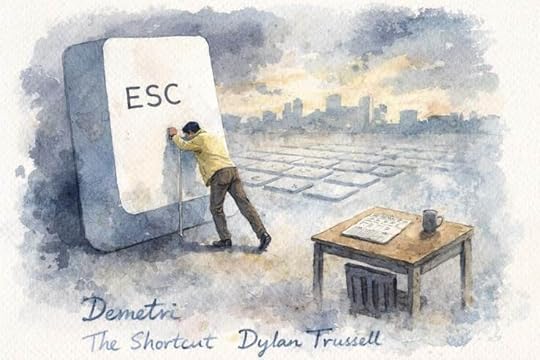
Watercolor Piece by Demetris Papadimitropoulos
There are business books that arrive like manuals – neat, laminated, safe to spill coffee on. And then there are business books that arrive like the founder himself has burst through the wall, hair on fire, waving a cash-flow spreadsheet in one hand and a cold plunge timer in the other, shouting: Stop romanticizing the struggle. Learn from mine. Don’t be cute. Be alive.
That is the governing energy of Dylan Trussell’s “The Shortcut,” a book that treats entrepreneurship less like a career path than a contact sport. It is written in the brash, caffeinated cadences of someone who has had to make payroll with five grand in the bank, and who has the scars – financial, psychic, social – to prove it. Each lesson is a small, self-contained detonation: a quote up top (Rockefeller, Buffett, Ogilvy, Kelleher), an anecdote from business lore (Carnegie, Warner Bros., Apple, SpaceX), then a punchline that lands somewhere between stand-up and exorcism. The chapters read like a friend texting you at 2 a.m. from the edge of a cliff: I found the map. Also, I’m bleeding. Here’s how not to fall.
If that sounds exhausting, it sometimes is. But it is also, in a genre crowded with polite bullet points and sanitized case studies, a strangely honest kind of music.
Trussell’s core argument is simple enough to fit on a Post-it – which is, of course, how he wants it. You don’t win by being “frugal” in the abstract. You win by being ruthless about what matters and boring about what doesn’t. Spend nothing on ego. Spend everything on leverage. Don’t take debt to keep the lights on. Do take it, carefully, when it buys you efficiency, talent, or market expansion that pays you back. Always have a buffer. When it rains, build a reservoir. The drought is coming. The unusual happens, usually.
This is the book’s heartbeat: a paradoxical romance with pessimism. Trussell is not selling you hope. He is selling you preparation. Over and over, he returns to the same humiliating truth that has ended more dreams than bad ideas ever will: cash-flow optimism. The villain isn’t competition. The villain is the founder who believes last month’s revenue curve is a promise. The villain is “effortless money” – the intoxicating season when your Uber driver has crypto advice and your mailman is sure the party will never end. Trussell’s heroes are not the visionary dreamers in black turtlenecks; they are the unglamorous misers with discipline: Hetty Green sitting on cash, Buffett waiting six years to deploy it, Carnegie expanding when no one else dares because he can buy labor and materials cheap, the businesses that don’t just survive black swans but eat them.
Read in 2026 – in a world still metabolizing pandemic aftershocks, interest-rate reality, layoffs-as-earnings-call theater, and the whiplash of algorithmic markets – the emphasis on buffers feels less like conservatism than like basic literacy. You can hear, between Trussell’s jokes, the contemporary anxiety that the ground can shift under any business overnight: a platform policy change, a supply-chain choke point, an ad auction gone feral, a sudden audit, a lender’s hold, a storm that knocks out the grid. His Hurricane Sandy anecdote about Goldman’s generators is less a flex than a warning: resilience is not a vibe, it is infrastructure.
And yet “The Shortcut” is not a book about safety. It is a book about speed.
Trussell is obsessed with the tradeoff between committees and momentum. He has little patience for what he sees as corporate anesthesia – focus groups, endless consensus, the soft tyranny of “alignment.” His ideal company is a benevolent dictatorship: one decision-maker, high standards, minimal bureaucracy, two pizzas’ worth of people in the room. He admires the founders who can say, like Bezos approving a warehouse, “You just got it,” and move on. He enjoys the provocation of the word dictator the way some entrepreneurs enjoy the provocation of the word disruption: as a way of declaring war on process.
Here the book flirts with its most interesting, and most dangerous, temptation. The fantasy of unilateral control is emotionally understandable in a world where everything feels slow – where regulations, legal reviews, stakeholder management, and the permanent court of public opinion can make even minor decisions feel like a referendum. But anyone who has worked inside a real organization knows the shadow side: the benevolent dictator is always one crisis away from becoming merely a dictator, and the company culture can go from decisive to fearful with one well-timed tantrum. Trussell knows this, in a way. He is at his best when he admits that panic comes from the top, and that demoralization – not competitors, not cold, not ice – is the most dangerous foe. Morale is fragile. Trust is perishable. When payroll is late, your team does not want your explanation. They want their money. They will not care about your heroic self-sacrifice, your “real” Zoom background, your cold plunge. They will think: deadbeat. Trussell writes this with the cold clarity of someone who has learned it the hard way, and it lands because it refuses consolation.
The book’s most moving passages are the ones that feel least like lore and most like confession. “The Shortcut” is filled with swagger, but it is also filled with the humiliations that swagger is designed to cover: the realization you hired too much, the late-payroll terror, the sickening math of fixed costs, the decision to cut what is “vital” to survive, the year of running a multimillion-dollar business on scraps and prayer. He tells you the truth most business books hide behind frameworks: leadership is not applause. Leadership is blame. When things go wrong, the story becomes your fault, even when it isn’t. And when you fix it, no one thanks you, because all you did was return to baseline.
That honesty makes his cynicism feel earned rather than performative. It is not the cynicism of someone sneering from the sidelines. It is the cynicism of someone still in the arena, occasionally coughing up blood, still selling.
If you want to locate “The Shortcut” in its genre lineage, imagine a bastard child of “The Hard Thing About Hard Things” and “Shoe Dog,” raised on “Principles,” caffeinated by “The Almanack of Naval Ravikant,” and periodically smacked in the face by “The Black Swan.” Like Ben Horowitz, Trussell is addicted to the gritty present tense: war stories, not theories. Like Phil Knight, he treats business as a series of absurd near-deaths survived by stubbornness. Like Taleb, he distrusts the human tendency to narrate randomness as destiny. And like many contemporary founder-memoirists, he is acutely aware of the optics of success – the urge to pop champagne, post the victory, buy the Ferrari – and the brutal speed with which the universe can turn your celebration into a screenshot.
His longest cautionary tale, the Hollywood financing saga, is essentially a parable about platform risk before we even name it as such. A deal is signed. The ink is dry. The champagne is popped. And then the lead actor detonates his brand with one video, and the whole structure collapses. It’s a story that reads differently now that the modern economy is so often built on borrowed credibility: creators, influencers, founders, companies that live and die by the reputational algorithm. Trussell’s superstition – keep the champagne on ice until the check clears, until the return window closes, until the rocket returns – is the kind of folk wisdom that emerges in eras when certainty is an illusion and the downside arrives via push notification.
But for all its hard-earned counsel, “The Shortcut” is also, inevitably, a performance. The book’s diction – its profane charm, its masculine bravado, its love of the “psychotic” grind – can feel like an energy drink poured into the already jittery bloodstream of modern work culture. Trussell mocks “work-life balance” as something the successful preach after they’ve made it, and he is not wrong that seed-planting precedes fruit. Yet there is a point where the rhetoric of suffering becomes its own aesthetic, and “passing out” starts to sound less like a phase and more like an identity. In a decade when burnout has become both a medical diagnosis and a marketing strategy, the book’s celebration of savage bursts risks teaching the wrong lesson to the wrong reader: that exhaustion is proof, and proof is the point.
This is where the New York of it all enters – not the city, but the sensibility. What saves “The Shortcut” from becoming a mere hustle manifesto is that it is repeatedly interrupted by its author’s self-awareness. Trussell is not an evangelist for pure grind; he is a realist about seasons. He points, unexpectedly, toward a Buffett-like ideal: make fewer decisions, think more, delegate, preserve mind. He talks about hiring operators, assistants, building systems that let you be on the business, not in it. He insists you should not be an ivory-tower boss, but also not a martyr. The book’s better self understands what our era’s best business writing has been trying to articulate – in books like “Four Thousand Weeks” and “The Psychology of Money,” even when they arrive from different angles – that time, not money, is the only truly nonrenewable capital.
Still, the book’s worldview remains fiercely founder-centric. Employees appear mostly as mouths to feed, costs to model, morale to manage, missionaries to recruit. That is not a moral failure so much as a limitation of perspective. “The Shortcut” is written by someone who has had to keep a company alive, not by someone tasked with imagining the equitable future of work. When Trussell tells you to “be vanilla” with employees – professional, firm, not their friend – he is offering a hard boundary that many leaders need. Yet when he returns, again and again, to the fantasy of control, you can feel how easily the benevolent dictator story might be misused by someone less self-critical, less generous, more addicted to being right.
There is also the matter of myth.
Trussell’s lesson format relies on a familiar American liturgy: Franklin, Rockefeller, Carnegie, Ford, Jobs, Musk. The saints of scale. The scripture of decisive men bending history. In 2026, when we have watched tech titans swing between hero and villain in the space of a quarterly report, that liturgy can feel both irresistible and insufficient. It is invigorating to read about furnaces that halve waste and sound films that revive studios. It is also sobering to remember what those stories often leave out: labor, externalities, luck, the moral luck of being born at the right time with the right passport and the right margin for error. Trussell nods to luck more than most. He admits randomness, timing, the surface area of chance. But the gravitational pull of the hero narrative remains strong, and it occasionally flattens complexity into a slogan.
And yet slogans are precisely what many readers will come here for. “The Shortcut” is built to be underlined. It wants to be turned into a doctrine. It believes repetition is cement. It wants you to close the book and do something. Its aesthetic is action: stop ingesting, start creating; default to no; protect Plan A; don’t white label your vision; never sell your best idea; take the stock; send the elevator back down. Even when you disagree with the posture, you can’t deny the craft: Trussell understands that advice is not adopted because it is true. It is adopted because it is memorable.
This is the book’s secret competence. It is not just a set of principles. It is a delivery system.
Like the most effective direct-response copy – a lineage Trussell openly admires – “The Shortcut” sells by making you feel. It makes you laugh, then makes you nervous, then makes you want to prove you’re not the kind of founder who will pop champagne too early and get punished for it. It does not flatter the reader with gentle permission. It provokes. It taunts. It dares you. It is, in the end, a motivational book that pretends it hates motivation.
There is, too, a very specific contemporary subtext: this is a direct-to-consumer book written in the long shadow of platform power. A privacy tweak, an attribution change, a paid-social algorithm deciding to “learn” the wrong lesson – any of it can turn a healthy quarter into a weekly emergency. Trussell drops the dashboard acronyms (ROAS, LTV, CAC) not to posture, but to translate modern business into its real vernacular: weather, not clocks. Hence the obsession with cash buffers and optionality. It’s not prudence – it’s rent.
One can quibble with the book’s billionaire canon, but Trussell occasionally surprises with a live-wire ethical ambivalence. He flirts with tax “hacks,” then recoils, not from sainthood but from the recognition that optimization is another form of distraction – a second job that steals hours from the work. In an age when inequality is a daily headline and “founder” can sound like either folk hero or private-equity henchman, his most persuasive counsel is the least glamorous: build something real enough that you don’t need tricks.
And yes, he sells. He plugs his brands with the grin of a showman hawking records at the back of the club. Some will find that grating. Others will read it as the book’s most honest evidence: in his universe, not selling is how you die.
That is why it lands where it does for me: 83/100 – a sharp, memorable, frequently practical book that earns its authority through lived panic, even as it occasionally mistakes adrenaline for wisdom.
In its final pages, Trussell insists the spotlight is on you. Slam the book shut. Go do some main character shit. It’s a line that could have been cringe in lesser hands. Here, it feels like the honest conclusion of a long, messy sermon: belief before ability, yes – but also, for the love of God, a cash buffer before the party.
Practical Advice not just for business but for life, and insanely (almost too much) honest!
Most business books are written by people who've already won. Trussell wrote this one while actively bleeding. That's the difference, and you feel it on every page.
The Shortcut opens with Trussell on the verge of losing everything — lenders threatening to freeze his company, employees' paychecks about to bounce — and instead of panicking, he starts writing a book. That probably tells you everything you need to know about the guy, and whether this book is for you.
At 127 chapters, it shouldn't work, but it does. The short format means you're never stuck in a chapter that isn't resonating with your particular situation.
While there's a plethora of historical figures and their wisdom, from Alexander the Great to Jeff Bezos, the book is at its best when Trussell gets personal. A chapter about being publicly humiliated by his best friend in fifth grade is more emotionally honest than anything you'll find in most memoirs, let alone business books. It builds a trust with the reader that makes the advice land harder.
For a first-time founder or anyone early in their entrepreneurial journey, this might be the only business book they need. It's funny, it's honest, and unlike most books in this genre, it doesn't pretend the author had it figured out the whole time.
The Shortcut by Dylan Trussell was honestly just a random curiosity read at first — mainly because his Instagram posts have always been making me laugh. What wasn’t expected at all was how much this book would actually stay with me. What makes Dylan stand out to me is the way he writes. He’s genuinely funny, incredibly sharp, honest, and never sounds forced. It feels less like someone trying to “teach you life” and more like listening to someone who actually has something real to say. Somehow, he manages to take lessons, experiences, and advice from insanely successful people and turn them into something that feels effortless to read. Not shallow — just accessible, entertaining, and human. And that’s probably what surprised me most: this book actually stirred something in me. Not the usual temporary motivation rush, but more this quiet feeling of, maybe I should finally start. Start my own project. And the fact that a book can do that probably says more about The Shortcut than any five-star review ever could.
I received access to this book courtesy of NetGalley and Scribe Media. All opinions are my own. I genuinely enjoyed The Shortcut. If you’re even thinking about starting a business or trying to grow one, this book delivers powerful insight in a very real and practical way. What stood out most to me were the countless real-life examples from billionaires and well-known entrepreneurs. Seeing how these founders think and pivot when necessary was incredibly motivating. My only critique is the organization. At times, it felt like flipping through a stack of genius note cards. It had very sharp ideas, butit didn’t always flowing seamlessly from one to the next. The content is strong, but I found myself wishing it had been structured in a more cohesive format. Overall, though, this is a valuable read for aspiring and current entrepreneurs who want mindset shifts and practical perspective from those who’ve already built at the highest levels.
Dylan Trussell’s The Shortcut is exactly what anyone trying to start a brand with little to no experience needs. It’s concise, practical, and refreshingly no-nonsense, cutting through the usual overwhelm of “how to start” guides.
What makes this book stand out is how actionable it is. Every chapter feels like a mini roadmap, with clear steps that you can actually implement immediately. The examples and insights make branding feel less intimidating and more achievable, even if you’ve never launched a business before.
If you’re ready to stop overthinking and start building your brand from scratch, this is the guide to get you moving. It’s an approachable, motivating, and surprisingly thorough primer that demystifies the early stages of brand creation.
Highly recommended for aspiring entrepreneurs who want clarity, focus, and real results without the fluff.
This entire review has been hidden because of spoilers.