Amos and Tom fall in love while working in the tobacco fields during the hot summers of the early 1900s, but it will be decades before they can truly be together. Tom cannot shake the strict religious code he was raised by nor the responsibilities of his family’s farm, and he ultimately marries his longtime friend Maeve; while Amos goes to New York City to find the anonymity required to live his life openly. And though Maeve pines for Paschal rather than Tom, the strict Jim Crow laws prevent her and Paschal from being together. The Tulip Poplars is a sweeping novel--intimate in its storytelling and epic in its scope--spanning most of the 20th century, centering on four people trying to find happiness in a world that demands conventional choices. It is an examination of faith and doubt, race and class, and desire—not just sexual desire, but also the longing to be good when the whole world is telling you are evil for loving who you love. Deeply moving and based on both his ancestors and his own life, as well as the history of the small Kentucky towns he knows so well, House’s new novel will leave you with a bigger heart.
Silas House is the nationally bestselling author of six novels--Clay's Quilt, 2001; A Parchment of Leaves, 2003; The Coal Tattoo, 2005; Eli the Good, 2009; Same Sun Here (co-authored with Neela Vaswani) 2012; Southernmost (2018), as well as a book of creative nonfiction, Something's Rising, co-authored with Jason Howard, 2009; and three plays.
His work frequently appears in The Atlantic, The New York Times, and Salon. He is former commentator for NPR's "All Things Considered". His writing has appeared in recently in Time, Ecotone, Oxford American, Garden and Gun, and many other publications.
House serves on the fiction faculty at the Spalding School of Writing and as the National Endowment for the Humanities Chair at Berea College.
As a music writer House has worked with artists such as Kacey Musgraves, Jason Isbell, Lee Ann Womack, Kris Kristofferson, Lucinda Williams, The Judds, Jim James, and many others.
House is the recipient of three honorary doctorates and is the winner of the Nautilus Award, an EB White Award, the Storylines Prize from the New York Public Library/NAV Foundation, the Appalachian Book of the Year, and many other honors.
This story starts off in the early 1900’s and ends in the 1970’s. It is about a group of four young people growing up as friends in the Appalachian Mountains of Kentucky. There is Tom, Maeve, Amos and Paschal, … forbidden love affecting their lives through many years. The story follows them through their entire lives. Much of their first three decades were spent unable to live as they would have liked due to gay relationships and black/white relationships actually being illegal, and damning in the eyes of their religion.
It’s a beautiful story.. I love this author’s writing and have read several of his books.. His books are an automatic read for me.
Thank you to NetGalley and Algonquin Books for the free ebook in exchange for an honest review!
The Publisher Says: A sweeping historical novel about hidden, forbidden love in the early 1900s by bestselling writer and former poet laureate of Kentucky, Silas House.
Amos and Tom fall in love while working in the tobacco fields during the hot summers of the early 1900s, yet Tom cannot shake his strict religious upbringing nor the responsibilities of his family’s farm. His longtime friend Maeve also pines for a man she can’t have, lest she endanger his already tenuous life in a town and world shaped by racial lines. How do you live a life that feels untrue, and at what point do you risk everything?
The Tulip Poplars is a gorgeous and moving novel spanning most of the 20th century, centering on four people trying to find happiness in a world that demands conventional choices. House tells a deeply intimate story of faith and doubt, race and class, sexual desire and the longing to be good when you’ve been taught that you are evil for loving who you love.
Based on the story of an ancestor, House’s new novel takes us from New York City to Southern cities to Appalachia and will leave you with a bigger heart
I RECEIVED A DRC FROM THE PUBLISHER VIA NETGALLEY. THANK YOU.
My Review: It's a lovely, lyrical telling of a story every last one of us, regardless of nationality or ethnicity, has in our direct line of descent. In a world a hostile as it is to same-sex love (let alone sex) the closet has created a lot of unhappy marriages. Statistically there were happy ones, too, but I'm willing to wager there were, and are, fewer of those.
So I was predisposed to like and enjoy the story of the "good" people of Bright Star, Kentucky, and unsurprisingly I did. Especially the men falling in love across class *and* queer prejudice lines. Talk about an uphill battle, though, that's Maeve, a white woman breaking literal Jim Crow laws by indulging in carnal congress with Paschal, the only Black person in her father's Episcopal school. He risks his literal life being with her; she loses social standing by her miscegenation, and becomes a pariah by getting pregnant out of wedlock. Fortunately Paschal's whisked away in 1919 due to the Corbin Expulsion, an appalling event I'd never heard of before. Amos self-exiles to New York City, where revolting incidents of police violence against queers impact (!) his life; Tom's confined to a mental institution to undergo insulin-overdose induced coma to cure him of being queer. (In order to include this nightmarish torture, the author says plainly he moved its US application earlier than it took place in reality, which I appreciated.)
As the escapees from Bright Star form new connections, Tom and Maeve navigate their dishonest marriage, raise a daughter, live lives...longing for others. So very many of us do this. We find the scraps and hidden bits we can enjoy to the degree possible, but happiness is a bit strong of a word for the twilight state of anesthetized misery company, if we're lucky turning into companionship, preents in the absence of a love lost. I know all of us carry some unfixable sadness. Far fewer carry this level of punishing loneliness found in settling.
The role of the piano, whose keys I discuss below, stitches the emotional reality of Bright Star together. I know for sure all y'all will know Satie's Gymnopédie No. 1 the instant you hear it. It will be less obvious until you read about the pieces why Author House likely chose them. Safe to say this is the point I fully got on board Author House's Yearning Express.
I've docked a star because on the first page, the first paragraph even, reference to a piano made in the nineteenth century having "Tanzanian ivory" keys caused me to stop reading for weeks. "Tanzania" is a name invented in 1964...during my lifetime. "Tanganyika" was used when it was a German colony in the 19th century, up through independence to the invention of the portmanteau of "Zanzibar" and "Tanganyika." This is easily checked, and as a throwaway line it could've been "African ivory" with no change in meaning. My remaining fraction of a star loss was down to my significantly lower interest and investment in the straight couples.
It's a lovely reading experience, another one of those where I'm compelled to read bits aloud. Normally I'd chuck one in here so you could feel smugly superior about not liking it, but there were six that I could not choose from, so I skipped it.
This caused me significant emotional anguish. It's beautiful writing, and proof one needn't insert weird line-breaks or fail to interconnect the ideas behind the words into grammatically correct sentences to evoke strong emotions and offer beauty to the Muses.
Take note of this before committing Poetry *ptooptoo* again.
I was lucky enough to receive an ARC of this masterpiece.
Mr. Silas House, I was not familiar with your messy game, but I am absolutely here for it. Once again, you've written a love letter to my beloved Appalachia.
This book is a journey filled with so many highs and lows. My favorite kinds of stories are the ones that span years because they feel more intimate, allowing me to truly know the characters as they grow. This novel is, at its heart, about longing and pining—the ache of yearning for someone you can't have because of law, faith, and the expectations of the world around you. Yet it beautifully reminds us that true love cannot die, no matter how hard people try to bury it.
The characters were beautifully three-dimensional. Tom and Amos's love was unbreakable, and I found myself rooting for them through every season of their lives. Paschal's story was fascinating, but my dear Maeve stole my heart. She was, without question, my favorite character.
What struck me was how unflinchingly this story portrays the suffering the LGBTQ+ community has endured throughout history. There were so many heartbreaking chapters that, while fictional, undoubtedly echo experiences that countless real people lived through. The novel also shines a light on the experiences of Black Appalachians, showing how racism could force someone to leave the only home they had ever known, separating them from their home and sense of belonging. Those realities make this story all the more powerful.
Silas House has written another unforgettable Appalachian novel—one that honors the beauty of the region while refusing to look away from its painful history. This is a story that will stay with me long after I turned the final page.
4.5 ⭐️ I loved this sweeping historical fiction story about forbidden love set in 1900’s rural KY. It focuses on four friends, Tom, Amos, Maeve, and Paschal, and is told in alternating chapters from the different points of view.
The writing is beautiful and brings the gorgeous Appalachian setting to life with the tulip poplars, hills, and rivers. Tom and Amos are gay, in love, but can’t be together and Maeve who is white and Paschal who is black can never fulfill their love for each other.
Their stories evolve over time and encompass their lives from Eastern KY to NYC. Based on one of the author’s ancestors makes it all the more interesting.
Although the last part of the book felt a bit rushed the way the author wrapped it up, it was still a beautiful story!
Thanks to NetGalley and Algonquin Publishers for the eARC in exchange for my honest review
Sometimes the best books are the ones you never would have discovered without a recommendation from a fellow reader. Anna on Bookstagram suggested The Tulip Poplars to me, and I am so grateful she did. This is a gorgeous, deeply moving work of historical fiction and easily one of the best novels I’ve read in 2026.
My closest comparison is Buckeye by Patrick Ryan. Both are sweeping, character-driven novels that follow four interconnected lives across much of the twentieth century. But where Buckeye is firmly rooted in Ohio, The Tulip Poplars takes us into the tobacco fields and communities of Kentucky.
At the center of the story are Tom and Maeve, a married couple whose hearts belong to other people. Maeve loves Pascal, a Black man with whom she cannot build a life because of the racial barriers imposed by Jim Crow society. Tom, meanwhile, is gay, although in the early 1900s he doesn’t even have the language to understand his own identity. He falls in love with a man named Amos while working in the tobacco fields, a relationship that profoundly shapes his life.
As the decades pass, we follow these characters through love, longing, sacrifice, and the painful compromises demanded by a society that refuses to accept them. Amos leaves Kentucky for New York City, hoping to find a community where he can live authentically, while Tom and Maeve attempt to construct a life together within the narrow boundaries they’ve been given.
In many ways, this is a tragedy worthy of Romeo and Juliet. Not because these people are incapable of loving one another, but because the world around them is determined to keep them apart.
What struck me most was how powerfully the novel illustrates the consequences of denying consenting adults the freedom to love and live authentically. The restrictions weren’t simply legal. They were woven into the fabric of society, reinforced by religious institutions and cultural expectations that were almost impossible to separate in the early twentieth century.
It’s especially haunting to consider how often people and institutions believed they were defending morality while causing tremendous suffering. Historical fiction at its best asks us to examine those assumptions, recognize the humanity of people who were marginalized, and consider what lessons we should carry into our own time.
And that is precisely what The Tulip Poplars accomplishes. If you want to read a novel that genuinely expands your capacity for empathy, this is the book.
I tandem-read the print and audiobook editions, and the audio experience added another wonderful dimension. The Southern accents felt authentic to the setting, something I particularly appreciate in fiction rooted so deeply in a specific place. I was especially delighted to recognize Charlie Thurston, whose narration I know from Jeff Zentner’s novels. His performance captures Tom’s vulnerability and tremendous heart so beautifully, bringing an additional layer of tenderness to an already moving story.
This is the kind of sweeping historical fiction that stays with you long after the final page. Beautiful, heartbreaking, and profoundly human.
Thank you, Anna, for putting this extraordinary novel on my radar. I absolutely loved it.
Oh I loved this beautiful coming of age/life in review. Silas House gives us two pairs of star-crossed lovers in early 20th century Kentucky: Tom and Amos, and Maeve and Paschal. Tom and Amos are in love, but can't be together because they're both men. Maeve and Paschal are in love, but can't be together because Maeve is white and Paschal is Black. I loved each of them. There's a lot of stolen moments and yearning in their youth, and our four main characters end up not quite alone, but not with the ones they want to be with. Tom and Maeve are lifelong friends who decide to get married, but of course they're not satisfied. Amos explores the more open lifestyle opportunities of New York City, but always feels called back home. Paschal finds love, but his wife doesn't want the same things out of life that he does. Silas House weaves historic events like race riots and raids on queer and gender non-conforming spaces into the storyline. There are villains, beautiful landscapes with the titular tulip poplars (one of my favorite trees), and a lovely mule named Daisy. Without spoiling anything, I will say that this is not an overall tragic story, despite the hardships. I only cried a couple of times. Recommended for fans of historical fiction like Kristin Hannah, sweeping stories of a life lived like John Irving, or emotional historical queer romances like Brokeback Mountain.
All the stars for this beautiful, emotional book. Silas House is such an incredibly talented writer, I would read his grocery list if he let me. But his talent isn’t surprising, considering he is a former poet laureate of Kentucky.
The book begins in rural Kentucky, a small town known as Bright Star, in 1918. Two young men, Tom and Amos, fall in love while working side by side on Tom’s family’s farm. They know that they have to keep their feelings for one another secret, although Amos dreams of being in a place where he can be himself and be with Tom.
Tom’s childhood friend Maeve is raised by the town’s Episcopal preacher, and he also runs an orphanage tied to the church. It is there that Maeve meets and falls for Paschal, but given their different races, they know their love cannot be, especially not in Kentucky.
When tragedy strikes Tom’s family, he feels like he must stay in Bright Star to care for his sister and protect the farm from the machinations of an evil preacher. But Amos no longer wants to stay where he has to hide who he is, so he moves to NYC. He realizes that with freedom comes very real danger.
The book spans from 1918-1976 and traces the lives of Tom, Amos, Maeve, and Paschal. It’s particularly bleak in places where the story deals with the treatment of gay people during these years. But it also emphasizes that love can last even when circumstances seem insurmountable or when you can’t be with the person you love. There are moments of beauty and hope as well.
House’s prose is so lyrical and evocative. I could see the tulip poplars in my mind’s eye and watch as love tears the characters apart and lifts them up. I’ll be thinking about this book for a long time.
This was my first Silas House novel, but it certainly won’t be my last. In this captivating yet heartbreaking novel, House does an incredible job of showing the duality of human beings. A tale of four friends set to the backdrop of early 1900s Appalachia, this story begs us to consider what we give up when we are forced to hide our true selves.
*** Special thanks to the publisher for sending a physical ARC to the bookstore I work at. ***
This beautiful novel broke my heart. Tom, Maeve, Amos, and Paschal grow up together in rural Kentucky in the early 1900s. Maeve and Paschal are soul mates, except she is white and he is black. Tom and Amos are also soul mates, but are men.
The writing here is gorgeous, and I found myself immersed in the beauty and longing and injustice of this story. Descriptions of nature are abundant, and I wanted nothing more than to see Tom’s farm property for myself, particularly the grove of tulip poplars. There is some hope in this novel and I cried as the novel ended and I had to say goodbye to these characters. Highly recommended.
Thank you to NetGalley and Algonquin Books for allowing me to read an ARC of this title.
This absolutely took my breath away. I read it in a little over a day because every time I put it down, I kept thinking about it. I finally just gave up on sleep.
I’d read Silas House’s poetry before, but this was my first time reading his fiction, and I can absolutely see why he is so lauded for his prose. His writing here is stunning, especially the way he writes about land and place. The heart of this story is set on a tree farm in Kentucky, which House writes about with such intimacy, beauty, and reverence that you can feel why this place is God for these characters. Even while the religion that raised some of them, and that some still follow, shuns them, the land accepts and holds them. That’s God.
The characters are deeply complex products of the early 1900s South, fighting for self-acceptance in a culture that shames them for who they are, whether queer, Black, unmarried and pregnant, or in love with someone of another race. I don’t know that I’ve ever rooted for a collection of characters so wholly. I also don’t know if I’ve ever read fiction that immersed me so viscerally in the experiences of its characters, particularly the queer characters. Tom stood out to me as especially well-developed. He is so obviously good and kind, yet carries so much shame about himself. That contradiction is one of the most heartbreaking truths this book deals with, how thoroughly a person seen as “other” can internalize the belief that something is wrong with them, even when there so clearly isn’t.
This was so much more than a love story, but my God, was it a beautiful love story. So many kinds of love—romantic, erotic, paternal, platonic, religious, mule (this is actually Daisy’s story).
I finished this feeling a little wrecked, even if the ending was maybe less powerful to me compared to the rest. This book will stay with me for a long time. I am very glad I read it.
Thank you to NetGalley and Algonquin Books for providing an advanced copy in exchange for an honest review.
Well, if this wasn’t exactly the kind of sweeping, character-driven novel I was in the mood for. I loved the sense of place, the writing, the tension and longing between the characters, and the feeling of witnessing their lives unfold over decades.
It gets a little saccharine toward the end, which I was kind of expecting, and the resolution feels a little too easy. I found one relationship much more convincing than the other and overall wish there’d been more nuance. But it scratched an itch.
A story of forbidden love and self-determination, definitely for fans of Buckeye by Patrick Ryan or even The Prophets by Robert Jones Jr.
Has softened edges on some nasty history, some prejudice-meets-prejudice. But man, I've never rooted so hard for 5 people. Beautiful book. Finch, you lucky, lucky girl.
Tom felt as if a flock of birds had burst out of his chest. The doctor had said the one thing he had wanted someone to tell him his whole life. from The Tulip Poplars by Silas House
Four teenage friends in 1918 Kentucky cannot live the life they want, and are forced to make choices that do not lead to a full life.
Maeve, the preacher’s daughter, loves Paschal, who is black. Maeve and Tom are loving best friends, but Tom’s heart truly belongs to the orphan Amos. When Tom and Maeve find solace in each other’s arms, resulting in her pregnancy, they marry and Amos goes to New York City to find another kind of life. Pachal marries a Black preacher’s daughter and becomes a minister instead of a scientist.
These characters love each other fiercely as friends. Tom adores Maeve and their child. But none are completely fulfilled, longing for the one person they cannot have.
This heartbreaking, lyrical love story reveals the prejudice and tragic consequences of loving outside of ‘social norms’ in the early twentieth century. In NYC, Amos finds an accepting underground culture but observes first hand the murderous hate against queer folk. Tom is blackmailed into admitting himself into an asylum where brutal treatments are administered to correct ‘unnatural’ desires.
The story follows into the later twentieth century and more enlightened times. Still, just forty years ago I remember how AIDS fueled fear, and a queer friend agonized over his identity.
The novel is also a love story to the land, the Tulip Poplar grove a place of romantic trysts but also a legacy of beauty to be protected. “At its heart this is an environmental novel,” House writes in the afterward, its proceeds supporting the Kentucky Natural Lands trust.
This was my first encounter with a Silas House novel, and I found “The Tulip Poplars” quite engaging. If you were a fan of “Buckeye” by Patrick Ryan, you’ll love this book!
The narrative follows two couples—Tom and Amos, Pascal and Maeve—weaving a complex tale of forbidden love across the first seven decades of the twentieth century.
I anticipated a more historical tone, yet the writing felt contemporary despite the era depicted.
Overall, I appreciated the book; it might have earned five stars, but I felt less connected to Pascal and Maeve’s storyline. Amos and Tom’s story seemed stronger, so greater focus there might have improved the novel.
Thank you to NetGalley and Algonquin Books for the advance copy of this upcoming novel releasing on October 13, 2026.
What a journey this book was. A love letter to place as much as people, it followed the lives of Maeve, Paschal, Amos, and Tom as they grew up in Bright Star. A historical novel, initially I felt the characters were a bit too modern, but as the story unfolded, it felt right. Reading the afterward, put things in more perspective why he chose the particular journey for this group. Maeve is in love with Paschal, but their color keeps them apart. Amos and Tom are also struggling with forbidden love. Things get more complicated when Maeve becomes pregnant out of wedlock. The book spans almost their entire lives. It switches perspectives from each of the four protagonists, which provides a sweeping view of their lives, but limits seeing the full depth of each of them. It is a beautifully written, emotional love story.
Thank you to Netgalley and Algonquin Books for the advance reader copy.
This year has been filled with extraordinary books for me, and this one may have just topped the charts. This was my first Silas House novel, and after reading it, I’m ready to work my way through his entire collection.
The writing is incredible, and the descriptions of the Kentucky landscape, the small-town atmosphere, and the people who call it home are so vivid that I finished the book feeling like I’ve been there. The author explores the hardships so many people have endured, and continue to endure, simply to exist as themselves and openly love the person they love. He perfectly describes how our external identities, internal struggles, and personal experiences affect how we view (and oftentimes treat) others. Some are capable of change; others struggle against it. Some grow to accept and even appreciate the many differences in people, while others remain constrained by fear, tradition, religion, prejudices, or societal pressure and expectations.
One quote that seems so simple on the surface but will stay with me for a very long time is
"Love without acceptance is not love at all."
Now that I've finished, I have a new problem. One of my current top ten books of all time must be demoted, because there is no chance this one isn't earning a place there. I'm not an influencer or a well-known book reviewer but trust me when I say either pre-order or put this one on your library's hold list asap!
Thank you to NetGalley, Algonquin Books, and the author for an advanced digital copy of this remarkable book!
My thanks to NetGalley and the publishers for an ARC of this title in exchange for an honest review.
Sentimental in the positive sense of the word.
At its heart, The Tulip Poplars is about four characters, Tom, Amos, Maeve, and Paschal navigating the strictures of small town life in early 1900’s Kentucky. Each of them desires something not permitted by their society, and they feel stifled by the social mores of the town of Bright Star, even as they relish the vibrant natural beauty of the land they call home. It’s a double bind familiar to many inhabitants of socially oppressive rural communities. They can’t quite be themselves there, yet nowhere else feels quite like home. Trying to build a life amid this tension, to be true to themselves while not losing their sense of place, is the crux of the novel.
The writing is picturesque and fluid. It’s really more of a character study than a plot driven narrative. Though there were a handful of unexpected moments, generally the tone of the book was contemplative and wistful, a love letter to Appalachia wrapped in historical fiction. It may not be to everyone’s taste, but I found it worked well. Particularly since the author portrays each character so distinctly and adeptly. I really felt like I knew these people after only a few chapters and it was riveting to see them conflict with the outside world and even amongst themselves. I appreciated as well that each character was genuinely trying their best almost all the time, yet none of them were perfect caricatures. They each had moments of messy jealousy, episodes of thoughtlessness; just like real people.
This was my first book by this author and I would gladly try anything else by this author. 3.5 (Bright) Stars.
I finished this on a plane, and had to ask a flight attendant for a napkin to sob into. Such a beautiful portrait of four young people who struggled to be who they were and love who they loved. Most of us have no idea how difficult that can be in a time and place different from our own. The writing is simple and gorgeous. Very highly recommended.
There is something particularly disappointing about finishing a book that, on paper, should have been exactly the kind of story you love, only to discover that somewhere along the way you have remained entirely unmoved. That was my experience with The Tulip Poplars by Silas House. I wanted to love this one. I wanted to be swept up in its Appalachian setting, its forbidden romances, its complicated relationships, and the sweeping passage of time. These are all things I generally gravitate toward. And yet, when I turned the final page, I found myself feeling rather lukewarm. Not disappointed exactly, not particularly impressed either. Just... fine.
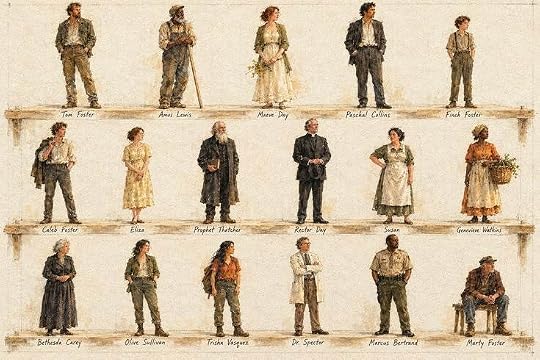
The novel opens in Bright Star, Kentucky, in 1918, introducing us to four young people whose lives and loves are shaped by the prejudices and expectations of the world around them. Tom Foster and Amos Lewis fall in love while working together in the tobacco fields. Their relationship is tender and genuine, but the religious conservatism of their community makes a future together seem almost impossible. Meanwhile, Tom's childhood friend Maeve Day has fallen for Paschal Collins, a young Black man whose own circumstances make their relationship equally dangerous. In a world governed by racial segregation and deeply entrenched social expectations, neither couple is afforded the luxury of loving freely.
As the years unfold, circumstances pull these four people in different directions. Amos eventually leaves Kentucky for New York City, where he can experience a degree of freedom unavailable to him at home. Paschal escapes racial violence and finds himself in Lexington, where he eventually marries and enters the ministry, abandoning some of his earlier ambitions. Left behind, Tom and Maeve find comfort in one another. Their friendship develops into marriage after Maeve becomes pregnant, and they attempt to build a conventional life together, despite the fact that their hearts belong elsewhere.
Tom is perhaps the most complicated of the four. Torn between his religious upbringing, his responsibilities to his family, and his love for Amos, he spends much of his life trying to reconcile the person he is with the person he has been taught he ought to be. Maeve is similarly caught between expectation and desire. Her affection for Tom is genuine, but it is not the romantic love she longs for. Amos represents the possibility of freedom, while Paschal's story explores the particular dangers of being a Black man navigating the racial hostility of early twentieth-century Kentucky.
There is also something important happening with the land itself. The tulip poplars, the family farm, and the natural world become symbols of permanence, belonging, and the things worth protecting. House clearly has a deep affection for Appalachia, and that affection comes through in his descriptions of the landscape and the lives built around it.
And this is where I find myself struggling a little. I can recognize what House is trying to accomplish. There are important themes here: forbidden love, religious hypocrisy, racism, sexuality, belonging, and the painful compromises people make simply to survive. There is plenty of material to sink your teeth into. The historical setting is compelling, and the premise is one that should have completely captured my attention.
But something never quite clicked.
I can't decide whether it was the writing, the characters, or perhaps a combination of both. I never found myself particularly invested in what happened next. I understood the longing, I understood the heartbreak, and I understood the circumstances that made these relationships so difficult. But understanding a character's suffering and actually feeling it are two very different things. I wanted to be emotionally wrecked by this story. Instead, I mostly watched it unfold from a distance.
There were moments when I desperately wanted more intimacy, more emotional depth, and a stronger connection to the people at the center of the narrative. I wanted to feel their desperation, their yearning, their little victories and enormous losses. Instead, I often found myself appreciating the ideas behind the story more than the story itself.
The one moment that genuinely stirred something in me was the scene involving the donkey being whipped. Absolutely deplorable. It was the one moment when my emotional response was immediate and undeniable. I felt genuine anger and distress, and I found myself far more affected by that cruelty than I had been by much of the human suffering elsewhere in the novel. Perhaps that says something about my reading experience, although I'm not entirely sure what.
I don't think The Tulip Poplars is a bad book. Far from it. There is ambition here, and House is exploring subjects that deserve attention. I can appreciate the importance of telling stories about queer and interracial love in rural Appalachia, particularly during a period when both were met with such hostility. I also appreciate the novel's insistence that love, in all its forms, has always existed, even when society has done everything possible to deny it.
I simply wish I had felt more of it.
Ultimately, this is a perfectly respectable three-star read for me. One I can appreciate without particularly loving, and one I suspect will resonate much more deeply with other readers than it did with me. Sometimes a book can have all the ingredients you usually adore and still leave you cold. Unfortunately, The Tulip Poplars was that book for me.
Well, somebody has to be the outlier. I suppose that's me. It's very clear that the majority of readers connected to the story in a way that I didn't.
I *loved* Lark Ascending, and still recommend it to everyone I know. Lyrical, evocative writing with such a powerful message about what we need most in a crumbling world wracked by spreading dystopia and catastrophic Climate Change. A very impactful read. 5 stars.
This novel does not strike that tone at all, in my view. The descriptions are almost tropey and caricaturish. The characters seem outlined in rushed brushstrokes. Even the traumatic backstories seem hurried.
The first character we are introduced to, Tom, seems in possession of a contradictory personality. Happy crowds of people make him terribly anxious, and reluctant to join them, but also those same exact crowds give him his absolute greatest joy. That strikes me as either highly unusual, or just downright odd.
The story felt so surface-level to me, that I was grateful for biological facts about red-spotted salamanders.
Prejudice and forbidden love are two strong themes, as long as they are not delivered in too heavy-handed of a way. I expected a little more yearning and pining away, a much lighter and more slowly-developing connection than we get here. "Oh, I guess we're skipping the courtship." It's like we arrive halfway through the movie.
So, feel free to fault me, but for all of these reasons, sadly, I cannot continue with this novel.
Silas House is a writer who grows with each book he writes. He's always been a good writer, but this one may be his best. The characters leap off the page, and the setting, in both Kentucky and New York, is so concise that you feel like you are there. Not only is the book beautifully written, it is also an important work that examines queer and interracial love during a time when both were verboten. The stories, unfortunately, still resonate today in many parts of our country and the world. Love cannot be wrong... ever. Love is the most powerful source of good there is. It doesn't matter who or how you love; it doesn't matter your skin color or orientation or gender. Love is love. Period. The ONLY reason I didn't give this book a full five stars is that I wanted more from the interracial story in the last quarter of the book.
Such a beautifully written novel. I appreciate how deftly House integrated a ton of historical research without it ever feeling as though he’s dumping his notes on the page.
The Trees Have Better Archival Instincts Than the Institutions Silas House’s “The Tulip Poplars” follows people misread by churches, hospitals, laws, and neighbors until songs, letters, paintings, graves, and a stubborn grove preserve the record more faithfully By Demetris Papadimitropoulos | October 3rd, 2026
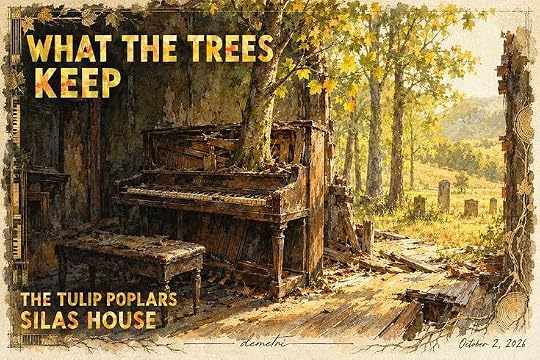
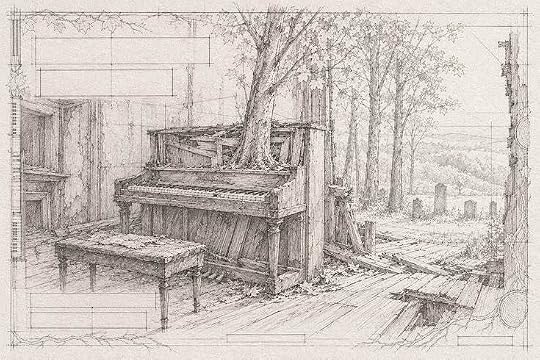
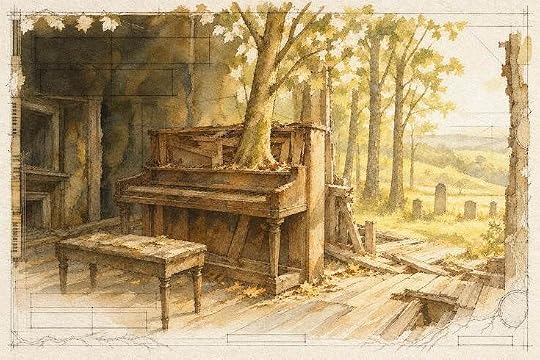
“What the Trees Keep” – An abandoned piano, a young tulip poplar, and the graves beyond the missing wall turn Bright Star’s ruin into an archive of what outlives the institutions that tried to define these lives.
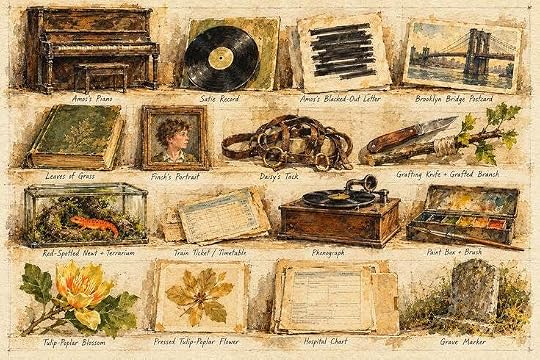
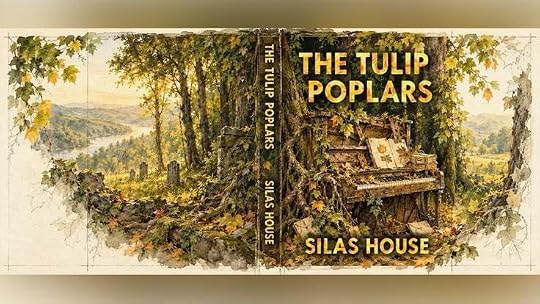
Dead towns make excellent archives because they cannot object to what survives them. “The Tulip Poplars” opens with Bright Star, Kentucky, collapsing into weather. A wall has fallen from an abandoned house. An upright piano stands exposed inside it. From the soundboard grows a young tulip poplar. Older trees circle graves descendants still visit, and a child presses a blossom into a book. House gives us the relics first. Nearly everything that follows explains how they got there.
Everything looks, briefly, like a machine we know how to operate. In 1918, farmer Tom Foster falls for Amos Lewis, an orphan taught by clerical abuse to distrust divine authority. Tom’s lifelong friend Maeve Day loves Paschal Collins, the only Black boy at her father’s Episcopal institute, for whom being seen with a white woman can be lethal. Race, law, church, family, and fear scatter the four into marriage, exile, and return. House’s larger gamble is to keep following them after reunion would satisfy a smaller novel.
Most of what prejudice steals here is measured in years. Paschal is hurried out of Bright Star after the 1919 Corbin Expulsion. Police violence reaches Amos’s queer life in New York. Tom enters an asylum where doctors induce insulin comas to cure his “unnatural desire,” a treatment House acknowledges moving earlier than its widespread American use. Yet the harsher loss is breakfasts never eaten together, fields not worked side by side, evenings never shared. Tom and Amos lose decades before they can become boring together. Giving them back is the book’s boldest repair.
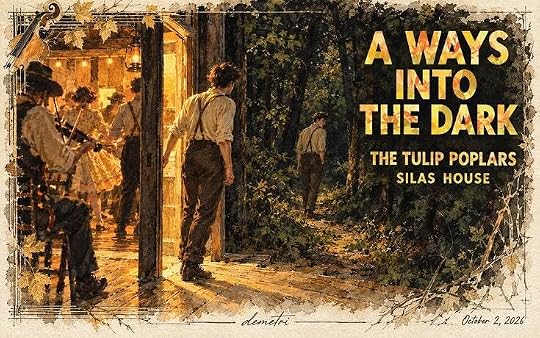
Early on, Amos slips away from a square dance and tells Tom, “Just walk with me a ways.” The modesty is almost funny. Walk makes love a motion. With me asks for company. A ways leaves forever suspiciously unmentioned. They move from the bright room into woods dark enough for the kiss. House tells us Tom will carry the phrase through separation, asylum, and death. The recurrence works, though the advance notice exposes one habit: sometimes a good image gets its own porch light.
“A Ways Into the Dark” – Tom pauses between square-dance light and the dark path where Amos waits ahead, making the threshold itself carry the danger and promise of their first kiss.
Tom’s problem can be heard in five words: “I want to be good, Amos.” Amos answers, “Why is being who we are not good?” Tom has inherited a vocabulary in which desire and goodness cannot occupy the same body. Amos, whose religion includes abuse alongside Scripture, discards the premise earlier. “I do. I want to be myself,” he says. The book does not let that become sufficient. Tom’s sexuality is not a wrong. Keeping Maeve inside a marriage built around what he cannot tell her still wounds her. Innocence of desire does not cancel responsibility.
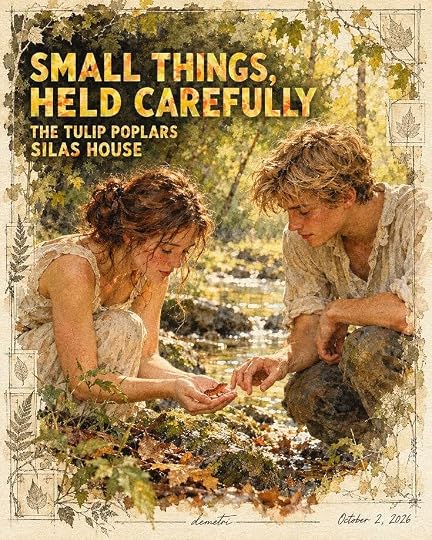
“Small Things, Held Carefully” – Maeve and Paschal bend toward a red-spotted newt, their almost-touching hands making Caleb’s ethic of small things briefly visible as tenderness.
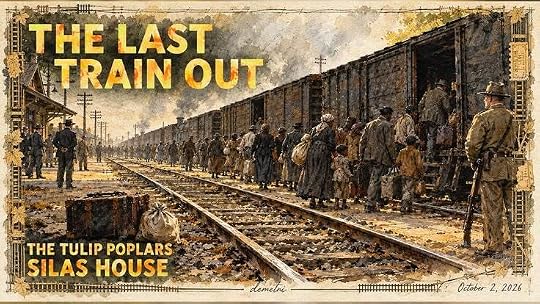
Race makes the two central love stories unequal in ways the book does not blur. Tom and Amos can sometimes pass through the world unread; Paschal cannot hide what makes Maeve dangerous to him. The Corbin interlude follows a white mob terrorizing Black residents and forcing hundreds onto trains. Paschal is removed before dawn. Maeve finally understands that his warning described his odds. House’s historical material works best when it changes an earlier scene.
“The Last Train Out” – Rails narrow toward forced departure as Black residents are driven from Corbin, letting infrastructure bear the historical pressure rather than turning violence into spectacle.
If Tom and Maeve existed only to delay Tom and Amos, their marriage would be dead weight with good table manners. Instead it produces Finch, companionship, resentment, work, tenderness, and years neither can revoke. They sleep together beneath the poplars associated with Tom’s desire for Amos, and their daughter comes from an encounter both know is incomplete. When the marriage ends, House does not retroactively empty it. A later truth does not make an earlier truth a lie.
Paschal’s marriage to Genevieve gets similar dignity. Lexington gives him a Black professional and Episcopal world larger than Bright Star. Genevieve is educated, ambitious, and alert to the vanity of benevolence. Their life matters. So does the moment Paschal assumes his rural ministry should become her future too. She will not disappear into his calling. The mountains that protect him feel like prison walls to her. A place does not become home by majority vote.
Amos discovers that New York is too complicated to function as a clean escape hatch. It gives him Bethesda, music, work, queer nightlife, and proof that people like him exist in public. During a police raid, Marcus runs while Amos stays with the beaten Bethesda, who later dies. The city gave her room to become herself and housed the authorities capable of killing her for displaying that self. Amos’s return to Kentucky carries neither defeat nor simple homecoming. He leaves one dangerous freedom for another.
Play Satie once and it is simply music. Let Amos describe “Gymnopédie No. 1” as longing, then let Maeve find Tom listening alone and crying, and the record changes without changing. No confession occurs. Maeve has acquired the noun capable of reorganizing years of evidence. The scene is one of House’s best because it withholds the explanatory speech he often supplies elsewhere. The revelation belongs to Maeve’s interpretation and ours.
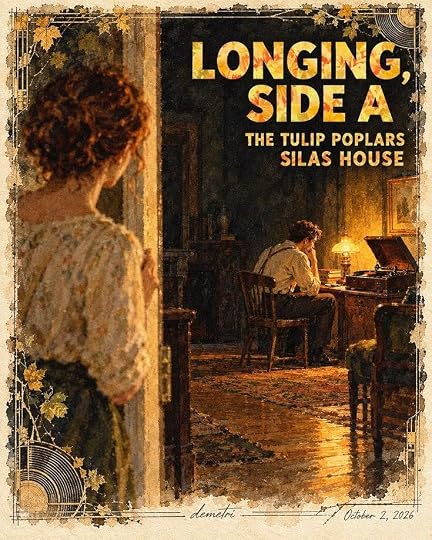
“Longing, Side A” – Maeve watches from the doorway as Tom listens to Satie alone, the room’s empty distance giving longing a shape before either of them can name it.
Amos later writes Tom a long confession, destroys it, and replaces it with “I’m coming home to you.” Before mailing the note he blacks out to you. Maeve finds the page and reconstructs the missing words. The erasure becomes evidence. Much of “The Tulip Poplars” works this way: postcards, records, paintings, flowers, songs, graves, letters. They carry relationships across gaps where public language fails. An archive need not be official to outlive officials.
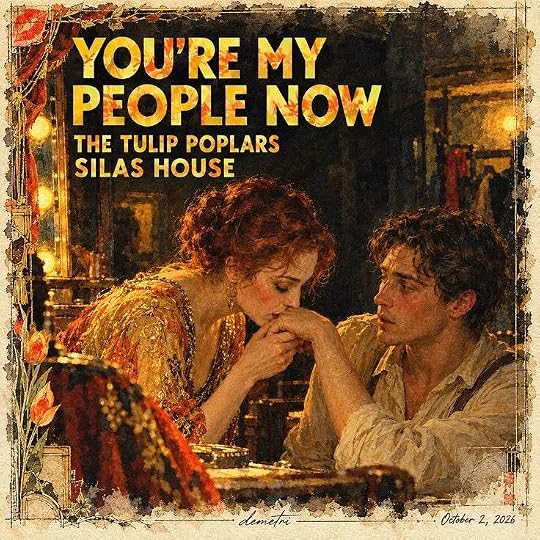
“You’re My People Now” – Bethesda’s kiss above Amos’s thumb turns chosen family into a small, luminous gesture held against the larger darkness of the room.
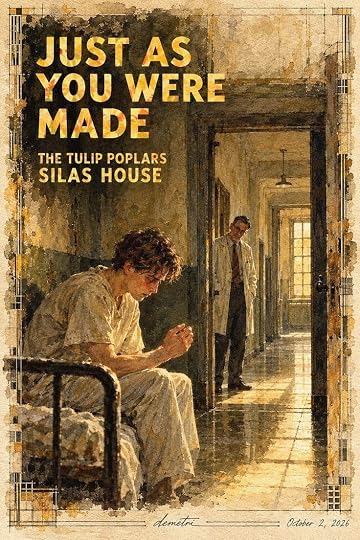
Dr. Spector tells Tom what he has wanted his whole life to hear: “There’s nothing wrong with you. You are just as you were made.” Then he gives him the less comforting half: Tom must commit honestly to Maeve or let her build another life. That distinction is one of the book’s cleanest ethical moves. Sexuality is not wrongdoing; deception can still have casualties. Spector also reveals House’s instinct to install an interpreter when the moral weather grows complicated. He is persuasive and extremely convenient.
“Just as You Were Made” – Tom’s exhausted body and trembling hand are dwarfed by asylum geometry while Dr. Spector’s affirmation opens the first narrow space not organized around cure.
In sentence after sentence, House prefers accumulation to abrasion. Rootstocks, sorghum, newts, wet earth, spring water, Daisy’s aging back: his prose likes things that can be touched, planted, carried, eaten, sung, or buried. Description gathers until feeling rises from matter, then a plain sentence names it. Sometimes that cadence is exact. Sometimes the explanation reaches the platform after the train has already gone.
Much of the book’s ethic sits inside Caleb’s rule that a person is revealed by the treatment of small things. House makes it stylistic. The narrative eye keeps dropping toward a newt, bees, seedlings, a mule, a flower, Tom’s tremoring hand. Dignity enters through scale. The prose keeps spending sentences on supposedly minor lives until “minor” becomes inadequate.
In one early scene Tom deals with Amos’s departure by grafting fruit trees. He cuts two living pieces, fits their wounds, seals the joint, waits for growth. House does not explain this one. He does not need to. Tom cannot yet imagine two men constructing a joined life, while his hands practice the proposition on wood. Two separate things meet at injury and continue. House’s symbols are often strongest when he leaves them alone.
The chapter headings make an argument of their own. “The Tulip Poplars” begins by separating Tom, Maeve, Amos, Paschal. Later the headings become “Tom and Amos,” then “Maeve and Paschal,” and finally “The Grove.” Self gives way to couple; couple to place. The shift is simple enough to miss, which is its pleasure. The table of contents understands something the explanatory passages occasionally labor to say.
Read time differently in Part IV. Earlier chapters linger over kisses, funerals, train rides, letters, meals. Later, years fall through the prose. When Tom and Amos are young and do not possess a future, an afternoon bears enormous weight. Once they share a life, decades can pass. The compression is meaningful and costly. Paschal’s later vocation, Finch’s adulthood, wartime changes, and Bright Star’s decline sometimes arrive as biography rather than experience. Sweep is purchased with detail.
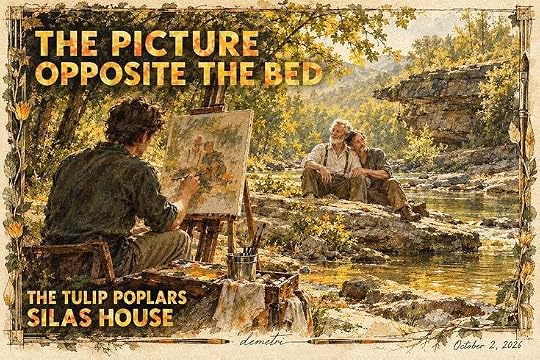
“The Picture Opposite the Bed” – Finch paints the older Tom and Amos at Turtle Rock, making ordinary duration – bodies aged together, landscape behind them, image within image – into an alternative archive.
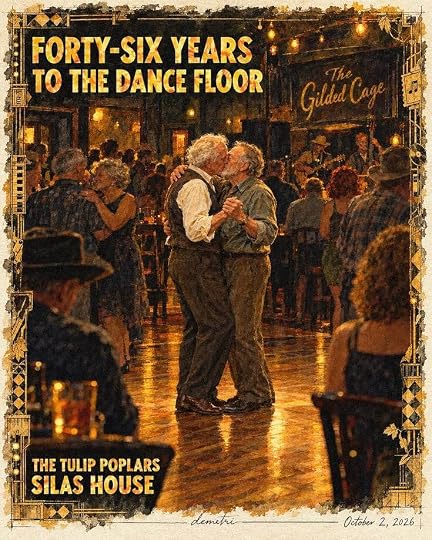
Once Tom and Amos share the farm, House refuses to turn cohabitation into a curtain call. They cook, work, read, host Finch, age beside Daisy, and privately declare themselves married beneath the poplars. Decades after their first hidden kiss, they dance at Lexington’s Gilded Cage and kiss publicly for the first time. The scene lands because so much uneventful life sits behind it. What was denied to them was not simply a lover. It was enough repetition for a life to acquire habits.
“Forty-Six Years to the Dance Floor” – After forty-six years, Tom and Amos enter public light together, their first public kiss isolated not by blur but by the breathing room a crowded room finally grants them.
Providence creeps in when the arrangements grow too exact. Thatcher is racist, homophobic, greedy, unfaithful, violent, environmentally destructive, manipulative, and willing to blackmail Tom. Eventually he holds so many of the book’s evils that he stops feeling entirely load-bearing. Eliza’s death raises a related question. After years of cruelty, she poisons Thatcher and herself to save the grove. The act cannot restore Caleb, Marty, or Tom’s childhood. Still, the moral geometry is suspiciously tidy.
One reunion follows another. Maeve and Paschal recover a life together. Tom and Amos do the same. Finch tells Tom that people have to be who they are and that the trick is to “let people be.” All four eventually rest beneath the same trees. That generosity is also House’s temptation. He refuses the old bargain in which marginalized characters earn seriousness through suffering, and rightly so. Yet abundance can become providence when every damaged line bends toward meaningful shape.
Unfortunately for any perfectly consoling reading, several wounds stay open. Bethesda, Marty, and Caleb remain dead. Tom’s left hand keeps shaking. Maeve cannot recover her surrendered education. Genevieve cannot recover years built around a vocation never hers. Paschal’s church burns. The ancestor whose records inspired the novel did not receive Tom’s old age. Fiction can rearrange possibility. It cannot make the original loss fictitious.
Lexington’s Faulkner Morgan Archive gives House’s recovery project a factual edge. Its collections document a Kentucky queer past long before Stonewall became the default starting gun, including Black queer performer Sweet Evening Breeze, associated with public drag performances beginning in the 1920s. House credits the archive in his acknowledgments. The frame changes: he is not planting queer people in a Kentucky past where they were absent. He is giving interior duration to lives the inherited record often preserves in scraps.
One of House’s measuring sticks is Thomas Hardy. In a September 2026 essay on his Substack, “A Country Boy Can Surmise,” he describes an Appalachian novel shaped by Hardy’s pressure of social rules, sexuality, and place; elsewhere he calls the bond between people and home ground one of this novel’s three love stories. Hardy matters less as pedigree than as craft standard. House admires fiction that lets social argument emerge from circumstance. “The Tulip Poplars” often does. Occasionally it solves the problem and then writes the answer twice in the margin.
Satie returns near the end, but so do simpler things. Amos has a piano. Paschal dies. Maeve dies. Amos dies in Tom’s arms. Tom follows a year later. Near death, he says again, “Walk with me a ways,” and Finch understands he is not speaking to her. Afterwards she remembers her father saying birds, crickets, frogs, and katydids sing “I am here.” Early, the phrase belongs to small creatures in the woods. Here it belongs equally to people repeatedly hidden, diagnosed, expelled, or denied.
Decades before we knew any of this, House had shown us Amos’s piano in ruins. Now its transformation can be read. Wood became instrument; the instrument made music; decay opens it to weather; a tulip poplar grows through what remains. The sequence is stranger than a simple triumph of nature over culture. Human making enters another material cycle. Piano becomes relic, ruin, ground, archive. Nothing stays intact, which is not the same as saying nothing lasts.
Each return to the tulip poplars adds another claim without exhausting the trees. They are Tom’s refuge, the site of sexual secrecy, threatened property, a private wedding place, a cemetery. Thatcher sees timber. Caleb sees stewardship. Tom sees holiness. Amos sees home. Finch inherits the memories attached to them. The symbolism can become officious, but the poplars survive because they remain stubbornly botanical, growing while everyone else argues about what they mean.
My rating is 88/100, or 4/5 Goodreads stars. The novel’s structural intelligence, emotional generosity, ecological thinking, and long view of queer and interracial lives outweigh its over-explanation, schematic villainy, and late compression. The distance from five stars is mostly a question of trust. House constructs images capable of carrying ambiguity, then sometimes verifies that we read the label correctly. His quietest scenes suggest he could trust us more.
Endings this circular risk sealing the book too neatly, but one contradiction stays open. Bright Star never becomes worthy of the people who love it. Kentucky never becomes a sanctuary for either couple. They claim the place anyway. Home here is not approval but attachment that survives the evidence against it. The four do not return because home has learned to deserve them. Rejection, House understands, does not automatically void belonging.
The quietest reversal is temporal. A novel about people struggling to remain visible ends by accepting that everyone will disappear. The answer is not immortality. It is enough life to leave traces another person may not know how to read: a grave, melody, creased postcard, painting above a bed, flower tucked into a book. For years these characters ask permission to exist. Their traces no longer need permission.
Ruins cannot testify, but they can hold evidence. By the time a tulip poplar rises through Amos’s piano, the authorities that presumed the right to define these lives have mostly disappeared with Bright Star: church, hospital, segregated order, watching neighbors, laws that refused certain marriages. The tree is not a tidy victory. It is still there, drawing another season out of what has decayed. “The Tulip Poplars” is most convincing when it trusts that continuation – not repair as erasure, simply the chance that something once forced into hiding may remain long enough for somebody else to find it.
Alternate Book-Cover Full Dust Jacket with Flaps Watercolor
First Underdrawing Pencil Drawing – “What the Trees Keep”
First Underdrawing with First Wash – “What the Trees Keep”
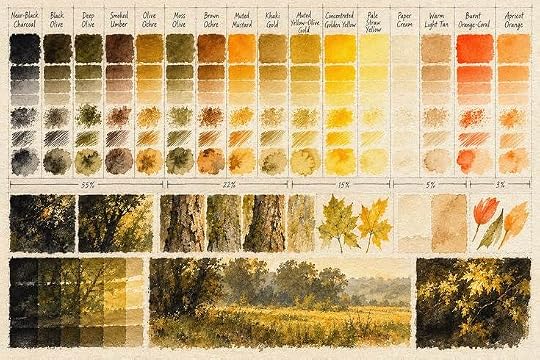
Cover-Derived Palette and Wash-Behavior Study
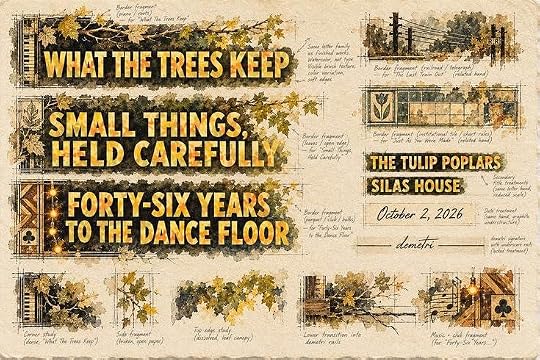
Series Typography + Border Architecture Study
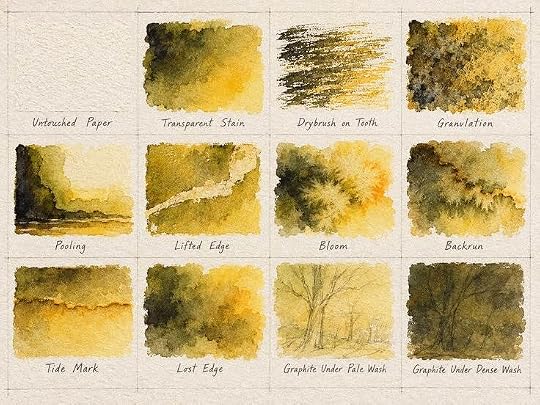
Cold-Pressed Paper + Pigment + Graphite Material-Behavior Study
All watercolor illustrations by Demetris Papadimitropoulos. Watercolors are done on 140lb vellum and then scanned into the computer using an Epson scanner. From there, they are finalized in Procreate. No AI was used in writing this review — all art and opinions are my own.
I received this ARC from a Goodreads giveaway, thank you! This was also my first Silas House Novel and it definitely didn’t disappoint!
This is a wonderful coming of age novel with intertwined plot lines about loving everyone and being true to yourself and your own desires even if they may not fit the norms of the time. At times is hard to read about the abuse and racism but overall it’s a great read. It’s set in the mining area of Appalachia in the 1900’s and 4 friends growing up in a small town, first loves, growing up, moving away and coming back together and ultimately all dying but being buried in the same tulip poplar grove together surrounded by those they loved.
Please be warned to have some tissues ready the last 50-ish pages.
Excellent book. It has moved me in so many ways. I was heartbroken for the ways humans have suffered over the years for not being able to love and be with the person they wanted to be with. So beautifully written. Very thought-provoking.
What a beautifully written, masterpiece of a book! I loved the story, the prose and everything about this novel. Bravo! I cannot believe this is my first book by Silas House. I have long been familiar with his books but never actually read one before.
I have no idea how The Tulip Poplars ended up on my dashboard, and I certainly don't remember requesting it. To be completely honest, this is definitely not my kind of book. By page 30, I was so bored and frustrated that I almost gave up on it entirely.
Once the story got going, it completely turned around. It ended up being one of the absolute best books.Let me emphasize again: romance is not the type of book I normally enjoy, but this easily became one of my favorite reads of the year. Don't let the slow start or the genre fool you. It’s not for everyone