

What do you think?

Strange Buildings
From the bestselling author of Strange Houses and Strange Pictures comes a mesmerizing novel of eleven strange buildings and one terrible secret.
A lonely hut in the woods.
A murder house.
A hidden chamber.
A mysterious shrine.
A home in flames.
A nightmarish prison. . . .
After receiving multiple tips from his devoted readership, a writer fascinated by the occult put together eleven case files, each featuring its very own strange building. Each of the eleven structures in this book has a floor plan that conceals a disturbing architectural quirk: from disappearing rooms to apartments with no means of escape. Each buildings tells its own chilling story. And each is part of a grander puzzle. Look closely . . . and you'll see that everything is connected. All leading to a revelation so horrifying you won't want to believe it.
Millions of readers have become addicted to solving Uketsu's dark mysteries. Strange Buildings is the strangest, and darkest, of them all.
A lonely hut in the woods.
A murder house.
A hidden chamber.
A mysterious shrine.
A home in flames.
A nightmarish prison. . . .
After receiving multiple tips from his devoted readership, a writer fascinated by the occult put together eleven case files, each featuring its very own strange building. Each of the eleven structures in this book has a floor plan that conceals a disturbing architectural quirk: from disappearing rooms to apartments with no means of escape. Each buildings tells its own chilling story. And each is part of a grander puzzle. Look closely . . . and you'll see that everything is connected. All leading to a revelation so horrifying you won't want to believe it.
Millions of readers have become addicted to solving Uketsu's dark mysteries. Strange Buildings is the strangest, and darkest, of them all.
384 pages, Hardcover
First published December 15, 2023
Ratings & Reviews
Friends & Following
Create a free account to discover what your friends think of this book!
Community Reviews
Displaying 1 - 30 of 5,861 reviews

June 6, 2026
How many odd and nefariously-utilized floorplans can there possibly be out there? Well, according to Uketsu and Strange Buildings, there's at least 11.
But first, let me take moment to shake off the goosebumps. That was intense, and I mean that in the best way possible. Reading Uketsu is always an experience. Once I start, I don't want to stop. I'm always thoroughly enthralled until I reach the very last page, and this was no different.
To understand Uketsu's appeal, you first have to understand what his stories are. Under the giant umbrella of the mystery/thriller genre, they fall onto the mystery side, specifically those that involve puzzles and fair play. As such, the clues are always there and the reader need only be clever enough to figure it all out alongside our protagonist. Now obviously, that did not happen to me and I succeeded in solving not a single iota of anything, but that's where all the fun and appeal lies.
And while I wouldn't go so far as to put Uketsu's books into any sort of horror category, his mysteries definitely feel tinged with chilling and macabre vibes. There is a tension and dissonance throughout that sets the overall tone, and it works to keep me on my toes.
Now, this goes without saying, but you do have to suspend a fair bit of disbelief to enjoy this story. In real life, have you ever come across even a single architectural anomaly that points to crimes and secrets? I don't think so. But the main character in here, after the success of his previous book Strange Houses, had so many people send in their own such house issues that he was able to pick out 11 and turn them into a story. Like, come on. So yes, a healthy suspension of disbelief is a must.
Speaking of that, I find it interesting that Uketsu has bestowed upon his main character the honor of being the writer of his books. I don't see this plot device often, but the few times I have, it blurs the line between fiction and nonfiction. And when it comes to mysteries, the more real and authentic it might seem, the more unputdownable it is.
Needless to say, I was absolutely riveted. The beginning, as each of the odd floorplans was introduced, felt more like a collection of short stories. But then as we went on and the disparate vignettes started to intertwine, the complexity and the addictiveness ratcheted up, until we reached the culmination of everything. And what a culmination it was. My suspension of disbelief skills was thoroughly tested, but I enjoyed every moment of it.
This is the sort of mystery that feels like it might be best read twice back-to-back. Because by the time everything comes together, there are so many elements and characters and floorplans at play, it can be hard to keep them all straight. The book did try to do some recapping, which was helpful, but I suspect if I read it again while everything was still fresh, I'd probably see the story from a whole new perspective.
A quick word of caution—be sure to check the trigger warnings if you're a sensitive reader. There are definitely some dark elements in this story.
Uketsu's mysteries are always so unique and such a celebration of the puzzle within, I can't help but be captivated. There's a part of me that has always clung to my childhood dream of being a detective when I grow up, and reading these books and hunting for clues in the pictures within, I feel like maybe I still can be.
~~~~~~~~~~~~
See also, my thoughts on:
Strange Pictures
Strange Houses
~~~~~~~~~~~~
✧ Connect with me ✧ Instagram ✧
But first, let me take moment to shake off the goosebumps. That was intense, and I mean that in the best way possible. Reading Uketsu is always an experience. Once I start, I don't want to stop. I'm always thoroughly enthralled until I reach the very last page, and this was no different.
To understand Uketsu's appeal, you first have to understand what his stories are. Under the giant umbrella of the mystery/thriller genre, they fall onto the mystery side, specifically those that involve puzzles and fair play. As such, the clues are always there and the reader need only be clever enough to figure it all out alongside our protagonist. Now obviously, that did not happen to me and I succeeded in solving not a single iota of anything, but that's where all the fun and appeal lies.
And while I wouldn't go so far as to put Uketsu's books into any sort of horror category, his mysteries definitely feel tinged with chilling and macabre vibes. There is a tension and dissonance throughout that sets the overall tone, and it works to keep me on my toes.
Now, this goes without saying, but you do have to suspend a fair bit of disbelief to enjoy this story. In real life, have you ever come across even a single architectural anomaly that points to crimes and secrets? I don't think so. But the main character in here, after the success of his previous book Strange Houses, had so many people send in their own such house issues that he was able to pick out 11 and turn them into a story. Like, come on. So yes, a healthy suspension of disbelief is a must.
Speaking of that, I find it interesting that Uketsu has bestowed upon his main character the honor of being the writer of his books. I don't see this plot device often, but the few times I have, it blurs the line between fiction and nonfiction. And when it comes to mysteries, the more real and authentic it might seem, the more unputdownable it is.
Needless to say, I was absolutely riveted. The beginning, as each of the odd floorplans was introduced, felt more like a collection of short stories. But then as we went on and the disparate vignettes started to intertwine, the complexity and the addictiveness ratcheted up, until we reached the culmination of everything. And what a culmination it was. My suspension of disbelief skills was thoroughly tested, but I enjoyed every moment of it.
This is the sort of mystery that feels like it might be best read twice back-to-back. Because by the time everything comes together, there are so many elements and characters and floorplans at play, it can be hard to keep them all straight. The book did try to do some recapping, which was helpful, but I suspect if I read it again while everything was still fresh, I'd probably see the story from a whole new perspective.
A quick word of caution—be sure to check the trigger warnings if you're a sensitive reader. There are definitely some dark elements in this story.
Uketsu's mysteries are always so unique and such a celebration of the puzzle within, I can't help but be captivated. There's a part of me that has always clung to my childhood dream of being a detective when I grow up, and reading these books and hunting for clues in the pictures within, I feel like maybe I still can be.
~~~~~~~~~~~~
See also, my thoughts on:
Strange Pictures
Strange Houses
~~~~~~~~~~~~
✧ Connect with me ✧ Instagram ✧

March 14, 2026
Two stars might seem harsh, but I stand by this rating.
I went into Strange Buildings with fairly high expectations. It is slightly better than the previous installment, mainly because it avoids relying on an overwhelming deus ex machina. I got to admit that I am still intrigued by the premise which is why I will continue to read the series despite the string of disappointment.
Strange Buildings is a story of all the people who has reached out to the author following his release of Strange Houses where now, eleven house floor plans are presented, each tied to a strange saying and an incident. As the story unfolds, subtle inconsistencies begin to connect, eventually revealing a larger truth behind them all.
On paper, this structure works. The format of having all these conversations about these building is engaging, and the act of piecing together clues from floor plans is genuinely compelling at first. There are moments that feel clever, and the final revelations do carry a degree of shock, especially when the person who we taught the culprit, may not be the culprit after all.
What works best here is Uketsu’s undeniable talent for pacing. The book is thick, filled with diagrams and summaries, yet the reading experience moves forward with ease. I have pointed out before that maybe the conversational style in the previous book proved ineffective, as it lacked the depth and narrative strength necessary to sustain atmosphere or leave a lasting impression. In contrast, with 11 cases at hand, the same approach works more, consequently making the book feel brisk despite its length.
However, the execution is where the novel falters.
Now- you may want to call me parrot for all the points I am about to say next, only because the strengths are consistently undermined by a lack of believability, as always seem the case even in the last book. But simply, the deductions made by the narrator and his architect friend rarely feel earned even in this installment. Instead of following a clear logical process, conclusions often appear to simply land in place. Even when they tried to make it a bit tad believable with what supposed to be human error, because some of the architect friend's initial guesses happened to be incorrect, the story still quickly pivots to the right answer without showing enough convincing reasoning. This just makes it difficult to trust or invest in the mystery like a good mystery book should be.
To boot, the architect friend in particular, feels underdeveloped. Honestly, I am not doubting that someone with high cognitive functioning could connect all these 11 cases simply from a report. Yet, we were never given reason to buy that this particular friend has that capability. The story expects the reader to accept his ability to connect all eleven cases, without properly establishes why he is capable of doing so. His insights drive the narrative, but they lack foundation. Without that credibility, the central mystery loses much of its impact.
The plot also leans heavily on coincidence, and while I used to put Uketsu's writing to pedestal, all these convenience plot just made up for a lazy author. It is one thing to use coincidence to complicate a story, but here it is used to resolve it. Access to all eleven floor plans happens too easily, and the decision to link these cases together does not feel justified from the start. I feel like in reality, it is not as easy to get a floor plan to every house simply. While digital databases are growing and it is possible for some; particularly new homes or those listed for sale recently to provide floor plans, there is no single, comprehensive, and publicly accessible repository for the floor plans of every existing house. And you meant to tell me that you are able to gain access them through connections and internet searching for what to be the floor plans from a house that existed ten years back or more.
For good measure, this is also another case of a book suffering from massive cast. With eleven cases and multiple characters in each, many of them blur together. When a book has too many characters and the author does not remind you who is who, it is easy to get lost. By the time the story attempts to tie everything into a cohesive whole, it becomes difficult to recall which undercuts the emotional and narrative payoff. Maybe I was not good with names, but I reason that having indistinctive name is also a contributing factor.
Tonally, the book shifts more toward mystery than horror, but it does not fully succeed in either. The eerie atmosphere that defined the author’s earlier work is mostly absent, and the mystery lacks tension because the solutions feel predetermined rather than discovered. I think this has always been my issue with this series. If believability cannot be achieved, suspense should carry the story, but here, neither element is strong enough. I found myself constantly pulled out of the story by how forced certain developments felt. Not to say, this book just has to be another cult story! Can all these murder cases just be a different kettle of fish, instead of tied down to one same phenomenon? This is just getting predictable at this point, although it does reflect a part of Japanese society where cults and fringe religious groups have had a noticeable influence, so I can see why authors keep coming back to that theme even if I wish they'd explore something different.
In the end, Strange Buildings retains Uketsu’s gift for propulsive storytelling. The structure is accessible, the layout is engaging to an extent, and there are moments of genuine surprise. Still, the convenience woven into every stage of the investigation undermines both suspense and eminence. If one can overlook the lack of logical grounding and simply enjoy the fictional construct this book has to offer, there is entertainment to be found. But for me, I could hardly bypass the story’s fictional expediency, which made it all feel far from believable.
I went into Strange Buildings with fairly high expectations. It is slightly better than the previous installment, mainly because it avoids relying on an overwhelming deus ex machina. I got to admit that I am still intrigued by the premise which is why I will continue to read the series despite the string of disappointment.
Strange Buildings is a story of all the people who has reached out to the author following his release of Strange Houses where now, eleven house floor plans are presented, each tied to a strange saying and an incident. As the story unfolds, subtle inconsistencies begin to connect, eventually revealing a larger truth behind them all.
On paper, this structure works. The format of having all these conversations about these building is engaging, and the act of piecing together clues from floor plans is genuinely compelling at first. There are moments that feel clever, and the final revelations do carry a degree of shock, especially when the person who we taught the culprit, may not be the culprit after all.
What works best here is Uketsu’s undeniable talent for pacing. The book is thick, filled with diagrams and summaries, yet the reading experience moves forward with ease. I have pointed out before that maybe the conversational style in the previous book proved ineffective, as it lacked the depth and narrative strength necessary to sustain atmosphere or leave a lasting impression. In contrast, with 11 cases at hand, the same approach works more, consequently making the book feel brisk despite its length.
However, the execution is where the novel falters.
Now- you may want to call me parrot for all the points I am about to say next, only because the strengths are consistently undermined by a lack of believability, as always seem the case even in the last book. But simply, the deductions made by the narrator and his architect friend rarely feel earned even in this installment. Instead of following a clear logical process, conclusions often appear to simply land in place. Even when they tried to make it a bit tad believable with what supposed to be human error, because some of the architect friend's initial guesses happened to be incorrect, the story still quickly pivots to the right answer without showing enough convincing reasoning. This just makes it difficult to trust or invest in the mystery like a good mystery book should be.
To boot, the architect friend in particular, feels underdeveloped. Honestly, I am not doubting that someone with high cognitive functioning could connect all these 11 cases simply from a report. Yet, we were never given reason to buy that this particular friend has that capability. The story expects the reader to accept his ability to connect all eleven cases, without properly establishes why he is capable of doing so. His insights drive the narrative, but they lack foundation. Without that credibility, the central mystery loses much of its impact.
The plot also leans heavily on coincidence, and while I used to put Uketsu's writing to pedestal, all these convenience plot just made up for a lazy author. It is one thing to use coincidence to complicate a story, but here it is used to resolve it. Access to all eleven floor plans happens too easily, and the decision to link these cases together does not feel justified from the start. I feel like in reality, it is not as easy to get a floor plan to every house simply. While digital databases are growing and it is possible for some; particularly new homes or those listed for sale recently to provide floor plans, there is no single, comprehensive, and publicly accessible repository for the floor plans of every existing house. And you meant to tell me that you are able to gain access them through connections and internet searching for what to be the floor plans from a house that existed ten years back or more.
For good measure, this is also another case of a book suffering from massive cast. With eleven cases and multiple characters in each, many of them blur together. When a book has too many characters and the author does not remind you who is who, it is easy to get lost. By the time the story attempts to tie everything into a cohesive whole, it becomes difficult to recall which undercuts the emotional and narrative payoff. Maybe I was not good with names, but I reason that having indistinctive name is also a contributing factor.
Tonally, the book shifts more toward mystery than horror, but it does not fully succeed in either. The eerie atmosphere that defined the author’s earlier work is mostly absent, and the mystery lacks tension because the solutions feel predetermined rather than discovered. I think this has always been my issue with this series. If believability cannot be achieved, suspense should carry the story, but here, neither element is strong enough. I found myself constantly pulled out of the story by how forced certain developments felt. Not to say, this book just has to be another cult story! Can all these murder cases just be a different kettle of fish, instead of tied down to one same phenomenon? This is just getting predictable at this point, although it does reflect a part of Japanese society where cults and fringe religious groups have had a noticeable influence, so I can see why authors keep coming back to that theme even if I wish they'd explore something different.
In the end, Strange Buildings retains Uketsu’s gift for propulsive storytelling. The structure is accessible, the layout is engaging to an extent, and there are moments of genuine surprise. Still, the convenience woven into every stage of the investigation undermines both suspense and eminence. If one can overlook the lack of logical grounding and simply enjoy the fictional construct this book has to offer, there is entertainment to be found. But for me, I could hardly bypass the story’s fictional expediency, which made it all feel far from believable.

July 26, 2026
"At first glance, their stories seem totally unrelated. But on careful reading, they begin to intertwine, telling one incredible tale."In the last book, the narrator noticed a rather odd floorplan of a single family house with a sinister reason behind its quirks. After publishing that book, he's been inundated with tips from fervent fans.
After sifting through the various floorplans and suggestions, eleven files stood out to him.
On their own, the floorplans are a bit odd or the stories might be a bit strange...but when taken together? That's a whole different conundrum.
So, this one started off at 4 stars, dipped down to 3 by the end.
"People are often irrational. They make stupid decisions for the sake of unquestioned beliefs, particularly where religion is concerned."
I really enjoyed the story when we were just going from case file to case file. It had a mystery element where we were right there with the author unveiling clues and sinister elements. It was also full of horror as seemingly innocuous elements from earlier are cast in different light upon further case file reveals.
But (and this is a big but, so allow me to capitalize it) BUT the story just didn't hold over time.
The case files read like individual short stories, yet by the time I got to the eleventh, I was losing track of the characters and their names from the earlier sections. Sometimes I rag on authors who remind us over and over who the characters are but I could've used it this time!
Furthermore, I was a bit skeptical of the assumptions from the first two books by the author...the third one felt like we were leaping over lakes. I love a big swing for a premise but there's a lot of coincidence and shoulder shrugging when it came to the conclusions made by the characters.
And finally, I just felt dissatisfied with the ending. No spoilers, but when the grand reveal happened...my reaction was, "I guess...that could make sense." It didn't have the wham or the POW from the previous books. It felt rushed and very surface-level when I was expecting something much more analytic. (Yes, I am considering the 'fake' and the 'real' big bad for this story).
Overall, I will definitely keep reading books from this author but I was disappointed with the way this one turned out.

March 4, 2026
I have never been so addicted to any series of books as I am to these creepy architectural mysteries
February 28, 2026
Amended from 2/5 to 1/5 after further reflection.
TL;DR: The mystery is mediocre, and the story features the abuse of women and children without any critical lens.
TL;DR: The mystery is mediocre, and the story features the abuse of women and children without any critical lens.
This entire review has been hidden because of spoilers.

February 9, 2026
The second installment of Strange Houses brings a very clever new mystery for the reader to work through. In this instance, there are 11 files containing 11 strange buildings. Each one brings something new to the table. The big question is, how are they all intertwined?
How these all came together was very clever, and while I was able to loosely see some of the connections, I was unable to see the whole picture until the author laid it out for me. Once all the pieces of the puzzle were laid out, it was amazing to see how intricately woven everything was.
What I really found helpful (since I’m not the brightest) was after the reader had the opportunity to review all 11 files, the resolution was explained by showing all the different pieces of evidence and how they tied together. My only quibble was some of this became a bit redundant as it would refer to certain aspects of the files multiple times. But I appreciated the little bit of redundancy in order to make sure I understood how everything tied together.
Strange Pictures will still be my favorite, but this one comes a close second. There is no need to read Strange Houses first, but a few characters are revisited, specifically the author’s architect friend, Kurihara. Fingers crossed there’s another installment on the horizon!
Thanks to NetGalley and the publisher for my advanced copy in exchange for an honest review
How these all came together was very clever, and while I was able to loosely see some of the connections, I was unable to see the whole picture until the author laid it out for me. Once all the pieces of the puzzle were laid out, it was amazing to see how intricately woven everything was.
What I really found helpful (since I’m not the brightest) was after the reader had the opportunity to review all 11 files, the resolution was explained by showing all the different pieces of evidence and how they tied together. My only quibble was some of this became a bit redundant as it would refer to certain aspects of the files multiple times. But I appreciated the little bit of redundancy in order to make sure I understood how everything tied together.
Strange Pictures will still be my favorite, but this one comes a close second. There is no need to read Strange Houses first, but a few characters are revisited, specifically the author’s architect friend, Kurihara. Fingers crossed there’s another installment on the horizon!
Thanks to NetGalley and the publisher for my advanced copy in exchange for an honest review

February 18, 2026
what in the epstein files did i just read??
this was fantastic and deeply relevant. i need uketsu to move like the knives out movies and give me 14 more!!!
p.s. EAT THE RICH.
this was fantastic and deeply relevant. i need uketsu to move like the knives out movies and give me 14 more!!!
p.s. EAT THE RICH.

February 25, 2026
Gonna learn Japanese so I don’t have to wait for Uketsu books. Oh my god, these are so good.
April 2, 2026
Going into this I already knew the drill. I’ve done this twice before so I know the vibes and I know I’m about to be handed a “story” that’s actually three puzzles in a trench coat. No straightforward narrative, no hand-holding, just me and a bunch of suspicious af buildings.
What keeps this one so engaging is how different it manages to feel despite the familiar framework. On paper, “weird interconnected buildings” should be running on fumes by now, but the author keeps finding new ways to mess with perspective and structure (and me, specifically). Every time I thought “okay I get where this is going,” the book immediately pivoted just enough to make me doubt everything again.
The format is a huge part of that. The book’s made up of floor plans, interviews, journals, and newspaper articles, with very little actual narrative. This isn’t a story where characters overcome great challenges or learn meaningful lessons. There’s no big emotional arc, no growth to latch onto, but it doesn’t detract from the experience at all. If anything, it sharpens the mystery. You’re not here for character development, you’re here to spiral over architectural choices and suspicious timelines, and the book fully commits to that.
Because I was already tuned into the format, I went in feral for details. Every line felt like a clue and every inconsistency felt intentional. There’s a real satisfaction in spotting patterns earlier this time around, like I’ve evolved and understand these books now, but also… not really, because I was still wrong a lot.
So even though I know this dance by now, I’m still dumb. I still missed so much. Like I’ve been fully conditioned at this point to pore over floor plans and criticise everything, and I felt incredibly smug when something I’d clocked actually mattered, but then the book would reveal something else and I’d have to flip back like “oh! oh it was right there. cool cool cool 😭” It’s humbling.
I also spent an embarrassing amount of time talking out loud while reading this. Like the main character would be working through a case and I’d just be sitting there arguing with the book like “no, that can’t have happened that way, check the floor plan again” as if I was part of the investigation. At this point I’m basically a co-detective. An unhelpful one, but still.
That quote sums up the whole unsettling tone. These buildings aren’t just weird, they feel complicit, like they’re quietly influencing everything in the background.
However, I do think this is where my relationship with the series gets slightly chaotic, because while I’m fully invested, I'm also a little split on it. There’s a very loud part of the experience that feels like genius puzzle design, like I’m actively participating and getting that little dopamine hit when a connection lands exactly right. And then there’s the other side, where some of the deductions get a bit too clean. Like, really, you’re telling me you worked out what someone had for dinner from a window placement and a slightly odd room angle? I’m exaggerating, but not by much. Sometimes it feels like the logic's sprinting ahead of itself just a little.
One minute I’m like “this is so clever, I’m basically inside the puzzle,” and the next I’m side-eyeing a conclusion thinking “wait… how did we get there that fast?” It’s impressive, but occasionally feels like the reasoning's doing backflips while I’m still trying to find the starting point.
The structure itself is great in theory. 11 houses, 11 cases is SUCH a good idea, but it does get a little tangled as it goes on. Not because the writing's unclear, but because there are just so many moving parts. By the time I hit case 9, I was like “I’m sure cases 2 and 3 were important… but I can’t recall a single detail.” It becomes a bit of a memory maze unless you’re actively keeping track.
The later sections also go HARD on the explanations (again, expected), and while I do enjoy the big “everything clicks” moment and the recap of everything we've learned, it starts to feel like the book's pinned me to a chair and is aggressively walking me through a conspiracy board. I respect it, but I was also slightly overwhelmed by it.
This is my least favourite of the three. Not because it’s bad, but because it felt a bit too disconnected for a bit too long. There’s a stretch where it kind of meanders and I was just floating there like “okay… but how does this all link???” Of course, the SECOND I recognised a name, I was right back in it and aggressively analysing every sentence, but it definitely took longer to hook everything together compared to the others.
Like with the others, in the last 10% or so, the story really picks up and goes completely off the rails. We go from Phoenix Wright to the Epstein Files in about 5 minutes flat and it’s enough to make your head spin. It’s chaotic and slightly overwhelming, but still incredibly compelling.
Tonally, it’s just as dark and unsettling as the earlier books. No unnecessary escalation, just a steady commitment to being quietly horrible. Love that but also kind of hate how effective it is.
What impresses me most is that this series still doesn’t feel like a gimmick. Each book feels like a deliberate remix rather than a repeat, like the author’s actively experimenting instead of coasting. Three books in and it’s still fresh and clever, and still making me question my ability to think.
If you’ve read the earlier books, this won’t surprise you, but it will absolutely drag you back into the madness.
Considering cryogenically freezing myself until book 4 comes out because I don’t want to wait.
What keeps this one so engaging is how different it manages to feel despite the familiar framework. On paper, “weird interconnected buildings” should be running on fumes by now, but the author keeps finding new ways to mess with perspective and structure (and me, specifically). Every time I thought “okay I get where this is going,” the book immediately pivoted just enough to make me doubt everything again.
The format is a huge part of that. The book’s made up of floor plans, interviews, journals, and newspaper articles, with very little actual narrative. This isn’t a story where characters overcome great challenges or learn meaningful lessons. There’s no big emotional arc, no growth to latch onto, but it doesn’t detract from the experience at all. If anything, it sharpens the mystery. You’re not here for character development, you’re here to spiral over architectural choices and suspicious timelines, and the book fully commits to that.
Because I was already tuned into the format, I went in feral for details. Every line felt like a clue and every inconsistency felt intentional. There’s a real satisfaction in spotting patterns earlier this time around, like I’ve evolved and understand these books now, but also… not really, because I was still wrong a lot.
So even though I know this dance by now, I’m still dumb. I still missed so much. Like I’ve been fully conditioned at this point to pore over floor plans and criticise everything, and I felt incredibly smug when something I’d clocked actually mattered, but then the book would reveal something else and I’d have to flip back like “oh! oh it was right there. cool cool cool 😭” It’s humbling.
I also spent an embarrassing amount of time talking out loud while reading this. Like the main character would be working through a case and I’d just be sitting there arguing with the book like “no, that can’t have happened that way, check the floor plan again” as if I was part of the investigation. At this point I’m basically a co-detective. An unhelpful one, but still.
“Of course, I wouldn’t go so far as to say that anyone who lived in this house would end up a murderer. I suspect the boy had something in him from the start. The house just brought it out. Nurtured the darkness in his heart, I guess you could say.”
That quote sums up the whole unsettling tone. These buildings aren’t just weird, they feel complicit, like they’re quietly influencing everything in the background.
However, I do think this is where my relationship with the series gets slightly chaotic, because while I’m fully invested, I'm also a little split on it. There’s a very loud part of the experience that feels like genius puzzle design, like I’m actively participating and getting that little dopamine hit when a connection lands exactly right. And then there’s the other side, where some of the deductions get a bit too clean. Like, really, you’re telling me you worked out what someone had for dinner from a window placement and a slightly odd room angle? I’m exaggerating, but not by much. Sometimes it feels like the logic's sprinting ahead of itself just a little.
One minute I’m like “this is so clever, I’m basically inside the puzzle,” and the next I’m side-eyeing a conclusion thinking “wait… how did we get there that fast?” It’s impressive, but occasionally feels like the reasoning's doing backflips while I’m still trying to find the starting point.
The structure itself is great in theory. 11 houses, 11 cases is SUCH a good idea, but it does get a little tangled as it goes on. Not because the writing's unclear, but because there are just so many moving parts. By the time I hit case 9, I was like “I’m sure cases 2 and 3 were important… but I can’t recall a single detail.” It becomes a bit of a memory maze unless you’re actively keeping track.
The later sections also go HARD on the explanations (again, expected), and while I do enjoy the big “everything clicks” moment and the recap of everything we've learned, it starts to feel like the book's pinned me to a chair and is aggressively walking me through a conspiracy board. I respect it, but I was also slightly overwhelmed by it.
This is my least favourite of the three. Not because it’s bad, but because it felt a bit too disconnected for a bit too long. There’s a stretch where it kind of meanders and I was just floating there like “okay… but how does this all link???” Of course, the SECOND I recognised a name, I was right back in it and aggressively analysing every sentence, but it definitely took longer to hook everything together compared to the others.
Like with the others, in the last 10% or so, the story really picks up and goes completely off the rails. We go from Phoenix Wright to the Epstein Files in about 5 minutes flat and it’s enough to make your head spin. It’s chaotic and slightly overwhelming, but still incredibly compelling.
Tonally, it’s just as dark and unsettling as the earlier books. No unnecessary escalation, just a steady commitment to being quietly horrible. Love that but also kind of hate how effective it is.
What impresses me most is that this series still doesn’t feel like a gimmick. Each book feels like a deliberate remix rather than a repeat, like the author’s actively experimenting instead of coasting. Three books in and it’s still fresh and clever, and still making me question my ability to think.
If you’ve read the earlier books, this won’t surprise you, but it will absolutely drag you back into the madness.
Considering cryogenically freezing myself until book 4 comes out because I don’t want to wait.

April 2, 2026
4.5 Stars
I loved this unsettling building horror story largely because it deviated from the usual tropey haunted house narrative. I appreciated that the vignettes of interconnected stories were not specifically about ghosts but more so about the evils of the people who reside within these buildings.
I got the opportunity to read this one on audiobook which I feel like enhanced the experience with the pseudo author giving the book a similar feeling to an investigative podcast. The atmosphere was so chilling and loosely gave me Junji Ito vibes (without the body horror).
I would highly recommend this one to horror readers looking for something a little different. I now want to read the rest of this author's published work.
I loved this unsettling building horror story largely because it deviated from the usual tropey haunted house narrative. I appreciated that the vignettes of interconnected stories were not specifically about ghosts but more so about the evils of the people who reside within these buildings.
I got the opportunity to read this one on audiobook which I feel like enhanced the experience with the pseudo author giving the book a similar feeling to an investigative podcast. The atmosphere was so chilling and loosely gave me Junji Ito vibes (without the body horror).
I would highly recommend this one to horror readers looking for something a little different. I now want to read the rest of this author's published work.

July 23, 2026
Not a novel, nor a collection of short stories, but more than an architectural or crime puzzle.
There is a chapter for each of eleven strange buildings. They comprise dialogue between the author and someone connected with the building, with floorplans, sketches, and the author’s musings on what he’s learned, inferred, and remains puzzled by. By the third chapter, I realised they were connected.
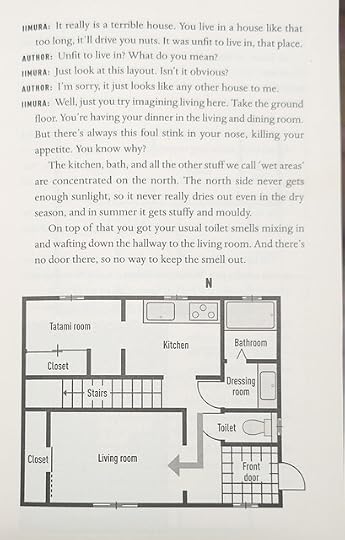
Image: A sample page from early on, so very straightforward
The writing (translation) is heavy-handed and simplistic, but it was intriguing. However, by Chapter 6, The Hall of Rebirth, it became increasingly weird (in addition to some grim crimes, albeit not graphically described).
The final 130 pages explain it all, via some dead ends, and recapping the other chapters (but in a different sequence). If you want to ‘solve’ it yourself, pause before starting this section.
It’s a quick read and best read over a short space of time. I suppose it’s quite well done, but it’s not really my thing, so I won’t read another.
A picture book on audio?
I picked it up in the library, knowing nothing of it, beyond the the novelty of a story with lots of floor plans. It’s apparently similar to his first such book, Strange Houses.
Both are available on Audible! How does that work?
There is a chapter for each of eleven strange buildings. They comprise dialogue between the author and someone connected with the building, with floorplans, sketches, and the author’s musings on what he’s learned, inferred, and remains puzzled by. By the third chapter, I realised they were connected.
Image: A sample page from early on, so very straightforward
The writing (translation) is heavy-handed and simplistic, but it was intriguing. However, by Chapter 6, The Hall of Rebirth, it became increasingly weird (in addition to some grim crimes, albeit not graphically described).
The final 130 pages explain it all, via some dead ends, and recapping the other chapters (but in a different sequence). If you want to ‘solve’ it yourself, pause before starting this section.
It’s a quick read and best read over a short space of time. I suppose it’s quite well done, but it’s not really my thing, so I won’t read another.
A picture book on audio?
I picked it up in the library, knowing nothing of it, beyond the the novelty of a story with lots of floor plans. It’s apparently similar to his first such book, Strange Houses.
Both are available on Audible! How does that work?

April 27, 2026
This is my second Uketsu novel, and I appreciated his logical structure even more - how the story feels like a demonstration. It makes you feel as though you’ve discovered the mysteries yourself. I also never thought more deeply about what a house is than I did with this novel, or about the impact a simple architectural choice can have on a person or a family. The central mystery about a cult wasn’t as interesting, but this book solidified Uketsu as a favorite contemporary writer.

April 14, 2026
Entertaining but with a very convoluted story. The denouement was so far fetched but I was never bored and I finished in a few hours.
Possibly a book that requires a re-read to appreciate all the intricacies.
Possibly a book that requires a re-read to appreciate all the intricacies.

Read
April 9, 2026These books are the ne plus ultra of this particular evolution of the Golden Age detective story, the super-elaborately constructed type, usually depending on wildly implausible behaviour and deductions, which Japanese writers especially have cultivated to a frankly bonkers peak. This one clicks together like a well oiled, if quite disturbing, machine; I have no idea how many spreadsheets it took.
Thoroughly involving in its way, and that's coming from a reader basically allergic to floor plans, although it doesn't have the emotional punch one might expect from the subject matter. But, English-Japanese translation is *hard*.
Thoroughly involving in its way, and that's coming from a reader basically allergic to floor plans, although it doesn't have the emotional punch one might expect from the subject matter. But, English-Japanese translation is *hard*.
March 19, 2026
uketsu thinks solving mysteries falls on the same difficulty level as finishing a children’s puzzle. it cant be that convenient smh
strange buildings was interesting until the eleventh and final case file then the narrator went to his friend and somehow this friend knew how to solve the mystery. it got boring pretty quick. besides maybe be this is a translation problem but the story lacks emotional depth specially when the author is tackling some really disturbing and horrible topics. and the ending was extremely unsatisfying i dont even know what to say. i still think strange pictures was the best one it made me guess and attempt at figuring out the mystery. nothing was spoon fed to the readers and it felt more horror-y.
strange buildings was interesting until the eleventh and final case file then the narrator went to his friend and somehow this friend knew how to solve the mystery. it got boring pretty quick. besides maybe be this is a translation problem but the story lacks emotional depth specially when the author is tackling some really disturbing and horrible topics. and the ending was extremely unsatisfying i dont even know what to say. i still think strange pictures was the best one it made me guess and attempt at figuring out the mystery. nothing was spoon fed to the readers and it felt more horror-y.

February 3, 2026
Some books scare you with monsters.
Some scare you with killers.
Strange Buildings scares you with something far more unsettling: spaces.
Uketsu has this uncanny ability to make architecture feel alive—and not in a comforting way. From the very first eerie location, I knew this was not going to be a traditional mystery. This is a story built out of rooms, hallways, walls, and invisible lines that quietly whisper, something terrible happened here.
Each building in this book feels like its own haunted memory. A hut in the woods. A house that remembers violence. A prison that seems designed not just to hold bodies, but to crush minds. A home that burns not just with fire, but with buried guilt. Every chapter drops you into a new structure, and every structure feels like a fragment of a larger nightmare waiting to be assembled.
What makes this book so addictive is the way it treats the reader like a detective without ever saying so. You aren’t handed neat clues—you’re given blueprints, odd details, missing rooms, strange inconsistencies. And slowly, without realizing it, your brain starts to connect things. Why does this wall exist? Why does this corridor lead nowhere? Why does this space feel wrong?
And then it hits you:
These buildings aren’t just settings.
They’re evidence.
Uketsu’s storytelling is icy and methodical, but emotionally devastating beneath the surface. As the puzzle tightens, it becomes clear that something truly monstrous connects all of these places. Not a single villain—but a pattern. A human horror that spreads through design, intention, and silence.
By the time the truth begins to emerge, I didn’t want to believe it. Not because it was confusing—but because it was horrifying in a very real, very human way. This isn’t a book that screams at you. It watches you. It lets you put the pieces together. And when you finally see the full picture, it lingers.
Strange Buildings is the kind of mystery that leaves you staring at your ceiling afterward, thinking about walls, doors, and the things people try to hide behind them.
Dark. Clever. Disturbing. Completely unforgettable.
Special thanks to NetGalley and HarperVia for sharing this unique, puzzle-driven thriller’s digital reviewer copy with me in exchange for my honest thoughts.
Follow me on medium.com to read my articles about books, movies, streaming series, astrology:
medium blog
instagram
facebook
Some scare you with killers.
Strange Buildings scares you with something far more unsettling: spaces.
Uketsu has this uncanny ability to make architecture feel alive—and not in a comforting way. From the very first eerie location, I knew this was not going to be a traditional mystery. This is a story built out of rooms, hallways, walls, and invisible lines that quietly whisper, something terrible happened here.
Each building in this book feels like its own haunted memory. A hut in the woods. A house that remembers violence. A prison that seems designed not just to hold bodies, but to crush minds. A home that burns not just with fire, but with buried guilt. Every chapter drops you into a new structure, and every structure feels like a fragment of a larger nightmare waiting to be assembled.
What makes this book so addictive is the way it treats the reader like a detective without ever saying so. You aren’t handed neat clues—you’re given blueprints, odd details, missing rooms, strange inconsistencies. And slowly, without realizing it, your brain starts to connect things. Why does this wall exist? Why does this corridor lead nowhere? Why does this space feel wrong?
And then it hits you:
These buildings aren’t just settings.
They’re evidence.
Uketsu’s storytelling is icy and methodical, but emotionally devastating beneath the surface. As the puzzle tightens, it becomes clear that something truly monstrous connects all of these places. Not a single villain—but a pattern. A human horror that spreads through design, intention, and silence.
By the time the truth begins to emerge, I didn’t want to believe it. Not because it was confusing—but because it was horrifying in a very real, very human way. This isn’t a book that screams at you. It watches you. It lets you put the pieces together. And when you finally see the full picture, it lingers.
Strange Buildings is the kind of mystery that leaves you staring at your ceiling afterward, thinking about walls, doors, and the things people try to hide behind them.
Dark. Clever. Disturbing. Completely unforgettable.
Special thanks to NetGalley and HarperVia for sharing this unique, puzzle-driven thriller’s digital reviewer copy with me in exchange for my honest thoughts.
Follow me on medium.com to read my articles about books, movies, streaming series, astrology:
medium blog

March 27, 2026
I am absolutely obsessed with Uketsu.
Strange Buildings was quite literally one of my favorite shin honkaku stories read to date— and I widely adore the genre, it’s one of my specialties.
Not only was this book extremely puzzling and a lot of fun, but the mystery is pretty outrageous.
The idea of an outrageous, probably-not-realistic enigma may genuinely throw some readers off, but for me— the book was absolutely PERFECT.
My inner couch-detective spent a lot of time writing a vast amount of notes hoping to connect the dots completely on my own.
And I made it incredibly far in my deductions!
Of course, Uketsu presents some solid red herrings and a brilliantly disturbing conclusion that nobody will completely see ahead of them.
People may think Uketsu’s stories are far-fetched, but really, they’re exceedingly witty. Sitting down to conjure up a complex mystery that actually makes sense is not an easy feat.
Strange Buildings is a novel that takes the common locked-room mystery and uses eerie floor plans and a collection of documented files instead. It’s a book that will pull its reader into a crazy conundrum of architectural and deeply investigative detective work. The premise is unique— just admit it.
Every one of Uketsu’s books have gotten more complex and fleshed out as he continues to release them, and it’s impressive. This time around, there are eleven separate “strange building” files that eventually wind together to create the most unexpected and malicious conclusion.
Both the unnamed author— who I believe is a specific individual from a story in the first book, and the author’s overly-intellectual architect friend, Kurihara— come together for the second time to solve the most puzzling mystery.
Love them.
Did I already say that I ♡ Uketsu…
And genuinely— I adore the translator, Jim Rion. He’s become a true favorite. The flow of the book is smooth and its readability high.
Strange Buildings was easily a ★ ★ ★ ★ ★ star read for me and I’m so happy that Uketsu is bringing shin honkaku to the FRONT for the whole world to explore and read. Hopefully this prompts readers new to the genre to pick up some other works.
Absolutely yes to all of this.
Strange Buildings was quite literally one of my favorite shin honkaku stories read to date— and I widely adore the genre, it’s one of my specialties.
Not only was this book extremely puzzling and a lot of fun, but the mystery is pretty outrageous.
The idea of an outrageous, probably-not-realistic enigma may genuinely throw some readers off, but for me— the book was absolutely PERFECT.
My inner couch-detective spent a lot of time writing a vast amount of notes hoping to connect the dots completely on my own.
And I made it incredibly far in my deductions!
Of course, Uketsu presents some solid red herrings and a brilliantly disturbing conclusion that nobody will completely see ahead of them.
People may think Uketsu’s stories are far-fetched, but really, they’re exceedingly witty. Sitting down to conjure up a complex mystery that actually makes sense is not an easy feat.
Strange Buildings is a novel that takes the common locked-room mystery and uses eerie floor plans and a collection of documented files instead. It’s a book that will pull its reader into a crazy conundrum of architectural and deeply investigative detective work. The premise is unique— just admit it.
Every one of Uketsu’s books have gotten more complex and fleshed out as he continues to release them, and it’s impressive. This time around, there are eleven separate “strange building” files that eventually wind together to create the most unexpected and malicious conclusion.
Both the unnamed author— who I believe is a specific individual from a story in the first book, and the author’s overly-intellectual architect friend, Kurihara— come together for the second time to solve the most puzzling mystery.
Love them.
Did I already say that I ♡ Uketsu…
And genuinely— I adore the translator, Jim Rion. He’s become a true favorite. The flow of the book is smooth and its readability high.
Strange Buildings was easily a ★ ★ ★ ★ ★ star read for me and I’m so happy that Uketsu is bringing shin honkaku to the FRONT for the whole world to explore and read. Hopefully this prompts readers new to the genre to pick up some other works.
Absolutely yes to all of this.

April 27, 2026
A longer book by Uketsu that definitely delivers on addictiveness and intricate maps.
I actually read my first Uketsu, the masked Youtube author and Japanese sensation, exactly one year ago and this third book is just as addictive.
The level of convolution in Strange Buildings is high, given 11 seemingly disparate cases are tied together.
They feature okitos, brothels run by the yakuza, self-immolation, violence against women and neglect and abuse of kids.
Exploitation of the poor by the rich for alibi’s and worse, while also serving up a religious cults like Aum Shinrikyo (that was responsible for the sarin attacks on the Tokyo metro).
I feel the Nurturing darkness story was not really resolved, but absolutely inhaled this and will read anything else Uketsu publishes.
I actually read my first Uketsu, the masked Youtube author and Japanese sensation, exactly one year ago and this third book is just as addictive.
The level of convolution in Strange Buildings is high, given 11 seemingly disparate cases are tied together.
They feature okitos, brothels run by the yakuza, self-immolation, violence against women and neglect and abuse of kids.
Exploitation of the poor by the rich for alibi’s and worse, while also serving up a religious cults like Aum Shinrikyo (that was responsible for the sarin attacks on the Tokyo metro).
I feel the Nurturing darkness story was not really resolved, but absolutely inhaled this and will read anything else Uketsu publishes.

February 28, 2026
like the d*mbass i am, this book triggered me during certain parts. it’s definitely the darkest in my opinion.
thank you netgalley and harpervia for the ARC!
thank you netgalley and harpervia for the ARC!

March 22, 2026
3.5 stars. Please keep translating Uketsu novels forever. Strange Houses was disappointing and yet I read the whole thing anyway. Strange Buildings is, thankfully, more like Strange Pictures where several different stories--with important illustrations, many involving the floor plans of buildings--eventually connect into one strange, larger story.
Ultimately that larger story is never going to be fully satisfying, that is not really the point. (Although it helps when it's not as ridiculous as the one in Strange Houses.) What Uketsu does so well is set this creepy atmosphere in those stories, everything feels ominous, disconcerting, weird. The stories seem so disconnected, it's unclear how they will come together. The last section goes very fast, but once it's done you are ready for another.
It's so hard to create this disconcerting feeling on the page, and Uketsu is 3 for 3. Ridiculously successful, I will always be ready for more.
Ultimately that larger story is never going to be fully satisfying, that is not really the point. (Although it helps when it's not as ridiculous as the one in Strange Houses.) What Uketsu does so well is set this creepy atmosphere in those stories, everything feels ominous, disconcerting, weird. The stories seem so disconnected, it's unclear how they will come together. The last section goes very fast, but once it's done you are ready for another.
It's so hard to create this disconcerting feeling on the page, and Uketsu is 3 for 3. Ridiculously successful, I will always be ready for more.
March 20, 2026
The perfect eerie Japanese mystery book that creates an unsettling, intense mystery atmosphere with architectural diagrams. It'll have you jumping out of your skin at the walls of your own house. I couldn't stop reading well into the night. Probably my favorite one by Uketsu so far.
It does get a little repetitive at the end, but the puzzle resolves satisfyingly. It gets pretty dark in its deductions though, look up trigger warnings for this one. There are small spoilers for the first book in this series, so wait to pick this up if you want to read it too (I'd recommend skipping the first one). 4.5 stars, maybe some translation issues brought it down.
It does get a little repetitive at the end, but the puzzle resolves satisfyingly. It gets pretty dark in its deductions though, look up trigger warnings for this one. There are small spoilers for the first book in this series, so wait to pick this up if you want to read it too (I'd recommend skipping the first one). 4.5 stars, maybe some translation issues brought it down.

May 29, 2026
Strange Buildings is my third book from Uketsu and reading it back to back with Strange Houses is kind of a weird experience because this one takes that same structure of the first book and kind of repeats it 11 times.
Here our Author/narrator is back to present eleven cases that are all somehow tied together. I will say, Uketsu is just as much of a magician as an author, as he uses a genius “smoke and mirrors” style to constantly make us think one thing while telling us another. If was an interesting experience as I saw all the clues, pieced together so much, but when we had the final sit down he was still pulling details out of his metaphoric hat that I hadn’t noticed. Much like the last book I found it a very fun read.
Also like the last book though, I honestly don’t find it a great story. It’s an interesting puzzle/game, a brilliant thought exercise, but as a piece of literature I find it very lacking (which I find all the more interesting as I did not have this issue with Strange Pictures before these two).
Overall for people who want an interesting puzzle or “challenge” I can happily recommend all these books. As novels, I’m still a bit more hesitant.
Here our Author/narrator is back to present eleven cases that are all somehow tied together. I will say, Uketsu is just as much of a magician as an author, as he uses a genius “smoke and mirrors” style to constantly make us think one thing while telling us another. If was an interesting experience as I saw all the clues, pieced together so much, but when we had the final sit down he was still pulling details out of his metaphoric hat that I hadn’t noticed. Much like the last book I found it a very fun read.
Also like the last book though, I honestly don’t find it a great story. It’s an interesting puzzle/game, a brilliant thought exercise, but as a piece of literature I find it very lacking (which I find all the more interesting as I did not have this issue with Strange Pictures before these two).
Overall for people who want an interesting puzzle or “challenge” I can happily recommend all these books. As novels, I’m still a bit more hesitant.

April 18, 2026
Crazy how the author created all of these women characters, put them through physical, sexual and emotional abuse and kind of villainized them all WHEN THERE IS AN ACTUAL PEDO BILLIONAIRE THAT IS THE OBVIOUS VILLAIN IN ALL OF THEIR LIVES.
“It was her who was pulling all the strings all along” u mean the literal child bride of a billionaire?? Of course! It was her, her disabled mother and then her 12 year old daughter. Of course. Not the child rapist billionaire, not him. He was sad when he was talking one time. It COULDNT have been him! Makes perfect sense.
It’s crazy cuz I really liked the story and all of the bits and pieces coming together, but the ending did not sit right with me, there was no resolution, and honestly there was a lot of reaching the author and the architect did to get to their final assumption of what happened. Like it probably didn’t actually all go down like that cuz the leaps they were taking to connect some dots was like a lot.
“It was her who was pulling all the strings all along” u mean the literal child bride of a billionaire?? Of course! It was her, her disabled mother and then her 12 year old daughter. Of course. Not the child rapist billionaire, not him. He was sad when he was talking one time. It COULDNT have been him! Makes perfect sense.
It’s crazy cuz I really liked the story and all of the bits and pieces coming together, but the ending did not sit right with me, there was no resolution, and honestly there was a lot of reaching the author and the architect did to get to their final assumption of what happened. Like it probably didn’t actually all go down like that cuz the leaps they were taking to connect some dots was like a lot.

July 21, 2026
I loved Strange Houses, but this book was even better! Each chapter is a different bizarre case, and they all tie together at the end. The way the narrator walked us through his deductions was low-key giving Poirot, and the central mystery is a bonkers one. There was one moment that was MUCH darker than I would expect from a book like this, but while I was taken aback, I’m not counting it as a negative. This whole book was just so incredibly compelling.

April 8, 2026
Better than Strange Houses but not as good as Strange Pictures, this was an easy 3.5, rounded to 4 for the wild mystery behind this one. It's a bit convoluted and OTT but it was a fun engaging read that had me trying to put the clues together once more to solve the mystery.
I just love this concept that Uketsu is doing here with the mixed media writing. So cool.
I just love this concept that Uketsu is doing here with the mixed media writing. So cool.

May 30, 2026
Another twisty, interconnecting story from Uketsu that uniquely blends mixed media to weave a story about, well, strange buildings. There's strange passageways, cults, odd shaped houses and our author is on a mission to solve several different mysteries that seem to have a strange link between them all. I always find these Uketsu novels to be fine, but it's as if there's something missing for me. It's like they're on the verge of being unsettling and creepy, but it never quite gets there. I love how quick these are to read - and this one is compelling, but the stories are quite convoluted and dubiously linked, and just a bit surface level for me.
I'm very interested in the next novel though, 'Strange Maps'. I think a departure from houses, yet keeping the unique premise of interesting pictures forming an integral part of the story, will work well with maps.
I'm very interested in the next novel though, 'Strange Maps'. I think a departure from houses, yet keeping the unique premise of interesting pictures forming an integral part of the story, will work well with maps.

May 29, 2026
This was definitely something. Not quite on the same level of spook as Strange Houses and certainly not the same as Strange Pictures, though still horrifying in its own ways. I was hooked in for the first third but then it just got repetitive and predictable. While everything got solved at the end, I don’t feel particularly satisfied? Maybe that’s just me 🤷♀️

March 18, 2026
another book written by a man

June 5, 2026
Rating: 4.4 stars.
(1) all these short stories about strange buildings everywhere in different regions of Japan are very interesting so far!
(2) Edogawa Rampo's novella "White Haired Demon" is mentioned, yeahhhh!!!
(3) I really like the no. 5 story: The House Where it Happened.
(4) The no. 6 story: Hall of Rebirth is interesting too! A cult and a national construction company, and a disfigured woman?! WTH?
(5) A boy died due to abuse from his mother and her partner, sad!
(6) No Escape: A widow and her daughter were trapped by gangsters, but then a rich man married the mother and saved them? Can things be so perfect? And the widow just happened to lose one arm and one leg, like the Holy Mother did?
(7) The Vanishing Room: A door to a mysterious room shows up in the house, but then a few hours later the door was gone.
(8) "Go home and have your children sleep in the Holy Mother's womb."
That's scary.
(9) Story no. 1 The Hallway to Nowhere: I like how the strange mother-daughter relationship is explained in the end.
(10) Kishimojin, or Hariti, or the Mother Goddess of Demon Children, a protector goddess of infants, is of course mentioned when the idea of 'children of sin' comes to the picture.
(11) Everything eventually has some good explanation, and in fact I am happy with most of the answers to the mystery provided by the author. Although I still feel a bit strange, a series of mysteries that have been in development for decades, can really be explained away so neatly by the author and his friend? I still feel every single thing that is able to come up with such a neat, final explanation which turns out to be a bit unrealistic for me in the end.
(1) all these short stories about strange buildings everywhere in different regions of Japan are very interesting so far!
(2) Edogawa Rampo's novella "White Haired Demon" is mentioned, yeahhhh!!!
(3) I really like the no. 5 story: The House Where it Happened.
(4) The no. 6 story: Hall of Rebirth is interesting too! A cult and a national construction company, and a disfigured woman?! WTH?
(5) A boy died due to abuse from his mother and her partner, sad!
(6) No Escape: A widow and her daughter were trapped by gangsters, but then a rich man married the mother and saved them? Can things be so perfect? And the widow just happened to lose one arm and one leg, like the Holy Mother did?
(7) The Vanishing Room: A door to a mysterious room shows up in the house, but then a few hours later the door was gone.
(8) "Go home and have your children sleep in the Holy Mother's womb."
That's scary.
(9) Story no. 1 The Hallway to Nowhere: I like how the strange mother-daughter relationship is explained in the end.
(10) Kishimojin, or Hariti, or the Mother Goddess of Demon Children, a protector goddess of infants, is of course mentioned when the idea of 'children of sin' comes to the picture.
(11) Everything eventually has some good explanation, and in fact I am happy with most of the answers to the mystery provided by the author. Although I still feel a bit strange, a series of mysteries that have been in development for decades, can really be explained away so neatly by the author and his friend? I still feel every single thing that is able to come up with such a neat, final explanation which turns out to be a bit unrealistic for me in the end.
March 15, 2026
There’s something oddly addictive about the way Strange Buildings unfolds. I went in knowing this series had a reputation for strange floor plans, hidden meanings, and elaborate reveals, but I still wasn’t fully prepared for how interactive the reading experience would feel. The diagrams and layouts turn the book into a kind of literary escape room where you start circling details in your head and convincing yourself you’ve cracked the mystery five pages before realizing you absolutely have not. It’s the kind of book that makes you stare at a floor plan like it personally offended you.
What I enjoyed most was how Uketsu keeps expanding the scope of the story. What begins as a series of disconnected architectural oddities slowly transforms into something much darker and much more unsettling. I loved the procedural side of it, especially the feeling that every hallway, hidden room, and awkward dead space mattered. At the same time, the book definitely asks readers to accept some pretty wild logical leaps. The narrator and Kurihara occasionally jump from “interesting layout choice” to “here is the exact psychological profile of the killer” at lightning speed. Somehow it still works because the confidence of the storytelling pulls you along before you have time to question it.
The second half leans harder into occult territory and conspiracy elements. Personally, I found it fascinating even when it drifted into “this should not make sense but I've gone this far” territory. A few of the darker themes and shock-heavy moments felt a little excessive. Still, I couldn’t stop turning pages.
3.5 to 4 stars from me.
What I enjoyed most was how Uketsu keeps expanding the scope of the story. What begins as a series of disconnected architectural oddities slowly transforms into something much darker and much more unsettling. I loved the procedural side of it, especially the feeling that every hallway, hidden room, and awkward dead space mattered. At the same time, the book definitely asks readers to accept some pretty wild logical leaps. The narrator and Kurihara occasionally jump from “interesting layout choice” to “here is the exact psychological profile of the killer” at lightning speed. Somehow it still works because the confidence of the storytelling pulls you along before you have time to question it.
The second half leans harder into occult territory and conspiracy elements. Personally, I found it fascinating even when it drifted into “this should not make sense but I've gone this far” territory. A few of the darker themes and shock-heavy moments felt a little excessive. Still, I couldn’t stop turning pages.
3.5 to 4 stars from me.
Displaying 1 - 30 of 5,861 reviews