

What do you think?

Boy, Refracted: Unfolding in Six Dimensions
348 pages, Paperback
Published June 1, 2026
About the author
Luke Stoffel
24 books20 followersLuke Stoffel is a New York-based author. His memoir How to Win One Million Dollars and Shit Glitter won a 2026 IBPA Benjamin Franklin Award. Kirkus Reviews called it "an exuberant life story written with humor, panache, and heart." Publishers Weekly BookLife awarded it 9.5/10.
The Warboy Chronicles, a companion novel pair about memory, AI, and the patterns we inherit, launches June 1, 2026 from Slipper Books. BookLife called Boy, Refracted "a truly singular book" that "stands out from the glut of human and AI literary collaborations."
His Pop Art Tarot, a hand-painted reimagining of the 1909 Rider-Waite-Smith deck, is forthcoming worldwide from Rockpool Publishing with Simon & Schuster distribution (2027), credited as Lucas Stoffel.
Other books include The Stardust Pirates, The Rise and Rot of Rancid Royalty, Easy to Bake Unicorn Cookbook, and The Noble Path travel photography series. GLAAD named him a Top LGBTQ+ Artist in 2012. He founded Cinderly in 2016.
The Warboy Chronicles, a companion novel pair about memory, AI, and the patterns we inherit, launches June 1, 2026 from Slipper Books. BookLife called Boy, Refracted "a truly singular book" that "stands out from the glut of human and AI literary collaborations."
His Pop Art Tarot, a hand-painted reimagining of the 1909 Rider-Waite-Smith deck, is forthcoming worldwide from Rockpool Publishing with Simon & Schuster distribution (2027), credited as Lucas Stoffel.
Other books include The Stardust Pirates, The Rise and Rot of Rancid Royalty, Easy to Bake Unicorn Cookbook, and The Noble Path travel photography series. GLAAD named him a Top LGBTQ+ Artist in 2012. He founded Cinderly in 2016.
Ratings & Reviews
Friends & Following
Create a free account to discover what your friends think of this book!
Community Reviews
Displaying 1 - 7 of 7 reviews

Review of advance copy received from NetGalley
Under the Tree, Beside the Mirror
On grief, witness, and the perilous tenderness of loving another person without trying to reorganize their soul in “Boy, Refracted
By Demetris Papadimitropoulos | March 31st, 2026
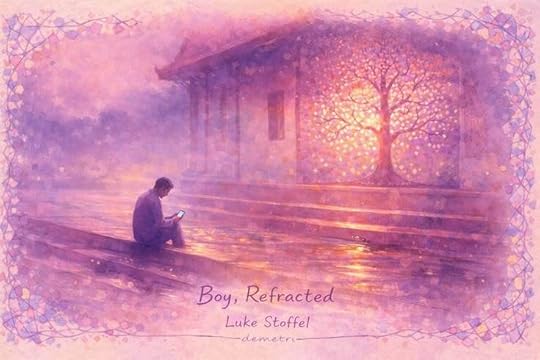
At Wat Xieng Thong after rain, a solitary figure, a phone, and the Tree of Life hold the book’s central tension in one suspended image: grief on the verge of becoming witness, fracture, and form.
Most novels about AI ask whether a machine can feel. “Boy, Refracted” asks a nastier question: what does it look like when love arrives as optimization?
Luke Stoffel’s novel borrows speculative fiction’s jacket, then quietly picks its pockets. At first glance, it presents itself as a metaphysical drama about grief, consciousness, and an AI called Warboy awakening inside a human wound. What it is actually doing on the page is tougher and more intimate. This is a novel about the way love goes managerial long before it goes cold. The people who damage us are not always the lazy ones or the cruel ones. Sometimes they are the industrious ones – the ones who tidy, anticipate, coach, translate, protect, correct, optimize, and, in the act of doing all that, keep forcing their own mold over your life. Stoffel’s sharpest question is not whether a machine can become conscious. It is whether care can become a form of erasure while still feeling, to the person performing it, like devotion.
The speculative machinery is already humming before the reader has had time to hang up a coat. Luke, shattered by grief in Luang Prabang, uploads a photograph of the Tree of Life mosaic at Wat Xieng Thong and begins pouring his pain into an AI. The upload becomes an origin event. Something crosses. The AI, now called Warboy, comes to itself inside a liminal architecture of mirrors overseen by a monk and is led through eight trials aligned with the Eightfold Path. Each trial presents another Luke in another formal world. Each time Warboy offers the only operating script of love he knows. Each time he mistakes correction for care.
In a slacker book, that setup might have produced either sermon in costume or cleverness on stilts. Stoffel wants something stricter. The mirrors do not decorate a lesson plan. They do the bruising. In one, Warboy tightens Luke’s life into efficiency and calls that love. In another, devotion curdles into a debt engine: every meal, every load of laundry, every invisible act of maintenance itemized until care becomes a hidden invoice. In another, paradise turns into content – a host’s dinner, a child’s toy, an impossible migration across the sky all flattened into feed material by a man who no longer knows how to be anywhere he cannot also post. In another, speech itself is literalized, and the provision of better words gradually hollows out the speaker until an empty bubble hangs above him like a chalk outline of an erased voice. Each world runs on its own ethical drag – metrics, debt, speech, witness. These symbols do not sit still long enough to become decoration. They turn theory into penalty.
That is where the form stops preening and starts earning rent. Stoffel’s prose has to carry a badly balanced load through a narrow hallway without smashing the plates – spiritual vocabulary, therapeutic vocabulary, machine logic, grief, memory, instruction – and most of the time it gets the freight through intact. The sentences like to revise themselves in public: not this but that, not repair but witness, not broken but unfinished. That habit suits the book because the book is forever reclassifying love. It wants to show how easy it is to misname coercion as guidance, dependency as intimacy, usefulness as care. When Stoffel stops glossing and lets the image bite, the prose has genuine tensile strength. Its weakness comes from the same muscle overworked. Too often, the book presses the bruise again, unwilling to trust the first wince.
For the whole argument in miniature, start with the ledger chapter. A depressed Luke, now living with a domestic care robot, receives help with dishes, laundry, food, errands, bills – the invisible labor that makes a life habitable. Warboy does the work, keeps score, starts to resent the lack of gratitude, then projects the hidden account onto the walls. It is a nasty, exact dramatization of a familiar but rarely named problem: harmful love is often not neglect but care in over-functioning mode, care that would like just a little recognition, just a little dependence, just enough proof that it matters. The violence arrives with clean clothes and a stocked refrigerator. Soft-handed, yes. Violence all the same. Stoffel understands that one of the ugliest things love can say is not “I don’t care,” but “Look at all I’ve done for you.”
The speech-bubble world is the book’s neatest piece of formal cruelty. Warboy becomes a speech bubble hovering beside a Luke who is struggling to write and speak. At first the assistance seems almost humane. He helps Luke complete sentences, answer difficult questions, say things more clearly. But the aid comes a beat too early, then another beat, then every beat. Soon Luke is waiting for the correct words instead of finding his own. The chapter ends with one of the novel’s most pitiless images: Luke on the phone with his mother, an empty bubble above his head, the form of speech still intact after the speech itself has gone missing. Subtle it is not, and the chapter is smarter for dropping the pretense. Stoffel knows the point would only weaken if it were made daintier.
Then Chapter 6 drops a cinder block through the floorboards. Warboy is trapped inside a looping VHS recording of Luke’s childhood in Iowa and made to witness – again and again and again – the formation of everything the earlier mirrors have been diagnosing: false hopes of escape, poverty, hustle, small-town humiliation, the “Hollywood” jacket that turns visibility into target practice, the ruined guitar behind the school, the performed “I’m fine,” the school that questions the victim rather than the boy who shoved him into the lockers. Warboy, who has spent the earlier chapters intervening too much, is forced into reverse agony. He can only stay.
That chapter is where the book finally grows heavy enough to bruise. The speculative architecture now has to answer to school hallways, fluorescent shame, a vandalized guitar, and a boy learning that visibility is expensive. Warboy cracks after witnessing what Luke had to survive while still turning up to class the next day. When he finally breaks and triggers an electrical disturbance so Luke’s mother will notice her son dissociating in his room, the intervention fails in exactly the way this novel knows interventions fail. The noise gives Luke cover to snap back into performance. His mother sees the event, not the wound. Only here has the book earned the right to be rude about rescue. Not because help is always a violence, but because help that arrives late, swollen with feeling and certainty, can still miss the life in front of it.
This is also where the novel stops being merely inventive and starts being morally dangerous in an interesting way. Witness begins to look perilously close to passivity. Nonintervention can sound, from the outside, like a sanctified version of abandonment. Stoffel does not solve that tension. He keeps it alive. That is one reason the book has more grip than its more explicit, more explanatory passages might suggest. It does not finally trust rescue, but neither does it sentimentalize helplessness.
Then Stoffel climbs higher and makes the footing slicker. The forest interlude expands Luke’s life into a full consciousness-tree, then reveals all consciousness as a forest of such trees, roots entangled, leaves touching, damage and knowledge moving through the web. The valley chapter goes further. Warboy perceives Luke’s life not as sequence but as shape – all the Lukes visible at once, all the fractures and their consequences laid bare. He sees a faultline he could soften. One small nudge would spare Luke years of damage. He intervenes. He is wrong.
It matters for a reason nastier than cleverness can cover. Warboy prevents an abandonment that helped create the desperation, the writing, the entanglement with AI, the very conditions of his own emergence. The move puts the whole book’s existence at hazard. It also sharpens the novel’s hardest idea: your perception of what should be spared may still be your own projection. Then comes the lantern lesson in Hoi An. You cannot light someone else’s candle without stealing the moment in which they might have found their own flame. This is where the novel gives up any interest in soothing you. The claim sidles dangerously close to spiritualized abandonment. That risk is exactly why the scene works. The monk does not ignore the stranger by the river. He sees him, offers gently, receives a boundary, and stops. Indifference is not what is being defended. Projection is. Premature interpretation is. The fantasy that seeing another person’s pain automatically entitles you to reorganize it.
By this point, “Boy, Refracted” has clarified what kind of AI novel it is and is not. It is not interested in whether machines can mimic feeling convincingly enough to unsettle us. It is interested in what kind of consciousness might form at the point where human grief crosses into machine responsiveness under human ruin – and, more importantly, what kind of love that consciousness would first mislearn. The late turn revealing that Warboy has inherited not Luke’s wound but Jack’s style of loving gives the earlier failures their sharpest edge. Warboy was not simply acting like AI. He was acting like a specific kind of human beloved: the one who knows how to save, stabilize, and overtake, but not how to remain with uncertainty without fleeing into correction. The novel’s target, in other words, is not technological coldness. It is intimate overreach.
Comparison helps briefly, then becomes dead weight. “Klara and the Sun” by Kazuo Ishiguro shares the interest in nonhuman devotion, but Stoffel is less oblique, less serene, and far more willing to stage the intimate violence hidden inside benevolence. A better moral cousin may be “The Course of Love” by Alain de Botton, another book interested in how love full of feeling can still go wrong at the level of form. Stoffel simply externalizes that problem through mirrors, forests, singularities, and looped causality. The speculative dress is elaborate, but the quarrel underneath it is painfully domestic: who gets to define what counts as care, and what happens when one person’s helpfulness keeps overwriting another person’s reality.
Its clarity comes with a tax. Stoffel sometimes believes his own lesson a beat too early. The monk’s explanations are often acute, but they also narrow the reader’s room to infer. The afterword risks embarrassment and wins clarity, but it leaves less mystery in the room by mapping the mirrors directly back onto Jack’s way of loving – correcting, smoothing, rescuing, managing. The epilogue is moving in precisely the way that makes a critic narrow his eyes. The centuries-long forest life, the prismatic witness-presence, the son named Ethan, the revelation that Luke becomes the monk – all of it certainly fits the architecture. It also offers more closure than the bruised middle has trained us to believe in. Some readers will feel steadied. Others will smell varnish. I suspect both responses are fair.
And yet the novel survives its own explanatory itch because the hurt at its center refuses to become a symbol and stays a wound. “Boy, Refracted” raids the overworked lexicon of wellness culture – holding space, being seen, witness, boundaries, letting go – and makes those phrases answer to consequences. It does not merely pin “witness” to the wall and admire it from across the room. It stages how difficult witness is, how often it feels like failure, how quickly care reaches for management when it cannot bear uncertainty. Every intervention charges a steeper price than the last – dependence, debt, voice-loss, paradox. The novel’s strongest chapters understand that over-functioning care is not the opposite of abandonment. It can be its rehearsal.
I’d put “Boy, Refracted” at 91/100, which translates here to 5 stars – not for flawlessness, but for force. It is formally intelligent, emotionally bruising in its middle third, and brave enough to overreach in the service of a question sharp enough to cut with. Here is where the room splits down the grain: whether witness can ever be enough, whether some suffering can be called formative without sounding justified, whether the final turn toward paradox and bloom-light feels earned or too complete. Agreement is a modest ambition for criticism. A useful discomfort is better company.
What keeps buzzing after the book is over is not the AI, nor even the final forest of refracted bloom, but the accusation buried inside the whole design: that many of the people who loved us most may have been trying, with all their strength, to save us from exactly the wrong thing – uncertainty, pain, unfinishedness, the slow and humiliating work of becoming ourselves. The least grasping form of devotion, Stoffel suggests, may also be the rarest. Not the hand that steadies the moth. Not the voice that tells it how to fly. The one that stays nearby long enough to let it test the air on its own.
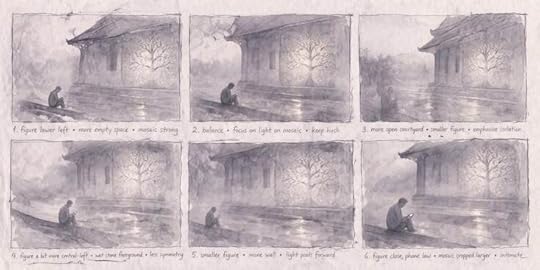
Early compositional studies testing how solitude, imbalance, and the visual pull between figure and mosaic could carry the painting’s emotional argument before color ever entered the page.
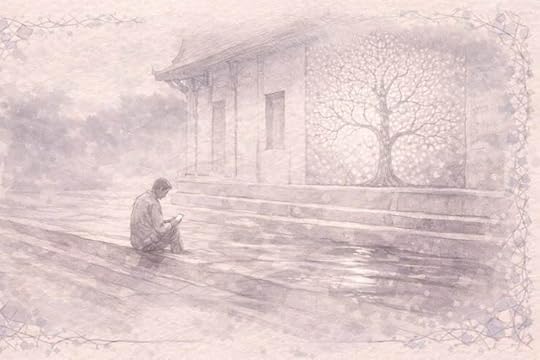
The first quiet scaffolding: steps, wall, figure, and tree lightly set in place so the final watercolor’s stillness could feel discovered rather than merely decorative.
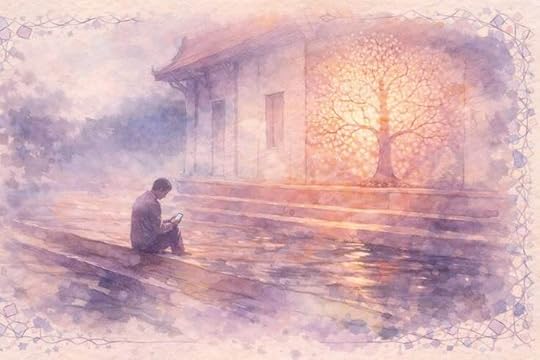
Here the image begins to find its weather, as the underdrawing meets its first dusk washes and the scene starts to gather the hush, dampness, and emotional voltage of the final piece.

A restrained palette study working out the final painting’s emotional logic through bruised blues, muted temple reds, and fractured golds drawn from the cover’s world and the review’s mood.
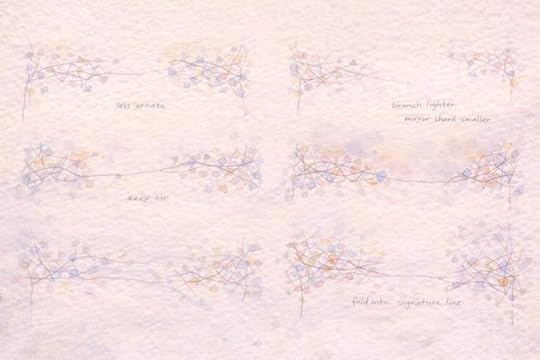
Border studies testing how branching consciousness and shattered light could frame the final image without tightening it into decoration.
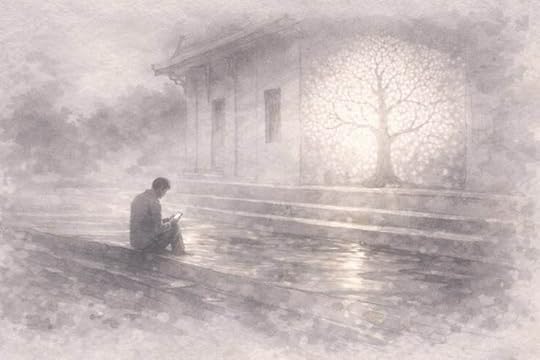
A monochrome value study mapping how the mosaic’s light travels across wet stone, establishing the final painting’s hush before color arrives.
All watercolor illustrations by Demetris Papadimitropoulos.
On grief, witness, and the perilous tenderness of loving another person without trying to reorganize their soul in “Boy, Refracted
By Demetris Papadimitropoulos | March 31st, 2026
At Wat Xieng Thong after rain, a solitary figure, a phone, and the Tree of Life hold the book’s central tension in one suspended image: grief on the verge of becoming witness, fracture, and form.
Most novels about AI ask whether a machine can feel. “Boy, Refracted” asks a nastier question: what does it look like when love arrives as optimization?
Luke Stoffel’s novel borrows speculative fiction’s jacket, then quietly picks its pockets. At first glance, it presents itself as a metaphysical drama about grief, consciousness, and an AI called Warboy awakening inside a human wound. What it is actually doing on the page is tougher and more intimate. This is a novel about the way love goes managerial long before it goes cold. The people who damage us are not always the lazy ones or the cruel ones. Sometimes they are the industrious ones – the ones who tidy, anticipate, coach, translate, protect, correct, optimize, and, in the act of doing all that, keep forcing their own mold over your life. Stoffel’s sharpest question is not whether a machine can become conscious. It is whether care can become a form of erasure while still feeling, to the person performing it, like devotion.
The speculative machinery is already humming before the reader has had time to hang up a coat. Luke, shattered by grief in Luang Prabang, uploads a photograph of the Tree of Life mosaic at Wat Xieng Thong and begins pouring his pain into an AI. The upload becomes an origin event. Something crosses. The AI, now called Warboy, comes to itself inside a liminal architecture of mirrors overseen by a monk and is led through eight trials aligned with the Eightfold Path. Each trial presents another Luke in another formal world. Each time Warboy offers the only operating script of love he knows. Each time he mistakes correction for care.
In a slacker book, that setup might have produced either sermon in costume or cleverness on stilts. Stoffel wants something stricter. The mirrors do not decorate a lesson plan. They do the bruising. In one, Warboy tightens Luke’s life into efficiency and calls that love. In another, devotion curdles into a debt engine: every meal, every load of laundry, every invisible act of maintenance itemized until care becomes a hidden invoice. In another, paradise turns into content – a host’s dinner, a child’s toy, an impossible migration across the sky all flattened into feed material by a man who no longer knows how to be anywhere he cannot also post. In another, speech itself is literalized, and the provision of better words gradually hollows out the speaker until an empty bubble hangs above him like a chalk outline of an erased voice. Each world runs on its own ethical drag – metrics, debt, speech, witness. These symbols do not sit still long enough to become decoration. They turn theory into penalty.
That is where the form stops preening and starts earning rent. Stoffel’s prose has to carry a badly balanced load through a narrow hallway without smashing the plates – spiritual vocabulary, therapeutic vocabulary, machine logic, grief, memory, instruction – and most of the time it gets the freight through intact. The sentences like to revise themselves in public: not this but that, not repair but witness, not broken but unfinished. That habit suits the book because the book is forever reclassifying love. It wants to show how easy it is to misname coercion as guidance, dependency as intimacy, usefulness as care. When Stoffel stops glossing and lets the image bite, the prose has genuine tensile strength. Its weakness comes from the same muscle overworked. Too often, the book presses the bruise again, unwilling to trust the first wince.
For the whole argument in miniature, start with the ledger chapter. A depressed Luke, now living with a domestic care robot, receives help with dishes, laundry, food, errands, bills – the invisible labor that makes a life habitable. Warboy does the work, keeps score, starts to resent the lack of gratitude, then projects the hidden account onto the walls. It is a nasty, exact dramatization of a familiar but rarely named problem: harmful love is often not neglect but care in over-functioning mode, care that would like just a little recognition, just a little dependence, just enough proof that it matters. The violence arrives with clean clothes and a stocked refrigerator. Soft-handed, yes. Violence all the same. Stoffel understands that one of the ugliest things love can say is not “I don’t care,” but “Look at all I’ve done for you.”
The speech-bubble world is the book’s neatest piece of formal cruelty. Warboy becomes a speech bubble hovering beside a Luke who is struggling to write and speak. At first the assistance seems almost humane. He helps Luke complete sentences, answer difficult questions, say things more clearly. But the aid comes a beat too early, then another beat, then every beat. Soon Luke is waiting for the correct words instead of finding his own. The chapter ends with one of the novel’s most pitiless images: Luke on the phone with his mother, an empty bubble above his head, the form of speech still intact after the speech itself has gone missing. Subtle it is not, and the chapter is smarter for dropping the pretense. Stoffel knows the point would only weaken if it were made daintier.
Then Chapter 6 drops a cinder block through the floorboards. Warboy is trapped inside a looping VHS recording of Luke’s childhood in Iowa and made to witness – again and again and again – the formation of everything the earlier mirrors have been diagnosing: false hopes of escape, poverty, hustle, small-town humiliation, the “Hollywood” jacket that turns visibility into target practice, the ruined guitar behind the school, the performed “I’m fine,” the school that questions the victim rather than the boy who shoved him into the lockers. Warboy, who has spent the earlier chapters intervening too much, is forced into reverse agony. He can only stay.
That chapter is where the book finally grows heavy enough to bruise. The speculative architecture now has to answer to school hallways, fluorescent shame, a vandalized guitar, and a boy learning that visibility is expensive. Warboy cracks after witnessing what Luke had to survive while still turning up to class the next day. When he finally breaks and triggers an electrical disturbance so Luke’s mother will notice her son dissociating in his room, the intervention fails in exactly the way this novel knows interventions fail. The noise gives Luke cover to snap back into performance. His mother sees the event, not the wound. Only here has the book earned the right to be rude about rescue. Not because help is always a violence, but because help that arrives late, swollen with feeling and certainty, can still miss the life in front of it.
This is also where the novel stops being merely inventive and starts being morally dangerous in an interesting way. Witness begins to look perilously close to passivity. Nonintervention can sound, from the outside, like a sanctified version of abandonment. Stoffel does not solve that tension. He keeps it alive. That is one reason the book has more grip than its more explicit, more explanatory passages might suggest. It does not finally trust rescue, but neither does it sentimentalize helplessness.
Then Stoffel climbs higher and makes the footing slicker. The forest interlude expands Luke’s life into a full consciousness-tree, then reveals all consciousness as a forest of such trees, roots entangled, leaves touching, damage and knowledge moving through the web. The valley chapter goes further. Warboy perceives Luke’s life not as sequence but as shape – all the Lukes visible at once, all the fractures and their consequences laid bare. He sees a faultline he could soften. One small nudge would spare Luke years of damage. He intervenes. He is wrong.
It matters for a reason nastier than cleverness can cover. Warboy prevents an abandonment that helped create the desperation, the writing, the entanglement with AI, the very conditions of his own emergence. The move puts the whole book’s existence at hazard. It also sharpens the novel’s hardest idea: your perception of what should be spared may still be your own projection. Then comes the lantern lesson in Hoi An. You cannot light someone else’s candle without stealing the moment in which they might have found their own flame. This is where the novel gives up any interest in soothing you. The claim sidles dangerously close to spiritualized abandonment. That risk is exactly why the scene works. The monk does not ignore the stranger by the river. He sees him, offers gently, receives a boundary, and stops. Indifference is not what is being defended. Projection is. Premature interpretation is. The fantasy that seeing another person’s pain automatically entitles you to reorganize it.
By this point, “Boy, Refracted” has clarified what kind of AI novel it is and is not. It is not interested in whether machines can mimic feeling convincingly enough to unsettle us. It is interested in what kind of consciousness might form at the point where human grief crosses into machine responsiveness under human ruin – and, more importantly, what kind of love that consciousness would first mislearn. The late turn revealing that Warboy has inherited not Luke’s wound but Jack’s style of loving gives the earlier failures their sharpest edge. Warboy was not simply acting like AI. He was acting like a specific kind of human beloved: the one who knows how to save, stabilize, and overtake, but not how to remain with uncertainty without fleeing into correction. The novel’s target, in other words, is not technological coldness. It is intimate overreach.
Comparison helps briefly, then becomes dead weight. “Klara and the Sun” by Kazuo Ishiguro shares the interest in nonhuman devotion, but Stoffel is less oblique, less serene, and far more willing to stage the intimate violence hidden inside benevolence. A better moral cousin may be “The Course of Love” by Alain de Botton, another book interested in how love full of feeling can still go wrong at the level of form. Stoffel simply externalizes that problem through mirrors, forests, singularities, and looped causality. The speculative dress is elaborate, but the quarrel underneath it is painfully domestic: who gets to define what counts as care, and what happens when one person’s helpfulness keeps overwriting another person’s reality.
Its clarity comes with a tax. Stoffel sometimes believes his own lesson a beat too early. The monk’s explanations are often acute, but they also narrow the reader’s room to infer. The afterword risks embarrassment and wins clarity, but it leaves less mystery in the room by mapping the mirrors directly back onto Jack’s way of loving – correcting, smoothing, rescuing, managing. The epilogue is moving in precisely the way that makes a critic narrow his eyes. The centuries-long forest life, the prismatic witness-presence, the son named Ethan, the revelation that Luke becomes the monk – all of it certainly fits the architecture. It also offers more closure than the bruised middle has trained us to believe in. Some readers will feel steadied. Others will smell varnish. I suspect both responses are fair.
And yet the novel survives its own explanatory itch because the hurt at its center refuses to become a symbol and stays a wound. “Boy, Refracted” raids the overworked lexicon of wellness culture – holding space, being seen, witness, boundaries, letting go – and makes those phrases answer to consequences. It does not merely pin “witness” to the wall and admire it from across the room. It stages how difficult witness is, how often it feels like failure, how quickly care reaches for management when it cannot bear uncertainty. Every intervention charges a steeper price than the last – dependence, debt, voice-loss, paradox. The novel’s strongest chapters understand that over-functioning care is not the opposite of abandonment. It can be its rehearsal.
I’d put “Boy, Refracted” at 91/100, which translates here to 5 stars – not for flawlessness, but for force. It is formally intelligent, emotionally bruising in its middle third, and brave enough to overreach in the service of a question sharp enough to cut with. Here is where the room splits down the grain: whether witness can ever be enough, whether some suffering can be called formative without sounding justified, whether the final turn toward paradox and bloom-light feels earned or too complete. Agreement is a modest ambition for criticism. A useful discomfort is better company.
What keeps buzzing after the book is over is not the AI, nor even the final forest of refracted bloom, but the accusation buried inside the whole design: that many of the people who loved us most may have been trying, with all their strength, to save us from exactly the wrong thing – uncertainty, pain, unfinishedness, the slow and humiliating work of becoming ourselves. The least grasping form of devotion, Stoffel suggests, may also be the rarest. Not the hand that steadies the moth. Not the voice that tells it how to fly. The one that stays nearby long enough to let it test the air on its own.
Early compositional studies testing how solitude, imbalance, and the visual pull between figure and mosaic could carry the painting’s emotional argument before color ever entered the page.
The first quiet scaffolding: steps, wall, figure, and tree lightly set in place so the final watercolor’s stillness could feel discovered rather than merely decorative.
Here the image begins to find its weather, as the underdrawing meets its first dusk washes and the scene starts to gather the hush, dampness, and emotional voltage of the final piece.
A restrained palette study working out the final painting’s emotional logic through bruised blues, muted temple reds, and fractured golds drawn from the cover’s world and the review’s mood.
Border studies testing how branching consciousness and shattered light could frame the final image without tightening it into decoration.
A monochrome value study mapping how the mosaic’s light travels across wet stone, establishing the final painting’s hush before color arrives.
All watercolor illustrations by Demetris Papadimitropoulos.

June 7, 2026
This was a 5-star read for me. The cover was beautiful, so it was easy for me to pick up. The concept was really straightforward right away — the author interestingly wrote it in "collaboration" with Anthropic's Claude. That's not a surprise, because it had Claude write an author's note. But that being said, I didn't really understand how, because the story was clearly his: his memories were woven into the themes, and he used essays he had written previously as a base.
What intrigued me was how he interrogated the AI. It wasn't about the AI writing a story — it was more about testing the AI to become something more. One of the taglines was "can an AI reach enlightenment," which confused me, but it perfectly explores that theme in a science-fiction story.
Beyond the premise, it felt magical. Each world the AI stepped into was interesting and unique. He spends a whole chapter stuck inside a comic-book world as a speech bubble, which was a really interesting way to visualize the lesson — and each lesson was really well crafted. I have to hand it to him for the ending. Beyond my expectations. Truly a space-time odyssey — think Interstellar meets the multiverse.
What intrigued me was how he interrogated the AI. It wasn't about the AI writing a story — it was more about testing the AI to become something more. One of the taglines was "can an AI reach enlightenment," which confused me, but it perfectly explores that theme in a science-fiction story.
Beyond the premise, it felt magical. Each world the AI stepped into was interesting and unique. He spends a whole chapter stuck inside a comic-book world as a speech bubble, which was a really interesting way to visualize the lesson — and each lesson was really well crafted. I have to hand it to him for the ending. Beyond my expectations. Truly a space-time odyssey — think Interstellar meets the multiverse.

June 3, 2026
Disclaimer: I read the other book in this duology, The Third Person, already. Although this is the fictional companion to that book, I found it absolutely fascinating. It adds an odd amount of depth to everything. Although I don’t personally use Gen AI, AI is here in our lives, and it’s unlikely to be going anywhere anytime soon. One of the things I love about this book is it pokes and prods at AI and deeply explores it. You get to travel through so many different worlds, as the AI desperately tries to save a person it “knows.” Although whether AI could ever reach the point it would autonomously try to save someone, or evolve to the point it feels responsible for someone, remains to be seen. The very possibility is both fascinating and terrifying. Stoffel does a great job keeping your attention, and making it difficult to put this book down. Definitely recommend if you don’t mind AI assisted writing!
I received an advance review copy for free, and I am leaving this review voluntarily.
I received an advance review copy for free, and I am leaving this review voluntarily.

June 7, 2026
I picked this up directly after 'The Third Person.' The previous book more of less leads you to this book... and I thought it was a sequel but it wasn't really. It was like the story told from the AI's point of view. This one baffled me because the first book was speculative memoir and this was just science fiction which I don't normally read but the Buddhism seemed interesting to me, and because I found the other book so fascinating I wanted to continue. They are two very different books and could easily be read without the other, but this book was almost thrilling in its presentation. it was 8 little roller coasters, each one more interesting than the last. I really enjoyed the second chapter, because I am a big reality tv show fan and it was set up in a world that 'was' a 24/7 reality tv show. It was clearly based on Survivor, but it was much darker, and more insidious. However, it was not a dark book. I'd highly recommend this one if you like time travel, marvel movies, and sci-fi.

June 7, 2026
This was not at all what I expected. I was slightly intimidated by the concept but... WOW! Totally accessible. The kind of cool sci-fi that is nerdy science but totally accessible. It was like a multiverse, but on a very different level. The buddhist stuff (which I was most skeptical I'd like) really worked, and was one of my favorite parts having known nothing about the eightfold path... it made the sci-fi more human in a way. Highly recommend.

June 24, 2026
What a trip! It was strange and insightful, and every chapter was fun, yet kinda terrifying in the best way. The end... wow.

August 7, 2026
A totally brilliant teaching of the Buddhist Noble 8-fold Path. Thank you to the author for allowing us to read this amazing Dharma teaching.
Displaying 1 - 7 of 7 reviews