Jump to ratings and reviews
Rate this book

l'Algérie c'est beau comme l'Amérique

Rate this book
Petite-fille de pieds-noirs, Olivia a toujours entendu parler de l’Algérie. Mais, entre nostalgie, images de cartes postales et blessures de guerre, elle trouvait cet héritage plutôt gênant.
Dans les années 1990, elle demande à sa grand-mère d’écrire ses mémoires mais n’obtient d’elle qu’un sourire fatigué. Pourtant, en triant ses affaires après son décès, Olivia tombe sur un dossier qui lui est destiné. À l’intérieur : ses souvenirs d’Algérie.
Dix ans plus tard, elle décide d’aller sur place, pour confronter ces récits à la réalité. Elle part seule, avec dans ses bagages le numéro de téléphone d’un contact sur place, un certain Djaffar...

180 pages, Hardcover

First published January 21, 2015

12 people are currently reading
521 people want to read

About the author

Olivia Burton

8 books5 followers
Agrégée de lettres modernes, Olivia Burton s’est dirigée vers le théâtre comme dramaturge et adaptatrice. Elle a également réalisé deux documentaires et écrit deux BD.


Ratings & Reviews

What do you think?
Rate this book

Friends & Following

Create a free account to discover what your friends think of this book!

Community Reviews

5 stars
120 (17%)
4 stars
293 (43%)
3 stars
217 (31%)
2 stars
41 (6%)
1 star
10 (1%)
Displaying 1 - 30 of 153 reviews
Profile Image for Hafsa | حفصہ.
174 reviews189 followers
July 31, 2018
Disclaimer: Received a free digital copy of the book through Netgalley.

This graphic memoir captures Olivia Burton's journey to Algeria to trace back her roots and deals with the French colonisation of Algeria and the subsequent independence of the country. The first 30 pages of this book or so were very hard to get into because of how the author's family kind of justified colonisation and lamented the ill treatment of colonisers by the colonized once they took over. As a history student and someone whose country was once colonized, it just made me angry in a way I can't describe. I got through those pages solely on the basis that this was non-fiction and the author was just presenting the family she grew up in and trying to give a background to the story.

After the said pages though, this got better. So much better. Once the protagonist (the author), grows up and her historical knowledge extends beyond listening to the stories of her family members about Algeria and she starts to question who her family really was in French occupied Algeria: racist colonisers or what her family describes, I was totally in for it all.

The history buff me really enjoyed all the eye-opening insight that this short book provided about Algerian independence and it prompted me to search more about it which says something considering the fact that I read this when my exams were going and I DID NOT want to read more history than I already was because of my textbooks. The story also had intriguing commentary about war and memory and I loved that it highlighted how history is actually what the rulers make of it by giving references to things such as the museum of massacres. It was also interesting to see how the same government who encouraged French people to settle in Algeria so many years ago now kind of discriminate against them.

Moreover, the story is crafted in a way that it traces Algeria’s history from colonisation to present day alongside the author’s family history which I think engages the reader in a way that only one of those things alone wouldn't have been able to achieve. The coloured photographs were a nice touch and although the format and layout of the book weren’t that appealing at the start, they became impressive as the book went on.

The dilemmas, feelings and personalities of the characters were fully fleshed out and I could connect to Burton a lot as someone who has heard a lot of stories about her country's journey to independence. Her character also provided some food for thought on how it feels like to be the children of colonists and realize all the wrong which runs in your family history. One particular quote stands out to me:

"I had inherited a war I hadn't experienced."

I liked Djaffer’s character and his musings on how "we maybe children of colonists but we’re nothing like them". His humour and sarcasm were a treat throughout, e.g.

Djaffer= “What are you doing?”
Olivia= “Soaking it in.”
Djaffer= “You should fill a bottle and take it back to Paris.”

Despite this there were some things which were exasperating and off putting such as Burton's lack of political awareness and some sentences/dialogues were just beyond reading without feeling like I wanted to punch someone, especially this conversation between Olivia and her mother:


I realize and appreciate that the author unabashedly tried to show the feelings of french settlers towards Arabs in Algeria but this still left me uncomfortable and furious. Overall, my reading experience definitely made me realize that memoirs might just be my favourite sub-genre of graphic novels, especially the ones which involve travelling and finding your roots by doing a pilgrimage to discover your family origins. This was emotional, brazen in its exploration of colonisation and the issues which emerge as a result of it, accompanied with pleasing illustrations and a story worth reading!
Profile Image for Jenny (Reading Envy).
3,876 reviews3,710 followers
March 1, 2018
Publisher summary:

Olivia had always heard stories about Algeria from her maternal grandmother, a Black Foot (a “Pied-Noir,” the French term for Christian and Jewish settlers of French Algeria who emigrated to France after the Algerian War of Independence). After her grandmother’s death, Olivia found some of her grandmother’s journals and letters describing her homeland. Now, ten years later, she resolves to travel to Algeria and experience the country for herself; she arrives alone, with her grandmother’s postcards and letters in tow, and with but a single phone number in her pocket, of an Algerian Djaffar, who will act as her guide. Olivia’s quest to understand her origins will bring her to face questions about heritage, history, shame, friendship, memory, nostalgia, fantasy, the nature of exile, and our unending quest to understand who we are and where we come from.
This was a lovely quick read that takes an honest look at the difficulties of a spotted family history, an exploration of what "home" means and if you can find one you never knew, the differences between nostalgia places and real spaces, and a bit of a love story to a landscape that is not frequently celebrated in western culture - the Algerian landscape. I came away feeling like I knew more about certain periods in Algerian history, and the appeal of the place.

Also this counts for the 2018 Reading Women Challenge: graphic novel or memoir (by a woman, obviously.)

Thanks to the publisher for approving my request through Edelweiss. I read it earlier than I meant to, because I was really interested in the experience! It comes out April 24, 2018.
Profile Image for Gorab.
843 reviews153 followers
February 28, 2022
Loved this sweet little memoir/travelogue, and it helped me learn a little bit about Algeria.
So this French girl heard stories from her grandmother since her childhood, and one day decided to take a leap and visit the country of her grandma's coming of age.

While trying to find her roots, she encounters a big slice of Algerian life. She gets to hear both sides of arguments related to the Algerian revolution. Were her grand parents among the oppressors?

Amidst harsh environment, she tries to visit the old apartment where her grandparents used to live.
Through her travels, we get to feel the life of Algerian people, their courtesy, landscapes, buildings and parks.

Towards the end, there are some Algerian postcards (my recent passion :P), one of them from 1930 features her grandmother when zoomed in :)

All in all, a satisfactory read. very much recommended for arm chair travellers.
Profile Image for sarah.
27 reviews
June 24, 2021
I suppose I wasn’t really the target audience for this. While I can acknowledge that the fate of Pieds-noirs in Algeria is unique in a sense, the fact remains that they made up an occupying force of French citizens in Algeria, were given rights and freedom that Indigenous Algerians weren’t allowed, and ultimately lived and believed themselves to be in a constant state of superiority over those same Algerians. So for me, an Algerian, to feel sympathy for a family of displaced colonizers is not only hard, but also incredibly unnatural and near impossible. In that regard, the first chapter was ridiculously hard to get through in particular: to read about how the author was simply unaware of the core of the conflict between France and Algeria until she reached her twenties felt like an uncomfortable slap in the face, when the racism and disregard for Algerian livelihood by her family was obvious from the start. But to her credit, she does come to that conclusion, eventually. I suppose.

While I can recognize the desire for the author to dig up her roots in Algeria, and the complexity of that pilgrimage, it isn’t lost on me either that it is quite a privileged feat to even be able to trace back that history and then make it back to France—undoubtedly the place where the author feels most at home, even if she has a hard time at first accepting the fact that her family isn’t quite like the “others” (the white ones, mind you)—like it was just one nice adventure. Maybe my perspective is also tainted by an immigration experience that definitely makes my own views of trips back to Algeria quite different. Our purpose for travelling back sure isn’t the same.

I didn’t enjoy this read. I didn’t entirely hate it though; at least, the art and some of the narrative managed to properly capture the Algeria that I know and love—and that I can believe the author did end up falling in love, too. But will it be enough for me to go back to it? Eh.

Profile Image for Rod Brown.
7,356 reviews282 followers
June 27, 2018
The author's grandparents and parents were French colonists in the Algerian countryside who fled the country during its struggle for independence decades ago. The family has mythologized its time in Algeria, compelling the author to tour the country herself to see if she can discover something about herself by searching for any remnants of her family's experience in the modern reality of this lost paradise.

While well told and illustrated, I'm frustrated that the book basically amounts to nothing. The author meets some nice people, is scared by stories about dangerous people who may be lurking nearby, sees some stuff that ties directly to her family and a bunch more that does not, and repeatedly draws attention to how poorly the Algerian women fare in their society. She pokes a bit at the idea that her family may have been evil imperialists, but balks at really drawing any conclusions that may be awkward to talk about at the next family get together. Deciding Algeria IS beautiful is about as deep as it gets.

So in the end we are left with the vacation slides of a privileged European white woman touring an African nation and passive aggressively finding fault with how things have progressed since the end of colonization. That seems problematic.
Profile Image for Yann.
1,413 reviews394 followers
February 12, 2015


Cette bande dessinée autobiographique raconte l'histoire d'une jeune française, petite-fille de colons pieds-noirs des Aurès, qui part en Algérie pour affronter les questions qui la taraudent, un héritage qui la pèse, pour voir à quoi ressemble un pays dont elle entend parler depuis son enfance mais qu'elle n'a jamais vu, pour mettre à l'épreuve ce qu'elle entend depuis toute petite sur les Arabes, un voyage auquel elle songe depuis dix ans, mais qu'elle a toujours repoussé, car la simple idée suscite autour d'elle énormément de craintes.

La première partie relate sa jeunesse entre une famille qui ressasse le chagrin du déracinement, vit refermée dans des souvenirs, tournée vers le passé, soudée et repliée sur elle-même, plongée dans une amertume et une mémoire qu'elle ne peut partager, dont elle se sent même exclue, mais qui l'affectent pourtant. Vis à vis de l'extérieur, elle peine à assumer le regard et le jugement des métropolitains par rapport à sa famille, elle a honte de leurs manières africaines expansives, de leur accent, de leur cuisine épicée, de leur remarques raciste, des valeurs qu'elle ne partage pas. Surtout, le spectre de la guerre la hante, et l'imagination se glisse dans les non-dits.

Suite à ces accrochages, je me replie dans un silence indifférent. Aux amis, je réponds le moins possible. La famille, je l'écoute ressasser en silence. L'Algérie m'ennuie et me pèse à la fois. Je ne peux partager ni leur douleur ni leur nostalgie. Mais elles me traversent, m'imbibent. A la seule mention du mot "Algérie", mon rythme cardiaque s'accélère. J'hérite d'une guerre que je n'ai pas vécue.
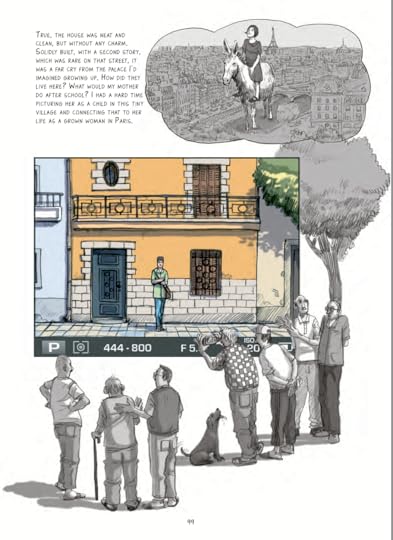
Dans la seconde partie, elle a la chance d'avoir un contact sur place avec lequel elle peut faire le voyage. Elle se rend à Alger, puis dans le village de sa grand-mère. Les appréhensions sont nombreuses, les échanges avec son contact local sont parfois difficiles pour elle au début, mais ils parlent beaucoup, et finissent par se connaître et s'apprécier. Sur place, l'hospitalité est au rendez-vous, les rencontres sont chaleureuses, le pays est magnifique; elle comprend la nostalgie de sa mère. Elle semble rentrer heureuse et apaisée de son voyage. Un témoignage intéressant sur un sujet sensible, mais peut-être un peu court, et que j'aurais préféré plus développé, mais c'est sans doute la faute du format bande dessiné...
Profile Image for Laura.
3,240 reviews101 followers
February 3, 2018
How much French colonial history do you know? As an American, I know that the French were in North Africa because of the movie Casa Blanca, and that The Stranger takes place in Algeria, but beyond that, zip. So little colonial history is taught in American school, which is probably why we don't understand so much of the world.

I had never heard of the term, Black Foot, other than used for Native Americans. But, according to this graphic novel, and online sources, this refers to people of French decent that were born in Algeria.

Olivia, the author of this memoire, is a descendent of Black Foots, but who now live in France. Her grandparents grew up in Algeria, and have memories that they have shared with her, how the beaches are more blue there. How the melons are more sweet there. How the palm trees were too scrawny in France.

With stories such as that, what would have kept her from wanting to visit the land her family left behind when the war broke out, and Algeria was liberated from the French.

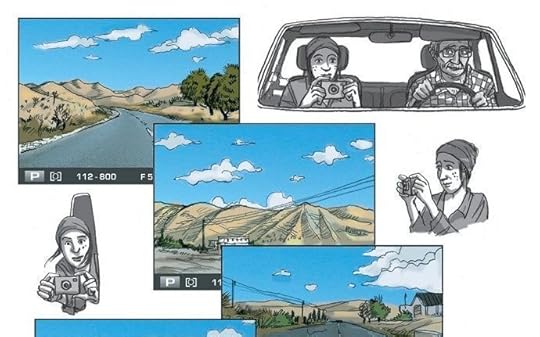
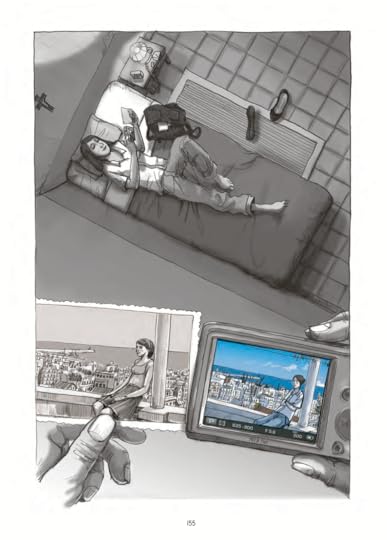
It is interesting story of a former colonist, or child of a colonist, visiting her families home. It is a little slow, but that is part of the travel. She took a lot of pictures and they were incorporated into this novel. Two examples below.


I thought the title of the book was odd, but it is the same in French as it is in English. And she does compare the wide open spaces to the American west.

Despite the lack of history, enough is explained that I felt I was up to speed as I read this. Very thoroughly enjoyed it.

Thanks to Netgalley for making this book available for an honest review.
Profile Image for BookCupid.
1,259 reviews71 followers
October 13, 2017
Even though I'm a huge fan of graphic memoirs and found the subject emotional enough to maintain the readers' interest throughout the story, it felt weak. Nothing really happened to the MC other than make friends everywhere she went.

All in all, Algeria seems friendly!
Profile Image for Maxine.
1,519 reviews67 followers
May 20, 2018
The graphic novel Algeria is Beautiful Like America is written by Olivia Burton and illustrated by Mahi Grand. It tells Olivia’s own story, a woman of Algerian descent, as she returns to Algeria to try to better understand her heritage after discovering her grandmother’s memoirs. Her family is ‘Black Foot’ (Pied-Noir), French settlers during France’s occupation of Algeria who left after the Algerian War of Independence. As she travels using her Grandmother’s words as a guide, Olivia compares her family’s recollections of the country including their distain for the Arab indigenous population with what she sees and learns as she travels across the country - much of the book recounts her internal struggle as she try to reconcile the two different accounts.

The graphic novel form may seem an odd choice for a memoir but, in fact, in the few I have read, I have found it works very well and Algeria Is Beautiful Like America is no exception. I admit I knew little about Algeria before reading this but I found Burton’s history of the French colonialism and the Algerian War fascinating as well as her own reactions to her discoveries. Mahi’s illustrations are beautifully done in black and white, the only exception the photographs Olivia takes on her journey and they complement Olivia’s story perfectly. For anyone who enjoys graphic novels as well as memoirs, this one is well worth the time.

Thanks to Netgalley and Diamond Book Distributors/Lion Forge for the opportunity to read this book in exchange for an honest review
Profile Image for ~:The N:~.
851 reviews56 followers
September 15, 2021
I don't know a great deal about Algeria so it is fascinating to read something that sets in the country.

A well-written and delightfully drawn journal of a young woman whose parents and grandparents were the Black Foot of Algeria, venturing out to a country she knew about only from the memory of her family. Appreciate that the author speaks the truth about the conflict she feels about colonialism.

I’ve learned a lot about Algerian history from reading this graphic novel. And I think the coloured ‘photographs’ in this book were nice.

Don't think that the title "... Like America" is apt though.
Profile Image for Mayar Mahdy.
1,810 reviews1 follower
Read
June 9, 2020
I was sitting in my room doing nothing when I remembered this GN. I want to tear it apart.

Imagine being a French colonizer; you're an abomination, an awful human being, a racist, and all-around disgusting. Imagine -after a century- that a country you colonized finally kicked you out. Imagine talking shit about the Algerians because THEY TOOK THEIR COUNTRY BACK.

This is a story of a colonialist woman telling her grandchild how the backwards people who aren't French brutalized the French occupants to have the country for themselves. What sort of sick mind would sympathize with a colonialist over a countryman? What merit does she have to talk about her days in Algeria like they were something good and natural? "I remember it like it was yesterday, we killed those little kids and tortured some people then we had a lovely party! Oh, Algeria!"

This book is so shameful. I can't believe an actual person wrote this. I also couldn't believe French doctors wanted to experiment on Africans, but oh well, Viva La France or whatever.

The BLM protests make me feel sad. I'm not an African- American, but I have so many awful memories about racism. My whole country would've had a better past, present, and future were it not for France and England being what they were in the past. It's sad that entire regimes still opress people to prove to themselves that they are better and stronger. Such a sad world.

This is an awful story. Please don't read it.
Profile Image for Preethi.
1,038 reviews136 followers
March 2, 2018
My first few thoughts were -
- wait, was Algiers prettier than Marseilles? Whoa!
- And locusts destroying a crop was a real thing?
- Whoa, the colonial life in Algeria feels so similar to how it was in India in the early 19th century!

Who among us hasn't wished to know where they come from? Am sure, growing up, we've all been surrounded by family histories, and as we understood the right from the left, we've questioned everyone of those stories and asked ourselves what our families' leanings were, really.
I thought this book was honest. This was the author's yearning to know the place she came from, curiosity in what her family was all about, and attempt to understand both these. I also loved the drawings, to me, they felt life-like.

If one is bothered to think deeper, this book also talks about the ravages of colonialism. One could argue that we've all learnt a little of the Western civilization thanks to being colonies, but the atrocities related to the Independence wars are something everyone in this generation should know about, to know their roots and what their ancestors have been through.
Indeed, as Newton said, men build too many walls and not enough bridges!

Note - I read this book thanks to Edelweiss
Profile Image for Derek Royal.
Author 16 books74 followers
May 21, 2018
A nice journey and self-discovery narrative. I enjoyed Burton's story, and Grand's art was an effective complement. Pascal and I will discuss this as one of the text we look at for the May Euro Comics episode.
Profile Image for Madeline.
1,005 reviews118 followers
April 20, 2020
Before reading Algeria is Beautiful Like America, I had thought it was a graphic memoir about a woman whose ancestors were from Algeria, a woman of colour, whose ancestors were African. I hadn't expected it to be about a descendent of colonialists whose grandparents and mother had been born in Algeria, but were all the same, white.

Ultimately, I feel unsettled by Algeria is Beautiful Like America. There's nothing explicitly wrong with Burton's depiction of colonialism and her ancestor's role in Algeria, I don't think. She charts her experience realising the position they occupied in Algeria, and trying to reconcile that knowledge with her knowledge of them as her family. All the same, it left a weird taste in my mouth, and the persistent question: did this story need to be told? It was interesting, absolutely, but I don't know that it was needed. I feel that the voices of black Algerians are the ones that need to be lifted and spread.

As for the art style, I didn't love it. I specifically didn't love the black and white colour palette. All through the graphic novel, Burton talks about how beautiful Algeria is, how her family couldn't find that beauty in France. Colour was used in a cool way for panels that represented a photograph, but I still would have liked it much more if the whole thing was in colour.

Reading Algeria is Beautiful Like America was a weird experience, but it happened. I've read it, I've shared my thoughts.
Profile Image for Kate Mester.
959 reviews13 followers
May 19, 2020
The title definitely needed to be Algeria is Beautiful. The "...like America" part is a red herring, as America is mentioned in exactly one sentence and has absolutely nothing to do with this story. I wonder if this was a weird publishing choice for an English speaking audience. That's really the only flaw with this book, though. Olivia Burton writes so contemplatively and vibrantly about her search for her family ancestral homes and history in her visit to Algeria. The art by Mahi Grand is vibrant and warm and the panels change and flow to match the feel and sweep of the story, with pops of color shown through photographs, such a great visual device. Burton doesn't shy away from mining her family's complex and problematic history, and the first few chapters showing her growing into questioning her family's beliefs and worldviews, with looming wars and deaths referenced through haunting skeletons, are exquisitely done and will resonate with teens grappling with the journey of their identity as they form their own personal beliefs. Would be absolutely great in an ELA or SS classroom, so much to discuss from a personal and historical/politcal standpoint. Her story exposed a massive gap in my own learning and I had to stop frequently to look up information about Algerian history and the war, making it a great pairing in SS classes learning about world conflicts and colonialism.
Profile Image for ❤SanaReads❤.
1,221 reviews67 followers
January 25, 2018
Book kindly offered to me by the publisher in exchange for an honest review.

⭐⭐⭐stars!

"When you don't know where you're going, take a look at where you came from."

I've never been to Algeria, but I know that there are great and generous people, delicious dishes and wonderful places to see.

Algeria Is Beautiful Like America is about a French girl who was brave enough to go on her own and explore a place she only heard of from her grandma's stories.

When her grandma passed away, Olivia decided to visit Algeria and see for herself the places that stole her grandmother's heart. Meeting all those generous people filled Olivia with love and gave her hope to come again and visit the place where her family was born and was always welcome to stay.
Profile Image for Vivek KuRa.
279 reviews51 followers
June 19, 2020
A very interesting travelogue/memoir and an obsessive quest to know the roots of her Mom and Grandparents. That too in a least known country for lot of us "Algeria" .This book lets us peak inside the life of three generations of a French family who settled and lived in Algeria and their troubled past due to the Algerian revolution. The illustrations in this book are beautiful and takes you there . I enjoyed this book thoroughly
Profile Image for Maggie Gordon.
1,914 reviews162 followers
September 2, 2018
Algeria is Beautiful Like America is one of the many graphic memoirs popping up lately. This one deals with one woman's return to Algeria and attempts to learn about and reconcile her family's past as colonisers. It's pretty light weight given the material. I thought the illustrations were quite novel at times, but unfortunately the narrative is pretty forgettable.
Profile Image for Amy.
608 reviews11 followers
July 21, 2018
3.5 stars - This graphic memoir reminds me a lot of Persepolis, except this story is heavier on exploring family history (and how it feels when your family is on the wrong side of history). Unlike Marjane Satrapi (who lived in Iran during the Islamic Revolution), Olivia Burton did not live through the war for Algerian independence from France, it was a conflict her mother and grandparents fled, and she grew up hearing a lot of one-sided stories.

As a product of the American public school system, I really have no background or context into the history between France's colonization of Algeria and the subsequent war, but Burton does attempt to give the reader a frame of reference by providing footnotes to key dates and the various factions involved. It provided enough grounding that I didn't feel lost, while also letting me know there is definitely much more to the story than she could (or would want to) provide in this format.

The artwork is done primarily in black and white, which ties in nicely with her words at the end, about traveling through her families' black and white memories. Her own memories, in the form of full color photographs, stand in bright contrast and add some nice visual interest at points along the way.
Profile Image for Kayla.
114 reviews
February 11, 2018
I received an ARC from NetGalley in exchange for an honest review.

Algeria Is Beautiful Like America follows Olivia as she journeys to Algeria to see where her family lived in the early 1960s.

After her grandmother’s death, Olivia finds her grandmother’s memoirs and uses those as a guide as she travels around Algeria. Along the way, Olivia learns more about Algeria’s colonial past and compares it to what she knows of the country through her family’s stories. She questions what the truth really is, if her family was on the wrong side of history, and what part she has to play in it all.

The pacing of the book is a little slow, but it never felt lagging to me. I didn’t know much about Algeria or French colonization going into the book, so the slow pace gave me time to process the information presented within.

I really liked the limited use of color; the majority of the book is in black and white, and the only parts in color are the photographs Olivia takes.

I enjoyed the story and learning about a part of history I hadn’t really come across before, and I would recommend this book to people interested in graphic memoirs.
Profile Image for J.
1,559 reviews37 followers
August 9, 2018
Really nice memoir graphic novel detailing a French woman, whose parents and grandparents were the pied noir of Algeria, traveling to a place she had only experienced in the memories of her family. Although she doesn't tackle the historical problems of the French in Algeria, she comes away with an understanding of the complexity of the French and Algerian relationship. Perhaps the most poignant moment in the book is when she is standing on the balcony of what she believes to have been her grandparent's apartment in Algiers, alongside the young Algerian mother who lived there now with her family. The Algerian notes that the war was something neither of them had anything to do with, yet still affected them in ways they must navigate. (Paraphrase)

The art is simply beautiful and makes me want to see more of his work.
Profile Image for Rianna.
374 reviews48 followers
March 19, 2018
9/52 books read in 2018.
Provided by NetGalley in exchange for an honest review.

I have to say that I don't know a lot about Algeria, so it was really interesting to read book set in this country. The art definitely made the story come to life, since it immediately also showed a representation of the places mentioned. The story was a little choppy at times, a few extra titles or 'introduction' pages between the segments could have helped with that.

I absolutely adore the artwork in this book! Scenery was beautifully illustrated and I am definitely considering visiting Algiers one day. The art is mostly black and white, but color is used to indicate recently taken pictures. The contrast was really cool.
Profile Image for K.
6 reviews19 followers
February 2, 2018
A story about a French girl who wanted a glimpse of her family's past in Algeria. It's a rare view since Olivia, the French girl is part of a colonial family who owned vast lands in Algeria before its independence. It's a reminder that our past is what makes us now and how important it is to look back and acknowledge our past in order to move on. And that no matter how our past was, it's all up to us, now, to change the way things are. That we are not responsible for the mistakes of others, including our family, but we are responsible for finding out about them and learning from it. The wonderful story with the beautiful illustrations is a delightful quick read.
Profile Image for Vinayak Hegde.
744 reviews93 followers
May 27, 2018
This is a graphic memoir of the author trying to find her roots in Algeria. She makes the journey back and things are quite different from the time her parents and grandparents lived there. The story denotes the conflict in here mind of being the daughter of blackfoot or the French Colonizers of Algeria. This colors the storyline as well as she grapples with this reality.

The artwork is quite good with the black-and-white pencil work and some of the pages stand out due to the way the past has been shown. The use of color photographs to show recent photographs is also use prudently. A decent read that piques your curiosity about Algiers and Algeria and their fight for independence.
Profile Image for Molly.
1,202 reviews53 followers
February 21, 2018
I honestly didn't know anything about Algeria prior to reading this graphic novel, and now I'm going to have to do some further reading to understand some of the references in Burton's book. It's beautifully drawn and very well written, though I found myself wishing for a little more historical context about her journey and her family. It was neat to see her attempts at finding the fondly remembered places of her family's past -- I suppose if I knew more about French and Algerian history, the larger issues in the book would have made more immediate sense to me.
Profile Image for Loz.
1,674 reviews22 followers
April 23, 2018
A thoughtful look at exploring verbal family history and confronting the disparities and difficulties in the delve. I also found it very educational, covering parts of time and the world that I am not the most familiar with. Art is distinct and absolutely portrays the beauty of Algeria. Definitely recommend.
Profile Image for Jeimy.
5,609 reviews32 followers
June 10, 2018
I loved this graphic novel chronicling how a young French woman travels to Algeria in search of her roots.
Profile Image for Meepelous.
662 reviews53 followers
September 12, 2018
TLDR summary, this book is about a white French woman retracing the steps of her mother's family as colonizers in Algeria. The title's comparison of Algeria to America really doesn't pan out to anything.
Looking even beyond Goodreads for reviews, my perhaps hottest take on this work is that I really didn't care for the art that much. Which, even as I knew my opinion was extremely personal and not actually based on the artist's actual abilities or anything, did kind of surprise me.
I'm just not a fan of grey colored art that I do not perceive as striking enough. I like contrast, and so I found the majority of this book visually pretty blah. Since this book was also largely premised on the idea that Algeria is beautiful, this certainly did not help. I did, however, appreciate the way in which Grand did use color in the photographs that Burton was taking. That did provide some interesting contrast in a way that communicated some interesting things.
Moving along to the narrative portion of this book, as you may have guessed by my lack of enthusiasm so far, I came away with it from this book with some pretty mixed feelings. It was a pretty interesting read for me at this moment but it definitely feels like the start of a conversation rather than anything definitive. Although with my lack of knowledge about Algeria some of that is my problem and not Burton's.
As the descendant of white colonizers of a few different eras, the start of the book that is mostly focused on Burton's journey around learning more about her family history in Algeria to be the most interesting. My family history still often feels far removed because the master narrative says everything is settled now and this book, for me, pushed a bit back on that.
Once Burton arrives in Algeria however, I did lose a lot of interest in the book personally. Trying to figure out why this was, I think part of the issue is how not personal this biography comic ended up being. I'm an avid genealogist myself so I hypothetically don't mind family stories but this felt like an awkward middle ground where we are literally following Burton around but hardly get to know who she is as a person. I found myself projecting myself on the character a lot at the start and once I tried to remove that there just didn't feel like there was much else.
The other major issue I took with this book was actually how nice everyone is who she met. Based off of her comments at the start about how racist her Algerian born family could be, and how worried her mother was, there is likely an argument for why it's important to show Muslim people as nice - but it also seemed to offer to comfortable an ending to all the violence that colonizers in general subjected indigenous peoples too.
Overall the book felt a bit too constricted by the facts. Not to say that Burton should have made shit up, I certainly hope that this is the closest to what really happened as possible, but being so fact focused can (again) lend a story to the colder side of things.
Perhaps if she had continued to juxtapose history with personal experience throughout the book, rather then just mostly loading into the front end, I might have personally found it a bit more enjoyable. That said, this is highly biased armchair conjecture so take it or leave it. I'm glad I read it but I'm not sure if I ever want to ever again.
Profile Image for Tawallah.
1,154 reviews61 followers
March 5, 2018
“When you don’t know where you’re going, take a look at where you came from. “ (Arabic proverb)

This nonfiction graphic novel traces a young French woman, Olivia, as she finally is able to travel to Algeria, homeland of her family. This is a journey which started with her grandmother’s account as well as her family’s sadness at having to leave Algeria during the fight for Independence. Beautifully rendered narrative and artwork which also propels the reader on a journey. Regardless of the level of knowledge of Algeria’s past this novel will provide a balanced view on life in Algeria. I appreciated the treatment of Arabs in this novel as well as the view of the French. Plus it has propelled me to do further reading on this African state.


Despite the few obscenities, I would recommend this translated French graphic novel to teens and older.

Thank you to NetGalley and Lion Forge for providing this ARC for a honest review.

245 reviews5 followers
September 21, 2024
Another piece of hateful propaganda against Algerian people masquerading as critics to Algerian authorities or the FLN. The book is a failed attempt to give France, both the State and the Colonists, a new virginity by rewriting history in order to present both as less criminal than what they really were. Algerians are still portrayed as inferior Arabs.
The story in itself was tasteless. The transition between the different chapters inconsistent.
Such propaganda only proves that the West is not ready to accept the others as equal human beings and still tirelessly working to perpetuate a cast system with white westerners as a dominant upper caste This is a very dangerous logic and is responsible for a great deal of today’s world problems.
Displaying 1 - 30 of 153 reviews

Can't find what you're looking for?

Get help and learn more about the design.