Alex Ross, the award-winning and bestselling creator of Marvels, Kingdom Come, and Fantastic Four: Full Circle, takes readers through the Marvel Universe—but all is not as it seems.
Marvel Dimensions includes a bonus 32-page comic and is legendary artist Alex Ross’ second book in the Marvel Arts series, following the national bestselling, critically acclaimed, and award-winning Fantastic Four: Full Circle.
The story opens with a sweeping tour through the classic origins of Marvel’s most iconic characters. Spider-Man, the Incredible Hulk, Iron Man, Wolverine, and many others appear in dramatic, fully painted spreads that echo their earliest stories. A narrator describes each moment with confidence, guiding the reader through these touchstones of Marvel’s history.
But as the story moves forward, the tone begins to shift. The voice behind the narration is not who the readers expect and carries a motive that slowly pushes the narrative somewhere darker and far more unpredictable.
Once this change becomes clear, the book expands into something larger and more surprising. Storylines twist in on themselves, characters behave in unexpected ways, and events ripple across the Marvel Universe with growing tensions. Ross uses the structure of the book to create anticipation and pull the reader deeper into a mystery that keeps widening.
Every new sequence reveals another layer, building toward a final act that reframes everything that came before it. A bonus 32-page comic book is included that is pivotal to the storyline.
With Marvel Dimensions, Ross approaches the Marvel Universe from a new angle with new character invention that invites readers to question what they think and what they know. Marvel Dimensions may be the latest title in the Marvel Arts line . . . but it is only the beginning.
Confession: big Alex Ross fan! This book introduces the 'In-Verse'...a place where Marvel villains may have come together to battle corrupted versions of Marvel heroes. The 'In-Verse' is a 32 page comic inside the book; hence it is the first appearance of this addition to the Marvel Multiverse. Worth the price of the book just to see a striking new version of Doctor Doom!
The majority of this book is just Alex Ross doing two-page secret origin recaps for dozens of marvel superheroes and groups. Looks nice, sure, but a bit of a slog to actually get through.
And tucked in the back there's a sort of story introducing the In-Verse, a Marvel take on Star Trek's Mirror Universe or DC's Earth-3 where all the heroes are instead evil super villains with goofy new code names. I say it's a sort of story, because mostly it's just a series of scenes where the members of a group of evil doppelgangers stick their head into frame long enough to say their new codenames and do something wicked before we cut to a different group of evil doppelgangers who only have enough time to announce some of their names and be slightly sinister, repeated with diminishing returns until we have enough groups to cram into a massive battle royale that gets crashed by yet more doppelgangers of -- Oh-ho! A twist! -- traditional villains with the most simplistic and silliest names yet.
Examples? Captain America is the American Sword. Iron Man is Blacksmith. Reed Richards is Mr. Unknown, the leader of the Unknowables, a group that includes Aunt Petunia's favorite nephew, the Blot, and, I think, Burningman? X-Men is fixed to O-Men, though I don't think it's because of their o-faces. Loki is the Asguardian. Thanos is Titanson. Green Goblin is Dragonrider -- because of that little thing he flies on, and how it can be made to look more like a dragon than a bat if the artist so chooses.
I was bored and irked by turns. Storywise, this is more like the garbage Ross did with Jim Krueger (Justice and Project Superpowers) rather than his masterworks with Kurt Busiek (Marvels) and Mark Waid (Kingdom Come).
I get the impression there are plans to expand on this In-Verse concept in the future, and I will most definitely pass on any sequels, even if they do have Alex Ross art.
Disclosure: I received access to a copy of this book from the publisher through NetGalley.com.
I don't buy comic books anymore. Mainly due to the price, as I am not made of money, and nobody, in my opinion, should have to buy a 40-page comic book for $4.99, especially when you can read them for free nowadays online on Hoopla or take comic books out of the library. I know there are collectors who like to own comic books, shoved in little mylar bags with a protective cardboard packing and placed in a box that will sit on the shelf for decades. Whatever. I'd rather just read them.
The few comic books that I would own usually depend on the name of the writer and/or artist on the title page. One of the few comic book writers/artists that I actually dish out money to buy is Alex Ross.
His latest graphic novel, "Marvel Dimensions", is, like his "Kingdom Come" and "Marvels" graphic novel series, brilliant.
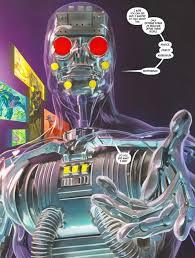
Told from the perspective of Machine Man---a sentient robot on the moon who was tasked by the Watcher to archive humanity's history of every alternate dimension in the multiverse---the story is a "what-if" story of a universe that gives Machine Man pause. It is the only one of its kind that he has found in the multiverse, and its existence has disturbing implications for the nature of good and evil. He calls it the "In-Verse", and in it, the world's mightiest heroes in every other universe are that world's mightiest anti-heroes, using their powers purely for self-aggrandizement and the subjugation of those weaker than themselves. (Any resemblance to rich, white, powerful assholes in our dimension is, of course, purely coincidental, I'm sure...)
I have a feeling (or a powerful sense of wishful thinking) that this won't be the last of the In-Verse.
Marvel has traveled to another dimension recently where the stories are no longer published by Marvel itself. Marvel Dimensions is basically two books that should have been sold separately. The first half of the book is a fantastic retrospective celebrating many of the Silver Age and Golden Age characters. Each two page spread introduces the character as described by another character. The monochromatic panels are painted in an artistic style that resembles that of the original era. Each section bursts into color in the last panel with the iconic logo for the character. But half way through the book, the mechanical man Watcher introduces the Inverse World and the book then tells a complete story about this world where the people are polar opposite from those we know and they are power hungry rulers instead. The retrospective is fantastic and would be enjoyed by Marvel enthusiasts with encyclopedic Marvel lore. It serves as a great source for those who primarily know the MCU and know little of the comic book timelines. If it was expanded and sold as a separate art book or character encyclopedia it would get my rave review. Unfortunately, I found the second half to be a lackluster story.
Any Alex Ross illustrated book is worth checking out, and this is no different. The story, writing, character development, and world were not as deep and fleshed out as they could’ve been. I think a full series on the InVerse universe would be great, but as a standalone, there is much to be desired. The art is amazing, especially the first half of the book before the art style goes more traditional (but even then it is still great, colouring too). A few of the new character designs were not overly original, but most of them were quite cool.
I’m not a huge follower of Alex Ross, but obviously I’m familiar with his work. I’ve always felt like his art works better as a calendar page, poster, or cover than it does as sequential storytelling.
Marvel Dimensions pretty much reinforces that feeling.
The book is an Elseworlds-style Marvel story told mostly through Ross’s painterly, double page spreads. Each one gives us a Silver Age-style retelling of the origin of a different Marvel hero. They look impressive, but a lot of the panels feel like stuff Ross has done before. His prose doesn’t really help either. It’s trying very hard to sound like an old Silver Age comic, but it mostly comes across as stiff and awkward.
After all of the heroes are introduced, the book suddenly switches gears and drops into a comic book that has actually been tipped into the graphic novel.
The art is inked and colored in a much more traditional comic book style, and the story introduces the Inverse, essentially evil versions of the Marvel heroes.
There isn’t much to the Inverse beyond the basic idea that they are the bad versions of the characters. They’re evil because they’re evil, with very little personality or depth. The whole thing also has a very 90s gritty for gritty sake feel to it.
And then, just as the Inverse comic starts to get going, it ends seemingly in the middle of a scene.
Dimensions then takes a jump back to the painterly Ross artwork as all of the evil-good guys come together to obtain the Ultimate Nullifier.
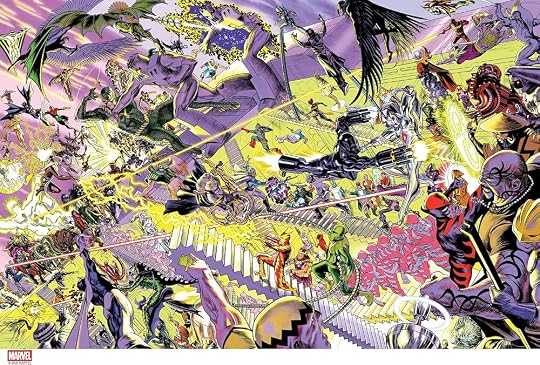
At this point, the pages become so packed and visually busy that it’s genuinely difficult to figure out what is happening. There’s a big fight, and then, wouldn't you know it, the action stops right in the middle again.
There’s a one-page denouement, and that’s basically it.
As a graphic novel, Marvel Dimensions is pretty underwhelming. The story is awkwardly constructed, the prose is stiff, the Inverse section is particularly weak, and the whole thing ends feeling less like a complete story and more like two half done ideas that got smushed together.
For $30, this is an easy pass for everyone except the most diehard Alex Ross fans.
Any graphic novel drawn by Alex Ross is a must-read for me, and in this case, he wrote it, as he also did for Fantastic Four: Full Circle. The book starts with 2-page spreads on some of the more famous Marvel heroes. He draws them in the classic Silver or Golden Age style in which the origin stories began, and chooses a monochromatic color palette, until the last panel, in which they are depicted in full color. Halfway through the book, an insert of a smaller colorful comic book is placed within, in which we are introduced to In-Verse characters. Our Marvel heroes are now slightly different, not only in name and costumes, but they are evil. That then leads us into the remainder of the book, in which a robot Watcher comments on how these In-Verse characters act when paired against each other.
This approach to storytelling was choppy and confusing. Ross delves deep into Marvel’s character vault- so unless you are a super-fan, you will not know who many of the characters (much less the doppelgangers) are. The pages were so filled with these new fighting characters that you didn't even know where to look first. Of course, you are meant to savor the pages and take your time looking at them, but still. His photorealistic art, which starts with painted pages, is unmatched. In later pages, he uses pencils and inks. His art continues to be stunning, with each character drawn with precision, and his fight scenes are kinetic and exciting.
This narrative might lead to continued storylines with these In-Verse villains, and if Ross draws it, I will continue with it; however, I hope he streamlines future stories.
Another in the increasing range of Marvel comics not actually published by Marvel (this one is from Abrams), which, alongside the recent layoffs and the general lack of excitement about most of what they are releasing, deepens the sense that all is not well in the House of Ideas. It's arguable, though, that they dodged a bullet here. Alex Ross' painted style, often using living models, makes for magnificent covers, but his interiors can be stilted, stiff figures in one epic pose after another with no sense of fluidity. And as a writer...well, there are plenty worse, but apart from anything else his Silver Age loyalism can turn sour sometimes. Initially, this seems like it's playing to his strengths, opening with an unseen watcher talking about the shared history of Marvel Earth and ours, illustrated by panels of same which would be at home in a great children's encyclopaedia, and then gorgeous vistas of the Blue Area of the Moon*. But from that we're into a too-long series of double-page spreads restating the too-familiar origins of Marvel mainstays, and just when you're wondering if that's going to be the whole damn thing, the unseen watcher reveals himself, explains the deal, and soon I was longing for more superfluous if pretty playing of the hits.
Our watcher**, you see, has found an alternate version of Marvel Earth unlike any other. Except that, even though he shows us brief Ross glimpses of various prior Marvel alternate timelines, he appears to think it's unique that this is a world where the heroes...are villains! Aaaaah. So if you've ever wanted to see Alex Ross do a made-over mirror universe Marvel (and yes, some characters do now have facial hair when they don't normally), before blowing it up again in a rushed solo precis of the usual event-concluding crossover ruck, then boy are you in luck. For the rest of us, there's an awkward sense of reading fanfic that doesn't significantly distinguish itself from the dozens of dark parallel worlds that came before. Yes, it has traces of subtext: the watcher talks about following variations of the same stories over and over, admits "I need to believe in the illusion of justice." But it's hardly Grant Morrison, is it? And I suspect there might be a teensy, very subtle hint of real-world commentary in scenes of an America under the thumb of a coterie of bickering, thin-skinned arseholes devoid of a single redeeming feature. But it's still not enough to make this feel like more than a celebrity artist's self-indulgence.
*If you don't know what the Blue Area is, you are probably not the intended readership for Marvel Dimensions. **SPOILER: It's Machine Man. But, because this is Alex Ross, obviously not the fun modern version.
As always Alex's art is very pretty. But this book is an incoherent mess of costumes and characters thrown together with no rhyme or reason, grandstanding and making heroic moments that feel empty and hollow. This is barely a narrative.
Ross' art is absolutely gorgeous as always. The book begins with beautiful spreads of the Marvel cast of characters' various origin stories. Then the book quickly becomes the most ridiculous, cheesiest thing I have possibly ever seen. And while Ross is an incredible artist, as the book went on, the pages just got louder and noiser and honestly started to physically hurt to look at. I truly don't know wtf it was even about in the end. Weird experience.
I love it when worlds collide and contrast, and mild philosophy makes its way into superhero pulp. Alex Ross has created a cute little dramatic piece and I'd love to see the idea executed in live action someday. It'd be a feast.
Only rating this at 2 stars because I loved the art work. Storyline? There really wasn't much of one. The first half of the book was introducing characters. The second half was barely a plot. Although I liked the art, there was so much going on with little description that I couldn't get into this one.
Thank you to NetGalley and the publisher for the arc.
Any Alex Ross is book will be filled with amazingly detailed and impressive artworks! Unfortunately that is largely all there is to Marvel Dimensions: A Graphic Novel. The bulk of the pages offer brief biographies and origins of major heroes and villains of the Marvel universe. They bookend a What If...? story that questions what it means to be a super powered entity and the possibilities of am multiverse.
Honestly, its hard to tell what this offers outside of great art. From the publication announcement Ross describes it as "like a combination of my most famous works... where my love of comics history and ambitious world-building collide."* Alex Ross is best known for Marvels, Kingdom Come, or, most recently, Fantastic Four: Full Circle.
The story feels like a retread of themes from Marvel Zombies about the possible ways power could corrupt or that there always seems to be a war between good and evil. And do we really need more origins stories for the Marvel Universe?
As a NetGalley reader it is possible I missed out on the bonus 32 page comic that could add a lot more to the story, but the e-version provided feels very light with the bulk of the pages already re-introducing characters I knew very well before the start of the movies in the early 2000s.
Recommended to new readers of the Marvel Universe, fans of great art or Marvel's What If...?.
*Josh Weiss. "Marvel Dimensions: Alex Ross Announces 'Sweeping tour' through the Marvel Universe.' SYFY. February 10, 2026. https://www.syfy.com/syfy-wire/alex-r... (Accessed April 20,2026)
I received a free digital version of this book via NetGalley thanks to the publisher.
My thanks to NetGalley and Abrams ComicArts for an advance copy of this graphic novel that looks at Marvel Superheroes through a different mirror, one where hope and heroics were not inspiration for being a heroes, but control and oppression, creating a world reminiscent of our own, though some still try to save it.
The idea of What If...? in comics has always interested me. Unlike many I am not a continuity well Watcher. I feel that certain things should stand, but the rest are just well myths in a way. Bad storylines, certain clone or dead Aunts can be forgotten. Maybe send a hero out on the road again wondering about his place in the world, a story told before but updated for the modern day. Alternate worlds allow this, and also allows people like myself and those who insist on continuity in all things good stories without endangering the status quo. Few have take this to heart like that comic artist Alex Ross. Ross has created works that allow characters to show their best, their worst, and all their possibilities. Dark tales, light tales, always well told, and with beautiful art. This might be his darkest tale, however, and one not easily forgotten. Marvel Dimensions: A Graphic Novel by Alex Ross features a world of heroes corrupted by the world, not striving to make it better, accepting in many ways of the worst that humanity is capable of, though there are still a few who try to make it better, or bring it all down.
The book starts in the Blue Area of the Moon, a place full of old civilizations, a breathable atmosphere, and once the home of the Uatu, the Watcher. The Watchers are an ancient race, who observe rather than interfere, telling the truth, while seeing all. Our narrator is not Uatu, but the hero known as Machine Man, Aaron Stack, or X-51. A sentient robot created for war, Machine Man has found peace on the Moon, watching the world, and also watching other universes. One in particular bothers him. A universe close to our own, but one where the heroes have been corrupted. By emotions, by governments, by baser instincts. The Fantastic Four have cursed powers. Spider-Man never learned great responsibility. The Hulk is a living bomb. However there are a few ready to stand up for something, and a cataclysmic battle awaits, with the fate of an entire Universe at stake.
This is a huge story, with lots of characters, and yet it is a short story, more a what might have been instead of a true What If...?. Alex Ross has proven to be a very good writer, as well as an exceptional artist, and this one is no different. There is a lot of sadness, as if the current world has infected the comic world. The characters are well rendered, but the ugliness of their sins show in the pages. When even Machine Man is disgusted, one knows the writing is good, and the characters are very bad. This might be a set-up to a future story, or maybe Ross is trying to exorcise some demons. Either could be true.
I liked this story, though I hated most of the characters. One knows how easy it is to turn bad. We see this everyday. Looking away as things happen to neighbors, soon to friends and family. I am not sure if this is what Ross was going for, but it really does speak of our times. A different kind of story, with amazing art, and a lot of questions. A work that I am still thinking about, and one I won't easily forget.
Reviewed based on an Netgalley ARC Marvel Dimensions introduces the "In-verse", an alternate dimension where everything is "inverted" The book is narrated by an android, who for some reason has replaced the Watcher. The first half of the book is spent introducing characters, not all of whom play a role in the story. These introductions are each narrated by someone who knows the character, but their identities are not explicitly stated. This does make it more interesting, still, so many character introductions one after the other is too much.
The actual story involves the Android narrator's anxiety over the In-Verse. There, the men and women he knows as heroes, are essentially villains. The US is ruled by super powered persons led by American Sword, an inversion of Steve Rogers. This despite the system being based on power, and Steve Rogers not being that powerful. The depiction of this dystopia, shows that the author has little experience of totalitarian regimes. A group of protestors have assembled outside the church that serves as the headquarters for the inverted avengers, this despite the willingness and capability for the super powered ruler to murder dissenters. This idea reminds me of those in real life who protest in America and claim it is a police state. The protestors, are of course massacred openly and without ceremony.
The first semblance of a story begins when Reed Richards, known here as Mr Unknowable, mentions having found evidence of a macguffin. This story line is continued as Peter Parker, known as Spider-Menace is caught breaking into the X-Land, in order to find information on the macguffin. Interestingly, Jameson still hates Spider-Menace in this dimension. I guess some things are always the same. The inverted characters have interesting redesigns, although the color black is relied on a lot (both an extra hairy Wolverine and Beast are black, making them resemble each other. All the characters have new code names, some being more successful than others, To be fair, at this point all the good comic book character names are taken by multiple characters. I wasn't able to identify the characters, and despite the pages dedicated to introducing the normal versions, I still felt like I was missing out on extra meaning from a lack of indepth background knowledge. All the inverted heroes then converge on the location of the macguffin, somewhere in the Dark Dimension. There is a twist, which despite being obvious, is skillfully done. However, what follows is mostly a chaotic battle scene with a flurry of characters. The ending and meaning of the story is then delivered by the android. He tries to make a deep point about morality, but it relies on a multiverse to make sense and seems contrived for the story. In short, the idea of the In-Verse was thought of, and then the android was given a point to make about it. I would have much preferred an actual story that appealed to universal values, not some point that is only relative in a contrived multiverse.
Also, I read this on PDF, which I can not recommend. Although my screen is big, the format is wrong and it was really a problem when the page orientation changed for a section. Other than that the art was good, with the exception of the text. It looks like someone just typed with Times New Roman over the artwork and doesn't fit the artwork.
Face front, true believers! Kurt Busiek and Alex Ross’s 1990s limited series Marvels remains a high watermark for comics, a work that proved that this is a true American art form and not just a category of juvenile pulp fiction to be dismissed by critics and naysayers. Busiek told a compelling story, lending a journalistic perspective to what a world populated with real-life superheroes might actually feel like. But it was Ross’s fully painted artwork that gave those stories a life and depth rarely seen in comics before. I’ve been a fan of both ever since, especially Ross. Getting the chance to read Marvel Dimensions, his upcoming graphic novel from Abrams ComicArts in partnership with Marvel Comics, was a genuine treat. I devoured it in a single sitting on my iPad at the car wash.
By the Hoary Hosts of Hoggoth, this review is lousy with spoilers. Consider yourself warned. ’Nuff said!
The first half of the book retells the origin stories of many familiar heroes and teams, focusing primarily on the Golden, Silver, and Bronze Age characters most beloved by fans: Namor the Sub-Mariner, Captain America, the Fantastic Four, the Hulk, Thor, Spider-Man, Iron Man, the X-Men, the Avengers, Doctor Strange, Daredevil, the Silver Surfer, the Black Panther, and Wolverine, among others. These origins are well-trodden territory and Ross doesn’t reinvent them, but his artwork carries the brief stories along with enough majesty to make them worth revisiting. For anyone new to Marvel Comics or its cinematic universe, this section functions as a gorgeous primer. All of it is narrated from the Watcher’s base on the moon, not by Uatu himself, but by Ross’s interpretation of Aaron Stack, the Machine Man, X-51.
The second half shifts to a parallel dystopian world where familiar heroes are villains and familiar villains are heroes, a concept the book dubs “The InVerse.” This territory has been covered before by both Marvel and the Distinguished Competition, and the story doesn’t do a great deal to distinguish itself from prior alternate-universe fare. The artwork here feels slightly less interesting than the first half, though I couldn’t tell you exactly why. Something about it just didn’t land quite the same way for me. Half a star comes off for this section.
What does set the InVerse apart is the sheer volume of distinct alternative character designs Ross produces for the roughly 200 heroes and villains who populate this world. That alone is a genuinely astounding creative achievement. The story is self-contained and, to my knowledge, doesn’t affect the continuity of any other Marvel timeline.
Story: 🦸🦸🦸 Artwork: 🦸🦸🦸🦸.5 Overall: 🦸🦸🦸🦸
Read this if you’re a casual fan looking to learn more about the history of Marvel’s most beloved characters (no deep cuts here, and plenty of omissions) or if you simply appreciate Alex Ross’s painted style at its best. There isn’t a lot of narrative depth, but there is plenty of beauty to appreciate.
Excelsior!
Disclaimer: I received a free advanced reader copy (ARC) from NetGalley and the publisher in exchange for an honest, unbiased review. All opinions are my own.
In addition to being a terrific painter, Alex Ross has a knack for distilling character origins and motivations into concise two-pagers. He (and Paul Dini) did this at DC, and here he brings the same precision to the first third of this hardcover graphic novel. These are the classic Marvel Age of Heroes and look like they stepped out of the 1960s.
However, unlike the DC entries, he uses them here as a prologue for Machine Man (looking nothing like his Kirby form, an oddity), who narrates from the Watcher's base of operations on the moon. It all sets up his look into another, new-to-us parallel reality. So, in essence, this is a giant, pricey, hardcover issue of What If...? In this case, with room to explore, Ross gives us the Marvel equivalent of Earth-3, where all the heroes are corrupt, evil mirror images of themselves.
After we meet many of them, we pause and read a 32-page comic Ross also wrote and drew (with color assistance from Josh Johnson) that shows them in action. Then we resume the main story as factions in this funhouse mirror world try to obtain the ultimate nullifier, which, for some reason, is no longer in Galactus' possession. There is a lot to enjoy here as we have to work at identifying who these new people are, which classic hero, mutant, or villain they are based on. While the Wasp becoming the Locust is easy, others are a real challenge for die-hard Marvel Zombies fans. It's a fun guessing game, which more than makes up for the lack of a strong reason to care about these people or this story.
Unlike massive crossovers, where there's a limited number of players and action scenes, the entire second half is all action, and Ross crams in as many figures as possible, forcing you to slow down and study the fine choreography in a way that's reminiscent of George Pérez 's work on Crisis on Infinite Earths.
Why this world? Why this story? What is so interesting to Machine Man? We don't quite get told, which is a shame.
It's imaginative and lovely to look at, but the story is underwhelming.
This was a very interesting book, and I’m still not entirely sure where I fall on it. I really enjoyed it and liked the direction the story took. However, the order of the story felt a little off, and there were sections that seemed like wasted space. I absolutely loved the art, so I didn’t necessarily mind these story elements, but they still felt somewhat forced into the book. A good portion of the first half is dedicated to retelling the origins of some of the most popular characters in the Marvel Universe. Some of these characters, such as Namor and the original Human Torch, are not even brought up again afterward. It’s always nice to get a recap of these characters and where they came from, but here it felt overdone and took up valuable space that could have been used elsewhere. The rest of the book focuses on exploring the “In-verse” and inverse, pun intended, versions of these characters and how they interact within their world. This was easily the most interesting part of the book for me, and I wish much more time had been spent developing these characters and their motivations. Cutting back on the lengthy origin recaps would have allowed the book to flesh out these mirror-image characters much more effectively. I was really intrigued by these characters and wanted a lot more than what we ultimately got. We receive a relatively brief introduction before jumping into a climactic battle, which was a lot of fun, but we never actually get to see its conclusion. It left me feeling like the most interesting part of the story was only beginning when the book ended. Overall, this was a fun and unique story, but it didn’t feel like nearly enough. I still recommend it because the artwork is absolutely amazing, and the story offers something different from what we normally get. There is a lot to enjoy here, but the pacing and use of space keep it from reaching its full potential. Grade: B-
This is a three-star review - 5 stars for the art and maybe 2 stars for the content/story.
I feel this was created to just showcase Alex Ross's art and if you're in the comic space, you know Alex Ross is one of the best artist out there (Kingdom Come, Marvels). Half of it is just origins of the famous Marvel heroes in his usual art style. Again, the art for it is just superb with 2-page spreads that reading it in a phone or computer doesn't do it justice.
The first half part feels it wanted to be the Marvel's equivalent to DC's recently released New History of the DC Universe, written by Mark Waid and tons of different artists. There's some minor connections and it seems to be in chronological order - like the first Marvel hero is the first one introduced, some other heroes being referenced in the origin pages, etc.
Then the "interlude" is in another Alex Ross art style, similar to his other Marvel Arts comic - Fantastic Four: Full Circle. This middle part shows another... Dimension, where the good superheroes are bad. I wonder if this is the bonus "32-page comic book" mentioned in the blurb, which is odd since it gives context to the latter half.
The Final Part is the continuation of the interlude and some thoughts of the narrator on good vs evil and other dimensions. This feels like the final big battle of a Marvel event, where tons of inverted heroes fight each other to pursuit the goal. It's just a bunch of people fighting in two-page spreads. Then it ended abruptly, since the narrator had seen enough. I wonder if this is supposed to be a prequel or companion book to a future Marvel event.
Those who have watched Marvel's What If...? animated series will find Marvel Dimension quite fascinating, as it begins by showing a different origin story for each superhero through a very engaging montage. The story is explained through Machine Man, a robot serving the Watcher's purpose, observing all the possibilities and variations in the multiverse. However, this one focuses on the "In-Verse," a dimension where our favourite Marvel superheroes exist on the opposite spectrum of their purpose.
We have the Avengers, Fantastic Four, X-Men, Inhumans, Defenders, and many more, but they are manipulated by their hunger for power and sheer need for dominance. These superheroes don't exist to protect the people of their Earth or universe but instead serve themselves above everything else. When the spectrum of power is reversed, the classic antagonists of Marvel become the protectors of the universe in this dimension. From the Sinister Six, Galactus, and Doctor Doom to Thanos's grand entry, Alex Ross presents a twisted universe that is both unsettling and frightening. The artwork deserves praise for how it makes the events feel larger than life and brings our beloved heroes into their cruelest forms, requiring us to redesign the way we perceive them. One look at these morally corrupted heroes is enough to tell us that they aren't there with even the slightest intention of protecting humanity.
For someone like me, who is a hardcore Marvel geek and is always curious to see how Marvel will play with its concepts and characters, Marvel Dimension provided a glimpse of a possibility that I genuinely hope gets adapted, even as a feature episode of What If...? series.
Thank you to the publisher and to NetGalley for the advanced readers copy!
Marvel Dimensions is a book I have complex feelings on - what it does well, it truly excels at. What it doesn’t do as well, sadly did not work for me.
The positives - Alex Ross’s artwork is fantastic. Incredibly detailed two page spreads recall the origin stories of many of Marvel’s finest, and demand to be put on display. These segments are very well done with simple yet effective descriptions adding a lot to the pieces. The colour choices add appropriate variation and accentuate the many dimensions and stories that these characters call home. If you like comic book art, you truly do owe it to yourself to explore what is on offer here.
The story is where I have a few qualms - once the initial introductions are done, the remainder of the book tells the story of the Inverse, an opposite version of the Marvel universe. Some questions are asked on what would happen if many of these characters had different experiences, however this is all stuff we have seen before. In an era defined by the multiverse story, the idea of our heroes being bad isn’t revolutionary, and has been executed in more depth in other places.
The story is still fun to read, but a little disjointed and heavily carried by the artwork. If this had been longer and had more time to develop its own unique plot, I definitely would have rated it higher.
This entire review has been hidden because of spoilers.
When you see an Alex Ross cover on the shelf you IMMEDIATELY know it's Alex Ross. This graphic novel is no different.
The first third of the book plays out like flipping through a Rolodex of the Marvel Universe. We see the heavy hitters (Spider-Man, the Hulk, Iron Man, etc) drawn in the signature Ross style.
While the art is consistently breathtaking, this section did feel a bit long for my tastes. It’s a gorgeous "greatest hits" reel, but I found myself waiting for the narrative hook to sink in. However, the Phoenix was an absolute standout for me. A beautiful two page splash. Iconic.
Around the halfway mark, the book takes a turn. Our narrator (no spoilers but it was a cool reveal) pulls back the curtain on a new reality: an alternate Earth, "In-Verse."
This is where the book shifts gears from a greatest hits display to a narrative arc through an alternative world.
Once we begin exploring this new world, the narrative feels a bit paint by numbers. Despite the high-concept setup of the In-Verse, the plot beats follow a fairly predictable path for an alternate-reality story. Enjoyable even if nothing particularly Earth-shattering.
Rating: 3.5 / 5 Stars
Thank you to NetGalley, Alex Ross and Abrams ComicArts for the ARC.
Abrams ComicsArt provided an early galley for review.
My first exposure to Ross' beautiful painted work was in Marvels. So, this was a nice, fitting way to revisit that in an all-new book.
This book will definitely be best enjoyed in a printed format as so much of the art is done in double-page spreads. The first half presents profiles of so many characters, recapping their origins and histories through (what I calculate) to be around the mid-1970's or so. This includes reinterpretations of classic panels and covers by Ross. I had fun trying to guess who the narrators were of each vignette.
The second half shifts to a place called "the In-Verse", a What If kind of reality where everything you ever knew about the Marvel Universe is spun on its axis. It is a big blow-out of combatants and confrontations. It reminded me a bit of another Marvel project Ross did - Earth X. Because this is some place new with so little tied to the Marvel Universe I grew up on, this part of the story left me feeling a little distant and uncaring about the end results. For me, the magic of shared universes like Marvel or DC is the long relationship I have built to it thanks to its sprawling continuity.
Alex Ross is one of those artists whose work makes you stop and stare at a page for minutes at a time, and Marvel Dimensions is packed with those moments. The painted artwork is absolutely stunning as Spider-Man, the Hulk, Iron Man, Wolverine and more rendered in that photorealistic style that made Marvels and Kingdom Come legendary. Every double-page spread feels poster-worthy.
What surprised me most was that this isn't just an art book or a greatest-hits tour of Marvel history. It opens with a confident, sweeping retelling of classic origins, but the tone gradually shifts into something stranger and more ambitious with storylines twisting in on themselves, characters behaving unexpectedly, a narrator who turns out to be less reliable than he seems. Ross is clearly trying something well beyond simply showcasing gorgeous paintings and mostly pulls it off. The story didn't always land as hard as the visuals for me, but the combination of breathtaking art, Marvel history, and an increasingly unexpected plot made this a very enjoyable read.
If you love Alex Ross or simply want to see Marvel's heroes presented at their most iconic and mythic, this is well worth your time. Beautiful, ambitious, and unlike anything else on the shelf.
From the original What If...? comics to the classic Age of Apocalypse crossover and even fully developed extended series like Exiles, Marvel has produced some of its most fun and creative work over the years by exploring 616's many alternative universes. Out of all of these stories and series, Alex Ross's extended Earth X / Universe X / Paradise X collaborations with Jim Krueger and John Paul Leon may be my favorite. While by no means flawless, everything about those three miniseries came together beautifully, making a success out of what could and probably should have been seen as an overly earnest effort to transcend the one superhero sub-genre that can't help but feel like fan-fiction.
Years later, how does Ross's own Marvel Dimensions hold up? Well, the art is truly phenomenal, as always. At the same time, the unbelievably extended character-by-character introductions in the first half of the book really test the reader's patience, and, even worse, they ultimately only serve as padding to what proves to be a short, simplistic, and truly underdeveloped exploration of how rivalry and antagonism can shape foils. Krueger is deeply missed here, but, if you're a fan of Ross, you should pick it up for the artwork.
First off, this is a new work by Alex Ross, so for a certain segment of comic fans it is an automatic Day 1 purchase. To those fans, I say you will not be disappointed, and to other prospective readers, I say give this one a chance. Ross's artwork is as amazing as always throughout the book, and he even shows more variety in his styles than is typical in Marvel Dimensions.
An aspect that is overlooked about Ross is that he is an excellent storyteller as well. Dimensions is divided into two sections. The first is an overview of the most prominent heroes and teams in the Marvel Universe. This section is basically the version of the Marvel Handbook that I have always wanted to read. The second section is more of a story and is about the In-Verse, a dimension where the Marvel heroes are evil villains. This section is good but would have been better served if it had more pages to expand the storyline. This storyline had the potential to be massive, but there just weren't enough pages dedicated to it.
What Works: This is simple; Alex Ross's artwork is phenomenal, as expected. What Doesn’t: I wish it was longer. Final Thoughts: Highly recommended for all comic fans. Alex Ross's storytelling and artwork shine in this book! Rating: 4 out of 5 Moonbases
In Marvel Dimensions, Alex Ross takes on the role of both writer and artist. He handles both tasks admirably. Marvel Dimensions opens with two page origin stories for various classic Marvel characters. Each is narrated by a different character. Afterwards, it shifts into the story. The story that follows is an epic look at a Marvel Universe that could be. Let’s get the artwork out of the way first. Is Alex Ross. The art is fantastic. He switches between painted and pencils and inks. This causes a different feel to some of the panels. The designs he comes up with for characters leaves me wanting to see more of some of them. As for the story, it was good. It kept my interest. I was looking forward to seeing more of the redesigns. If there was any downside to the story, it was the character histories at the beginning. There were just so many in a row. I began to hear myself thinking, “another one??” Maybe if he had broken them up a bit. Did a few, have some story, a few more, more story. In all, of you come just for the artwork, you won’t be disappointed. The story is a nice bonus. Enjoy.
Review of ARC from NetGallery. Reviews and opinions are my own.
The art work in this book is absolutely phenomenal, Alex Ross really knocked it out of the park. The first third of the book was a history into many of Marvel's most iconic heroes. The panels in this section were drawn beautifully, but did end up feeling a bit long. With this being a digital copy, I don't think I got the double page spread that this would obviously look like in a physical copy.
The rest of the book took us through a large universal What If... like storyline. I actually enjoyed the story which basically showed us a reversal of good and evil. I particularly enjoyed trying to figure out which character was which, however in some circumstances it wasn't exactly immediately clear so could understand if others find the way this is presented a bit frustrating. The dialog for this section of the book felt a bit rigid, but was overall a quick read.
If you're a fan of Alex Ross's art, that's basically what this book is a showcase of. It's probably not a book I usually would have picked up on my own, but overall had fun reading this.
This entire review has been hidden because of spoilers.
Review of ARC from NetGallery. Reviews and opinions are my own.
The art work in this book is absolutely phenomenal, Alex Ross really knocked it out of the park. The first third of the book was a history into many of Marvel's most iconic heroes. The panels in this section were drawn beautifully, but did end up feeling a bit long. With this being a digital copy, I don't think I got the double page spread that this would obviously look like in a physical copy.
The rest of the book took us through a large universal What If... like storyline. I actually enjoyed the story which basically showed us a reversal of good and evil. I particularly enjoyed trying to figure out which character was which, however in some circumstances it wasn't exactly immediately clear so could understand if others find the way this is presented a bit frustrating. The dialog for this section of the book felt a bit rigid, but was overall a quick read.
If you're a fan of Alex Ross's art, that's basically what this book is a showcase of. It's probably not a book I usually would have picked up on my own, but overall had fun reading this.