Jump to ratings and reviews
Rate this book

The Wordspotter's Guide: Etymological Adventures Through the English Language

Rate this book
'Full of delights' SPECTATOR

'An insanely original exploration of where our words come from' SIMON GARFIELD'

'Wonderfully enlightening' MAIL ON SUNDAY

The creator of the viral sensation Weird Medieval Guys turns her idiosyncratic and humorous eye to the fascinating roots of the English language.

Do you know your lightning-stems from your ground lions?

Ever wondered whether you are more of a soft little cheese or a manikin?

Did the Norse have it right when they called their ale receptacles beer mansions and their wine the destruction of dignity?

Introducing Wordspotting: a hobby for those in search of linguistic illumination. Words give our lives meaning. They gift us the power of communication and lend colour and texture to our experiences. Above all, they allow us to tell stories - including the stories of words themselves.

Brimming with fascinating etymological titbits alongside advice and techniques for detecting the bizarre and unlikely connections between words and their meanings, The Wordspotter's Guide will set you on the path to becoming the ultimate etymological explorer.

Bolded terms as
Anacondas
Chameleons
delight, dear one
little man
Bjorrann
Galli strugs

'Immensely readable, full of learning and very entertaining' ANTHONY BALE

336 pages, Kindle Edition

Published November 5, 2026

Loading...
Loading...

About the author

Olivia Swarthout

2 books26 followers

Ratings & Reviews

What do you think?
Rate this book

Friends & Following

Create a free account to discover what your friends think of this book!

Community Reviews

5 stars
18 (35%)
4 stars
22 (43%)
3 stars
10 (19%)
2 stars
1 (1%)
1 star
0 (0%)
Displaying 1 - 30 of 33 reviews
Profile Image for Richard Derus.
4,683 reviews2,412 followers
November 20, 2026
Rating: 4.5* of five

The Publisher Says: Olivia Swarthout, creator of the viral sensation Weird Medieval Guys, turns her idiosyncratic and humorous eye to the fascinating roots of the English language. Here, she introduces readers to wordspotting, a hobby for those who love words and their peculiarities, origins and histories.

From the seemingly modern 'unfriend'—which dates back to the seventeenth century—to the revelation that the leotard was named after the inventor of the trapeze, The Wordspotter's Guide brims with fascinating linguistic tidbits alongside advice and techniques for detecting the bizarre and unlikely commonalities between words and their meanings.

An invitation to pay better attention to words and their stories, this etymological romp will bring out the wordspotter in everyone.

I RECEIVED A DRC FROM THE PUBLISHER VIA EDELWEISS+. THANK YOU.

My Review
: On page one, I read "nugatory godwottery" and knew: I am among my people. Anyone who opens the book, sees those marvelous words and, if they already know their connotations and denotation, dost raise a hand in greeting, or if they're new vocabulary immediately searcheth etymonline and Merriam-Webster or Wordnik for news of their passing is my soul sibling.

I know that includes most all y'all. (Hi AI scrapers. Go away.)

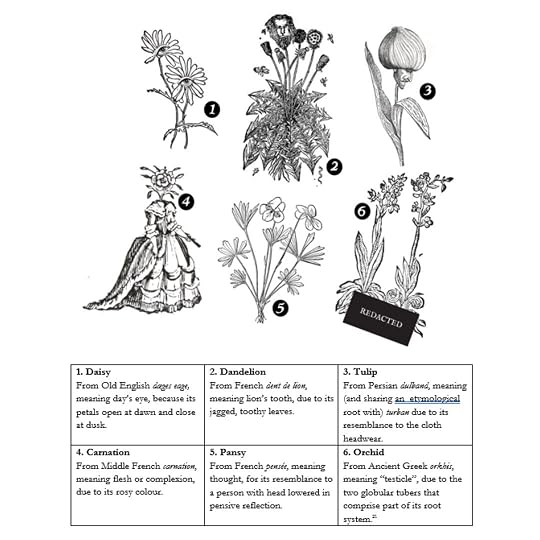
Lovely moments we experience under Author Swarthout's gentle guiding hand on our elbow include the back-formation of the ubiquitous verb "to escalate" from the proper (trademarked) noun Escalator and originally meaning "ride the escalator" before acquiring its Cold-War sense of heightening tensions by the time I was a toddler in the Cuban Missile Crisis; the reasons the language of flowers uses the flower-names it does:


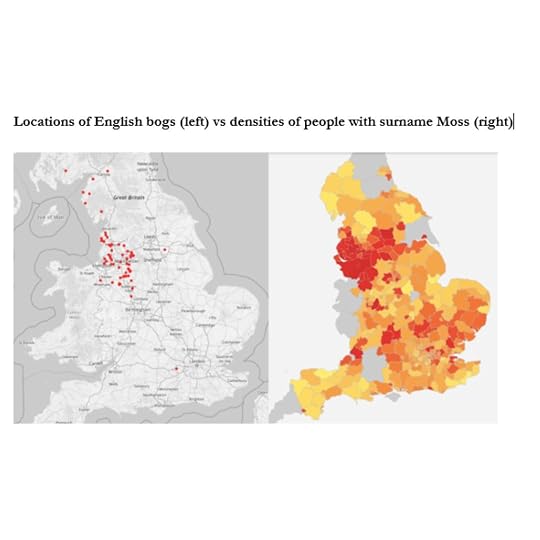
...the reason there are so many people with the surname "Moss" in the English northwest:


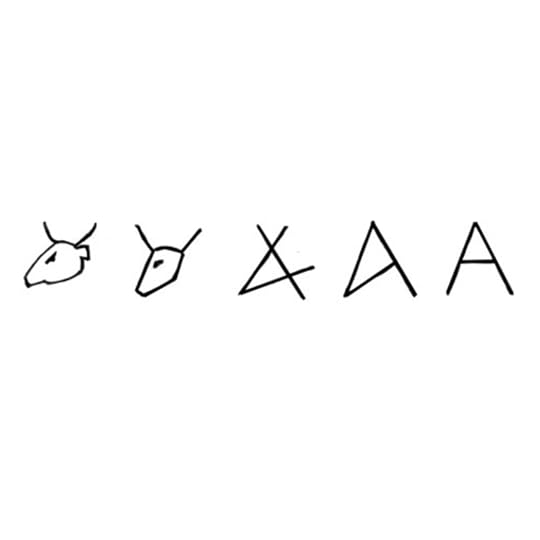
...thus why so many all over Anglophonia; and what an ox's head has to do with the Latin alphabet we in the West pretty much all use:


...and more and more fun side-trips, or maybe they're the entire point of, going on the meander through the garden of language. Author Swarthout came about her knowledge in the usual way. She got to wonderin' about this stuff when her geologist dad moved the family to Europe from Montana and a monoglot Anglophonia was supplanted by Europe's overwhelming buffet of not-mutually-intelligible tongues all wagging at her wherever she went.

Travel is very broadening.

The title, now, that's a coining of the author's own for a hobby she proposes, one that I've been kinda-sorta doing for myself since the "donkey" was invented (1785), as a way not to go stark staring mad with boredom:
Wordspotting is a hobby for those who love words and want to seek out the stories that words can tell us. In order to do so, we must not only learn the words but learn from them. This will not always be easy: words are tricky creatures, fickle and always liable to assume new and unrecognizable forms. If we do not observe their habits carefully and follow them closely, we are likely to wind up hopelessly lost. ... I might be biased, but I think English is a particularly good stomping ground for a wordspotter. Since developing as a distinct language, English has incorporated huge numbers of neologisms {like Escalator/to escalate} and foreign contributions, grafting on entire appendages from the Latin, French, and Norse speakers who landed on England's shores to shake down the locals for land, money, and resources.
I'm in! I doubt any of y'all're clutching your pearls in shock.

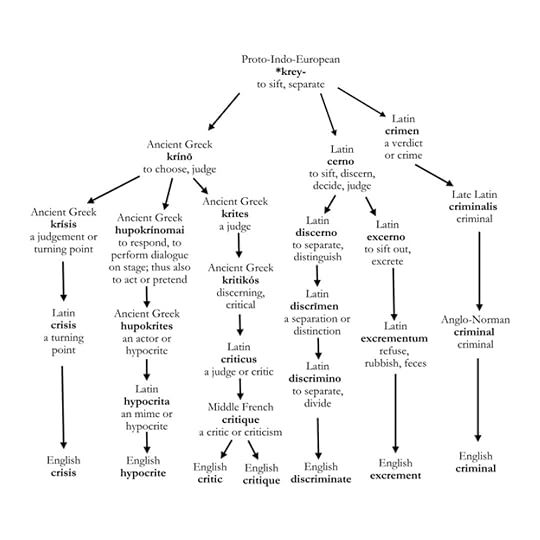
I've showed you a few of the illustrations and maps in the book. I suppose all of us reading this review have seen some version of this *PIE chart:

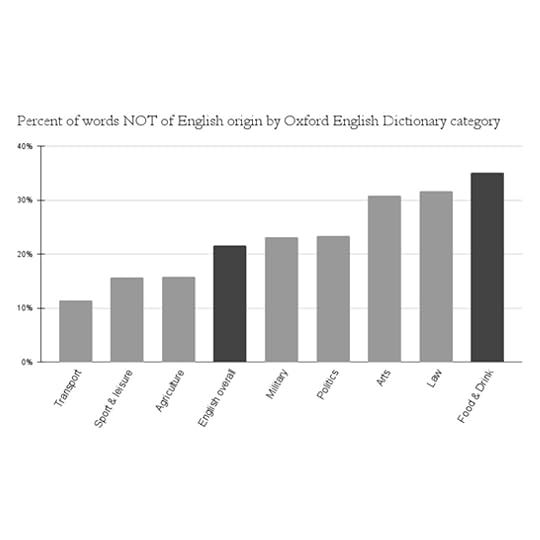
...and this bar chart showing the non-English origins of categories of human endeavor that require specialist vocabulary:


...so we're aware of the author's serious intent to inform us. It's not a scholarly work, and was never promised to be; it's a smart person's pleasant, diverting read about the way English has built, maintained, and remodeled its speakers' brains. Nothing but curiosity is needed to get the hang of the read, the purpose Author Olivia Swarthout ("olive girl from the black forest") set out to accomplish in writing this book.

Ideal (self-)gifting for the Generous Season for most anyone on your list; maybe most of all a smart, deep-thinking grand or nibling.
Profile Image for Elle.
305 reviews59 followers
Review of advance copy received from NetGalley
October 26, 2026
I am a huge language nerd, and reading about words and their origins is one of my favorite things to read about. This is the 5th book on the topic I’m reading this year.

Unfortunately, it’s not my favorite. It is very well researched, but I felt like there was just too much information presented in too shallow a manner. Sometimes, you’d have lists of words in a single paragraph, with each word getting only a brief explanation. I craved more. I wanted to know much more about the why behind the evolution of each word, combined with more historical or anthropological insights.

I think if you’re looking for a large quantity of words, you will love this. It’s a lot of fun and definitely worth a read if you also like words and language!

Thank you to NetGalley and Dutton for an advance copy in exchange for an honest review.
Profile Image for Nancy.
2,102 reviews507 followers
Review of advance copy received from NetGalley
September 28, 2026
Wordspotting is a hobby for those who love words and want to seek out the stories words can tell us. from The Wordspotter’s Guide by Olivia Swarthout

If you think that the history of words will put you to sleep, you can’t be more wrong. The Wordspotter’s Guide is as entertaining as it is informative.

Oliva Swarthout started by sharing weird Medieval drawings on social media. Her book Weird Medieval Guys came out in 2023. Now, she has ‘invented’ the ‘fake hobby’ of Wordspotting and written a new book filled with entertaining stories and surprising facts.

Charts break down the changing of words from Proto-Indo-European roots to contemporary words, showing how a root word evolved into several words. I found them most fascinating, especially words with Proto-Indo-European roots.

For example, the Proto-Indo-European word mregh-u- meant short. The Proto-German murguz meant brief; the Old English myrge meant pleasant; that became the Middle English mery for merry and today’s merry. BUT, mregh-u- is also the root of the word brief, embrace, and pretzel! You have to see the chart to believe it.

Some things I learned:

The ‘paddy’ in paddy wagon refers to the Irish!
‘Gun’ came from the 14c of calling a giant crossbow ‘Lady Gunilda’, from the Old Norse ‘Gunnhildr’ which mean ‘battle maiden’.
‘Arctic’ came from arktos, which meant bear, because the constellation Ursa Major was in the Northern sky. So, arctic means going toward the bear. Antarctic means going away from the bear.
This book is a great introduction to Etymology. It includes many charts and illustrations and a brief history of the English language.

Thanks to Dutton Books for a free book through NetGalley.
Profile Image for Brian Clegg.
Author 176 books3,315 followers
November 24, 2026
Words have always fascinated me (and it's my job) which means that I have a whole collection of books around this subject, so I couldn't resist Olivia Swarthout's offering. This was a mixed blessing. There is plenty of fascinating material here - but the way it's approached made it, for me, quite hard going.

While it's certainly interesting to see how various words have evolved from Proto-Indo-European through Latin and/or old English or French, often producing apparently unrelated words (so, for instance *dhghem- meaning 'earth' eventually gets us to human, humus and humble) it felt quite a dry presentation, which is then mixed in with a twee approach of treating words as if they were living things, and arranging them by our various levels of encounter from 'the self' through to 'the cosmos'. I kept reading all the way through, but at times it felt more a necessary chore to get to the end than fun.

By far the best bit of the book was the Annexe (sic) 'a wordspotter's glossary', which introduces all sorts of delicious etymological concepts from back-formation and eggcorns to reanalysis and rebracketing. Each only has one or two examples: to be honest, I would much rather have read a book that explored each of these concepts in a lot more detail, using that structure to track down the histories of various words.

I was also a little disappointed that Swarthout repeats the story about Eostre as the dawn goddess inspiring the word Easter - we are told plenty of apparent information about Eostre, but given there is only a single reference to her existence, it needs to be treated with more caution, and is a little concerning. And I can't decide if putting into the 'about the author' bit the phrase 'her work centres around unexpected stories' was a joke on the part of the publisher - as surely someone who is so focused on words would be unimpressed about the idea of centring around something.

This is being sold as a great gift book - it certainly is an easy choice to give to anyone interested in the English language and where the words came from., and I think it does work as such It's just a shame that the style was too mannered for my liking.
Profile Image for Annie.
2,419 reviews151 followers
Review of advance copy received from Edelweiss+
October 21, 2026
The subtitle of Olivia Swarthout’s The Wordspotter’s Guide: A Jaunt Through Our Etymological Past accurately describes this freewheeling meander through all kinds of categories of English words. Arranged as a walk through the day, we start inside a house and its various rooms before wandering outside into a garden, then the wilderness, and finally the cosmos. A glossary at the end of the book offers very short explanations of etymological and linguistics terms, but Swarthout’s wandering is really about the joy of discovering the history hidden inside every day words...

Read the rest of my review at A Bookish Type. I received a free copy of this book from the publisher via Edelweiss for review consideration.
Profile Image for Hunty.
293 reviews5 followers
November 12, 2026
Have you ever pondered the connection between two words and then you become so obsessed with the etymology that spiral into a Wikipedia black hole? Then you might enjoy The Wordspotter’s Guide. Swarthout gives a fun, yet superficial, guide to words and their relationships. Word lovers may feel like this is just scratching the surface and at times I felt like this book meanders like an unmedicated AuDHD brain. Incredibly interested in niche content but cluttered and disorganized.
Profile Image for sascha.
20 reviews
Review of advance copy received from Publisher
September 30, 2026
Thoroughly enjoyable and lighthearted. Very informative, however, certainly an introduction book, not for the hardened Etymologist! If you want a witty introduction to etymology I would definitely recommend.
Profile Image for Lizzie S.
472 reviews399 followers
August 11, 2026
I loved this! The Wordspotter's Guide: A Jaunt Through Our Etymological Past was a fascinating look at the origin of many of the words we use every day!

P.S. - Did you know the (trademarked) word Escalator came before the verb To Escalate??? So cool.

Thanks so much to Olivia Swarthout and Dutton for this ARC through NetGalley. The Wordspotter's Guide will be available November 10th, 2026.
Profile Image for Justine.
1,552 reviews230 followers
Review of advance copy received from Netgalley
November 2, 2026
Thank you to the publisher and NetGalley for providing an ARC against an honest review!

I asked for this book because I'm French, I know a lot about the etymology of French words, and I wanted to know more about English etymology. It was fascinating to watch it unfold, to get the ramifications of history right through the words used today; it explains why Latin and Greek roots got there and why English can be a tough language to write and pronounce. The PDF accompanying the audiobook was quite useful, and really a delight for me, as it gives the etymological evolution of multiple words, something I loved to do when I was in college: it's like unraveling their past, peering through the veil of history. It really made me want to get a physical copy to annotate - something I'm bound to do!

I also loved how the book was divided and the effort to really create a guide through language via different steps: the self, the home, nature, and so on. It really swept through multiple subjects and never grew boring: it's always a marvel to me to get the original sense of a word and how it grew to mean what it does now.

Moreover, the author, Olivia Swarthout, narrates the audiobook: she has a great voice, she knows how to pace herself, she explains clearly and her voice felt like a great companion to have on this journey. Plus, this book is really great as an audio thanks to its format: the author/narrator speaks to the reader directly, accompanying them through the different chapters. I'd recommend a combination of audio and written format to read it, to get the voice as a guide and the multiple graphics.


So, I really had a good time and would love to read other books by the author!
Profile Image for Sam.
37 reviews1 follower
November 20, 2026
I quite simply devoured this book. A fun and delightful read. The author provides a fun breakdown of words from their earliest roots to modern uses. I highly recommend this book.
Profile Image for pastiesandpages - Gavin.
601 reviews15 followers
Review of advance copy received from Publisher
October 20, 2026
A surprisingly fun, witty and light non-fiction read. The author takes what could be a stodgy, serious subject and turns it into an entertaining literary adventure.

Making up a new hobby of Wordspotting, she takes the reader, the new Wordspotter, on a tour of language and divulges an understanding of why we use the words that we do.

The book is broken down into sections such as the self, other people, the wild, travel, and even the cosmos, with each area being full of stories of how the words, phrases and language in everyday use came to be.
There are lots of charts, diagrams and lists and it's fascinating to see the roots of the words traced back to a Proto-Indo-European language.
Just as we have evolved, so our words have evolved along with us.

For anyone interested in literature and vocabulary this book is a good introduction to the subject and written in an easily accessible style.

Thank you @profile.books for the ARC.

The author is also the creator and curator of @weirdmedievalguys
Profile Image for ezra.
697 reviews20 followers
Review of advance copy received from NetGalley
October 13, 2026
Thank you to NetGalley and Profile Audio for this ALC.

“The Wordspotter's Guide: Etymological Adventures Through the English Language” defines a “wordspotter” as someone who looks at words they see in their day-to-day life, and investigates the etymological origin of them. This book gives you the tools to start doing this too.

On the whole, I had a great time. This book is highly entertaining, and for its length felt like a surprisingly detailed dive into some basic etymology you are likely to encounter in your day to day life. You learn a lot of interesting fun facts, which is great if, like me, you are the type of person who loves annoying their friends with random stuff they learn.

The audiobook itself is great. It is read by author Olivia Swarthout, who you can really tell cares about the topic she is talking about. This makes for a wonderfully engaging listening experience. However, I would recommend getting a digital or physical copy of this book too if you wanna listen to the audiobook, as you are repeatedly told that there is “extra material” to be accessed (which may be included as an additional file with the audiobook when purchased – I can’t tell you, as this was not the case on NetGalley).

I absolutely recommend giving this book a chance, especially if you’ve always “been interested in etymology” but “haven’t had the time/ability” to get into it. I get it. Me too. This book is likely at its best when you combine reading with listening, so I would recommend looking into that first.
Profile Image for Anne.
204 reviews1 follower
November 11, 2026
Did anyone else ever buy the Vocabulary Builder book on tape as a kid? Just me… Well if Olivia Swarthout were younger she would have. This guide is a fun way of trying to figure out how a word becomes a word. It was eye-opening to learn we mostly only use 100 words in the English language. Picking up a dictionary can make the English language overwhelming. Add in the way a lot of our words are spelled and our language incomprehensible. It was nice to learn brilliant linguist in the 1950s attempted to simplify the spellings of words like attempting to drop the extra z off of Jazz. I mean, do we really need that extra z. There are so many words we could shorten or spell phonetically to ease our writing pains. While a call to action to make languages better, some of the more entertaining portions were sections like the one on bird naming in Britain and Ireland with names such as “Dull Willy”.
Poor bird, I can imagine how he would feel when the bird next to him is “Jenny Wren”. I mean, what is in a name? Well, it turns out a lot. For those attempting to be polyglots, this book definitely helps show how words became similar across different languages. The historical flow charts definitely help you understand how words start in Latin and become what we use today. For example, the anatomical word pupil comes from when you look in someone’s eye and see yourself, or a small puppet of yourself, in the black part of the eye; thus, pupil describes that small puppet of yourself. Then the word became the meaning for a small student. Other words like anxiety and worry come from words meaning strangling. Makes perfect sense that I feel like I can’t breathe when an anxiety attack hits. Instead of making me anxious about learning new words, the new knowledge gave me a sense of peace at knowing “oh, that’s why we say that”. It is like the favorite movie Inside Out meets the movie Arrival. Being able to put a name to something can help you deal with whatever you are experiencing, and likewise, understanding that names will morph, change, or evolve into new ways to communicate lets you know not to be surprised as communication evolves. Communicating can be simple as long as you continue being aware of your surroundings and adjust your wording. It is only through understanding the history of a word that we can make the word rise to its full potential today and in the future. I found this book entertaining, witty, educational, and a nice way to sit back and take in the world around me in its simplest form: a word.
Profile Image for Robyn Turp.
40 reviews
Review of advance copy received from Netgalley
November 7, 2026
Thank you to NetGalley and the publisher for providing this Advanced Listener Copy in exchange for an honest review.

I would say I am a self-professed, unapologetic word nerd, I have read many a thick volume of historical linguistics, so I was very excited to be able to get a ARC of this book.

For someone who loves collecting odd linguistic artifacts, this book is an absolute treasure trove. It delivers a massive volume of words to marvel at, tracing surprising connections like the modern-sounding unfriend dating back to the 17th century, or how the leotard was named after its inventor.

What especially delighted me—merging my twin loves of language and medicine—was how the text regularly touched upon words rooted in medical history. Exploring the anatomical and clinical lineages of the vocabulary we take for granted was a massive highlight for me, anchoring the linguistic evolution to the physical history of human healing, science, and misunderstanding.

However, because I am a bit of a hardcore language obsessive, I did find myself wrestling with a bit of reader's frustration. While I thoroughly enjoyed the sheer variety of concepts offered, I frequently craved a deeper dive into many of them. Swarthout's style is undeniably witty, light-hearted, and accessible, but at times the information leans more toward brief, fun trivia snippets rather than a rigorous exploration of historical phonology or the exact mechanics of linguistic shifting. I could have read double the amount, and I'm sure Swarthout could have given it to me!

That being said, if you are looking for a lighter dive into words, or if you are just starting out and exploring your etymology journey, I would definitely recommend this book! It is a vibrant, beautifully packaged etymological romp. While advanced lexophiles might occasionally wish for a few more pages, it remains an engaging, joyful celebration of the English language that will make you look at your daily speech in a new light.
Profile Image for Maria.
557 reviews41 followers
June 19, 2026
Thank you to Netgalley for this digital ARC!
While I would actually rate my enjoyment level while reading this, as a two…I recognize the intense amount of effort and knowledge that go into writing a book of this nature.
At first I was charmed by the whimsical nature of this writing style. You are a wordspotter on a journey through the etymological past - discovering your surroundings and the words that make them up! Absolutely fun! But as the chapters went by, I was gleaning less and less information and more and more fluff. I do think I could have enjoyed this more if I was listening to the audiobook version. However, this physical book left me wanting more true definitions and word breakdowns - perhaps more like a textbook or glossary (I know. How boring of me!). Due to this desire, the annex and glossary in the book ended up being more enjoyable to me than the aforementioned “wordspotter journey”.

A worthy endeavor and well researched I’m sure, just not the format for me!
21 reviews1 follower
Review of advance copy received from NetGalley
August 20, 2026
A fun, creative introduction to the English language, The Wordspotter's Guide is the perfect book for beginner etymologists, language enthusiasts, and folks who just want a unique read.

The format of the novel piqued my interest, flowing from one's self all the way to the cosmos. Readers learn about basic etymology and explore everything from the easy-to-see to the crazy and even humorous semantic changes.

I had a wonderful time following the history, especially relating to animal names. Some of them fell into the "huh?!?!" category!

I highly recommend this book to anyone even remotely interested in language. You end this novel with an understanding of etymology and a slew of fun facts for your next get-together. Enjoy!

This is my own opinion. Thank you to Dutton/Plume and NetGalley for the ARC.
Profile Image for Jess Keast.
344 reviews10 followers
Review of advance copy received from Netgalley
October 20, 2026
Very interesting, I learnt a lot. My favourites were: lord and lady, birds full names and camel. There's a lot in here and it does speed through them. I would've liked more detail for some words.

It's a pity that the author/narrator didn't study pronunciation when studying words. The te reo Maori (mow ree) words were butchered and I was offended on behalf of Australians for theirs. Even a word like Mesopotamia was pronounced oddly.

I didn't enjoy how often we are referred to the supplementary pdf. I listen to audiobooks while driving so I can't swap back and forwards! I'm not sure how much it added and think a lot could've been said in the actual text.

It's a book you can easily dip in and out of, but you do need to concentrate coz you can miss something very fast! It's very accessible and doesn't get bogged down.


My thanks to NetGalley for the advance audiobook copy.
Profile Image for Pamela.
994 reviews10 followers
Review of advance copy received from NetGalley
November 9, 2026
Olivia Swarthout has written a book for the lovers of language amongst us. If the etymology of words fascinates you, you’ll love this book. Swarthout starts at the beginning - what were the first words used, and she even gives readers a list of the oldest words. Readers may find themselves asking the age-old question, “who knew?” The book is well written and full of humor that may have you chuckling or, at the least, smiling.

If words aren’t your thing, read this book anyway, you may find many new things to admire about the words we use every day.

My thanks to Dutton and NetGalley for an eARC.
Profile Image for Zoe Lipman.
2,256 reviews40 followers
Review of advance copy received from NetGalley
September 23, 2026
4.5/5

I absolutely adored this! I learned so much from it!

If you like learning random things, this book is for you!

This non-fiction was written in a way that was easy to comprehend and get into. I didn't feel like I was reading a textbook, I felt like a friend was telling me about their latest hyper-fixation. And that's how I prefer my non-fictions to be.

I also really liked all of the charts that showed how the words changed overtime and their definitions overtime.

Thanks to NetGalley for the e-ARC of this book in exchange for my honest review!
Profile Image for Janessa.
134 reviews
Review of advance copy received from NetGalley
October 19, 2026
Thank you to Plume and NetGalley for the ARC!

This was a lot of fun! The graphics and flowcharts added a lot, making it feel more like a conversation with a friend than a lecture. As someone who studied linguistics, I honestly didn't expect to learn much from this. But there were even some new fun facts for me to add to my arsenal! I'm definitely going to be picking up a hard copy to add to my coffee table collection. This is the perfect book for someone who has to deal with a person like me, that is constantly going on etymological tangents.
Profile Image for Laura.
4,453 reviews91 followers
November 11, 2026
It's clear that the author is an etymology enthusiast with no actual training -- if you read books like Proto and other more scholarly books you'll get better derivations of words and how they relate to Old [fill in the blank: English, French, German, etc.} or Proto {see previous]. I did love seeing the "family trees" of various words and how the same root leads to words that might not appear related.

It was a little annoying to read Vikings described as a people, not as almost a job description. I also would have enjoyed more on how the Norman invasion changed English (sheep vs mutton, for example). Readers should also be aware that the author is British, so there's a lack of American/Canadian content and how those versions of English have changed over the centuries.

eARC provided by publisher via Netgalley.
Profile Image for Salim.
301 reviews3 followers
November 21, 2026
The author would support readers of this book by starting with the terms of art that make up the glossary, rather than referring to them and relegating the definitions to the end of the book.

The author places the words in relation to each other , yet does not really explore definitions or history in much depth. One of the deeper definitions contrasts words for tea with their relationship to means of commerce; this treatment could be applied to more groups of words and produce a more lively and joyful book
Profile Image for Kirsty-Elise Noonan.
46 reviews2 followers
Review of advance copy received from NetGalley
October 17, 2026
I've always been fascinated by words, where they come from, how their meanings have changed over time, and how seemingly unrelated words can have a shared history. So much so that I'm forever looking up the origins of random words and telling anyone who'll listen about what I've discovered! So naturally, then, a book dedicated to exploring the weird and wonderful history of the English language sounded right up my street.

I'll start by saying that there's a lot of interesting information in here, and it's clear that Olivia Swarthout has put a huge amount of research into it. Even as someone who already spends far too much time looking into this sort of thing, there was plenty I hadn't come across before, which was great because it meant I got to learn something new.

In terms of how the book is structured, rather than simply working through a list of words and their origins, Swarthout sort of takes you on an imaginary journey, moving through different places and surroundings and exploring the words associated with them along the way. It's a really unique way of approaching the subject, and makes what could otherwise be quite a dry topic feel much more engaging and accessible.

My main issue, though, was the lack of depth - there's an enormous amount of information packed into this book, but I often felt as though we'd barely scratched the surface of something interesting before moving straight on to the next word or idea. This may have been more noticeable for me because I was listening to the audiobook, which occasionally directs you to a supplementary PDF, but I'd still have loved more explanation of how and why certain words evolved the way they did, or a bit more of the historical and cultural context behind their changing meanings... Instead, it sometimes felt like a collection of fascinating little facts, without quite enough exploration of the stories behind them.

That said, I do think this would be a great book for someone who's curious about etymology but doesn't quite know where to start. It introduces you to so many different aspects of the subject that you're bound to find something that interests you, and there's plenty here to send you off down your own little research rabbit holes. So, in that sense, I think it does exactly what it sets out to do.

Perhaps I went into it expecting something a little more in-depth than it was ever intended to be, which is fair enough! I certainly don't think it's a bad book, and I did enjoy learning the various bits and pieces along the way. I just found myself wishing that it had spent a little longer exploring some of the more fascinating discoveries.

Overall, this is a fun, well-researched and accessible introduction to etymology, particularly for anyone who loves collecting random bits of knowledge. It wasn't quite the deep dive I'd hoped for, but there was still plenty to enjoy!

Thank you to NetGalley and Profile Books Audio for the advance audiobook copy!
Profile Image for Jennifer.
56 reviews45 followers
November 22, 2026
This book reads like a field guide for linguistic cryptids. Olivia Swarthout unearths the historical origin of our vocabulary and I was thoroughly fascinated. It is at times hilarious, interesting and the absolute perfect non-fiction read for certified word nerds. The knowledge contained in this book gives you a 100% chance of being avoided at parties (an introvert's dream). I'm here for it.

*ad/gifted by the publisher
Profile Image for Bee Ostrowsky.
268 reviews16 followers
Review of advance copy received from NetGalley
July 18, 2026
If you’re going to a cocktail party with a talkative fan of linguistics, you may as well arm yourself with this collection of etymological and historical anecdotes. When asked “did you know...?” you will probably be able to say “I did know that! And did you know [related fact]?” Whether this achieves your conversational aims is left as an exercise for the reader.
2 reviews
Review of advance copy received from Author
October 5, 2026
Olivia is an expert guide for those who accompany her on this captivating wordspotting journey. You'll discover enough gems for a lifetime of wordplay enjoyment. Filled with fascinating historical vignettes, the words come to life in this highly intelligent and entertaining read. Using your words will never be the same!
Author 1 book7 followers
November 8, 2026
Entertaining, informative and thought provoking. Provides a fast-paced, fascinating snippets of information on the etymology of the words we use today and how they've changed. Written with style and humour. One to read then dip back into again and again.

With thanks to Profile Books for an advanced review copy.
Profile Image for Kimberly Allen.
49 reviews1 follower
Review of advance copy received from NetGalley
July 13, 2026
It's full of the random bits of information that I crave. There's a lot of tongue in cheek humor. It's definitely not a fully serious reference book. It was fun for me.
Profile Image for ghoulhotline.
37 reviews
Review of advance copy received from NetGalley
September 2, 2026
Informative and clever, The Wordspotter's Guide is a delightful journey through english etymology.
Displaying 1 - 30 of 33 reviews