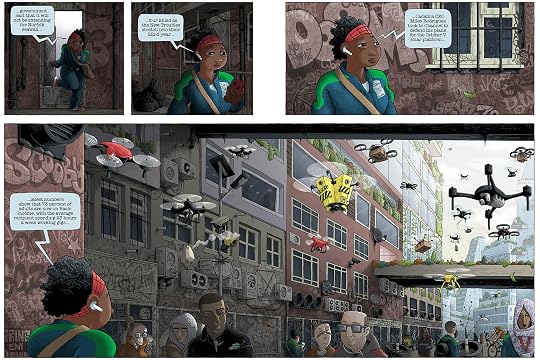
A.I. took the work. Gigs replaced jobs. Ordinary people are left to scrape together lives in a world that's no longer built for them. These are their stories. In a frighteningly near future where Basic Income is supplemented by gig work assigned by “the app”…an octogenarian punk and a lonely young worker seek escape through music. A street artist makes art by night and paints over it by day. A has-been detective chases a case into a forgotten world. A drug runner makes a long, strange delivery. A writer marks her days on a decaying space station she can’t leave. And a refugee asks for help in the last free place. With a hard-won blend of biting satire and humanistic passion, two creators from the North of England weave together six divergent chapters into an extraordinary graphic novel. Gigs is both a powerful warning about the oppressive world to come and a defiant celebration of the humanity that will sprout up in the cracks. “A sharp, funny look at where the future’s heading and what we can do about it. Emotive, thought-provoking, beautifully drawn and written with wit, this is the sort of science-fiction we need more of.” — Adrian Tchaikovsky Author of the Hugo Award–winning Children of Time series.
Gigs (2026) is a dystopian graphic novel by Mark Mosedale and Si Smith set in a near future where, as the back of the book exclaims, “A.I. took the work. Gigs replaced jobs. Ordinary people are left to scrape together lives in a world that's no longer built for them.” The government runs an app that 70 percent of the population must use to qualify for a basic income. The authors tie six stories together, and in some places use very few words at all. I love the design, and the timing of it for the year of AI fears, though mid-twentieth-century sci fi was all about AI/robots taking over our world, so right, NOW, we're listening, okay, I didn't really believe that part about extinction, but now am paying attention! This is a good and compelling and caring book.
PS A school is just now opening in Evanston, Illinois with no teachers, only run by AI, with a few aides on campus to help with tech issues in the transition. Parents can send their children there in self-driving vehicles and instead of playng on a playground (if they still get recess!) they can play with their AI friends online.
A fascinating look into the possible future. It feels very "what if" or "black mirror" esk, providing six stories that weave together, some very subtly, others quite clearly.
The narrative and artwork are beautiful together, creating a world that feels both alive and familiar.
It's a few years from now. AI and robotics have progressed to the extent that all entry-level jobs have been eliminated. The majority now live on a universal basic income. What was once touted as the ultimate safety net to ensure none ever dip below the poverty line has become a form of indentured servitude. Because, let's face it, there's still far too many jobs out there for people to do that robotics haven't mastered yet. So once you're on basic income, you'd better accept every job that's sent your way lest your welfare be cut: welcome to the gig economy.
The best bits of this graphic novel are the ones exploring the everyday. The gig workers doing 17-hour shifts and never able to grow. The ever-present landlords. Art as protest being used against its creator. The millenial good intentions falling prey to capitalist tech acquisition. Gaming addiction. Great stuff, go read it just for that.
Where it falls short is on two fronts, for me at least. The linework and design is fun but I hate the digital coloring/shading. The scratchy lines made this look amateur because they don't feel deliberate. They feel like someone didn't know how to change the line thickness or do hatching. The other issue I had is that in the last two thirds of the book a larger plot takes shape that feels naieve in its hope... or perhaps I'm too jaded. I would have actually preferred it if the book kept going after the conclusion and showed us how these good intentions failed. The optimism jumps the shark.
Overall this is worth the read. It's from a small team based a few miles away from where I grew up in northern England and it feels like we're around a year away from the gig economy becoming a reality (some of the other, larger pieces are hopefully a few decades away yet), so.. topical!
Read this to feel bleak and inspired and then go outside and enjoy the countryside and live music. And if you're a current gig worker, good luck out there.
A good graphic novel (GN) can convey information in ways that very few writers could manage without sounding trite. Often, this takes the form of graphic novels that are largely visual poems: illustrations with few words that focus on feeling and mood more than plot. I’m thinking of Olivia Sullivan’s 2026 GN Oracles or Richard McGuire’s titanic ode to a single place over time, Here. Other GNs work in a more traditional novelistic style but use illustration to do more than advance the plot or describe action. Such works can depict complex emotions or social connections in just a few images.
The team of Mark Mosedale and Si Smith has produced such a novel in GIGS. The novel starts as a relatively conventional near-future dystopia. The blurb on the back of the book exclaims, “A.I. took the work. Gigs replaced jobs. Ordinary people are left to scrape together lives in a world that's no longer built for them.” The government—or perhaps a large corporation—runs a gig app that 70 percent of the population must use to qualify for a basic income. People do not earn money from the gigs so much as points, which determine their eligibility for that income. It is an interesting take on a well-worn dystopian premise familiar from many other works of near-future speculative fiction. S. B. Divya’s Machinehood and Kurt Vonnegut’s Player Piano come to mind.
From its opening pages, however, GIGS distinguishes itself by using its artwork to make us feel the oppression of this society: the burden of constant surveillance and the social isolation of being alone in a crowd. I can think of several well-regarded science-fiction novels that spend pages of didactic, stilted prose trying to convey what Mosedale and Smith accomplish in only a few panels. By establishing this emotional and cultural register early, the novel is able to build toward darker and more complex themes.
Running through the novel’s different stories is the idea that capitalism can easily appropriate rebellious or inspirational victories and feed them into machines that produce more capital. The novel chronicles the early punk movement, in which one of the “I was there when it happened” types ends up founding a game company that eventually develops the app used for gig work. The game company itself begins as a creative world-building exercise before it, too, is co-opted.
Even outer-space exploration, which promises that workers will “be part of this grand destiny…make [their] life work mean something,” becomes just another means of obtaining cheap labor. As one gig worker laments, “Down there I felt like the world was squeezing my humanity out of me. But it turns out the up here, it’s just the same, only with a better view and worse company.” Site 1, an ecological haven restored from an abandoned oil rig and run by outcasts from society, eventually closes its doors to refugees in order to preserve its own way of life.
The novel is not entirely dark. Elements of solarpunk optimism underlie the book. The graffiti artists, the techies reprogramming drones, and the Site 1 barge are all flawed and limited. But they reminded me of what critical theorist Rebecca Ariel Porte terms a “minor paradise,” a phrase Ajay Singh Chaudhary borrows in The Exhausted of the Earth: Politics in a Burning World. These minor paradises “discard[] perfection for the more limited — and the more dangerous — proposition — that the world might be differently arranged and more vibrantly […] to make the best of flawed materials." Again, the visuals do the work of showing us what such a limited paradise might look like—and, more appropriately, feel like—with remarkable grace and economy.
The novel can lapse into didacticism and simplicity, particularly in its dialogue. Perhaps the book would be improved by leaning further toward the form of a visual poem after all! Yet the final scenes end on a note of complexity. When the scarred character from the beginning of the book leaves to build her own Site 2, free from the flaws of the previous settlement, the moment inspires a mixture of hope that she can succeed and dread that the project will eventually be co-opted, just like the novel’s other efforts to improve the world.
Não consigo deixar de ler este Gigs como um grito de alarme e revolta das novas gerações face ao futuro distópico que o nosso deslumbre alucinado pelas bigtech lhes quer impor. Construído a partir de histórias episódicas que se interligam com detalhes e personagens em comum, toca nas consequências do capitalismo late stage alimentado pelos algoritmos. Mostra-nos um futuro que, em grande medida, já é o nosso presente: um fosso enorme entre os mais ricos e os que os servem, e uma sub-classe permanentemente empobrecida que sobrevive do rendimento universal, mas é forçada a participar numa economia de biscates geridos por algoritmos. Enquanto a sociedade se degrada, o planeta caminha em direção ao colapso ecológico.
Percebe-se o desespero que leva Gigs a ser escrito, mas não é um livro com falta de esperança. Muito pelo contrário, as histórias são contadas pelo ponto de vista daqueles que estão do lado de quem está a perder, e mostram como se pode reagir a um descalabro perante o qual nos sentimos impotentes. Sim, o livro reflete aquele sentimento de impotência que todos sentimos perante mais um anúncio de brilhantes resultados económicos face a despedimentos massivos de pessoas trocadas por IA. Mas diz-nos que podemos resistir a isso, que se nos sentimos impotentes perante o grande panorama, podemos nas nossas vidas, no nosso dia a dia, ter as nossas ações de resistência, de independência pessoal face à gestão algorítmica das nossas vidas.
Reflexão sobre as más mudanças que a tecnologia, ou melhor, a tecnologia manipulada pelos um percentistas está a impor à sociedade global, é também um livro que nos mostra que podemos resistir, organizarmo-nos e tentar, nos nossos reduzidos âmbitos, não baixar os braços para tentar legar um mundo melhor aos nossos sucessores. Por impossível que isso agora nos pareça.
I loved this. It was compelling right from the start and really kept me enveloped in the world. I loved the way the focus shifted but the stories crossed over because that's the point right, that we're all connected even if some people may not want to be. And there's quite a few people I'd like to not be connected to... The world felt so deeply built, and that's partially since it's speculative, so we can recognise so much of the now in it and see how the world is shifting closer and closer to this. (sorry but to the reviewer who said it felt so far away from now that they couldn't get into it or the characters, you must be living a drastically different life to the rest of us - maybe that's part of the point (the landlord character etc...)? So many people are already living this gig economy lifestyle, so many people live exactly how these characters do already. But whatever, not everyone has the have the same view as me I know! The reasons stated in those couple of low reviews though... Look, I hope we don't get to where this story shows us, but if we do I hope Ivy is there with me. Or rather, I hope I'm brave enough to be the Ivy I need to be in the future that I hope doesn't arrive. I loved the art, I loved the characters, the whole design and vibe was so good. Thanks for making me cry at the end with God I hate what the world is becoming. God I hate AI. But the best of humans might just be able to win in the end right? We have to hope so.
Thanks to NetGalley and Top Shelf Productions for the digital copy of this book; I am leaving this review voluntarily.
I really like books that explore societal oppressions because they usually provide some social commentary. Ever since I saw V: The Miniseries when I was 10, I’ve liked the “warning” stories, where evil is revealed in subtle ways. Gigs does just that, by showing what a world might look like with extensive AI and the billionaire class controlling every part of society.
Gigs is a slam against capitalism in all forms. There’s a Universal Basic Income featured, but it also shows the flaws. People must work X number of hours, doing many menial tasks in order to keep their UBI, which is barely enough to survive. However, there is a small number of people who resist, including the main characters. This serves as a critique of modern-day economic struggles as well as political warnings. Even though this graphic novel is set in the recent future, it is totally plausible that this type of society would be possible given recent events.
I loved the illustrations in this book. At times, stark, at other times humorous, or even revealing great beauty, Gigs is a reminder of what could be and how we as a society can change the outcome.
Imagine if your life is surveilled by drones 24/7.
You’re placed on a government allotment called: Basic Income.
No more regular job, just GIGS. They arrive at all times of the day or night, menial jobs. If you don’t do them you will have the Basic Income reduced or eliminated.
There is so much to like about this story, which has 6 threads to follow. The premise of a dystopian world where A. I. takes over is contemporary and relevant. It’s blessed with extraordinary artwork and infused with satirical stats about the advancement, or not, of society. If nothing less, readers should be motivated to pay attention to today’s impact by A.I.
SO, why only two stars? On the very first page with dialogue, I’m presented with a crude expression in the second panel. Three panels further, the first expletive. Twelve pages later, the very next time there’s dialogue between two characters, I’m “treated” with the first of MANY F-bombs; the second - 4 pages later…very deep sigh.
Regardless of all that’s good in this book, no recommendation from me📚
I received a copy for review purposes. All opinions are honest and mine alone. Thanks to Publisher’s Weekly, the publisher and author for the eARC.
This was a really interesting premise that feels like it could be closer than we think. Gigs is set in a future where AI has taken over the workforce and individuals earn basic income by completing assigned gigs. Think TaskRabbit or temp jobs you don’t get to pick.
The graphic novel follows several different characters in a way that often feels disjointed. It’s ultimately a story about rebellion and finding ways to survive. It starts out with Ivy filling in for her sister Sara at a retirement home. There Ivy meets Syd. Frustrated with the world they live in, the two come together in a clandestine friendship. Ivy is clearly the main character but it jumps away from her for extended periods.
I was thrown off by the jump to the detective. It wasn’t clear initially why the reader should care about his character. The same was true for some of the other characters like the runner. Alone each of these stories provided interesting plots but they just weren’t cohesive enough for me. I liked the idea that the ending was pushing but it felt a bit anticlimactic.
Thanks to the publisher and NetGalley for the ARC!
Gigs takes place in a future where spy drones watch your every move and something like 73% of people can’t afford to live without constantly picking up tasks through an app. Siri has become Houdini, Uber Eats has become Gigs, and honestly… it all felt a little too believable.
The story follows several different characters whose lives are connected through the Gigs app. One of my favorite threads was Ivy’s. During a gig she meets Syd, an elderly pot smoking former punk who introduces her to music and becomes an unlikely friend. Their relationship added a lot of heart to a world that otherwise feels pretty bleak.
The structure was interesting. It jumps between different stories and characters, but they’re all tied together through the Gigs ecosystem. Some worked better for me than others, but I liked seeing the different ways people were navigating the same world.
Overall this felt like social commentary in comic form. A little depressing because it doesn’t seem that far removed from reality, but thoughtful and interesting throughout.
In the not to distant future tech has taken over the planet, people are suffering, the planet is dying. In order to get any form of support, people who reach certain qualifications can sign up to do Gigs. These are usually one off, terrible jobs/tasks, that people don't want to do, and it's easier to have a random person do it then hire them for a long term position. You have to complete a certain amount of Gigs in order to receive basic support like food and health care.
Ivy's sister no longer wants to run Gigs, but Ivy knows they need to. She takes on her sister's Gigs and befriends an elderly woman in a care facility. This woman shares the music of Punk and Alternative, and teachers her about the resistance she participated in. Ivy decides to take her out for one last adventure and sneaks her out of the facility.
Slowly around them, people are starting to resist. People are starting to push back. People are working hard on doing the next right thing.
This does get a little odd in point, but is very reflective of current society. This is one to pick up.
Thank you so much to Netgalley and Top Shelf Comics for providing me with an ARC in exchange for an honest review!
I really really liked this! It delved deeper into another form of society/what society Could become and did so with beautiful and practical world building. It didn't introduce too many characters but definitely enough to tell the story and add multiple different elements (they all came from somewhere and there's Opinions and I felt that it added to the story). I like a good dystopia but this was also a really neat and layered analysis of how we might never be able to escape and how a basic universal income scenario Could work (luckily it's fiction but the feelings felt are Not) - and it's definitely thought provoking. Also, the surprise Dutch came out of nowhere but I can always appreciate a Dutch element (purely because I'm Dutch and I'll always be biased, I quite literally can't help it).
"Gigs" is conceptually amazing. In a world where AI has taken jobs, humans are forced to complete gigs, which are odd jobs mandated by the government, in order to earn Basic Income. Where "1984" is a critique of authoritarianism as a whole, "Gigs" switches its focus to capitalism.
I did feel like the majority of plotlines in "Gigs" were either unremarkable or felt unfinished, but still, I enjoyed the story as a whole. I think the author should have shaped it into stand-alone stories or a sharpened focus on the protagonist, Ivy. This straddling leads to a noncommittal and incomplete feel.
Both bleak and hopeful, "Gigs" is worth the read for dystopian fans, but struggles to leave a lasting impact.
"Gigs" is set in a world where most people survive thanks to Universal Basic Income, a modern iteration of a Victorian Workhouse run by AI. The book follows several characters whose stories are slightly or deeply interconnected and how they survive in a world assailed by climate change and the disasters caused by it, and the hopelessness caused by late-stage capitalism.
Great sci-fi is a reflection of today, not tomorrow, and I knew this was going to be a 5-star read a few pages in, and I'm so happy I still think that now. I couldn't recommend this more.
Thank you to NetGalley, IDW Publishing and Top Shelf Productions for this DRC.
4.5 stars I really enjoyed the humanity and insight in this thoughtfully imagined anthology of interlocking tales about resistance in a near future dystopia. There’s hope, but it’s the kind measured and not the naively false sort. There’s stories of befriending elders and discovering with disappointment that their own pasts are flawed and full of regrets they’ve hidden away, resistance being captured and commodified, resistance building community, resistance building personal strength and satisfaction, and resistance curdling into the same selfish fear-based nastiness it was originally set against.
Going in blind I had no idea I was jumping into a collection of short stories. I felt like they did a good job building the Sara/Ivy dynamic and the rest of the world in the first story. Just as I was pulled in and connected BAM... Jumped to another story. Sure the stories were all interconnected in a way, but the way they were connected felt cheap, almost as of the major chapters were penned and the writers had no ways to weave them together.
This entire review has been hidden because of spoilers.
I was blown away by this book. It presents a stark but somehow realistic picture of the future. Some welcome the arrival of the gig economy due to the freedom it offers, but this book presents a different picture of this new way of earning an income. It seems so realistic that it is somewhat chilling.
DANG! I needed this book. You need the "right frame of mind," and due to current events, this is perfect. The connecting stories smacked me upside the head and I said, "Thank you. I would like some more." Amazingly emotional, beautifully created and have a box or ten of tissues ready as you will laugh, cry, get ticked off, and so much more.
This would be a fun mini series. The art was awesome, and the stories were all pretty good. I did feel the space station one was kinda random and that this became individual stories by lack of having a story to begin with. Its as if the writer started the first story then totally forgot about it. Then decided upon finding it how he could finish it😆
This is an important book with a biting critique of where the world is headed. Like Ursula Le Guin suggests, the best sci-fi is a mirror of the present, and Gigs holds that mirror steady. But it’s also not didactic or preachy. The book is driven forward by compelling character studies, making this not-so-far future feel real.
With thanks to NetGalley and the publisher for the ARC.
Gigs was a pleasure to read. Great, unique art, and several stories and pov’s that intertwine and lift eachother up. A dark vision of the future with the seeds of hope for humanity’s future. Also, surprise Dutch!
At first I had a hard time getting into the artwork but after a few pages it really grew on me and I liked it a lot. A very thoughtful and well-written exploration of a possible future that is both touching and saddening. Really enjoyed it.
Loved this! It reminded me of Feed by MT Anderson, only on graphic novel form and some years after Feed takes place. Alarming, nostalgic, defiant and hopeful. Great book!