'Farage is Britain's new prime minister. Nirvana or nightmare? Whatever our reaction, we all need to take this scenario very seriously, as Peter Chappell's invigorating book does' Anthony Seldon
'a dazzling imagined account of Nigel Farage's first year in Number hilarious, terrifying and totally believable... Spoiler it doesn't end well.' Ferdinand Mount
A compulsive, chilling nonfiction thriller that imagines what might happen if Reform win a majority at the next general election.
At 10pm on 28th June 2029, exit polls predict that Nigel Farage will be the 60th Prime Minister of the United Kingdom. This is the story of what could happen next.
What If Reform Wins is a chilling and deeply researched scenario that takes us day-by-day, minute-by-minute through a world in which Reform has the opportunity to put their policies into practice, from deporting 600,000 people to leaving the ECHR, abandoning net zero and ending the BBC's license fee. How will people fight back against mass deportations and fracking? And will this self-described 'ill-disciplined pirate ship' survive the rigors of government?
Drawing on dozens of new interviews, Peter Chappell, a reporter at The Times, explores a nation on a new and dystopian path.
This book & this review are strictly for fans of the bizarre twists and turns of current British politics. I mean, where do you start? Gone are the days when we were a beacon of stability in a sea of seething dangers. We have a by-election coming up in 2 weeks which will elect a new MP for that area. If elected (he probably will be) this guy (Andy Burnham) will almost immediately challenge Kier Starmer for the leadership of the Labour Party, and will beat him, and will therefore immediately become our new Prime Minister, the seventh in ten years. And why is this happening when you have a government with a gigantic majority so they can pass any bills and govern happily until the next general election? Well, it’s happening because as soon as Kier Starmer was elected – less that two years ago – he instantly turned into King Midas In Reverse. One horrible mistake after another. And now everyone hates him and the rightwing Reform Party are miles ahead in the polls and everyone expects that the Labour Party will lose the next election and – clutch your pearls now! – Reform might/will/could be/surely not become the next government. The Apocalypse will then follow, according to some people.
The boss of reform is Nigel Farage and he has been without any doubt the most influential politician in Britain for maybe 30 years even though he only became an MP on the same day Kier Starmer became Prime Minister, i.e. not very long – July 2024. But in the early 1990s he began the campaign for Britain to leave the EU at a time when that idea seemed only slightly less marginal than those of the Flat Earth Society. But like a snowball rolling down the side of a snow-covered hill, as the Temptations sang in 1965, the idea got bigger and bigger until in 2016 Britain voted to leave the EU to every mainstream politician’s shock and horror.
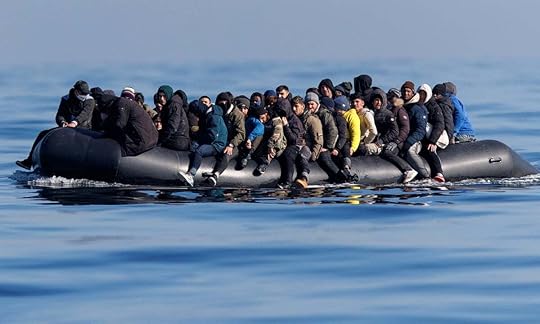
Job done! Nigel can now pack up his Brexit Party, knock back a carafe of red and jump on a yacht. But instead he decided to form a new party full of people who, like him, thought that the two main Parties, one nominally left, one nominally right, were really an amorphous liberal blob who ignored the wishes of the majority of the people by importing vast numbers of immigrants into the country – from 2004 net migration has been between 200,000 and 350,000 each year. The famous small boats that have proved so very hard to stop only account for a fraction of this (2025 total : 41,000) but they get all the bad publicity.
That’s just one issue Reform are quite cross about - there's also net zero policies, too many able bodied people claiming benefits, etc. The usual right wing pick 'n' mix.
So this book imagines what happens when Reform win the next election in July 2029 – and they really might! Naturally, it’s a nerdily written, somewhat humorous hatchet job – no surprise, it all ends in tears. For me there was way too much detail about what committee does what, what cabinet secretary has what constitutional powers, blah blah; and there was surprisingly not enough about how Reform would actually stop the small boats and cut immigration.
Spoiler alert – in this scenario Farage and his boys have not fully understood what the EU will do if Britain unilaterally withdraws from the ECHR. The EU retaliates by cancelling the TCA and all hell is let loose. It’s a bit like Trump and his boys not realising the importance of the Strait of Hormuz before they started up that thing in Iran. Surely nobody in a position of power would drop a clanger like that?
Note : the ECHR is the European Convention on Human Rights which stops Britain from deporting illegal immigrants. I knew that. I never heard of the TCA but it turns out that you don’t wanna mess with it.
This book should be required reading for anyone that thinks Reform’s small minded policies and overly generalised populism is in anyway the answer. They are playing to your insecurities. There is no simple way out of the mess other than small steps forward.
This book was terrifying. But it was such an interesting read. I have become a massive lover of ‘a scenario’ books, and this might be my favourite. Full of so many insights into individuals and how governments work, this book made me even more aware of how delicate democracy is.
I loved Nuclear War: A Scenario and thought I would love this one too. While it’s in the same vein, there’s much more conjecture and guess work; less policy to be followed as rule and while it not might be off mark it is just a potential. I found the same in Nuclear War when for the sake of a more spicy scenario the President gets lost and can’t speak to his Russian counterpart. So, while I have found this book terrifying in its possibilities, Chapter 4 specifically and also when we actually zoom in on the fact of what might happen to UK-Europe relationships and immigration status if they follow through with the potential policies that they are promising!! I just wanted more of that and it felt too much fictionalising for the sake of a narrative to me like reading Paul Lynch again.
Interesting in places, and there's some interesting information about what has happened to bring us to this point. But quite a bit of it is just a bit silly
This is the current book for my non-fiction book club which we are due to discuss in a couple of days time. The author Peter Chappell is a reporter at The Times who has written this book using his journalistic expertise after research and interviews with experts and decision makers, as he explains in his prologue. Whilst some of the characters are fictitious, he also uses real life figures in the public eye, as he says, many of whom are already part of Farage’s inner circle and would be likely to have influence and/or a prominent role in a Reform government. The book is written on the premise that Reform wins by a narrow majority at the 2029 General Election and thus Nigel Farage is asked by the King to form the next government.
The book begins on Election Night as results come in and continues with a chapter called Victory, detailing events of the following day as the Reform leader heads to Buckingham Palace and moves into Downing Street. Subsequent chapters deal with different issues, immigration, climate change, the BBC and relations with Europe at the time of Reform’s second budget. Peter Chappell takes Reform’s manifesto pledges as of early 2026 and speculates about what would happen if a Reform government tried to make good on their promises, what obstacles they would face and possible outcomes.
I was very impressed with the detailed research that had gone into writing this book. It also draws on recent history to give examples, such as the downfall of the short lived Truss government following a disastrous budget and Boris Johnson’s (short lived) determination to cling onto power despite multiple resignations from his ministers.
This book made chilling reading! The scenarios were in my opinion very plausible, such as flooding in Bristol, caused by climate change but made worse following the axing of many jobs in the Environment Agency: ‘The people who would have been there before to help put a flood barrier up along the Avon have, in 2030, been sacked or made redundant, whilst the others are out on strike against Farage and Tice’s cuts’.
Despite the seriousness of the subject matter, the book is not without its humorous aspects. Describing the BBC’s coverage showing images from Election Day, the viewers are treated to :’Lib Dem Leader Ed Davey shaking hands with Paddington Bear’ and ‘Kemi Badenoch looking angry at a vape shop’. Interestingly, in this scenario, whilst labour are still in power in 2029, the prime minister is not named, although the author has predicted that Keir Starmer will no longer be at No 10. The book was published in February 2026 by which time Starmer’s position was beginning to look insecure - and this prediction has already come true, just sooner.
Where I thought the book was slightly vulnerable was in describing events in the very near future. A week is a long time in politics, as the saying goes, and already in the six months since the book was published we have had a new prime minister and war in the Middle East. And of course the Clacton bye election in a few days time which has turned into a complete farce with Farage standing against more than 30 independent candidates, but none from a major political party. Whilst I would love to see Count Binface win, I don’t think it’s going to happen! So I would say read this book now, before it gets out of date.
I learnt a lot about parliamentary process by reading it. For many years the country has been run following well established procedures, overseen by civil servants. Whilst they may not necessarily reflect the changing nature of society, this book shows how easy it would be to ignore the rules and just plough ahead regardless. The book starts with a quote by William Waldegrave from 1978, warming that ‘Our constitution is dangerously vulnerable to capture by the minority who can get hold of a political party which then .... gains a Majority in the House’.
All in all a very interesting book which I look forward to discussing at the non-fiction book club.
I have finished reading “What If Reform Wins: A Scenario” by Peter Chappell.
“Politicians Should Wear Sponsor Jackets like NASCAR drivers, then we know who owns them.” Robin Williams.
What would a Reform UK majority Government do to the United Kingdom (UK)? How would they act in power? How would the older parties react? How would the leadership of Reform UK interact with the machinery of government? All of these questions are addressed in this well researched and curious fictional story (“scenario” as described by the author). What is perhaps most unsettling is how tenuously the institutions of our country, governing and wider, cling to life and irrelevance. While major parties have merely nibbled away at their power or jostled where needed, this book is a warning that more determined extremists may just knock in what they perceive as a rotten door obstructing achieving their ends.
In this depiction of Nigel Farage as PM, one of the first things he does as he arrives in 10 Downing Street is to light up a cigarette in front of a shocked Cabinet Secretary, something banned there since the Blair era. In many ways this serves as the firing of the starting gun in Reforms’ ambition to bend the Civil Service machinery to it’s will. The start of Reform being in government leads to a process by which, through various means, the Civil Service becomes a natural place for actively Reform-supporting workers. One could say that Reform’s effort Americanised the British Civil Service at an unknown long term cost.
There are various crisis scenarios brought up in the book, some more plausible than others. The one in which a Reform Government’s quest for more oil sources, leads it to lose the Falkland Islands to Argentina is particularly telling. This is because when it happens it is partly a consequence of a future US President J.D Vance, acquiescing to it despite Reform’s obvious ideological sympathies between themselves and the Make America Great Again (MAGA) movement. It also neatly exposes Reform’s inconsistent and confused commitments and approaches to questions concerning foreign policy and defence. Perhaps tellingly, Far Right and Far Left movements and parties have similar problems with regards to these questions.
Hypothetical environmental national catastrophes are prominently featured in the book. One in particular caught my interest since it was based on the Bristol Channel experiencing a flood by storm surge (of particular interest since I live in Bristol)! In this scenario a third of Bristol ends up underwater. This is partly a consequence of the long term effects of climate change, UK Government refusal over decades to build a barrier for the estuary and severe cuts imposed by Reform on the Environment Agency. This chapter features a geographical claim that would probably get many of my fellow Bristolians irate. Is Ashton Gate Stadium in Bedminster? Because I would say it is in Ashton? I will leave that for more veteran Bristolians to decide on. What is interesting in this chapter is the chilling prophecy that Farage would limit aid on Bristol for political revenge. The author also prophesises that eventually all of Bristol’s seats will go to the Green Party. I would wager that at least one of them will go to Reform.
What is Reform’s ultimate undoing? It is the economy stupid! Finally they are put on the spot and in an impossible situation with regards to fulfilling all of their spending commitments in the face of a hostile trade environment with the EU that they stirred up to rally their base. Drawing on what we know about the internal rivalries within Reform, the author shows that Richard Tice and Zia Yusuf’s hatred for each other has a part to play in their final act too.
I have read few books which are simultaneously absurd, chillingly prescient and eerily prophetic. What is the most chilling part of this book? It makes Reform’s actions look less like a spectacular aberration, but the latest in a long tradition of parties bending our institutions and the unwritten constitution to their will. If one doesn’t necessarily subscribe to the view of the author that Reform in government will be as bad as they say, their inherent argument for constitutional reform (for want of a better word) is a persuasive one. At one point the book raises the prospect of Farage at first refusing to leave 10 Downing Street after a Parliamentary no-confidence vote, leading me to wonder when reading whether I was going to read Farage’s Fuhrerbunker moment! This doesn’t ultimately comes to pass, but it once again brings to question our country’s archaic reliance on the “good chaps” principle for following the constitution, in as much as we have one.
This book raises questions that makes British civil society and it’s institutions look worryingly fragile, making this book more than a mere hatchet job on Reform. They are in the end made to look pretty ridiculous. But their misbehaviour is cast in a continuum of British Governments over successive years that warrants wider discussion.
While this was an enjoyable read for a political nerd like me, I just don’t see how it stands up to any real scrutiny. Don’t get me wrong, I’m about as far from a Reform voter as you can get, but at times this almost felt like a fantastical plot to me.
Especially at the end, when we have MPs fighting in the Commons and Farage nearly being arrested to remove him from Downing Street, it just really stretched the realms of believability for me. I was looking forward to this being a serious analysis of the dangers of a Reform government but instead it felt like a political thriller which lost its thread halfway through and careered off the rails at the end.
this was actually just a very boring book about political science, the uk constitution and general speculation. i thought this wouldve been juicier or weirder. more gossip or more fantasy/catastrophising in a fun way. there was no weirdness. i only ever want weirdness
There's a funny part where Chappell imagines a completely flooded Bristol. Battered by a storm, Bedminster has become a lagoon, submerged beneath a sewage-infused deluge. So, what's new?
Without going into politics... This book was darkly hilarious.
I read it expecting long chapters about unsustainable migration policy and wasn't expecting a break out of the REAL issues like; how the BBC would produce "Race Around the World" if Reform abolished the TV licence. The suggestion of downgrading the program to "Race Around the UK" seems pretty realistic.
Equally realistic was Reform letting Bristol drown during a flooding event. I mean, who wouldn't? £7.50p a pint over there.
A nice opportunity to leave our political hellscape, and spend time in a far worse universe.
Some interesting predictions in here, which seem well grounded. Not as alarmist as I expected.
- Dom Cummings advising Reform in Gov seemed implausible but then relatively convincing. - Once the Reform base turns on Farage (this will happen before the election in my view) then it’ll all fall apart. - The Reform cabinet candidates are too incompetent to make the change they’re actually intending to - so we’re basically all doomed.
3.5 stars. This novel is fiction, a scenario but reads with its political procedure knowledge of the author as almost non fiction. Whether this scenario of Reform in No 10 and Farage at liberty as PM to go through with repealing acts of parliament that have stood for decades (in some cases more) to ….spoiler alert…. cause division chaos and support from certain politicians, right wing financial supporters and yes Dominic Cumming making a return is likely is beside the point. It’s readable, insightful as to parliamentary and constitutional policy and procedure which isn’t the cheeriest of topics hence the 3.5 stars but it’s paints a potentially scary scenario that we should perhaps be wary of.
This entire review has been hidden because of spoilers.
0 stars for the future envisioned in it, but a really important and useful read. I think by imagining the specifics of the catastrophe, it helped to take some of the emotional weight out of it for me, which I needed!
‘What if Reform Wins’ is realistic speculative fiction of a scenario of how a Reform government could play out.
Declaring a culture war to undo all race, gender, immigration, disability and class progression in favour of British nationalism, it’s a shame only Leftists will bother reading it. It’s also a shame the organisation is diabolical and is absent of emotion. Choosing to tell the events from the perspective of an insulated Downing Street, I don’t know who a majority of these namedrops are and frankly, I don’t care. I care what will happen to Reform’s victims.
Britain is a ticking time bomb, but there is still time to defuse it.
Reform wins the next election, but the one aspect everyone wants to read about - migration and deportation - gets one chapter and then never mentioned again. I think this book has been outmoded in just the last few weeks, with the scandal regarding the death of Henry Nowak, the attempted beheadings in Britain and ever-building resentment between hard workers and handout claimants (deserved from disability or no).
I found it very realistic, a great but obviously biased look into deeper Reform rhetoric, but other than that entirely unmemorable.
An interesting and entertaining read. This is not a book for someone politically disengaged. You need at least some knowledge of politics and current affairs for the scenarios to resonate. A few of the situations seemed to lean more towards fiction than scenario but I think this helped to keep things engaging. The constitutional chaos that would result from a limpet prime minister raises many interesting questions.
I think this book was a little confused as to what it wanted to be when it grows up. Political dystopian? Academic essay? Biting commentary on the party (lowercase because I maintain that Reform is not a real Party) or critique of the system that got us here?
Either way, the themes were confirmation of my suspicions: vitriolic crackdown on immigration, market manipulation, erosion of press freedom, end to universal healthcare, resurgence of independence movements.
I enjoyed it to the extent that one can enjoy reading about the impending collapse of the country that one grew up in and loves dearly.