Inteligentísima novela gráfica de ficción política que se ha comparado con la aclamada serie de televisión El ala Oeste de la Casa Blanca, y cuyo protagonista es un senador asiáticoamericano que decide participar en la carrera presidencial por el Partido Demócrata en las elecciones de 2000 en Estados Unidos. Para darle mayor realismo a la obra, Kawaguchi se inspiró en personalidades políticas del momento para construir a algunos de sus personajes: el presidente Bill Clydon (Bill Clinton), el vicepresidente demócrata Al Noah (Al Gore) o el asesor de campaña George Tuck (Dick Tuck). Sin embargo, y por esas casualidades de la vida, es un personaje de ficción el que parece sacado directamente de la realidad. Y es que las similitudes entre el protagonista, el senador Kenneth Yamaoka, y Barack Obama son asombrosas.
Kaiji KAWAGUCHI (Japanese: 川口開治 or かわぐちかいじ) is a Japanese manga author whose works include Eagle and Zipang. Generally, his stories involve Japan and examine the moral choices that people make in extreme situations. He received the Kodansha Manga Award three times, for Actor in 1987, for The Silent Service in 1990, and for Zipang in 2002. He has also received the Shogakukan Manga Award, for A Spirit of the Sun in 2006 and Kūbo Ibuki in 2014.
I remember seeing the first two volumes of this series in a second-hand bookshop in Crofford and, naturally, thought, “this isn’t my thing”. Every time I went back there, those two books would still be there, and I would always think about them. So, as I eventually told myself, “Yes, I am into politics”, I finally bit the bullet and decided to buy them. But even then, it took me some time to finally get around to reading them. But once I finally did start reading the first volume, my god.
Usually, I read 4-8 pages of a book a night; with this, I read 25 pages a night, which is unheard of. It would be the equivalent of reading one-third of War and Peace in one sitting. And with good reason, I think Mange is so engaging and well-written that you just have to read as much of it as you can. When I first bought this manga, I assumed that it would focus on Yamaoka himself as he goes from a journalist to a Presidential candidate. But instead, we have a Japanese journalist going over to America to report on the first Japanese American Presidential Candidate. And from there, there are loads of twists and turns that make this more than just the anime equivalent of The West Wing.
This kind of act serves as an outsider's introduction to the world of American Politics, which is a good thing. I like how we follow Jo as he, in turn, follows Yamaoka’s campaign trail, an anime version of Hunter S. Thompson’s Fear and Loathing on the Campaign Trail '72. And what he inevitably finds out is that politicians, no matter how good they seem on the surface, are all awful people. We get a good sense of what it’s like on American Political Campaigns and how each candidate is keen to stab the other in the back in any way possible. I’ve always been interested in stories about power and gaining power, so I really related to this story and loved its realism, with police motorcycles and people staying overnight in the office.
I also really loved the characters in this one, Takashi Jo seems like he’ll be another spinless weirdo like some many manga protagonists, but he’s really intelligent and prophetic, and when he does have his crying moments, it works because that is exactly how anyone would react in that situation. I also enjoyed his relationship with Rachel, who is Yamaoka’s adopted daughter. Takashi is in a really awkward spot, which makes you feel for him, and you want to see him and Rachel together, but you know deep down, it can’t work. But they still end up together either way, which makes things even more complicated. And that bit in the Baseball court where Rachal is scared for the future and Takashi tells her how hard she’s worked to get there, was just so heartfelt, one of the most romantic things I’ve read. And as for the twist in the first third, man, I could never have seen that coming, and it came the rest of the story so much more profoundly, and makes you think about the relationship between Takashi and Kenneth more gut-wrenching. I also like the other characters, like Yamaoka’s press secretary, who felt like Malcome Tucker from The Thick of It if he were played by Samuel L. Jackson, and also the shady guy who was in charge of Yamaoka’s ad campaign.
As for the negatives, Takashi and Rachel do despise each other a bit in the second half, as it becomes more about politics. Yes, that is to be expected in a series about politics, but I feel it pulled us away from what was really working about the story so far, and the second two volumes lost me a star. I also found some of Yamaoka’s actions a bit hard to swallow, as I wasn’t sure if we were supposed to like him or not. We know he has a troubled history that ties into his relationship with Takashi, but even then, I don’t know if we're supposed to find some of the things he does cool or narcissistic. I guess we’re supposed to come to our own conclusions about whether Yamaoka is a good person or not, which I think was a good way to go about this. Another problem is one that a lot of manga suffer from, which is trying to make the story about Japan when it really doesn’t need to be. I don’t really know why Yamaoka “had” to be half-Japanese, or why it had to be followed by a Japanese reporter. You could theoretically cut out any mention of Japan and make Yamaoka, a pure-blooded American, and it wouldn’t really change the story that much, other than making it about just another Presidential Candidate. But that’s just me, and I’m not saying that making about Japan was a hindrance to the plot, just something I noticed.
Overall, this is definitely one of the best manga I’ve read, alongside Black Jack. I notice that all the best manga I’ve read are always the ones you wouldn’t think I’d be into, as they have things I have no interest in, like surgery or political analysis. So, it shows you that you should never underestimate something just by its premise. I’ve got volume 2 of this series, but I don’t know if I’ll find volumes 3-5 as this series is now out of print. So, I hope Viz Media reprints this series, as I feel this manga is desperately underrated. If Slamdunk can find an audience among people who don’t play basketball, then I think this manga can find a big audience among people who aren’t into politics.
You may as well know from the outset that I'm not really in any way optimistic over the American body politic. It's a system that, for everything I can see, is essentially and fundamentally broken. As nation-wide protests have asserted in the last year, a very distinct minority wields the power in a nation that teaches its children to believe in democracy. "The will of the people" is routinely dismissed by those who would purport to be its servants. And even if the desires of the general populace were taken into consideration, the 99% are too ill-informed in the realms of history, economics, strategy, and political philosophy to be able to make adequate decisions in either national or international realms. We the people are puppets to our news sources, whether liberal or conservative or international or backwoods. If we are to gain leaders who will usher us into a golden age of peace and prosperity, it will be by accident.
You may call me a bit of a cynic—and you would be correct in that estimation. So what's a guy like me doing pretty thoroughly enjoying a book like Eagle: The Making of an Asian-American President: a book that in many ways is a celebration (or fetishization) of the American electoral process?
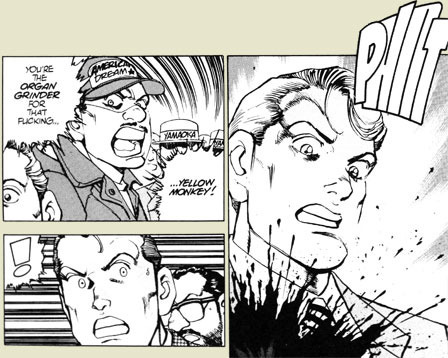
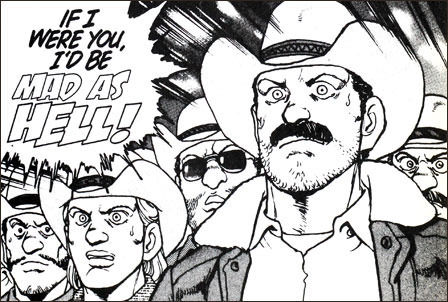
Honestly, part of it is novelty. The bare concept alone is interesting: 2264 pages following a candidate's campaign from the lead-up to the Democratic National Convention all the way through to the results of the Presidential Election—but written by a Japanese creator for a Japanese audience. Seeing how an outsider views and understands and interprets something that remains mysterious even to many Americans is a treasure of cross-cultural appreciation. When he mythologizes Texas, through heavy play on ranchers and late-night T-bones as big as your head, you can see where he's coming from. When he follows a trail into the sordid realm of labour union politics, American readers may well wonder how closely the author's original audience could relate (what with the differences in American and Japanese business ethics and practices). And when the book's candidate-of-choice, Kenneth Yamaoka, a third-gen Japanese-American senator (D-NY) is confronted by some of the racial difficulties that confronted Obama, you wonder how much it hurt to write those sentiments and how much author Kawaguchi was able to empathize with the more hateful elements he had to portray.
[Wait. Isn't the organ grinder the one in charge? If this guy doesn't like East Asians, shouldn't he be happy that Yamaoka would be this guy's puppet? Racists, man: how do they work?]
Eagle's subtitle (The Making of an Asian-American President) is interesting because you're pretty sure that Kawaguchi is giving away the whole bag of cookies at the outset. While reading, there may be some doubt in the occasional reader as to the author's destination, but as the story unfolds, presidential hopeful Yamaoka unveils to be perhaps the ultimate Mary Sue. There is no obstacle that he will not overcome—no scandal that will not either fade from memory instantly or turn out somehow to work in the anointed man's favour. It might be annoying if Yamaoka was ever really the point of the book. But he's not.
[I like how similar Kawaguchi's people style is to Katsuhiro Otomo's.]
Kawaguchi's primary interest seems almost wholly concerned with exploring what it takes to become president of the United States. And since someone is undoubtedly going to become president, for Kawaguchi's purpose, it hardly matters who. He just needs readers to willingly tag along for the ride—most likely to see just how crazy a ride it actually is. Or at least how crazy it is in a Very Dramatic reading of the quad-annual script. To that end, he offers up a bit of melodrama.
Takashi Jo is our window into Senator Yamaoka's world. Jo is an unknown journalist for the Mainichi Shimbun and is mysteriously invited to all-access coverage of the senator's campaign the day after his mother mysteriously dies in a home gas leak. This mystery plagues Jo for the story's duration, but at least part of it (the fact that Senator Yamaoka is the secret father that Jo never met) is revealed in the first thirty pages of volume 1. Then Jo falls in love with Yamaoka's daughter, but it's okay because she's his adopted daughter. Probably. As I said, a bit of melodrama.
Still, Eagle is paced like a thriller. Whether we're wondering how Yamaoka is going to gain points on his latest rival or how Jo is going to react to the latest bombshell about his life, his love, or his parents, the trip is an exciting one. I first read Eagle as it was released in America around the turn of the century, but with all the presidential campaign hoo-ha going on the last couple months, I thought I'd like to reread the book. After all, I remembered enjoying it a decade ago. When I say it's paced like a thriller, I'm not kidding. I blew through all five 400+ page volumes in two days. I may have stretched my one-hour lunch breaks to an hour and ten. I had a hard time putting Kawaguchi's book down. It's like if you took Twilight or The DaVinci Code and made them smart and interesting. Basically, Kawaguchi created something like crack in bound paper form, which makes it all the more tragic that VIZ is no longer publishing the book. Apparently, it just wasn't as popular as I believe it probably ought to be.
[I would, too. It's a good book and deserves continued circulation.]
And again, this is coming from someone who doesn't like American politics. Kawaguchi asked me (through his series) to empathize with a politician and support a candidate for a presidential election—something I traditionally have found myself unable to do. It says something that, despite my jaded perspective on the political realm, I was happy to read about Senator Yamaoka and his dreams and purpose. Basically, Kawaguchi did for politics what Mitsuru Adachi did for baseball—he got me following the game. At least for the space of his book.
[Just to prove I meant it with the promise of melodrama.
Also, you can't tell here, but Kawaguchi draws naked people funny and his women have awkward boobs. (Note: please don't be offended real people who look just like Kawaguchi's naked people.)] ________________
Eagle is a story of a third generation Japanese-American lawyer-turned-senator, Kenneth Yamaoka, running for president in the 2000 election. Yamaoka has personally invited a journalist, Takashi Jo, writer for a Japanese newspaper, to follow his campaign, for reasons unbeknownst to Jo.
I found the first volume to be rather captivating, finishing it in just a couple hours. Eagle kept me wondering what was coming next. Seeing an American election told by a Japanese author/artist was most definitely an interesting portrayal. I did, however, feel that some of the characters reflected more Japanese characteristics rather than your "average American", although it's easily overlooked. I also found the introduction of a romantic interest for Jo was somewhat unnecessary.
Overall, I enjoyed this volume. Will be picking up the second volume to continue the story.
When I saw this on my friend's desk at work, I knew I had to read it. The words, "Asian American President" really stuck out. I mean, it's more than half the title. And normally, I'm okay with a great story that simply has Asian American representation, but here, my expectations were a little more specific.
I'll start by saying I think this is a great story about the brains and gears that run a political campaign. As one who used to enjoy observing politics (I'm from Chicago where politics is bloodsport), this is a pretty cool story. But because it's billed as an Asian American story, I felt like that aspect was missing. Maybe it's in Volume 2, but this story could have easily swapped "Japanese" with "Italian" or "English" and the core of the story would remain the same. This is not a deal breaker. I will read Volume 2. But this time, I'll keep my expectations limited to the political rather than expanding it to the cultural exploration of Asian American in the 2000's.