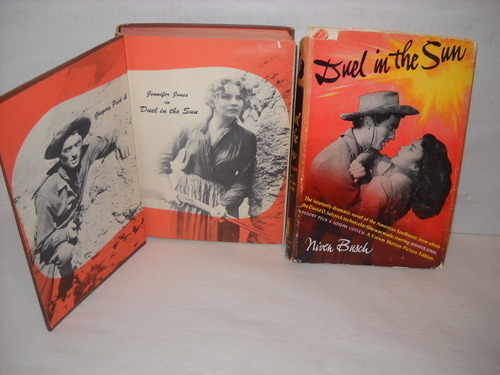
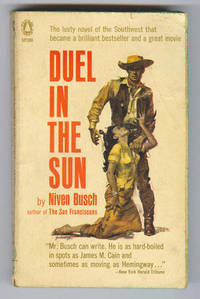
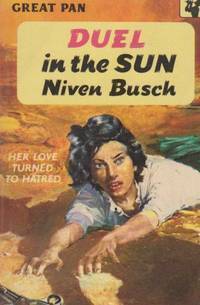
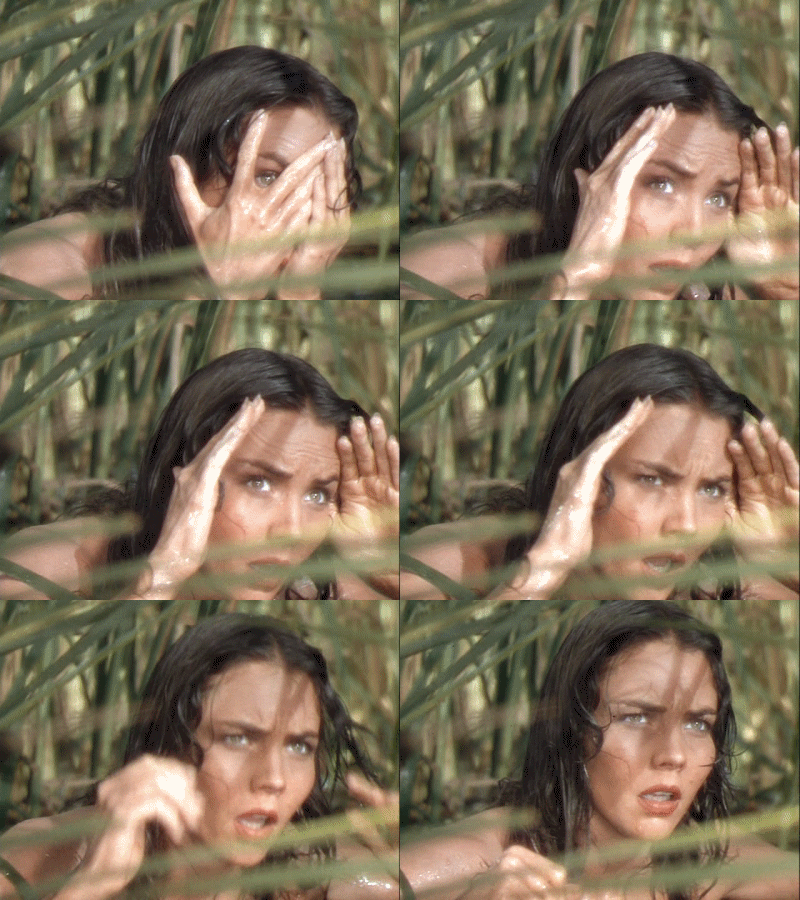
Spanish Bit Ranch is the insular domain of Senator Jackson McCanles; a kingdom carved from the Texas soil in the 1880's and containing thousands of acres of “steers and wire, mesa and windmills and horses, cap rock and barren trail and pleasant river shallows.” A way of life ruled by the Code of the Plains and carefully constructed to withstand the relentless path of progress and interfering outsiders.
But, despite their efforts, the Senator and Mrs. McCanles and their four sons are not destined to go on as they always had. Certainly not with the coming of the railroad and the arrival of a 12 year old Pearl Chavez.
Pearl is a poor niece only remotely related to Mrs. McCanles, but she is no ordinary girl. By eighteen, her brownish-green eyes, ropy black hair, and olive skin seasoned by the Texas sun, had captured the hearts of three young men; hearts soon gripped with jealousy and discontent. When young Pearl chooses the wild and irresponsible second son, Lewt—a match not sanctioned by the McCanles family—Lewt gets into a shooting scrape and has to leave the range and live as an outlaw. In the midst of his son's tempestuous affair, Senator McCanles, an astute but inflexible old-line rancher, finds himself caught in the controversy of the advancing railroad. However, his oldest son, a young and upcoming lawyer, also in love with Pearl, takes an opposing position, and the rift in the family's murky solidarity deepens—Mrs. McCanles begins to drink, sons are pitted against sons, and a father must face the unfaceable.
Novelist, screenwriter and producer, Niven Busch, was, as David Shipman says, "associated with some interesting films at the time when movies were movies". Busch was born in Manhattan on April 26,1903, and died in San Francisco August 25, 1991. He was 88.
Busch's father was born into a New York banking family, was a stock broker at times yet was in the film business and ran a night club in Paris; his mother was British. Niven's childhood was spent in luxury in Oyster Bay, NY, and at a fashionable boarding school. He decided to become an author at the age of 14, when he again saw his name in print when his poem was published in his school magazine. Previously, at about age 9, St. Nicholas Magazine published a few of his little stores and poems in its section reserved for children's compositions. Before he left for Princeton in 1921 he had already sold verses and sketches to such well-known magazines as McClure's. He left Princeton before the end of his sophmore year when his father's firm went broke. He soon connected with his cousin, Briton Hadden who was editor of the new Time magazine. He worked at Time for a number of years, becoming an editor himself. He was also contributing stories and profiles to Harold Ross's budding The New Yorker. He owed much, he later confessed, to Ross's tuition. His first book, Twenty-one Americans, a collection of portraits of current famous Americans which had appeared in The New Yorker, was published in 1931.
In 1932, realizing he had gone as far as he was likely to go as a New York-based magazine writer and editor, Busch decided Hollywood was the place to be, and he had a connection through his father, who was at one time in the motion picture distribution business with Lewis Selznick. And through that connection, Niven met Lewis's son, David. It was David who brought Niven out to Hollywood.
David Selznick soon secured work for Busch at Warner Brothers, and Busch decamped to Los Angeles to write his first film, Howard Hawk's The Crowd Roars (1932).
By the early 1940s, Busch was chief story editor for independent producer Sam Goldwyn. During his stint with Goldwyn, Busch met and married contract actress Teresa Wright. For 21 years he was a screenwriter at such studios as Warner Brothers, 20th Century Fox, Goldwyn, Paramount and Universal, scripting movies which included The Big Shakedown (1934) staring Bette Davis, The Man With Two Faces (1934) staring Edward G. Robinson, and He Was Her Man (1934) staring James Cagney. He was nominated for an Academy Award for best original screenplay for In Old Chicago (1937), a film based on his story We the O'Learys, which climaxed with the Chicago fire of 1871 and one of the most expensive films made at the time. In 1940 he co-wrote The Westerner for director William Wyler and producer Sam Goldwyn. Soon thereafter he went to work as Goldwyn's story editor, recommending Pride of the Yankees (1942), in which Gary Cooper and Teresa Wright starred.
Another notable film of the period, for which Busch produced and wrote the original screenplay, was Pursued (1947) staring Robert Mitchum and Teresa Wright, one of the first psychological Westerns with “noir” overtones. Around the same time, Busch also adapted the noir thriller The Postman Always Rings Twice (1946), for Metro- Goldwyn Mayer. The Furies (1950), from Busch's novel, attracted some scorn for its "Freudian excesses". However, says the London Times, "Busch was always shrewd and knew exactly what he was doing".
"I always wanted to write a novel. I started two or three, then dropped them when a film job came along. I finally figured out the problem: when I was writing a novel no one was paying." But he did find time in 1939; The Carrington Incident, published in 1941, was followed by the best-seller Duel in the Sun (1944), which was purchased by David Selznick and turned into the 1946 blockbuster of the same title. He now alternated between the writing of screenplays and novels, most of w
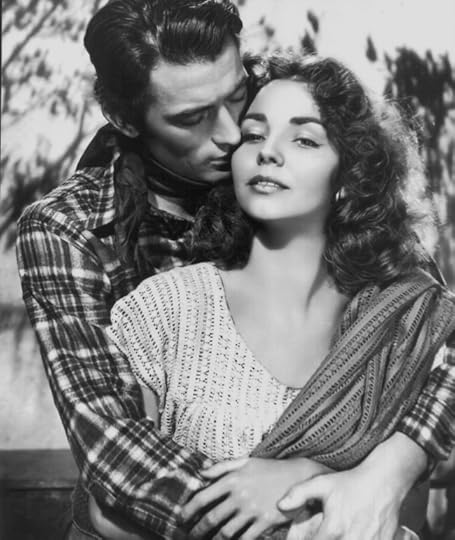
Those of you who have seen the movie starring Gregory Peck and Jennifer Jones are familiar with the story; the book is a bit more detailed and has a different ending.
Surly Senator Jackson McCanles, the despotic ruler of the Texas ranch Spanish Bit, gets a burr put under his saddle by the arrival of orphaned Pearl Chavez. The precocious 12 year-old is a poor distant relation to the long-suffering, secret drinking, mother to four sons, Mrs. Laura Belle McCanles.
The curvy half-breed girl, who is not modest about nudity, inspires an instant fixation in the handsome, spoiled, bad-boy second son, Lewt McCandles. The two become lovers when they are 15 and 17, respectively, and declare themselves affianced by breaking a dime in half. However, Lewt is full of teenage boy swagger and cowboy machismo and blows Pearl off.
When she is 19, Pearl becomes engaged to ranch foreman Sam Pierce, whom Lewt murders in fit of jealous rage the night before the wedding. For the next two years, Lewt lives as an outlaw, aided at first by the Senator’s money, then by a series of robberies and murders.
When Lewt sends a secret message to Pearl to join him in exile, so that they can continue their toxic relationship, the stage is set for a deadly showdown.
Busch works a lot of historical accuracy into this novel, capturing a slice of history - when the West was truly wild, before the arrival of the civilizing influences of towns and railroads. For example, the senator can no longer afford to finance Lewt’s outlaw lifestyle because of “The Great Die-Up of 1887”. I’m sure this book would be just as successful if published today, but the nudity and sex scenes would be more explicit.
Ever want to read Gone With the Wind without the interesting characters, epic historical context, or a plot that moves, but still keeping the racism and adding a bunch of sexual assault? I know I don't. I thought it would be an interesting window to the thinking of a different time, but it ended up just leaving me depressed and bored.
something to think about: settler colonialism males possible naturalization/nativism. myth of rebirth in west hinges on idea that you can escape the past. land is important because it's the literal foothold upon which transformation can take place--from savage to civil (Pearl the Indian orphan to Mrs. McCanles) and from outlaw Texas to dignified place in new society. Also completely ellides history of Indian removal, specifically opening of Cherokee land (same people from long walk, by the way) for settlement. includes news clip from pres Harrison and Pearl and Jesse marry on day of opening. book ends with consummation of marriage and land claim. she's so thoroughly sexualized throughout the novel, we can assume she's have several children and they'll build a house upon this claim. think too about how impotent Sam was drawn and the fact that his house remained empty. Also, how Jesse handles horses, talks about horses, thinks about her being bricked, looks down on the mule sod buster will use. pearl, his mare, is destined for nobler purposes.
The film , with its focus on mutual sexual obsession (at a time when that couldn't be filmed!) is much better. Despite the novel. Pearl Chavez, as portrayed by Jennifer Jones, is no Scarlett O'Hara and the book is no Texas version of Gone with the Wind. Then book though has some good parts: discussion of the railroad and the civilizing of the frontier, cattlemen v nesters, and settler colonization.
Niven Busch’s 1944 novel Duel in the Sun is nearly as preposterous as the epic fail of David O. Selznick’s misbegotten film adaptation. Busch’s far superior later novel, The Furies (basis for Anthony Mann’s much-admired 1950 film), refreshes many of these same Western cliches by cleverly aligning them with Freudian complexes and neurotic impulses.
Picked this up because it's the basis for quite a movie. The story in the book is different from that on film, and each offers something distinct.
As the giant ranches and their owners are gradually losing their fiefdoms - and their corresponding control over the southwest weakens with the coming of the railroad - distant poor relation and half-Mestizo Indian Pearl Chavez arrives at the McCanles Ranch. In spite of the prejudices still holding strong against children born on the wrong side of the blanket and against ethnic parentage, Pearl has literally nowhere else to go. Oldest son and lawyer Jesse extends kindness, but second son and range rider Lew is aggressively sexual with this unprotected girl.
Lonely and essentially unwanted, Pearl is drawn to the something that each of them seems to offer, while father the "Senator" (now an honorary title) and his wife - friends with Pearl's mother - seem powerless to influence the behavior of those around them. Therein lies the conflict we see throughout the rest of the 255-page (in my Popular Library Edition) book, as the railroad brings all forms of "civilization" to the southwest - both welcome and unwelcome.
It's a powerful story of the violence of the times, and the virulent hatreds of both sexes, that hide just beneath the veneer of culture. In the arena of that violence, there are lives that decline, and the lives that, in spite of it all, have the potential to recover and perhaps even prosper. Engrossing read.
The 1946 film starred Joseph Cotton as Jesse, Gregory Peck as Lewt, Lionel Barrymore as the Senator, Lillian Gish as his wife, and Jennifer Jones as Pearl. It was nicknamed "Lust in the Dust" - which may give you an idea of what it had to go through to pass the Hays Code.
Movie was better than the book - which is quite unlike the norm. Pearl kept reminding me of a watered & bland version of Scarlett O'Hara, but much less convincing, gritty or endearing. The guy remains a major disappointment - to Pearl and to me (Especially after expecting Gregory Peck). The climactic nod to domestic demureness is , well, the last straw.
Duel in the Sun proves Niven Busch isn't interested in making friends with the establishment—they're tearing down the sanitized myths that keep us passive.