Jump to ratings and reviews
Rate this book

The 6:41 to Paris

Rate this book
Cécile, a stylish forty-seven-year-old, has spent the weekend visiting her parents in a provincial town southeast of Paris. By early Monday morning, she's exhausted. These trips back home are always stressful and she settles into a train compartment with an empty seat beside her. But it's soon occupied by a man she instantly recognizes: Philippe Leduc, with whom she had a passionate affair that ended in her brutal humiliation thirty years ago.

In the fraught hour and a half that ensues, their express train hurtles towards the French capital. Cécile and Philippe undertake their own face to face journey—In silence? What could they possibly say to one another?—with the reader gaining entrée to the most private of thoughts. This is a psychological thriller about past romance, with all its pain and promise.

146 pages, Paperback

First published January 1, 2013

99 people are currently reading
2150 people want to read

About the author

Jean-Philippe Blondel

40 books82 followers
Jean-Philippe Blondel was born in Troyes, France, in 1964. His mother was a schoolteacher and his father worked for the National Railways. Jean-Philippe still lives in Troyes today after attending university in Paris and travelling around the world, including South and Central America, Nepal, India, and most of Europe.

Writing has always been Jean-Philippe’s way of expressing himself. He started writing poems when he was seven, then moved on to short stories as a teen. He wrote his first novel when he was 19. One book that had a profound effect on him as a child was Alice in Wonderland: he tended to identify with the White Rabbit…

Jean-Philippe’s favorite subjects at school were languages: French, English, and Spanish. He remembers telling his parents, at the age of 12, that he wanted to be an English teacher, which he’s been for the last 20 years in a high school.

Since no one in his family was particularly interested in literature, Jean-Philippe often wonders how reading and writing took on so much importance in his life—and at such an early age. However, books became his life-support when, at the age of 17, he lost his mother and brother in a car crash, and his father in another crash four years later.

His novels—for adults, young adults, or teenagers—are always based on everyday life. He writes in the first person because he wants readers to identify closely with the narrator, whom he tries to portray as the person next door. His novella, A Place to Live (2010), takes place in a high school. It is a very special text for him and reading it aloud always evokes strong emotions. He dedicated it to a class which he taught for three years: he had so enjoyed watching his students grow up and evolve that he wanted to offer them something special when they graduated. He read it to them during their last period together, and even now, several years later, thinking about the moment moves him deeply.
Jean-Philippe writes with the earplugs of his MP3 player in. He carefully selects one song before writing, and it becomes the original soundtrack of the novel. He listens to it over and over, sometimes forgetting everything else, including where he is and what he’s doing there. It gives him the opportunity to live two lives at the same time—a fictitious one (because he so identifies with his narrators) and a real-life one. In the latter, he is married to a primary school teacher and has two daughters, aged 8 and 11. His favorite activities are teaching, writing, reading, and rock music. He is working on his eighth novel for adults, which also explores the boundaries between teenagers and “so-called” grown-ups.

Ratings & Reviews

What do you think?
Rate this book

Friends & Following

Create a free account to discover what your friends think of this book!

Community Reviews

5 stars
341 (14%)
4 stars
920 (39%)
3 stars
832 (35%)
2 stars
214 (9%)
1 star
39 (1%)
Displaying 1 - 30 of 384 reviews
Profile Image for Ilse.
552 reviews4,437 followers
November 21, 2025
Life is priceless
even to an ant.

― Xiaobo Liu, June Fourth Elegies

ant
Lilith Ohan, Ant

I love trains. And reading on trains, just like the characters in this slender novel do. Cécile Duffaut. Philippe Leduc. A woman, a man, both 47, two former lovers ending up in a pesky huis-clos situation seated next to each other in the crammed early morning train from Troyes to Paris, after having lost sight of each other 27 years ago. Recognizing each other, but pretending not to. Embarrassed. Not talking. Alternating chapters voice their inner monologues, both ruminating separately on what have been their lives so far, their children, careers, marriages, youth, families, personal growth and decline, success and failure –and what happened 27 years ago between them.

If you by now imagine (or hope for) the beginning of a variation on the conversation between Franz and Sabina on the train to Geneva in The Unbearable Lightness of Being to occur (You travel by train? Always. I love trains. They are so erotic.) you might have to write that story yourself. This isn’t such a tale.

Instead follow musings on cruelty, regrets and sense of guilt. There is a seething resentfulness in the air, anger, bitterness as well as melancholy and nostalgia. Look at them, from the corner of your eye, just like they try to throw glances at each other, unnoticed. While time has been most kind to mousy Cécile, who turned into an attractive, distinguished business woman, it hasn’t to former golden boy Philippe, looking grey, vague and paunchy, pitiful. Ostensibly the tables have turned. Or are appearances simply as they so often are - deceptive?

9c6ddca04df7102b5d45d96085f59c1e

What Becomes of the Broken Hearted? Can such a short term affair which happened so long ago possibly affect one in such a profound, life-changing way? Slowly the mysteries surrounding the antics of their break –up and the endurance of the hurting unveil. And how hard it is to ask for and grant forgiveness!

Ants are swarming over the pages, as ants are essential to the plot – and there is slight reminiscence of the fable of The Grasshopper and the Ant. For you to find out if the Ant will show mercy of the Grasshopper this time. If wondering how to classify this tale, as it is short, is set on a train and has a gracious open ending, I would consider it passable commuting literature (thank you, Lisa, for naming this subgenre).

Adieu, adieu, sweet Bahnhof, my train of thoughts is leaving.
4edd288cbd69f76c0abbaf46e9eca4c1
Christian Lemaire, Le dernier train, Gare Saint Lazare, Paris, 1958.
Profile Image for Jim Fonseca.
1,163 reviews8,492 followers
November 2, 2023
Two passengers, a man and a woman, sit next to each other on a several-hour train ride to Paris. Each recognizes the other as a partner they had an affair with 27 years ago. It ended in disaster, especially for the woman, who still considers it the most humiliating experience of her life.

description

Do they speak? Is either of them even sure the other recognizes them after all those years? If they speak, what do they say? “Oh, hi, how have you been?” LOL

So the novel becomes two interior monologues as each goes over their current life situation, analyzes the aging of the other, and assesses where they think the other person is at. Married? Kids? Career? Each thinks back to how they met, how the relationship progressed, and how it dramatically ended.

Meanwhile we learn a lot about each from their own and from each other’s thoughts.

The woman is 47 now; the man about the same age.

The man reviews his life and thinks

The tension builds as they get closer to their destination and each weighs the risk of starting a conversation.

Here’s a line that summarizes the moral of the story: “Everything goes so fast, but twenty-seven years later, it is all still there.”

What they don’t know about each other is also a good part of the story.

The story reminds me of two other novels I’ve read of a man and a woman romantically involved long ago and then getting back together later in life. One is Love in the Time of Cholera and the other is Journey into the Past.

description

In addition to being a writer, the author (b. 1964) is a high school English teacher in France. He’s a prolific writer with two-dozen novels published. Many are young adult stories. About four have been translated into English. This one, The 6:41 to Paris, is his big hit and it has been translated into ten languages.

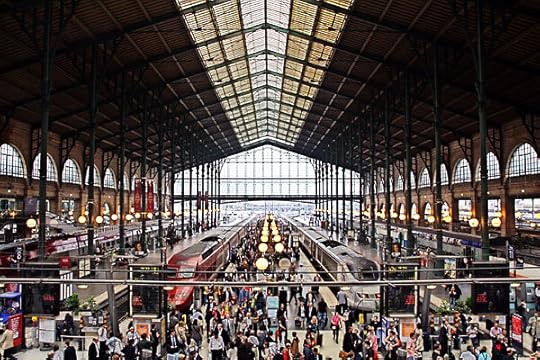
Top photo, Gare du Nord in Paris from Wikimedia Commons
The author from frenchculture.org

[Spoilers hidden 8/22/22; edited 11/2/23]
Profile Image for Diane.
1,117 reviews3,199 followers
November 19, 2015
Have you ever done something so cruel to another person that it still haunts you decades later? What if you suddenly ran into that person today? Would you have the courage to apologize?

I do not know Jean-Philippe Blondel and I have not read any interviews with him, but I would guess those questions prompted this lovely and haunting novel. I was completely absorbed in this book from the first page, and when I had to set it down, I couldn't wait to return to it.

Cecile and Philippe haven't seen each other since they dated in college, which was more than 25 years ago. By chance, they end up sitting together on an early morning train into Paris. They recognize each other, but don't acknowledge it. Cecile is still angry over how she was treated, and Philippe is embarrassed and anxious. The chapters alternate between what each person is thinking, and we slowly learn about their former relationship, their breakup, and their complicated lives since then.

Let me reiterate that these two people are stuck on a moving train. The car is full, so changing seats would be difficult. Each person has things they want to say to the other, but neither knows how to begin. For some, this could be considered a horror story.

This is a short novel in which not a lot happens other than people thinking and remembering, and desperately trying to figure out how to act in this awkward social situation. The tension builds as the train gets closer to Paris, but I am not going to spoil what happens.

All I will say is that I freaking loved this book. I loved the simple and elegant writing. I loved the way the characters slowly unearthed memories they thought had been buried. And I loved how Cecile and Philippe each considered their youth and how they've changed in middle age.

I recognize that not everyone will appreciate this novel, especially if you don't like stream-of-consciousness writing, or if you want a story with more action.

But to everyone else, I say jump on the train to the nearest bookstore and find a copy. You never know who might be sitting next to you.

Favorite Quote
"I didn't want to be an observer anymore. Someone who absorbs. Someone who keeps to one side and stares out at the spectacle of the world with indifference. I wanted to be in the world. Really in it. I didn't want to be an artist. I wanted to be a protagonist. I wanted to live passionately, with love and hate and scorn. I wanted to throw myself on the bed weeping floods of tears, tearing my hair out in despair, jumping for joy, flinging my arms around people, holding their hands, holding a hand — and leading the dance."
Profile Image for Adam Dalva.
Author 8 books2,159 followers
July 11, 2019
I enjoyed this slim book, though Blondel's more recent EXPOSED is much better. The idea is great: two leads sit next to each other on the train, each recognizes the other, neither mentions it for the same reason: things ended badly. In the 27 years since, one has risen in the world, the other has collapsed. Each thinks about the past, and their present, and the reader gets more and more tense. Are they going to talk? But some odd clunkiness in the writing - lots of unimportant one paragraph sentences.

Like this.

Distracted me. A quick airplane read, with some depth. And will leave you wanting more, in the best of ways.
Profile Image for Carol.
1,370 reviews2,351 followers
April 13, 2017
2.5 Stars

On THE 6:41 TO PARIS, two old flames find themselves uncomfortably stuck sitting next to each other on the train. For nearly the entire trip, both Cecile' and Phillipe remain silent ignoring each other, but relive (in their minds) an unpleasant and humiliating encounter of thirty years ago.

By the end of the awkward trip, a brief conversation ensues (which I will not divulge) that brings the commute and novelette to a close.

Overall, a somewhat interesting and unusual read with a, sorry to say, Ho-Hum ending.

(may round up to 3 Stars after I digest awhile???)

Profile Image for Elyse Walters.
4,010 reviews11.9k followers
June 13, 2016
"For thirty seconds or so I saw through to my future--and then a door slammed shut. It took me more than fifteen years to open it again. They weren't lost years. It took me that long to come to terms with everything I was feeling that night."

"I liked to reassure him. I would cling to his back without saying anything. I knew that talking would be the worst thing. So I put my hand between his thighs and my lips on his shoulder blades and stay there without moving. I closed my eyes. I tried to imagine everything that was going through his mind--bits of conversations. locker room bragging, clips from porn films, and other dream-like sequences of drownings or
fires or railroad disasters. And then gradually the calm would return. Memories of a deep blue lake in the mountains. Walking along the ocean. Slowly, beneath my fingers,
he would regain his vigor. I know that he liked this about me. My discretion. My patience. Then I would take over, still ever so gently. That's what he needed, gentleness. That's why our affair lasted for months and not days. That's why I was so angry with him afterward".

Phillippe sits next to Cecille on the train...."The 6:41 to Paris". They have not seen each other for almost 30 years. They had a passionate affair which ended heartlessly.
It's unbelievable, sometimes, the sudden turn life can take.
Cecille is pretending not to recognize him.

Their thoughts are compelling. Cecile and Phillippe each question their self worth...shielding their emotions. They each re-visit old memories...often depicting the awkward moments.

I had the privilege of listening to Jean-Philippe Blonde speak recently. I came away higher than a kite. He left me exhilarated....( I believe everyone in that room felt much the same). ...My desire to read more international books have increased.

Jean-Phillppe Blonde's book left me satisfied emotionally -and intellectually .....
......I especially felt the powerful vulnerability through his use of duel narrative.

Spare and elegant, yet is filled with feelings and tension of things these two character don't ever say.

LOVED IT!!!!!!
Profile Image for Carol.
410 reviews455 followers
April 13, 2017
**2.5 Stars**

Two mostly unlikable characters spend way too much time navel gazing over a mortifying incident from a brief affair 30 years in the past. Unique story but ultimately disappointing for me.
Profile Image for Rae Meadows.
Author 11 books446 followers
July 30, 2016
What a conceit! So good. Two forty-seven-year-olds, Cecile and Philippe, hardened, wearied by life, end up next to each other on the train from Troyes to Paris. They recognize each other--they'd had a four-month relationship when they were twenty, which had ended in anger and humiliation--but neither acknowledges the other. They sit in strained silence, reflecting on what happened twenty-seven years before. Soon they are examining choices made their whole adult lives and attempting to come to terms with those choices or at least give them narrative shape.

For the first third of this book I was in three-stars territory--I found the characters cold, the writing stilted, too many cliches for comfort. I thought maybe it was a translation issue. But then the book really started to gel and the last third was excellent. I will not give away the ending but I found it incredibly moving, exactly right.

I liked that Cecile had fared better than Philippe in her appearance and success in the ensuing years and the way this played with the power dynamic they once had. Neither is that likable a character but they have such pathos. There is a real tautness in how the novel unfolds. Will they talk to each other? Will they make some sort of middle-aged amends? I agree with GR friend Jenny (Reading Envy) who notes the parallels to the Richard Linklater Before Sunrise/Before Sunset/After Midnight movies--I also love these movies--but Blondel's novel is much darker. And French, of course, so the sensibility is different. At its heart The 6:41 to Paris is a deeply melancholic book. Definitely recommended.
Profile Image for Julie.
561 reviews310 followers
February 16, 2018
If you didn't bring anything to read, and all the newspapers have been grabbed up, and the wi-fi isn't working, by all means, ... waste an hour on this one.

Nobody from any planet, in any galaxy, would behave this way, let alone two ex-lovers. If you didn't slap (him) then you'd have at least a few choice words. Or you'd have the decency to move. Something real. You certainly wouldn't do what she did, in the end. A man's egotistical dream. I vomit in their general direction.

It was only OK, because it didn't send me into a complete coma. I was awake enough at the end to toss it into the bin near the exit.


Profile Image for Marc Lamot.
3,462 reviews1,976 followers
May 8, 2021
This seemingly simple story (you can read it on 1 long train ride - pun intended) offers quite a few questions about life: do events from long ago still affect our lives?, how can negative experiences change a way of life?, what a diversity of experiences people build up in 27 years?, what is success if you are in middle age?, can you really completely throw your life around?, etc.

That’s quite something, isn’t it? And it is the merit of Blondel that he wrapped this all up in a short story in which 2 people who once had a relationship, happen to sit next to each other 27 years later in a train, they recognize each other but dare not say anything, and all that time in their mind their lives pass by and they evaluate what happened then and what their live has become since. It’s a bit like in a theater play. Interesting, but all in all it remains rather superficial (how could it be different, in such a short story?), and the end is reasonably predictable. Nice read, though.
(2.5 stars)
Profile Image for Jennifer.
350 reviews448 followers
January 10, 2016
"The 6:41 to Paris" is a most unique and thought-provoking book.

Forty-seven year old Celine is on a crowded train back to her home in Paris after visiting her aging parents for the weekend. The train stops and more passengers board. A gentleman asks if the seat next to her is available. Both Celine and the gentleman (Philippe) realize at the same time, and too late to change seats, that they know each other. Nearly thirty years prior they had a short, but passionate affair that ended very badly. They haven't spoken since, yet the affair and its end have deeply affected who they have each turned out to be.

Told in alternating chapters, the reader is privy to the thoughts in Celine and Philippe's minds. We learn their stories and their history with each other. The author lets us ask ourselves questions about the extent to which mistakes of youth can impact another person's life; what we might say to someone who has hurt us; and how to forgive.

I love books about complicated relationships, and I was thoroughly enjoying this book
Profile Image for Jodi.
546 reviews236 followers
February 21, 2024
A short novel, with chapters alternating between Philippe and Cécile as they sit thinking about their 4-month relationship that ended very badly—with embarrassment for Philippe, and humiliation for Cécile—nearly 30 years ago.

Cécile has a window-seat, returning home to Paris after a weekend in the suburbs with her ageing parents. Philippe boarded the same crowded train to visit a childhood friend who lay dying in a Paris hôpital. He is stunned to realise, too late, that the “Non” reply to his “Is this seat taken?” query has come from none other than her. Of course she, too, notices too late, and now the two sit horrified—seething and hoping the other hasn’t recognised him/her.

Surprisingly, their recollections are quite similar. What’s different is what has become of each of them over the preceding 27 years. In a satisfying twist of fate—for her at least—is that the tables have completely turned.

3.5 “People-change-Memories-don’t” stars ⭐⭐⭐⭐
Profile Image for Jessica J..
1,082 reviews2,507 followers
February 22, 2016
"You never imagine that certain phrases can stick, buried in your skin like splinters, and that at certain moments in life they come back and wreck everything."
Have you ever experienced a break-up that stays under your skin, even against your better judgement? It’s not so much that the relationship meant something extraordinary or even so much that you long to be with the person again, but even after you’ve made peace with the fact that you are better off without that person in your life, you can’t quite patch over the hurt completely.
Maybe there were criticisms that kept you from growing in a direction you wanted to go. Maybe you worry that the mean words were true and everyone else believes them, too. It made you feel just a little less sure of your self-worth and you never quite got it all back. You’re back at, like, 98% but even after you’ve moved on and found a new partner—married, even, started a family—something small might pop up to remind you of that person and it’s all too easy to remember the hurt that you felt way back when.

I’ve definitely been there, done that. A lot of the sadness that I felt and had a hard time dealing with had less to do with that I missed him or wanted to rekindle things between us than it did with the fact that he’d somehow figured out how the trip wires for all of the deepest insecurities I felt about myself at that moment in my life. I know I responded badly to the situation at the time—so, so badly—and there have definitely been moments over the years when I find myself thinking about what I’d say to him if I ever crossed paths with him again. As more and more time has passed, that inner dialogue became less I’m sorry I didn’t handle that so well and more Now I know it really wasn't me, it was you..

That kind of inner dialogue is what inspired this book. If you come to it based on the marketing copy’s description of it as a “psychological thriller,” you might find yourself incredibly disappointed. This book is perfect for fans of movies like the Before Sunrise trilogy where not much happens except for introspection and conversation. It’s tense but it’s not very plot heavy, with most of the narrative taking place in the characters’ heads as they sit aboard the 6:41 train to Paris, awkwardly sitting next to the lover they were with for four months 27 years earlier.

Cecile and Philippe have both moved on in the decades since their brief relationship. They’ve even been able to go years without thinking of one another. Then they realize that they are trapped in a crowded train car, sitting next to each other, unable to escape, and they spend the ninety-minute commute in alternating chapters, thinking about the way things were and whether or not they should say something or just bite their respective tongues and get through it.

It’s kind of like anxiety porn, so maybe that’s your idea of a psychological thriller.

I remember once, after I’d already met the guy who’s since become my husband, my friend told me that she’d bumped into the douche canoe and he’d either asked, “Hey, how’s Jessica?” or she’d proactively offered up a “Have you heard how well she’s doing?” on my behalf. Either way, he’d learned how I was doing and I spent the next two days fighting off an intense anxiety attack. I had no means of responding to him or even a desire to do it, but just thinking about it reminded me of all of those negative feelings I’d had to work so hard to get past. After maybe 48 hours of stewing, I forced myself to go into my email and find a message to myself called things to remember. It was something I’d written years earlier and would read whenever I was feeling a little bummed about a bad date or subsequent relationship snag, reminding myself of different platitudes like, “You are better than the way he treated you,” and “Holding onto hurt feelings doesn’t affect him, it just keeps you from growing.” Reminding myself of those thing was the only way I could process the anxiety that I was feeling.

After I read this book, I remembered that email which is still buried at the bottom of my inbox, though I hadn’t reread it in a long, long time. It was weird to go back and see all those things that seem so obvious to me now but which I needed so much help remembering at different, lower points in my life. The experience of having gone through that break-up was an awful one, but it was a formative one and I ultimately appreciate the things I learned by having gone through it.

This book was lovely and authentic. Because of its brevity, Cecile and Philippe sometimes feel a little stereotypical, but their emotional experiences struck me as universal. It's the kind of thing that forces you into self-reflection but it never really falls into anything overly syrupy or melodramatic. I loved the experience of reading this book and I think it’s something that could easily appeal to a wide array of readers.
Profile Image for Jenny (Reading Envy).
3,876 reviews3,710 followers
July 26, 2016
Does a lover ever leave you, and do regrets/hurts ever heal? In this very slim novel, two former lovers end up seated next to one another on the train, thirty years past their breakup. The short chapters alternate between the man and woman, with almost all of it the internal dialogue. Cécile and Philippe (hmm, is the author self-referencing here?) ruminate on their relationship's failure but also their current situations, how each of them ended up vs. where they were, and what happened in between. I was left feeling I learned a lot about each of them. The author could have left it at that, but he gives us brief moments of interaction between the two that are so awkward and painful that it really added to the internal agony each of them was feeling. Having just returned from my 20 year highschool reunion, I kind of know the pain.

My favorite movies of all time are the Ethan Hawke/Julia Dempfy "Before" movies - Before Sunrise, Before Sunset, Before Midnight. It isn't just the train element that is similar but this idea of two people who have so many decades between them, and the dialogue that occurs in an enclosed space. In the films, it happens in conversation. In this book, it happens internally, but the effect is very similar.

(Thanks to the publisher for sending this title my way! I'm so happy to be discovering more independent publishers doing great translation work, giving us access to titles like this one.)
Profile Image for Julie Ehlers.
1,117 reviews1,604 followers
September 25, 2016
I like most kinds of books, but if I had to point to a particular type of book and say, “This is exactly the kind of book I like,” The 6:41 to Paris would be exactly the kind of book I would point to. The chance meeting! The awkwardness! The interior monologues! The hurts from decades earlier coming back to the surface! I loved just about all of it. I related to some of it. My only complaints: (1) while I liked the ending, I didn’t feel entirely that it was earned; and (2) if I were these people, I absolutely would not have sat in silence for so long. Say something, people! These are minor criticisms, though. Both in real life and in fiction there’s a lot of fun to be had on a train, and The 6:41 to Paris is a stellar example of this.
Profile Image for piperitapitta.
1,050 reviews465 followers
March 2, 2018
C'è un treno che parte alle 6.41…

Ci vogliono un paio d'ore per leggere questo breve romanzo, poco più dello stesso tempo che i due protagonisti impiegano per recarsi in treno da Troyes a Parigi.
Un incontro casuale, due posti vicini l'uno all'altro, Mi scusi c'è qualcuno di fianco a lei? domanda Philippe a Cécile un attimo prima di riconoscerla, un momento prima che lei alzando gli occhi e scuotendo la testa per dirgli di no, che il posto è libero, faccia altrettanto; e inattesi si scatenano i ricordi di una vita, quelli di due storie che corrono parallele, dopo un breve incrocio avvenuto a vent'anni, e che sembravano destinate a non incrociarsi di nuovo.
Rancori dimenticati ma mai sopiti, due vite che si oppongono l'una all'altra, fallimenti e realizzazioni che in quasi trent'anni hanno sovvertito ogni previsione. Lui era bello e destinato al successo, lei anonima e insignificante, ma ora è lei, che forte della sua conquistata autonomia e della sua matura bellezza, osserva lui, un uomo invecchiato male sul viale del tramonto fisico e emotivo.
Poche pagine, appunto, periodi brevissimi, pensieri che corrono senza interruzione sulle rotaie del treno, cullate e sballottate dall'indecisione, dall'ammirazione e dal rancore, dal pentimento e dalla rabbia. Pensieri che ancora non sanno se trasformarsi in parole o anche solo in un gesto.
Non è un capolavoro, niente affatto, forse nemmeno un libro da consigliare, ma solo un specchio in cui guardarsi per ripensare alle proprie occasioni perdute.

Nessuno ci ha mai avvertiti che la vita è una faccenda lunga.
Che gli slogan che fanno battere il cuore, i «vivere a cento all'ora», i «morire da giovane» - tutte 'ste cose, sono solo balle.
Nessuno ci ha mai detto neppure che la cosa più dura non sono le separazioni, ma il declino. Lo sbriciolarsidelle relazioni, degli esseri, dei gusti, dei corpi, della voglia. Fino a una specie di palude in cui è impossibile sapere cosa ci piace. E quello che ci fa schifo. Una condizione che non è poi così spiacevole. È solo un'atonia. Con qualche macchia di luce qua e là.
Profile Image for Suzanne.
500 reviews292 followers
February 5, 2016
Awkward! So what do you do when you’re sitting on the train, exhausted after visiting your elderly and difficult parents for the weekend, and who sits down beside you but a jerk you dated briefly 27 years ago (not seen since), whose behavior through an upsetting incident literally influenced who you subsequently became. That’s the premise of the short 146-page novel, a story told through flashbacks to that earlier time and ruminations on their lives since then, from the alternating viewpoints of both the man and woman as they both pretend to ignore/not recognize the other. This was a quick, entertaining little two-day read, a page-turner dealing with relationships, fate, gaining insight into our own behavior over the years, why we make the choices we do, and the incidents that drive our destiny.
Profile Image for Rebecca.
4,185 reviews3,448 followers
March 2, 2017
Forty-something Cécile Duffaut is on a train back to Paris from Troyes, where she’s been visiting her ageing parents. Having gotten such an early start, she’s looking forward to 95 minutes of reading and relaxation. That is, until she realizes that the man who sat down in the empty seat beside her is Philippe Leduc, who was her boyfriend for a few brief months about 27 years ago – before he broke things off in a horrible way in a London hotel. Each recognizes the other but pretends not to; as the ride progresses the narrative switches between them as they plunge into their memories of their short relationship and the changes the intervening decades have wrought in them. What I most liked about this zippy novel is that it takes about as long to read as the train ride is supposed to take, so as they approach Paris you get increasingly anxious to know whether they’ll acknowledge each other and their shared past.
Profile Image for Gabril.
1,043 reviews255 followers
March 14, 2018
Breve romanzo, breve come un viaggio in treno. Nel treno delle 6.41 che dalla campagna torna a Parigi.
Intenso, come può essere un viaggio in treno quando si incontra qualcuno che rappresenta una parte significativa di sé, del proprio passato. Forse una parte che era più comodo dimenticare e che invece riaffiora, diventando il pretesto per fare un bilancio della propria vita; un viaggio perlopiù malinconico verso le intemperanze e gli inevitabili errori della giovinezza.
Certi ricordi, poi, sono imbarazzanti, fastidiosi...ma sono anche la dolorosa apertura di una ferita che sembrava, sembrava soltanto, già guarita.
E invece “non si pensa mai che certe frasi possono restare inchiodate, piantate come schegge -e che possano ritornare per devastare ogni cosa in certi momenti della vita”. E non solo le frasi. Anche i gesti, le azioni, il contatto dei corpi, il loro dialogo muto. La loro brusca separazione.
Insomma: tutto ritorna per Cecile e Philippe, nel breve tempo in cui sono seduti accanto, sul treno delle 6.41, e fingendo di non conoscersi ripercorrono interiormente la strada che la loro vita ha intrapreso, seguendo piste inaspettate.
Il finale sospeso lascia al lettore la possibilità di fantasticare sulla direzione che prenderà il loro incontro.
Profile Image for Melinda.
1,020 reviews
August 12, 2016
The dual narrative provides a psychological and emotional glimpse into old wounds of two former lovers as their paths accidentally cross after many years. An emotional and affecting train ride. Tension builds as each party reveals their recollection along with feelings of hurtful event.

Characters revisit choices made in youth, regrets, hurt, anger all untangled as the story of the former lovers is exposed. An inadvertent meeting sparks a journey of healing when all is said and done. A raw old wound cleverly and openly exposed with the remorse, and anguish blistering to this day, a fateful meeting providing closure after much time has passed. Reflection of past and present and what could or could not have been.

Anyone enduring hurt of any kind without closure will relate to this story. I personally found my own experience parallel to the two characters. Luckily my offender tracked me down after 20+ years to apologize and seek forgiveness - accepted and granted. His olive branch offering provided much and was an unexpected surprise, needless to say it made a huge impact in my life. Youth is ignorance but cruelty is never acceptable.
Profile Image for Connie  G.
2,143 reviews710 followers
December 20, 2018
There is only one seat left in the crowded train car when Philippe boards. He finds himself in an awkward situation sitting next to Cecile, a former lover. Their parting, twenty-seven years ago, was very hurtful. The pain made Cecile stronger, and Philippe feels guilty for his bad behavior. They pretend not to recognize each other for a while as the book alternates between their internal monologues. The story shows the psychological journey they have taken from being twenty-year-old students to becoming the middle-aged man and woman they are today. "The 6:41 to Paris" is recommended for readers who enjoy character studies and stream-of-consciousness writing.
Profile Image for Blair.
2,038 reviews5,861 followers
March 17, 2016
Two former lovers end up sat next to one another on a train - the 6:41 to Paris. Twenty years earlier, their affair ended badly, but they are now both much changed. The narrative switches between their points of view as, without speaking to one another, both relive their short relationship and the disastrous events of the night they broke up. The publisher's blurb for this describes it in an odd way - 'a psychological thriller about past romance' - which isn't, in my opinion, accurate; it's more like a smart, subtle romantic comedy, though it's just as compelling as a thriller. It's also rather too short, and I would've liked to read more about these two fascinating characters, but the book's brevity would, admittedly, make it absolutely perfect for a train journey.
Profile Image for Negin.
775 reviews147 followers
March 5, 2017
This book is quite unique. It’s about former lovers ending up on a train almost thirty years after a horrible break-up. Although there’s barely any dialogue, the writing style is excellent, and it’s a short and quick read. It’s riveting and I simply had to finish it one day. As with any book, it’s won’t be everyone’s cup of tea, but for me it was an engrossing read.

Profile Image for Grazia.
503 reviews220 followers
August 7, 2017
Nel mezzo del cammin di loro vita Philippe e Cecile, ex fidanzati (termine un po' demodè, ma non saprei come definirli altrimenti), si ritrovano seduti fianco a fianco sul treno delle 6.41 per Parigi.

Esordio irresistibile, molto intrigante.

Poi. Lo svolgimento.
Fingono di non riconoscersi, perchè le modalità con cui era avvenuta la fine del loro rapporto, si intuisce non essere stata proprio una passeggiata (per sapere cosa è successo tra i due bisogna però completare la lettura)

Questo non riconoscersi, questo far finta di nulla nonostante l’estrema vicinanza, fa partire i pensieri, alternati, dei due, che cominciano a fare un bilancio delle loro vite più o meno a partire dai tempi della loro passata relazione.
Le prospettive dei due son ribaltate rispetto il tempo della loro passata relazione : Cecile, un tempo insignificante, ora pare essere una donna di successo, vita famigliare apparentemente armoniosa, fisicamente "ben conservata" per l'età che ha.

Philippe, un tempo il più ambito della classe, appesantito dall'età, e triste... ma proprio triste triste. Non voglio svelare, ma basti un particolare per capire il personaggio, per tirarsi su di morale, ha bisogno di andare a pranzo dalla mamma del migliore amico d'infanzia (questo particolare credo sia abbastanza esplicativo)

Questo romanzo, seppur ben scritto, non mi ha tanto soddisfatto.
Ho messo tre stelle, ma sono proprio scarse.
Perché? Mi pare sterile lo svolgimento, l’idea cosi’ carina, non è stata sviluppata con sufficiente originalità , e i pensieri dei protagonisti, seppur in alcuni casi condivisibili, diventano un po’ un'esposizione di luoghi comuni.

La curiosità di sapere che cosa mai avesse fatto Philippe a Cecile è il motore che mi ha spinto ad arrivare al termine della lettura.
Profile Image for Morgan .
925 reviews246 followers
May 27, 2020
Told almost completely through the inner thoughts of two people sitting on a train.

This is a novel of introspection. Cécile and Philippe, now in their late forties, had a brief affair twenty-seven years ago. It ended in a humiliating scenario for Cécile who, in time, moved on with her life, or did she?

Seeing Philippe again, so suddenly and unexpectedly, could only bring all the repugnant memories rushing back. Should she be glad to note that Philippe is no longer the once handsome boy that so destroyed her?

Philippe is stunned by the memories of what a cad he had been, and really, has he changed all that much? At the very least this moment has brought about a tinge of regret. As he takes note of the fact that the once drab Cécile appears now quite fashionable and even, yes, a little attractive, would an apology be apropos after all this time?

Neither one speaks, both pretending not to recognize the other until the train is at its destination.
The ending leaves the reader with a question.

*Thanks to my elderly neighbour who has kindly left me a few books at my door.*
Profile Image for Malacorda.
598 reviews289 followers
August 9, 2017
L’idea è piuttosto originale, ci sono invece carenze nello sviluppo: lui e lei che si incontrano casualmente dopo oltre 25 anni, quello che vorrebbero dirsi che invece viene detto a sé stessi nel silenzio dei propri pensieri, le due rispettive vite che vengono ricostruite attraverso due monologhi interiori. La lettura scorre bene, una specie di “sliding doors”, però rimane molto superficiale e in alcuni passaggi anche un po' banale.
Profile Image for Lauren.
301 reviews35 followers
April 8, 2022
Oh Dear Me ,My favorite kind of book- the unexpected turns in life wether they are good or bad or things you would rather forget or hold onto forever. I love this part of life ,somewhat imaginary falsely romantic ,and so damn hopeful. that which makes us keep going on and keeping an open heart ,watching the world go by with great optimism. a new writer to follow- thank you Ilse ,who has led me to so many new reads and new worlds. merci merci.
Profile Image for Roberto.
627 reviews1 follower
July 29, 2014
Cécile e Philippe si ritrovano seduti l’una accanto all’altro sul treno affollato delle 6.41 dopo trent’anni dalla brusca fine della loro breve relazione.

Fare finta di niente? Ignorarsi? Iniziare a parlare? Cosa dire? Chi inizia? Mentre i due si fanno tutte queste domande, iniziano a ricordare, a fare bilanci. E lentamente ci trascinano in questi loro ricordi.

Cécile ha fatto tesoro dell’esperienza vissuta con Philippe, ha preso il controllo delle proprie debolezze, ha un lavoro di successo, un marito e una figlia. Philippe, invece, non è riuscito ad ottenere il successo cui sembrava destinato ai tempi dell’università.
Tante le considerazioni: la normalità, che da giovani si ritiene banale, viene forse vista quando siamo maturi come la base per la nostra felicità. Le differenze e le incomprensioni tra generazioni diverse rimangono sempre le stesse. L’impatto delle esperienze negative fatte da giovani sul carattere. L’inutilità dei rancori per cose avvenute tanto tempo prima.

“Non si pensa mai che certe frasi possano restare inchiodate, piantate come schegge – e che possano ritornare per devastare ogni cosa in certi momenti della vita.”

Lo stato d’animo dei due protagonisti è descritto in maniera minuziosa. Il libro è breve, ben scritto, scorrevole, ma nel finale secondo me cala parecchio di tono. Troppa rabbia, troppo rancore, troppa malinconia.
Profile Image for Siv30.
2,783 reviews192 followers
January 31, 2018
ססיל ופיליפ לא התראו מאז ימי האוניברסיטה לפני 27 שנים. הוא בן 50 היא בת 47 והם נפגשים במקרה ברכבת הבוקר של 6.41 לפריז.

מים רעים חלפו בין סיסיל ופיליפ שהיו בני זוג למשך 4 חודשים. את הימים האחרונים לזוגיותם הם בילו בלונדון והבילוי הטראומטי שינה את חייהם.

סיסיל הפכה עם השנים ליזמית מצליחה וזוהרת. פיליפ שקע אל תוך השיגרה המשמימה שכללה זוגיות נכשלת, גירושין ושני ילדים שמעדיפים את בן זוגה החדש של אימם על אביהם.

הנסיעה הזו היא הזדמנות לחשבון נפש נוקב של סיסיל ופיליפ.

הרומאן כתוב בצורה מעניינת ורובו מתרחש בראשיהם של הדמויות המרכזיות שכמעט אינן מחליפות מילה במהלך שעתיים נסיעה.

יחד עם זאת הוא לא מפעים ולא מצאתי בו רוממות רוח. הוא פשוט מתאר סיטואציה קרובה אליה נקלעו שני אנשים שלא ברצונם. סיטואציה שיכולה לקרות לכל אחד. שניהם לא מתעלים על עצמם במהלך רוב הנסיעה וסוף הסיפור נותר פתוח.

זה גם לא רומאן אמיץ עם דמויות שמותירות את חותמן. גם סיסיל וגם פיליפ הן דמויות אפרוריות ושגרתיות. למרות ניסיונותיו הנואשים כמעט של הסופר להרים את הדמות של סיסיל ולטעון, אפילו לא לרמוז, שהיא אדם שמושך תשומת לב, עם כריזמה ויצרתיות. כל אלה לא ניכרים בדמות שברומאן. גם הניסיונות להכניס מימד נוסף בסיפור על מתייה לא מצליחים.

כך שנהנתי מקריאה הקולחת ומאידך אני חושדת שעוד יומיים לא ישאר לי הרבה ממנו.
Profile Image for Abby.
207 reviews87 followers
April 28, 2016
3.5 stars

I seldom buy, borrow, or otherwise acquire books I've never heard of. But once in a while, I take a flier. This was one of those times. The 6:41 to Paris caught my eye in two different bookstores in Cambridge and the second time I took it home. It turned out to be a happy diversion for a cold winter day.

Two people who haven't seen each other since a nasty breakup twenty-seven years ago find themselves sitting side by side on a crowded early morning train to Paris. Neither acknowledges recognizing the other but both are drawn into the past and roiled by still-raw emotions. Cécile is still angry. Philippe is still embarrassed. Neither of their lives has turned out as might have been expected when they were twenty.

There's no fancy prose in this short, competently translated novel, thankfully lacking romantic claptrap. In alternating chapters, we are made privy to the thoughts and reminiscences of Cécile and Philippe and each gradually becomes a fully realized character.

I liked this slight book. The lives and feelings of these two people felt real. And there's a natural tension as the train rolls toward Paris. Will they speak to each other? What could they possibly say? Nicely done.
Displaying 1 - 30 of 384 reviews

Join the discussion

Can't find what you're looking for?

Get help and learn more about the design.