In this collection, the world-famous newspaper comic strip starring Snoopy, Charlie Brown, Lucy and the gang enters its final decade.
The Complete Peanuts: 1991-1992 is the 21st volume (of 25) of the perennial, best-selling series that collects every single one of the 18,000-plus Peanuts newspaper comic strips created by Charles M. Schulz, from its debut in 1950 to its end in 2000. In this volume, the series enters its homestretch as the strip enters its final decade: Schulz's cartooning has never looked more confident, and his sense of humor is unrestrained. This material is perhaps the most overlooked of Charles M. Schulz's career, and The Complete Peanuts: 1991-1992 will cast it into a new light for scholars.
Charles Monroe Schulz was an American cartoonist, whose comic strip Peanuts proved one of the most popular and influential in the history of the medium, and is still widely reprinted on a daily basis. Schulz's first regular cartoons, Li'l Folks, were published from 1947 to 1950 by the St. Paul Pioneer Press; he first used the name Charlie Brown for a character there, although he applied the name in four gags to three different boys and one buried in sand. The series also had a dog that looked much like Snoopy. In 1948, Schulz sold a cartoon to The Saturday Evening Post; the first of 17 single-panel cartoons by Schulz that would be published there. In 1948, Schulz tried to have Li'l Folks syndicated through the Newspaper Enterprise Association. Schulz would have been an independent contractor for the syndicate, unheard of in the 1940s, but the deal fell through. Li'l Folks was dropped from the Pioneer Press in January, 1950. Later that year, Schulz approached the United Feature Syndicate with his best strips from Li'l Folks, and Peanuts made its first appearance on October 2, 1950. The strip became one of the most popular comic strips of all time. He also had a short-lived sports-oriented comic strip called It's Only a Game (1957–1959), but he abandoned it due to the demands of the successful Peanuts. From 1956 to 1965 he contributed a single-panel strip ("Young Pillars") featuring teenagers to Youth, a publication associated with the Church of God. Peanuts ran for nearly 50 years, almost without interruption; during the life of the strip, Schulz took only one vacation, a five-week break in late 1997. At its peak, Peanuts appeared in more than 2,600 newspapers in 75 countries. Schulz stated that his routine every morning consisted of eating a jelly donut and sitting down to write the day's strip. After coming up with an idea (which he said could take anywhere from a few minutes to a few hours), he began drawing it, which took about an hour for dailies and three hours for Sunday strips. He stubbornly refused to hire an inker or letterer, saying that "it would be equivalent to a golfer hiring a man to make his putts for him." In November 1999 Schulz suffered a stroke, and later it was discovered that he had colon cancer that had metastasized. Because of the chemotherapy and the fact he could not read or see clearly, he announced his retirement on December 14, 1999. Schulz often touched on religious themes in his work, including the classic television cartoon, A Charlie Brown Christmas (1965), which features the character Linus van Pelt quoting the King James Version of the Bible Luke 2:8-14 to explain "what Christmas is all about." In personal interviews Schulz mentioned that Linus represented his spiritual side. Schulz, reared in the Lutheran faith, had been active in the Church of God as a young adult and then later taught Sunday school at a United Methodist Church. In the 1960s, Robert L. Short interpreted certain themes and conversations in Peanuts as being consistent with parts of Christian theology, and used them as illustrations during his lectures about the gospel, as he explained in his bestselling paperback book, The Gospel According to Peanuts, the first of several books he wrote on religion and Peanuts, and other popular culture items. From the late 1980s, however, Schulz described himself in interviews as a "secular humanist": “I do not go to church anymore... I guess you might say I've come around to secular humanism, an obligation I believe all humans have to others and the world we live in.”
These collected works volumes occupy a special place in my library. I value them as much as any books I own and the physical quality of the volumes may be the best.
This volume has the feel of Charles Schulz getting his second wind. The best strips, in my opinion, are from the mid-to-late 60s. Those of the 80s are still very good, they just don't have the punch of those a couple of decades earlier. In the latter half that decade the daily strips went from four frames to three. In the nineties, the standardized format was thrown out completely. Now Schulz experimented with one frame, two frames, even up to five frames. Sometimes the Sunday strips were one frame, some with a density usually only seen in great political cartoons.
Another great part of this collection is the introductory essay by avant-garde cartoonist Tom Tomorrow. He reminds us that as innocent and tame as Schulz may have seemed, many of the strips had a surreal quality to them, such as the Dr. Who Tardis-like interior of Snoopy's doghouse. And a dog that fantasizes about historical epochs, plays baseball, hangs out with birds, dreams about cookies, and still remains his owner's best friend has no counterpart in all of literature. Neither do the friendships and the occasional conflicts that never betray the love and respect each character has for each other. Make no mistake, this is literature.
It's getting hard to think up new things to say about these Peanuts collections. Marcie is quickly becoming my favorite Peanuts character. She has so much more depth than she's given in the cartoons and even teams up with Linus on Halloween. This collection, like the last one, is a little Snoopy heavy. Sally is probably my #3 character at this stage of the strip.
This volume had plenty of lols and introspection of the adult human psyche. Lucy pulling that football away never gets old. People thought Schultz was in decline at this time. Not in my book. He actually experimented with several frame layouts in this volume. These volumes are always my go to when I need a feel good read.
Sally: "Who are all those people driving by in those cars?" Charlie Brown: "Those are people going to work..." Sally: "Work?" Charlie Brown: "They used to wait for the school bus like we're doing... Now they have to go to work every day for the rest of their lives..." Sally: "Good grief! Whose idea was that?"
Schulz works deeper into the fifth and final decade of his extraordinary career, giving voice to familiar characters in familiar situations and introducing new characters (Cormac, a romantic rival to Linus for Sally) and ideas as well.
In the familiar world of Peanuts, Snoopy laughs while reading the comics over Charlie Brown’s shoulder, getting the joke that Charlie Brown doesn’t. Peppermint Patty gives Marcie a series of signals for when she goes to the board to answer a teacher’s question (“If the answer is George Washington touch your head. If the answer is Lincoln touch your shoulder like this, okay?"). Marcie inadvertently gives the signal for a Hit and Run and baseball savvy Patty bolts the room.
In the world of new ideas: Schulz begins to regularly use a single panel with an array of characters each getting a bit of dialogue. In one the children complain, one after the other, about Snoopy hanging around at the school bus stop. “But why,” the next to last wonders. “What does he want?” Snoopy is waiting because he knows one of them will likely leave his or her lunch bag behind. One of the reasons I like this format is it gives opportunity for Violet, a major character early in the strip who almost disappeared later.
More familiar: Sally assaults Linus with her lunch box when he says that he’d toss a Valentine from her in the trash. Linus’s attorney shows up to eat the sandwiches that escaped from the lunch box but drops the case when Sally takes his supper dish hostage.
Something new: in one three-panel Sunday strip, Schulz does what looks like a tip of the hat to Bill Watterson. The first two normal sized panels show Charlie Brown and Snoopy walking on a golf course. “You know what I think?” Charlie Brown asks. Snoopy tees up, “I’m afraid to ask.” Then the big third panel shows the two characters in the lower left corner as an enormous and realistically rendered tidal wave fills the panel except for their small corner. Charlie Brown says: “On a hole like this, I think you just have to relax and pretend the water isn’t there.” It is so impressive this deep into his career that Schulz is still experimenting and learning from others. That’s genius. Watterson, by the way, whose Calvin and Hobbes was absolutely brilliant from the start, began his strip in 1985, some thirty-five years after Schulz started his, and ended it in 1995, five years before Schulz’s retirement and death. No knock on Watterson but further reason to esteem Schulz for his long and brilliant career: it is hard doing something like this really well for even a decade, let alone five.
But back to the strips—because I can’t help myself: Lucy to Linus angrily: “So you know just what I’m thinking, huh? I suppose you can read my mind…” Thumb-sucking, blanket-clutching Linus: “Not yet…I’d rather wait until it comes out in paperback.” Charlie Brown, who can’t decide between the Little Red-Headed Girl, who he won’t talk to, and Peggy Jean, who has moved away, is talking about love to Peppermint Patty, unable to make anything of the fact that both Patty and Marcie are rivals for his affection. “There once was a time when I thought I knew something about love, but now I don’t know anything.” “How come, Chuck?” “The older I got, the less I knew.” Not so much funny that as real. Patty does a report on the four seasons, “Baseball, Football, Basketball, and Hockey.”
In Peanuts, Snoopy doesn’t eat Charlie Brown’s homework, he writes it. A Tale of Two Cities is about Minneapolis and St. Paul. Okay, it’s not, but that is Peppermint Patty’s guess after not reading the book. And in the world of Peanuts, Charlie Brown always falls for Lucy’s promise to hold the football so he can kick it. Sally wonders if it is because Charlie is in love with Lucy. “I should hope not,” he says. “I’ve discovered,” says Sally, “that love makes us do strange things.” A dizzy Charlie replies, “So does stupidity.” There is more, a lot more, but I’ll stop here.
Another new character, and experimentation with large Sunday panels. I can essentially repeat what I've said before about previous volumes. Schulz continuous to do what he does, consistently.
Instead of telling you how great Peanuts is (because you already know!) I always share my favorite strip from the collection I am reviewing, because frankly that's more interesting than me trying to actually review Charles Schulz's fifty year masterpiece. But before we get to that, I just want to mention that as I've begun to reach the home stretch of these collections (only four more to go I think) that the introductions to these volumes have been getting better as I've continued reading. Tom Tomorrow provides an excellent introduction here where he pretty much reiterates what previous contributors from the comics pages (Lynn Johnston and Garry Trudeau among others) said about Schulz--he was always willing to make time for new creators on the comics pages to show them the ropes and give encouragement. I think this says volumes about the character of the man who brought the Peanuts gang into the world, as if the comic didn't speak to that.
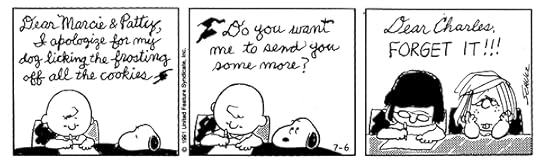
So now for the strip, which requires some setup. Usually every summer Schulz would seen Charlie Brown to summer camp. However in 1991, Charlie Brown decides not to go, and begins a correspondence with Marcie and Peppermint Patty, who have gone to summer camp. Something that not many people know/acknowledge in the later days of Peanuts is that Marcie has something of a crush on Charlie Brown and as such, Marcie suggests that they send Charlie Brown a letter from camp telling them he misses them. Charlie decides that he needs to send them some cookies in appreciation but while he goes to find a box to place them in, Snoopy licks the frosting out from the cookies (they are obviously Oreos or something akin to them.) Marcie and Patty then send a letter indicating that someone had licked the frosting out of the cookies (this is how we learn about Snoopy's transgression.) Charlie Brown decides he wants to make amends and sends a reply on July 6, 1991, which happened to be my sixteenth birthday:
As a joke, I often refer to these volumes as "My Guide to Life, 19xx to 19xx edition." This strip belies the old adage that honesty is the best policy, because obviously, sometimes it isn't--especially when you are trying to impress someone and your efforts (as so often is the case with Charlie Brown) go to shit. But of course, even for his lack of candor, Charlie Brown will keep soldiering on, because that is what we do in the face of adversity, and after reading forty years of Peanuts if you can't see the Charlie Brown inside of you, there's likely no hope for you.
A return to form for Charles M Schulz from a period where I rarely saw his work. The Snoopy moments are particularly inspiring at times and even Spike was enjoyable in this time period. Sally Brown is roped into teaching infants in a bible class and one of her pupils, Larry, seems to think that the Great Gatsby features in the old testament despite his dad being a minister. My favourite moment is Peppermint Patty's boomerang.
At this point of a long multi-volume series, there’s almost no point in doing individual reviews of the volumes as we rack them up. But pointlessness never held me back before, why should I let it now? For readers who have made it this far, or anyway have read at least some of the previous volumes, you’ll find more of the same here – Schulz is Schulz, and even at his worst was pretty good at what he did. (And he’s definitely in good form in this particular stretch of his run.) For anyone who somehow stumbled on this volume without having read any of the others, this might not be the best point to start – a lot of the material here will make more sense if you know the background to it.
Pigpen makes a two day appearance in this stretch, and even has some lines. Violet continues to flesh out crowd scenes – one of them during Pigpen’s appearance! You can imagine their surprise at meeting each other in the studio, they probably each thought the other was dead. Or at least had left the neighborhood.
The genius of Charles Schultz is actually more for adults than children and cannot be appreciated until you are at least 30. Love Snoopy's philosophy about chocolate chip cookies and Sally's views on life.
Most of the Peanuts collections that I have read, literally, so many times throughout the years that I can quote them and about name the year they're from, are largely the 50's-early 70's. While I have read the later years, I for some reason don't own as much from the period in my personal collection of Peanuts paraphernalia. So it almost feels like I'm reading these years for the first time again. And there is a definite change in these years, but I think it's a good change. For one thing, Charlie Brown and Snoopy's relationship seems deeper, with Charlie Brown wanting to just "make his dog happy". In the last collection, '89-'90, we see Marcie very upset and turning to Charlie Brown for help as her parents are putting so much pressure on her to do well in school and excel in everything she does- that is so relatable to many, though I daresay that most wish they had a Charlie Brown in their life to care the way he did for Marcie. These are just a couple examples. Overall, these years just seem sweeter in their context. There is still the 'laugh out loud' factor, but I have always thought it was the endearing sweetness of Peanuts that made people love it so much and continue for so many years.
I distinctly remember Tom Tomorrow's Schulz obituary strip that he references in his introduction. I suppose that helped rekindle my interest in the Schulz oeuvre. The Michaelis biography, Bill Watterson's review of that biography, and the ensuing Fantagraphics reissues sealed the deal for me. Critics loved the sellout angle, but most of those critics didn't live through the Great Depression or do pioneering creative work that reached popular heights. James Brown and Elvis Presley came along in the penumbra of the Depression and I think their stories provide useful perspective.
These strips find Schulz continuing to tinker with his creations. By this point he's kind of abandoned popular culture references. Peppermint Patty has fully acquired the "dumb" part of her jock persona as she struggles in school. Snoopy's adventures can get a little meh but the Sunday strip experiments with big panels, typically featuring him and Charlie Brown golfing, are marvelous. Spike's lonely life on the desert and the annual summer camp storyline add fun variety. Fifty years of the strip and there is a fine seasonal feel to it: the terrible baseball team, summer camp, school, kicking the football, the Great Pumpkin, Christmas, Valentines Day.
I hope to find as many of the volumes as I can. My love for the Peanuts kiddos hasn't changed in years. They are oldies but goodies. RiP Sparky.. and thanks for leaving these for us to read and pass to future generations..
Schulz no deja de sorprender años después de haberse ido. La filosofía de Snoopy y las galletas, el existencialismo de Charlie, el feminismo de Lucy, la negación de Linus, la compañía, la soledad, son cosas que van tomando forma entre más se viva. Cuando era niña no me gustaba tanto Peanuts, lo consideraba triste y monocromo, ahora lo entiendo mejor, y me acompaña ☺️
Despite Schulz’s at times self-indulgent format experimentations, Peanuts in the 90s starts to feel a little tired. (Snoopy’s cookie fixation, for instance, disappoints as a recurring punchline.) Nevertheless, there is much here to like. Only by his own benchmark is Schulz diminished.
There is a great difference between this book and the others I've read (from the 50s-60s). The characters are less snarky and almost less enjoyable because of it. I was used to having so much more Lucy and missed her dearly.
Snoopy plays a lot of golf. Lots about Marcie and Peppermint Patty and their battle to see who Charlie Brown likes better. And Sally really shines in this edition.
There is a good deal of Spike in this one, if you like Spike. Also, there is a boy named Cormac who has a crush on Sally. I don't remember that at all from the 90s!
Schulz's art is very subtle, but if you are paying attention, it can be quite funny! This was a great collection of strips that frequently had me laughing!
More classics that I remember reading as a grade school kid in the papers. Some of these resonated more with me than others, so a somewhat higher grade. Worth the read for any Peanuts fan.