Jump to ratings and reviews
Rate this book

Malc's Boy

Rate this book
Malc's Boy charts a son’s struggle and friendship with his father, Malc, who leaves him with a legacy of toxic masculinity and violence. Shaun grows up in Wigton, a small market town on the fringes of the Lake District as the son of a prominent pub landlord known for his acts of brutality. More concerned with establishing himself as an artist than asserting himself physically in the town’s hierarchical pub scene, Shaun rebels against his father’s expectations. But when Malc is attacked by a local criminal, Shaun is forced to confront his father head on and escape the life he's been expected to lead.

334 pages, Paperback

Published April 23, 2026

Loading...
Loading...

About the author

Ratings & Reviews

What do you think?
Rate this book

Friends & Following

Create a free account to discover what your friends think of this book!

Community Reviews

5 stars
6 (46%)
4 stars
6 (46%)
3 stars
0 (0%)
2 stars
1 (7%)
1 star
0 (0%)
Displaying 1 - 5 of 5 reviews
Profile Image for Benedict Sangster.
3 reviews
May 7, 2026
An unflinching novel depicting autofictive scenes from the life of a northern working-class man, Shaun; in particular his upbringing and the complicated (yet undoubtedly loving) relationship with his complicated and at many times violent father, Malc.

There is an interesting and enjoyable experimentalism in the 100 chapters and all their variations, confident and playful, ranging from reminiscence and re-enactment to script-like dialogue about the above and even the text itself to Cumbrian-steeped vernacular inner narrative to moments of sustained literary evocation. In terms of sheer variety, Malc’s Boy’s ambition is impressive.

The scenes flow from the heartfelt and uplifting to the violent and ugly in a (at one time self-stated) Henry Millerian manner – little left out, depicting a portrait that is often as unflattering as it is uncompromising. There is ugliness particularly in the violence and the casual attitudes towards it, as well as in the sleazy scenes in Thailand. Violence, specifically male violence, is a constant throughout Malc’s Boy, and the novel is unequivocal in portraying its endemicity in Shaun's life and the unanswered questions inherent in its effects and its elusion.

The core of the novel, for me, was in Shaun’s relationship and dialogue with Malc. The play-like dialogue between Shaun and Malc is sincere and exploratory and often very funny. Shaun’s interest in his father’s life is reflected in Malc’s interest in his son’s writing, the two learning from one another. This, then, until the appearance also of the older, maturer Shaun in Part Four (and the older, violence-forbearing Malc), is the novel's heart.

It is evident and stated in the novel that women do not feature heavily in the world of Malc’s Boy. While I did notice it (the absence of his mother from the narrative, whilst explained in one of the meta-dialogues, still looms large), the emergence of Martine in the later part of the book reflected the maturity in age and attitude of Shaun as we go with him through his (autofictive) past. For a book about masculinity in many forms, the absence of femininity perhaps is even to an extent explanatory.

Malc’s Boy is novel of glimpses of a life: for what it says about masculinity, manhood, violence, sex, love, growing up, the meaning is yours to interpret. A strong literary debut.

A small note: Malc’s Boy is the first novel published by Conduit Books, a new independent press whose ethos I heartily endorse.
Profile Image for Gumble's Yard - Golden Reviewer.
2,297 reviews1,839 followers
Review of advance copy received from Publisher
April 23, 2026
A'll admit that me books haven't got many women in them, an ah wanna respond te that in two parts. The first reason is that the books a've written so far are based on me life, inspired by me struggles wid inherited masculinity, toxic masculinity, whatever ye wanna call it. A've tried to keep them lean an just leave the stuff in that's relevant te the shape uh the book, the plot, even though ye couldn't call them plots, but shaped around themes uh violence, power, subversion an all that. An women didn't have a strong role te play in my particular struggle wid inherited violence. Apart from bein subjected to it, through being viewed as sexual conquests an all that, or being in opposition to it, like when a've written Shaun's mam as providen a more responsible, empathetic view uh the world. If it wuz a straightforward fictional novel a could uh invented a plot, included strong women an given them more of a voice, but as ah wuz restricted by the form uh me books, in terms uh usen material from me own life experience, a wasn't at liberty te do that. So most uh the key events a had te work wid didn't focus on women. A'm letten the fact that women didn't feature speak fer itsel - their wider exclusion kind uh reflects in their absence. It meks the book purer than if a tried te crowbar them in.

 
The launch novel for a intriguing new press – Conduit Books, set up by Jude Cook (author, writer, editor, academic and reviewer) with a declared focus to“publish ambitious, funny, political, and cerebral fiction and memoir, with an emphasis on working-class narratives and regional voices, initially by male authors. The definition of a ‘conduit’ is a ‘channel for conveying’, and we believe we can provide a modest space for these books to come through in the coming years.”
 
The launch of the press – with its specific focus on male authors (and with the working class and regional emphasis) did cause some culture war type noise on both sides – but was I think specifically designed as a thoughtful and non-confrontational response to an unarguable recent pendulum swing to a clear (although not in my view unwelcome) female bias in literary fiction. This Guardian article provides a balanced overview of the need to launch the press and some measured responses (https://www.theguardian.com/books/202...).
 
And this I have to say is a bold choice for that launch novel – a distinctive autofictional novel by a Creative Writing PhD and teacher (the novel I assume part of his PhD and research into excluded voices in autofiction) which combines meta-fiction with a fairly explicit examination of the legacy of inherited violence-infused toxic masculinity in a combination which knowingly and I think deliberately runs the risk of being too “up itself” for non-literary fiction readers (as the book itself points out) and too violent and male dominated for literary fiction readers (as the book itself points out).
 
The narrator of the novel – Shaun (born in 1980) is known to most people in his small Lake District adjacent home town of Wigton by his identity as son to his publican father Malc – well known and feared for his violent reactions to any slights and particularly for his bloodily effective headbutt. 
 
Set in 2023 Shaun is, via a creative writing course, writing about his life and its interaction over decades with that of his now Septuagenarian father (including a number of trips to Thailand effectively as sex tourists) – but discussing the novel, very much as a work in progress with Malc whose is sceptical about its non-action parts “Not everyan's a bloody brainbox, man. A's tellen ye noo, folk in Wigton won't buy a book like that. Folk wanna good story. Plenny uh action.'
 
And the transcripts of the discussions between Malc and his father including Malc sharing feedback from his tutor on his novel to date, are as much part of the novel as the more straightforward narrative sections with which they are interleaved and interact.  And the voice of the novel itself changes from a relatively standard (if straightforward) narrative voice (typically told with Shaun or the boy in the third person) to a not always easy to follow (as the book itself points out) literary vernacular particularly in the transcripted conversations and the dialogue in the narratives. 
 
One particular passage which is the culmination of Shaun – a one time hopeful indie band guitarist – after a lengthy period of boxing training attempting to out of character take revenge for his father for a sucker-punch attack – very effectively switches person and form vernacular to literary mid paragraph. 
 
Two I would say less successful passages are a lengthy extended woman as coffee table passage which I am surprised made the edit cut, and a long drug related lyrical session which I am less surprised survived but I found equally unwelcome.
 
The action itself is often not to my tastes – I am not a fan of novels which equate working class regional male voices with routine petty crime drug taking, and a in my view misogynistic attitude and deplorable actions to women (the narrator here starts very young), perhaps because it bears no resemblance to my own working class regional male upbringing but I have to accept that the novel is autofictional and so true to the author’s upbringing. 
 
And further as with so many of its superficial shortcomings the book actively points them out confronts them - here via a discussion with Shaun’s long term on-off partner over the lack of female voices in the novel (which as an aside I understand from interviews began with the author knowing his Mum would not agree to appear in an autofictional novel).
 
Because overall this is a really thoughtful and distinctive novel – and one which I really hope to see on prize lists like the Goldsmith and Queen Mary Prize who with their focus on precisely the mould breaking and risk taking fiction this novel represents, could adopt as their new judging criteria “folk in Wigton won't buy a book like that”.
 
My thanks to Jude Cook at Conduit for an ARC
 
An loads uh what we say gets left out - the reader doesn't wanna read everythin we say, cuz loads of it's not relevant, or borin or whatever. So by the time a've written it up, it's crafted an shaped around the narrative, so it's not a true and complete representation uh reality, even though it's bein recorded. So this version of me, here now, that's on film sitten next te you, right, it's got the sense uh bein real, but Shaun's still a protagonist, cuz it's a version uh me set within the crafted prose uh the novel, mebbe more of an avatar than a protagonist in the traditional sense uh the word, but Shaun the author is the one who's gonna type it up, an a'm only real in that moment, as me fingers hit the keys, an as yer reading it the moment's gone, and a might uh died by now, in real life, comin te exist only in the mind uh the reader, an the impression that's formed of us'll be different in the mind uh every single reader, teken inte consideration all their preconceptions an intelligence an all that, so in a way were bein immortalised, but not as oursels, more like impressions offered te the imagination uh the world.
Profile Image for Paul Fulcher.
Author 2 books2,044 followers
Review of advance copy received from Publisher
March 21, 2026
Keep moven past the glowen winders uh The Lion, loosenen me arms. Offerin mesel te the night, guided by manifestations of an emerging fate, an awareness of passing into the future and its memories and it's like I'm watching it happen as I start to cut across the road with Kyle in me sights, me arms working me body along a taut line, the yellow street light passing over uz, me scalp through the messy bits of hair, me shadow shortening in me wake. Far above the halos of the lamps the silver slice of moon stands against the unseen curtain of sky and the stars appear as passages of light shone through the pierced holes of the stage set as Shaun cuts across the road and past the monument on a path he would sense as being on the edge of his target's peripheral vision. If you were there, watching, from the perspective of Kyle's entourage, let's say his younger brother, Brett, who was standing outside Arena Sports, you might've seen someone coming across the road, someone you recognised as Shaun Wilson, Malc's boy....

Malc's Boy is the debut novel by Dr Shaun Wilson, and also the first book published by Conduit Books, the press launched last year by Jude Cook. The press's aim (which triggered some hand-wringing) is explained as possible: "The aim of the press is to publish ambitious, funny, political, and cerebral fiction and memoir, with an emphasis on working-class narratives and regional voices, initially by male authors. The definition of a ‘conduit’ is a ‘channel for conveying’, and we believe we can provide a modest space for these books to come through in the coming years."

But this is the perfect novel to illustrate the press's mission - about the author/narrator's struggles with inherited toxic masculinity, with a strong regional voice, and focus outside of the middle-class literary mainstream.

The novel begins:

We're always on about fighting when we drink, my dad and me. That and sex. Probably the times we feel most alive. It'd be good if we could discuss literature. Recently I recommended a television series based on the life of Pablo Escobar, thinking Malc would enjoy the themes of masculinity, subversion and power, and that it'd also give us something vaguely educational to discuss in our research sessions. Our big meeting of the minds, however, was doomed before it started, cause the series is in Spanish and he can't get on with subtitles.

The story has Shaun, the author/narrator, born in 1980, telling the story of his life, largely through conversations with his father, Malc, who is aged 72 when the story ends in 2023, with scenes set in both the Cumbrian town of Wigton, where Malc owned a pub, and Thailand.

And it is very cleverly, and self consciously, meta-(as well as auto-) fictional - with the conversations about the work-in-progress included in the book, often as transcriped interviews - at one point Malc commenting on the transcription of their previous conversation.

The narrator's voice changes in the text, from literary to vernacular: the former used for the 1st person reflection on his life, the second both for the conversations with Malc, but also for certain passages told as third person stories; sometimes switching mid-sentence (see e.g. the opening quote); the events narrated also varying from the brutally violent (Malc's prowess with the headbutt would put Yosser Hughes to shame, and is a skill in which he tutors Shaun) to the lyrical.

And it's a novel that openly acknowledges potential critiques including Malc himself commenting on how he struggles to read his own written dialect (A know that's hoo it soonds when a'm talken, but a've never read it like that afore an a fin it hard te foller sometimes?), and, most notably, an extended sequence towards the end as the novel is nearing completion, where the author deals with objections from his partner as to the very masculine focus of the work:

A'll admit that me books haven't got many women in them, an ah wanna respond te that in two parts. The first reason is that the books a've written so far are based on me life, inspired by me struggles wid inherited masculinity, toxic masculinity, whatever ye wanna call it. A've tried to keep them lean an just leave the stuff in that's relevant te the shape uh the book, the plot, even though ye couldn't call them plots, but shaped around themes uh violence, power, subversion an all that. An women didn't have a strong role te play in my particular struggle wid inherited violence. Apart from bein subjected to it, through being viewed as sexual conquests an all that, or being in opposition to it,...

As for Malc and Shaun's story - and the act of revenge on which it centres - that's for the reader to discover.

A press and a novel - the first book in both cases - made for each other, and one that should attract prize consideration.

Resources

A piece from the author back in 2019 when he was first writing the book, and a piece was accepted for Common People: An Anthology of Working Class Writers, edited by Kit de Waal.

A piece from the author's substack reflecting on his acceptance by Conduit Books, entitled Too Male? On Finally Getting Published

Further autobiographic background to some of the events in the story: From Weakling to Whatever It Was

A Granta piece The Legion, which is a precis of some of the longer narrative in Malc's Boy.

Music

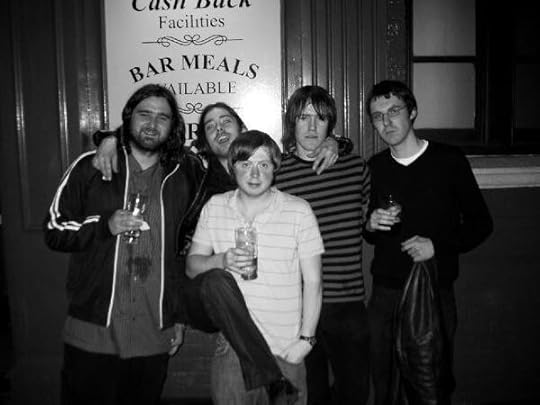
The author's own band She Kills, and their 2005 song My Apology:

description

The author's excellent Spotify playlist
Profile Image for Tripfiction.
2,088 reviews214 followers
Review of advance copy received from Publisher
April 3, 2026
Autofiction set in WIGTON, NEWCASTLE and PATTAYA

#ADPR (Advance copy)

Malc’s Boy by Shaun Wilson is warts-and-all autobiography and it’s an extraordinary book with a unique and memorable voice. Growing up, Shaun wants to be just like his dad – as might any young boy. Malc is not the ideal role model, however, so Shaun both loves and rejects his father. The novel is Shaun’s coming-of-age story, and it tells of the tensions and affections between the two. It reflects Shaun’s internal dialogue and the struggles he has in choosing his direction in life.

Malc’s Boy is written partly in Cumbrian dialect, which can take a bit of getting used to, but adds to its authenticity. Shaun’s character is both narrator and protagonist, with some chapters written in the first person and some in the third. At times the navel-gazing self-consciousness is quite alarming, but it is well balanced with self-deprecating and downright funny episodes.

Shaun and his father, Malc, are the main characters in this examination of “toxic masculinity”. The book explores Shaun’s working-class childhood and the influence that his fist-fighting, bird-shagging father had on his development. This despite the two having lived apart seemingly for much of Shaun’s childhood. (Shaun knows he has half-siblings but appears surprised to learn how many women Malc has been married to). The book goes so far as to suggest that being a hard man – or at least aspiring to it – is a hereditary trait. Shaun’s mother hardly rates a mention and the women in the book are objectified. There are exceptions – Shaun’s girlfriend “Martine” and a few others who offer insights into a feminine world. For the most part Shaun rejects this knowledge, seemingly fearful that it will weaken him. He does see himself as “a man of peace”, and he wants to be a better person, but that doesn’t stop him fighting and shagging just like his father.

Shaun was born in Wigton, Cumbria – a small market town where it is hard for a person to hide. This might explain his preoccupation with how others see him; something that governs his actions and choices throughout. His father, Malc, was second hand car dealer but became a property developer/publican in the 1980s. He bought a farm and sent Shaun to boarding school where others were middle class. Shaun said they were more sheltered than him. But he got top grades. He contrasts his experience with that of a “posh boy” who once attended his local school and who tried to blend in. “Ye can’t help who ye are”.

As a young man he moves to Newcastle. The author describes both locations in a no-nonsense, factual way – but then he can’t help himself and there are some wonderfully poetic descriptions of his surroundings. This seems to me to reflect the inner conflict he’s experiencing. Sometimes his artistic soul can’t help but burst through. You might expect the descriptions of Pattaya to be more romantic but that’s not the case. Shaun is focussing too much on finding a girlfriend (and not being killed) to create tourist-brochure-style accounts of one of the most beautiful parts of the world.

The book recalls such working-class, post-industrial novels as Shuggie Bain. It proclaims itself to be a work of autofiction, and it depicts the author’s life (and his father’s) but with a big dollop of artistic licence and creativity. It also falls into the category of metafiction, in that the author-protagonist discusses at length the process of writing the book – much as I imagine he did in tutorials with his PhD tutor. Malc’s Boy was written as part of his PhD studies, which explored autofiction.

Malc’s Boy relies on detailed descriptions to place the narrative in the seedier side of the locations it features, with references to drink, drugs and prostitutes. It also has fantastic descriptions of people, its characters virtually punching their way off the pages. As such, I recommend it to anyone wanting to know more about what makes people tick.

1 review
Review of advance copy received from Author
March 25, 2026
Kerry Hudson tipped Shaun Wilson for ‘big things’ after Common People in 2019, and in his experimental autofiction debut he’s more than proved her right. Malc’s Boy explores Wilson’s ‘version of reality’, born with the soul of an artist into a world of a toxic masculinity that lives with – and lauds – violence as a part of life, stymied by social class systems that do not ‘see’ boys and men like him. Set on living a creative life and rejecting many of the norms around him, Wilson weaves hypnotic prose through script, essay, non-fiction, fiction, tense, time, vernacular, to tell the story of what happens when the moment comes for him to avenge a father of legendary ferocity – and who has always avenged him. The result is an astonishing and almost filmic narrative; a mastery of what can happen when creative experiment meets compelling story.

This isn’t always the easiest of reads: it covers a lot of brutality, it makes a striking call to arms with its themes of class, among the more general issues of belonging, finding the self and finding peace within that self, and of the difficulty of working-class creative life. But there’s also a lot of humour, heart and soul here; a warmth to a wider perspective on a life we too rarely see, and running underneath everything, the many and varied currents of love. The questions ‘Shaun’ asks both of what is here and what is not, leave an imprint that lasts far longer than the last page. This is serious talent on display – Wilson is without doubt one to watch.
Displaying 1 - 5 of 5 reviews