Seed Nineteen - a bizarre name for the most bizarre characters ever to enter the lives of the Fantastic Four: Threshold, Fountain, Magnificent Brute, Dreamcatcher. These incredible entities hold the key to a cosmic conflict that has raged for untold millennia and now involves our quarrelsome quartet.
Librarian Note: There is more than one author in the GoodReads database with this name. See this thread for more information. Mike Carey was born in Liverpool in 1959. He worked as a teacher for fifteen years, before starting to write comics. When he started to receive regular commissions from DC Comics, he gave up the day job.
Since then, he has worked for both DC and Marvel Comics, writing storylines for some of the world's most iconic characters, including X-MEN, FANTASTIC FOUR, LUCIFER and HELLBLAZER. His original screenplay FROST FLOWERS is currently being filmed. Mike has also adapted Neil Gaiman's acclaimed NEVERWHERE into comics.
Somehow, Mike finds time amongst all of this to live with his wife and children in North London. You can read his blog at www.mikecarey.net.
I wasn't wowed by this volume. Yes, it has Thanos & Ronan the Accuser, but it was still pretty boring.
I didn't recognize any of the other characters in this, so for me, this was just another cosmic fight. I'm guessing that Thanos will play a larger part in Reed's life later on down the line, but there didn't seem like much here plotwise. Thanos is doing Thanos-y stuff and all of these Seed Nineteen folks are rebels. They started fighting the FF as soon as they hit the ground on their earth, then they find out they aren't enemies, then they find out they need each other, then they go fight Thanos in space, then they come home.
I'm just going to assume I'm missing the references to obscure (to me) characters. This is a readable volume, but it's my least favorite so far.
Oh... my... Galactus! Now, THIS is how you write a great Fantastic Four story! This was proper space opera with high stakes, high concepts, all the action you could ever hope for and a suitably ominous ending! Even Thanos being in it didn’t bother me one bit and I HATE Thanos!
Oh, and the artwork! Pasqual Ferry’s story-telling chops are in evidence in spades. I love his style, but did feel it could have done with a more tangible line at times. Oh, and let’s not forget the colour art by Justin Ponsor! Absolutely beautiful, my man... you are deeply, deeply missed. RIP.
If only this creative team had been on this book from the beginning...
This story arc is all about the beautiful art. Stunning stuff really. As for the story, it starts out slow and confusing but picks up speed once the team gets sucked into another universal dimension where Thanos is revealed as a death obsessed galactic emperor locked in a fight against the forces of good. There are fights galore, a few cool ideas, and it ends with a nice piece of foreshadowing of future calamities.
Score: 1.5 out of 5 Grade: 30% (F) | Nonsensically Bad
You know when you read something, but you read it faster just to get it over with? Yeah, that was me with this volume. The majority of this was a scattershot of sci-fi nonsense. The best thing I can say is at least it ended stronger than it started.
This big graphic novel stood out for me more for its awesome art than it's average to good tales.
Covering #33 to #41 as well as Ultimate Fantastic Four Annual #2.
Written by Mike Carey and artwork by a variety of people. Again, the artwork is where it is at for this piece.
For those interested here's a brief summary of each tale (all Wiki sources):
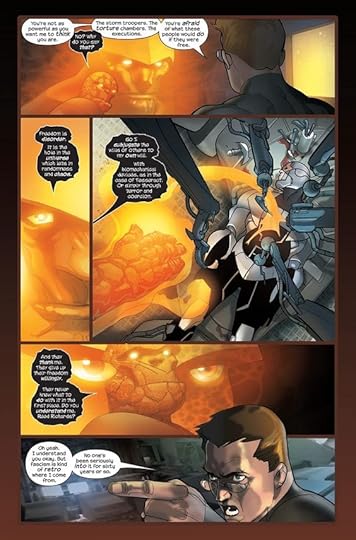
“God War”: Seed Nineteen show up and attack the FF while looking for "the seed." The seed informs Seed Nineteen that they will need the FF's help to defeat Gallowglass, and the groups team up to do so. They are all transported to an alternate dimension, and interact with Thanos the Destroyer and Ronan the Accuser.
Ultimate Fantastic Four Annual # 2: General Thunderbolt Ross is touring the relocated Think Tank in Pinhead Buttes, Oregon when it suddenly begins to sink beneath the ground, as the Fantastic Four arrive above and Reed reaches the conclusion that the Mole Man is responsible. Meanwhile, Molekevic is explaining his plans to the Think Tank and goes into a lengthy recollection of his childhood in Yugoslavia, his work with the Soviet military, his studies in western Europe, and his fondness for wearing women's clothing. The Think Tank children eventually chase away Molekevic, the Fantastic Four and the government officials, intending to recolonize the subterranean city. The final page implies that their reactivation of the artificial sun either awakens or attracts the various giant monsters and abominations hiding in the depths, which serve as a defense for the Think Tank children from the government coming back for them.
“Devils”: Diablo, a sorcerer from the past, looks to the future for the 'elementals' he needs, which turn out to be the Fantastic Four. To challenge them, he kidnaps Dr. Storm, Ben's mother, Johnny's girlfriend, and Reed's sister. After Diablo appears in the future, the Four must accept his challenge to save their loved ones.
ARTWORK PRESENTATION: B plus to A minus; ACTION: B to B plus; CHARACTERS/DIALOGUE: B minus to B; STORY/PLOTTING: B; OVERALL GRADE: B; WHEN READ: mid November 2012.
Mark Millar really should be the only person to write Ultimate Fantastic Four. He successfully rebooted the not-very-edgy concept of a family of superheroes, making it hip but still hitting all the emotional notes. Mike Carey, who'd done a few fill-in issues before, just doesn't quite hit it. This book brings in cosmic characters that I'm not that familiar with in the regular Marvel Universe (Thanos and Ronan the Accuser were the only ones I recognized), and Carey doesn't do a good job introducing them. Reed and Sue stumble upon some creatures from another dimension (one they claim is a higher dimension), then get sucked into their battle with other creatures, and end up going back to their dimension, and fighting a bunch of weird looking aliens. It all ends with them facing off against Thanos and his son (I think), Ronan, in a war-torn Midtown Manhattan. Pasqual Ferry's art is as obtuse as Carey's writing (he uses way too many big words. Who likes "Praetor?"). His work on Adam Strange was energetic and fun, but there's too much muddled gray, dystopian space-junk in this cosmic tale.
First issues had me lost and bewildered but I’m glad I stuck with it as the stuff was pretty fun and I liked the Ultimates universe take on the characters.
This story about an alien cluster that brings Thanos into the Ultimate Universe, and is one of the first harbingers of Reed Richards as The Maker, is totally servicable but mostly boring. The dialog is fine. The pencils, inks, and colors are pleasant to look at. The layouts are run-of-the-mill, though, and the plot moves from Points A to B to C, etc without any feints or interesting twists.
It's a perfectly servicable superhero book, which is a disappointment coming out of the pen of such a good writer.
I enjoyed a break from the early 2000s shiny art in this series. Read for a cool extra-planar super team joining forces with the FF, and Ultimate [spoiler]
I really liked this one. Again I didn't recognize the characters, although I think the first characters you see are new, but I could be wrong. It was a slow reveal and once you heard one familiar name and then another the FF was already in the middle of it and it really hit you.
Another thing I really like about this series and especially this trade is the scifi tone. It really feels like you're exploring a new world through somewhat familiar eyes. And talk about worldbuilding (well I guess I've been) this really feels alien on a whole other level. That's what makes it all the more shocking.
The art took a little getting used to, but eventually it worked to submerse you in the story. I think that had a lot to do with the strength of the story. I'm not sure if the art was jarring so much that it was different (and keeps changing) or it had to do with Scott McCloud's theory that a more detailed drawing seems more removed from ourselves than a simple figure.
With all the changing artists and writers, it feels a bit like a patchwork, but I think its remarkable that a thread of continuity has continued with it. But maybe that's my own mind trying to make sense of everything :)
I love the Ultimate universe, and while Ultimate Fantastic Four has had some bumps in the road (cough, Doctor-Doom-with-goat-legs, cough cough), it is still a really good series. However, I didn't care too much for this particular arc. It was okay, but mostly your run-of-the-mill story about fighting an invincible alien overlord. Granted, the overlord in question is Thanos, which was a nice surprise, but still, as I read this, I was mostly in "autopilot" mode. Hopefully the next Ultimate Thanos arc will be more epic (Infinity Gauntlet anyone?).
I haven't read many Thanos arcs in other Marvel series, so I was pretty hooked by his Ultimate Universe introduction. I also really liked the supporting characters in "Seed 19" I can't quite put my finger on why though... they weren't particularly developed but I liked their powers, home world and Dreamcatcher in particular.
This has probably been the most enjoyable UFF yet and I don't quite get the low scores on here.
I guess there are some clunky parts and the art is a bit meh at times, but still worthy of 3.5 stars which I rounded up to 4.
Didn't care much for this one. The art was a bit off, and so far, the storylines scripted by Mike Carey just don't measure up to Mark Millar's work. But still interesting and worth the read. I really don't care for all that cosmic stuff, like Thanos (an obvious ripoff of DC's Darkseid), so this was never going to be high on my list anyway.
This story just confused me. I don't know if the Seed 19 characters were ultimate versions of other Marvel characters, but it took forever for me to figure out who they were supposed to be and what their powers were. Overall I'm finding Ultimate Fantastic Four hard to connect to, but I'm trying to read through the whole Ultimate U in order and I don't hate it enough to skip completely.
Peu attiré par les histoires cosmiques, je savais que ce volume de Ultimate Fantastic Four ne deviendrait pas instantanément mon arc préféré, mais je me suis quand même ennuyé.
Commençons par le positif : après 12 issues à souffrir des horribles visages copiés-collés et sans âme de Greg Land, tout droit sortis de la vallée de l'étrange, j'ai pu souffler un peu et apprécier la prestation artistique délivrée par Pasqual Ferry sur cet arc. Les visages sont expressifs, les décors font le boulot et l'action est claire, sans parler des très jolies couleurs.
Du côté scénario, Mike Carey, dont les issues 19 et 20 présentes dans Ultimate Fantastic Four Vol. 4: Inhuman m'avaient déjà laissé de marbre, ne parvient pas rendre ces nouveaux personnages intéressants, excepté peut-être le personnage de Dreamcatcher qui possède un pouvoir singulier et entretient des interactions sympathiques avec les protagonistes. Ultimate fait le boulot en tant que méchant, il est menaçant et dégage une puissance impressionnante, et le moment où est je trouve réussi. Cependant, il n'est pas omniprésent et le reste des antagonistes laisse à désirer.
Pour résumer, un arc peu engageant, encore moins pour ceux qui comme moi sont ennuyés par le cosmique, mais agréable à l'oeil.
I understand the low rating here, and I also cannot put it higher than 3 stars. At the same time it does seem unfair because its clear that Mike Carey put a lot of effort into the story. The problem is that it's too dialogue and story heavy and fits in really poorly with how the series has been up until this point. I'm also not a fan of the whimsical watercolor artwork. Pasquale Ferry has done a lot better than this before. Everything just kind of mushes together and drags on for way way too long. Even i was only 10 pages from finishing the book, I couldnt keep my interest anymore and just flipped towards the end. I didnt read the background for the story, but it felt like a script that was already there and developed for a long time, and was then adapted to fit into the FF4. Unfortunately the fit is not great.
God War adalah peperangan antara dua kekuatan di luar jagat yang kita huni, Halcyon dan Acheron. Ultimate Fantastic Four terjebak di tengah-tengah peperangan itu. Mereka berkolaborasi dengan sekelompok alien pengelana dimensi yang berjuluk Seed 19 untuk membebaskan Tesseract, manusia kelahiran Halcyon yang dicuci otak dan dijadikan budak di Acheron. Kolaborasi unik ini berhadapan dengan Ronan the Accuser dan ayahnya, Thanos the Destroyer.
Maybe it's as a result of reading so much Ultimate Fantastic Four in a row, but I found myself getting a bit bored with it by this point. I wasn't really a big fan of them getting into some more of the more cosmic aspects of Marvel. It seemed a bit soon to be getting into that, considering there was still so much they could do Earth-bound.
Great art, exciting space opera, huge stakes... I should love this, but it never really worked for me. Maybe I'm in the wrong mood. Maybe I've been reading too many comics too fast (that one's just true). Who knows. But it never really clicked.
I wish Ellis wrote more Ultimate Fantastic Four. So far, he's the only one who's really found the right tone.
The art is terrible. The story is terrible. It’s all just pointless and boring.
Such a forgettable volume. The Seed are boring, Thanos is boring here (even with the promise that he is important to Reed’s future life), and golly Ronan the accuser makes an appearance here. Mike Carey is killing my interest in this book.
It ended better than it started. If I were to re-read it later knowing what (and whom) they're setting up, I may like it better, but there was too much ridiculousness thrown all at once for me to enjoy.
1.5/5. I usually really love dense sci-fi AND Fantastic Four comics no matter what, but most of this story was a slow, boring, character-driven story that, unfortunately, had weak characters. There was also too much jargon for the sake of sci-fi jargon.