

What do you think?
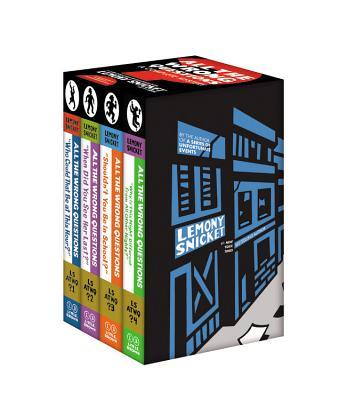
All the Wrong Questions #1-4
All the Wrong Questions: A Complete Mystery Gift Set
Give the gift of Lemony Snicket!
Before his research into the plight of children in strange circumstances, which was published as A Series of Unfortunate Events, Lemony Snicket was himself a child in strange circumstances. He was almost thirteen and undertook an apprenticeship that didn't go as planned. His record of this curious time, published as four books in the bestselling series All The Wrong Questions, has been gathered together for the first time in one handsome gift box. It's a complete mystery.
Before his research into the plight of children in strange circumstances, which was published as A Series of Unfortunate Events, Lemony Snicket was himself a child in strange circumstances. He was almost thirteen and undertook an apprenticeship that didn't go as planned. His record of this curious time, published as four books in the bestselling series All The Wrong Questions, has been gathered together for the first time in one handsome gift box. It's a complete mystery.
1200 pages, Hardcover
First published October 20, 2015
About the author
Lemony Snicket
387 books27.1k followersLemony Snicket had an unusual education and a perplexing youth and now endures a despondent adulthood. His previous published works include the thirteen volumes in A Series of Unfortunate Events, The Composer is Dead, and 13 Words. His new series is All The Wrong Questions.
For A Series of Unfortunate Events:
www.lemonysnicket.com
For All The Wrong Questions:
www.lemonysnicketlibrary.com
For A Series of Unfortunate Events:
www.lemonysnicket.com
For All The Wrong Questions:
www.lemonysnicketlibrary.com
Ratings & Reviews
Friends & Following
Create a free account to discover what your friends think of this book!
Community Reviews
Displaying 1 - 19 of 19 reviews

June 30, 2017
Pretty great introduction to noir for kids, I think. Wears its influences (mostly Hament and Christie) on its sleeve - like it has characters named for them and references their works throughout all four books.
Lemony Snicket is doing the lord's work by writing unsatisfying endings in children's lit. I think that's a really important thing to do, and I think that he's probably the reason I like anything post-modern.
Lemony Snicket is doing the lord's work by writing unsatisfying endings in children's lit. I think that's a really important thing to do, and I think that he's probably the reason I like anything post-modern.

April 21, 2020
Reviewing the entire series as a unitary work. Let's start with the fundamentals: Dan Handler, while a laudable and interesting creator, is creepy. While far from a prime offender in the #metoo era, there are questionable incidents. Handler can also be gallingly pretentious, although the New York Times' review of his most recent adult novel Bottle Grove offers an awesome takedown.
All these qualities are reflected in Handler's alter ego Lemony Snicket, who's also a little creepy and a little sanctimonious. And yet in All the Wrong Questions, Snicket distinguishes himself through his humanity. He appreciates a good meal and a good book. He cares about friends and helping others, though by the end there's a tiny bit of whinging martyrdom complex to go with it. He's entertaining but perhaps not worth emulating.
I read all four volumes out loud with my daughter (10), every other page. And in some ways, the more annoying aspects of Lemony's character added zest to what would otherwise be a sanctimonious trudge against villainy. (Goddammit! "Zest.")
That slightly subversive note, laced with laudanum, made All the Wrong Questions a satisfying read. And frankly, not a bad book to share with my kid either. I take the view that a certain amount of subversive content is good for kids, as long as rebelliousness is leavened with a bit of critical thinking. And in All the Wrong Questions, Handler aptly strikes the balance. It's pretentious but not too pretentious, creepy but not too creepy. And reading with my daughter, we call it out when we see it.
I was also impressed by a solid cast of women characters, both heroes and villains. Lemony may be the narrator but he is surrounded by interesting women: the obsequious S. Theodora, the principled Moxie Mallahan, the duplicitous Ellington Feint. Although I would have been much happier if Handler or his collaborator Seth had made some effort to incorporate characters of color verbally or visually. (Using jazz artists' names does not count: Ornette, Ellington, Armstrong.)
Maybe I should mention the plot, which is mostly style without much thickener to patch the holes. I don't care; the dialogue is fun, the plot is breezy, and swashes are buckled. For all those reasons, recommended with some modest reservations for adults; of course strictly forbidden for kids.
All these qualities are reflected in Handler's alter ego Lemony Snicket, who's also a little creepy and a little sanctimonious. And yet in All the Wrong Questions, Snicket distinguishes himself through his humanity. He appreciates a good meal and a good book. He cares about friends and helping others, though by the end there's a tiny bit of whinging martyrdom complex to go with it. He's entertaining but perhaps not worth emulating.
I read all four volumes out loud with my daughter (10), every other page. And in some ways, the more annoying aspects of Lemony's character added zest to what would otherwise be a sanctimonious trudge against villainy. (Goddammit! "Zest.")
That slightly subversive note, laced with laudanum, made All the Wrong Questions a satisfying read. And frankly, not a bad book to share with my kid either. I take the view that a certain amount of subversive content is good for kids, as long as rebelliousness is leavened with a bit of critical thinking. And in All the Wrong Questions, Handler aptly strikes the balance. It's pretentious but not too pretentious, creepy but not too creepy. And reading with my daughter, we call it out when we see it.
I was also impressed by a solid cast of women characters, both heroes and villains. Lemony may be the narrator but he is surrounded by interesting women: the obsequious S. Theodora, the principled Moxie Mallahan, the duplicitous Ellington Feint. Although I would have been much happier if Handler or his collaborator Seth had made some effort to incorporate characters of color verbally or visually. (Using jazz artists' names does not count: Ornette, Ellington, Armstrong.)
Maybe I should mention the plot, which is mostly style without much thickener to patch the holes. I don't care; the dialogue is fun, the plot is breezy, and swashes are buckled. For all those reasons, recommended with some modest reservations for adults; of course strictly forbidden for kids.

November 10, 2017
What's not to love? The Baudelaire-less world of Lemony Snicket is just as imaginative as the original series; even if it is ever-so-slightly less enjoyable.
While I'd never advocate slapping on one rating to an entire series, I blew through this series too quickly to parse out each book in my mind; it truly was that fun. One of the many highlights of the series was the unforgettable cast of characters:
1) Moxie Mallahan; journalist, "The News". ("What's the news Moxie?")
2) S. Theodora Markson, unreliable chaperone ("What does the 'S' stand for?")
3) The Officers Mitchum, married squabblers. It's too early to make assumptions, but they are certainly among my favorite literary marriages.
4) Ellington Feint; the girl with the question mark eyebrows and a smile that could mean anything.
5) The Bellerophone Brothers; Pip and Squeak, taxi drivers in Stain'd by the Sea, always looking for a literary tip.
6) Hangfire, Sally Murphy, Cleo Knight, and, quite frankly, too many others to count.
Handler once again creates very lovable and memorable characters, this time in the equally memorable location, Stain'd by the Sea.
The series beginning with a parody of "Maltese Falcon", and ending with a mock "Murder on the Orient Express", the tone of the series is consistent; it's that of a mystery. Knowing this, I find it ironic that "The Series of Unfortunate Events" seemed more mysterious to me; perhaps because he simply leaves questions unanswered and constantly pokes at his audience in playful, yet infuriating ways. The "All the Wrong Questions" series is a self contained mystery, complete with a beginning, middle, and end that wraps up the narrative in a satisfying way.
While it is self contained, I appreciated the numerous references to the original Series. VFD, Captain Widdershins, Aunt Josephine, and even the Bombinating Beast all tie back into our main adventure with the Baudelaires; which makes the series even more worthwhile for true fans of the originals.
As with the originals, Lemony has a way with words. Numerous times I found myself stopping to think about one of his signature offhand comments, sayings that reveal a keen sense of understanding of the world around him. I also enjoyed the little game he plays with the audience, of describing a book plot without actually giving away the title. In this way he often blurs the lines between children's lit and adult fiction, as you being to wonder who this series is truly meant for.
Would highly recommend to anyone who is a fan of the original "Series of Unfortunate Events". It's a similar story, familiar writing style, and if nothing else, informs you of the troubled past of Lemony Snicket, the Baudelaires watchful investigator.
4 stars overall!
While I'd never advocate slapping on one rating to an entire series, I blew through this series too quickly to parse out each book in my mind; it truly was that fun. One of the many highlights of the series was the unforgettable cast of characters:
1) Moxie Mallahan; journalist, "The News". ("What's the news Moxie?")
2) S. Theodora Markson, unreliable chaperone ("What does the 'S' stand for?")
3) The Officers Mitchum, married squabblers. It's too early to make assumptions, but they are certainly among my favorite literary marriages.
4) Ellington Feint; the girl with the question mark eyebrows and a smile that could mean anything.
5) The Bellerophone Brothers; Pip and Squeak, taxi drivers in Stain'd by the Sea, always looking for a literary tip.
6) Hangfire, Sally Murphy, Cleo Knight, and, quite frankly, too many others to count.
Handler once again creates very lovable and memorable characters, this time in the equally memorable location, Stain'd by the Sea.
The series beginning with a parody of "Maltese Falcon", and ending with a mock "Murder on the Orient Express", the tone of the series is consistent; it's that of a mystery. Knowing this, I find it ironic that "The Series of Unfortunate Events" seemed more mysterious to me; perhaps because he simply leaves questions unanswered and constantly pokes at his audience in playful, yet infuriating ways. The "All the Wrong Questions" series is a self contained mystery, complete with a beginning, middle, and end that wraps up the narrative in a satisfying way.
While it is self contained, I appreciated the numerous references to the original Series. VFD, Captain Widdershins, Aunt Josephine, and even the Bombinating Beast all tie back into our main adventure with the Baudelaires; which makes the series even more worthwhile for true fans of the originals.
As with the originals, Lemony has a way with words. Numerous times I found myself stopping to think about one of his signature offhand comments, sayings that reveal a keen sense of understanding of the world around him. I also enjoyed the little game he plays with the audience, of describing a book plot without actually giving away the title. In this way he often blurs the lines between children's lit and adult fiction, as you being to wonder who this series is truly meant for.
Would highly recommend to anyone who is a fan of the original "Series of Unfortunate Events". It's a similar story, familiar writing style, and if nothing else, informs you of the troubled past of Lemony Snicket, the Baudelaires watchful investigator.
4 stars overall!
This entire review has been hidden because of spoilers.

January 5, 2019
I decided read this four book series because my son read it and wanted to discuss it with me. First of all Daniel Handler (real name of Lemony Snicket) is obviously a literary and creative genius (as well as a foodie; I want Jake Hix as my personal chef). This series is crawling with references to other literary works, most of which probably went over my head. The whole thing also is a little off, which is why people love Snicket, and I think it’s this quirkiness that draws my son in. Lemony Snicket is the author and the main character, and the series fleshes out (but not fully, because Snicket books never give full answers) his life before the Series of Unfortunate Events. I honestly didn’t love this series. It’s just too dark and weird. The second book in particular has Lemony walking around an abondoned hospital, where is encounters child-size shakles and finally the villain in a room with a huge broken window. Eek. (I made the mistake of reading this at bedtime.) The fourth book, although just as dark, was probably the best. It has multiple plot twists and a huge surprise at the end. There is also a permeating theme of “is there really evil in the world, or is everyone just doing what they think is best?” This doesn’t sit well with me, but other reviewers call it refreshing. Go figure. The one ideal held up as irreproachable is that of literacy/libraries/librarians. I love libraries more than most people, so this is somewhat endearing, but again, this ideal as the highest value of all doesn’t sit well either.
September 23, 2017
I just finished reading these 4 books, and i also read those series of unfortunates events.
as for me, this kind of plotting story of bunch of kids who constantly get distrust by adults is suit my kind of book i enjoy.
Both in All the wrong questions and series of unfortunate events, we are in the point of view of kids having some encounters with adults who think they know the best. I know exactly how it feels that adults always acts like that when i was a kid. It just fit in my shoes.
Even as I am grown up now, I still can remember how it feel and these stories reminds me of my old days. Plus, i love some twist in the plot, about betrayal, plans, and tricks. to be honest I almost cant guess the villain identity up until half of 4th books. That was quite surprising, i think.
as for me, this kind of plotting story of bunch of kids who constantly get distrust by adults is suit my kind of book i enjoy.
Both in All the wrong questions and series of unfortunate events, we are in the point of view of kids having some encounters with adults who think they know the best. I know exactly how it feels that adults always acts like that when i was a kid. It just fit in my shoes.
Even as I am grown up now, I still can remember how it feel and these stories reminds me of my old days. Plus, i love some twist in the plot, about betrayal, plans, and tricks. to be honest I almost cant guess the villain identity up until half of 4th books. That was quite surprising, i think.

December 24, 2017
These books are amazing for any age. I flew through them myself, gobbling up all the subtle jokes and literature references, and I played them as audiobooks for my lower elementary kids (who were not yet reading at this level). With a complicated yet traceable plotline and obnoxious yet likable characters, each book delivers as both entertainment and enlightenment. I may not be challenged philosophically by Snicket's writing, but these stories make me a better person in a different way -- by making me laugh and rest and think too.
October 20, 2022
I love this series. I read the third and listened to the others. I like the voice for snicket. I was heavily confused sometimes because it would give clues to something but never actually say what it was. Like when lemony was hit by a car I was so confused. Was he even? Other then the confusion I really liked it. It’s a cliffhanger so what’s next? I’m going to read “file under: 13 suspicious incidents “ because it seems like it’s tied with that. I still got to figure out the order of the series. The spin on books and the fact that the main character is the author is fun. He’s got spunk.
October 30, 2019
I haven't read all of the books in this series, but I will always think of this series as the best book series ever. I decided to pick out one random book from my teacher's personal library, and it was the first book. I got so hooked up in this series that i read all but one. I did start the fourth book, but stopped, because I moved away
September 17, 2024
I love this series so much. Lemony Snicket is one of my favorite authors and these books are so fun and witty to read. The mystery remains even after finishing the books and you’re still left with many questions but it’s best to let your imagination run. This series is a must read for any age. So much fun!!
June 8, 2024
Soul-crushing
I can't believe I read these books when I was a kid
Why is This Night Different from All Other Nights defenestrated my ability to see the good in people.
5 stars for teaching me that word though
That's equivalent to my faith in humanity, right?
I can't believe I read these books when I was a kid
Why is This Night Different from All Other Nights defenestrated my ability to see the good in people.
5 stars for teaching me that word though
That's equivalent to my faith in humanity, right?
December 30, 2025
برای زیر 15 سال خوبه. معمایی و جالب.
May 25, 2016
This is a fantastic series! The best of the best, I have never read a book like this: it is very well-written, with surprising characters and plots--this noir mystery series is by far the best series I will probably ever read.
It follows the story of Snicket, a twelve, almost thirteen-year-old apprentice for a secret organization. Nobody is as clever or sneaky as he is--other then Ellington Feint, a femme fatale who works for a secret organization that is trying to destroy the falling apart town of Stain'd-by-the-sea, yet she is only doing it to save her father.
The books are clever, and the names of the characters are often real words, or reference something about their personality or occupation. (Such as Stain'd-by-the-seas only librarian, who's last name is 'Qwerty', the first six letters on a keyboard). And the series references many books, have great mysteries, and arguments that are great to read.
It also seemed to have little hidden details; V.F.D (The 'good' organization) and the Inhumane Society (The 'bad' organization) are noted to be quite similar: the agents in both sneak around doing strange plots that no one knows about, yet for some reason, V.F.D is good and the Inhumane Society evil.
The main villain is the most complex you will probably ever read about; in all books series, if the villain is not after money, he or she is after revenge. This story is no different, but the villain is not after revenge for the death of a love interest or family member, but trying to get revenge on the town that destroyed nature by draining the sea. The villain's name is 'Hangfire', and he does love animals and nature; he loves the things that many of us hate.
Plus, there is his name. Hangfire is revealed to be the father of Ellington Feint, she didn't know this, but he was. A Hangfire is something that doesn't happen quite yet, it is commonly used to describe an attack waiting to happen. Hangfire lights many buildings on fire before the one he wants to burn most of all, but this is not the source of his name. A 'Hangfire' is also a type of phonograph--an old-fashioned music player that Ellington Feint is noted to have.
Perhaps the most interesting part of the series is how Ellington is the Inhumane Society counterpart of Snicket, and vise vera. Both have a family member who is in danger: For Snicket it is his elder sister Kit, who got arrested unfairly, and for Ellington it is her father who she thinks was kiddnapped. Both of them are new in a town that almost no one ever comes too, both are clever and sneaky, and both would prefer to be somewhere else--Snicket in the city with his sister, Ellington in her old home with her father. And both have the option to do the wrong thing that will help their family member--Snicket could have gone back to the city in the second book to help his sister, Ellington could join the Inhumane Society to rescue her father--and both have an option to do the right thing--Snicket could stay and help the people of Stan'd-by-the-sea, and Ellington could volunteer with V.F.D --the difference? Snicket did the right thing, and Ellington the wrong.
Until the last book. In the earlier books, Ellington stole a statue of creature called the Bombinating Beast, she helped kidnap someone, and she lied to Snicket countless times. But she wasn't a murderer, and was against being one. The murderer of Dashiell Qwerty (Which, as far as I know, she couldn't have been involved in) is the reason she has second thoughts about the organization, and even threatens to leave unless she is sure her father is alive. Snicket worked to find the stolen object, went to find the kidnapped person (who as it turned out did not really need to be rescued) and no matter how long it took him saw through her lies every time--but he was a murderer. He killed Hangfire, but he didn't do it in self-defense.
I found that be very brilliant writing. This story is sure to please any mystery-lover.
It follows the story of Snicket, a twelve, almost thirteen-year-old apprentice for a secret organization. Nobody is as clever or sneaky as he is--other then Ellington Feint, a femme fatale who works for a secret organization that is trying to destroy the falling apart town of Stain'd-by-the-sea, yet she is only doing it to save her father.
The books are clever, and the names of the characters are often real words, or reference something about their personality or occupation. (Such as Stain'd-by-the-seas only librarian, who's last name is 'Qwerty', the first six letters on a keyboard). And the series references many books, have great mysteries, and arguments that are great to read.
It also seemed to have little hidden details; V.F.D (The 'good' organization) and the Inhumane Society (The 'bad' organization) are noted to be quite similar: the agents in both sneak around doing strange plots that no one knows about, yet for some reason, V.F.D is good and the Inhumane Society evil.
The main villain is the most complex you will probably ever read about; in all books series, if the villain is not after money, he or she is after revenge. This story is no different, but the villain is not after revenge for the death of a love interest or family member, but trying to get revenge on the town that destroyed nature by draining the sea. The villain's name is 'Hangfire', and he does love animals and nature; he loves the things that many of us hate.
Plus, there is his name. Hangfire is revealed to be the father of Ellington Feint, she didn't know this, but he was. A Hangfire is something that doesn't happen quite yet, it is commonly used to describe an attack waiting to happen. Hangfire lights many buildings on fire before the one he wants to burn most of all, but this is not the source of his name. A 'Hangfire' is also a type of phonograph--an old-fashioned music player that Ellington Feint is noted to have.
Perhaps the most interesting part of the series is how Ellington is the Inhumane Society counterpart of Snicket, and vise vera. Both have a family member who is in danger: For Snicket it is his elder sister Kit, who got arrested unfairly, and for Ellington it is her father who she thinks was kiddnapped. Both of them are new in a town that almost no one ever comes too, both are clever and sneaky, and both would prefer to be somewhere else--Snicket in the city with his sister, Ellington in her old home with her father. And both have the option to do the wrong thing that will help their family member--Snicket could have gone back to the city in the second book to help his sister, Ellington could join the Inhumane Society to rescue her father--and both have an option to do the right thing--Snicket could stay and help the people of Stan'd-by-the-sea, and Ellington could volunteer with V.F.D --the difference? Snicket did the right thing, and Ellington the wrong.
Until the last book. In the earlier books, Ellington stole a statue of creature called the Bombinating Beast, she helped kidnap someone, and she lied to Snicket countless times. But she wasn't a murderer, and was against being one. The murderer of Dashiell Qwerty (Which, as far as I know, she couldn't have been involved in) is the reason she has second thoughts about the organization, and even threatens to leave unless she is sure her father is alive. Snicket worked to find the stolen object, went to find the kidnapped person (who as it turned out did not really need to be rescued) and no matter how long it took him saw through her lies every time--but he was a murderer. He killed Hangfire, but he didn't do it in self-defense.
I found that be very brilliant writing. This story is sure to please any mystery-lover.
This entire review has been hidden because of spoilers.
March 8, 2017
A noirish mystery, well-told, in Lemony Snicket's style. I thought it was a good story and it revealed some background on the early years of the Series of Unfortunate Events narrator and his casework for the V.F.D.
April 8, 2019
I love Lemony Snicket’s (Daniel Hadler) work , all of it. This series is a prequel which centers around lemony , the narrator of a series of unfortunate events , this time he isn’t researching the Baudelaire’s lives , but recounting a story of when he was 13 years old and began his apprenticeship with the secret organization VFD from the series of unfortunate events books. While this series does mention some characters from a series of unfortunate events they have very small roles and short appearances in this series and are only nods at the original series which fans will appreciate but that’s all , this series doesn’t reveal much more about VFD than you already knew or have investigated yourself through other complimentary works like for example “Lemony Snicket the unauthorized autobiography” , and it won’t answer any questions left behind from the original series like the current whereabouts of the Baudelaire’s or the mysteries surrounding their parents and guardians and the Baudelaire parents deaths. This series is more of a whole new story that takes place long before the events of Lemony Snicket’s more beloved series and introduces new fun characters and the solving of small cases which leads up to the answers of the big mystery set throughout all 4 of the books and all takes place in the town of stain’d -by- the -sea , final disclosure even this series will leave more questions involving this new story and the characters in it , and won’t offer much closure or insight into what came next in lemony’s life after his time in this town, but I guess that’s just how it goes with Daniel Hadler , he keeps the mystery , which in turn has always kept my interest
June 9, 2016
They were awesome! There was just enough humor with the never invented but great characters. You never know what it going to happen. It always is a surprise.

September 5, 2016
I grew up with A Series of Unfortunate Events, so it was great to revisit Snicket's writing style and how it's evolved since the beginning.

October 9, 2016
My favorite series by far!
November 5, 2023
Lemony Snicket has done it again. FIVE stars. Enough said.
Read
October 28, 2016These books are kinda confusing
Displaying 1 - 19 of 19 reviews