

What do you think?

The Final Solution to the Jewish Question: A Love Story for the Living
NEW YORK TIMES BESTSELLER • From three-time National Jewish Book Award winner Dara Horn, a masterful new work of nonfiction that boldly confronts and dismantles the myths and lies that have spread antisemitism from ancient times until today—and then offers an audacious but achievable vision for the future.
After publishing the “extremely engaging” (The Washington Post) and award-winning essay collection People Love Dead Jews about the insidious nature of contemporary antisemitism, Dara Horn heard from thousands of people, online and in person, demanding solutions. Then, in the aftermath of the October 7, 2023, massacre in Israel and the subsequent attacks on Jewish communities worldwide, the calls started coming not just from average readers but from university presidents and the United States government. From her front-row seat to this nightmare—including serving on Harvard’s Antisemitism Advisory Group, meeting with the White House and Congress, and speaking with communities of all backgrounds across North America—she was surprised to discover that there was far more ignorance than malice, and saw an opportunity for change.
Combining deep historical research, investigative reporting, and storytelling bravado, The Final Solution to the Jewish Question is both diagnosis and prescription. She explores and exposes the failures of Holocaust education, the long history of the antizionist movement, the compromises of the American Jewish “Golden Age,” and the organized plot to poison artificial intelligence with anti-Jewish propaganda, and weaves it all into an erudite, audacious, and convincing series of arguments that invites readers of every background and inclination to become curious about their blind spots and to absorb new and uncomfortable truths. From there, she proposes a dramatic solution rooted in a new understanding of freedom and responsibility, and clears a path toward a shared future.
The Final Solution to the Jewish Question is a worldview-shifting book by one of our most incisive thinkers and writers—a lamentation, a manifesto, a call to action, and, ultimately, a love story for the living.
After publishing the “extremely engaging” (The Washington Post) and award-winning essay collection People Love Dead Jews about the insidious nature of contemporary antisemitism, Dara Horn heard from thousands of people, online and in person, demanding solutions. Then, in the aftermath of the October 7, 2023, massacre in Israel and the subsequent attacks on Jewish communities worldwide, the calls started coming not just from average readers but from university presidents and the United States government. From her front-row seat to this nightmare—including serving on Harvard’s Antisemitism Advisory Group, meeting with the White House and Congress, and speaking with communities of all backgrounds across North America—she was surprised to discover that there was far more ignorance than malice, and saw an opportunity for change.
Combining deep historical research, investigative reporting, and storytelling bravado, The Final Solution to the Jewish Question is both diagnosis and prescription. She explores and exposes the failures of Holocaust education, the long history of the antizionist movement, the compromises of the American Jewish “Golden Age,” and the organized plot to poison artificial intelligence with anti-Jewish propaganda, and weaves it all into an erudite, audacious, and convincing series of arguments that invites readers of every background and inclination to become curious about their blind spots and to absorb new and uncomfortable truths. From there, she proposes a dramatic solution rooted in a new understanding of freedom and responsibility, and clears a path toward a shared future.
The Final Solution to the Jewish Question is a worldview-shifting book by one of our most incisive thinkers and writers—a lamentation, a manifesto, a call to action, and, ultimately, a love story for the living.
384 pages, Kindle Edition
First published September 1, 2026
About the author
Dara Horn
27 books931 followersDara Horn is the award-winning author of six books. One of Granta magazine’s Best Young American Novelists (2007), she is the recipient of three National Jewish Book Awards, among other honors, and she was a finalist for the Kirkus Prize, the Wingate Prize, the Simpson Family Literary Prize, and the Carnegie Medal for Excellence in Fiction. Her books have been selected as New York Times Notable Books, Booklist’s 25 Best Books of the Decade, and San Francisco Chronicle’s Best Books of the Year, and have been translated into twelve languages.
Her nonfiction work has appeared in The New York Times, The Wall Street Journal, The Washington Post, The Atlantic, Smithsonian, Tablet, and The Jewish Review of Books, among many other publications.
Horn received her doctorate in comparative literature from Harvard University, studying Yiddish and Hebrew. She has taught courses in these subjects at Sarah Lawrence College and Yeshiva University, and held the Gerald Weinstock Visiting Professorship in Jewish Studies at Harvard. She has lectured for audiences in hundreds of venues throughout North America, Israel, and Australia.
She currently serves as Creative Adviser for The Weitzman National Museum of American Jewish History.
She lives in New Jersey with her husband and four children.
Her nonfiction work has appeared in The New York Times, The Wall Street Journal, The Washington Post, The Atlantic, Smithsonian, Tablet, and The Jewish Review of Books, among many other publications.
Horn received her doctorate in comparative literature from Harvard University, studying Yiddish and Hebrew. She has taught courses in these subjects at Sarah Lawrence College and Yeshiva University, and held the Gerald Weinstock Visiting Professorship in Jewish Studies at Harvard. She has lectured for audiences in hundreds of venues throughout North America, Israel, and Australia.
She currently serves as Creative Adviser for The Weitzman National Museum of American Jewish History.
She lives in New Jersey with her husband and four children.
Ratings & Reviews
Friends & Following
Create a free account to discover what your friends think of this book!
Community Reviews
Displaying 1 - 30 of 90 reviews

June 5, 2026
Dara Horn’s latest book, the profound follow-up to her acclaimed “People Love Dead Jews”, is an absolute masterpiece. If her previous work exposed the world's morbid fixation on dead Jews over living ones, this book goes a step further, aggressively dismantling the systemic failures of how we address antisemitism today, while beautifully reconnecting us to the vibrant, living heart of Jewish civilization.
Following her previous book, Horn describes how she unexpectedly became the "Lorax" of antisemitism, a repository for a relentless trove of private, painful stories and desperate pleas for help from American Jews.
This book is a massive, eye-opening wake-up call regarding Holocaust education. Horn bravely points out that “Holocaust education is failing”. We are teaching historical antisemitism in a complete vacuum, entirely divorced from contemporary realities. Even worse, by introducing students to Jews only when they are already headed for a mass grave, education fails to humanize them. Horn asks the biting, necessary question: “Why does no one teach anything about Jewish culture?”
The tragic reality she uncovers is that today's educators fear that teaching people what it actually means to be Jewish, or simply telling them not to hate Jews, will be viewed by parents as "pushing an agenda." This cowardice leaves us in a world so backwards that students literally ask, "Are any Jews still alive today?"
Horn tracks the terrifying evolution of genocidal antisemitism with sharp historical precision, connecting the dots from Nazi propagandist Johann von Leers to modern-day charters and propaganda. She brilliantly captures the core psychology of the bigot: “In the end, the antisemite’s claim is not that all Jews are evil, but rather that all evil is Jewish.”
Her chapter on Harvard University and the exhausting history of the "Gentleman’s Agreement" is a must-read. She exposes the constant pressure on Jews to convince others of their worthiness, to assimilate into a "don't ask, don't tell" dynamic, and to strip away their peoplehood just to blend in. Furthermore, she delivers a vital reality check to the modern political landscape, noting that the majority of Israeli Jews are not descendants of "white, Western, European" Jews for one simple, devastating reason: in the heart of civilized Europe, the antizionists won.
Despite the heavy truths, the ultimate triumph of this book is its beautiful shift in perspective. Horn weaves the story of dead and living Jews into a singular tapestry: “a love story.”
She powerfully illustrates how Jews have survived for so long against impossible odds: because that is the choice we made. “We chose life.” Reading Horn's words on this deliberate, generational choice made me think deeply about my own grandmother, Alta. She was the living embodiment of this truth, she chose life, grabbed my dad and my aunt, and ran from the Nazis. Horn’s book beautifully honors the fierce, loving agency of survivors like Alta who refused to let the story end in a mass grave.
Horn reminds us that Jewish history begins with a love affair between a people and their God, with the Torah serving as their private love letter and marriage contract. She masterfully highlights the incredible gifts Jewish culture gave the world.
Halfway through this book, it is easy to feel a sense of despair, to feel as though we are trapped in an endless loop of hatred. But Horn doesn't leave us in the dark. She provides a path forward through her incredible work with The Tell Institute, an initiative designed to fundamentally reframe how the public understands Jewish civilization, the 2,500-year history of antisemitism, and the very ideas that shape free, pluralistic societies.
This book moved me, educated me, and ultimately gave me profound hope for our shared future. It is a mandatory read for everyone.
Do not pass this up. Buy it, read it, and talk about it.
Following her previous book, Horn describes how she unexpectedly became the "Lorax" of antisemitism, a repository for a relentless trove of private, painful stories and desperate pleas for help from American Jews.
This book is a massive, eye-opening wake-up call regarding Holocaust education. Horn bravely points out that “Holocaust education is failing”. We are teaching historical antisemitism in a complete vacuum, entirely divorced from contemporary realities. Even worse, by introducing students to Jews only when they are already headed for a mass grave, education fails to humanize them. Horn asks the biting, necessary question: “Why does no one teach anything about Jewish culture?”
The tragic reality she uncovers is that today's educators fear that teaching people what it actually means to be Jewish, or simply telling them not to hate Jews, will be viewed by parents as "pushing an agenda." This cowardice leaves us in a world so backwards that students literally ask, "Are any Jews still alive today?"
Horn tracks the terrifying evolution of genocidal antisemitism with sharp historical precision, connecting the dots from Nazi propagandist Johann von Leers to modern-day charters and propaganda. She brilliantly captures the core psychology of the bigot: “In the end, the antisemite’s claim is not that all Jews are evil, but rather that all evil is Jewish.”
Her chapter on Harvard University and the exhausting history of the "Gentleman’s Agreement" is a must-read. She exposes the constant pressure on Jews to convince others of their worthiness, to assimilate into a "don't ask, don't tell" dynamic, and to strip away their peoplehood just to blend in. Furthermore, she delivers a vital reality check to the modern political landscape, noting that the majority of Israeli Jews are not descendants of "white, Western, European" Jews for one simple, devastating reason: in the heart of civilized Europe, the antizionists won.
Despite the heavy truths, the ultimate triumph of this book is its beautiful shift in perspective. Horn weaves the story of dead and living Jews into a singular tapestry: “a love story.”
She powerfully illustrates how Jews have survived for so long against impossible odds: because that is the choice we made. “We chose life.” Reading Horn's words on this deliberate, generational choice made me think deeply about my own grandmother, Alta. She was the living embodiment of this truth, she chose life, grabbed my dad and my aunt, and ran from the Nazis. Horn’s book beautifully honors the fierce, loving agency of survivors like Alta who refused to let the story end in a mass grave.
Horn reminds us that Jewish history begins with a love affair between a people and their God, with the Torah serving as their private love letter and marriage contract. She masterfully highlights the incredible gifts Jewish culture gave the world.
Halfway through this book, it is easy to feel a sense of despair, to feel as though we are trapped in an endless loop of hatred. But Horn doesn't leave us in the dark. She provides a path forward through her incredible work with The Tell Institute, an initiative designed to fundamentally reframe how the public understands Jewish civilization, the 2,500-year history of antisemitism, and the very ideas that shape free, pluralistic societies.
This book moved me, educated me, and ultimately gave me profound hope for our shared future. It is a mandatory read for everyone.
Do not pass this up. Buy it, read it, and talk about it.

August 8, 2026
This is the first time I ever finished an ARC and immediately preordered not one but two copies from my local bookstore. Because me owning this masterpiece isn’t enough. This needs to be shared. I wish I could afford to get copies for everyone I know.
While the title is clearly meant to grab your attention, Dara Horn actually does end the book with the final solution. There is a real answer but skipping ahead to read it won’t help because you need to read the rest for it to make sense in context.
I’ve read lots of books about antisemitism and still this one taught me so much I didn’t know. It was truly eye opening. Both insightful and horrifying in equal measure. Horn organizes each chapter around a theme, and the most disturbing ones for me were related to the way new media can be manipulated to spread lies quickly and so regularly, nonstop 24/7 so there’s no chance truth can get in there. We can’t go on like this. I hope “Nigel,” the Reddit mod data scientist interviewed can make the positive change he feels confident in. Otherwise I only feel hopeless despair.
This is a book everyone should read, and a book that the people who really need to read are the ones who never will. Horn is not asking for a total change in one’s beliefs, however based in lies they may be — she is asking for the return of curiosity. For asking questions. For working to solve a problem.
I highlighted so much that I won’t cover it all in this review but one thing I never knew and found mind blowing was how Jews in America after WWII made a conscious effort and movement to reframe Judaism as a religion. Why? So that non Jewish Americans would have a frame of reference to something they understood and allow Jewish people to blend in and avoid discrimination and hatred.
While this was one of the best books I’ve ever read, it was also very hard to read, emotionally. I had to take many breaks. Take care of yourselves if you read this. I promise it is worth it.
One thing to keep in mind as Horn so eloquently puts it, to paraphrase: in every society it’s the same. Jews are destroying what you value the most. The only thing that that changes over centuries is what the society values the most.
As for my main takeaway? I’m going to try to move forward with less fear. I’ve felt excluded from most online places since 2023, and that’s a large part of why I quit all social media except LinkedIn. I’ve also kept quiet when people around me say something I find harmful. I shy away and stay silent when I see Jewish authors getting one star reviews on here for being Jewish or having a Jewish character in their books. Same when someone famous gets slammed for being Jewish or supporting Jewish people. I see my friends openly supporting and engaging with posts claiming blood libel or even posting their own and back away from the friendship but never say anything about it to them. With other friends we just never discuss the topic at all — I assume they believe the Big Lie because they haven’t ever asked me if I’m ok and I don’t want to open a can of worms.
I’m still afraid. But I will think more each time about the choice I want to make and the potential long term impact for the future. I will try to come from a place of curiosity and foster that in those around me.
Thank you Avid Reader Press and NetGalley for an early copy in exchange for my honest review.
While the title is clearly meant to grab your attention, Dara Horn actually does end the book with the final solution. There is a real answer but skipping ahead to read it won’t help because you need to read the rest for it to make sense in context.
I’ve read lots of books about antisemitism and still this one taught me so much I didn’t know. It was truly eye opening. Both insightful and horrifying in equal measure. Horn organizes each chapter around a theme, and the most disturbing ones for me were related to the way new media can be manipulated to spread lies quickly and so regularly, nonstop 24/7 so there’s no chance truth can get in there. We can’t go on like this. I hope “Nigel,” the Reddit mod data scientist interviewed can make the positive change he feels confident in. Otherwise I only feel hopeless despair.
This is a book everyone should read, and a book that the people who really need to read are the ones who never will. Horn is not asking for a total change in one’s beliefs, however based in lies they may be — she is asking for the return of curiosity. For asking questions. For working to solve a problem.
I highlighted so much that I won’t cover it all in this review but one thing I never knew and found mind blowing was how Jews in America after WWII made a conscious effort and movement to reframe Judaism as a religion. Why? So that non Jewish Americans would have a frame of reference to something they understood and allow Jewish people to blend in and avoid discrimination and hatred.
While this was one of the best books I’ve ever read, it was also very hard to read, emotionally. I had to take many breaks. Take care of yourselves if you read this. I promise it is worth it.
One thing to keep in mind as Horn so eloquently puts it, to paraphrase: in every society it’s the same. Jews are destroying what you value the most. The only thing that that changes over centuries is what the society values the most.
As for my main takeaway? I’m going to try to move forward with less fear. I’ve felt excluded from most online places since 2023, and that’s a large part of why I quit all social media except LinkedIn. I’ve also kept quiet when people around me say something I find harmful. I shy away and stay silent when I see Jewish authors getting one star reviews on here for being Jewish or having a Jewish character in their books. Same when someone famous gets slammed for being Jewish or supporting Jewish people. I see my friends openly supporting and engaging with posts claiming blood libel or even posting their own and back away from the friendship but never say anything about it to them. With other friends we just never discuss the topic at all — I assume they believe the Big Lie because they haven’t ever asked me if I’m ok and I don’t want to open a can of worms.
I’m still afraid. But I will think more each time about the choice I want to make and the potential long term impact for the future. I will try to come from a place of curiosity and foster that in those around me.
Thank you Avid Reader Press and NetGalley for an early copy in exchange for my honest review.

September 7, 2026
I was barely into Dara Horn's new book The Final Solution to the Jewish Question: A Love Story for the Living when I found myself highlighting almost everything in the introduction and silently screaming: "EVERYBODY MUST READ THIS BOOK!"
A quote from the introduction, talking about all the people who've approached and written to Dara Horn after her best-selling book of essays People Love Dead Jews:
I've often been tongue-tied since the October 7th, 2023, massacre, butchering, torture, and rape of 1,200 humans in Israel, feeling caught between two hostile groups: American Jews who refused to criticize Netanyahu for war crimes in his response to Hamas's attack (ironically 61% of Israeli Jews have no such problem—my 2 cents; not in the book) and the instant and absolute tsunami of worldwide antisemites whose proud, self-righteous hateful, indiscriminate rhetoric not only stunned and hurt me, but also so invaded publishing that it has become impossible to even mention anything Jewish in an article and, in my case, infected responses to two articles I'd had accepted for publication: one was not published; one was published but with no mention in the Table of Contents so the only way to find it was to know it was there.
And what makes this even more difficult is that most non-Jews are either blind to this epidemic of Jew-hate or refuse to believe it is a problem.
I became so distraught that I enlisted the help of a therapist friend to talk with me about it in a Zoom call that I published on Substack: Two Jews Talk about Zohran Mamdani.
The issue feels so overwhelming because of the age-old subversive nature of antisemitism, where it is simultaneously justified, denied, and celebrated—where people are literally celebrating the slaughter of Jews because they are Jews. Sometimes I get lost in the accusations and counteraccusations. So Dara Horn has done the impossible in The Final Solution to the Jewish Question: A Love Story for the Living. She has deconstructed the whole mess, giving historical facts and dissecting truth from the "barnacles of antisemitism" that are so baked into worldwide culture that it can make a person who is reeling from it feel insane.
To say the history of Jews and Arabs is complicated and multi-layered is a colossal understatement. And to say the history of anti-Zionism is virtually unknown is equally so—the diabolical long-range vision and planning of the authoritarian Iran government makes our present hubristic war declared by a fool with no education whatsoever almost laughable; and Iran's long-time understanding of the way to penetrate the world's (and particularly American) universities with propaganda equivalent to teaching "black is white" explains to me the blinding speed of the antisemitic explosion following Hamas's October 7th attack—they were absolutely prepared for and had laid the ground for what followed. All this is delineated in a chapter that begins with Horn being hired to educate the student body of a private school that has had an outbreak of antisemitic events. Here, she indeed gives a blow by blow of the whole astounding histories. It is so complex that I cannot retain it, let alone relay it to anybody else, but I am so glad Horn is one of the Jewish scholars who can intelligently counter easy condemnation and hyperbole with historical facts. (Read the book if you assume you know who's good and who's bad. Whatever you believe, if it's an easy conclusion, you are wrong. Historically wrong.)
(And here, anticipating backlash, I should add that Horn acknowledges human rights abuses in Israel—as in so many other countries around the world, where we do not declare a whole people or country evil and want to annihilate them. She mourns the lack of space in this 384-page book to fully discuss the flaws of Zionism—she does discuss the highly modern flawed founder, Theodor Herzl, a failed rom-com writer. But this is not a book about those topics. It is a book about the ancient tropes, propaganda, and straight-out lies about history that have brought us to where we are today with antisemitism and the blatant or veiled belief that all Jews must be exterminated and if they are butchered, raped, and murdered, they deserve it. It is about what is behind the rhetoric that has become so popular it is spouted easily and automatically without the speakers even understanding they are repeating ancient tropes as well as Nazi propaganda—literal phrases written by those parties that are an instant dog whistle for Jews but whose meaning the speakers are not even aware of.)
Part of the insanity for present-day Jews is the gap between discussion about antisemitism and the immediate experience of being the target of it. (In the Substack video call, I mentioned an experience at a protest against the Iran war when I was suddenly having Jew- and Israel-hate blasted at me through a bullhorn. To say it shook me up is an understatement, and I left the demonstration. No amount of discussion about this will convey the feeling: it shakes every cell of your being.) Dara Horn constantly negotiates this in her furious commentary about what has erupted and her personal feelings. I fear some readers will react to the fire of her writing in the early part of the book by turning off because it is just too much for them, resulting in them never "hearing" what she is talking about—the almost indescribable insidiousness of hate disguised as rational notions.
But sometimes, Horn is unnervingly clear and calm. For instance, she writes, according to a 2020 Pew survey, only 2.4 percent of US adults are Jews. And as she visits Holocaust museums and education centers around the country, it becomes apparent that the vast majority of people teaching this topic are not Jewish. When she visits Benjamin Vollmer, a non-Jewish teacher in Venus, TX, "a rural community with fifty-seven hundred residents" where most of the students are Latino, she is puzzled by his popular Holocaust education program including a field trip to Dallas, so she asks him:
And there it is: Jewish history is not "our own history," so therefore it can be taught in a box, and antisemitism is therefore a normal part of the fabric of society, and permissible outside of that box! And it largely goes unnoticed by non-Jews.
To quote from later on in the book:
There is so much in this book I didn't know. My Jewish parents decided to raise us without the religion or culture, telling us only that had we lived in Hitler's Germany, we'd have been murdered, but we were nothing and if we wanted a religion when we grew up, we could decide what we wanted to be. Until I went out into the world and, on-sight, was relentlessly labeled "Jew," or "New York Jew" all over Europe, I hadn't a clue about my true history. I've been educating myself for decades, but still was surprised by some of the facts in this book. Although I knew that my mother and uncle changed their name in order to work in the 1940s, until reading Horn's book, I did not know that "the Green Book travel guide for Black Americans, informing them which hotels were open to them, was inspired by preexisting Jewish travel guides published to inform Jewish travelers where they were allowed to stay." I didn't know that real estate redlining kept Jews out of neighborhoods and entire towns. I did not know that Jews built their own hospitals and law firms because it was the only way to get services. And so much more that my parents kept silent about.
The book lightens noticeably in a chapter called "Learning from Living Jews" about adult and teenage Jews going into classrooms to share about normal Jewish life in an attempt to nurture students' curiosity. It sounded wonderful and like something I could benefit from—fill in holes left by my lack of Jewish upbringing. This section is the beginning of what was teased in the introduction: the power of curiosity to close our divides—the central theme of the new documentary The Work in Progress (see a review at link). It discusses what sociologists call the "contact hypothesis": "Personal contact between people from different groups can reduce prejudice." But even within this section, Horn debunks significant misinformation. Her allegiance to historical fact and breadth of knowledge are staggering. (For instance, did you know that the common explanation for early Jews being bankers due to the fact that they were prohibited from owning land is false? "In reality, bankers and merchants in Europe were overwhelmingly Christian," according to economic historians Maristella Botticini and Zvi Eckstein. Prohibitions against Jews "owning land did not appear in many places until the late medieval era." The reason for "Jewish communities' disproportionate involvement in trade and finance [which] predated this period by many centuries," the scholars conclude: literacy.)
The ripping apart of "academic malpractice" and both students' and teachers' "commitment to ignorance," continues in the third to last chapter, "Rebuilding the Humanities," further making my head swim with the same overwhelm antisemitism triggers. On one hand, our corrupt administration wages a culture war on universities (Horn is "a deep cynic about those leading" the US and Israel. "The authoritarian bent and also plain incompetence of some of those leaders is a profound concern, and people should continue shouting from the rooftops for change."); on the other hand, the universities have done themselves in with so many contradictions and support of popular lies in order to remain popular. Read the book. No way can I begin to summarize this material. Suffice it to say, Dara Horn, like the movie The Work in Progress, realizes the incredible power of curiosity:
No matter how fiery Horn gets, keep reading, because the last two chapters, "A Story to Tell" and "A Love Story of Living," lead to revolutionary ideas—a whole new story of Jews and antisemitism. And believe it or not, it's a countercultural love story that closes on the notion that:
Put simply, The Final Solution to the Jewish Question is astonishing! A masterpiece of scholarship, journalistic reporting, and personal experience. Dara Horn's clarity and ability to take apart this ancient plague feel almost superhuman.
My epilogue using Dr. Bertice Berry, sociologist and storyteller
Just substitute Jewish for Black, and this is accurate:
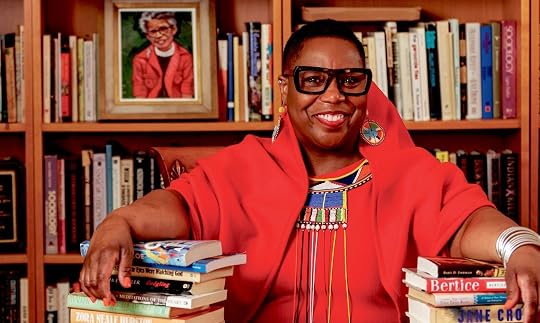
Go to Bertice Berry, PhD, on Instagram
FYI
An updated census says that as of 2023, there are 15.7 million Jews in the world. Jews are .189157% of the world population—according to Dara Horn in a chapter about coordinated online disinformation spreaders, this statistic "is roughly half the number of online followers of Kanye West."
Different sources give different statistics, but an AI answer states that people of color, also known as the Global Majority, are between 6.1 and 6.8 billion, or approximately 76% to 85% of the world.
Which means that, per Dr. Berry's story, 76 to 85 percent of the world population's history and experience is being distorted by most White Americans.
Can you see how much easier it is to misrepresent a mere .189157% of the world when the population that might dispute it is half the number of an antisemitic rapper's followers? And within the USA, a mere 2.4% of Americans?
Does that make the truth of Dara Horn's history and the herculean achievement of writing it more palatable if you are a doubter?
* * *
Thank you to Avid Reader Press/Simon & Schuster for an advance reading copy. Because I read an ARC, page numbers were not available for citations. The book launched September 1st.
A quote from the introduction, talking about all the people who've approached and written to Dara Horn after her best-selling book of essays People Love Dead Jews:
On multiple occasions, I had the surreal experience of readers approaching me for the sole purpose of apologizing to me personally for the last several thousand years. (I explained to them that it wasn't their fault.) More often, though, these readers—a self-selecting group, to be sure, but a surprisingly diverse one—were simply curious and eager to learn more. The most common response I received from these readers was a humbled and bewildered "I had no idea." And then: "How can I help?"
I realized there was a disconnect between my Jewish readers who were asking for support and my non-Jewish readers who were offering it. It occurred to me, in this time of confusion and fear, that somewhere in that space between my Jewish and non-Jewish readers, was a vast and mostly unexplored opportunity for the future.
I've often been tongue-tied since the October 7th, 2023, massacre, butchering, torture, and rape of 1,200 humans in Israel, feeling caught between two hostile groups: American Jews who refused to criticize Netanyahu for war crimes in his response to Hamas's attack (ironically 61% of Israeli Jews have no such problem—my 2 cents; not in the book) and the instant and absolute tsunami of worldwide antisemites whose proud, self-righteous hateful, indiscriminate rhetoric not only stunned and hurt me, but also so invaded publishing that it has become impossible to even mention anything Jewish in an article and, in my case, infected responses to two articles I'd had accepted for publication: one was not published; one was published but with no mention in the Table of Contents so the only way to find it was to know it was there.
And what makes this even more difficult is that most non-Jews are either blind to this epidemic of Jew-hate or refuse to believe it is a problem.
I became so distraught that I enlisted the help of a therapist friend to talk with me about it in a Zoom call that I published on Substack: Two Jews Talk about Zohran Mamdani.
The issue feels so overwhelming because of the age-old subversive nature of antisemitism, where it is simultaneously justified, denied, and celebrated—where people are literally celebrating the slaughter of Jews because they are Jews. Sometimes I get lost in the accusations and counteraccusations. So Dara Horn has done the impossible in The Final Solution to the Jewish Question: A Love Story for the Living. She has deconstructed the whole mess, giving historical facts and dissecting truth from the "barnacles of antisemitism" that are so baked into worldwide culture that it can make a person who is reeling from it feel insane.
To say the history of Jews and Arabs is complicated and multi-layered is a colossal understatement. And to say the history of anti-Zionism is virtually unknown is equally so—the diabolical long-range vision and planning of the authoritarian Iran government makes our present hubristic war declared by a fool with no education whatsoever almost laughable; and Iran's long-time understanding of the way to penetrate the world's (and particularly American) universities with propaganda equivalent to teaching "black is white" explains to me the blinding speed of the antisemitic explosion following Hamas's October 7th attack—they were absolutely prepared for and had laid the ground for what followed. All this is delineated in a chapter that begins with Horn being hired to educate the student body of a private school that has had an outbreak of antisemitic events. Here, she indeed gives a blow by blow of the whole astounding histories. It is so complex that I cannot retain it, let alone relay it to anybody else, but I am so glad Horn is one of the Jewish scholars who can intelligently counter easy condemnation and hyperbole with historical facts. (Read the book if you assume you know who's good and who's bad. Whatever you believe, if it's an easy conclusion, you are wrong. Historically wrong.)
(And here, anticipating backlash, I should add that Horn acknowledges human rights abuses in Israel—as in so many other countries around the world, where we do not declare a whole people or country evil and want to annihilate them. She mourns the lack of space in this 384-page book to fully discuss the flaws of Zionism—she does discuss the highly modern flawed founder, Theodor Herzl, a failed rom-com writer. But this is not a book about those topics. It is a book about the ancient tropes, propaganda, and straight-out lies about history that have brought us to where we are today with antisemitism and the blatant or veiled belief that all Jews must be exterminated and if they are butchered, raped, and murdered, they deserve it. It is about what is behind the rhetoric that has become so popular it is spouted easily and automatically without the speakers even understanding they are repeating ancient tropes as well as Nazi propaganda—literal phrases written by those parties that are an instant dog whistle for Jews but whose meaning the speakers are not even aware of.)
Part of the insanity for present-day Jews is the gap between discussion about antisemitism and the immediate experience of being the target of it. (In the Substack video call, I mentioned an experience at a protest against the Iran war when I was suddenly having Jew- and Israel-hate blasted at me through a bullhorn. To say it shook me up is an understatement, and I left the demonstration. No amount of discussion about this will convey the feeling: it shakes every cell of your being.) Dara Horn constantly negotiates this in her furious commentary about what has erupted and her personal feelings. I fear some readers will react to the fire of her writing in the early part of the book by turning off because it is just too much for them, resulting in them never "hearing" what she is talking about—the almost indescribable insidiousness of hate disguised as rational notions.
But sometimes, Horn is unnervingly clear and calm. For instance, she writes, according to a 2020 Pew survey, only 2.4 percent of US adults are Jews. And as she visits Holocaust museums and education centers around the country, it becomes apparent that the vast majority of people teaching this topic are not Jewish. When she visits Benjamin Vollmer, a non-Jewish teacher in Venus, TX, "a rural community with fifty-seven hundred residents" where most of the students are Latino, she is puzzled by his popular Holocaust education program including a field trip to Dallas, so she asks him:
Why not focus on something more relevant to his students . . . like the history of immigration or the Civil Rights Movement?
I hadn't yet appreciated that the absence of Jews was precisely the appeal.
"Some topics have been so politicized that it's too hard to teach them, Vollmer told me. "Making it more historical takes away some of the barriers to talking about it."
Wouldn't the Civil Rights Movement, I asked, be just as historical for his students?
He paused, thinking it through. "You have to build a level of rapport in your class before you have the trust to explore your own history," He finally said.
And there it is: Jewish history is not "our own history," so therefore it can be taught in a box, and antisemitism is therefore a normal part of the fabric of society, and permissible outside of that box! And it largely goes unnoticed by non-Jews.
To quote from later on in the book:
Jewish civilization was not only a story about a minority group. It was a foundational building block of civilization for the majority of the world's population, including the overwhelming population of the United States. It was actually impossible to understand Christianity, Islam, the thinking of the American founders, or even many expressions of American history concepts like abolition and civil rights without understanding Judaism.
There is so much in this book I didn't know. My Jewish parents decided to raise us without the religion or culture, telling us only that had we lived in Hitler's Germany, we'd have been murdered, but we were nothing and if we wanted a religion when we grew up, we could decide what we wanted to be. Until I went out into the world and, on-sight, was relentlessly labeled "Jew," or "New York Jew" all over Europe, I hadn't a clue about my true history. I've been educating myself for decades, but still was surprised by some of the facts in this book. Although I knew that my mother and uncle changed their name in order to work in the 1940s, until reading Horn's book, I did not know that "the Green Book travel guide for Black Americans, informing them which hotels were open to them, was inspired by preexisting Jewish travel guides published to inform Jewish travelers where they were allowed to stay." I didn't know that real estate redlining kept Jews out of neighborhoods and entire towns. I did not know that Jews built their own hospitals and law firms because it was the only way to get services. And so much more that my parents kept silent about.
The book lightens noticeably in a chapter called "Learning from Living Jews" about adult and teenage Jews going into classrooms to share about normal Jewish life in an attempt to nurture students' curiosity. It sounded wonderful and like something I could benefit from—fill in holes left by my lack of Jewish upbringing. This section is the beginning of what was teased in the introduction: the power of curiosity to close our divides—the central theme of the new documentary The Work in Progress (see a review at link). It discusses what sociologists call the "contact hypothesis": "Personal contact between people from different groups can reduce prejudice." But even within this section, Horn debunks significant misinformation. Her allegiance to historical fact and breadth of knowledge are staggering. (For instance, did you know that the common explanation for early Jews being bankers due to the fact that they were prohibited from owning land is false? "In reality, bankers and merchants in Europe were overwhelmingly Christian," according to economic historians Maristella Botticini and Zvi Eckstein. Prohibitions against Jews "owning land did not appear in many places until the late medieval era." The reason for "Jewish communities' disproportionate involvement in trade and finance [which] predated this period by many centuries," the scholars conclude: literacy.)
The ripping apart of "academic malpractice" and both students' and teachers' "commitment to ignorance," continues in the third to last chapter, "Rebuilding the Humanities," further making my head swim with the same overwhelm antisemitism triggers. On one hand, our corrupt administration wages a culture war on universities (Horn is "a deep cynic about those leading" the US and Israel. "The authoritarian bent and also plain incompetence of some of those leaders is a profound concern, and people should continue shouting from the rooftops for change."); on the other hand, the universities have done themselves in with so many contradictions and support of popular lies in order to remain popular. Read the book. No way can I begin to summarize this material. Suffice it to say, Dara Horn, like the movie The Work in Progress, realizes the incredible power of curiosity:
[A new way of teaching] "was going to require everyone's strongest skills of communication and persuasion and weighing evidence and collaboration to bring forth new methods of determining truth and solving problems. Curiosity would be mandatory, and so would courage. It was long past time to begin again.
No matter how fiery Horn gets, keep reading, because the last two chapters, "A Story to Tell" and "A Love Story of Living," lead to revolutionary ideas—a whole new story of Jews and antisemitism. And believe it or not, it's a countercultural love story that closes on the notion that:
The opposite of hatred is something much more commonplace, and which we are all capable of feeling about anyone: curiosity, open to every person with the courage to ask questions.
Put simply, The Final Solution to the Jewish Question is astonishing! A masterpiece of scholarship, journalistic reporting, and personal experience. Dara Horn's clarity and ability to take apart this ancient plague feel almost superhuman.
My epilogue using Dr. Bertice Berry, sociologist and storyteller
Just substitute Jewish for Black, and this is accurate:
Go to Bertice Berry, PhD, on Instagram
FYI
An updated census says that as of 2023, there are 15.7 million Jews in the world. Jews are .189157% of the world population—according to Dara Horn in a chapter about coordinated online disinformation spreaders, this statistic "is roughly half the number of online followers of Kanye West."
Different sources give different statistics, but an AI answer states that people of color, also known as the Global Majority, are between 6.1 and 6.8 billion, or approximately 76% to 85% of the world.
Which means that, per Dr. Berry's story, 76 to 85 percent of the world population's history and experience is being distorted by most White Americans.
Can you see how much easier it is to misrepresent a mere .189157% of the world when the population that might dispute it is half the number of an antisemitic rapper's followers? And within the USA, a mere 2.4% of Americans?
Does that make the truth of Dara Horn's history and the herculean achievement of writing it more palatable if you are a doubter?
* * *
Thank you to Avid Reader Press/Simon & Schuster for an advance reading copy. Because I read an ARC, page numbers were not available for citations. The book launched September 1st.

Review of advance copy received from NetGalley
As someone who is an advocate against antisemitism and someone who lives "Jewishly" in Canada, this book is an excellent and concrete breakdown of the chaos, immorality, and misinformation plaguing our world when it comes to the "Jewish Question." Horn sets up the world as it was between her last book (People Love Dead Jews - which taught me to challenge certain assumptions about my place in the world), and the world as it has become since the Hamas massacre on October 7, 2023. She reminds us of the massive (absolutely massive) coordinated digital campaign seeding the social media and campus hate, and that the many protests and encampments, and acts of vandalism and physical harm against Jews and Jewish spaces, 1) are not "freeing Palestine" or 2) born of out any true understanding of a foreign conflict in a country most folks cannot find on a map.
Horn maps out the "vague sense of dread" most diaspora Jews are facing right now when workplaces, friend groups, and organizations have adopted dehumanizing language in relation to Jews, and antisemitic tropes by the dozens. She gives voice to the palpable and often successful attempts to push Jews (again) out of civil society and ties it to the age-old issue of blaming the Jews for the world's ills. Horn uses the absurdity of "the fight" against the antisemitism at Harvard to illustrate many of her points (we have a similar comparison in Canada at Toronto Metropolitan University - not nearly as prestigious as Harvard - but equally committed to committee after committee to ensure it never addresses its reported and documented raging campus antisemitism). Horn speaks about the imperative of introducing Jewish life (not death) to people who do not or have never met a Jew. And she clearly recounts "The Big Lie of Antisemitism" which contends Jews are destroying whatever it is you value, and her creation of the The Tell Institute to counter it.
But. With every page, every chapter, every myth busted, every misinformed trope broken apart, I wished for an alternate universe where I was not the one reading this. Rather it was the former colleague and friend, a lawyer, who has not spoken to me since November 2023. Or the former friend and colleague, a politician, who has ghosted me since July 2025. Or the authors I used to read who would stake their livelihood protesting American book bans, but think nothing of excluding Jewish authors from literary festivals or book spaces. The list is endless. On better days, I remember the allies. I remember the good about the society in which I live. I remember the Jewish love story for the living Horn wants us to create. I remember that the world continues to turn. And I remember Dara Horn and her wisdom, empathy, and grace. Highly recommend for everyone. Thank you to NetGalley and Avid Reader Press for the DRC.
Horn maps out the "vague sense of dread" most diaspora Jews are facing right now when workplaces, friend groups, and organizations have adopted dehumanizing language in relation to Jews, and antisemitic tropes by the dozens. She gives voice to the palpable and often successful attempts to push Jews (again) out of civil society and ties it to the age-old issue of blaming the Jews for the world's ills. Horn uses the absurdity of "the fight" against the antisemitism at Harvard to illustrate many of her points (we have a similar comparison in Canada at Toronto Metropolitan University - not nearly as prestigious as Harvard - but equally committed to committee after committee to ensure it never addresses its reported and documented raging campus antisemitism). Horn speaks about the imperative of introducing Jewish life (not death) to people who do not or have never met a Jew. And she clearly recounts "The Big Lie of Antisemitism" which contends Jews are destroying whatever it is you value, and her creation of the The Tell Institute to counter it.
But. With every page, every chapter, every myth busted, every misinformed trope broken apart, I wished for an alternate universe where I was not the one reading this. Rather it was the former colleague and friend, a lawyer, who has not spoken to me since November 2023. Or the former friend and colleague, a politician, who has ghosted me since July 2025. Or the authors I used to read who would stake their livelihood protesting American book bans, but think nothing of excluding Jewish authors from literary festivals or book spaces. The list is endless. On better days, I remember the allies. I remember the good about the society in which I live. I remember the Jewish love story for the living Horn wants us to create. I remember that the world continues to turn. And I remember Dara Horn and her wisdom, empathy, and grace. Highly recommend for everyone. Thank you to NetGalley and Avid Reader Press for the DRC.
July 19, 2026
Review of a digital advanced reader copy from Edelweiss plus.
Dara Horn’s first nonfiction book “People Love Dead Jews” immediately became one of my top books on the subject of antisemitism. I realized that I sat on reading her follow up for months because I was worried that her new book “The Final Solution to the Jewish Question: A Love Story to the Living” would not live up to the paradigm shifting power that her previous nonfiction piece achieved. I was wrong, this new book has surpassed my expectations.
Dara Horn describes the role she found herself in after publishing her “People Love Dead Jews” as a “Lorax” and in her new book “The Final Solution to the Jewish Question: A Love Story to the Living” she has managed to describe a Jewish young adult’s experience after October 7th, 2023 right down to the specific Atlantic magazine cover article. With the prose of an experienced novelist but with the genuine concern for the future of an activist parent, Dara Horn manages to end a work of social commentary about bigotry and misinformation on an impossible note - a hopeful actionable one.
There are times that “The Final Solution to the Jewish Question: A Love Story to the Living” reads as if the reader has already read “People Love Dead Jews”, acting as a direct sequel, creating a nonfiction duology. Readers could jump into “The Final Solution to the Jewish Question: A Love Story to the Living” and get a satisfying read, but the experience would be enhanced by reading “People Love Dead Jews” first.
This is a writer who has met the moment and has delivered the book that every Jewish and non-Jewish reader needs to read.
Dara Horn’s first nonfiction book “People Love Dead Jews” immediately became one of my top books on the subject of antisemitism. I realized that I sat on reading her follow up for months because I was worried that her new book “The Final Solution to the Jewish Question: A Love Story to the Living” would not live up to the paradigm shifting power that her previous nonfiction piece achieved. I was wrong, this new book has surpassed my expectations.
Dara Horn describes the role she found herself in after publishing her “People Love Dead Jews” as a “Lorax” and in her new book “The Final Solution to the Jewish Question: A Love Story to the Living” she has managed to describe a Jewish young adult’s experience after October 7th, 2023 right down to the specific Atlantic magazine cover article. With the prose of an experienced novelist but with the genuine concern for the future of an activist parent, Dara Horn manages to end a work of social commentary about bigotry and misinformation on an impossible note - a hopeful actionable one.
There are times that “The Final Solution to the Jewish Question: A Love Story to the Living” reads as if the reader has already read “People Love Dead Jews”, acting as a direct sequel, creating a nonfiction duology. Readers could jump into “The Final Solution to the Jewish Question: A Love Story to the Living” and get a satisfying read, but the experience would be enhanced by reading “People Love Dead Jews” first.
This is a writer who has met the moment and has delivered the book that every Jewish and non-Jewish reader needs to read.

Review of advance copy received from NetGalley
FTC DISCLOSURE: I received a complimentary copy of this book. A positive review was not required. These are my honest thoughts and opinions.
We are tired, and the author of this book, dubbed "The Antisemitism Lorax", is the most tired of us all. And yet she toils on to share this book which was so comforting, galvanizing, and affirming that we Jews are not crazy for how we feel about current events.
I appreciated her book People Love Dead Jews, but I've been waiting for more from her on the post-October 7th world. This book delivered. She wrote about modern-day antisemitism, historical antizionism, disinformation in the digital age, well-meaning but ultimately ineffective methods of education, and so on.
It was the last two chapters that really filled me with hope and brought me to tears. 💙🤍
I wish everyone would read this book and understand.
We are tired, and the author of this book, dubbed "The Antisemitism Lorax", is the most tired of us all. And yet she toils on to share this book which was so comforting, galvanizing, and affirming that we Jews are not crazy for how we feel about current events.
I appreciated her book People Love Dead Jews, but I've been waiting for more from her on the post-October 7th world. This book delivered. She wrote about modern-day antisemitism, historical antizionism, disinformation in the digital age, well-meaning but ultimately ineffective methods of education, and so on.
It was the last two chapters that really filled me with hope and brought me to tears. 💙🤍
I wish everyone would read this book and understand.

September 22, 2026
This book is a follow-up to Horn's excellent "People Love Dead Jews: Reports from a Haunted Present" but works just fine as a stand-alone. In both cases she went with a deliberately provocative title, with which I'm still a bit uncomfortable, but as the goal is to shock people to reevaluate their preconceived attitudes towards Judaism, Zionism, and antisemitism, they serve the purpose.
Since October 7 I've read a great many books about these topics, and this is arguably the very best of the bunch. Horn uses her experiences at Harvard and Holocaust education to question the way the educational system and society in generally fail to be normal about Jews. She then goes on to explain why this is the case, highlighting various antisemitic movements throughout history, and tying them all back to what she calls the Big Lie, namely that Jews are responsible for whatever is deemed the worse in each society. This common thread underlies the disparate expressions of Jew hate, from charges of deicide, the Blood Libel, the Protocols, the nazis and their "race science", the Soviet led 1975 UN resolution condemning Zionism as racism, the absurd 2001 World Conference against Racism, and the contemporary demonization of Israel and Jews on campus and in the public sphere. Although I was familiar with most of the content, she does an extraordinary job of succinctly summarizing these historic events and cutting through the centuries of bullshit and lies. She elucidates both the sources and the reasons behind this extraordinary smear campaign, and brilliantly dissects and refutes each accusation.
Although she doesn't hide her hurt or scorn, she also doesn't shy away from legitimate criticism, for instance acknowledging throughout the book that Israel is far from perfect. Which serves to strengthen her arguments, as she exposes the hypocrisy underlying the singling out of Israel's faults, the well-funded and concerted efforts to applying double standards that would be rejected out of hand in any other situation.
Despite the extremely high quality writing throughout, and my classification as a Must-Read for anyone who has ever expressed a thought about Jews, Israel, or Zionists, I did have a couple of minor issues with the book. As acknowledged in the afterward and evident while reading the main text, a lot of the content was compiled from previous articles and presentations. There was therefore a bunch of overlap and repetition, with the same examples and phrases appearing multiple times. It's one thing to restate the same idea for emphasis, another to introduce it as "new" more than once. There were also a couple of minor factual errors that should have been caught prior to publication (thankfully not substantive but still they detract from the otherwise solidity of her arguments).
Audiobook: She narrates the audiobook herself, and her erudition, passion, concern, and simmering rage add a visceral emotional element to the text that makes it even more powerful. But since the book is so full of important information, having a written copy for reference in addition to the audiobook would also be valuable.
Since October 7 I've read a great many books about these topics, and this is arguably the very best of the bunch. Horn uses her experiences at Harvard and Holocaust education to question the way the educational system and society in generally fail to be normal about Jews. She then goes on to explain why this is the case, highlighting various antisemitic movements throughout history, and tying them all back to what she calls the Big Lie, namely that Jews are responsible for whatever is deemed the worse in each society. This common thread underlies the disparate expressions of Jew hate, from charges of deicide, the Blood Libel, the Protocols, the nazis and their "race science", the Soviet led 1975 UN resolution condemning Zionism as racism, the absurd 2001 World Conference against Racism, and the contemporary demonization of Israel and Jews on campus and in the public sphere. Although I was familiar with most of the content, she does an extraordinary job of succinctly summarizing these historic events and cutting through the centuries of bullshit and lies. She elucidates both the sources and the reasons behind this extraordinary smear campaign, and brilliantly dissects and refutes each accusation.
Although she doesn't hide her hurt or scorn, she also doesn't shy away from legitimate criticism, for instance acknowledging throughout the book that Israel is far from perfect. Which serves to strengthen her arguments, as she exposes the hypocrisy underlying the singling out of Israel's faults, the well-funded and concerted efforts to applying double standards that would be rejected out of hand in any other situation.
Despite the extremely high quality writing throughout, and my classification as a Must-Read for anyone who has ever expressed a thought about Jews, Israel, or Zionists, I did have a couple of minor issues with the book. As acknowledged in the afterward and evident while reading the main text, a lot of the content was compiled from previous articles and presentations. There was therefore a bunch of overlap and repetition, with the same examples and phrases appearing multiple times. It's one thing to restate the same idea for emphasis, another to introduce it as "new" more than once. There were also a couple of minor factual errors that should have been caught prior to publication (thankfully not substantive but still they detract from the otherwise solidity of her arguments).
Audiobook: She narrates the audiobook herself, and her erudition, passion, concern, and simmering rage add a visceral emotional element to the text that makes it even more powerful. But since the book is so full of important information, having a written copy for reference in addition to the audiobook would also be valuable.

Review of advance copy received from NetGalley
This is the follow-up to Dara Horn's acclaimed "People Love Dead Jews," and it's an important read.
Horn certainly has a knack for shocking titles. She is a brave woman who has the talent and intelligence to address emerging global antisemitism, and she does it beautifully.
The beginning of the book is how she became the "antisemitism lorax" after the publication of the first book, in 2021. She was in position after what happened in 2023, and she got calls from all over, including from President Biden, for her input. There's plenty of humor here, and I loved how she said that even the president wanted her to solve antisemitism.
She doesn't shy away from her new calling. The next part of the book details some of the grotesque instances of antisemitism across the country, particularly at universities. She was called into Harvard, where she is an alumna, to sit on an antisemitism task force, and she is brutal and honest about how they handled it -- or more accurately, didn't handle it.
Next, she gives a short but accurate history of the Jewish presence in Israel and explains what Zionism is, and isn't.
Finally, at the end, she explains her solution, and it's quite beautiful, especially as she ties it into her own family's history.
I do fear that this will be preaching to the choir, but she does give examples at the end of how her approach has changed some people's mindsets, so there's hope. I do recommend this for anyone looking for an honest understanding of the problem.
Thank you to NetGalley, Simon & Schuster, and Dara Horn for the opportunity to review an advanced copy.
Horn certainly has a knack for shocking titles. She is a brave woman who has the talent and intelligence to address emerging global antisemitism, and she does it beautifully.
The beginning of the book is how she became the "antisemitism lorax" after the publication of the first book, in 2021. She was in position after what happened in 2023, and she got calls from all over, including from President Biden, for her input. There's plenty of humor here, and I loved how she said that even the president wanted her to solve antisemitism.
She doesn't shy away from her new calling. The next part of the book details some of the grotesque instances of antisemitism across the country, particularly at universities. She was called into Harvard, where she is an alumna, to sit on an antisemitism task force, and she is brutal and honest about how they handled it -- or more accurately, didn't handle it.
Next, she gives a short but accurate history of the Jewish presence in Israel and explains what Zionism is, and isn't.
Finally, at the end, she explains her solution, and it's quite beautiful, especially as she ties it into her own family's history.
I do fear that this will be preaching to the choir, but she does give examples at the end of how her approach has changed some people's mindsets, so there's hope. I do recommend this for anyone looking for an honest understanding of the problem.
Thank you to NetGalley, Simon & Schuster, and Dara Horn for the opportunity to review an advanced copy.

July 18, 2026
Review of advance copy received from NetGalley.
Dara Horn has a way of saying what so many of us have been thinking, but have struggled to articulate.
Much like her book, "People Love Dead Jews," she writes about double standards that Jews and the Jewish state are subjected to that should be obvious to us, but for whatever reason (read: antisemitism, historical illiteracy, biased or inadequate education, political ideologies, etc.) aren't and so when we hear them outlined in the way that only she can, there's a quiet rage that starts building. Why were these things allowed to happen? Why did no one report on them accurately? Why isn't this taught in school? Why do schools only teach about Jews via the Holocaust? Why aren't we all demanding better? How do we fix this? Can we?
I had to take breaks reading this book because, while it says it is a "love story for the living," the first half is heavy. She traces the threads of antisemitism all the way back to the beginning and then follows them all the way forward to the ways in which the same lies, tropes, and methods of intimidation and harassment are being used today.
I don't know if "sardonic" is the right word exactly for the tone of much of the book, but there is a lot of dry, biting wit & social commentary that might be missed if you don't understand Horn's voice. I recommend reading "People Love Dead Jews" before reading this or watching her interviews with Jonah Platt if you struggle with her voice here.
It was equal parts cathartic and infuriating. I felt validated in many things I had been quietly thinking about 10/7 and the world's reaction to it, the campus protests, the attacks on and murders of diaspora Jews in broad daylight, the problem with only teaching the Holocaust, etc. At the same time, it brought back all the feelings of disappointment, sadness, and anger I had as those things were happening, while also deepening those feelings as I reacted to reading about her own experiences and the many stories that were shared with her that I had no idea about before.
There's also a lot of content covered at a sort of breakneck speed, such that if you weren't closely following all the news from the attacks, the protests, the war in the Middle East (and if you weren't following all of the corrections from those news stories), maybe you'll need to slow down and do some research through parts of the book to catch up. Thankfully there is a large section at the end with cited works & endnotes.
Horn has a way of describing the Jewish people, or “am,” and their thousands of years of survival despite oppression, persecution, and attempts at erasure, while ultimately continuing to thrive and flourish, in a way that left me genuinely inspired. I felt proud and hopeful by the end of the book, especially after learning about her new education initiative and others like it that seem like they might actually make a difference. Highly recommend.
Dara Horn has a way of saying what so many of us have been thinking, but have struggled to articulate.
Much like her book, "People Love Dead Jews," she writes about double standards that Jews and the Jewish state are subjected to that should be obvious to us, but for whatever reason (read: antisemitism, historical illiteracy, biased or inadequate education, political ideologies, etc.) aren't and so when we hear them outlined in the way that only she can, there's a quiet rage that starts building. Why were these things allowed to happen? Why did no one report on them accurately? Why isn't this taught in school? Why do schools only teach about Jews via the Holocaust? Why aren't we all demanding better? How do we fix this? Can we?
I had to take breaks reading this book because, while it says it is a "love story for the living," the first half is heavy. She traces the threads of antisemitism all the way back to the beginning and then follows them all the way forward to the ways in which the same lies, tropes, and methods of intimidation and harassment are being used today.
I don't know if "sardonic" is the right word exactly for the tone of much of the book, but there is a lot of dry, biting wit & social commentary that might be missed if you don't understand Horn's voice. I recommend reading "People Love Dead Jews" before reading this or watching her interviews with Jonah Platt if you struggle with her voice here.
It was equal parts cathartic and infuriating. I felt validated in many things I had been quietly thinking about 10/7 and the world's reaction to it, the campus protests, the attacks on and murders of diaspora Jews in broad daylight, the problem with only teaching the Holocaust, etc. At the same time, it brought back all the feelings of disappointment, sadness, and anger I had as those things were happening, while also deepening those feelings as I reacted to reading about her own experiences and the many stories that were shared with her that I had no idea about before.
There's also a lot of content covered at a sort of breakneck speed, such that if you weren't closely following all the news from the attacks, the protests, the war in the Middle East (and if you weren't following all of the corrections from those news stories), maybe you'll need to slow down and do some research through parts of the book to catch up. Thankfully there is a large section at the end with cited works & endnotes.
Horn has a way of describing the Jewish people, or “am,” and their thousands of years of survival despite oppression, persecution, and attempts at erasure, while ultimately continuing to thrive and flourish, in a way that left me genuinely inspired. I felt proud and hopeful by the end of the book, especially after learning about her new education initiative and others like it that seem like they might actually make a difference. Highly recommend.

August 20, 2026
The most important book written in the last few years. Laughed, cried, shook my head in frustration and nodded in furious agreement.
Thank you Dara.
Thank you Dara.

Review of advance copy received from NetGalley
Last year, I read Dara Horn’s People Love Dead Jews, and was gobsmacked by the obvious truths she pointed out—but that I’d never seen anybody else acknowledge. I was excited to read this followup book. She writes that after People Love Dead Jews came out, she was approached constantly with people telling her their experiences with antisemitism and asking her what her solution was. In her darkly humorous style, she wonders how in the world she is expected to solve a problem that has existed for thousands of years. But then she goes ahead and gives it a try, in an interesting and, I think, promising way.
I really like Horn’s opening gambit. She introduces us to the notion something you learn by it not being taught in school. Her example is how when sex education isn’t taught in school, that’s an invitation to learn about sex from your older brother’s porn stash. Similarly (!), she notes that we are taught about the Holocaust, but nothing else about Jewish history and culture, which becomes apparent when people do things like classify all Jews as white or as colonizers. One old man from Wyoming wrote a long letter to her saying that her book made him realize that his own antisemitism was because of “mind barnacles” he had to scrape off by educating himself.
Horn takes us on an illuminating and often horrifying trip through many antisemitism lowlights, Holocaust education and the history of the Palestinian/Zionist issue that has become such an inflammatory topic in the US today. It took me a long time to get through the book because it’s all so depressing and infuriating. But also eye-opening. Even when she discusses things I already knew, she has a way of contextualizing them that is illuminating. And even when discussing very dark subjects and events, she has a biting wit that helped me keep going.
I can only hope that as many people as possible read this important and enlightening book.
I really like Horn’s opening gambit. She introduces us to the notion something you learn by it not being taught in school. Her example is how when sex education isn’t taught in school, that’s an invitation to learn about sex from your older brother’s porn stash. Similarly (!), she notes that we are taught about the Holocaust, but nothing else about Jewish history and culture, which becomes apparent when people do things like classify all Jews as white or as colonizers. One old man from Wyoming wrote a long letter to her saying that her book made him realize that his own antisemitism was because of “mind barnacles” he had to scrape off by educating himself.
Horn takes us on an illuminating and often horrifying trip through many antisemitism lowlights, Holocaust education and the history of the Palestinian/Zionist issue that has become such an inflammatory topic in the US today. It took me a long time to get through the book because it’s all so depressing and infuriating. But also eye-opening. Even when she discusses things I already knew, she has a way of contextualizing them that is illuminating. And even when discussing very dark subjects and events, she has a biting wit that helped me keep going.
I can only hope that as many people as possible read this important and enlightening book.

September 13, 2026
Thank you, Dara Horn. Being the Antisemitism Lorax may not be fun, but we are all so deeply indebted to you for it. Thank you a million times over.
I'm not really sure how to properly review this book, other than to say I think it is one of the most important pieces of writing of our time. I desperately want all Jews to read it, and I also desperately want the people who reflexively hate us because it's the cool thing to do to read it, too...though I know none of them will. It is a true shame. They all have the capacity to be better people, and yet they consistently choose otherwise.
This book made me want to smile and cry and laugh and scream and sigh in love and sigh in frustration and nod in understand and shake my head in bewilderment and put my hand to my heart and nearly tear out my hair...but above all it made me firmly and boundlessly and proudly and indestructibly love being a Jew. As our saying goes, I love being Jewish so much more than anyone could ever hate me for it. As Horn says, our people defy easy modern categorization of "religion" or "ethnicity" or "culture". We are Am Yisrael. We have been for thousands of years, and as much as it angers the billions of people who think 0.2% of the world population are the sole source of evil and strife, we will continue to be for thousands more. Our story and our identity and our existence is complex and fraught, but it is so so strong.
If anyone who has developed a persistent tic of screaming FREE PALESTINE at anything or anyone even remotely or possibly Jewish is able to put aside the lies and bigotry that have been fed to you by well-funded disinfo campaigns and bot farms and massively wealthy and powerful structures and actually open your mind to the radical notion that Jews are people, I urge you to read this. If you have any capacity whatsoever for learning, I promise it will prove fruitful. Wouldn't you rather not live a life based in seething, maniacal hatred? If you are usually on the side of social justice and support for and defense of minorities, and would recoil at the same tactics you use against Jews being used against any other group, consider for a moment that perhaps you have been led astray by people who benefit from redirecting your ire away from them and onto a group whose worldwide population totals slightly more than that of the country of Rwanda.
This is expertly researched and written, exquisitely crafted, and monumentally meaningful. Thank you, Dara Horn. Tizkeh lemitzvos. Am Yisrael Chai.
I'm not really sure how to properly review this book, other than to say I think it is one of the most important pieces of writing of our time. I desperately want all Jews to read it, and I also desperately want the people who reflexively hate us because it's the cool thing to do to read it, too...though I know none of them will. It is a true shame. They all have the capacity to be better people, and yet they consistently choose otherwise.
This book made me want to smile and cry and laugh and scream and sigh in love and sigh in frustration and nod in understand and shake my head in bewilderment and put my hand to my heart and nearly tear out my hair...but above all it made me firmly and boundlessly and proudly and indestructibly love being a Jew. As our saying goes, I love being Jewish so much more than anyone could ever hate me for it. As Horn says, our people defy easy modern categorization of "religion" or "ethnicity" or "culture". We are Am Yisrael. We have been for thousands of years, and as much as it angers the billions of people who think 0.2% of the world population are the sole source of evil and strife, we will continue to be for thousands more. Our story and our identity and our existence is complex and fraught, but it is so so strong.
If anyone who has developed a persistent tic of screaming FREE PALESTINE at anything or anyone even remotely or possibly Jewish is able to put aside the lies and bigotry that have been fed to you by well-funded disinfo campaigns and bot farms and massively wealthy and powerful structures and actually open your mind to the radical notion that Jews are people, I urge you to read this. If you have any capacity whatsoever for learning, I promise it will prove fruitful. Wouldn't you rather not live a life based in seething, maniacal hatred? If you are usually on the side of social justice and support for and defense of minorities, and would recoil at the same tactics you use against Jews being used against any other group, consider for a moment that perhaps you have been led astray by people who benefit from redirecting your ire away from them and onto a group whose worldwide population totals slightly more than that of the country of Rwanda.
This is expertly researched and written, exquisitely crafted, and monumentally meaningful. Thank you, Dara Horn. Tizkeh lemitzvos. Am Yisrael Chai.
September 28, 2026
MUST READ!

September 5, 2026
This is a masterpiece.
An important book for Jews and none Jews alike.
An important book for Jews and none Jews alike.

September 21, 2026
A book that every educator should read.
This book made me sad and also angry. But it also gave me hope that I'm on the right path. I won't give up; I won't back down, and I'll always be proud of being Jewish.
Thank you, Dara.
This book made me sad and also angry. But it also gave me hope that I'm on the right path. I won't give up; I won't back down, and I'll always be proud of being Jewish.
Thank you, Dara.

September 13, 2026
This is an extraordinary, insightful, and provocative exploration of antisemitism and how it should be confronted. The author covers the historical origins of the big lie behind antisemitism, how it has and is being propagated, and the reason why it seeks to erase Jewish culture and peoplehood . The author critically addresses the failures and misdirections of Holocaust education and the misguided efforts to combat antisemitism by obscuring the uniqueness of Jewish identity and history rather than emphasizing it as the author rightfully believes it should be. The author’s project to do just that is described at the end as a solution. Hopefully it will be successful. This is a must read for both Jews and non-Jews seeking to end the plague of antisemitism and the ignorance on which it’s based.
September 23, 2026
The book we all need right now

September 17, 2026
Dara Horn sure knows how to title a book
September 12, 2026
An outstanding exploration of antisemitism and the failure of decades of Holocaust-centered educational initiatives. At the end of the book, the author introduces innovations her new organization, The Tell Institute, is developing. These are centered on curricula that focus on the significance of Jewish civilization rather than on the Nazi period.
Beyond her compelling subject matter, Ms. Horn’s unusual honesty, sensitivity and curiosity make The Final Solution to the Jewish Question a remarkable book. I’d describe it as a memoir focused on her quest to understand and challenge the surge of public anti-Jewish hatred that exploded on October 8, 2023, before Israel had even responded militarily in Gaza.
I found the Cowardice at Harvard chapter particularly interesting. The school is apparently suffering from a possibly terminal form of groupthink. The Digital Ghetto chapter is equally alarming. It explains how AI large language models are being trained on “poisoned” Reddit and Wikipedia data. Both of those platforms have been hijacked by groups who coordinate to spread distortions and outright lies that support the anti-Israel, anti-Jewish agenda that Qatar’s Al Jazeera also propagates. Like Harvard, both platforms’ managers take a hands-off approach.
As soon as I finished the book, I bought a second copy to lend out.
Beyond her compelling subject matter, Ms. Horn’s unusual honesty, sensitivity and curiosity make The Final Solution to the Jewish Question a remarkable book. I’d describe it as a memoir focused on her quest to understand and challenge the surge of public anti-Jewish hatred that exploded on October 8, 2023, before Israel had even responded militarily in Gaza.
I found the Cowardice at Harvard chapter particularly interesting. The school is apparently suffering from a possibly terminal form of groupthink. The Digital Ghetto chapter is equally alarming. It explains how AI large language models are being trained on “poisoned” Reddit and Wikipedia data. Both of those platforms have been hijacked by groups who coordinate to spread distortions and outright lies that support the anti-Israel, anti-Jewish agenda that Qatar’s Al Jazeera also propagates. Like Harvard, both platforms’ managers take a hands-off approach.
As soon as I finished the book, I bought a second copy to lend out.
September 14, 2026
Of all the books about Israel and Judaism that I've read since the terrorist attacks of October 7, 2023, this is by far the best. So much so that if any of my friends would commit to reading it, I would buy it for them. It brilliantly encapsulates the horrifying reality that most Jews are living through, surrounded by friends and acquaintances who ignorantly and self-righteously bleat "Free Palestine" with less-than-zero knowledge of history, can't point to Gaza on a map, can't name the "river" and the "sea," and think that Gaza was occupied when Hamas gang-raped and murdered its way through southern Israel. "Less than," as most people's understanding of Judaism and Israel has come either from learning from 15-year-olds on TikTok over the past three years, or having been taught a college curriculum written and funded by Qatar. Literally. Read the book.
If you think that Israel: (a) is an "apartheid state," or (b) is committing a "genocide," but you fancy yourself to have an open mind, I dare you to read this book. And once you've read it, I dare you to maintain those positions, and I dare you to continue to support the Jihadi regime who continues to state proudly that their goal is not a "two-state solution," but rather the death of all Jews globally.
If you think swastikas and Nazi salutes are bad, but also lately have been upset that the Je...Zionists...are controlling the media, the U.S., etc., do I have some sobering news for you.
If you've seen the stupid meme (among thousands of them) listing all of the NGOs and newspapers that say Israel is committing apartheid and genocide, with the punchline "I guess they're ALL lying?," this book is the detailed explanation of the "YES."
Don't read this book if you don't want to understand exactly why you'd have fallen for the Nazi propaganda of the 20s, 30s, and 40s.
The book is also gorgeous, particularly the ending. I'll leave it at that.
If you think that Israel: (a) is an "apartheid state," or (b) is committing a "genocide," but you fancy yourself to have an open mind, I dare you to read this book. And once you've read it, I dare you to maintain those positions, and I dare you to continue to support the Jihadi regime who continues to state proudly that their goal is not a "two-state solution," but rather the death of all Jews globally.
If you think swastikas and Nazi salutes are bad, but also lately have been upset that the Je...Zionists...are controlling the media, the U.S., etc., do I have some sobering news for you.
If you've seen the stupid meme (among thousands of them) listing all of the NGOs and newspapers that say Israel is committing apartheid and genocide, with the punchline "I guess they're ALL lying?," this book is the detailed explanation of the "YES."
Don't read this book if you don't want to understand exactly why you'd have fallen for the Nazi propaganda of the 20s, 30s, and 40s.
The book is also gorgeous, particularly the ending. I'll leave it at that.

September 13, 2026
This is another must-read book by Dara Horn. I see it as a companion piece to her previous non-fiction book, "People Love Dead Jews," about why so many people love dead Jews but are anti-Semitic toward living Jews.
She explains why anti-Semitism has been with us throughout Jewish history.
If you want to understand why Jews everywhere have been experiencing a new reality since Oct. 7, 2023, then read this book.
It focuses on understanding the scourge of anti-Semitism, particularly the latest wave, which was launched on October 7, to accompany Hamas' brutal war in which it murdered 1200 people, and kidnapped another 251 people and took them to Gaza as hostages.
Dara Horn makes sense of this coordinated attack in the context of anti-Semitic attacks throughout Jewish history. She analyzes the link between Judaism and anti-Semitism, and she suggests concrete solutions.
To my non-Jewish Goodreads friends, if you read this, I'd be very interested in your opinion.
She explains why anti-Semitism has been with us throughout Jewish history.
If you want to understand why Jews everywhere have been experiencing a new reality since Oct. 7, 2023, then read this book.
It focuses on understanding the scourge of anti-Semitism, particularly the latest wave, which was launched on October 7, to accompany Hamas' brutal war in which it murdered 1200 people, and kidnapped another 251 people and took them to Gaza as hostages.
Dara Horn makes sense of this coordinated attack in the context of anti-Semitic attacks throughout Jewish history. She analyzes the link between Judaism and anti-Semitism, and she suggests concrete solutions.
To my non-Jewish Goodreads friends, if you read this, I'd be very interested in your opinion.

September 16, 2026
I really enjoyed this book and it has a clever and quick way of examining and pathologizing a lot of the anti-Semitism that Jews are experiencing today. I love Horn's framing of the Big Lie, which I won't spoil here. I gave four stars instead of five because at times I had trouble connecting Horn's concepts across chapters.
September 23, 2026
Dara Horn has spent years with Jews trauma dumping their stories on her and asking what to do, and she has answered with a masterpiece that drags you to the depths of hell and back to true hope.

Review of advance copy received from NetGalley
I read this in galley. Seek it out.
Puncturing the Big Lie
Dara Horn’s The Final Solution to the Jewish Question: A Love Story for the Living will make readers deeply, profoundly angry. Yet it is an indispensable piece of cultural criticism.”Cultural crime” is perhaps too polite for an author as righteously angry as Horn.
A renowned novelist, scholar, and Harvard alumnus— Horn is a uniquely courageous thinker.
In the wake of the October 7, 2023, Hamas massacres, Horn found herself on the front lines of an ideological war zone. As a member of Harvard’s Antisemitism Advisory Group, she spent months trying to get her alma mater to acknowledge and address the rampant, escalating levels of Jew-hate permeating its institutions and campuses. The university’s shameful refusal to act, paired with the infamous congressional testimony of its then-president Claudine Gay—who claimed that calls for the genocide of Jews violated campus policy only "depending on the context"—ultimately contributed to the president's resignation. Horn captures this institutional cowardice with the clarity of an insider who watched the gold standard of American higher education completely implode. These pages are worthy of a “South Park” episode, with administrators perhaps weeping, “Why are the Jews making such a fuss.”
A central focus of Horn’s exposure of academic rot lies in her coverage of Ivy League colleges and their direct financial and ideological links to Qatar and Hamas. Horn shows how billions of dollars in foreign funding from the Persian Gulf petrostate have poured into elite universities. This financial pipeline has systematically underwritten programs, endowed chairs, and hosted panels that launder fundamentalist propaganda under the guise of "decolonial" frameworks. By tracing these financial links, Horn demonstrates how foreign actors sympathetic to or explicitly backing Hamas effectively bought real estate in the minds of American academics. (For instance, Oberlin hired a faculty member subsidized by Qatar after he retired as diplomat in charge at the Qatari embassy in Berlin in the 1990s when refugee dissidents were being killed.)
Equally infuriating is Horn’s sharp-eyed sociological dissection of the post-October 7 protesters. She refuses to accept the narrative that these mobs were merely idealistic youth moved by humanitarian concern. Instead, she focuses on the stark reality that the vast majority of those spewing anti-Jewish hatred and cheering on terror went to exclusive prep schools and elite elite colleges. In these highly insular incubators of extreme privilege, wealthy youth were systematically conditioned to love fundamentalist terrorist organizations like Hamas—rebranding their barbaric sadism as "noble resistance"—while learning to utterly despise Israel and bait its supporters. Horn demonstrates that Jew-hatred was adopted as a fashionable badge of moral superiority.
Beyond the elite colleges and universities, Horn embeds herself with local educators in different parts of the country. She follows them into public high schools and community centers as they attempt the daunting task of explaining to teenagers what Judaism actually is, beyond a caricature of dead Holocaust victims or a caricature of Israeli villainy. Horn captures these educators trying to convince impressionable youth why they should not overlook or normalize open calls for the destruction of the world's only Jewish state and the murder of its people.
If the book has a flaw, it is its political limitations regarding solutions. Horn admits throughout that her only tangible prescription to the total breakdown of solidarity between Jews and non-Jews is "more education"—a solution she herself acknowledges is desperately insufficient when facing a three-thousand-year-old psychological pathology still accelerating faily.
Yet, despite this limited remedy, the sheer weight of the facts she presents is undeniable. Her research is an essential armory for anyone in any walk of life trying to dismantle the anti-Jewish lies dominating modern discourse.
Chapter Summaries
Introduction: The Antisemitism Lorax
Horn reflects on her post-2021 experience traveling the country after publishing People Love Dead Jews. She recounts an endless deluge of private stories from ordinary American Jews facing normalized harassment, and describes her growing horror as she realized that neither public institutions, Jewish organizations, nor government task forces had any idea how to solve the crisis.
Chapter 1: The Return of the Big Lie
Horn provides a devastating eyewitness account of her time on Harvard's Antisemitism Advisory Group following October 7. Drawing on historian David Nirenberg's concept of "Anti-Judaism," she demonstrates how Western societies routinely define their highest ideals by demonizing Jews, explaining how elite universities allowed anti-Jewish harassment and open support for Hamas to flourish under the cover of hyper-intellectualized "activism".
Chapter 2: The Problem with Everyone’s Favorite Solution
Embarking on a cross-country investigation of Holocaust education, Horn exposes its fundamental limitations. She reveals how teaching about dead Jews in isolation—without ever teaching about living Jewish civilization—has failed to stop antisemitism and, in some cases, has led students to blame Jews for their own destruction or view them merely as historical props.
Chapter 3: Generation Anti-Z
Horn takes the reader through a deep historical excavation of "antizionism," tracing its lineage from early 20th-century Russian propaganda to Soviet "Zionology," Nazi collaborators like Johann von Leers and Hajj Amin al-Husseini, and the 2001 UN Durban Conference. She shows how current youth culture and prep-school/Ivy League activism are repeating recycled totalitarian lies manufactured to push Jews out of public life.
Chapter 4: The Gentleman’s Agreement Examining post-WWII American Jewish history, Horn dismantles the myth of a "Golden Age" brought on by non-Jewish guilt over the Holocaust. She explores how American Jews achieved social integration through a Faustian bargain—editing their ancient civilization to fit a non-threatening, Western "religious" model—and shows why that compromise has left Jews defenseless against modern attacks on their collective identity as a people.
Chapter 5: Escape from the Digital Ghetto Horn dives into the modern digital ecosystem, investigating "data poisoning" on platforms like Reddit and Wikipedia. She documents how coordinated bad actors, terror-linked operatives, and biased moderators systematically alter information online, manipulating search engines and training artificial intelligence models to embed antisemitic conspiracy theories into the permanent record of human knowledge.
Chapter 6: Learning from Living Jews Highlighting ground-level efforts to counter ignorance, Horn focuses on local educators and grassroots initiatives working to teach non-Jews about the actual content, literacy, values, and traditions of living Jewish civilization, rather than defining Jewish existence solely through persecution.
Chapter 7: Rebuilding the Humanities
Horn critiques the total ideological capture of modern higher education and the decay of the humanities. She calls for a complete overhaul of how history, literature, and culture are taught, advocating for the restoration of genuine curiosity, rigorous debate, and baseline historical truth over rigid ideological dogmatism.
Chapter 8: A Story to Tell Horn emphasizes the power of Jewish narrative and agency. She argues that Jews must stop playing defense against their harassers' lies and instead reclaim the rich, countercultural, and resilient story of their own three-thousand-year heritage.
Chapter 9: A Love Story for the Living
In an intimate and moving final chapter, Horn offers a defiant tribute to the continuity of Jewish life. Rejecting fatalism, she presents a love letter to the living Jewish people, urging them to embrace their heritage with pride, joy, and an unyielding commitment to building a hopeful future despite the darkness of the present.
Jay
27 July 2026
Puncturing the Big Lie
Dara Horn’s The Final Solution to the Jewish Question: A Love Story for the Living will make readers deeply, profoundly angry. Yet it is an indispensable piece of cultural criticism.”Cultural crime” is perhaps too polite for an author as righteously angry as Horn.
A renowned novelist, scholar, and Harvard alumnus— Horn is a uniquely courageous thinker.
In the wake of the October 7, 2023, Hamas massacres, Horn found herself on the front lines of an ideological war zone. As a member of Harvard’s Antisemitism Advisory Group, she spent months trying to get her alma mater to acknowledge and address the rampant, escalating levels of Jew-hate permeating its institutions and campuses. The university’s shameful refusal to act, paired with the infamous congressional testimony of its then-president Claudine Gay—who claimed that calls for the genocide of Jews violated campus policy only "depending on the context"—ultimately contributed to the president's resignation. Horn captures this institutional cowardice with the clarity of an insider who watched the gold standard of American higher education completely implode. These pages are worthy of a “South Park” episode, with administrators perhaps weeping, “Why are the Jews making such a fuss.”
A central focus of Horn’s exposure of academic rot lies in her coverage of Ivy League colleges and their direct financial and ideological links to Qatar and Hamas. Horn shows how billions of dollars in foreign funding from the Persian Gulf petrostate have poured into elite universities. This financial pipeline has systematically underwritten programs, endowed chairs, and hosted panels that launder fundamentalist propaganda under the guise of "decolonial" frameworks. By tracing these financial links, Horn demonstrates how foreign actors sympathetic to or explicitly backing Hamas effectively bought real estate in the minds of American academics. (For instance, Oberlin hired a faculty member subsidized by Qatar after he retired as diplomat in charge at the Qatari embassy in Berlin in the 1990s when refugee dissidents were being killed.)
Equally infuriating is Horn’s sharp-eyed sociological dissection of the post-October 7 protesters. She refuses to accept the narrative that these mobs were merely idealistic youth moved by humanitarian concern. Instead, she focuses on the stark reality that the vast majority of those spewing anti-Jewish hatred and cheering on terror went to exclusive prep schools and elite elite colleges. In these highly insular incubators of extreme privilege, wealthy youth were systematically conditioned to love fundamentalist terrorist organizations like Hamas—rebranding their barbaric sadism as "noble resistance"—while learning to utterly despise Israel and bait its supporters. Horn demonstrates that Jew-hatred was adopted as a fashionable badge of moral superiority.
Beyond the elite colleges and universities, Horn embeds herself with local educators in different parts of the country. She follows them into public high schools and community centers as they attempt the daunting task of explaining to teenagers what Judaism actually is, beyond a caricature of dead Holocaust victims or a caricature of Israeli villainy. Horn captures these educators trying to convince impressionable youth why they should not overlook or normalize open calls for the destruction of the world's only Jewish state and the murder of its people.
If the book has a flaw, it is its political limitations regarding solutions. Horn admits throughout that her only tangible prescription to the total breakdown of solidarity between Jews and non-Jews is "more education"—a solution she herself acknowledges is desperately insufficient when facing a three-thousand-year-old psychological pathology still accelerating faily.
Yet, despite this limited remedy, the sheer weight of the facts she presents is undeniable. Her research is an essential armory for anyone in any walk of life trying to dismantle the anti-Jewish lies dominating modern discourse.
Chapter Summaries
Introduction: The Antisemitism Lorax
Horn reflects on her post-2021 experience traveling the country after publishing People Love Dead Jews. She recounts an endless deluge of private stories from ordinary American Jews facing normalized harassment, and describes her growing horror as she realized that neither public institutions, Jewish organizations, nor government task forces had any idea how to solve the crisis.
Chapter 1: The Return of the Big Lie
Horn provides a devastating eyewitness account of her time on Harvard's Antisemitism Advisory Group following October 7. Drawing on historian David Nirenberg's concept of "Anti-Judaism," she demonstrates how Western societies routinely define their highest ideals by demonizing Jews, explaining how elite universities allowed anti-Jewish harassment and open support for Hamas to flourish under the cover of hyper-intellectualized "activism".
Chapter 2: The Problem with Everyone’s Favorite Solution
Embarking on a cross-country investigation of Holocaust education, Horn exposes its fundamental limitations. She reveals how teaching about dead Jews in isolation—without ever teaching about living Jewish civilization—has failed to stop antisemitism and, in some cases, has led students to blame Jews for their own destruction or view them merely as historical props.
Chapter 3: Generation Anti-Z
Horn takes the reader through a deep historical excavation of "antizionism," tracing its lineage from early 20th-century Russian propaganda to Soviet "Zionology," Nazi collaborators like Johann von Leers and Hajj Amin al-Husseini, and the 2001 UN Durban Conference. She shows how current youth culture and prep-school/Ivy League activism are repeating recycled totalitarian lies manufactured to push Jews out of public life.
Chapter 4: The Gentleman’s Agreement Examining post-WWII American Jewish history, Horn dismantles the myth of a "Golden Age" brought on by non-Jewish guilt over the Holocaust. She explores how American Jews achieved social integration through a Faustian bargain—editing their ancient civilization to fit a non-threatening, Western "religious" model—and shows why that compromise has left Jews defenseless against modern attacks on their collective identity as a people.
Chapter 5: Escape from the Digital Ghetto Horn dives into the modern digital ecosystem, investigating "data poisoning" on platforms like Reddit and Wikipedia. She documents how coordinated bad actors, terror-linked operatives, and biased moderators systematically alter information online, manipulating search engines and training artificial intelligence models to embed antisemitic conspiracy theories into the permanent record of human knowledge.
Chapter 6: Learning from Living Jews Highlighting ground-level efforts to counter ignorance, Horn focuses on local educators and grassroots initiatives working to teach non-Jews about the actual content, literacy, values, and traditions of living Jewish civilization, rather than defining Jewish existence solely through persecution.
Chapter 7: Rebuilding the Humanities
Horn critiques the total ideological capture of modern higher education and the decay of the humanities. She calls for a complete overhaul of how history, literature, and culture are taught, advocating for the restoration of genuine curiosity, rigorous debate, and baseline historical truth over rigid ideological dogmatism.
Chapter 8: A Story to Tell Horn emphasizes the power of Jewish narrative and agency. She argues that Jews must stop playing defense against their harassers' lies and instead reclaim the rich, countercultural, and resilient story of their own three-thousand-year heritage.
Chapter 9: A Love Story for the Living
In an intimate and moving final chapter, Horn offers a defiant tribute to the continuity of Jewish life. Rejecting fatalism, she presents a love letter to the living Jewish people, urging them to embrace their heritage with pride, joy, and an unyielding commitment to building a hopeful future despite the darkness of the present.
Jay
27 July 2026

Review of advance copy received from NetGalley
I sat on this book for a few days, reviewing my notes and annotations, before writing this review. I love Dara Horn; I think her work is incredibly important, I think her sense of dry humor permeates the text in a way that really draws you in, and her research has been well-conducted. Her main argument in this book is that antisemitism cannot be fought through Holocaust education; indeed, she feels that in many ways, Holocaust education has made antisemitism worse in some educations. She doesn't think Holocaust education should be eliminated, but that the method by which it is taught is less effectual than it could be. Instead, she argues that educators need to work on cultivating curiosity in their students, to start approaching people and situations with less certainty and more wonder. In short, she argues that the humanities need to return to prominence in schooling, and that there are Jewish modes of learning that would be incredibly helpful in reinvigorating the humanities. She also argues that rather than focusing on the Holocaust as the key point of entry for students, we instead should be teaching about Jewish history, civilization, and beliefs - things that students rarely learn in the course of their education.
I took so many notes in this, and really love what Horn did here, but in some ways it falls a little short. This feels like a continuation of "People Love Dead Jews", her first nonfiction book, and that isn't a bad thing, given how phenomenal that book is. However, towards the end of the book she introduces a new initiative that she is working on, the Tell Institute. I think this initiative sounds incredibly exciting, as it focuses on teaching about Jewish civilization and history to help give students information that they might otherwise get from conspiracy theories and TikTok videos that aren't exactly accurate. The Tell Institute is clearly meant to be the a culmination of Horn's thoughts on how we should reinvigorate education and inquiry, and I'm eager to see where it goes and its results. But that is, for me, what detracts a little from the book. There isn't enough data or assessment pieces yet to see if Horn's theories are correct or create a difference. Through my own work with students, I do think this is a good path to take, but it left the book feeling a little incomplete. I would imagine, at some point, Horn will write a third book which explores the outcomes of the Tell Institute. As a result, though, it left this book with a bit of middle book syndrome, something odd to write about a piece of nonfiction!
I also read this as an eARC, which made it incredibly difficult to check the sources that Horn was using. This is not a fault of Horn herself, so I'm not holding it against the book or letting it affect my rating, but it did mean that I couldn't independently fact-check things as easily as I would like. If you read on an ereader, you may want to have a system in place for how you're going to look up her sources. (Which I think she would approve of - weighing evidence and fact checking are a major component of the humanities!)
Nevertheless, this was beautifully written. Despite the heavy subject matter and the many, many details of antisemitism and violence over the centuries, Horn ends with so much hope about how things could be different. Chapter 8 was a love letter, and it filled me with joy and awe at how she described our culture and our people.
I am looking forward to purchasing a physical copy of this for myself when it comes out, so I can annotate it physically and also dive deeper into the sources. Thank you to NetGalley for the eARC; all opinions are my own. 4.5 stars rounded up.
I took so many notes in this, and really love what Horn did here, but in some ways it falls a little short. This feels like a continuation of "People Love Dead Jews", her first nonfiction book, and that isn't a bad thing, given how phenomenal that book is. However, towards the end of the book she introduces a new initiative that she is working on, the Tell Institute. I think this initiative sounds incredibly exciting, as it focuses on teaching about Jewish civilization and history to help give students information that they might otherwise get from conspiracy theories and TikTok videos that aren't exactly accurate. The Tell Institute is clearly meant to be the a culmination of Horn's thoughts on how we should reinvigorate education and inquiry, and I'm eager to see where it goes and its results. But that is, for me, what detracts a little from the book. There isn't enough data or assessment pieces yet to see if Horn's theories are correct or create a difference. Through my own work with students, I do think this is a good path to take, but it left the book feeling a little incomplete. I would imagine, at some point, Horn will write a third book which explores the outcomes of the Tell Institute. As a result, though, it left this book with a bit of middle book syndrome, something odd to write about a piece of nonfiction!
I also read this as an eARC, which made it incredibly difficult to check the sources that Horn was using. This is not a fault of Horn herself, so I'm not holding it against the book or letting it affect my rating, but it did mean that I couldn't independently fact-check things as easily as I would like. If you read on an ereader, you may want to have a system in place for how you're going to look up her sources. (Which I think she would approve of - weighing evidence and fact checking are a major component of the humanities!)
Nevertheless, this was beautifully written. Despite the heavy subject matter and the many, many details of antisemitism and violence over the centuries, Horn ends with so much hope about how things could be different. Chapter 8 was a love letter, and it filled me with joy and awe at how she described our culture and our people.
I am looking forward to purchasing a physical copy of this for myself when it comes out, so I can annotate it physically and also dive deeper into the sources. Thank you to NetGalley for the eARC; all opinions are my own. 4.5 stars rounded up.

Review of advance copy received from NetGalley
I received an Advance Reader Copy (ARC) of this book through #NetGalley. Here is my honest review:
Dara Horn is no stranger to provocative titles, having authored the excellent National Jewish Book Award-winning People Love Dead Jews: Reports from a Haunted Present back in 2021, before large swaths of the Internet chose to validate that assertion. Her latest title, The Final Solution to the Jewish Question: A Love Story for the Living (which is available September 1, 2026), is sure to raise a few eyebrows as well, but if the somewhat disturbing title gets a few more people curious enough to pick up a copy, it will be well worth it.
After the release of People Love Dead Jews, Horn heard from thousands of people who shared their personal experiences, from mild microaggressions to violent antisemitism and everything in between. The Final Solution shares some of these stories along with Horn's own experiences after publishing People Love Dead Jews, and especially in the aftermath of the terrorist attacks of October 7, 2023.
The book moves among three main threads: the current environment of rising antisemitism in the US and throughout the world, the limitations of current and traditional Holocaust education in America, and a historical lesson on the origins and the spread of antisemitism starting in pre-Christian times and through to the present. In each of the three areas, Horn offers insight, a little bit of sardonic humor, and ultimately some ideas about how to effect a more hopeful future.
I have read a lot of books and articles on Jewish history and antisemitism over the past few years, but rarely has someone summarized the problem so succintly. Horn's writing elucidates an incredibly complex, multilayered topic, bringing about a clarity that is rarely achieved in this type of work. As I read, I highlighted perhaps more passages than I ever have before in any book. With each highlighted passage time wishing I'd had this fact or that bit of history handy during some argument (online or in person) over the past few years. In the weeks since I finished reading, I've already dropped several bits of newly acquired knowledge in casual conversation.
In addition to lessons on the past, Horn offers us both hope and warnings for the future. She makes clear that education is a key component of providing a better, safer future for Jews, but that brighter outlook is by no means assured. Horn shows how easily misinformation spreads through new media in particular (whether it's woodcut illustrations in the 1470s spreading the blood libel or Henry Ford producing his own imprint of the Protocols of the Elders of Zion), and warns that concerted efforts to spread antisemitic lies via Artificial Intelligence are well underway.
If books are meant to make you feel something, Horn is equal to the task: the anecdotes she relays from students, educators, and others she met on her book tour made me sad, angry, occasionally hopeful. If books are meant to educate, I can almost guarantee you'll learn something new here: from Simon of Trent to the Bolsheviks to Qatar, Horn has plenty to teach us on the origins of antisemitic tropes, how new forms of media have spread them, and how they continue to be perpetuated to this day.
The Final Solution to the Jewish Question should be required reading for anyone who wants to have an opinion (or thinks they already have one) on Israel, Judaism, or antisemitism. I highly recommend you grab a copy as soon as it hits the shelves.
Dara Horn is no stranger to provocative titles, having authored the excellent National Jewish Book Award-winning People Love Dead Jews: Reports from a Haunted Present back in 2021, before large swaths of the Internet chose to validate that assertion. Her latest title, The Final Solution to the Jewish Question: A Love Story for the Living (which is available September 1, 2026), is sure to raise a few eyebrows as well, but if the somewhat disturbing title gets a few more people curious enough to pick up a copy, it will be well worth it.
After the release of People Love Dead Jews, Horn heard from thousands of people who shared their personal experiences, from mild microaggressions to violent antisemitism and everything in between. The Final Solution shares some of these stories along with Horn's own experiences after publishing People Love Dead Jews, and especially in the aftermath of the terrorist attacks of October 7, 2023.
The book moves among three main threads: the current environment of rising antisemitism in the US and throughout the world, the limitations of current and traditional Holocaust education in America, and a historical lesson on the origins and the spread of antisemitism starting in pre-Christian times and through to the present. In each of the three areas, Horn offers insight, a little bit of sardonic humor, and ultimately some ideas about how to effect a more hopeful future.
I have read a lot of books and articles on Jewish history and antisemitism over the past few years, but rarely has someone summarized the problem so succintly. Horn's writing elucidates an incredibly complex, multilayered topic, bringing about a clarity that is rarely achieved in this type of work. As I read, I highlighted perhaps more passages than I ever have before in any book. With each highlighted passage time wishing I'd had this fact or that bit of history handy during some argument (online or in person) over the past few years. In the weeks since I finished reading, I've already dropped several bits of newly acquired knowledge in casual conversation.
In addition to lessons on the past, Horn offers us both hope and warnings for the future. She makes clear that education is a key component of providing a better, safer future for Jews, but that brighter outlook is by no means assured. Horn shows how easily misinformation spreads through new media in particular (whether it's woodcut illustrations in the 1470s spreading the blood libel or Henry Ford producing his own imprint of the Protocols of the Elders of Zion), and warns that concerted efforts to spread antisemitic lies via Artificial Intelligence are well underway.
If books are meant to make you feel something, Horn is equal to the task: the anecdotes she relays from students, educators, and others she met on her book tour made me sad, angry, occasionally hopeful. If books are meant to educate, I can almost guarantee you'll learn something new here: from Simon of Trent to the Bolsheviks to Qatar, Horn has plenty to teach us on the origins of antisemitic tropes, how new forms of media have spread them, and how they continue to be perpetuated to this day.
The Final Solution to the Jewish Question should be required reading for anyone who wants to have an opinion (or thinks they already have one) on Israel, Judaism, or antisemitism. I highly recommend you grab a copy as soon as it hits the shelves.

September 29, 2026
Ten stars for the importance of the topics, the courage to raise them, the history and information Dara Horn brings together, and the questions she is asking. It has the potential to bring desperately needed education and truth to a wide audience and perhaps create a paradigm shift for people who genuinely want to learn and understand. I applaud Horn for fighting the genocide accusations against Israel and dismantling the ongoing narrative, this is extremely important.
Still, I kept wondering: Who exactly is this book for? I doubt it will change the minds of committed Jew-haters or those determined to remain ignorant. I hope it reaches non-Jews who are uninformed or misinformed (but how?), and Jews who are confused. What makes it relevant to audience as myself - Jewish, deeply engaged with these issues, and do not need to be persuaded on the topics of antisemitism? Learning and knowing that brilliant voices like Horn’s are not sitting quietly, but are researching, questioning, arguing and pushing back.
My frustration is that such an important book does not yet feel like the strongest version of itself. There is an overwhelming magnitude of ideas, history, arguments and emotion here, and at times they become difficult to process. The book feels rushed to publication. I feel
Dara Horn should temper some of the emotional repetitiveness, sharpen the presentation and structure, and give her strongest ideas more room to breathe. I know from her “People Love Dead Jews” how powerful and precise she can be, and I think she can do even better with this material.
For me, the book became clearer and more relevant around Chapter 4 and after. I particularly appreciated her chapter on Harvard, how she tore them apart and exposed what is going on there and other educational institutions. Maybe, if this book becomes a part of Harvard or other colleges curriculum (wishful thinking!) it can help with so much needed critical thinking students ought to develop.
There is also an odd structural problem created by the title. About an hour into the audiobook, Horn essentially tells us that there is no “final solution” to antisemitism. My immediate reaction was: Then what are we going to talk about for the remaining thirteen hours? The answer, of course, is much more complicated than finding a solution. But I wish the book had established where she intended to take us more clearly. In the final minute, I heard a great message: do not bow to antisemitism. That was powerful. Perhaps this message had been running through the book all along, but I only fully recognized it at the end. If so, I wish Horn had made that thread more explicit earlier, and allow this book to have a clearer structure.
One of the strongest ideas appears surprisingly early as well: instead of trying to combat antisemitism primarily through Holocaust education, teach people about Jewish history, civilization, and values, about Jews as a living people, culture, nation. And that educating Jews and non-Jews primarily through the Holocaust allows antisemitism to define the Jewish story. That was my paradigm shift from the book.
One final note specifically about the audiobook: I strongly wish this had been narrated by a professional narrator. Xe Sands did a magnificent job with People Love Dead Jews.
This is a book I learned from but also struggled with and even wanted to stop listening to early on, but in the end I think it is a must read. Perhaps this contradiction says something about both its importance and its flaws.
Still, I kept wondering: Who exactly is this book for? I doubt it will change the minds of committed Jew-haters or those determined to remain ignorant. I hope it reaches non-Jews who are uninformed or misinformed (but how?), and Jews who are confused. What makes it relevant to audience as myself - Jewish, deeply engaged with these issues, and do not need to be persuaded on the topics of antisemitism? Learning and knowing that brilliant voices like Horn’s are not sitting quietly, but are researching, questioning, arguing and pushing back.
My frustration is that such an important book does not yet feel like the strongest version of itself. There is an overwhelming magnitude of ideas, history, arguments and emotion here, and at times they become difficult to process. The book feels rushed to publication. I feel
Dara Horn should temper some of the emotional repetitiveness, sharpen the presentation and structure, and give her strongest ideas more room to breathe. I know from her “People Love Dead Jews” how powerful and precise she can be, and I think she can do even better with this material.
For me, the book became clearer and more relevant around Chapter 4 and after. I particularly appreciated her chapter on Harvard, how she tore them apart and exposed what is going on there and other educational institutions. Maybe, if this book becomes a part of Harvard or other colleges curriculum (wishful thinking!) it can help with so much needed critical thinking students ought to develop.
There is also an odd structural problem created by the title. About an hour into the audiobook, Horn essentially tells us that there is no “final solution” to antisemitism. My immediate reaction was: Then what are we going to talk about for the remaining thirteen hours? The answer, of course, is much more complicated than finding a solution. But I wish the book had established where she intended to take us more clearly. In the final minute, I heard a great message: do not bow to antisemitism. That was powerful. Perhaps this message had been running through the book all along, but I only fully recognized it at the end. If so, I wish Horn had made that thread more explicit earlier, and allow this book to have a clearer structure.
One of the strongest ideas appears surprisingly early as well: instead of trying to combat antisemitism primarily through Holocaust education, teach people about Jewish history, civilization, and values, about Jews as a living people, culture, nation. And that educating Jews and non-Jews primarily through the Holocaust allows antisemitism to define the Jewish story. That was my paradigm shift from the book.
One final note specifically about the audiobook: I strongly wish this had been narrated by a professional narrator. Xe Sands did a magnificent job with People Love Dead Jews.
This is a book I learned from but also struggled with and even wanted to stop listening to early on, but in the end I think it is a must read. Perhaps this contradiction says something about both its importance and its flaws.

September 30, 2026
When I finish sobbing I will write an actual review. In the meantime, please read this book!
I took about 11 pages of notes as I read this book, and I did in fact cry as I read the last chapter. Most of the book I felt angry. It doesn't really matter how many citations or historical accounts are shared, the people who want to flood the world with anti Jewish rhetoric have always had the upper hand. With only 0.2% of the population, it feels like a fight we can never win. I have noticed that I am trying to actively bring up Jewish topics - holidays, stories, recipes, personal experiences - even in random interactions with people because I am trying to see if there is any curiosity. There doesn't seem to be much. It is possible that in the US, people are hesitant to ask questions because they are afraid of saying "the wrong thing" or they don't want to seem intrusive. Maybe. It is true though that most people in the world will never meet a Jewish person and that the data poisoning is vast and comprehensive. I typed "how many Israelis were killed on October 7th" into Google and got an answer about Israelis killed by "friendly fire" by the IDF. I was shocked, but not surprised after reading this book. The argument that the Jews shouldn't be hated because they are "just like everybody else," is cut down as Dara Horn points out that Jews have actually spent the past 3000 years "not being like everyone else." She says "The requirement that Jews be "just like everyone else" in order to not be hated is the fatal flaw that exposes the limits of a society's diversity. It requires that people erase themselves to conform to the majority's demeaning demands." For Horn, it is a fundamental lack of curiosity that has allowed the "big lie" of antisemitism to flourish for thousands of years. While there is no actual "final solution" in this book, her reference to the famous rabbinical quote, "you are not required to complete the work, but neither are you free to desist from it," feels extremely relevant. The Jewish people have always encountered civilizations that strive to eliminate the rigorous, questioning, bookish tendencies of our culture. As a tiny minority who does not proselytize, it is easy for the majority rulers to simply scapegoat the Jews for whatever ails their society. It is analogous to what is happening now in the US with all of the anti-trans legislation. They are such a tiny minority that attacking them does little to hurt their political opportunities and makes a big impact towards appeasing their conservative base. The Jews have been on the receiving end of that strategy even prior to the technology innovations that made it into a global phenomenon (the printing press, radio, social media - all new ways to expand the message). I hope that there is a way to open minds to curiosity. We try to model the benefits of asking questions at home (sometimes with outright bribes - like the marshmallows at the Passover seder), but my kids tell me that no one raises their hands in class anymore. Even in advanced classes. They would rather just look up an answer online later than expose their lack of understanding in front of their peers. That is worrisome and I hope there is a way to bring inquiry, examination, and wonder back into the world. I'd love to get trained on the Tell Institute's Curriculum - where do I sign up?
I took about 11 pages of notes as I read this book, and I did in fact cry as I read the last chapter. Most of the book I felt angry. It doesn't really matter how many citations or historical accounts are shared, the people who want to flood the world with anti Jewish rhetoric have always had the upper hand. With only 0.2% of the population, it feels like a fight we can never win. I have noticed that I am trying to actively bring up Jewish topics - holidays, stories, recipes, personal experiences - even in random interactions with people because I am trying to see if there is any curiosity. There doesn't seem to be much. It is possible that in the US, people are hesitant to ask questions because they are afraid of saying "the wrong thing" or they don't want to seem intrusive. Maybe. It is true though that most people in the world will never meet a Jewish person and that the data poisoning is vast and comprehensive. I typed "how many Israelis were killed on October 7th" into Google and got an answer about Israelis killed by "friendly fire" by the IDF. I was shocked, but not surprised after reading this book. The argument that the Jews shouldn't be hated because they are "just like everybody else," is cut down as Dara Horn points out that Jews have actually spent the past 3000 years "not being like everyone else." She says "The requirement that Jews be "just like everyone else" in order to not be hated is the fatal flaw that exposes the limits of a society's diversity. It requires that people erase themselves to conform to the majority's demeaning demands." For Horn, it is a fundamental lack of curiosity that has allowed the "big lie" of antisemitism to flourish for thousands of years. While there is no actual "final solution" in this book, her reference to the famous rabbinical quote, "you are not required to complete the work, but neither are you free to desist from it," feels extremely relevant. The Jewish people have always encountered civilizations that strive to eliminate the rigorous, questioning, bookish tendencies of our culture. As a tiny minority who does not proselytize, it is easy for the majority rulers to simply scapegoat the Jews for whatever ails their society. It is analogous to what is happening now in the US with all of the anti-trans legislation. They are such a tiny minority that attacking them does little to hurt their political opportunities and makes a big impact towards appeasing their conservative base. The Jews have been on the receiving end of that strategy even prior to the technology innovations that made it into a global phenomenon (the printing press, radio, social media - all new ways to expand the message). I hope that there is a way to open minds to curiosity. We try to model the benefits of asking questions at home (sometimes with outright bribes - like the marshmallows at the Passover seder), but my kids tell me that no one raises their hands in class anymore. Even in advanced classes. They would rather just look up an answer online later than expose their lack of understanding in front of their peers. That is worrisome and I hope there is a way to bring inquiry, examination, and wonder back into the world. I'd love to get trained on the Tell Institute's Curriculum - where do I sign up?

Review of advance copy received from NetGalley
Review of advance copy received from Netgalley!
This book has been almost all I've thought about since starting it last Friday. I don't even know where to start, it was like drinking from a firehose in the best (and saddest) way. I am currently converting to Judaism within a few minute drive to where the Boulder firebombing antisemitic attack happened. When I asked my conversion sponsor about wearing Judaica at this point in my conversion journey, she told me gently and solemnly that she supported me wearing Judaica if I felt ready - but that I needed to know that I would likely instantaneously start receiving antisemitic comments in our very blue community. Boy howdy was she right. I get at least one comment a week - ranging from pointing at my Magen David and saying "But FREE PALESTINE, right?" or asking if I wear a mitpachat because I'm dirty.
There is no way to describe this book other than being exactly what I needed right here and right now. I buddy read it with a fellow Jewish friend and it felt like every chapter we were texting each other to prep the other for the newest bit of Dara Horn honesty that was going to punch us in the face. This book is angry, it is sarcastic, it is sometimes a little bitter sounding - and it is full of longing and love and hope and survival. The citations section is as long as the long chapters. Ms. Horn "proves" herself time and time again in this through her meticulous research, her on the ground interviewing and her rootedness in history.
Chapter 8 had me in tears, as much of the book did - but with love this time and not with immense sadness like some of the others. Most Jews now are Jews by choice - by the act of choosing to remain Jews, to contain to choose life, had me staring at the wall. The last sentence of the book shook me, I read it several times over and then walked outside to cry in the sun. I will be carrying this with me into Shabbos tonight and into next week and the week after. Thank you. Thank you. Thank you.
I was given the opportunity to read this title by NetGalley, in exchange for an honest review.
This book has been almost all I've thought about since starting it last Friday. I don't even know where to start, it was like drinking from a firehose in the best (and saddest) way. I am currently converting to Judaism within a few minute drive to where the Boulder firebombing antisemitic attack happened. When I asked my conversion sponsor about wearing Judaica at this point in my conversion journey, she told me gently and solemnly that she supported me wearing Judaica if I felt ready - but that I needed to know that I would likely instantaneously start receiving antisemitic comments in our very blue community. Boy howdy was she right. I get at least one comment a week - ranging from pointing at my Magen David and saying "But FREE PALESTINE, right?" or asking if I wear a mitpachat because I'm dirty.
There is no way to describe this book other than being exactly what I needed right here and right now. I buddy read it with a fellow Jewish friend and it felt like every chapter we were texting each other to prep the other for the newest bit of Dara Horn honesty that was going to punch us in the face. This book is angry, it is sarcastic, it is sometimes a little bitter sounding - and it is full of longing and love and hope and survival. The citations section is as long as the long chapters. Ms. Horn "proves" herself time and time again in this through her meticulous research, her on the ground interviewing and her rootedness in history.
Chapter 8 had me in tears, as much of the book did - but with love this time and not with immense sadness like some of the others. Most Jews now are Jews by choice - by the act of choosing to remain Jews, to contain to choose life, had me staring at the wall. The last sentence of the book shook me, I read it several times over and then walked outside to cry in the sun. I will be carrying this with me into Shabbos tonight and into next week and the week after. Thank you. Thank you. Thank you.
I was given the opportunity to read this title by NetGalley, in exchange for an honest review.
October 2, 2026
A Powerful, Thought-Provoking Book That Stays With You
Some books entertain you for a few hours, while others leave you thinking long after you've put them down. Dara Horn's The Final Solution to the Jewish Question: A Love Story for the Living strikes me as the kind of book that invites readers to do the latter. Its subject is difficult, but its message feels deeply important: understanding prejudice requires more than remembering history; it requires us to pay attention to how that history continues to shape the world around us.
What stands out to me about this book is its effort to look beyond the surface of antisemitism and examine the ideas, misunderstandings, and failures of education that allow it to persist. I find the connection between historical memory and present-day attitudes especially compelling. It is easy to assume that learning about past atrocities automatically teaches us how to recognize prejudice today, but the questions raised here challenge that comfortable assumption.
I also appreciate the promise of a book that doesn't stop at identifying a problem but asks what can be done differently. The themes of freedom, responsibility, and genuine understanding give the discussion a sense of purpose beyond simply revisiting painful events. The title's reference to a love story for the living is particularly striking because it suggests that remembering history should ultimately help us care more deeply about the people living through its consequences today.
This sounds like an important read for anyone interested in Jewish history, antisemitism, cultural understanding, and the responsibility we all share in confronting prejudice. It may challenge readers, encourage uncomfortable questions, and prompt conversations that are not always easy but are certainly worth having.
Five stars for tackling such a serious subject with intellectual ambition and for asking readers to consider not only what we remember, but what we choose to do with that knowledge.
Some books entertain you for a few hours, while others leave you thinking long after you've put them down. Dara Horn's The Final Solution to the Jewish Question: A Love Story for the Living strikes me as the kind of book that invites readers to do the latter. Its subject is difficult, but its message feels deeply important: understanding prejudice requires more than remembering history; it requires us to pay attention to how that history continues to shape the world around us.
What stands out to me about this book is its effort to look beyond the surface of antisemitism and examine the ideas, misunderstandings, and failures of education that allow it to persist. I find the connection between historical memory and present-day attitudes especially compelling. It is easy to assume that learning about past atrocities automatically teaches us how to recognize prejudice today, but the questions raised here challenge that comfortable assumption.
I also appreciate the promise of a book that doesn't stop at identifying a problem but asks what can be done differently. The themes of freedom, responsibility, and genuine understanding give the discussion a sense of purpose beyond simply revisiting painful events. The title's reference to a love story for the living is particularly striking because it suggests that remembering history should ultimately help us care more deeply about the people living through its consequences today.
This sounds like an important read for anyone interested in Jewish history, antisemitism, cultural understanding, and the responsibility we all share in confronting prejudice. It may challenge readers, encourage uncomfortable questions, and prompt conversations that are not always easy but are certainly worth having.
Five stars for tackling such a serious subject with intellectual ambition and for asking readers to consider not only what we remember, but what we choose to do with that knowledge.
Displaying 1 - 30 of 90 reviews