From “possibly the most engaged mainstream journalist of our age” (New Statesman) comes a new global history of communism—ranging from Renaissance England to 21st century China and tracing communism’s transformation from a political idea, into a mass movement, and ultimately into totalitarian regimes that covered half the earth.
Twenty years ago, we thought we’d seen the last of communism. Today, the world’s most successful economy labels itself communist. If China becomes the dominant country on the planet, it will get to rewrite the definition of communism—and the history books.
Capitalism, meanwhile, is in trouble, together with the rules-based global order that was once its strongest selling point. Millions of people in the Global South see China’s offer of an authoritarian, state-led development model as a viable alternative.
In Reds, Paul Mason sets out to arm a new generation, who never experienced the death throes of the Soviet system, with an understanding of where it came from and why it failed. He shows how communism mutated from a Utopian critique of early capitalism into a revolutionary plan of action, migrating from the advanced economies to the periphery to inflict existential defeats on the autocracies of Russia, China, and their satellites.
He confronts the horrors of mass incarceration and devastating famine, alongside the heroism of workers and peasant activists for whom all other alternatives to fascism had failed.
Reds explains why, and what we can do to guard against a repeat of the Gulag and the Purges. With capitalism failing and the far right on the advance, Reds warns a new generation against the dangers of authoritarian leftist politics which substitutes action for ethics.
I received this book courtesy of NetGalley for the purpose of a fair and honest review.
Overview: Communism is believed to have been defeated with the fall of the Soviet Union. So, what is the big fascination with socialism and the utopian dreams that are associated with both socialism and communism? Just because one communist stronghold was so bad, doesn't mean that they all are, right? Let's see what the history of socialism and communism has to show us.
Dislikes: Mr. Mason is a Marxist at the very least. That is the only reason that I can see concerning his theory comes around due to far-right idealogues. Fascism may have used antisemitism yet the socialists, by their own words, didn't approve of the actively practitioners of any religion. They seem to see God as a drug for the downtrodden.
Also, a truly capitalist market does not have monopolies. In order to get a monopoly, you need to have the Government's help in crushing all competition. This is why in communistic countries you have so little choice. The government has picked its winners and everyone else loses. True free markets have a natural block against monopolies as if someone is making too much money in an area, then more people jump on that money making opportunity.
Likes: It was fascinating to see how old socialist utopian ideas were. The seeds popped up in Ancient Greece. Then, you could see the flames flicker in many of the European revolutions.
This book also goes to show that those seeking the socialist utopias knew that they would need and rely on slave labor. Feminism and many equality movements are easily co-opted into utopian ideals.
Conclusion: This is a fascinating book. If you are interested in communism, socialism, or Marxism in any form, then this book is for you. Enjoy the read.
The Politics of Being Wrong: Paul Mason’s “Reds” and the Institutions That Make Error Harder to Name From Utopian design to Leninist discipline, Stalinist falsification and the collapse of central planning, Mason follows certainty as it hardens into structure. By Demetris Papadimitropoulos | August 14th, 2026
As Lenin retreats from War Communism while Kronstadt and internal opposition are being suppressed, a congress table becomes frozen barrier and the space for correcting policy remains wider than the space for correcting power.
Difficult revolutions are often described by the moment they seize power. Paul Mason’s “Reds: A Global History of Communism” is more interested in the moment power discovers it has been wrong – and in who is still allowed to say so. In 1921 Lenin recognizes that War Communism is wrecking the economy and prepares the retreat that will become the New Economic Policy. Almost simultaneously, sailors at Kronstadt demand freer soviet elections and civil liberties, the Workers’ Opposition attacks bureaucratization, and the party moves against organized dissent. Economic policy can still be corrected. The machinery by which politics corrects itself is already being narrowed.
Exactly where Mason places the emphasis matters. “Reds” begins centuries before Bolshevism, with communal Utopias, technocratic schemes and revolutionary conspiracies, because he wants to catch communism before it settles into its twentieth-century shape: first a dream of common ownership, then a theory of history, then a doctrine of action, then a party, a state, an economic system and finally a contested memory. The book’s deepest concern is not that communist governments became murderous or inefficient. It is that movements promising emancipation built institutions increasingly unable to hear contradiction without treating it as disloyalty.
An ordered communal settlement promises equality in its repeated courtyards and shared paths, while one small governing structure casts the longest shadow, returning Mason’s Utopian history to the question of who administers the classless world.
Mason calls this a narrative history rather than an encyclopedia, and the choice can be felt in the joints. Sixteen chapters proceed chronologically, without formal parts, so that one solution hardens almost visibly into the next problem. Babeuf’s clandestine organization leads toward Blanqui’s discipline; Russian populism collides with Marxism; Lenin turns revolutionary theory into an organizational method; civil war rewards centralization; Stalin inherits instruments he did not invent and enlarges them into machinery of terror; central planning later collides with information it cannot reliably gather. The cross-cutting among Russia, Germany, China, Spain and elsewhere is not decorative globe-trotting. Orders, shocks and tactical reversals move across borders quickly enough that international communism begins to feel like a nervous system, including the occasional catastrophic misfire.
Even at its most severe, “Reds” refuses the convenience of knowing how everyone turned out. Mason does not pretend that people drawn to communism were merely waiting for an excuse to build prisons. They encounter monarchy, exploitation, imperialism, hunger, war, fascism and political exclusion. Communists organize workers, resist dictatorships, fight fascists and, in the Soviet case, absorb almost incomprehensible losses defeating Nazism. Courage and complicity share pages because they shared organizations. An ideal does not become fraudulent merely because institutions later weaponize it.
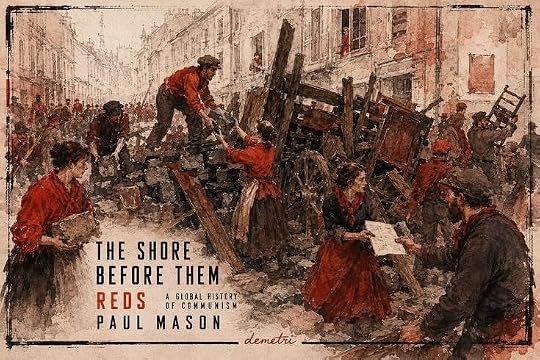
Communards build and inhabit the barricade as both defense and temporary civic commons, preserving the revolutionary exhilaration that makes the later history of discipline, repression and betrayal more than a simple tale of bad faith.
That doubleness matters most in Mason’s treatment of Lenin and Stalin. He neither absolves Lenin nor smuggles Stalin into every earlier Bolshevik decision. Leninism is the hinge because it makes the conquest and defense of state power central to communist strategy, and because bans, expulsions, emergency coercion and party discipline leave tools later rulers can use. Yet Mason argues that Stalin’s fabricated conspiracies, show trials, ethnic persecution and destruction of much of the revolutionary generation are not automatic consequences of Marx or Lenin. Inherited machinery can enlarge the range of possible horrors without dictating which one must arrive.
Read sentence by sentence, the book is propelled by a journalist’s impatience with ceremonial fog. Mason favors medium-length explanatory sentences that gather facts and then stop short, often with a brief verdict that clears the table. He likes the vivid historical particular, the quick character sketch, the doctrinal quarrel translated into an actual decision. Specialized vocabulary arrives without academic plumage; ministries, factions and theories remain attached to rooms, documents, bodies and committees. A five-hundred-page political history rarely moves with this little starch.
If that speed is a pleasure, it is also where the prose can overpersuade. Mason is excellent at carrying a reader from complication to judgment, sometimes so smoothly that the argument seems to have closed before the historical dispute has. His declared politics are not the difficulty; they give the book much of its energy and make clear what is at stake for him. The difficulty comes when resemblance turns into lineage, or lineage into causation, with less friction than the evidence deserves. The sentence has landed. History may still be standing at the baggage carousel.
Perhaps nowhere is that pressure clearer than in the opening chapters. Mason’s Utopian prehistory is lively and provocative: communal societies repeatedly confront the problem of conformity, technocratic planners imagine rule by expertise, and Babeuf’s revolutionaries connect economic equality to clandestine organization. The question behind these episodes is sharp: if private property and class hierarchy disappear, who governs, and through what institutions? But the twentieth century sometimes throws too long a shadow backward. Plato, More, Morelly, Saint-Simon, Babeuf, Marx and Lenin can illuminate one another without becoming stations on a single railway line to Stalin. A history suspicious of political inevitability should be especially careful with retrospective inevitability.
And chronology works precisely because Mason usually resists that temptation. There is no clean chapter break where aspiration expires and authoritarianism begins. The same practical problems return in altered form: how to coordinate action, survive defeat, maintain unity, govern during emergency, tell temporary coercion from permanent authority. “Reds” is particularly good on the afterlife of expediency. Revolutionary measures survive the conditions that produced them; administrative habits acquire doctrine; the exception, before long, is wearing office clothes.
Political history at this scale can turn people into name tags on a conference table. Mason avoids that often enough to matter. Semen Kanatchikov, a worker who rises through Bolshevik institutions and is later consumed by the system he helped serve, returns during the Great Purge as more than an illustrative victim. Mason reconstructs a death the official record falsified. The bureaucracy does not merely kill a man; it manufactures an untrue version of his ending. Power has reached the point where it wants jurisdiction over the past tense.
Semen Kanatchikov’s file places his real execution before the sentence and later natural death assigned to him by the official record, turning bureaucratic falsification into a small, chilling claim of authority over the past.
Against that falsified record, the book’s larger pattern comes into focus. “Reds” is, beneath its declared subject, a history of the politics of being wrong. What institutions can tell leaders that a cherished theory has failed? What happens when disagreement becomes evidence of disloyalty, bad news threatens careers, and errors are easier to disguise than correct? Mason follows the problem from revolutionary cells to faction bans, from Stalinist orthodoxy to doctored files and economic planning. Kronstadt is especially revealing: the Bolsheviks can change an economic policy while narrowing the channels through which political error can be contested. A government can adapt and still become less corrigible.
During the long Soviet decline, that political problem turns material. Central planning requires immense quantities of timely, local, contradictory information. Enterprises flatter targets, ministries defend their interests, planners work with distorted signals, reforms threaten the bureaucracies expected to enact them. Computers promise salvation but cannot cleanse bad data or decide political ends. Mason eventually names information, or truth, as what kills centralized planning. The claim is strongest when it joins two failures usually discussed apart: a state that makes unwelcome information politically costly also makes accurate economic coordination harder.
It is also where Mason’s most elegant idea begins to explain a little too much. Soviet failure involves incentives, weak productivity, distorted allocation, military burdens, bureaucratic self-protection, nationalism, partial reforms and exhaustion as well as information. Mason knows this and supplies much of the evidence himself. Still, “truth” is such an attractive master key that the other causes can start to resemble locks designed for it. The synthesis illuminates; it does not exhaust. That distinction is worth keeping in a book so alert to the dangers of explanations that become difficult to challenge.
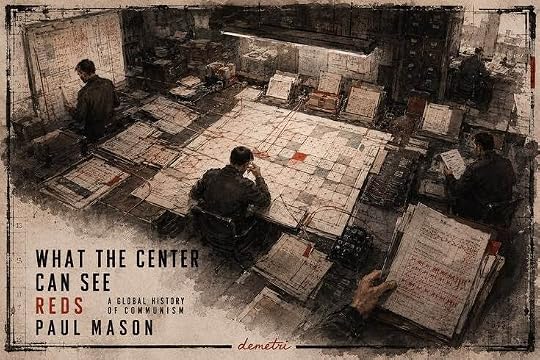
Reports, targets and plans converge on the administrative center but arrive distorted, incomplete or circular, giving visual form to Mason’s argument that a state that makes unwelcome information politically costly eventually makes accurate economic coordination harder as well.
Mason pays elsewhere for the size of his canvas. By following communists as his principal actors, he necessarily gives feminists, liberals, social democrats, nationalists and cultural movements less room except where they meet or obstruct his chosen line. China must also carry unusual weight in the opening and conclusion despite an evidentiary record Mason acknowledges is less open and intimate than the post-Soviet archive. These are declared limits, not hidden defects. Yet declaration does not erase effect. A very confident synthesis can make what it leaves outside the frame feel, for a moment, as if it happened somewhere else.
If chronology gives “Reds” its forward motion, recurrence gives it texture. Barricades begin as practical technology and become revolutionary mythology. Cells become factions, factions become parties, parties become apparatuses. Utopian administration returns as economic planning. Technology repeatedly promises abundance, first through industry, later through computation and finally through digital systems. Above all, emergency measures outlive their emergencies. Mason says chronology is his method; much of the book’s meaning comes from watching old political problems return in new uniforms.
The final chapter, on contemporary China, is why “Reds” cannot end comfortably with the Soviet collapse. Mason argues that the most successful surviving communist party presides over an economy transformed largely through capitalist methods while preserving centralized party authority, censorship, surveillance and ideological discipline. The paradox forces a separation the preceding history has been preparing. Mason does not want to abandon the desire for equality, every form of planning, or the possibility of a society less dependent on markets and compulsory work. He wants to abandon the political tradition that treats monopoly of power as the road to liberation. China sharpens the point because economic methods can change almost beyond recognition while the party’s claim to political supremacy remains largely nonnegotiable.
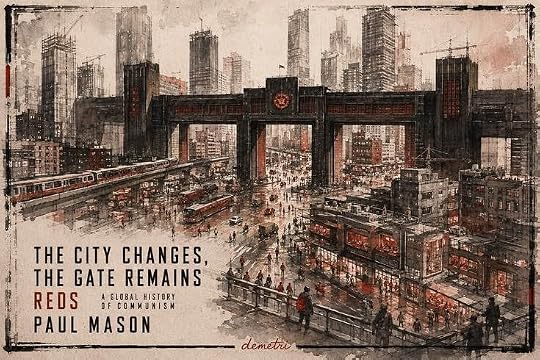
A restless contemporary city shifts beneath rigid institutional architecture, separating the extraordinary adaptability of China’s economic life from the political supremacy Mason sees as the durable Leninist inheritance.
Rather than requiring a topicality parade, “Reds” carries its present tense inside its design. Mason begins and ends with struggles over historical memory because the argument eventually reaches beyond policy into the ownership of fact. Gulag memorials, Tiananmen, Mao, Stalin and the stories states tell about them are not ornaments proving that the past still matters. Kanatchikov’s falsified death record has already shown the smaller version of the same impulse. A state that claims authority over what citizens may say about the present will have reasons to police what they are allowed to remember about the past.
Of the books that sit nearest Mason’s project, David Priestland’s “The Red Flag: Communism and the Making of the Modern World” is closest in sweep, while François Furet’s “The Passing of an Illusion: The Idea of Communism in the Twentieth Century” shadows its concern with political belief. Mason’s position is less elegiac than either comparison might suggest. Capitalism’s survival is not, for him, moral vindication, and his warning is aimed most sharply at readers who have not abandoned the wish for a more equal world. “Reds” still wants something from the future, which is part of what keeps its argument from becoming an obituary.
Part of the book’s charge comes from Mason quarreling with an inheritance rather than delivering a coroner’s report. He wants to salvage the moral horizon without salvaging the machinery that claimed to reach it. At moments, especially near the end, the activist’s urgency presses harder than the historian’s restraint. More often, that declared stake clarifies the audience he is actually addressing: not people already convinced that equality is dangerous, but people tempted to believe that a good destination can make concentrated authority harmless.
Only after all that do the numbers seem useful: “Reds” earns 85/100, or 4/5 stars. It is a formidable synthesis whose explanatory architecture does not quite escape the costs of its own ambition. The prose is brisk rather than beautiful, the character work vivid rather than immersive, the history selective by design, and the information thesis occasionally too pleased with the fit of its own key. But by the end, Kronstadt looks different from the way it did at the beginning: one kind of correction survived while another was being made harder to imagine. That distinction travels through “Reds” like a hairline crack across glass, almost invisible at first, then suddenly explaining the shape of the break. Mason’s final warning is not that people should stop wanting societies radically better than the ones they inhabit. It is that any politics calling itself emancipatory must build a way to be contradicted, corrected and, if necessary, defeated. The most dangerous political systems may not begin with the wrong answer. They may be the ones that gradually destroy the room in which anyone can tell them so.
[image error]
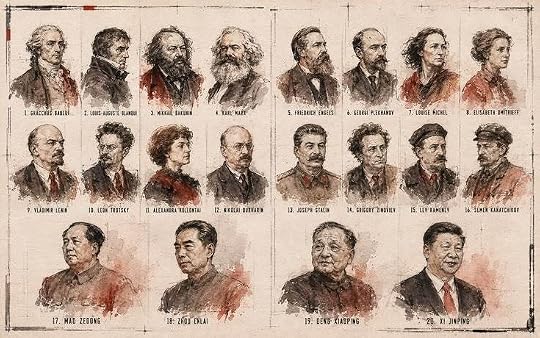
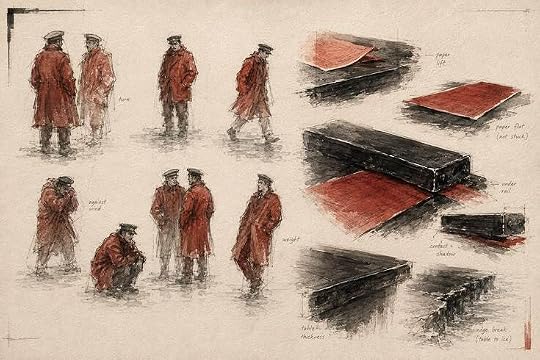
Historical Figure Watercolor Reference Bank
Cover-Palette and Wash Study
Composition and Negative-Space Study
Sailor Movement and Paper-Contact Study
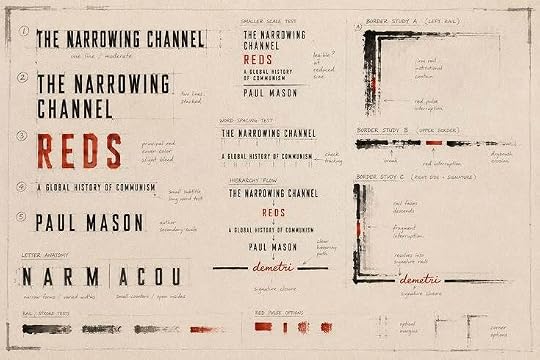
Border and Hand-Lettering Study
First Underdrawing Study
First-Wash Visualization
All watercolor illustrations by Demetris Papadimitropoulos. Watercolors are done on 140lb vellum and then scanned into the computer using an Epson scanner. From there, they are finalized in Procreate. All art and opinions are my own.
I would have had a much different (and positive) review if it had another title (it would have been 5 *) My biggest letdown of this book is that it doesn't deliver on its promise - a global history of Communism. It deals mainly with events connected to the USSR, a bit of China, and a speckle of other nations. I liked the part where we had a few paragraphs that followed what happened in the different countries and how they responded to each other - if it had more of this, it would have been great. I was surprised that a lot of countries with interetsing communism histiry weren't mentioned at all, like Romania, Yugoslavia (ok, it was mentioned, but what felt like a second), Albania (huge suprise as the regime there was one of the most 'comunist' like) or Bulgaria (where we has a bit more "free" versionof communism; Dimitrov was mentioned in passing to be fair). Otherwise, I liked the way it was written and presented; you can tell that Mason knows what he is writing about and the research that went into it. I learned more than a few things (as this is definitely not my historical period, which is the main reason I wanted to read the book). As mentioned, for me, the title is misleading; the content is good.
I would recommend it to people who want to learn more about communism, especially in the USSR, and how the USSR came to be.
Thanks to NetGalley, the author and publisher for the ARC
Disclosure: I received a free copy of this book from NetGalley in exchange for an honest review.
There are few ideologies that have such an impact on the world as Communism, and this book aims to give an overview of its history. This is a major task and the book does not have as broad of coverage as I had expected. The core of the book is focused on the Soviet Union before WW2, which does somewhat undermine the claim of the book to be a "Global History". China is discussed in detail but most of the rest of the world is only briefly mentioned.
However, what is covered is discussed well. The book is readable and enjoyable, it never got bogged down in technical details or abstract theory. The book does a good job charting the development of the idea of Communism, how the Bolsheviks interpreted (or twisted) it and by doing so, sowed the seeds of their own collapse. The author is broadly sympathetic to the idea of Communism, but strongly critical of how it was implemented in practice. So he doesn't hold back on criticising the flaws of central planning, the murderous purges or the self-serving foreign policy decisions of the Soviet Union.
Reds tells the story of communism as one of history’s most fascinating ideas and, like many fascinating ideas, one of its great causes of misery. A case study, perhaps, in what Hayek called the fatal conceit: the belief that a single mind, theory or ideology can engineer society and reliably produce the desired outcomes.
But Mason is fair and balanced, and gives communism its due. He shows how it rallied millions around a deeply human cause: a fairer and more equal world. And that aspiration remains relevant today, given capitalism’s own brutal excesses and cruelties.
Perhaps that is the real lesson.
No single system, however noble its intentions, should ever become too sure of itself.
Rights, freedom, the rule of law, and the ordinary human dignity of every individual are not obstacles to some greater project. They are the values that keep us from becoming the demons we set out to fight.
Put differently, these values—and, perhaps more importantly, humility about our own limitations—are what prevent a well-meaning project from becoming the road to hell paved with good intentions.
Reds is an ambitious and wide-ranging history of communism, tracing its origins well before Marx and Lenin and following its development through the Russian Revolution, Stalinism, Maoism, the Cold War and the collapse of the Soviet Union, right up to China’s very different 21st-century model. Mason examines the original ideal of a more equal, classless society to the authoritarian regimes that claimed to embody it and contrasts the genuine appeal and idealism that attracted millions with the repression, famine, purges and mass imprisonment that followed when revolutionary ideals became instruments of state power. I found it quite a demanding read, but accessible, readable and clearly written. It’s informative, thought-provoking and relevant and I learnt a lot from it.
Paul Mason's "Reds" is a history of communism. "Reds" as a title is a tad misleading as the book portrays communism in all its stripes, not just the familiar red associated with China and the old flag of the USSR flag. As a history, Mason dives deep and it makes for something of a complex read. It certainly highlights how the idealism of communism is quickly corrupted by man. The book is thoroughly researched and deeply cited. Much like the end of communism in the early 90's, the last chapter about the end sweeps by too quickly. The book makes for challenging reading but is worth it. Thank you to #netgalley and #scribner for the opportunity to preview this book.
A history of the world in communism - except, it's very much about the Russian experience with passing information about other countries as you go. It's well written and my daughter, who has read widely in this area, has said she'll recommend it to her friends as an intersting introduction. Thank you for the advance copy.