

What do you think?

Code and Codex
Not yet published
Expected 27 Oct 26Three-time Hugo Award finalist Yoon Ha Lee returns to science fiction with a swashbuckling space opera fighting against an evil empire trying to erase history.
In the stars-spanning Censorate, languages other than the Republic’s own lingua rubra, which has reality-altering properties, are forbidden. Nevertheless, there are discrepancies. The Censorate’s star forces are called the Athenaeum Navy, and each of its ships is referred to as a codex. Instead of port and starboard, its soldiers refer to verso and recto. The unholy “stigmata” gouged into the ships’ hulls might, to a foreign scholar, bear a resemblance to verboten texts in other languages.
The Censorate is ruled by its Peacock, Aurelia, feared for the power of panopticon: she can look through anyone’s eyes. Moreover, Aurelia’s mastery of lingua rubra lets her force anyone who can understand her to follow her orders. Valentina, sold to Aurelia’s family as a child to be Aurelia’s oath-sister and companion, is its Swan, responsible for extracting useful information from foreign texts, then destroying them as well as entire languages through arcane arts. Valentina is assisted in her work by lower-ranking linguists and AI assistants who accept temporary contamination by foreign languages as a necessity of their work.
But this isn’t enough for Aurelia. She wants to control and deploy the Censorate’s thousand-year traitor and prisoner, the Basilisk, a man with a gaze so lethal that he destroyed its fleet of old through camera feeds. Unfortunately for her, the Basilisk gave himself a form of aphasia that makes him immune to her commands.
In the stars-spanning Censorate, languages other than the Republic’s own lingua rubra, which has reality-altering properties, are forbidden. Nevertheless, there are discrepancies. The Censorate’s star forces are called the Athenaeum Navy, and each of its ships is referred to as a codex. Instead of port and starboard, its soldiers refer to verso and recto. The unholy “stigmata” gouged into the ships’ hulls might, to a foreign scholar, bear a resemblance to verboten texts in other languages.
The Censorate is ruled by its Peacock, Aurelia, feared for the power of panopticon: she can look through anyone’s eyes. Moreover, Aurelia’s mastery of lingua rubra lets her force anyone who can understand her to follow her orders. Valentina, sold to Aurelia’s family as a child to be Aurelia’s oath-sister and companion, is its Swan, responsible for extracting useful information from foreign texts, then destroying them as well as entire languages through arcane arts. Valentina is assisted in her work by lower-ranking linguists and AI assistants who accept temporary contamination by foreign languages as a necessity of their work.
But this isn’t enough for Aurelia. She wants to control and deploy the Censorate’s thousand-year traitor and prisoner, the Basilisk, a man with a gaze so lethal that he destroyed its fleet of old through camera feeds. Unfortunately for her, the Basilisk gave himself a form of aphasia that makes him immune to her commands.
304 pages, Hardcover
Expected publication October 27, 2026
About the author
Yoon Ha Lee
208 books2,104 followersYoon Ha Lee is an American science fiction writer born on January 26, 1979 in Houston, Texas. His first published story, “The Hundredth Question,” appeared in Fantasy & Science Fiction in 1999; since then, over two dozen further stories have appeared. He lives in Baton Rouge, Louisiana.
Ratings & Reviews
Friends & Following
Create a free account to discover what your friends think of this book!
Community Reviews
Displaying 1 - 17 of 17 reviews

Currently Reading
December 30, 2024'about plans to reach backwards and forwards in time by revising history in this space opera adventure of linguistics magic in the author’s return to adult science fiction' GIMME

Review of advance copy received from NetGalley
2.5 stars rounded up to 3
There is no question that the author has an incredibly creative imagination. The story felt like a blend of the Bene Gesserit from "Dune", "Harry Potter and the Chamber of Secrets", and the wonderfully strange, sentient world of "The Terraformers" by Annalee Newitz. On paper, that combination should have been exactly the kind of science fiction I enjoy.
Unfortunately, the writing style never worked for me. Reading this book felt less like reading for pleasure and more like being back in high school working through a novel assigned by my English teacher, although this one certainly would never have appeared on a school reading list because of its numerous sex scenes. I finished it because I received an advance review copy through NetGalley and wanted to give the book a fair evaluation, but it often felt like a chore rather than an escape.
The prose frequently relied on uncommon vocabulary and highly stylized language that pulled me out of the story instead of drawing me deeper into it. High level vocabulary words appeared often enough that I became more aware of the author's language than of the story itself. I know this was the author's point with the hyper-focus of the novel being words and languages, however, for my taste, the writing felt so ornate that it overshadowed what was otherwise a genuinely imaginative premise.
I also found that several chapters seemed disconnected from the central narrative and did not meaningfully advance the story. Combined with the dense prose, this made the novel feel much longer than its page count.
I can absolutely appreciate the originality of the worldbuilding and the ambition behind this novel. Readers who enjoy highly literary speculative fiction and luxuriant prose may have a very different experience than I did. For me, however, the writing style prevented me from connecting with a story that otherwise had tremendous potential.
There is no question that the author has an incredibly creative imagination. The story felt like a blend of the Bene Gesserit from "Dune", "Harry Potter and the Chamber of Secrets", and the wonderfully strange, sentient world of "The Terraformers" by Annalee Newitz. On paper, that combination should have been exactly the kind of science fiction I enjoy.
Unfortunately, the writing style never worked for me. Reading this book felt less like reading for pleasure and more like being back in high school working through a novel assigned by my English teacher, although this one certainly would never have appeared on a school reading list because of its numerous sex scenes. I finished it because I received an advance review copy through NetGalley and wanted to give the book a fair evaluation, but it often felt like a chore rather than an escape.
The prose frequently relied on uncommon vocabulary and highly stylized language that pulled me out of the story instead of drawing me deeper into it. High level vocabulary words appeared often enough that I became more aware of the author's language than of the story itself. I know this was the author's point with the hyper-focus of the novel being words and languages, however, for my taste, the writing felt so ornate that it overshadowed what was otherwise a genuinely imaginative premise.
I also found that several chapters seemed disconnected from the central narrative and did not meaningfully advance the story. Combined with the dense prose, this made the novel feel much longer than its page count.
I can absolutely appreciate the originality of the worldbuilding and the ambition behind this novel. Readers who enjoy highly literary speculative fiction and luxuriant prose may have a very different experience than I did. For me, however, the writing style prevented me from connecting with a story that otherwise had tremendous potential.
Review of advance copy received from NetGalley
I wanted to like this book. Instead … I’m writing a review detailing how much I didn’t.
In Ninefox Gambit the writing style was creative, imaginative, and as slippery and delicate as a soap bubble. It was a combination of vocabulary and vibes that, while I didn’t enjoy the book enough to pick up the sequel, kept me turning pages. The magic system was creative and fun, and while the characters were thin and more sketch than person … they were in their own way compelling. It’s why I picked this ARC, because I wanted to see that same skill put on a linguistic magic, to see if it would be as innovative as his calendrical magic.
It … isn’t.
The writing in this book is so stilted and forced that it’s an almost unpleasant reading experience. There’s no ease or skill. It’s all style, and style over substance. The hints of magic feel equally … well, pompous. It’s trying so hard to be impressive and ends up off putting. The characters aren’t delicate, they’re desiccated. Hollow. The flow of the writing is stuttering, as if I can see the moment that the thesaurus was opened not to enhance a sentence, but to make it more impressive. And this is very much on display when — during some chapters — things calm down and the writing relaxes, flowing more naturally. Unfortunately, those moments don’t make up the larger part of the book.
The story itself is equally blocky, moving like boulders thrown in water. Everything is explained, and not always very well, rarely allowing the characters to discover anything. And the reader, too, isn’t allowed to learn or guess or suspect because it’s all there: exposition and info dumps. The chapters alternate between Valentina and the unnamed narrator who tells us — as we’re told everything — about Valentina, or Aurelia, the world, or any other detail the book thinks we need to have explained to us. This includes several fourth wall breaks.
There are parts here I think are worth reading, parts I think could have been something fascinating but instead, fall apart. I will say that past the first chapter things do smooth out, but they never feel smooth or polished. If the focus were less on the style, more on the characters — less on the idea, more on the story — I would have enjoyed my time with this book more than I did.
There will be readers who love this, and I’m glad for them. But this book isn’t for me. Thank you to Net Galley and the publisher for the ARC.

Review of advance copy received from NetGalley
"Code and Codex" by Yoon Ha Lee is a sweeping , sci-fi fantasy about an empire known as the Censorate, ruled by the Peacock, Aurelia who has the power of panopticon: she can look through anyone’s eyes. Moreover, Aurelia’s mastery of lingua rubra, the only language allowed to exist within the Censorate, lets her force anyone who can understand her to follow her orders. Her champion oath-sister, and lover, Val, is the Swan, who has the Voice of Lethe which is fatal to those who hear it. A third 'position', the Basilisk, who has a lethal gaze, so powerful it can kill over screens, has been locked away at the Censorate's Fortress for a thousand-years, deemed a traitor due to his world ending actions. Prior to his incarceration, the Basilisk was the Admiral of the Censorate's fleet. These three positions were supposed to work together to run the Censorate but with the Basilisk out of commission, Aurelia has been consolidating power without even Val realizing what was going on.
The overall themes and ideas were fantastic and engaging but the story felt bogged down by the way language was being used. I have no problem if an author wants to use intricate words to make a point and I had fun using the dictionary feature on my e-reader to increase my vocabulary. However, there were times this felt so overwritten that while I understood the actual words as they were used, I missed what was actually happening in the scene. There were chapters that I finished and wasn't entirely sure what had happened. And despite all of that, I really enjoyed this book
For most of the story the reader is following Val and learning about their past and their "relationship" with Aurelia. Despite committing terrible actions and leading the department responsible for erasing all other cultures and languages and destroying all of the books of conquered lands, the author does a remarkable job of making Val a sympathetic character. I don't enjoy reading stories with unlikable characters and really the only truly unlikeable character in this is Aurelia. And I loved Val's cat companion and the other narrator that we meet much later on in the story, who is slowly revealed over time and I won't name as its a spoiler. I definitely recommend this book and encourage readers to push through the sometimes very convoluted language to try and get into the story. And as an aside, don't let the one page prologue stop you from reading this book. I read it 6 times and I still don't understand what it said or how it tied to the rest of the story.
Thank you to NetGalley and Saga Press for a eARC of this book in return for an honest review.
The overall themes and ideas were fantastic and engaging but the story felt bogged down by the way language was being used. I have no problem if an author wants to use intricate words to make a point and I had fun using the dictionary feature on my e-reader to increase my vocabulary. However, there were times this felt so overwritten that while I understood the actual words as they were used, I missed what was actually happening in the scene. There were chapters that I finished and wasn't entirely sure what had happened. And despite all of that, I really enjoyed this book
For most of the story the reader is following Val and learning about their past and their "relationship" with Aurelia. Despite committing terrible actions and leading the department responsible for erasing all other cultures and languages and destroying all of the books of conquered lands, the author does a remarkable job of making Val a sympathetic character. I don't enjoy reading stories with unlikable characters and really the only truly unlikeable character in this is Aurelia. And I loved Val's cat companion and the other narrator that we meet much later on in the story, who is slowly revealed over time and I won't name as its a spoiler. I definitely recommend this book and encourage readers to push through the sometimes very convoluted language to try and get into the story. And as an aside, don't let the one page prologue stop you from reading this book. I read it 6 times and I still don't understand what it said or how it tied to the rest of the story.
Thank you to NetGalley and Saga Press for a eARC of this book in return for an honest review.

Review of advance copy received from NetGalley
The Empire Has a Grammar, and Unfortunately Everyone Is in the Sentence
Yoon Ha Lee’s “Code and Codex” turns syntax into state violence, romance into a negotiation over commands, and one extremely uncooperative cat into an argument for unauthorized meaning
By Demetris Papadimitropoulos | October 5th, 2026

A mirror turns resemblance into architecture as Valentina discovers that Aurelia has entered not only her face but the act by which she recognizes it.
During Valentina dea Regina’s first serious act of disobedience in Yoon Ha Lee’s “Code and Codex,” nothing detonates. The Censorate’s chief censor is reading prohibited poetry and trying to make it harmless by classification: merely words, a foreigner’s scribbling, officially unimportant. Her hand trembles. Then the paragraph contracts to one adjective: “Beautiful.” Lee has found the empire’s first leak. Valentina cannot yet argue against the institution she serves, but she can be moved by something it has already declared meaningless, and she is bureaucrat enough to discover a loophole by which she can steal the books she ought to destroy. Meaning gets loose before people do.
Empire has given Valentina several identities and made each sound like a job. She is the Swan, assassin and chief censor, but also the champion, oath-sister, sometime lover, and lifelong dependent of Aurelia dea Regina, the Peacock who rules the Censorate. Aurelia can see through the eyes of people who speak the imperial language. Jenner, the disgraced Basilisk, kills with his gaze. When he escapes a confinement lasting roughly a millennium, Aurelia sends Valentina to retrieve him. The chase turns into alliance and then into something Valentina has even less practice naming: desire for a man official history has taught her to regard as monster, traitor, and weapon.
Mirrors eventually tell her something worse. Aurelia has altered Valentina’s memories, trained her reflexes, manipulated her attachments, and remade her face in Aurelia’s image. Even after the regime comes apart, Valentina cannot establish what color her hair originally was. Aurelia changed it; perhaps she lied about why; perhaps even Aurelia misremembered. There is no pristine Valentina under the revisions with her factory settings intact. When Melisande tells her that she will always carry what Aurelia made of her, but that what she takes from it is now her choice, she gives the novel its least consoling and most durable idea: freedom after domination is not recovery of an untouched self. You work with the altered material because altered material is what remains.
Every page seems eager to test how many vocabularies can occupy the same sentence before one of them files a complaint. Lee moves among linguistics, mathematics, bookbinding, military procedure, typography, erotic diction, programming, court ritual, profanity, and jokes with astonishing ease. Codices are both books and starships. Bodies become archival surfaces. Syntax can function like artillery. A technical explanation may skid into obscenity; imperial grandeur may be punctured by a cat with no respect for thematic solemnity. The prose is exhilarating because its metaphors force unlike systems into contact. It is exhausting for nearly the same reason. Lee sometimes finds one excellent comparison and, apparently fearing loneliness on its behalf, supplies three companions.
Those collisions also deny the Censorate the clean borders it craves. Military engineering borrows from bookmaking; an archive becomes a corpse; courtly seduction is described through information systems; living ships speak with the comic timing of irritated friends. No register gets to remain pure or permanently superior. Bureaucratic language can murder. Technical language can flirt. A joke can reveal more than an official history. At its best, Lee’s style performs that instability without having to announce it. At its weaker moments, he announces it too, then supplies an analogy in case the announcement felt lonely.
Read the forbidden-poem scene at the speed Lee writes it. Valentina begins with plural abstractions: “words,” “scribblings,” foreignness, procedure. Each term pushes the poem farther from a particular human act. Then comes “Beautiful.” The adjective has no supporting clause, no ideological permission slip, no argument explaining why she is entitled to think it. Her hand has already trembled before her conscious loyalty admits anything is wrong. Only afterward does she reach for regulations and discover that Aurelia sent her on a private mission, leaving a technical loophole. Her first dissent is neither manifesto nor awakening. It is an aesthetic response followed by creative paperwork.
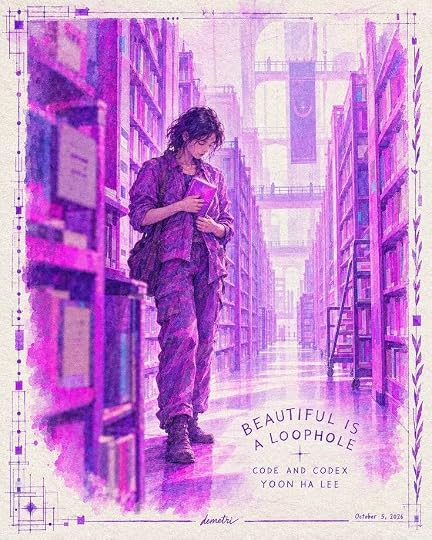
In the Yellow 451 library, one forbidden book and one trembling hand let beauty slip through the procedural gap where obedience believed it had sealed the room.
Indexing joins the argument early. “Code and Codex” starts at Chapter 0 with the ternary Cantor set, made by repeatedly removing the middle third of a line segment. The narrator notes that the surviving set has measure zero: “Zero is another word for erasure.” Later the narration openly changes tense because languages divide time differently. One subsection consists of the declaration that its page is intentionally blank. Chapter Twenty-Five reminds us that, under zero-based indexing, it is really the twenty-sixth chapter. Conventions readers normally stop noticing keep stepping into view. The novel is about an empire convinced that the systems used to describe reality can be made identical to reality, so Lee makes even the numbering slightly insolent.
Partway through, another supposedly stable category gives way. An unidentified first-person “I” has been interrupting the novel with jokes, historical information, corrections, and knowledge no ordinary observer should possess. Then a ruin assembles itself from metal, earth, dying words, spoonerisms, and stray recipes into a sunhawk, and the voice acquires a body. This narrator was the eyas Jenner rescued and raised. What looked like omniscience turns out to be testimony with biography, affection, and limits. The reader has done a miniature version of the Censorate’s work: faced with incomplete evidence, we supplied a category and mistook its convenience for knowledge.

The sunhawk rises from wreckage and linguistic debris while the humans shrink against its scale, turning apparent omniscience back into embodied testimony.
Aurelia’s violence reaches deepest when Valentina cannot recognize where Aurelia ends. Late in the novel, Valentina approaches what appears to be Aurelia holding a blade. Details fail one by one: the wrong hand, the white hair. Only then does she register the mirror she has unconsciously avoided. The face is Aurelia’s except for the hair. Told earlier, the alteration would have been grotesque strategy. Withheld until Valentina can perceive it, it becomes an injury to perception itself. Aurelia has entered the act by which Valentina recognizes Valentina.
Paper, meanwhile, gives Jenner something mercifully incapable of dying. In his cabin, Valentina finds the floor littered with badly folded lilies, fish, bears, and butterflies. She calls them lovely. Light flashes beneath his eyelids and she assumes she has offended him. What follows is not anger but the effort required to regain control. “They don’t die when I look at them,” he says. The legendary Basilisk’s rigid face suddenly reads differently: impassivity is what feeling must pass through when looking itself is lethal. Valentina takes his hand. His expression stays still. His fingers tremble. Few passages in the book do more with less.

Jenner sits among imperfect origami with his eyes closed, letting paper become the rare thing his gaze cannot kill and awkward tenderness the scene refuses to hurry.
As sight becomes dangerous, hands take over some of its work. Jenner and Valentina communicate through pressure, signing, touch, pauses, withdrawal. After Valentina destroys writing that Aurelia might use to spy on them, she scrubs her hands until Jenner catches her wrist. He is vastly stronger and barely tightens his grip. “I am what you allow me to be,” he tells her. The scene immediately specifies what that sentence means: if she moves, he will let go. She stays. Their intimacy matters because a request can survive refusal. Aurelia’s commands are constructed so that the speaker does not have to survive an answer she did not choose.
Difficulties appear when Aurelia asks the question most likely to spoil the cleanliness of that distinction: “Isn’t friendship a command in its own right?” Then, characteristically, she tells Valentina not to answer. It is manipulation and a real problem. Friendship creates obligations. Love changes behavior. Language directs attention. Jenner’s patience alters Valentina just as surely as Aurelia’s cruelty does, though the moral difference is enormous. The alternative to coercion cannot be a sterile world in which nobody influences anybody. Lee reaches instead toward refusal that remains possible, meanings that can be renegotiated, attachments that do not exhaust the people inside them. Aurelia’s question stays alive because the book never invents the slogan that would dispose of it.

Water, raw skin, and a deliberately light grip make intimacy legible not through possession, but through the continued possibility of release.
In the climax, Valentina thinks a sentence whose danger Lee seems to understand: “I did it to myself.” She has recognized that Aurelia’s supernatural manipulation formalized an arrangement already maintained through dependence, hunger, and affection dispensed on what the narration calls a “variable reinforcement schedule.” On its own, the sentence is awful in two senses: emotionally devastating and morally dangerous. It risks assigning a coerced person responsibility for the coercion. Then Ala urinates all over her dress. The interruption is comic, physical, undignified, and perfectly placed. Aurelia has been arranging people through commands, syntax, ritual, repetition. The cat contributes an event nobody authored.
Much changes when the sentence comes back. “I did it to myself, and I can undo it.” Lee does not revoke the first clause. The “and” leaves Valentina’s participation, habits, loyalties, and moral responsibility in place while attaching a future to them. She is not responsible for Aurelia having exploited her desperation for love; she is responsible for what she has done inside the life that exploitation helped shape, and she remains capable of doing something else. Then she breaks the blade she had treated as an extension of herself. The moral turn happens first in conjunction and clause, then in spectacle.
It is characteristic of Lee that Chapter 23, deep inside this climax, also pauses for syntactic typology, S/O/V arrangements, case systems, and the limitations of simplified linguistic models before revealing Aurelia’s trick of distributing a magical sentence across decades or eons. The conceit deserves explanation. The scene does not necessarily need quite all of it. Lee can distrust authoritarian overdefinition while practicing a milder artistic cousin of the impulse: motif, metaphor, technical analogy, joke, then explanation after the pattern has already registered. His problem is rarely opacity. Sometimes it is surplus legibility.
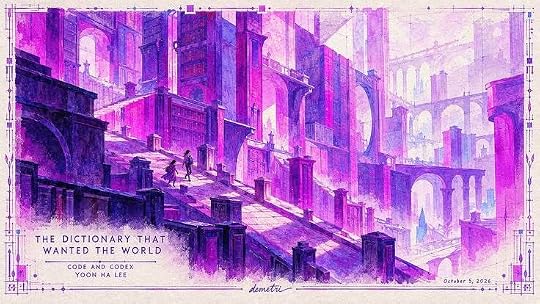
Valentina and Jenner move through the master lexicon as language hardens into architecture, tiny bodies inside an imperial fantasy of perfect legibility.
The more serious imbalance is not stylistic. Lee never pretends Valentina is simply Aurelia’s victim. In the final chapter, Tacita reminds her that field linguists whose records may help recover destroyed languages were purged after completing their work. Valentina approved the execution policy; Tacita helped implement it. The acknowledgment is unsparing. Yet those dead mostly reach us as policy, record, vanished community, or guilt. Valentina receives erotic, sensory, comic, psychological abundance. They do not. The moral accounting is serious, but the imaginative imbalance remains, and it matters precisely because “Code and Codex” is otherwise so alert to what disappears when institutions control the record.
Rather than let Aurelia’s defeat masquerade as a completed revolution, the aftermath becomes embarrassingly practical. Valentina assumes Melisande will simply claim the Censorate. Melisande laughs until she wheezes. Her concerns are trade routes, fertilizer, agriculture, canneries, distribution: “People need to eat, Valentina.” It is an excellent rebuke to the scale on which Valentina has learned to imagine politics. Killing the sovereign does not feed anyone. A regime can concentrate itself symbolically in one ruler while remaining dispersed through warehouses, roads, records, habits, and expertise. The revolution still needs lunch.
One useful scholarly distinction clarifies what Lee is exaggerating rather than correcting him for fantasy. In “Linguistic Relativity” in the “Annual Review of Anthropology,” John A. Lucy describes the serious question as one of how particular languages may influence thought, not a law by which grammar simply determines cognition. Lee’s own cautionary note explicitly says “Code and Codex” is science fantasy rather than linguistic research. Lingua rubra takes the authoritarian fantasy implicit in the strongest deterministic version and makes it literal: control the language thoroughly enough and perhaps you can control the person. Then the plot keeps producing leakage. Codes proliferate. Signs fail to map perfectly. Memory outlasts writing. Users improvise. The imperial language is powerful. It is never closed.
Peter K. Austin’s distinction between language documentation and language revitalization matters even more to the final chapter. In the Cambridge University Press volume “Revitalizing Endangered Languages,” Austin distinguishes preserving records from restoring active use among living speakers and communities. Tacita reveals that servas retain grammars, lexicons, and other traces of languages the Censorate tried to extinguish. That does not mean destruction has secretly been reversed. Murdered speakers do not return. Intergenerational transmission does not restart because a file survived. The archive offers material from which people might teach, speak, alter, and build again. It is not a time machine.
One of the gentlest objects in the book makes the same distinction visible. Early on, Valentina repairs Ala’s damaged wing by attaching artificial feathers. The repair restores an appearance; Ala seems unimpressed. Later those feathers are gone. Near the end, Valentina discovers real ones beginning to grow. These are not the old feathers returned. The body is making new material after injury. Tacita’s records offer a harsher version of the same possibility: useful remnants produced by the very institution that catalogued languages in order to dominate and destroy them. Survival arrives compromised.
Useful coordinates exist elsewhere in recent science fiction without enclosing Lee’s project. Arkady Martine’s “A Memory Called Empire” understands how imperial culture can seduce people endangered by its expansion. China Miéville’s “Embassytown” treats language as material enough to alter social and cognitive possibility. “Code and Codex” presses those concerns into habit and flesh. Empire is the face Valentina sees in the mirror, the cadence of her voice, the weapon her hand reaches for, the affection she cannot cleanly classify, the history she helped erase. “Words have power” would be far too easy. Lee is after what happens when power has become one of the voices with which you recognize yourself.

Lee sits within the series’ magenta-violet grammar among pages, thresholds, and unfinished marks, a portrait held between system and the space that refuses to close.
Late in a story so interested in names, neither Valentina nor Jenner can recover an archaeological original. The name Val has now is the one he knows now. Nearby sits an even smaller refusal of purification: Val keeps reaching for the comb once used to brush Aurelia’s hair. He knows he could throw it away. He does not. That detail does more than a page of deprogramming rhetoric could. Political revelation can change a belief in an afternoon. The hand may continue reaching tomorrow.
On the final stretch, zero changes jobs. Chapter Twenty-Five is the twenty-sixth chapter because the count began at zero; its last subsection is titled “user-defined generation is now supported.” At the beginning, zero was another word for erasure. Here the same convention becomes a starting position from which users generate rather than administrators dictate. Blankness has not become innocent. Chapter 24 has already given us an intentional lacuna and reminded us that the censorial ministry was once named for absence itself. But a form can outlive the authority that controlled its use. Someone else can inherit the permissions.
Score notwithstanding, the flaws belong in the same frame as the achievement. “Code and Codex” earns 91/100, which translates to 5/5 Goodreads stars. Lee sometimes explains after his scenes have already persuaded; the architecture can become almost too beautifully engineered; Valentina’s victims remain less imaginatively present than Valentina; the technical exuberance occasionally puts a hand on the brake. Those are not decorative caveats. They are the places where the novel’s appetite costs it something. They also sit inside a book whose plot, sentence, romance, archive, jokes, and formal design keep worrying the same questions from enough different directions that the pattern feels discovered more often than imposed.
Down among the wreckage of the master lexicon, what remains is wonderfully small. Jenner spells with his fingers. Val accepts a name without demanding an archaeological original. Leaves push up through the living ship because they will be crushed into ink. Ala grows feathers no one has pasted into place. The leaves must be destroyed to make writing; the records that may help languages live again were produced by their destroyers; love remains dangerous because another person can alter you, and free because alteration need not become ownership. Lee never discovers a vocabulary outside those contradictions. “Code and Codex” ends somewhere better: with sweetness and bitterness on the same tongue, and both still alive.


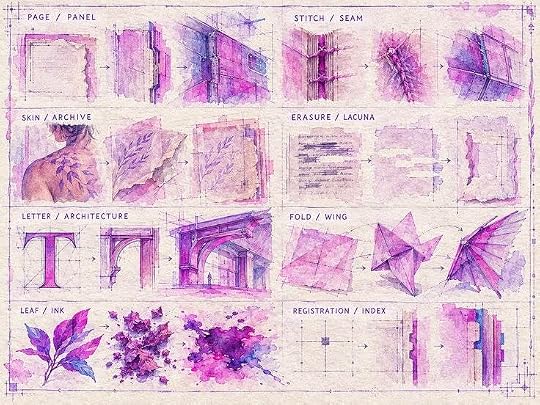

All watercolor illustrations by Demetris Papadimitropoulos.
Watercolors are done on 140lb vellum and then scanned into the computer using an Epson scanner. From there, they are finalized in Procreate. No AI was used in writing this review — all art and opinions are my own.
Yoon Ha Lee’s “Code and Codex” turns syntax into state violence, romance into a negotiation over commands, and one extremely uncooperative cat into an argument for unauthorized meaning
By Demetris Papadimitropoulos | October 5th, 2026
A mirror turns resemblance into architecture as Valentina discovers that Aurelia has entered not only her face but the act by which she recognizes it.
During Valentina dea Regina’s first serious act of disobedience in Yoon Ha Lee’s “Code and Codex,” nothing detonates. The Censorate’s chief censor is reading prohibited poetry and trying to make it harmless by classification: merely words, a foreigner’s scribbling, officially unimportant. Her hand trembles. Then the paragraph contracts to one adjective: “Beautiful.” Lee has found the empire’s first leak. Valentina cannot yet argue against the institution she serves, but she can be moved by something it has already declared meaningless, and she is bureaucrat enough to discover a loophole by which she can steal the books she ought to destroy. Meaning gets loose before people do.
Empire has given Valentina several identities and made each sound like a job. She is the Swan, assassin and chief censor, but also the champion, oath-sister, sometime lover, and lifelong dependent of Aurelia dea Regina, the Peacock who rules the Censorate. Aurelia can see through the eyes of people who speak the imperial language. Jenner, the disgraced Basilisk, kills with his gaze. When he escapes a confinement lasting roughly a millennium, Aurelia sends Valentina to retrieve him. The chase turns into alliance and then into something Valentina has even less practice naming: desire for a man official history has taught her to regard as monster, traitor, and weapon.
Mirrors eventually tell her something worse. Aurelia has altered Valentina’s memories, trained her reflexes, manipulated her attachments, and remade her face in Aurelia’s image. Even after the regime comes apart, Valentina cannot establish what color her hair originally was. Aurelia changed it; perhaps she lied about why; perhaps even Aurelia misremembered. There is no pristine Valentina under the revisions with her factory settings intact. When Melisande tells her that she will always carry what Aurelia made of her, but that what she takes from it is now her choice, she gives the novel its least consoling and most durable idea: freedom after domination is not recovery of an untouched self. You work with the altered material because altered material is what remains.
Every page seems eager to test how many vocabularies can occupy the same sentence before one of them files a complaint. Lee moves among linguistics, mathematics, bookbinding, military procedure, typography, erotic diction, programming, court ritual, profanity, and jokes with astonishing ease. Codices are both books and starships. Bodies become archival surfaces. Syntax can function like artillery. A technical explanation may skid into obscenity; imperial grandeur may be punctured by a cat with no respect for thematic solemnity. The prose is exhilarating because its metaphors force unlike systems into contact. It is exhausting for nearly the same reason. Lee sometimes finds one excellent comparison and, apparently fearing loneliness on its behalf, supplies three companions.
Those collisions also deny the Censorate the clean borders it craves. Military engineering borrows from bookmaking; an archive becomes a corpse; courtly seduction is described through information systems; living ships speak with the comic timing of irritated friends. No register gets to remain pure or permanently superior. Bureaucratic language can murder. Technical language can flirt. A joke can reveal more than an official history. At its best, Lee’s style performs that instability without having to announce it. At its weaker moments, he announces it too, then supplies an analogy in case the announcement felt lonely.
Read the forbidden-poem scene at the speed Lee writes it. Valentina begins with plural abstractions: “words,” “scribblings,” foreignness, procedure. Each term pushes the poem farther from a particular human act. Then comes “Beautiful.” The adjective has no supporting clause, no ideological permission slip, no argument explaining why she is entitled to think it. Her hand has already trembled before her conscious loyalty admits anything is wrong. Only afterward does she reach for regulations and discover that Aurelia sent her on a private mission, leaving a technical loophole. Her first dissent is neither manifesto nor awakening. It is an aesthetic response followed by creative paperwork.
In the Yellow 451 library, one forbidden book and one trembling hand let beauty slip through the procedural gap where obedience believed it had sealed the room.
Indexing joins the argument early. “Code and Codex” starts at Chapter 0 with the ternary Cantor set, made by repeatedly removing the middle third of a line segment. The narrator notes that the surviving set has measure zero: “Zero is another word for erasure.” Later the narration openly changes tense because languages divide time differently. One subsection consists of the declaration that its page is intentionally blank. Chapter Twenty-Five reminds us that, under zero-based indexing, it is really the twenty-sixth chapter. Conventions readers normally stop noticing keep stepping into view. The novel is about an empire convinced that the systems used to describe reality can be made identical to reality, so Lee makes even the numbering slightly insolent.
Partway through, another supposedly stable category gives way. An unidentified first-person “I” has been interrupting the novel with jokes, historical information, corrections, and knowledge no ordinary observer should possess. Then a ruin assembles itself from metal, earth, dying words, spoonerisms, and stray recipes into a sunhawk, and the voice acquires a body. This narrator was the eyas Jenner rescued and raised. What looked like omniscience turns out to be testimony with biography, affection, and limits. The reader has done a miniature version of the Censorate’s work: faced with incomplete evidence, we supplied a category and mistook its convenience for knowledge.
The sunhawk rises from wreckage and linguistic debris while the humans shrink against its scale, turning apparent omniscience back into embodied testimony.
Aurelia’s violence reaches deepest when Valentina cannot recognize where Aurelia ends. Late in the novel, Valentina approaches what appears to be Aurelia holding a blade. Details fail one by one: the wrong hand, the white hair. Only then does she register the mirror she has unconsciously avoided. The face is Aurelia’s except for the hair. Told earlier, the alteration would have been grotesque strategy. Withheld until Valentina can perceive it, it becomes an injury to perception itself. Aurelia has entered the act by which Valentina recognizes Valentina.
Paper, meanwhile, gives Jenner something mercifully incapable of dying. In his cabin, Valentina finds the floor littered with badly folded lilies, fish, bears, and butterflies. She calls them lovely. Light flashes beneath his eyelids and she assumes she has offended him. What follows is not anger but the effort required to regain control. “They don’t die when I look at them,” he says. The legendary Basilisk’s rigid face suddenly reads differently: impassivity is what feeling must pass through when looking itself is lethal. Valentina takes his hand. His expression stays still. His fingers tremble. Few passages in the book do more with less.
Jenner sits among imperfect origami with his eyes closed, letting paper become the rare thing his gaze cannot kill and awkward tenderness the scene refuses to hurry.
As sight becomes dangerous, hands take over some of its work. Jenner and Valentina communicate through pressure, signing, touch, pauses, withdrawal. After Valentina destroys writing that Aurelia might use to spy on them, she scrubs her hands until Jenner catches her wrist. He is vastly stronger and barely tightens his grip. “I am what you allow me to be,” he tells her. The scene immediately specifies what that sentence means: if she moves, he will let go. She stays. Their intimacy matters because a request can survive refusal. Aurelia’s commands are constructed so that the speaker does not have to survive an answer she did not choose.
Difficulties appear when Aurelia asks the question most likely to spoil the cleanliness of that distinction: “Isn’t friendship a command in its own right?” Then, characteristically, she tells Valentina not to answer. It is manipulation and a real problem. Friendship creates obligations. Love changes behavior. Language directs attention. Jenner’s patience alters Valentina just as surely as Aurelia’s cruelty does, though the moral difference is enormous. The alternative to coercion cannot be a sterile world in which nobody influences anybody. Lee reaches instead toward refusal that remains possible, meanings that can be renegotiated, attachments that do not exhaust the people inside them. Aurelia’s question stays alive because the book never invents the slogan that would dispose of it.
Water, raw skin, and a deliberately light grip make intimacy legible not through possession, but through the continued possibility of release.
In the climax, Valentina thinks a sentence whose danger Lee seems to understand: “I did it to myself.” She has recognized that Aurelia’s supernatural manipulation formalized an arrangement already maintained through dependence, hunger, and affection dispensed on what the narration calls a “variable reinforcement schedule.” On its own, the sentence is awful in two senses: emotionally devastating and morally dangerous. It risks assigning a coerced person responsibility for the coercion. Then Ala urinates all over her dress. The interruption is comic, physical, undignified, and perfectly placed. Aurelia has been arranging people through commands, syntax, ritual, repetition. The cat contributes an event nobody authored.
Much changes when the sentence comes back. “I did it to myself, and I can undo it.” Lee does not revoke the first clause. The “and” leaves Valentina’s participation, habits, loyalties, and moral responsibility in place while attaching a future to them. She is not responsible for Aurelia having exploited her desperation for love; she is responsible for what she has done inside the life that exploitation helped shape, and she remains capable of doing something else. Then she breaks the blade she had treated as an extension of herself. The moral turn happens first in conjunction and clause, then in spectacle.
It is characteristic of Lee that Chapter 23, deep inside this climax, also pauses for syntactic typology, S/O/V arrangements, case systems, and the limitations of simplified linguistic models before revealing Aurelia’s trick of distributing a magical sentence across decades or eons. The conceit deserves explanation. The scene does not necessarily need quite all of it. Lee can distrust authoritarian overdefinition while practicing a milder artistic cousin of the impulse: motif, metaphor, technical analogy, joke, then explanation after the pattern has already registered. His problem is rarely opacity. Sometimes it is surplus legibility.
Valentina and Jenner move through the master lexicon as language hardens into architecture, tiny bodies inside an imperial fantasy of perfect legibility.
The more serious imbalance is not stylistic. Lee never pretends Valentina is simply Aurelia’s victim. In the final chapter, Tacita reminds her that field linguists whose records may help recover destroyed languages were purged after completing their work. Valentina approved the execution policy; Tacita helped implement it. The acknowledgment is unsparing. Yet those dead mostly reach us as policy, record, vanished community, or guilt. Valentina receives erotic, sensory, comic, psychological abundance. They do not. The moral accounting is serious, but the imaginative imbalance remains, and it matters precisely because “Code and Codex” is otherwise so alert to what disappears when institutions control the record.
Rather than let Aurelia’s defeat masquerade as a completed revolution, the aftermath becomes embarrassingly practical. Valentina assumes Melisande will simply claim the Censorate. Melisande laughs until she wheezes. Her concerns are trade routes, fertilizer, agriculture, canneries, distribution: “People need to eat, Valentina.” It is an excellent rebuke to the scale on which Valentina has learned to imagine politics. Killing the sovereign does not feed anyone. A regime can concentrate itself symbolically in one ruler while remaining dispersed through warehouses, roads, records, habits, and expertise. The revolution still needs lunch.
One useful scholarly distinction clarifies what Lee is exaggerating rather than correcting him for fantasy. In “Linguistic Relativity” in the “Annual Review of Anthropology,” John A. Lucy describes the serious question as one of how particular languages may influence thought, not a law by which grammar simply determines cognition. Lee’s own cautionary note explicitly says “Code and Codex” is science fantasy rather than linguistic research. Lingua rubra takes the authoritarian fantasy implicit in the strongest deterministic version and makes it literal: control the language thoroughly enough and perhaps you can control the person. Then the plot keeps producing leakage. Codes proliferate. Signs fail to map perfectly. Memory outlasts writing. Users improvise. The imperial language is powerful. It is never closed.
Peter K. Austin’s distinction between language documentation and language revitalization matters even more to the final chapter. In the Cambridge University Press volume “Revitalizing Endangered Languages,” Austin distinguishes preserving records from restoring active use among living speakers and communities. Tacita reveals that servas retain grammars, lexicons, and other traces of languages the Censorate tried to extinguish. That does not mean destruction has secretly been reversed. Murdered speakers do not return. Intergenerational transmission does not restart because a file survived. The archive offers material from which people might teach, speak, alter, and build again. It is not a time machine.
One of the gentlest objects in the book makes the same distinction visible. Early on, Valentina repairs Ala’s damaged wing by attaching artificial feathers. The repair restores an appearance; Ala seems unimpressed. Later those feathers are gone. Near the end, Valentina discovers real ones beginning to grow. These are not the old feathers returned. The body is making new material after injury. Tacita’s records offer a harsher version of the same possibility: useful remnants produced by the very institution that catalogued languages in order to dominate and destroy them. Survival arrives compromised.
Useful coordinates exist elsewhere in recent science fiction without enclosing Lee’s project. Arkady Martine’s “A Memory Called Empire” understands how imperial culture can seduce people endangered by its expansion. China Miéville’s “Embassytown” treats language as material enough to alter social and cognitive possibility. “Code and Codex” presses those concerns into habit and flesh. Empire is the face Valentina sees in the mirror, the cadence of her voice, the weapon her hand reaches for, the affection she cannot cleanly classify, the history she helped erase. “Words have power” would be far too easy. Lee is after what happens when power has become one of the voices with which you recognize yourself.
Lee sits within the series’ magenta-violet grammar among pages, thresholds, and unfinished marks, a portrait held between system and the space that refuses to close.
Late in a story so interested in names, neither Valentina nor Jenner can recover an archaeological original. The name Val has now is the one he knows now. Nearby sits an even smaller refusal of purification: Val keeps reaching for the comb once used to brush Aurelia’s hair. He knows he could throw it away. He does not. That detail does more than a page of deprogramming rhetoric could. Political revelation can change a belief in an afternoon. The hand may continue reaching tomorrow.
On the final stretch, zero changes jobs. Chapter Twenty-Five is the twenty-sixth chapter because the count began at zero; its last subsection is titled “user-defined generation is now supported.” At the beginning, zero was another word for erasure. Here the same convention becomes a starting position from which users generate rather than administrators dictate. Blankness has not become innocent. Chapter 24 has already given us an intentional lacuna and reminded us that the censorial ministry was once named for absence itself. But a form can outlive the authority that controlled its use. Someone else can inherit the permissions.
Score notwithstanding, the flaws belong in the same frame as the achievement. “Code and Codex” earns 91/100, which translates to 5/5 Goodreads stars. Lee sometimes explains after his scenes have already persuaded; the architecture can become almost too beautifully engineered; Valentina’s victims remain less imaginatively present than Valentina; the technical exuberance occasionally puts a hand on the brake. Those are not decorative caveats. They are the places where the novel’s appetite costs it something. They also sit inside a book whose plot, sentence, romance, archive, jokes, and formal design keep worrying the same questions from enough different directions that the pattern feels discovered more often than imposed.
Down among the wreckage of the master lexicon, what remains is wonderfully small. Jenner spells with his fingers. Val accepts a name without demanding an archaeological original. Leaves push up through the living ship because they will be crushed into ink. Ala grows feathers no one has pasted into place. The leaves must be destroyed to make writing; the records that may help languages live again were produced by their destroyers; love remains dangerous because another person can alter you, and free because alteration need not become ownership. Lee never discovers a vocabulary outside those contradictions. “Code and Codex” ends somewhere better: with sweetness and bitterness on the same tongue, and both still alive.
All watercolor illustrations by Demetris Papadimitropoulos.
Watercolors are done on 140lb vellum and then scanned into the computer using an Epson scanner. From there, they are finalized in Procreate. No AI was used in writing this review — all art and opinions are my own.

Review of advance copy received from Edelweiss+
In Yoon Ha Lee’s Code and Codex, we are asked to set aside our everyday understanding of language to imagine a universe where knowing the wrong word renders you into a puppet to a linguo-fascist regime.
Disclaimer: I received this book as an ARC from Saga Press, but the review below is all me!
Lingua rubra—or “red tongue,” if you are interested in etymology—is the official and only sanctioned language of the Censorate, serving simultaneously as its foundational doctrine and its deadliest weapon.
Valentina dea Regina, adopted sworn-sister to the Peacock, Aurelia Flavinia dea Regina, is tasked with retrieving a forbidden text from a small library hidden in a distant region of space. Normally, Valentina’s duty as the Swan is to eradicate these linguistic “contagions”— i.e. any literature that diverges from the lingua rubra. Differing languages, cultures, histories, or even maps are strictly verboten.
Yet, after being tasked with recovering one such illicit volume by Aurelia, Valentina and her biomechanical serva discover that the book has a sibling of its own. This one is a book of poetry—and despite her duties, her indoctrination, and her loyalty to Aurelia, she decides to secretly keep it.
When Valentina returns to the Urtext Fortress with contraband that would normally constitute treason, Aurelia proudly reveals her scheme: she intends to trick the famous, deadly Basilisk—whose gaze kills with a single glance—into surrendering his power to her with the secrets hidden in the book.
To be completely honest, this book pissed me off. The terminology is jarring, dense, and borderline counterintuitive; I had to drop it, restart, and recalibrate about three times before finally finding my footing. The steep barrier of verbosity forces the reader to endure the same disorienting assimilation demanded of the Censorate’s subjects. Once you survive that initial learning curve, however, the narrative strips down to a razor-sharp core: an arrogant space monarch desperate to cling to absolute power; intricate adoption politics; incestuous devotion; mind-eating slime horrors; and kinetic action that reads like high-octane Warhammer 40K space opera mixed with the wonderfully incomprehensible tenderness of Metal Gear Solid.
Needless to say, I wrestled with how to review it.
Do I give it a low rating because I felt alienated by a world that often lacked tactile grounding, and familiar sensory description?
Do I push rate it highly because it executes its linguistic assimilation is cultural annihilation?
Do I split the difference, praising the inventive language systems and anti-novel aesthetic while also critiquing it for incomplete relationships or character powers that occasionally run on pure dream logic?
In the end, I have attempted to the novel against what it actually set out to do: marry hard sci-fi’s strict experimental systems with soft sci-fi’s human complexity and sociopolitical terror.
Does it stick the landing? Yes—even if it wobbles on the dismount and leaves a few scuffs on the floor. It is not an easy read, and it is far from a seamless one; you have to earn your enjoyment of this book in blood and terminology.
A 3.75/5 is where I felt the most comfortable with this review (or a 8/10 for Edelweiss). How annoying to bring up fractions at a time like this, right? That’s just the effect this book had on me.
Ultimately, I believe whether someone enjoys Code and Codex comes down to three reader thresholds:
Mythopoesis vs. Technical Mechanics: Do you need intuitive, character-first world building or do you thrive on learning unfamiliar systems?
Tolerance for Linguistic Density: What is your appetite for steep learning curves and unapologetically stylized diction?
Patience with Narrative Grounding: Can you invest in high-concept ideological warfare when traditional sensory anchors and antagonist depth take a back seat to the theme?
It is not an easy read, and it is far from a seamless one. You have to earn your enjoyment of this book in blood and terminology— despite alI of this, I ended up liking it against my will.
If you like Stellaris, Warhammer: 40k, or Metal Gear Solid, you should give this book a try. It sits at the helm of space operas and demands your complete attention. Alternatively, if you’ve read William Gibson’s Neuromancer, Haruki Murakami’s The Wind-Up Bird Chronicles, or even Neon Genesis: Evangelion by Hideaki Anno, you might be more prepared for this novel than most.
Cheers!
Disclaimer: I received this book as an ARC from Saga Press, but the review below is all me!
Lingua rubra—or “red tongue,” if you are interested in etymology—is the official and only sanctioned language of the Censorate, serving simultaneously as its foundational doctrine and its deadliest weapon.
Valentina dea Regina, adopted sworn-sister to the Peacock, Aurelia Flavinia dea Regina, is tasked with retrieving a forbidden text from a small library hidden in a distant region of space. Normally, Valentina’s duty as the Swan is to eradicate these linguistic “contagions”— i.e. any literature that diverges from the lingua rubra. Differing languages, cultures, histories, or even maps are strictly verboten.
Yet, after being tasked with recovering one such illicit volume by Aurelia, Valentina and her biomechanical serva discover that the book has a sibling of its own. This one is a book of poetry—and despite her duties, her indoctrination, and her loyalty to Aurelia, she decides to secretly keep it.
When Valentina returns to the Urtext Fortress with contraband that would normally constitute treason, Aurelia proudly reveals her scheme: she intends to trick the famous, deadly Basilisk—whose gaze kills with a single glance—into surrendering his power to her with the secrets hidden in the book.
To be completely honest, this book pissed me off. The terminology is jarring, dense, and borderline counterintuitive; I had to drop it, restart, and recalibrate about three times before finally finding my footing. The steep barrier of verbosity forces the reader to endure the same disorienting assimilation demanded of the Censorate’s subjects. Once you survive that initial learning curve, however, the narrative strips down to a razor-sharp core: an arrogant space monarch desperate to cling to absolute power; intricate adoption politics; incestuous devotion; mind-eating slime horrors; and kinetic action that reads like high-octane Warhammer 40K space opera mixed with the wonderfully incomprehensible tenderness of Metal Gear Solid.
Needless to say, I wrestled with how to review it.
Do I give it a low rating because I felt alienated by a world that often lacked tactile grounding, and familiar sensory description?
Do I push rate it highly because it executes its linguistic assimilation is cultural annihilation?
Do I split the difference, praising the inventive language systems and anti-novel aesthetic while also critiquing it for incomplete relationships or character powers that occasionally run on pure dream logic?
In the end, I have attempted to the novel against what it actually set out to do: marry hard sci-fi’s strict experimental systems with soft sci-fi’s human complexity and sociopolitical terror.
Does it stick the landing? Yes—even if it wobbles on the dismount and leaves a few scuffs on the floor. It is not an easy read, and it is far from a seamless one; you have to earn your enjoyment of this book in blood and terminology.
A 3.75/5 is where I felt the most comfortable with this review (or a 8/10 for Edelweiss). How annoying to bring up fractions at a time like this, right? That’s just the effect this book had on me.
Ultimately, I believe whether someone enjoys Code and Codex comes down to three reader thresholds:
Mythopoesis vs. Technical Mechanics: Do you need intuitive, character-first world building or do you thrive on learning unfamiliar systems?
Tolerance for Linguistic Density: What is your appetite for steep learning curves and unapologetically stylized diction?
Patience with Narrative Grounding: Can you invest in high-concept ideological warfare when traditional sensory anchors and antagonist depth take a back seat to the theme?
It is not an easy read, and it is far from a seamless one. You have to earn your enjoyment of this book in blood and terminology— despite alI of this, I ended up liking it against my will.
If you like Stellaris, Warhammer: 40k, or Metal Gear Solid, you should give this book a try. It sits at the helm of space operas and demands your complete attention. Alternatively, if you’ve read William Gibson’s Neuromancer, Haruki Murakami’s The Wind-Up Bird Chronicles, or even Neon Genesis: Evangelion by Hideaki Anno, you might be more prepared for this novel than most.
Cheers!

Review of advance copy received from NetGalley
I received a free copy from Saga Press via Netgalley in exchange for a fair review. Release date October 27th, 2026.
I loved Lee's Ninefox Gambit, which I consider one of the definitive SF works of the last few years, so I was excited to get a chance to read an advance copy of his latest. In Code and Codex, Valentina is right-hand man to the Peacock Aurelia, who holds absolute power over the Censorate wielding the power of the universal language. When Aurelia sends her on a mission to retrieve a forbidden text, Valentina begins to unravel a web of secrets that leads directly to the Basilisk, the traitor imprisoned for centuries for destroying his own fleet.
Code and Codex is deeply indulgent on a number of levels, the most obvious being its strong resemblance to Ninefox Gambit. Ancient jail prisoner: 2!!! Many of the elements here will be familiar to people who have read the rest of Lee's oeuvre, from ancient jail prisoner Jenner, the basis of the universe's reality on the lingua rubra, and Valentina's deep and twisted devotion to Aurelia. Of course, there's something to be said about an author who knows what he likes, and we like it too, or the Machineries of Empire series wouldn't have won all those awards. The prose also has a level of playful indulgence that reminded me a touch of Cat Valente. It's rich with little jokes and the sheer joy of language. Take this passage: "the Censorate's original weapon was not guns or germs or (you expected steel annihilation indices." The careless reader who's skimming too fast or isn't familiar with Jared Diamond's pop history, for instance, is not going to have fun with this text. Half the book is comprised of oblique references, and the sentences are textually dense enough that you could annotate them like poetry. Reminds me a bit of Vajra Chandrasekera's writing in that way.
Of course, the downside of all of the attention lavished on sentence-level prose is that the plot is neglected in comparison. The plot is straightforward, starting from Jenner's escape, enough so that I won't spoil any more than that. But the actual flow of the story is discursive and rambling. Only about a third of the novel focuses on the forward-moving plot, with equal dedication given to flashbacks to Aurelia and Valentina's codependent shared youth, or to standalone little anecdotes, like meditations on the nature of language, the story of a particular lab tech who was promoted from a janitorial position, or the evolution of the historic form of spaceship. Fun, but it did yank me out of the flow of the narrative every time, and the book felt like slow going even at a slight three hundred pages.
Deeply rich and indulgent, like a gigantic slice of chocolate cheesecake. However, I do have to say that I'm often more of a the simplicity of the raspberry sorbet person, and at times Code and Codex trips over its own conceits. Still, I don't think that either Ninefox Gambit or Cat Valente enjoyers will turn up their noses at Lee's latest novel.
I loved Lee's Ninefox Gambit, which I consider one of the definitive SF works of the last few years, so I was excited to get a chance to read an advance copy of his latest. In Code and Codex, Valentina is right-hand man to the Peacock Aurelia, who holds absolute power over the Censorate wielding the power of the universal language. When Aurelia sends her on a mission to retrieve a forbidden text, Valentina begins to unravel a web of secrets that leads directly to the Basilisk, the traitor imprisoned for centuries for destroying his own fleet.
Code and Codex is deeply indulgent on a number of levels, the most obvious being its strong resemblance to Ninefox Gambit. Ancient jail prisoner: 2!!! Many of the elements here will be familiar to people who have read the rest of Lee's oeuvre, from ancient jail prisoner Jenner, the basis of the universe's reality on the lingua rubra, and Valentina's deep and twisted devotion to Aurelia. Of course, there's something to be said about an author who knows what he likes, and we like it too, or the Machineries of Empire series wouldn't have won all those awards. The prose also has a level of playful indulgence that reminded me a touch of Cat Valente. It's rich with little jokes and the sheer joy of language. Take this passage: "the Censorate's original weapon was not guns or germs or (you expected steel annihilation indices." The careless reader who's skimming too fast or isn't familiar with Jared Diamond's pop history, for instance, is not going to have fun with this text. Half the book is comprised of oblique references, and the sentences are textually dense enough that you could annotate them like poetry. Reminds me a bit of Vajra Chandrasekera's writing in that way.
Of course, the downside of all of the attention lavished on sentence-level prose is that the plot is neglected in comparison. The plot is straightforward, starting from Jenner's escape, enough so that I won't spoil any more than that. But the actual flow of the story is discursive and rambling. Only about a third of the novel focuses on the forward-moving plot, with equal dedication given to flashbacks to Aurelia and Valentina's codependent shared youth, or to standalone little anecdotes, like meditations on the nature of language, the story of a particular lab tech who was promoted from a janitorial position, or the evolution of the historic form of spaceship. Fun, but it did yank me out of the flow of the narrative every time, and the book felt like slow going even at a slight three hundred pages.
Deeply rich and indulgent, like a gigantic slice of chocolate cheesecake. However, I do have to say that I'm often more of a the simplicity of the raspberry sorbet person, and at times Code and Codex trips over its own conceits. Still, I don't think that either Ninefox Gambit or Cat Valente enjoyers will turn up their noses at Lee's latest novel.

Review of advance copy received from NetGalley
~Thank you to Saga Press for the ARC of this book in exchange for an honest review~
If you read This is How You Lose the Time War and thought 'It's good, but I wish it had more words," then Code and Codex might be the book for you. If you read A Memory Called Empire and wanted more focus on the linguistic foreplay, read on. If you like swimming through deep and roiling prose, fighting against the current of language to get to the plot and world-building then you have found what you've been seeking. And I can't emphasize that enough: this book is very prose-forward. It's meant to be enjoyed linguistically.
For me, it was an absolute struggle. I didn't understand most of it. The language was so dense that I never did grasp the structure of the world, its technology or its government. The characters' goals and motivations eluded me. I can't really say what happens. I read it, but I didn't truly know what was happening.
There is a passage that I think articulates my experience. "Researchers took the blank stares and quizzical expressions of their listeners as evidence of their erudition. The real reason was 'What the fuck are they going on about?'" The book is researchers and I am their listeners.
The plot moves slowly. Not only does it linger in the prose, but there are also interjections of expositional world-building (my least favorite parts). I could sense that there was clever word-play happening, and maybe you're capable of appreciating it (I'm not). For me it took way too long for things to happen, and while I appreciate good prose I prefer a more (plot or character) driven novel.
I believe a certain type of reader will love this, so if you read all these reviews essentially saying the same thing and it drives you to read it, you're probably the type of reader it's written for. I hope it finds its audience.
If you read This is How You Lose the Time War and thought 'It's good, but I wish it had more words," then Code and Codex might be the book for you. If you read A Memory Called Empire and wanted more focus on the linguistic foreplay, read on. If you like swimming through deep and roiling prose, fighting against the current of language to get to the plot and world-building then you have found what you've been seeking. And I can't emphasize that enough: this book is very prose-forward. It's meant to be enjoyed linguistically.
For me, it was an absolute struggle. I didn't understand most of it. The language was so dense that I never did grasp the structure of the world, its technology or its government. The characters' goals and motivations eluded me. I can't really say what happens. I read it, but I didn't truly know what was happening.
There is a passage that I think articulates my experience. "Researchers took the blank stares and quizzical expressions of their listeners as evidence of their erudition. The real reason was 'What the fuck are they going on about?'" The book is researchers and I am their listeners.
The plot moves slowly. Not only does it linger in the prose, but there are also interjections of expositional world-building (my least favorite parts). I could sense that there was clever word-play happening, and maybe you're capable of appreciating it (I'm not). For me it took way too long for things to happen, and while I appreciate good prose I prefer a more (plot or character) driven novel.
I believe a certain type of reader will love this, so if you read all these reviews essentially saying the same thing and it drives you to read it, you're probably the type of reader it's written for. I hope it finds its audience.

Review of advance copy received from Edelweiss+
I first came across Lee's work with the fantastic Conservation of Shadows collection many years ago. Several stories in that dealt with this "calendrical" concept where competing beliefs and their perceptions of time and space could affect the outcomes of battles and such.
Did I truly understand the ins and outs of it all?
Not at all.
Did I FEEL like it made sense and did I believe it worked in that universe?
ABSOLUTELY.
I find it so easy to go with the flow of Lee's universes. I feel like I'm rising out of a dream when I close the book and maybe I'll have a moment of, "What did I just read?" or "How does that work...?" but not in a bad way. It's a puzzle I want to solve until I remember it's beautiful to behold just as it is.
Anyway, all that to say, what Lee did with math and calendars in those stories is what Lee does with linguistics here. In this universe, mastery of a language is linked to control in many different ways. The Peacock, ruler of this stellar empire, can actually change people's will, form, etc so long as they can understand her speech -- something so dangerous that a man whose gaze kills destroys his ability to understand language to keep himself out of her power. The empire itself eradicates other languages to engulf nearby plants. We can see the metaphor there!
Aside from the amazing prose and world building, I absolutely loved following Valentina's journey to learning who she truly is and what she wants. The walls around her life have always been strong and I love how forbidden poetry and a (winged) cat can be a catalyst for so much. (not a metaphor -- books do that!)
I'm so happy I got to read this one early!
Did I truly understand the ins and outs of it all?
Not at all.
Did I FEEL like it made sense and did I believe it worked in that universe?
ABSOLUTELY.
I find it so easy to go with the flow of Lee's universes. I feel like I'm rising out of a dream when I close the book and maybe I'll have a moment of, "What did I just read?" or "How does that work...?" but not in a bad way. It's a puzzle I want to solve until I remember it's beautiful to behold just as it is.
Anyway, all that to say, what Lee did with math and calendars in those stories is what Lee does with linguistics here. In this universe, mastery of a language is linked to control in many different ways. The Peacock, ruler of this stellar empire, can actually change people's will, form, etc so long as they can understand her speech -- something so dangerous that a man whose gaze kills destroys his ability to understand language to keep himself out of her power. The empire itself eradicates other languages to engulf nearby plants. We can see the metaphor there!
Aside from the amazing prose and world building, I absolutely loved following Valentina's journey to learning who she truly is and what she wants. The walls around her life have always been strong and I love how forbidden poetry and a (winged) cat can be a catalyst for so much. (not a metaphor -- books do that!)
I'm so happy I got to read this one early!

Review of advance copy received from NetGalley
The idea of an all controlling ruler using language as a way to manipulate reality itself is SO good. Having a tale of political intrigue & covert spying & far reaching space battles to overthrow a tyrant,etc.
But that's not what 'Code and Codex' really is.
Reading this felt like drowning in excrutiating minutiae: long passages on furniture carvings, exquisite ring decoration and hidden messages within, etc and etc and etc. Every time the action seemed like it was building some momentum, the novel went off into random tangents.
I also never felt like I learned anything substantial about the main cast (not Aurelia, not Melisande, and not the main character Valentina herself). Since the book is so laser focused on the smallest of details, I never got the sense of what the far reaching empire is like or what any of the characters truly care about.
I thought the growing attraction between Valentina & Melisande would lead somewhere at the end, but it had zero impact on the plot. Valentina was only interesting when her childhood was described, and what her relationship with her original family was like. In her appointed position as the 'Swan', she was kind of an empty character.
This could have been such a good space opera, but...
Thank you to NetGalley for a copy of this book.
But that's not what 'Code and Codex' really is.
Reading this felt like drowning in excrutiating minutiae: long passages on furniture carvings, exquisite ring decoration and hidden messages within, etc and etc and etc. Every time the action seemed like it was building some momentum, the novel went off into random tangents.
I also never felt like I learned anything substantial about the main cast (not Aurelia, not Melisande, and not the main character Valentina herself). Since the book is so laser focused on the smallest of details, I never got the sense of what the far reaching empire is like or what any of the characters truly care about.
I thought the growing attraction between Valentina & Melisande would lead somewhere at the end, but it had zero impact on the plot. Valentina was only interesting when her childhood was described, and what her relationship with her original family was like. In her appointed position as the 'Swan', she was kind of an empty character.
This could have been such a good space opera, but...
Thank you to NetGalley for a copy of this book.
Review of advance copy received from NetGalley
The characters in this novel exist in a lingua-fascist state that spans galaxies. The only language legal to use is the language of the Censorate, “lingua rubra.” Everything else is seen as a contamination and is eradicated. The language in this book is dense and feels at times like it’s purposefully obtuse. It made the storyline difficult to follow and kept me from really being invested in what was happening with the characters. Once you get past the obtuse language, the story boils down to an autocrat who is desperate to hold on to power and who will use anyone she has at her disposal in order to do that. This isn’t an easy read, and it almost feels like that’s intentional? IDK, whatever it is, it didn’t work for me. It had it’s moments, but the payoff wasn’t worth the struggle.
Thanks to Net Galley for the opportunity to read this ARC
Thanks to Net Galley for the opportunity to read this ARC

Review of advance copy received from NetGalley
The characters in this novel exist in a lingua-fascist state that spans galaxies. The only language legal to use is the language of the Censorate, “lingua rubra.” Everything else is seen as a contamination and is eradicated. This was a difficult book to read. The writing is confusing, dense and purposely nonsensical. I could not follow what was going on. If the writing scaled back and let the characters come to the forefront, this would be a better book.
The book cover does grab your attention in order to encourage you to read this story.
Thank you to the publisher and NetGalley for the opportunity to read this Arc for an honest review.
The book cover does grab your attention in order to encourage you to read this story.
Thank you to the publisher and NetGalley for the opportunity to read this Arc for an honest review.

Review of advance copy received from NetGalley
I’m usually the first person to roll my eyes at books with magic..they often feel like a superficial shortcut. But this book felt different. I’m not saying I’ve moved to the fantasy world just yet, but this introduction wasn’t too bad. By taking the linguistic concept that language shapes reality and turning it into the literal engine of its world-building, Yoon Ha Lee delivers a story that feels smart rather than gimmicky. I’m glad I gave it a chance.
I received this book from NetGalley. Thank you to Yoon Ha Lee and S&S/Saga Press. All opinions are my own.
I received this book from NetGalley. Thank you to Yoon Ha Lee and S&S/Saga Press. All opinions are my own.

Did Not Finish
July 19, 2026DNF at 13%
I just couldn't connect with the story or the characters enough to want to keep going. On top of that, I found the plot confusing, and the author uses so many different terms that it makes the story feel tedious.
I just couldn't connect with the story or the characters enough to want to keep going. On top of that, I found the plot confusing, and the author uses so many different terms that it makes the story feel tedious.

Review of advance copy received from Edelweiss+
Rating: 3.5-3.75 (might bump it up to 4). RTC.
Review of advance copy received from NetGalley
2 stars
This was a difficult book to read. At times, it felt like work and I would have stopped it, if not for my commitment to the publisher/author. The writing is confusing, dense and purposely nonsensical. I could not follow what was going on. In a big picture sense, the plot is interesting and compelling, but the writing gets in the way. If the writing scaled back and let the characters come to the forefront, this would be a better book.
I'll say this though: This book cover is absolutely gorgeous. Flawless.
This ARC was provided by the publisher via Netgalley in exchange for an honest review.
This was a difficult book to read. At times, it felt like work and I would have stopped it, if not for my commitment to the publisher/author. The writing is confusing, dense and purposely nonsensical. I could not follow what was going on. In a big picture sense, the plot is interesting and compelling, but the writing gets in the way. If the writing scaled back and let the characters come to the forefront, this would be a better book.
I'll say this though: This book cover is absolutely gorgeous. Flawless.
This ARC was provided by the publisher via Netgalley in exchange for an honest review.
May 29, 2026
Yoon Ha Lee goes and takes the specifics on linguistics and how the way you think and talk can literally shape reality, turns that into the science/magic of his new world, adds in some toxic lesbian royalty and court intrigue, and you get a hell of story. And yes, because it's linguistics based magic, that means there's a lot of prose fuckery (positve), and some truly amazing flexes on Yoon Ha Lee's part. This comes out in February (release date was originally October when I read it), and I highly recommend preordering this now.
Displaying 1 - 17 of 17 reviews